The Sunday coffee and cake came out of a kitchen run by a man with a trade, a German officer with hotel experience, and the prisoners of Camp Crossville on the Cumberland Plateau of Tennessee knew enough not to write home about it. The man’s name was Hans Albertson, and of those Sunday afternoons he later wrote a single line: “Naturally, we could not write home such extravagances, nor could we tell that to our prison guards. ”
About seven months before Albertson reached Tennessee, on the harvest festival of October 4, 1942, Hermann Göring told Germans by radio that the German people came before all other peoples for food. America, he said, was a splendid facade with misery behind it, a country where only a few, the dollar millionaires, swam around on top like fat flecks on top of bouillon.
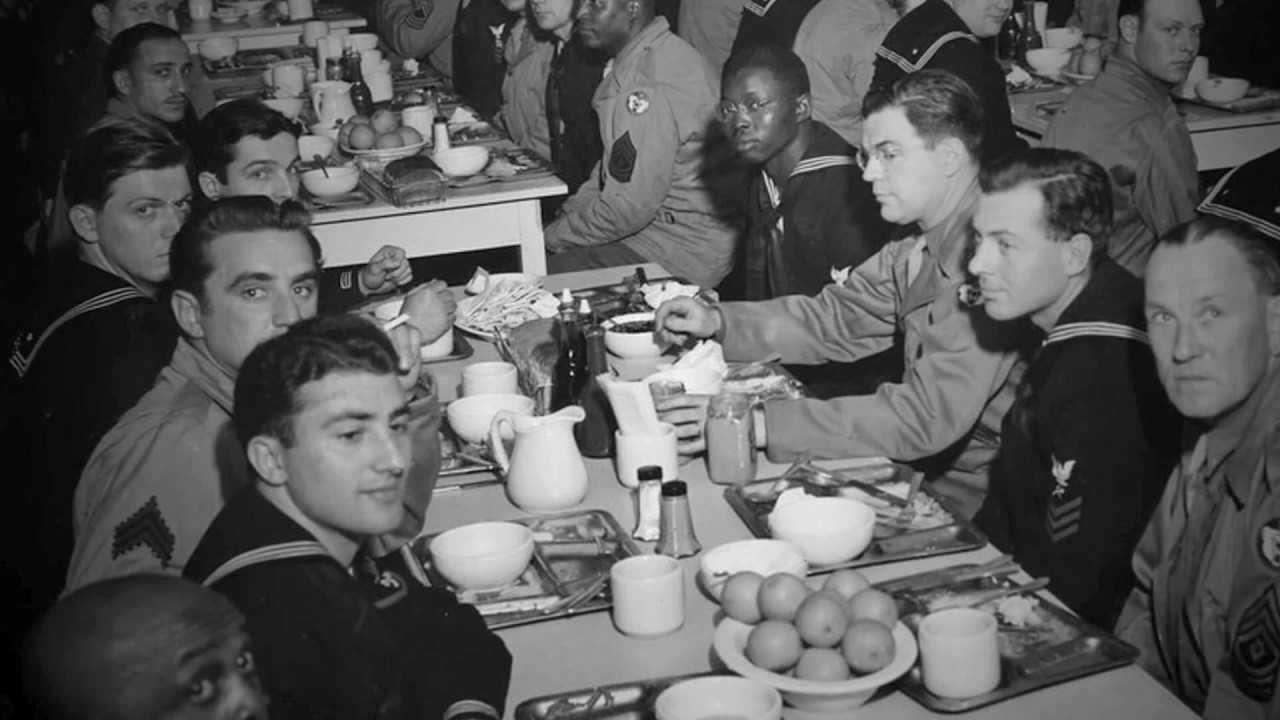
The United States Army fed its prisoners to the standard of its own soldiers at their base camps. The Army’s peacetime ration order, signed by President Herbert Hoover in 1932, allowed each soldier two ounces of bacon a day. German prisoners who could not believe the smell of bacon in an American camp sound like a scene from a war movie, but the bacon was real, the ration order was real, and so was the grease that American kitchens sent to war. And in September of 1943, two German prisoners who had escaped in Colorado were caught with a purchase that, to the historian who later wrote about the escape, pointed to help from someone outside the wire.
The choice between guns and butter had been put to Germans for years before the war. On December 19, 1935, the exile artist John Heartfield published a photomontage under the title “Hurrah, the butter is gone. ” It appeared in the Arbeiter-Illustrierte-Zeitung, a workers’ picture magazine published in exile, and the montage showed a family gnawing on iron. Under the picture, Heartfield printed a line from a speech Göring had given in Hamburg in 1935: “Ore has always made an empire strong, butter and lard have made a country fat at the most.
” Heartfield was an enemy of the regime, and he printed the sentence in order to turn it against the men who had said it. Göring also framed the choice as a matter of freedom. A research file on guns and butter in the collection of the Wiener Library, covering the years from 1935 to 1938, records him saying that Germans could either buy butter and give up their freedom, or seek freedom and do without butter. Joseph Goebbels put it in plainer terms on January 7, 1936.
Germany could do without butter, he said, but for all its love of peace, not without arms; a man could not shoot with butter, only with guns. By then, the idea had a slogan of its own. In a chronicle of the period kept by the Friedrich Ebert Foundation, the words “guns instead of butter” belong to the four-year plan announced at the party rally in September of 1936, and the chronicle’s entry for September of the following year names “guns instead of butter” as the watchword. The plan soon had a journal of its own, and in 1939, that journal printed a piece by Herbert Backe, the state secretary in the Reich food ministry, under a title about the farmers’ struggle for Germany’s freedom in food.
In it, he wrote that the most difficult problem in feeding Germany was the problem of fat. He put the country’s output of pork fat for 1937 at close to 1. 1 billion pounds, and he gave the rest of the figures himself. Counting the fat brought home by German whaling, Germany now produced about 60 percent of the fat it needed against 45 percent in 1932, and about three-quarters of the raw materials for its margarine still came from abroad.
He added that the country still had to import large amounts of fat and of the materials for making it. Inside Germany, the fat that Backe counted reached families through the ration card. There were separate cards for bread and flour, meat, fat, eggs, and marmalade or sugar. The largest group of card holders were the people the system called normal consumers, about 55 percent of the total, while children and young people made up 31 percent and men and women in long, heavy, and very heavy work made up 14 percent.
The economic historian Christoph Buchheim, writing in a German journal of contemporary history in 2010, drew up a table of what a normal consumer’s cards allowed in a week. In April of 1942, by his table, they allowed about 4. 4 pounds of bread, about 10. 6 ounces of meat, and about 7.
3 ounces of fat. That was the whole allowance for one adult, meat and fat together, until the next week’s coupons came due. By October of 1944, the same table gives about 8. 8 ounces of meat and about 7.
7 ounces of fat a week, so the meat had fallen since the spring of 1942 and the fat had risen by a fraction of an ounce. Both figures stayed well under a pound for a whole week. The regime promised that the table would hold. A propaganda brochure of about 1939 or 1940 titled “How They Lie,” kept in the German propaganda archive at Calvin University, granted that one kind of meat or another was occasionally in short supply and insisted that Germans had always had enough sausage included before it added: “But no one is hungry nor will anyone ever be.
” The comparisons the regime chose for its own people ran back to the last war and across the sea to England. In September of 1941, the propaganda ministry’s newsletter for magazine editors told them to remind their readers how much meat and fat Germans had eaten in 1920 and what rations the families of soldiers had received in the war of 1914 to 1918. Editors were also to stress that England had had to ration food and clothing, sometimes even more than Germany. Göring’s harvest broadcast from Berlin on Sunday, October 4, 1942, went on well past his lines about America.
The New York Times printed excerpts in English the next day. In the Times translation, he told his listeners where the soldiers’ food came from: “The whole German army is fed from conquered countries. ” In the German text, he also said that the fighting men at the front were getting full meals and enough to eat, and that soldiers going home on leave were handed a food parcel at the border. He reached back to the last war for a comparison.
The enemy, he said, had hoped to break Germany through hunger as it had done with the blockade in 1918, and now the blockade was working in reverse. He promised more meat, about two ounces a week for the areas threatened by air raids. On one point he admitted a problem himself, saying that the supply of fat had not yet been fully ironed out, and he blamed a rapeseed harvest that had been lost to the winter. A German paper in Lodz carried the speech as well, and its report included the sentence that Germans had not gone hungry in this war and would not go hungry.
A briefing for party speakers dated October 26 of that year told them that England was being forced to bring in new rationing measures, while Germany was now able to increase its rations. Göring also spoke about American industry, and the Times excerpts carry his concession. “I would be the last person to underestimate American production. In certain fields,” he went on, “the Americans had made colossal achievements,” and he named the automobile, the radio, and the razor blade.
But those things, he said, were something other than what a country needed for war. Then he waved the concession away: a country could not build up an army of several million men and at the same time multiply its workforce, and that would not work in America either, because even in America two times two remained four. What the German soldier actually received was set down in detail by his enemies. In March of 1945, the United States Army issued a handbook on the German armed forces, and its tables give the ration for troops committed to combat per man per day as about 24.
7 ounces of rye bread, about 4. 8 ounces of fresh meat weighed with the bone, and about 2. 1 ounces of fats and bread spreads. Added up, the combat ration came to about three and three-quarters pounds of food a man each day.
The lowest of the handbook’s scales still allowed about two ounces of meat and about 1. 2 ounces of fats in a day’s ration of about 3. 3 pounds. Over a week, the fresh meat in the combat ration came to about 2.
1 pounds bone included, nearly four times the weekly meat card of a civilian normal consumer in October of 1944. Its fats and spreads came to almost double that civilian’s weekly fat. The comparison flatters the soldier’s share somewhat, since his meat was weighed with the bone. The handbook also describes the iron ration, a reserve made up of biscuits, preserved vegetables, coffee, salt, and about seven ounces of cold meat, about a pound and a half in all without its packing.
One veteran of the Afrika Korps, Werner Morck, born in Kronach in 1921, wrote down his own memory of those rations long after the war, in January of 2005, and his account is kept in the German History Museum’s online collection of eyewitness accounts. He remembered that the Afrika Korps received the same rations as the soldiers on the other fronts, among them the famous and notorious tins of lentils, beans, peas, and cabbage that came with a fatty piece of meat already in them and were mostly eaten cold. Captured British stores were prized loot, he wrote: sardines in oil and corned beef above all, along with gin and whiskey. And the best of it was kept for the officers.
A professor, Mike Lane, in a talk titled “Rommel Gets a Gazelle for Dinner,” said that captured British bully beef was even sent home to Germany, where at the time it was regarded as a delicacy, and that after Tobruk, the Germans ate canned fruit from South Africa. For all the complaints about the tins, the two American sociologists Edward Shils and Morris Janowitz, who studied the German army, found in a study published in 1948 that few German soldiers felt their food supplies were inadequate. In May of 1943, the Afrika Korps surrendered in Tunisia, and its men were about to be fed by the country Göring had described. Most of those taken prisoner were sent across the Atlantic to camps in the United States.
Ernst Kaufmann was one of them. He came from the Remstal, the valley of the Rems River in Württemberg, and he kept a diary of his captivity. Years later, the Stuttgarter Nachrichten told his story from that diary under a headline that translates as “Prisoners of War from the Remstal in America, a Little-Known Fate,” along with the stories of two comrades who had been prisoners in America with him. The comrades took different roads.
Albert Ellwanger landed in New York in July of 1943 and was sent on to Camp Campbell in Kentucky. Kaufmann reached Camp Joseph T. Robinson in Arkansas that September, and Reinhold Schanbacher arrived there with him. By the newspaper’s account, which retells the diary in its own words rather than quoting it, Kaufmann, Schanbacher, and Ellwanger were all home again in July of 1946.
Heinrich Krahforst came in through the same harbor as Ellwanger. He was 22 years old when he reached Camp Bowie near Brownwood, Texas, and the prisoners had arrived by boat in New York City, where they were put on a train. In an interview of 2007, kept in an edited summary by the Brown County Historical Society, he said, “We were treated very well and they always gave us plenty of food. ” He was looking back across more than sixty years when he said it, so the line is a memory of the camp rather than a record made inside it.
In Alabama, the first prisoners reached the camp at Aliceville in 1943. They were given peanut butter sandwiches and coffee when they arrived, and they were surprised to be offered food. The Germans who came to Aliceville were malnourished, and they were afraid of being forced into slave labor. The townspeople had been watching for blond, blue-eyed super soldiers, and the men who arrived turned out to be young, many of them drafted while they were still in their teens.
Aliceville’s prisoners had come into the country by way of New York, according to a documentary about the camp made by the University of Alabama. One former prisoner remembered a crossing that took three weeks, and then a train south from New York, with none of the men knowing where it was heading. Another remembered Aliceville as a place where the men had their regular meals and had facilities to shower. New York was one door among several.
Prisoners also landed at Norfolk in Virginia, and notes for an exhibit on the camp at Pocatello, Idaho, record prisoners who came in through Boston. At Camp Myles Standish, a German prisoner named Walter Scherdel was given a job in the traffic that ran the other way. He was assigned to work in a mess hall, where he served meals to American soldiers returning from Europe. The men Scherdel served had just crossed the same ocean that had carried him to America.
Hans Gobeler came into American hands at sea. He was a crewman of the German submarine U-505, captured on June 4, 1944, and he described his first weeks as a prisoner aboard the carrier USS Guadalcanal. He and his shipmates were locked in an enclosure under the flight deck, which he called a cage. The heat from the carrier’s engines was so terrible, he said, that the prisoners sweated off their weight: “We lost 20 or 30 pounds during those weeks.
” From the carrier, the men were taken to Bermuda, where they stayed about six weeks. There, by his account, they gained some of the weight back and began to look like human beings again. His first weeks in American hands ran the opposite way from the weight gains that other prisoners would later describe, and they passed at sea and in Bermuda before he had seen a camp in the United States. Whatever the port and whatever the ship, the journey ended in a camp, and once the prisoners reached one, their meals followed a rule set by treaty.
Under the Geneva Convention of 1929, prisoners of war were to be fed like the captors’ own troops at base camps. A Luftwaffe fighter pilot held at Camp Ruston in Louisiana described what that meant in practice. The prisoners had good food, the pilot said: “Just the standard issue American food as prescribed by the Geneva Convention. ”
The issue on those trays came from American farms.
The Department of Agriculture later told the story of their war in a monograph called Fats and Oils in World War II, by Robert M. Walsh, published in October of 1947. By Walsh’s account, the government had set a support price for hogs in April of 1941 at nine dollars for every hundred pounds of live weight. The gains came in the seasons that followed.
The fall pig crop of 1941 showed a gain of five million head, or 17 percent. The spring crop of 1942 was up twelve million head, 24 percent. In Walsh’s words, a record-breaking pig crop in 1943 resulted in a flood of hogs to market. In time, prisoners from the camps were sent out to work on those farms themselves.
At Owosso, in Michigan, a local history kept by the Shiawassee District Library describes the lunch that the government sent out with the prisoners who worked there: a couple of slices of bread with either a piece of meat or a piece of cheese. The library’s account says that this was inadequate for many of the men doing manual labor, and so the farmers fed them. The hogs also meant fat. In the year that began in October of 1943, by Walsh’s account, the output of lard reached more than three billion pounds, about a billion pounds above normal.
Fat was the commodity that Herbert Backe had called the most difficult problem of German nutrition. In 1943 to 1944, Walsh wrote, the total output of fats and oils in the United States topped eleven billion pounds, despite a decline in butter production, a total that he described as a record never reached before or since. On the civilian side, the controls on fat came off in stages. Lard, the fat rendered from hogs, was taken off the civilian ration list in March of 1944, and shortening and oils followed in April of the same year.
Butter and margarine stayed on the list longer, and they were rationed through November of 1945, months after the war in Europe had ended. One prisoner had brought something with him from Africa that turned up only in a hospital laboratory. On May 29, 1945, at Fort Warren in Cheyenne, Wyoming, James Fitzpatrick of the post hospital laboratory removed a tapeworm from a German prisoner. The prisoner had picked it up from improperly cooked meat while he was fighting in Africa, and the same account adds that tapeworms were a common ailment among the prisoners, and that this one was extremely long.
Lowell Bangerter recorded the case in an article published in the Journal of German-American Studies in 1979. The fighting in Africa had ended two years before Fitzpatrick found the worm, so the meal that infected the man had been eaten at least that long before. Food also came to the camps from the towns around them. In New Ulm, Minnesota, in 1944, bread, donuts, and other bakery goods were brought out to the prisoners of war on Saturdays, and a sixteen-year-old who spoke German was asked to carry them in.
From the ships and the trains, the men went into the camps and into the mess halls. Some of those camps had bakeries of their own, and at Camp Atlanta in Nebraska, an encyclopedia entry lists a bakery among the buildings along with a laundry and repair shops for all purposes. In many of the camps, the food that the army issued passed through the hands of German cooks, and it was those cooks who would decide what the American ration became. The order that President Herbert Hoover signed at the White House on November 23, 1932, set out the army’s garrison ration item by item in ounces per man per day, and it took effect on April 1, 1933.
Its table ran to dozens of entries, from beans, rice, and rolled oats through canned peaches, prunes, and jam down to fractions of an ounce of cinnamon and black pepper. Meat had a section of its own. In that section, the order allowed each soldier two ounces of bacon a day. Beside the bacon, it set ten ounces of fresh beef and four ounces of fresh pork, with a fresh egg for every man on every day.
Fresh chicken had a line of its own as well, and so did lard and a lard substitute. Butter came to two ounces a day under the same order. Wheat flour to twelve ounces and potatoes to ten. A separate note covered the holidays, and on Thanksgiving Day and on Christmas Day, the meat component was to be turkey, twenty-five ounces of it for each man once the bird had been drawn.
The table bent where the army’s posts required it. Soldiers in Alaska drew larger allowances of beef, bacon, and vegetables than the standard list gave, and troops on the move had a travel ration of their own, made up of bread or hard bread, corned beef or hash, baked beans, tomatoes, jam, coffee, sugar, and evaporated milk. The standard list itself gave each man five ounces of sugar, eight ounces of fresh milk, and two ounces of coffee a day. Under the law the order rested on, the president could also direct the issue of equivalent articles in place of the ones on the list, and the Secretary of War could raise the allowances further in special cases.
All of this was written for a peacetime army living in garrison, more than ten years before the first Afrika Korps prisoners reached an American camp. Over a week, that bacon allowance comes to fourteen ounces. A German normal consumer in April of 1942 was given about 10. 6 ounces of meat for the whole week on his card.
So the bacon alone outweighed it before any of the order’s beef or pork was counted. Taken together, the order’s bacon, beef, and pork came to more than three times the fresh meat with bone that the army’s own handbook later credited to a German soldier in combat. At Camp Hearne in Texas, the cooks were prisoners. Michael Waters, who wrote the history of the camp, describes a cooking staff made up of German prisoners, and a Texas A&M University-Commerce thesis of 2016 adds that the Americans gave those cooks the ingredients for a hearty bread, which the Germans preferred to white bread, as part of the camp’s effort to meet the prisoners’ requests for familiar food.
The same thesis quotes a former prisoner from Waters’ book, Hans Lamersdorf, who said that he and his comrades all admitted the food was superb and that it was better than anything they had eaten before as civilians or as soldiers in Germany. Bread became a question for Washington as well. The historian Arnold Krammer, writing about the Afrika Korps men in Texas, describes compounds that each held a mess hall among the barracks, and he records a common early complaint that the food in the camps did not reflect German or Italian diets, with too much spaghetti and not enough meat and potatoes, or the other way around. American white bread, in his account, was declared inedible next to the hearty whole-grain bread of Europe.
Krammer finds it surprising that the War Department agreed, and he gives its reasoning: that if the prisoners liked and ate what they were served, they would throw away less and save food for the war effort. Heinrich Krahforst, the Camp Bowie prisoner, had a good friend at the camp, a man named Stern Jakob. Jakob came from Oberzissen and he worked in the kitchen, Krahforst remembered, as a baker. Far to the north, a photograph that the Des Moines Register later published shows the same work in Iowa, and its caption has prisoners of war baking bread inside Camp Algona on April 11, 1944.
Other camps baked for themselves too. In Wyoming, the prisoners at Douglas, housed in four large compounds, ran their own bakery alongside a tailor shop, a barber shop, a shoe shop, and a carpenter shop. At Fort Warren, near Cheyenne, prisoners worked in the kitchens and as gardeners. In Alabama, a prisoner at Aliceville was allowed something sweeter.
Ruth Beaumont Cook, the author of a book on the camp, spoke about her research to a Kiwanis club in Helena, Alabama, and the Shelby County Reporter wrote in April of 2013 that she still remembered a remark from Ellen, the daughter of a former prisoner named Eugene Wanders. Ellen set her father’s captivity beside that of German prisoners in Russian hands, who, she said, were made to eat cockroaches off the wall. Her father, she said, was allowed to make donuts in the mess hall kitchen on Sunday mornings. In Louisiana, the cooks among the prisoners made an impression of their own.
The Luftwaffe fighter pilot at Camp Ruston called it a tough camp, but by German standards still like a vacation. And after describing the standard American food, he gave the credit to his own side: “The professional cooks that we had among the prisoners made an excellent dinner out of it. ” The film’s narrator adds that the prisoners at Ruston ate as well as their keepers, and possibly even better, because they had some excellent cooks among their numbers. Camp Trinidad in southern Colorado was among the major base camps in the state, built for 2,500 prisoners, and it held German officers in a compound of their own.
The historian Alan Paschall wrote about Colorado’s prisoner camps for Colorado magazine in the summer of 1979, and he describes Trinidad as a camp that saw escape attempt after escape attempt. Among them was a tunnel 150 feet long that ran out from a trapdoor in the officers’ compound to a point beyond the beam of the night searchlight. In his account, the camp was more of a haven for Nazi activity than any other in the region, and the army counted it among the most important centers in the country for counterintelligence work. Around 10:00 in the evening of September 4, 1943, Karl Gallwitz, a lieutenant in the Luftwaffe, and Horst Erb got out of compound four wearing their Afrika Korps uniforms, which they had made over to look like the uniforms of American Boy Scouts.
Their absence came to light only at roll call the next day, shortly after noon, when neither man answered to his name. A general alert went out, and the pair were found almost immediately near a farm to the west of Trinidad. When they were taken, Paschall writes, they had seven dollars in American money, and they apparently had bought bacon without any food ration stamps. Paschall read the purchase as a sign of the cooperation of someone in or near Trinidad.
That year, bacon was a rationed food for American civilians, and a buyer was expected to hand over ration stamps along with the money. The army’s investigation heard two versions of how the men had got out. Gallwitz and Erb claimed that they had gone through a fence in compound three, but no cut wire was found to support the claim. An informer told the investigators that the pair had jumped over gate one in their own compound between guard changes, and the guards testified that the gate was out of the sentry’s sight for only three seconds during the change.
The report judged that the prisoners’ own testimony was so full of contradictions that it could not be relied upon. Two more prisoners from the same compound, Gustav Wilhelm and Willy Weinig, had gone missing as well, and they were caught soon afterward heading toward the border with New Mexico. Wilhelm and Weinig refused to tell the investigators how they had escaped. Paschall noticed that the investigation left the tunnel out of its reckoning.
Although four prisoners had gone missing in a single evening by suspicious means inside the wire, an officer at Trinidad later described the opposite problem. Günther Oswald, a Luftwaffe lieutenant held at the camp and among the few officers there who volunteered for work, told the historian Lewis Carlson: “We had so much food that we finally even refused to eat mutton. ” The reason, he said, was that they had too much of it. Years later, speaking to Ronald Bailey, Oswald summed up his time in the camp in the same spirit, recalling that the prisoners got lots of food and cigarettes.
At Crossville, the Sunday coffee and cake came out of a kitchen run by a German with hotel experience, who began serving coffee and cake on Sunday afternoons with whipped cream. Albertson arrived on April 28, 1943, as a second lieutenant. Inside the stockade stood the commander’s office, the camp hospital, the barracks, the latrines, the mess halls, and the prisoner canteen. Officers could not be required to work, though they could volunteer.
The prisoners were woken shortly before 8:00 in the morning for breakfast, with a roll call right after it, and in Albertson’s memory, it was a German officer who blew the whistle to rouse them. Many prisoners’ fondest memories seem to be of the abundant food, and they generally ate their fill at every meal. Albertson welcomed the chance to work, and he was far from alone, since 160 of Crossville’s German officers volunteered to work alongside 202 enlisted prisoners, most often on private farms outside the camp. He and a friend asked permission to grow crops on a nearby farm.
The camp commander granted it, and the two were soon swamped with other prisoners who wanted to join the project. Some of the men could not keep up with what they were given. Many Afrika Korps soldiers who had grown used to meager rations actually became sick from the abundant and rich food they received as prisoners. For the waste, Gerhard Hennis, another officer at Crossville, remembered that even with the prisoners’ appetites, a meal could leave several garbage cans of food thrown out.
An Italian prisoner remembered being given three meals a day on his train journey while his guards had only two. The camp hospital felt the food as well after a Thanksgiving at Crossville. Refusing to celebrate an American holiday, many of the German prisoners saved their turkey until the following Sunday. The result was an overfilled camp hospital on Monday morning, brought on by ample servings of turkey that had been thawed and kept for four days.
As an example of a day late in the war, Krammer prints the meals served to the prisoners at Camp Fabens, near El Paso, on April 14, 1945, about three weeks before the war in Europe ended. Breakfast was milk, cornflakes, coffee, and bread. Lunch was eggs, sausage, soup, tomato salad, and tea. And dinner was meatballs, potatoes, cabbage, fruit, and coffee.
Krammer judged it “perhaps not gourmet food, but certainly nutritious. ”
In Arkansas, Ernst Kaufmann kept his own account of the food in a small diary at Camp Robinson. As the Stuttgarter Nachrichten reports it, he called the food good and plentiful, and he noted real bean coffee every morning and roast turkey at Christmas. Peanut butter, cornflakes, and corn, the paper adds, were new territory for the German prisoners.
In Texas, the prisoners found uses for their food that no menu had planned. Some of them fermented wine from the raisins in their breakfast toast, and working prisoners who cooperated could be rewarded with a truckload of watermelon or a barrel of ice cream. Farther north, the same habit turned up with potatoes. At Douglas, Bangerter writes, “Potato peelings and anything else that would serve for a mash never went into the garbage and found their way into the prisoner compounds instead.
” Back at Trinidad, Paschall records that the camp’s commanding officer openly acknowledged in 1945 that stills were operating in the camp, and that the camp’s German blacksmith often went to work drunk. At Westover Field in Massachusetts, an army record caught a newcomer’s reaction. Ernst Goertzel was put to work in the enlisted men’s mess hall when he arrived, and the record says that he was surprised by the quantity and quality of the food available to the prisoners. A large stretch of ground inside the stockade had been set aside for vegetables to supplement the mess and reduce what the camp drew from the commissary.
The prisoners’ day ran to breakfast a few minutes after 6:00 in the morning, lunch at noon, and dinner a few minutes before 6:00 in the evening. Gerhard Reese reached Westover in 1945, and he described his arrival. A lieutenant named Daniel Fenning welcomed the new prisoners with a speech telling them that the sun shone in the United States exactly as it did in Germany, that men who behaved respectfully and kept out of politics could have it good at Westover Field, and that anyone who spread Nazi slogans would go to another camp and be worse off. After the speech, dinner was served in the mess hall, and to Reese’s surprise, three United States Army officers served it to the prisoners.
Reese later worked in the officers’ mess at the airfield doing kitchen duty and handing out meals. Another Westover prisoner, Friedrich Geitel, was put in charge of a sick station of American soldiers at the hospital, where he saw to its cleanliness and to its food. Near Scotts Bluff, Nebraska, a farm wife found a use for the prisoners’ appetite. Mrs.
E. B. Fairfield, as Bangerter quotes her, enjoyed making jelly and jam, but the rest of her family did not care for it as she did, and she had a lot of the jars on her table and was thinking of throwing them out. When she let two or three prisoners into her kitchen to get drinking water, a prisoner noticed the jars, called it marmalade, and made motions to ask for it.
She was glad to be rid of it, and every jar came back completely cleaned out. The prisoners at Aliceville made something out of the meat as well. In a University of Alabama documentary about the camp, a speaker remembered that the prisoners took the bones from the big sides of beef they were served, let them dry, and carved them until they looked just like ivory. The same speaker said that the prisoners could take nothing and come up with something of beauty.
Elsewhere in the film, a speaker placed the prisoners’ farming and garden raising at the outer edge of the camp and said that they raised a lot of their own food. An unnamed German prisoner in the same oral history book that recorded Oswald said that he weighed 128 pounds when he was captured and 185 after two years as an American prisoner: “I had gotten so fat you could no longer see my eyes. ”
Not everyone in America or in Germany was willing to believe what was on those trays. Across the papers that survived from the camps, bacon turns up in a few plain places.
It sits in an army ration order written for soldiers in peacetime, on the breakfast tables of some American farms and camps, and in the escape that ended near a farm west of Trinidad. In the prisoners’ memoirs, letters, and interviews that the published accounts quote, none describes the smell of bacon. What the men did set down is the size of the meals and the surprise of being fed so well by the enemy. The regime’s own words about American food took a different line.
In the speeches and newspapers of the regime that historians have collected and translated, no passage claims that America itself was short of meat. When the regime measured German rations against someone else’s, it chose England and the hunger of the last war, and Göring’s harvest broadcast of 1942 had left America’s fat with its millionaires floating on top. Once its army in Africa was gone, the regime answered American strength by calling it smaller than it looked. A few weeks after the surrender in Tunisia, in a speech in Berlin in June of 1943, the armaments minister Albert Speer claimed that German production capacity in the field he was describing was about the same as America’s.
On January 2, 1944, Joseph Goebbels came back to American abundance in an essay titled “A New Year,” printed in the newspaper Das Reich. The enemy, he wrote, was using clever and boastful bluff propaganda to build the illusion of a material superiority and an invincibility that Germany could not oppose. In some of the camps, men who had come from Africa still held to the regime’s version of the war. A German prisoner held in Pennsylvania, at Indiantown Gap and at Stewartstown, told the story at the age of 101 in a film made by Daubner Filmworks.
He had been captured in Italy, and when his group was marched into an American camp, the men already there, captured in Africa, met them with shouts of “Sieg Heil. ” Someone took the newcomers aside and told them to keep quiet because these were super Nazis who believed that Germany was winning the war. The next morning, seven of the newcomers went to the gate and told an American sergeant that they felt their lives were threatened, and before long they were taken out of the camp and put up in an empty civilian house. Inside the United States, the food on the prisoners’ trays set off arguments of its own in letters, editorials, and memoirs, and some of the sharpest came from men in American uniform.
In April of 1944, Corporal Rupert Trimmingham, a black soldier, wrote a letter to Yank, the Army Weekly, about a trip he had made from Camp Claiborne, Louisiana, to Fort Huachuca, Arizona. He was refused service in the dining room of a lunchroom on the way, and he ate in its kitchen. From that kitchen, he watched about two dozen German prisoners of war and their guards. The group sat at the tables and, in his words, had their meals served, talked, smoked.
And by his account, they were having a fine time. Trimmingham asked the editors why those prisoners were treated better than he was. Charles Dryden, a Tuskegee Airman, kept a memory of the same kind and put it into his memoir, A Train: Memoirs of a Tuskegee Airman, published in 1997. At a base in South Carolina, he remembered, German prisoners could walk into the white side of the post exchange cafeteria, a part of the building that he and the other black airmen were not allowed to enter.
In Wyoming, the complaint arrived as an accusation of waste. On May 19, 1944, an editorial in the Wyoming State Tribune claimed that 78 quarters of beef and 150 hams had been burned with gasoline at the prisoner camp in Douglas because the meat had gone moldy. Lowell Bangerter gives the camp’s answer to the editorial. Its supply director replied in writing, “Not 1 oz of meat received on this post.
” The hams and the quarters of beef stand in the record as a newspaper’s claim, printed about a month after Trimmingham’s letter, with the camp’s written denial beside it. Other papers took up the charge that the prisoners were being treated too gently. On September 21, 1944, the Daily Times of Salisbury, Maryland, ran a story about the prisoners at Fort Riley, Kansas, under the headline “Nazi Prisoner Codling Halted by Commander. ” Reporting from Paris in January of 1945, the correspondent Helen Kirkpatrick wrote that the American handling of prisoners in France angered the soldiers there, and her report said the prisoners ate the same food as the American troops.
Some of that newspaper talk reached the men in the camps. Bernhard Lutz reached Westover Field in Massachusetts, the camp where, by Gerhard Reese’s account, three American officers served the prisoners their dinner in March of 1945. In a letter of 1996, he remembered that a local paper had written that the German war prisoners were fat like pigs. That spring, American markets ran short of meat in earnest, and on March 22, 1945, a newspaper in Fort Worth, Texas, ran a story under the headline “Meat Shortage.
” Megan Springate, writing the National Park Service’s history of meat rationing on the home front, records that despite rationing, a severe meat shortage hit the market in the spring and summer of that year. As much as 17 percent of the nation’s meat trade, by her account, went through the black market, and meat rationing for American civilians did not end until November 23 of that year. In North Carolina, the Wilmington Morning Star told its readers on April 28, 1945, that the prisoners’ tables had already changed. In an editorial headed “By Way of Contrast,” it reported that menus for German prisoners of war in the country had been simplified in most areas, and it set those menus beside the food given to American prisoners held in Germany, telling its readers to keep calm if they could.
In Texas, a local history of the camp at Huntsville describes a six-month rationing plan inside the camps there, running from April to August of that year, because of a large meat shortage in America. The cuts were argued over at the time, and historians have gone on arguing over them. Katherine Elizabeth Russell, in a master’s thesis titled “The Home Front Food Fight: The Conflict Between the American Public and Enemy Prisoners of War During World War II,” written at the University of Memphis in 2010, argues that the War Department’s claim that the cuts were necessary was undercut by press reports, by congressional inquiries, and by the military’s own large purchases of food. Wilfried Gruber, born in October of 1923, had worked as an interpreter in his unit’s kitchen, and he described the change from the inside.
In an interview of 2001, he said that the food rations had been good and sufficient until Germany’s surrender in May of 1945. After it, the rations were reduced to 1,200 calories, and the men on outside work began to procure food for themselves, which he explained meant that they stole it. Some of the men found an explanation of their own for the smaller portions. Caleb Melby, a historian writing for the History News Network in 2009, drawing on a study published ten years earlier, records that when food rations were cut in the prisoner camps of the United States, Canada, and Britain, many Germans concluded that the allies were exercising a kind of vengeance as victors.
Through all of those arguments over the prisoners’ plates, American kitchens were saving their waste fat for the war effort. Animal fat had a use far from the table. Fats were processed into glycerin, a key ingredient of explosives such as nitroglycerin, and the glycerin went into bullets and bombs. The government paid households to save it.
From December of 1943, Americans who turned in their waste kitchen fat received two red ration points and four cents for every pound, and the collection was run under the Department of Agriculture together with the American Fat Salvage Committee. The National Archives holds the records of that salvage campaign, and in a post on its own blog in 2011, it called the cash payments to households meager. Between August of 1942 and July of 1945, by the same account, the campaign recovered 537 million pounds of household fats. Another count, which an encyclopedia article on the wartime drives titled “Salvage for Victory” takes from the park service, puts the total at 711 million pounds collected over four years, and the two figures do not agree.
By either count, the fat ran to hundreds of millions of pounds saved in American kitchens in the same years that the camps were feeding the men of the Afrika Korps. In a speech in Hamburg in 1935, Göring had set ore against butter and lard, as if a country had to choose between them. In the years that followed, the United States fed its prisoners well, and still sent its kitchen grease to be made into explosives. The camps kept some of their men for more than a year after Germany’s surrender.
By 1946, they were going home, Ernst Kaufmann and his two comrades from the Remstal among them, to a country with very little to eat. The prisoner who had been moved out of the camp of the super Nazis was later shipped back across the Atlantic on a troop ship, and at 101, he could still describe the voyage. “The bunks were stacked four or six high,” he said, “the way American troops traveled. The food was good, ordinary prisoner food with nothing extra, and the service was good, too.
” When the ship was unloaded, it had brought him to Belgium instead of Germany, and he remembered that the men had no idea where they were going until they were put ashore. He also remembered what the men were told about the country waiting for them. “Germany is poor,” was the warning as he recalled it, “and anyone who had the chance was to buy and carry the small things that would be scarce there, with toiletries, toothpaste, and cigarettes among them. ”
In Belgium, the prisoners went into a tent camp on a mountain and stayed for two or three weeks, living on crackers and terrible water, with nothing but bread and water practically.
In his telling, they were kept there because Germany could not feed them. “And Belgium itself,” he added, “had people who were not getting enough food. ” From Belgium, a boat took the men to England, to a camp at an air force base, and there he stepped on a scale and found that he weighed 95 pounds. He thought the men were given a decent meal in England, and they could take a shower there, which none of them had done for months.
In Scotland, where the prisoners were sent next, they were housed in a sports facility, and because he spoke English, he was the man who passed on what everyone needed to know. Meat there was very scarce. The fields they passed on the way to work were full of rabbits, so the men asked the man in charge for clubs. He found them a dozen, and the rabbits they killed in those fields went back to the camp in the evening, where they were skinned and cooked, and the men had meat.
The following spring, a small boat carried him from southern England to Bremen, where he was discharged from the military in a great tent. The free train ride that came with his papers had no glass in its windows, and after thirty or fifty miles, it stopped and sent its passengers on to find another train. It took him three days to get from the north of Germany to his home in the south near the Swiss border. In the Germany he came home to, he said, “everything was gone and there was nothing to buy.
German money was worth nothing by the end of the war, and even when new money came, the goods were not there to spend it on. ” He remembered the first year or two after the war as poor, and he found that he no longer liked living in Germany. Heinrich Krahforst, the Camp Bowie prisoner whose friend had baked bread in the kitchen there, took a longer road. He spent about a year after Bowie working on farms in Illinois, Wisconsin, and Michigan.
Then he was shipped to France, still a prisoner of war, and from there he escaped and walked home. Johannes Ruschky had been a prisoner at Statesboro, Georgia, and on July 1, 1947, he sent a letter from Hamburg, the city where Göring had once ranked ore above butter and lard. As the Statesboro Herald later reported it, the letter said, “We have very little to eat. ” Ruschky wrote it a few months after the end of the winter that German histories call the hunger winter.
The hunger winter ran from November of 1946 to March of 1947, and the German Weather Service counts it as the hardest winter of the 20th century in the lands around the North Sea. Historians estimate that hundreds of thousands of people in Germany died in it. In Cologne, Cardinal Joseph Frings used his sermon on New Year’s Eve of 1946 to justify taking food for one’s own need. “Fringsen,” a verb made from the cardinal’s own name, became a byword for stealing fuel or food.
The daily ration for a normal consumer, the same term that the wartime ration cards had used, was set at 1,550 calories. Richard Wiggers, a historian of the occupation, describes that number as a ceiling that held for the first two years. At hearings of the United States Senate in June of 1946, the ration actually given was put at 1,180 to 1,225 calories. Late that year, by Wiggers’ account, a combined nutrition committee reported that fewer than 1,500 calories had been made officially available to most adult German civilians over the past year.
What was actually issued in the hunger winter, by Wiggers’ figures, came to about 1,000 to 1,500 calories a day. An encyclopedia summary of his work sets that beside the intake of an American adult in the same period, about 3,200 to 3,300 calories a day. General Lucius Clay put the shortfall in political terms, and Wiggers quotes his judgment of it: “Between becoming a communist on 1,500 calories and a believer in democracy on 1,000,” Clay said, “there was no choice. ” Herbert Hoover, the former president whose signature was on the army’s ration order of 1932, went to Germany on the president’s economic mission to Germany and Austria in 1947.
As Wiggers quotes him, Hoover found conditions at the lowest level known in 100 years of Western history. His report from the mission on German agriculture and food requirements is dated February 28 of that year. An encyclopedia account of the report says that it found starvation in the autumn of 1946 had raised the death rate among Germans over 70 by 40 percent. A Council of American Relief Agencies was approved on February 19, 1946, to send private relief from America into Germany.
By December of that year, private parcels were arriving at 17 million pounds a month. Wiggers counts 10,000 tons of private relief supplies delivered by the end of that year. Over three years, the private relief came to 441 million pounds of goods valued at 200 million dollars. The former prisoner from Stewartstown left Germany again.
America had no opening for Germans, as he remembered it, but Canada was hiring people in Europe, and he went there, married by then. When he later came into the United States by way of Long Island, he stopped in Lancaster, Pennsylvania, to see the chef from the Army mess hall at Indiantown Gap, where as a prisoner he had led a crew of about ten men in a hall that served 1,200 to 1,500 soldiers at every meal. The chef, who had driven from Lancaster to the gap every day, was surprised to see him and kept him for a few days, and he told his old prisoner that California was not all that great and that he could stay. Albertson’s own memories were written down almost 50 years after he reached Tennessee.
His memoir of Crossville, an unpublished manuscript titled My Memories of the Prisoner of War Camp in Crossville, Tennessee, which holds his line about the Sunday cake, is dated March 8, 1993, and it is kept in the special collections of the University of Tennessee in Knoxville. Ernst Kaufmann’s diary was passed down in the Remstal, the valley he had come from, and a Stuttgart newspaper later used it to write about him and his comrades. At Westover Field, Gerhard Reese had worked in the officers’ mess, and Bernhard Lutz remembered what a local paper said about the prisoners’ weight. In 1996, both men wrote down their memories of the camp in letters to a researcher about half a century after the war.
In 1942, Germans were told that in America the fat floated only on top, and in American camps their own soldiers were fed to the standard of an army that allowed two ounces of bacon a day, while American kitchens sent their grease to war.






