Rough, but fast. That was the forecast most often repeated by Major General William Rupertus in the summer of 1944 as his First Marine Division prepared at a rest camp on Pavuvu, a coconut plantation in the Russell Islands. The camp had no mess halls at first, and the tents leaked. For years, the palms had dropped their coconuts with nobody to gather them, and the rotting husks turned the paths into a brown mush that some men found easier to cross barefoot.
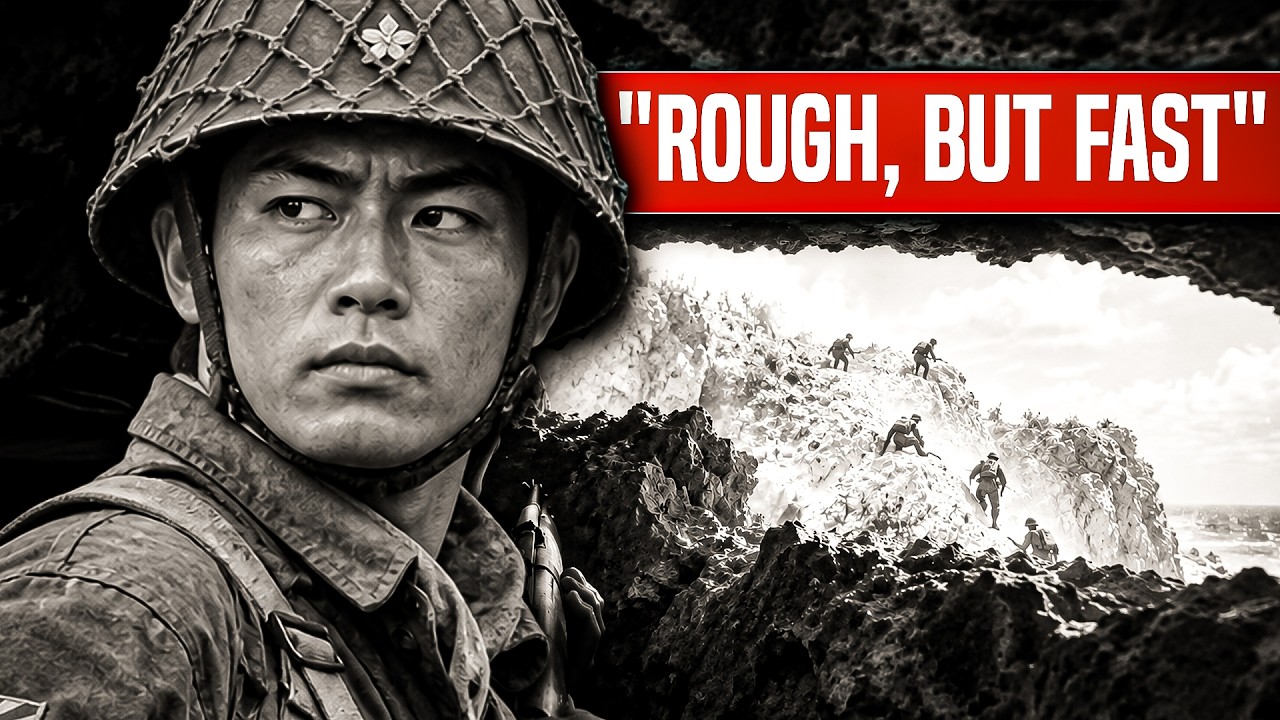
At night, rats ran across the canvas over their heads, and on one occasion the division turned out for a mass flamethrower hunt to thin them. Where Rupertus first said it and to whom, the accounts do not agree. What they agree on is that the men heard it. The Marine Corps’ own commemorative history of the battle says that the riflemen in the amphibious tractors had been told their division commander expected the operation to be tough, but quick, largely because of the naval gunfire and dive-bombing scheduled to go in ahead of them.
One of the three rifle regiments sleeping under that leaking canvas was the First Marines. Within a week of landing on Peleliu, it would be reporting 1,749 casualties, and what was left of it would be put on ships and sent back to the rats. Rupertus himself broke his ankle in a training exercise before the landing. He sailed anyway.
On Peleliu, a different set of instructions had already arrived. In the spring of 1944, General Hideki Tojo sent Lieutenant General Sadae Inoue and the 14th Division to the Palau Islands. Tojo had concluded that Japan could no longer hold the Palaus against the growing weight of Allied sea power. He had decided instead to sell them to the United States at the highest possible cost to Americans in blood and time.
Inoue was to take command of every Japanese force in the islands, hold them as long as possible, and kill as many Americans as possible in the doing. The man who would carry out that order on Peleliu was Colonel Kunio Nakagawa, who had brought his infantry regiment down from Manchuria that spring. Inoue sent a major general named Kenjiro Murai to the island as well, but Murai’s job was liaison, and the fighting plan stayed in Nakagawa’s hands. The Marines on Pavuvu knew how the enemy’s island garrisons fought, or believed they did.
Some of them had been on Guadalcanal in 1942 and watched Japanese infantry come across open ground at night into machine gunfire. In May of 1943, the garrison on Attu in the Aleutians had ended its defense with a charge. On Saipan that July, thousands of soldiers and sailors had come out together in the largest such attack of the war. Those charges were alarming, and they were also cheap to beat, because it was easier and less costly to cut down a charge in the open than to dig stubborn men out of fortified positions.
Fight after fight had ended with the enemy walking into the guns, and the men on Pavuvu had no reason to expect Peleliu to end any other way. Nakagawa had been told not to oblige. By that spring, the lessons of the Solomons had reached the top of Tokyo’s army, and the new instruction to island garrisons was to dig in and make the final defense as costly as possible to the Americans. Inoue’s own training order for the Palaus, issued in July, told his commanders to minimize their losses under the American bombardment and to counterattack from positions planned and prepared in advance.
It still hoped to throw the landing back into the sea in one blow by dawn of the first night. A footnote in the Marine Corps’s 1950 monograph on the battle describes a quieter tactic which the Americans called passive infiltration: men lay hidden in positions the Marines had already overrun and waited to come up behind them. Peleliu gave Nakagawa the ground for all of it. The island’s spine was a tangle of coral ridges known as the Umurbrogol, and the Marines would later give its knobs and draws their own names, Bloody Nose Ridge among them.
Japanese naval units had already tunneled into the limestone. Nakagawa took over those tunnels, brought in miners to cut more, and turned natural fissures into gun positions that covered one another. There were hundreds of caves and tunnels in all, some fitted with sliding steel doors. Nakagawa still fought for the beaches with machine guns and mortars along and behind the sand, and guns set into the rocks at the ends of the landing area.
The bulk of his strength, though, waited in the ridges behind the airfield. What his plan did not say was how Peleliu would end. A charge was how every garrison before it had finished. When the ridges finally went and the last caves were full of smoke, Nakagawa would have to order something, and for the rest of that autumn, the Marines had no way of knowing what it would be.
On the night of September 13, with the invasion fleet already at sea, Admiral William Halsey sent Admiral Chester Nimitz an urgent message recommending that the Palau landings be canceled along with several others, after his carrier strikes had met surprisingly little Japanese air opposition over the Philippines. Nimitz passed the recommendation on to the Joint Chiefs, who were meeting at Quebec, but he was not willing to cancel Palau. The two plans met on September 15, 1944. The morning landing was worst on the left, where the First Marines came ashore under the guns Nakagawa had set into the rocks.
By the afternoon, the division held a strip of beach and the southern edge of the airfield. At about 4:50, Nakagawa launched the one move in his plan that looked like the old war. Japanese light tanks, with infantry riding on them and running alongside, came out of the ground north of the airfield and headed south across the front of the First Marines. Every Marine commander had been warned that an armored attack was possible on the first day, and they were ready for it.
The attacking tanks were all destroyed, and the Japanese infantry were literally blown away. For one afternoon, the island behaved the way the forecast said it would. That night, the Marines dug in as best they could and waited for the rest of it. But night after night, what came out of the dark was a few men feeling their way forward, or a grenade tossed from a crevice into a hole that had seemed safe a moment before.
By day, the fire came from the ridges, from caves that seemed empty until someone walked in front of them. The Marine Corps’s 1950 monograph says it flatly: there were no frantic feudal banzai charges to simplify the attacker’s problem. That was what Nakagawa ordered in place of the charge. His men would stay down in the rock, in the heat and the dark, and make every yard of coral cost American blood for as long as the ridges held.
The riflemen paid for the ridges and the heat first. On the second day, the temperature passed 100 degrees in the shade, and there was almost no shade anywhere on the Umurbrogol. Drinking water came ashore in oil drums. Crews had steamed the drums out before filling them, but the steam had left oil behind, and men already sick from the heat drank the water, tasted the fuel, and threw it back up.
The coral would not take a shovel. A rifleman who needed cover piled loose rock around himself, lay down behind it, and hoped. The First Marines went at the ridges until they could not, under a colonel named Lewis Puller, who pushed his men forward again and again. On September 21, the corps commander, Major General Roy Geiger, came up to Puller’s forward command post and saw what was left of his battalions.
He ordered Rupertus to take them out of the line and send them back to Pavuvu, and he brought in the 321st Infantry of the Army’s 81st Division to take their place. The number of the regiment was reporting that day is the one this story began with. The Seventh and Fifth Marines kept going into what the Americans came to call the Pocket. Colonel Harold Harris of the Fifth wanted to spend ammunition freely and spend men as rarely as he could, and his companies worked the ridges from the north, one cave at a time.
It was slow, and it was never cheap. On October 4, Captain James Shanley, commanding a rifle company, went down under a mortar round. His executive officer, Lieutenant Harold Collins, went out to bring him in and was killed by a Japanese anti-tank round on the way. By the middle of October, the Pocket had shrunk to an oval a few hundred yards across, and it was still killing people.
One observer suggested clarifying the situation by stringing barbed wire around the whole thing and declaring it a prisoner of war enclosure. The division did not stay to see it finished. The Army’s 81st Division set up its command post on October 20 and took over the fight. Geiger and his corps staff flew out that morning, and Rupertus and his division staff followed by air at 11:00 that night, leaving the Pocket and the ridges around it to the soldiers.
The Army finished the Pocket the way the Marines had been doing it, yard by yard. Nakagawa’s garrison dwindled. On October 24, his final message went out to Inoue’s headquarters on Koror, and it answered the question his plan had left open. The running account kept by Inoue’s chief of staff reports that the men had been split into teams.
Following the commander’s wishes, we will attack the enemy everywhere. This will be the last message we will be able to send or receive. A Japanese soldier captured the next morning told his interrogators what that meant. Nakagawa and Murai had ordered the survivors to break through the American cordon and fight on as guerrillas in the rear areas.
Then, by his account, the two officers notified headquarters that the end had come, burned the regimental colors, and shot themselves. Even the ending was built to cost the other side something. Accounts of that night differ. The prisoner said the two officers shot themselves, while another history describes a ritual suicide in the command post.
Later accounts give Nakagawa a different last message altogether, reporting that the regiment’s sword was broken and its spears were gone, followed by a code phrase, sakura, meaning it had ended there. At 11:00 in the morning on November 27, Colonel Arthur Watson, commanding the Army’s 323rd Regimental Combat Team, reported officially to the 81st Division’s commander that the Peleliu operation was over. The Marine Corps’ count for the operation, published in 1950, listed 1,252 Marines as dead. Nakagawa’s command post stayed where he had left it, in the rock at the north end of a ridge the Marines had called the China Wall.
In 1991, a veteran of the landing named Gordon Wiener Jr. wrote about going back to look for it. He had come away with nothing. Two years later, he went again with three men who had served in Vietnam, Ed Underwood, Lee Harmon, and Carl Baylon.
After two sweltering days on the ridges, Harmon found the vertical shafts that led down into the command post, the living quarters, and the communications room. On a second trip, Underwood and Harmon climbed back down. The human remains they found there they identified as Murai and Nakagawa. Underwood sent word of the find to Boone Fukuchi, director of the South Pacific Memorial Association of Japan, with the hope that the remains would receive proper rites and honor.
The search had been Wiener’s own idea from the start, an old veteran’s hunt for the place where the other side’s commander had finished his war. Nakagawa’s widow had hoped to be on Peleliu on September 15, 1994, fifty years after the landing, but she was too frail to make the trip.






