The dive team’s sonar had just painted a picture on the screen that made Jacob Grubbs call it in without hesitation. It was a small car, upside down, sitting in the water right off Pleasant View Road. He had gone over it six times, and every pass gave the same reading. He was confident enough to say so.
Jared relayed the words to the family standing on the bank. “He will not say that he has a car unless he’s confident that he has a car. ” Then he looked at the screen himself. “Yep, sure enough.
There it is, right there. ”
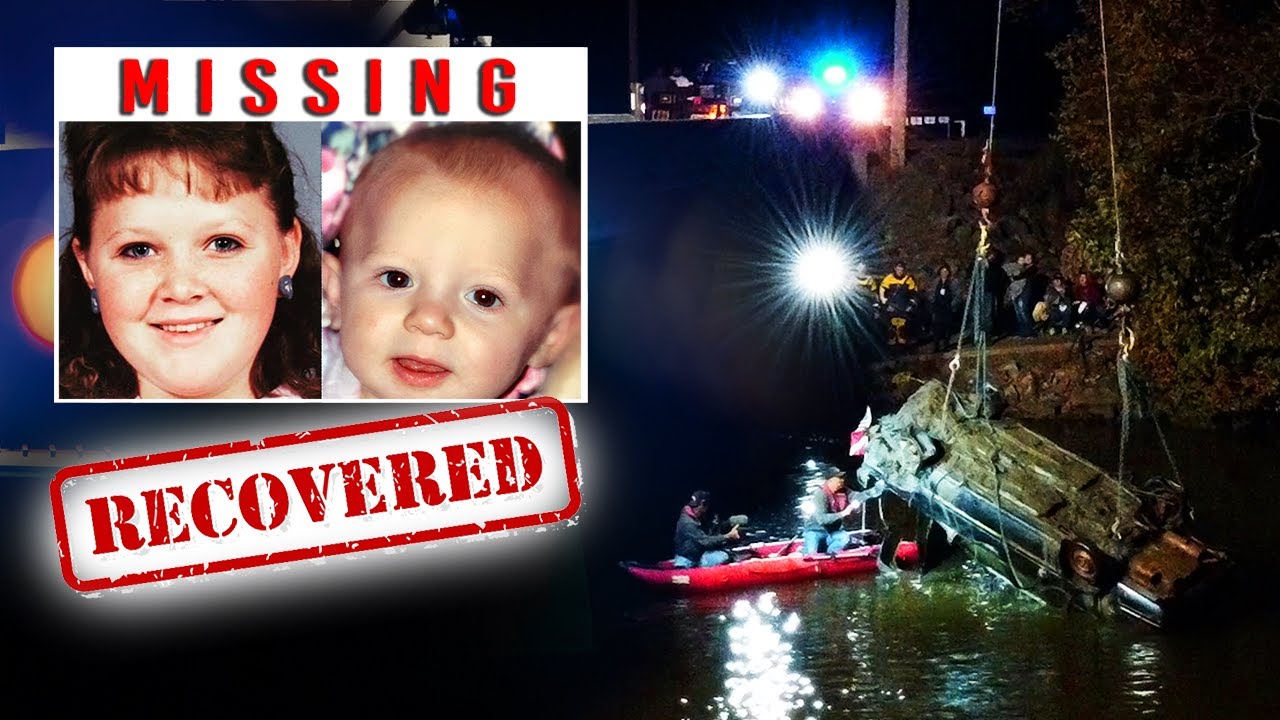
For twenty-three years, Samantha Jean Hopper had been a missing person. An eight-months-pregnant mother who told her own mother she was going to a concert in Little Rock, Arkansas, and would be back on September 12th, 1998. She took her twenty-two-month-old daughter, Courtney, with her.
The two of them were reported missing that September from Russellville, Arkansas, last seen traveling in a blue 1989 Ford Tempo. Now, on a stretch of river that the family had pointed to as the most likely place of all, the search had found something. But no one was ready to say what it was yet. The identification would have to come from the water.
Doug, the team’s diver, suited up as a marker buoy was dropped near the target. “It’s the right location, it’s the right road,” Jared told Dezarae, Samantha’s daughter. Dezarae, who had been three years old when her mother disappeared and now remembered her only through pictures, said what everyone was thinking. “It would make a lot of sense.
”
The story had begun decades earlier, in the small Arkansas town where Samantha lived with her two daughters. At the time of her disappearance, Dezarae was three and Courtney was twenty-two months old. Samantha worked at the Waffle House. She was eight months pregnant.
The father of the unborn child, Scotty, lived in West Memphis, roughly three or four hours away. On the day she vanished, Samantha came home from work and asked her mother, Debbie, to watch the girls. She said she was going with a friend, Selena, to a concert in Little Rock. Debbie told her she could only watch one child.
Samantha said she would take Courtney to her father, Les, who lived in West Memphis, and drop Dezarae off at Debbie’s house. “Mom, I’ll be back in the morning. I promise,” she said. Debbie never saw her again.
The family always doubted that Samantha would have taken Courtney to West Memphis. She was going there to have private time with Scotty for the night, and she had plenty of people locally who could watch the children. But the last confirmed sighting placed her at Les’s house in Russellville, near the Dardanelle Bridge area on South Arkansas Avenue, around six in the evening. She made it there.
After that, the timeline became a question of routes. Samantha’s mother lived on Ball Hill Road, about ten to fifteen minutes from Russellville. The drive from town back to the house was short enough that Samantha had plenty of time for the round trip. The question was which road she would have taken.
Selena, the friend who had been with her, knew Samantha’s habits better than almost anyone. Samantha always took Pleasant View Road. “Mom, it’s faster if you get on Pleasant View,” she used to say. There were not as many curves.
She would turn onto Mill Creek Road only to connect to Pleasant View, and from there to Ball Hill. There was water on both sides of Pleasant View. A body of water that had been there the entire time, with a bridge that spanned some depth. Jared studied the map and asked if Samantha ever stopped at the edge of the river to wait or kill time.
Selena shook her head. Samantha was afraid of water. She was not a swimmer, did not go near it, wanted nothing to do with it. For the search team, that detail mattered less than the roads themselves.
Pleasant View Road and Mill Creek Road both ran alongside water. The family said Samantha always took Pleasant View. But Jared kept coming back to Mill Creek, because of the way that road curved and the way Samantha drove. Selena laughed.
“She was a terrible driver. Everybody’s like, ‘No, we’ll drive. We’re not riding with you, Sammy. You stop driving.
’” She never crossed the bayou on Highway 64, as far as anyone knew, and never took the parkway that would have brought her to Mill Creek. Pleasant View was her road. Always. Two main bodies of water sat off Pleasant View and Mill Creek.
The team split up to cover both. Jacob, with a faster boat, was sent to the Pleasant View area. Jared and Doug stayed to work Mill Creek, scanning both sides of the bridge, then heading up the creek. The river was deep that day, already at ten to thirteen feet.
The sonar read cleanly. Big fish on the bottom, bait fish, bridge structure. Nothing that looked like a car. Then Jacob called.
He saw a small car off Pleasant View Road. Upside down. He sent a pin and a photo. Jared and Doug turned their boat around and headed over.
The location was a kind of party spot where you could drive down to the water. As they approached, the sonar lit up again. “There’s the one. There’s the two.
” The reading was unmistakable. Doug was careful. They had a target, nothing more. A vehicle underwater, but they did not yet know what vehicle.
“Please remain optimistic,” he told the family, “but until I get into the water, we don’t know if there’s a Ford Tempo there. ” The dive team would mark the vehicle, Doug would descend on a direct line, make an identification, and go through his other processes. If it was the vehicle they were looking for, they would contact law enforcement immediately and put together a recovery plan. The marker was placed about ten feet from a bridge pillar, directly in line with it.
As the boat passed over the target, Jared called it. “Right there. That’s it right there, so we just went right over the top of it. ” Doug prepared to descend.
The team had done this before. Doug spoke about how easy it was to misread sonar, how in the beginning he would circle over a rock fifteen or twenty times, wanting it to be a car. But a car, he said, would be completely visible. It would stick out like a sore thumb.
After twenty-three years underwater, it might be sunk in a foot, maybe not even that. It would look as though it had gone in last week, except for the buildup on it that made it absorb sonar differently than a newer car. People thought a car that went in decades ago would be buried. It was not.
In a river like this, it would be right there. Visibility in the water was poor, about two feet. Doug reached the vehicle and worked through his checklist. No emblem on the first tire he reached.
He was at the rear of the vehicle. It appeared to be blue. He found a Ford emblem. No license plate on the front, none on the rear.
The trunk was closed. All four wheels were exposed, none of them with heavy damage. The rear passenger window was up. The driver’s side rear window was intact.
Both passenger side windows were intact. Every window was intact, except the driver’s window, which was completely buried in the mud, along with the front windshield. The front of the vehicle was sunken in. Then Doug said the words that changed everything.
“I think we just found Samantha Hopper and her babies. ”
Topside, the weight of it hit. Debbie sobbed. Dezarae broke down.
“I knew it, I knew it,” Debbie kept saying. Jared reminded everyone that Doug had not yet confirmed the vehicle beyond what he had seen. But the way Doug had said it, the calm certainty in his voice, left little room for doubt. The blue Ford Tempo had been recently purchased, which explained the missing license plate.
Where the Tempo emblem used to be, it had rusted off. The car was blue. The location was the road the family had always believed she took. They called 911.
Jared gave the dispatcher their location: off Pleasant View Road, at the west bridge near the 3700 block, stationed underneath the bridge. The dispatcher pinged his phone and sent a deputy. Doug explained that they had the capability and rigging to handle the recovery themselves, but they would need a rotator, and the bridge would have to be closed. A deputy was on the way.
When the deputy arrived, Doug went over what he had found. The vehicle was upside down. All four wheels were exposed. The passenger side windows and the rear window were intact.
The driver’s side window and front windshield were buried, which meant the team had to presume they were open. Whatever was inside the car was inside. One hundred percent. The team deferred to the local OEM team, which had done this many times.
“We’re not here to cowboy anything,” Jared said. The OEM agreed to take control of the recovery, using the dive team’s findings. Doug explained the plan. The vehicle sat with its entire front end under.
Lifting the front end and tilting it would contain the driver’s side window if it was open. The bridge would be shut down entirely. The crane operator received pictures and videos of the scene. The towing company on police rotation arrived with a rollback and a carrier.
The crane service was still about an hour out. Planning the lift took time. The strap had to be positioned so it would not slip off. They discussed running a line between two points to stop it.
“One at a time, breaking that front free slowly is gonna be the key to it,” Doug said. The back trunk was solid, so they would hook to that first. The team was confident the plan would hold. But there was always an X-factor with something that had been underwater for multiple decades.
Every move had to be calculated. Dezarae spoke while they waited. She had started to lose faith that she would ever know anything. The current investigator had done more than anyone ever had, but in the last five years his hands seemed tied.
He worked for the police department. She had his direct number. The team said they would call him once the identification was confirmed. Selena watched with Debbie.
“We found Samantha. It doesn’t matter how it happened, at the end of the day, Debbie’s got her answers and she’s got her babies home, all three of them. ”
Debbie said she did not have to worry anymore. All the could-haves and would-haves and should-have-beens were answered.
The crane arrived. The lift began. As the car came up, an officer called to the OEM team. “Can y’all grab that purse right there before we lift it any more?
” They reached in and pulled out a purse. A shoe came out of the front. Inside the car, another shoe was about to fall out. The team member grabbed it.
When he pulled the shoe out, the sock came with it, and inside the sock were human remains. Foot bones. Confirmation. They had found her.
The car was lifted onto a tarp, rigged, and wrapped. The windows had held. The recovery was complete. Doug confirmed the vehicle was a blue Ford.
The Tempo emblem had rusted away, but the car itself was unmistakable. Afterward, Dezarae talked with Jared. “It’s knowing,” she said. “That you’re able to start that healing process, that you can move to the next chapter.
” She thanked him and the team for coming down and doing this for her family. Jared told her it was a bittersweet happiness. Dezarae said maybe she could get on with life now. “I don’t have much left anyway.
At 65, we’re almost there. ” Jared pointed out that she had an incredible smile on her face. Her husband had not been able to stay and watch. She told him she could not not know.
She had to stay. “When they started pulling it out, I knew it as soon as I saw that car it was her,” she said. The driver’s side window and front windshield had been buried, and the team had presumed they were open. The rear window and all three other windows were intact.
Whatever was inside had stayed inside for twenty-three years. The recovery gave Debbie her answers and brought Samantha, Courtney, and the unborn baby home. All three of them. On the bank, Debbie asked Jared for his address.
She wanted it. He told her he would make sure she got it. Then he went back up to the bridge to finish the recovery. The car was out of the water.
The search that had started with a mother’s promise to be back in the morning was over.






