In 1961, a 23-year-old named John Galardi opened a small hot dog stand in Wilmington, California, with a simple proposition: hot dogs deserved the same treatment hamburgers were getting. At that moment, American fast food was still forming itself. McDonald’s had been franchising its modern format for only about six years, Taco Bell opened its first location that same year, and the interstate highway system was still under construction. There was no established model for what a winning concept looked like.
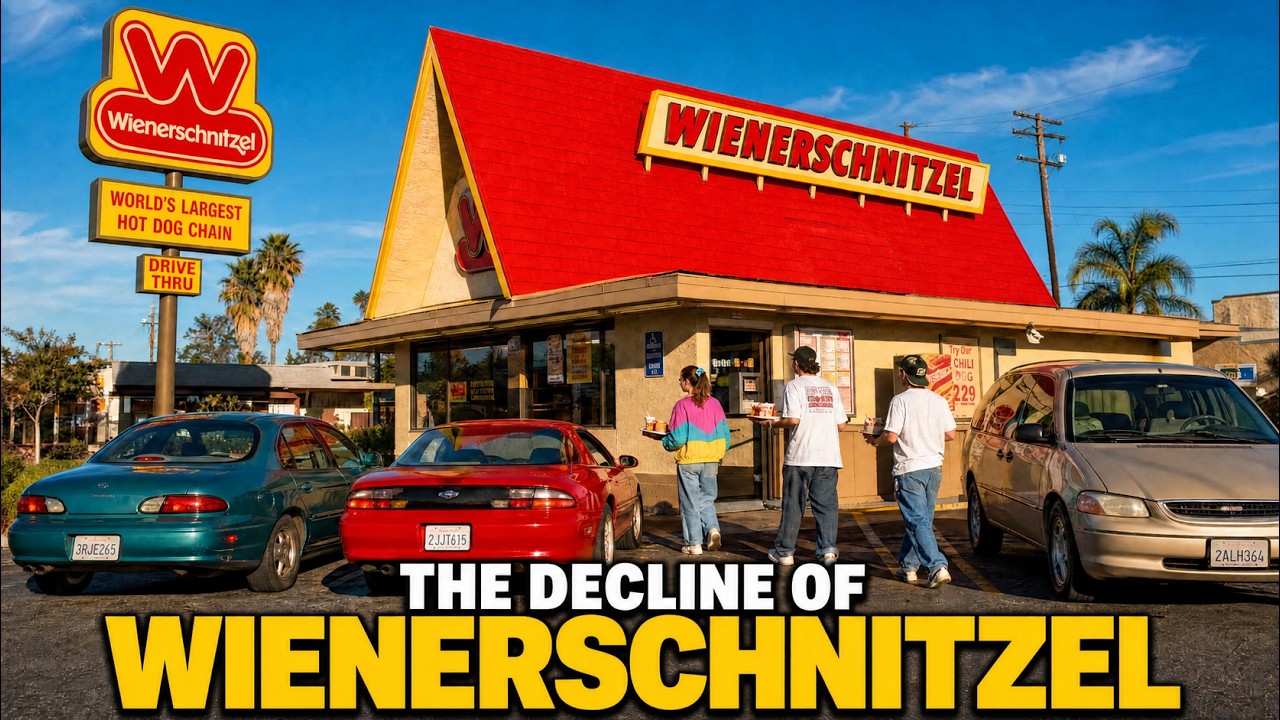
Galardi believed a hot dog chain could be built on a short menu, fast service, low prices, and a drive-thru or walk-up window. He named his company Der Wienerschnitzel, after a German and Austrian breaded veal cutlet, a whimsical and calculated choice that made the name impossible to forget even if it was difficult to pronounce. Over the decades, the company dropped the first word and standardized to Wienerschnitzel. The first location was small and functional, built around a steam tray, a chili pot, and a fast turnaround.
Galardi kept costs low from the beginning, but his most distinctive move was architectural. He borrowed the A-frame shape that had become fashionable in American leisure design in the late 1950s and early 1960s, the form used for vacation cabins and ski lodges, and put it to commercial use. The two steeply slanted sides met at a sharp peak, painted red, with the sign hung directly on the structure. From a hundred yards away, you knew what it was without reading a word.
The golden arch identified McDonald’s; the red slanted roof line identified Wienerschnitzel. Inside, there was little to distract from the food. Basic seating, a counter, and often a service window rather than a full dining room. Drive-through service, now universal in American fast food, was part of the model from early on, genuinely ahead of the curve for 1961.
What came out of that window was what people remembered. The signature item was the chili dog: a steamed bun, soft and warm from the steam; a beef hot dog with enough snap in the casing to prove it was real; and then the chili, ladled over the top and covering the dog almost completely. The chili was its own specific thing. Not Texas style with chunky meat and beans, not a tomato-forward sauce, not a broth.
It was a smooth, dark meat sauce, well seasoned, savory in the foreground with a slight sweetness in the background. Regular customers learned to identify its taste the way you learn to identify a brand you have bought for years. Add yellow mustard and diced white onion, and you had the basic version. Add a thin layer of melted orange cheese, and you had the most popular combination on the menu.
The corn dog occupied a separate but equally loyal corner of the menu, a beef dog on a stick dipped in a slightly sweet cornmeal batter and fried golden. The chili cheese fries were for a meaningful portion of the customer base the whole reason to stop. Crinkle-cut fries with more surface area than a flat cut, chili over the top, cheese melted into it. The entire operation revolved around that one signature sauce, and the consistency of that sauce from location to location was the real product the chain was selling.
If a customer drove to a Wienerschnitzel they had never visited before, in a city they had never lived in, the chili tasted the same. That was the promise. The price was part of the promise too. A basic chili dog in the late 1970s cost under a dollar.
A full order with fries and a drink might come to two dollars, sometimes less. When McDonald’s was trending toward the two- and three-dollar range for a comparable meal in the early 1980s, Wienerschnitzel remained accessible to any budget. Families with multiple kids, teenagers pooling pocket change, a worker on a lunch break who needed to eat fast and cheap. Expansion through the 1960s and 1970s moved steadily through the western states, California first by a large margin, then Arizona, Nevada, Oregon, Washington, eventually Texas and parts of the Mountain West.
Each expansion brought the same A-frame building, the same red sign, the same menu to a new commercial strip. By the early 1980s, Wienerschnitzel was operating in the hundreds of locations across more than a dozen states and could justifiably claim to be the largest hot dog chain in America. In California, it had become part of the landscape, one of the regular options on the strip. But the California base also meant the chain operated in one of the most competitive fast food markets on the planet.
Southern California in the 1980s had more fast food chains concentrated per square mile than almost anywhere in the country. The headquarters for McDonald’s, Taco Bell, Carl’s Jr. , Del Taco, Jack in the Box, and Wienerschnitzel were all within a short drive of each other, fighting for the same customers on the same streets. Wienerschnitzel owned the hot dog.
Nobody else was seriously competing in that lane. The question was whether owning the hot dog was enough. Hot dogs are genuinely beloved in American culture, tied to baseball games, county fairs, backyard barbecues, and summer occasions. But as an everyday, year-round drive-thru lunch option, the hot dog was always a harder sell.
The hamburger occupied a different position in the American fast food imagination, reading as a complete meal built by decades of marketing. Wienerschnitzel’s chili topping made the item feel more substantial, more like a meal, but it could not entirely reposition the hot dog against a category that had already won the war for default fast food status. The consequence was a ceiling on how large the chain could realistically grow. In markets where it had operated for decades, where the A-frame was familiar and the chili flavor embedded in routines, customer loyalty was real and durable.
In new markets, the chain had to convince customers to choose a hot dog over something they already knew, a much harder kind of persuasion. Then Subway happened. Subway’s real expansion came in the late 1980s and especially the 1990s, going from a few thousand locations to over thirteen thousand by the mid-1990s. It positioned itself as healthier and customizable, with price points comparable to Wienerschnitzel, and built stores on the same streets.
Taco Bell expanded hard through the same period. Chicken chains gained significant share. Pizza delivery built national infrastructure. Every one of these expansions pulled at the pool of customers who might have cycled through Wienerschnitzel more often in an earlier decade.
The chain’s response was to broaden the menu. The pastrami burger and pastrami dog, reflecting the deep Southern California tradition of pastrami as a sandwich meat, became significant sellers. Breakfast items gave some locations a morning revenue stream. Nachos, burritos, and tamale items tried to extend what a Wienerschnitzel visit could be.
Some additions worked; the pastrami genuinely belonged. Others felt like a company searching for something beyond its core concept. Every additional item added complexity to a kitchen originally designed for speed and simplicity. A hot dog required almost no cooking time.
A breakfast menu required eggs, different equipment, different staffing patterns, and more cost to control. In the early 2000s, the Galardi Group, the privately held company that owned Wienerschnitzel, acquired Tasty Freeze, a soft serve ice cream chain that had contracted to a fraction of its former size. Some locations began co-branding, adding soft serve to the menu. The pairing gave some locations an additional product with reasonable margins and kept the Tasty Freeze name alive, but it also forced the company to manage two franchise systems, two sets of relationships, and two menu identities for customers who walked in unsure what they were looking at.
John Galardi ran Wienerschnitzel through all of it, from the founding through the A-frame expansion, the competitive pressures of the 1980s, the menu experiments of the 1990s, and the Tasty Freeze acquisition. He died in December 2008 at seventy years old, having been the chain’s constant presence for forty-seven years. The Galardi Group continued under family leadership, but losing a founder who had been the company’s center of gravity for nearly half a century created real uncertainty. The timing was also difficult.
The financial crisis of 2008 tightened consumer spending sharply. Fast food generally held up better than full-service restaurants during the downturn, and Wienerschnitzel’s price points helped, but a company adjusting to new leadership in a stressed economy had less margin for error. The years that followed saw the location count decline from its peak. The direction was consistent: smaller.
Some markets that had supported multiple locations contracted to one or none. Some franchisees, reaching the end of their agreements, chose not to renew rather than invest in updating aging buildings. The A-frames presented a genuine operational problem by the 2000s and 2010s. A structure built in 1968 and updated incrementally through the 1980s looked nothing like what American consumers had come to expect from a fast food restaurant by 2010.
The national chains had rebuilt with bigger windows, contemporary interiors, updated seating, and digital menu boards. An original A-frame with its low ceilings and dated layout was not competing on equal footing. For a franchisee already seeing lower traffic, the capital required to renovate was a difficult argument to make. Locations that could not close the math closed, not all at once, but over years, one at a time.
What Wienerschnitzel kept was something harder to build than a location count: a specific, loyal customer base in its longest-established markets. In parts of Southern California, a Wienerschnitzel is not an unusual choice or a nostalgic detour. It is just where some people eat. Customers who have visited the same location for twenty-five or thirty years know the chili dog the way they know the neighborhood they grew up in.
For teenagers in California during the 1980s, the chain had a specific role beyond any one meal. The after-school stop, the A-frame near high schools and junior highs, the place where a few dollars covered a corn dog and fries without requiring adult involvement. For working-class families, it was the place you went when you needed to feed four people for under ten dollars and nobody had made any other plan. The price made the decision automatic.
You did not read the menu board; you just said what you always got. Today, Wienerschnitzel operates somewhere around 350 locations, primarily in California and across several western states. It remains, by that count, the largest hot dog chain in the United States. The competition never showed up in any serious form, and the title still belongs to it by default.
The Galardi Group continues to run the company privately. There have been menu updates, building renovations in many markets, and efforts to appeal to customers who did not grow up with the chain. The pastrami items remain significant sellers. The chili is still the chili.
Some of the original A-frame buildings are still standing, serving customers continuously since the late 1960s. The communities around them have changed, the streets have changed, other restaurants have come and gone. The A-frame is still there. John Galardi opened his first location at twenty-three with the proposition that hot dogs deserved to be taken as seriously as hamburgers.
He spent the next forty-seven years running the company that proved the idea could work in the right markets. The chain peaked in the hundreds of locations across the West, contracted through the competitive pressures of the 1990s and 2000s, lost its founder, and survived anyway. It never became McDonald’s. It never covered all fifty states.
It sold hot dogs when the rest of the industry went hard on burgers, then chicken, then subs, and it was still selling hot dogs when most of the chains that opened alongside it in 1961 were long gone. The chili dog is still on the menu, same basic components: steamed bun, beef frankfurter, that specific dark chili sauce, mustard and onion if you want them, cheese if you want it. The crinkle-cut fries still take the chili well. The corn dog is still there.
For the customers who grew up eating there, none of that is surprising. They would have been surprised if it changed. Sixty-five years is long enough that the people who first tasted that chili as children now have children of their own who know what it tastes like.






