The spring of 1945 did not feel like a victory for everyone inside Germany. For millions, it felt like the end of the world. As the Allied armies tightened their ring around the collapsing Third Reich, the SS leadership, long the undisputed masters of life and death inside the concentration camps, began to panic. With Soviet artillery rumbling from the east and American tank columns approaching from the west, the guards who had ruled through the whip, the dog, and the gas chamber understood that their black uniforms had become targets for vengeance.
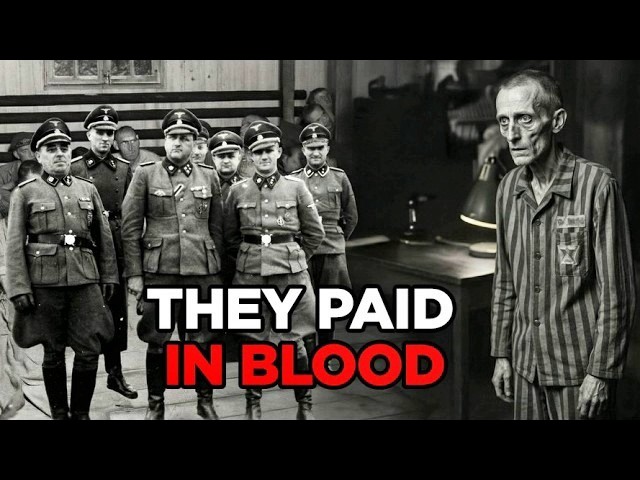
Chaotic orders from Berlin triggered the infamous death marches, driving thousands of emaciated prisoners into the German interior. But in camps like Dachau, Buchenwald, and Bergen-Belsen, thousands of inmates remained, too weak to move, trapped between liberation and a final desperate massacre. When the first Allied scouts reached these camps, even the most battle-hardened veterans were paralyzed by what they saw. The air was thick with the sweet, cloying stench of death.
They found piles of bodies stacked like cordwood and living skeletons who crawled toward them, weeping and clawing at their uniforms. The rules of war and the Geneva Convention suddenly felt inadequate in the face of such absolute evil. For the prisoners, watching through a haze of typhus and starvation, a dormant emotion began to stir: the thirst for reckoning. It was not about law or courtroom trials.
It was about the man who had kicked them yesterday, the guard who had shot their brother for a piece of bread. Liberation was not just the end of imprisonment. It was the beginning of an era of uncontrolled retribution. The transition from the systematic terror of the SS to the explosive rage of the liberated was instantaneous.
A moral vacuum existed in those final weeks. The German state had vanished, and the Allied military government was not yet established. In that vacuum, the only law that mattered was the law of the jungle. Guards who tried to surrender with their hands raised were not viewed as soldiers by the GIs who had just walked through the crematoriums.
They were monsters. Military discipline dissolved in many sectors, with some officers looking the other way and others actively handing their sidearms to former inmates. On April 29, 1945, soldiers of the 45th Infantry Division of the US Army approached the gates of Dachau, the first and longest-running concentration camp of the Nazi regime. As they neared the perimeter, they stumbled upon a death train: 39 railway cars filled with thousands of emaciated corpses, people who had starved or suffocated just days before help arrived.
The shock turned into cold, radiating fury. When the soldiers entered the camp and saw the ghostlike survivors, the standard procedures for taking prisoners of war were effectively discarded. While the higher-ranking SS officers had fled days earlier, several hundred guards remained, some recent recruits, others veteran Death’s Head members. They expected to surrender and be treated according to the Geneva Convention.
Instead, they walked into a whirlwind of vengeance. The punishment at Dachau began almost immediately. Eyewitness accounts suggest that American soldiers did not wait for orders. In the coal yard and near the hospital, the sound of M1 Garands and Thompson submachine guns echoed through the camp as dozens of SS men were mown down in bursts of gunfire.
General Felix Sparks later recalled the difficulty of maintaining order as his men, overcome by the stench of the crematoriums, began to view the guards not as humans but as vermin to be eradicated on the spot. The Americans were not the only ones seeking blood. Once the fences were breached, survivors who still had the strength to stand took matters into their own hands. Using shovels, pieces of iron, and their bare hands, they pulled guards from towers and beat them to death in the courtyards where they had once presided over roll calls.
In one of the most chilling accounts, inmates were given handguns and bayonets by sympathetic soldiers to settle years of torture in a matter of minutes. By midday, the hospital wall had become a site of mass execution. While the exact number of SS guards killed remains debated, it is clear that several hundred met their end that day without a trial. The American High Command later attempted to investigate these incidents as war crimes committed by their own troops, but the emotional weight of the Holocaust made prosecutions nearly impossible.
The guards who survived the initial wave of executions were forced by the Americans to handle the thousands of rotting corpses. They were made to see, touch, and carry the evidence of their crimes under the bayonets of soldiers looking for any excuse to pull the trigger. It was a raw, brutal confrontation with reality, the first true moment of denazification, not through textbooks or laws but through direct exposure to the camps. Buchenwald, located near the cultural heart of Weimar, presented a different kind of retribution.
The camp had a highly organized underground resistance composed of political prisoners. As General Patton’s Third Army approached in mid-April 1945, the inmates did not wait to be rescued. Sensing the vacuum of power as the SS began to flee, prisoners who had spent months secretly assembling crude weapons and stealing grenades launched an armed uprising. They stormed the watchtowers and seized the perimeter.
When American troops finally rolled through the gates, they found the camp already under inmate control. Captured guards were gathered on the dreaded Appellplatz, the central muster ground, where the roles were reversed. The prisoners interrogated their former tormentors, and for many guards, the interrogation was the last thing they experienced. The violence at Buchenwald was more calculated than the spontaneous shootings at Dachau.
Inmate committees identified the most brutal kapos and SS guards, who were taken behind the barracks. The sounds of heavy thuds and muffled screams filled the nights following liberation. Survivors spat on guards and struck them with sticks as they were marched through the camp, a public ritual of humiliation designed to strip the SS of their perceived racial superiority before they were disposed of. Bergen-Belsen offered a different horror altogether.
When the British 11th Armored Division entered the camp on April 15, they did not find a battle. They found a graveyard. There was no food, no water, and thousands of bodies rotting in the open air due to a typhus epidemic. The British soldiers, usually known for their stiff upper lip, were broken by the sight.
The camp commander, Joseph Kramer, known as the Beast of Belsen, greeted the British with an arrogant smile, expecting to be treated as a fellow officer. The British response was a harbinger of the specialized punishment that awaited the Belsen guards. They did not immediately execute them. Instead, they forced the SS men and women to bury the thousands of corpses with their bare hands.
Under the barrels of British Bren guns, the guards were denied gloves or tools. They had to drag the typhus-ridden bodies into mass graves day after day until many of the guards themselves contracted the disease and died. The local German population was also forced to walk through the camp to witness the horror. The hatred was so intense that British soldiers often had to be rotated out to prevent them from gunning down the prisoners in cold blood.
As the front lines moved deeper into Germany, a new and chaotic phase of vengeance began. Thousands of SS men discarded their black tunics, burned their paybooks, and donned the tattered clothes of common soldiers or farmers, hoping to disappear in the smoke of a collapsing nation. But groups of liberated prisoners, often still wearing their striped uniforms, refused to stay in the camps. They formed small hunting parties, roaming nearby villages and searching barns, cellars, and forest shacks.
When they found a man who looked too well-fed or whose posture was too military, they did not call for a military policeman. They settled the matter on the spot. Allied intelligence officers also developed a foolproof method for identifying SS elite: every member of the SS was supposed to have his blood group tattooed on the underside of his left arm. During mass surrenders, Allied soldiers would force thousands of German men to raise their arms, and any man with the telltale A, B, or O near the armpit was immediately pulled from the line.
The fear was so great that many attempted to cut the tattoos out with knives or burn them with cigarettes, leaving behind raw scars that only confirmed their guilt. The fury directed at the female SS overseers was unique. Women like Irma Grese, known as the Hyena of Auschwitz, and Maria Mandel had proven themselves just as sadistic as their male counterparts. At Bergen-Belsen, the British found the female guards still in the camp, seemingly convinced their gender would protect them.
They were wrong. They were subjected to the same brutal labor as the men, forced to handle decaying bodies while being mocked by survivors. In several documented incidents, groups of women survivors surrounded their former tormentors, stripped them of their uniforms, and cut their hair in a ritual of public shaming. The British and American legal systems struggled with how to handle these women.
While some were eventually brought to trial, many met their end in the wild justice of liberation, handed over to vengeful crowds by soldiers who walked away. As the occupation became more organized, the Allied leadership realized that uncontrolled vengeance could destabilize the entire region. They began to establish provisional courts, but these were far from the polished proceedings later seen at Nuremberg. In these early trials, the evidence was often the physical state of the survivors.
The defense for the SS was almost always the same: “I was only following orders. ” In the spring of 1945, this excuse was met with stony silence or open derision. The wild tribunals provided immediate closure that official trials could not. For a survivor who had lost everyone, a six-month trial in a distant city meant nothing.
Seeing his tormentor face a firing squad in the camp courtyard meant everything. By the autumn of 1945, the fires of immediate revenge had largely burnt out, replaced by the machinery of international law at Nuremberg. But a bitter truth emerged: while thousands of SS guards had been executed in the chaos of liberation, thousands more had slipped through the cracks. Rat lines, escape routes organized by sympathizers, allowed many of the most brutal killers to find refuge in South America or the Middle East.
This unevenness of justice created a lasting moral scar for survivors, leading to the rise of professional Nazi hunters like Simon Wiesenthal, who understood that if the world would not provide justice, they would have to hunt for it for decades. The legacy of this retribution shaped modern understanding of human rights and military conduct. The Dachau massacre investigations, though they led to no convictions, forced military leaders to realize that troops must be psychologically prepared for the horrors of war to prevent them from becoming the monsters they fight. For the survivors, the acts of revenge were often the only thing that allowed them to reclaim their humanity.
By striking back at their masters, they proved to themselves that the SS was not a master race, but merely men who could bleed, fear, and die. The fall of the Third Reich was not just a military victory. It was a visceral, bloody, and often lawless reckoning, a time when the victims refused to be victims any longer, and the executioners finally had to face the eyes of those they had tormented.






