On the morning of October 17, 1910, Silas Buchanan rode his dun mare up the steep trail that switchbacked through stands of oak and hickory on Harkness Ridge. He carried eleven envelopes in his coat pocket, bundled with twine by Postmaster Jeremiah Collier of Milston, a small coal-mining settlement in Windham County. The letters were addressed to Ambrose Penhallow, a resident who lived in a cabin four miles up the winding dirt road into the higher elevations. None of them had been collected in seven months.
Collier, meticulous in his postal records since 1897, had noted in his daily log that he would ask the next person heading up the ridge to deliver them personally. Buchanan, a wiry mule driver in his fifties who worked for the Eastern Cumberland Mining Company, mentioned he needed to scout timber on the ridge and volunteered for the task. The trail narrowed as it climbed, forcing Buchanan to dismount and lead his horse by the reins for the final mile. The sound of his boots crunching through fallen leaves was the only disturbance in the deep stillness of the forest.
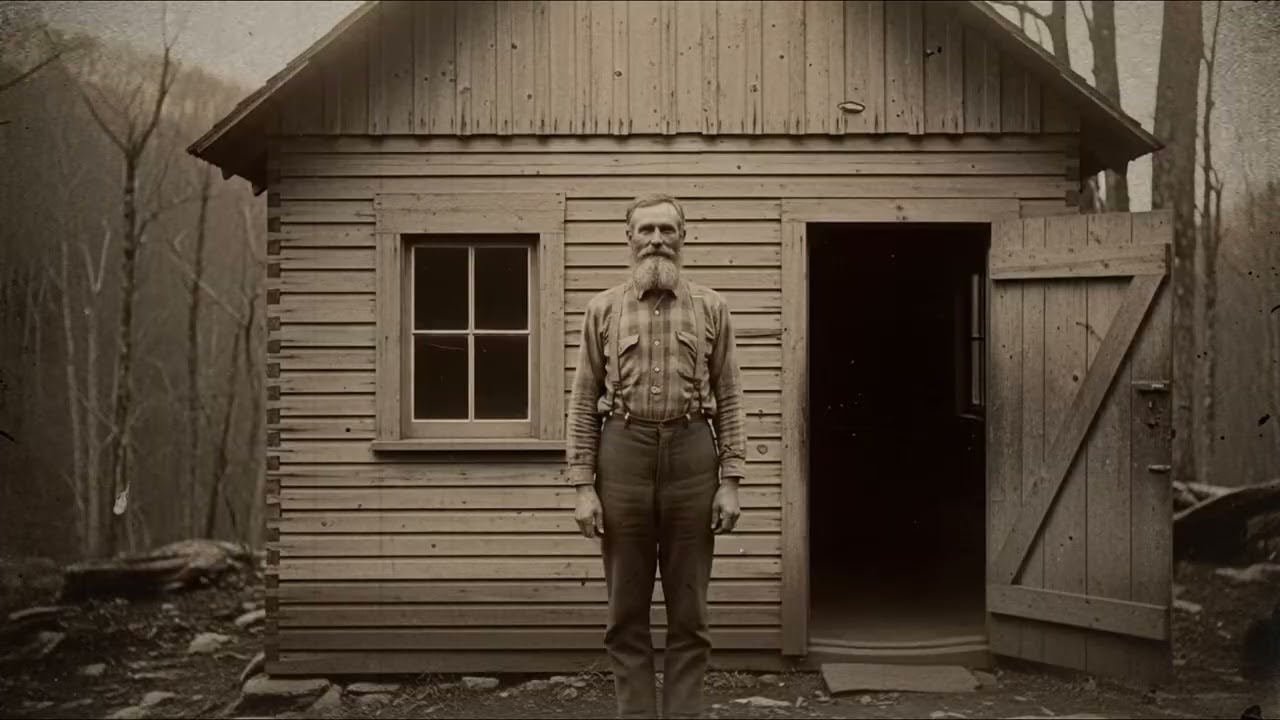
As he approached a bend, he heard a low, continuous murmur coming from somewhere ahead. The sound grew more distinct as he rounded the bend and caught his first glimpse of Penhallow’s cabin through the trees. It was a substantial structure for these parts: two stories of rough-hewn logs, a covered porch across the front, and a stone chimney rising from the north side. Smoke curled from the chimney.
But it was the source of the murmuring that caused Buchanan to halt his approach and tether his horse to a young maple some fifty yards away. The sound, he realized, was a human voice. Penhallow’s voice, engaged in what seemed to be an animated conversation. From his vantage point, Buchanan could see no other horses or evidence of visitors.
The voice continued steadily, rising and falling in the cadences of normal discourse, punctuated by what sounded like questions. Pauses, as if waiting for responses, then the monologue resumed. Buchanan approached the cabin, his footsteps masked by the continued monologue within. He had nearly reached the porch steps when he heard something that made him stop short.
Penhallow’s voice had shifted tone dramatically, now speaking in a voice unlike his own—higher pitched, like a woman’s, but strained, as if coming from a great distance. This was followed immediately by Penhallow’s regular voice responding to the question the other voice had posed. The conversation continued in this manner, Penhallow seamlessly alternating between his natural voice and the strained, higher-pitched one, carrying on both sides of what appeared to be a heated exchange. Buchanan, thoroughly unsettled, backed away.
His foot caught on an exposed root and he stumbled slightly. The noise was enough to halt the conversation inside. A heavy silence fell, broken only by a chair scraping across wooden floorboards. The door opened, and Ambrose Penhallow stood in the doorway.
He was tall, over six feet, with a frame once powerful but now slightly stooped with age. His full beard was streaked with gray, and his face bore the deep lines of someone who had spent decades exposed to mountain weather. But it was his eyes that Buchanan would later describe most vividly: clear as creek water after a hard rain, and fixed on him with such intensity that he felt Penhallow was looking straight through to the trees behind him. “Mr.
Buchanan,” Penhallow said, his voice perfectly normal and controlled. “What brings you to my door? ”
Buchanan explained his errand, producing the bundle of letters. Penhallow nodded once, descended the three porch steps, and took the mail without comment.
He did not examine the envelopes or express gratitude. Instead, he continued to regard Buchanan with that unsettling gaze. “You heard me talking, I expect,” Penhallow said. It was not a question.
Buchanan admitted that he had. “Sounded like you had company,” he offered, though both men knew this was not the case. Penhallow’s face remained impassive. “The walls,” he said simply, “they speak to me.
”
“Is there anything you need from town? ” Buchanan asked, eager to end the interaction. “I’ll be heading back down this afternoon. ”
Penhallow seemed to consider this for a moment, then shook his head.
“I have everything I need right here. The walls provide. ” With that cryptic statement, he turned and re-entered his home, closing the door firmly behind him. Buchanan returned to his horse and continued his timber scouting mission, though he later admitted he deliberately chose a route that took him farther from Penhallow’s property on the return journey.
That evening, Buchanan stopped at Hartley’s general store, where several men typically gathered around the pot-bellied stove to exchange news and gossip. He shared his strange encounter. Edmund Hartley, the proprietor and unofficial keeper of local knowledge, listened with growing interest. When Buchanan mentioned Penhallow’s claim that the walls speak, Hartley exchanged significant looks with Abel Crawford, an elderly man who had lived in the area longer than anyone present.
“That’s not the first such report we’ve heard,” Hartley said carefully. “Penhallow’s been up there alone since his wife passed in ’03. Some folks who’ve had occasion to visit him over the years have come back with similar stories. ”
Crawford nodded slowly.
“My nephew went up there last spring to sell him some traps. Said he heard Penhallow carrying on a conversation with nobody there. When asked about it, Penhallow told him the same thing—that he was talking to the walls. Said they’d been speaking to him for years.
”
The men offered fragments of information about Penhallow. He had come to Windham County around 1895 with his wife, Cordelia. The couple lived quietly, keeping to themselves. Penhallow worked briefly for the mining company but left after a tunnel collapse that killed three men.
He was not injured in the accident, but reportedly walked off the job the next day and never returned, supporting himself instead through hunting, trapping, and occasionally selling firewood in town during the winter. After his wife died of what was presumed to be pneumonia, Penhallow became increasingly reclusive, making fewer trips to Milston and interacting minimally when he did appear. No one could recall him ever having visitors stay at his cabin, nor did he have any known relatives in the area. The discussion might have remained just another tale of mountain eccentricity, forgotten within a few weeks, if not for the events that unfolded over the following months.
In early December 1910, severe winter weather forced a hunting party to seek shelter near Penhallow’s cabin. Joseph Fletcher, Elijah Moss, and Daniel Quinn had been tracking deer in the higher elevations when an unexpected blizzard descended. With visibility reduced to mere feet and temperatures plummeting, they headed toward Penhallow’s cabin, which Quinn knew to be roughly a mile east of their position. Arriving half-frozen, they were relieved when Penhallow grudgingly invited them inside.
The interior, as later described by Fletcher—the only one of the three still living when a university researcher began investigating in 1969—was unexpectedly well-appointed for such an isolated dwelling. The main room featured a large stone fireplace, several sturdy chairs, shelves lined with books, and walls covered almost entirely with pages torn from books, newspapers, and what appeared to be personal letters, all affixed to the logs with small nails. Penhallow offered minimal hospitality: a place by the fire and some weak tea, but no food or conversation beyond what was necessary. As daylight faded, Penhallow lit several oil lamps, casting long shadows across the paper-covered walls.
After nightfall, as the hunters prepared to sleep on the floor near the fire, they noticed Penhallow’s strange behavior. He began moving around the room, stopping at different sections of the wall, running his fingers over the pages, and appearing to listen intently. Then, in a voice barely above a whisper, he began to speak to the wall. The hunters pretended not to notice, but as the night progressed, Penhallow’s interactions became more animated.
He asked questions, paused as if listening for responses, then nodded in agreement or shook his head vigorously. Occasionally he tore down a page, crumpled it in his fist, and threw it into the fire, muttering about lies and deception. Around midnight, his behavior escalated. He began speaking in multiple distinct voices: his own deep baritone, the strained higher voice Buchanan had described, and at least two others—a rasping whisper, and what Fletcher described as an old crone’s voice filled with bitterness and spite.
The content centered around judgment, revelation, and repeated references to what lies beneath. At several points, Penhallow pressed his ear directly against the wall, nodding as if receiving instructions, then responded aloud, “Yes, I understand what must be done. ”
The three hunters, thoroughly alarmed but trapped by the storm, huddled together on the floor, barely sleeping, as Penhallow continued his strange communion throughout the night. When morning came and the storm abated enough to allow travel, they made hasty excuses and departed, despite Penhallow’s unexpected insistence that they stay longer.
“He seemed desperate for us to remain,” Fletcher would later recall. “He grabbed Daniel’s arm so hard it left bruises, saying the walls had more to share, that they wanted to speak to new ears. ”
Upon returning to Milston, the hunters shared their experience with Sheriff Wallace Thornton, expressing concern for Penhallow’s mental state and for the safety of anyone who might encounter him. Thornton made note of their concerns but took no immediate action beyond advising people to avoid Penhallow’s cabin when possible.
This advice proved difficult to follow in the harsh winter of 1910–11, which saw record snowfalls and dangerously low temperatures across the Appalachians. Travel became treacherous, trails obscured, landmarks hidden beneath snow. In late January, several trappers were caught in a sudden storm while checking their lines on Harkness Ridge. When one failed to return, a search party was organized.
Sheriff Thornton, accompanied by four armed men, made the difficult journey up to the cabin on January 28, 1911. Penhallow was found alone. There was no sign of the missing trapper, and Penhallow denied having seen anyone. But Thornton noted several troubling observations.
First, despite the extreme cold, Penhallow had a large fire burning, with what appeared to be scraps of clothing still visible among the embers. Second, the walls, previously covered with pages, had been completely stripped bare in some areas, the papers burned or piled in corners. Third, and most disturbingly, strange markings had been carved directly into the exposed logs—symbols Thornton described as unlike any writing he had encountered, more akin to the pictographs said to be used by Indian tribes, but of a different character entirely. Thornton questioned Penhallow at length about the trapper’s whereabouts, but his responses were increasingly incoherent, ranging from claims that he had never seen anyone to insistence that the walls had taken him to a better place.
Without a body or clear proof of a crime, Thornton was unable to arrest him, though he concluded his report: “It is my belief that further investigation into the activities of Ambrose Penhallow is warranted, particularly as relates to the disappearance of the missing trapper and possibly other unreported incidents in this remote area. ”
Thornton’s intended investigation never materialized. Within a week, he was called away to deal with labor unrest at mines in the eastern part of the county. By the time he returned, new emergencies demanded his attention, and the mystery gradually faded from official concern, though not from local memory.
In April 1911, Dr. Philip Garrett, the only physician serving several mountain communities, was summoned to treat a logger who had suffered a serious ax wound on the lower slopes of Harkness Ridge. After stabilizing the man, Garrett decided to take a different route back to town, one that allowed him to check on an elderly patient near the base of the ridge. The route took him within a quarter mile of Penhallow’s cabin.
Curious about the man he had heard so many strange rumors about, and motivated by professional concern, Garrett decided to pay an unannounced visit. Garrett’s account, recorded in his personal journal later donated to the County Historical Society, provides one of the most detailed descriptions of Penhallow and his dwelling from this period. Garrett described him as severely malnourished, with sunken eyes and a pallid complexion of one suffering from both physical and mental exhaustion. Despite this, Penhallow welcomed the doctor cordially enough, inviting him inside and offering tea.
The interior had changed significantly since the hunters’ visit in December. The walls were now completely bare of paper, but the strange symbols Thornton had noted were more numerous, covering nearly every available surface. Penhallow had also begun removing sections of the interior walls, exposing the spaces between the logs. In some places, objects had been inserted into these gaps: small bundles of herbs, feathers, bones that Garrett thought might belong to small animals, and rolled scraps of paper.
When Garrett inquired about these modifications, Penhallow became animated, explaining that he had misunderstood for years. “It’s not the walls that speak,” he told the doctor. “It’s what’s inside them. They’ve been trapped there, you see, waiting for someone to listen, waiting for someone to let them out.
”
Garrett asked who “they” were. Penhallow’s response was cryptic. “The ones who were here before. Before the trees, before the mountains.
They sleep in the deep places, but they’re waking up now. They speak through the earth, through wood that remembers. ”
Throughout this explanation, Garrett noted that Penhallow’s manner remained calm and his speech coherent. Despite the bizarre content, he showed none of the agitation expected in a case of acute mental disturbance.
This led the doctor to consider that Penhallow’s condition might stem from a slow-developing delusion, possibly triggered by prolonged isolation following his wife’s death. Garrett attempted to persuade Penhallow to return with him to town, suggesting regular meals and human company. Penhallow declined politely but firmly, stating that he couldn’t leave because “they need me here to complete the work. ” When Garrett asked what work, Penhallow gestured to the partially dismantled walls and said, “Preparation.
The threshold must be prepared. ” Then, fixing the doctor with an intense gaze, he added, “You should prepare, too, Dr. Garrett. They know you now.
They’ve heard your voice, marked your presence. You’ll hear them soon enough, calling through your own walls. ”
Disturbed, Garrett made a note to discuss Penhallow’s condition with Sheriff Thornton. But a diphtheria outbreak at a nearby mining camp consumed the doctor’s attention for the next several weeks, and the planned conversation never took place.
By early summer 1911, strange reports began circulating about activities on Harkness Ridge. Hunters and trappers passing within a mile of Penhallow’s cabin claimed to hear unusual sounds—not just one man talking, but multiple voices raised in some kind of chant or song, though no visitors were ever observed arriving or departing. At night, eerie lights were reportedly visible among the trees, described variously as floating lanterns or pale fires that moved against the wind. Several people reported feeling watched when traveling near Penhallow’s property, even in broad daylight.
Two separate hunting parties discovered their game inexplicably altered after being shot—deer and wild turkeys found with strange markings similar to those Sheriff Thornton had described on Penhallow’s walls. Most disturbing were reports from residents on the lower slopes who complained of identical nightmares: dreams of a tall, bearded man standing outside their windows at night, accompanied by shadow people who spoke in whispers and invited them to come to the walls where all voices are heard. These accumulated rumors finally spurred Sheriff Thornton to organize another visit in August 1911. This time he brought not only armed deputies but also Dr.
Garrett, whose medical expertise might help determine whether Penhallow should be removed to the state asylum in Charleston. The group set out at dawn, expecting to reach the cabin by mid-morning. The journey took longer than anticipated—the trail had become overgrown in places, with several large trees fallen across the path. It was nearly noon when they emerged into the clearing.
The cabin appeared abandoned. No smoke from the chimney despite the cool mountain air. The small garden was overgrown with weeds, and the woodpile had collapsed, its contents scattered and partially rotted. Thornton called out Penhallow’s name several times.
Receiving no response, he signaled for his deputies to secure the perimeter while he and Garrett entered. The door was unlocked, swinging open easily. The interior was dark, the windows covered with animal hides nailed over the frames. As their eyes adjusted, the two men took in a scene of profound disarray.
Furniture had been broken apart, pieces stacked against the walls. The strange symbols carved into the logs were now accompanied by writing in a more conventional alphabet, though the legible words made little sense: strings of consonants without vowels, or phrases that seemed to start in English but devolved into incomprehensible sequences. Most of the interior walls had been partially dismantled, gaps of varying sizes between the logs—some large enough for a man to put his arm through, others just wide enough to peer into the space between the outer and inner layers. These gaps had been stuffed with an assortment of objects: more of the bundles Garrett had noted, but also personal items—watches, jewelry, small tools, and unusual carved objects.
The second floor, accessed by a ladder against one wall, revealed an even more disturbing scene. The entire space had been converted into what Thornton would later describe as a kind of shrine or altar. The floorboards had been torn up in the center, exposing the ceiling of the room below. Around this opening, Penhallow had arranged a circle of crude wooden figures, each about two feet high, carved to resemble human forms but with exaggerated features—elongated limbs, oversized hands, and faces frozen in expressions of distress.
The walls of the upper room were covered not with symbols but with words—thousands of them, written in what appeared to be Penhallow’s handwriting but varying in size from tiny script to letters several inches high. These writings, where they could be made out, contained repeated references to those who wait beyond, the voices between, and the opening of the way. Intermixed were passages that seemed to be attempts at transcribing conversations, with different handwriting styles apparently representing different speakers. There was no sign of Penhallow himself.
No clothing appeared to be missing, and a quick inspection of the root cellar revealed that his preserved food stores remained largely intact. Thornton ordered a thorough search of the surrounding woods. As daylight faded with no sign of Penhallow, he withdrew his men back to town. Before leaving, he had the cabin secured, nailing shut the door and windows in case Penhallow returned.
He also collected evidence: one of the wooden figures, a bundle of papers from between the walls that appeared to contain coherent writing, and a journal found beneath Penhallow’s straw mattress. This journal would prove to be the most valuable piece of evidence, though its contents were so disturbing that Thornton initially shared them only with Garrett and the county judge. Written in Penhallow’s increasingly erratic hand, the journal documented his descent into obsession from his wife’s death in 1903 to approximately one month before the sheriff’s August visit. The earliest entries described profound grief following Cordelia’s passing and a growing sense of her continued presence in the cabin they had shared.
He wrote of hearing her voice at night, faint but recognizable, seeming to emanate from the walls near their bed. Initially, he attributed these experiences to dreams or the natural creaking of the timber structure. By 1906, the entries indicated that Penhallow had become convinced these sounds were actual communications. He described conversations with what he still believed to be his wife’s spirit, though he noted with some confusion that her manner of speech had altered, becoming formal in a way it never was in life.
The significant shift appeared in early 1908, when Penhallow wrote: “It is not Cordelia. It has never been Cordelia. They merely used her voice because they knew I would listen. Now they no longer bother with the pretense.
They speak with their true voices, and there are many. ”
From this point, the journal detailed a growing obsession with the voices between the walls. He recorded fragments of their communications, which initially consisted of simple demands: remove the papers covering the walls, create openings between the logs, leave offerings in these spaces. As Penhallow complied, the voices reportedly grew stronger and more numerous.
By 1910, the entries became increasingly fragmented, Penhallow’s neat handwriting deteriorating and multiple writing styles appearing on the same page, as if different entities were taking control of his hand. The content shifted from Penhallow recording what the voices told him to passages that seemed to be written by the voices themselves: strange proclamations about the thinning of barriers and the return of those who ruled before time was measured. The final coherent entry, dated July 12, 1911, read: “They have shown me the way, not through the walls, but beneath them. The foundations are the true threshold.
I begin digging tonight. ”
Following this entry were several pages of the strange symbols seen carved throughout the cabin, interspersed with drawings of abstract geometrical patterns that seemed to suggest dimensional spaces beyond normal human perception. Based on this evidence, Thornton’s official report concluded that Penhallow had suffered a complete mental breakdown, likely wandered into the wilderness in his delusional state, and perished from exposure or accident. The case was officially closed in October 1911, when a hunting dog discovered a boot containing human remains approximately three miles from the cabin.
Though the remains were too decomposed for positive identification, they were assumed to be Penhallow’s and were buried in the Milston Cemetery under a simple marker. The cabin itself was left to deteriorate naturally. Locals generally avoided the area out of superstition. By 1920, the roof had partially collapsed; within another decade, the structure was little more than a pile of rotting logs reclaimed by the forest.
That might have been the end of the story, were it not for a series of unsettling incidents in Windham County over the subsequent decades. Between 1912 and 1950, there were seven documented cases of individuals living in isolated cabins who reported hearing voices speaking to them from within their walls. In each case, the affected person began making modifications to their dwelling similar to Penhallow’s: removing interior coverings, creating openings between logs, leaving offerings in the spaces revealed. Three of these cases ended in suicide, two in disappearances, and two with the individuals committed to asylums.
In each instance, investigators found journals or letters describing nearly identical experiences to those Penhallow had recorded. Several mentioned him by name, suggesting his story had become known locally. Others had no apparent connection or knowledge of the original incident. The most recent documented case occurred in 1969, when Appalachian State University researcher Martin Hullbrook, investigating the historical accounts, rented a cabin near the original Penhallow property while conducting field research.
After three weeks in residence, Hullbrook contacted his department chair, Dr. Eleanor Vance, with an excited message claiming he had made a breakthrough in understanding the Penhallow phenomenon. According to Vance’s subsequent statement to local authorities, Hullbrook described hearing what he initially thought were squirrels or mice moving within the walls. Over several nights, however, he became convinced the sounds were actually whispered voices.
Rather than being alarmed, Hullbrook, already immersed in the historical accounts, decided to attempt communication. Hullbrook reported to Vance that he had received responses—not audible voices, but what he described as direct impressions in his mind. These communications allegedly revealed that the phenomenon Penhallow had encountered was not supernatural, but rather evidence of what Hullbrook called “dimensional bleed-through” at places where the barrier between our reality and another had grown thin. Vance, concerned about her colleague’s mental state, arranged to visit him the following weekend.
When she arrived, she found the cabin empty, research materials scattered across the floor. Most disturbing was a half-completed letter to Vance that ended mid-sentence with a long, jagged penstroke trailing off the page. Hullbrook himself was never found, despite an extensive search of the surrounding forest. The university subsequently suppressed much of Hullbrook’s research, citing concerns about its scientific validity.
Copies of his notes were preserved in Vance’s personal collection. She continued to believe Hullbrook had encountered something genuine. Upon her retirement in 1985, these materials were sealed in the university archives with instructions that they remain closed until fifty years after her death. The seal would likely have remained unbroken were it not for a construction project that began in 2001, when a developer purchased a large tract of land on Harkness Ridge for a planned vacation home community.
During initial excavation for the main access road, workers uncovered a strange formation approximately twenty feet below the surface: a circular arrangement of stones surrounding what appeared to be a natural fissure in the bedrock. Within this circle, they discovered human remains. Forensic examination revealed remains of at least twenty-three individuals of varying ages, all appearing to date from the early 1900s through the 1970s. Due to the condition of the remains and the remote location, identification proved impossible for most, though dental records confirmed that one set belonged to Martin Hullbrook.
Most significant, however, was the discovery of a small metal box among the remains. Inside was a journal written in what experts would later confirm was Ambrose Penhallow’s handwriting, though the dates indicated it had been written after his presumed death in 1911. The final entry, dated October 17, 1928—exactly eighteen years after Silas Buchanan had delivered those fateful letters—contained just one sentence:
“The walls have never stopped speaking. And now I understand why.
They are not barriers but conduits. And what lives between them has always been here watching through every crack, listening through every joint, waiting for someone to weaken the boundaries enough to allow their return. ”
The construction project was abandoned after several workers reported strange experiences: whispered voices when no one was present, tools moving on their own, and the sensation of hands reaching out from the spaces between walls. The developer, citing environmental concerns, sold the property at a loss to a conservation trust, which designated the entire area as protected wilderness, permanently closed to development or habitation.
To this day, hikers in the Windham County section of the Appalachians report occasional strange phenomena when passing near the site of Penhallow’s cabin: unexplained sounds, sensations of being watched, and most commonly the impression of whispered conversations just at the edge of hearing. Local rangers discourage overnight camping in the area, citing concerns about unstable ground and hidden sinkholes. But those familiar with the full story understand the real reason. In the years following the abandoned construction project, more peculiar reports emerged.
Forest rangers patrolling the newly protected wilderness reported finding strange arrangements of stones in the exact pattern discovered during the excavation: perfect circles with a central opening, like miniature versions of the underground formation that had contained the human remains. These stone circles would appear overnight, even in areas thoroughly checked the previous day. Hikers who ventured too close to the old Penhallow property often found themselves inexplicably disoriented, with several experienced outdoorsmen reporting that their compasses spun wildly or that the sun seemed to jump positions in the sky, hours passing in what felt like minutes. Many described a persistent buzzing sound that seemed to follow them, growing louder whenever they approached certain ancient trees or rock formations.
In 2008, documentary filmmaker Lucinda Marrow became fascinated with the Penhallow story after reading about it in an obscure journal of Appalachian folklore. Despite warnings from locals, she spent three weeks camping near the site, recording ambient sounds and keeping detailed video logs. The footage showed nothing overtly supernatural, but the audio recordings contained anomalies experts could not explain: stretches of static that, when digitally enhanced, contained what sounded like fragments of human speech and multiple overlapping voices. Marrow’s final video log, recorded on her eleventh night in the forest, showed her setting up her tent as usual.
Just before turning off the camera, she paused, cocking her head as if listening to something offscreen. “Do you hear that? ” she asked softly, though she was alone. “They’re getting louder tonight.
”
The camera continued to run for another eighteen minutes, showing only the empty tent interior before the battery died. Marrow was found three days later by a search party, wandering along a logging road twelve miles from her campsite. She had no memory of how she had gotten there or what had happened during the intervening time. Her equipment, tent, and personal belongings were discovered scattered throughout the forest in a perfect spiral pattern, each item placed exactly ten feet from the next, spanning outward nearly half a mile from where her camp had been.
Though physically unharmed, Marrow displayed symptoms similar to severe dissociative disorder, often speaking in multiple voices during interviews with psychiatric professionals. She insisted she was not one person but many, that her body now contained fragments of those who wait between. Within six months, she had covered the walls of her apartment with the same strange symbols found in Penhallow’s cabin, eventually being committed to a psychiatric facility after experiencing a profound psychological break. In 2015, a team of geologists from the University of Virginia conducted a seismic survey of the Harkness Ridge area as part of a broader study of Appalachian bedrock.
Their findings revealed something extraordinary: a network of natural caverns and fissures running directly beneath the site of Penhallow’s cabin, extending downward to depths their equipment couldn’t penetrate. More curious still, these cavities appeared to be arranged in patterns identical to the symbols carved into the cabin walls, though there was no possible way Penhallow could have known about these subterranean formations in 1910. The lead geologist, Dr. Sylvia Morland, noted in her published paper that sound waves traveling through these caverns produced harmonic resonances in the 18–20 hertz range—frequencies just below the threshold of normal human hearing, but known to cause feelings of unease, disorientation, and in some cases auditory hallucinations when experienced over prolonged periods.
This led her to propose a naturalistic explanation for the Penhallow incident: the cabin’s precise location over this unusual geological formation had exposed its occupant to infrasonic frequencies that gradually affected his mental state. This theory might have been accepted as the final word, were it not for what happened to Morland herself. Six months after publishing her paper, she resigned her university position and purchased a small cabin in the Blue Ridge Mountains, not far from Harkness Ridge. Former colleagues who visited her reported finding her home in a state remarkably similar to Penhallow’s: walls stripped bare, strange symbols carved into exposed beams, and Morland herself engaged in animated conversations with empty rooms.
When questioned about her dramatic life change, Morland would only say that her research had revealed a greater truth about the nature of reality, and that the voices between walls were merely the first manifestation of something that existed in the spaces between all things. She maintained that she was perfectly sane, that her choice to live in isolation was based on a desire to better hear those who have always been speaking, if only we would listen. Morland disappeared in January 2018. Her cabin was found abandoned, though meticulously arranged—every item placed in deliberate patterns that, when mapped from above, replicated the same symbols found in Penhallow’s journal.
On her desk was a single sheet of paper containing what appeared to be a final message:
“They are not confined to walls. They move between all boundaries, between waking and sleeping, between thought and matter, between what is and what might be. I go now to meet them on their own terms, in the spaces where boundaries dissolve entirely. ”
The Windham County Historical Society maintains a small exhibit dedicated to the Penhallow case, containing photographs of the cabin before its collapse, copies of Sheriff Thornton’s reports, and selected pages from the journal found beneath the floorboards.
The wooden figure collected as evidence is notably absent, having been removed from display in 1997 after multiple visitors reported hearing whispered voices emanating from it when no one was nearby. Local tour guides in Milston, now a modestly popular destination for those interested in Appalachian history and folklore, occasionally mention the Penhallow incident as part of their standard narratives, though most significantly downplay the more disturbing elements. They describe Ambrose Penhallow as a tragic figure, a grieving widower whose isolation and sorrow drove him to madness, rather than addressing the unexplained aspects that continue to trouble those who study it in depth. For the few researchers who have dedicated significant time to understanding what happened on Harkness Ridge, the most unsettling aspect is not the possibility that Penhallow’s experiences were entirely delusional, but rather the consistency with which similar phenomena have appeared over more than a century, affecting individuals who had no knowledge of the original incident.
The pattern suggests something beyond mere contagious psychosis or local superstition—something that perhaps was there long before Penhallow built his cabin and remains there still, speaking through the spaces between walls to anyone willing to listen. As one elderly resident of Milston put it when interviewed for a regional newspaper in 2020: “Folks think the mountains are just rock and dirt and trees, but they’re ancient beyond reckoning, and they have their own voice, if you know how to hear it. Penhallow heard something up there on that ridge. Maybe it was just his own madness talking back to him.
But maybe, just maybe, he stumbled onto something that’s always been there, whispering in the spaces we can’t see. And maybe that something is still whispering, still looking for new ears to hear it, new hands to let it through. ”
In recent years, paranormal investigation teams equipped with sophisticated audio and electromagnetic field detection equipment have attempted to document the phenomena around the former Penhallow property. Most leave disappointed, capturing nothing but the natural sounds of the forest.
But a few have recorded what they describe as electronic voice phenomena—whispered phrases that appear on their recordings despite not being audible during the sessions themselves. The most common phrases reported include: “Open the way,” “We have always been here,” and most disturbingly, “We remember you. ”
One investigation team from a popular streaming service abandoned their project entirely after their lead audio technician was found unconscious at the base of a large oak tree, his recording equipment missing and strange symbols carved into the bark above him. Upon regaining consciousness, he claimed no memory of the incident but insisted they leave immediately.
The footage they captured was never released, the production company citing only ethical concerns about its content. Folklorists studying Appalachian traditions have noted similarities between the Penhallow incident and much older stories from indigenous peoples who once inhabited the region. Cherokee oral histories speak of thin places in the mountains where the boundary between worlds could be crossed. These locations were traditionally marked with stone circles and avoided, particularly during certain lunar phases when the barriers were believed to be at their weakest.
European settlers brought their own superstitions about speaking walls and whispering forests, with many early Scots-Irish immigrants believing that certain types of wood, particularly old-growth oak and hickory, retained memories of what they had witnessed while living trees. This belief led to customs around the construction of homes, including rituals to blind the walls by carving specific protective symbols into support beams. For those who visit the Appalachians today, particularly the remote areas of Windham County, where cell service fails and GPS signals grow unreliable, a piece of advice has become common among locals. When staying in one of the many historic cabins that dot the mountainsides, pay no special attention if you hear the timbers creak in the night.
Do not press your ear to the wall to listen more closely. And if you begin to hear what sounds like whispered voices coming from within, pack your belongings immediately and return to civilization. For what begins as a curious echo may soon become a conversation from which there is no easy return.






