The box had no label, nothing written on the side, no inventory number that matched anything useful. One anonymous wooden crate among thousands in the storage rooms of the Hungarian Natural History Museum in Budapest, until a researcher slid it off its shelf in 2018 and lifted the lid. Inside, packed in dry paper that smelled dark, was a human skeleton. And even a quick look told the staff this was no ordinary set of bones.
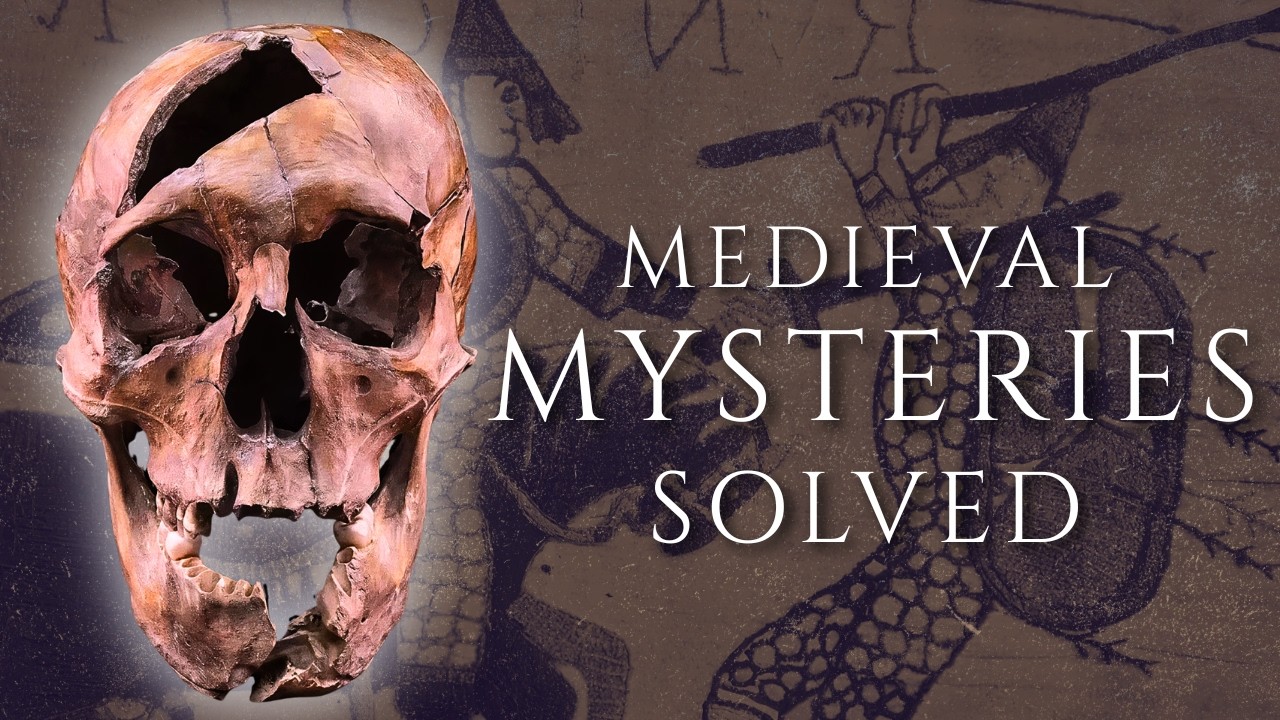
The skull had been split open in multiple places. The hands were sliced through. The forearms carried long gouges where blades had gone down to the bone. Whoever this man was, he had died badly, surrounded by people determined to destroy him, and then someone had gathered up what was left of him and buried it with care in consecrated ground.
The museum had assumed for seventy years that these bones were gone, lost in the Second World War when so much of Budapest burned. Turns out they had been sitting in that box the whole time, waiting for someone to open it. The man in the box was a prince. His name was Béla, Duke of Macsó, grandson of a king of Hungary, great-grandson of an emperor.
And in November of 1272, he walked into a convent on an island in the Danube and was hacked apart by men he knew personally. The island sits in the middle of the river between Buda and Pest. Today it is a park, full of joggers, an old water tower, ruins you can walk through. In the thirteenth century, people called it the Island of Hares, and it was one of the holiest places in the Hungarian kingdom, mostly because of one woman, King Béla IV.
The man who had to rebuild Hungary after the Mongols burned it to the ground in 1241 and 1242 had promised God during that catastrophe that if the kingdom survived, he would give his newborn daughter to the church. The kingdom survived barely, and the king kept his word. The girl Margaret was placed in a Dominican convent built specifically for her on that island, and she grew up to become one of the most extreme ascetics of her century. She refused marriage offers from kings.
She wore a hair shirt, did the filthiest work in the convent by choice, tended the sick nobody else would touch, and essentially starved and worked herself to death by January of 1270, dead at twenty-eight. She would eventually be made a saint, and the island carries her name to this day. Saintliness in the thirteenth century was a competitive sport, and Margaret played it at a level that alarmed even her fellow nuns. The testimony collected after her death from the sisters who lived beside her describes a princess who wore a band of hedgehog skin against her flesh, spikes inward, who volunteered for the latrines and the laundry and the washing of the sick, who barely slept, barely ate, and refused the baths and comforts of her rank so completely that the other nuns complained about sharing choir stalls with her.
Kings asked to marry her, Otto of Bohemia among them, and her own father, the king, the man who had given her to God as a baby, tried to take her back for diplomacy’s sake. She refused him to his face, reportedly saying she would sooner cut off her own nose and lips than leave the cloister. She got her way, wore her body out in the getting, died in January of 1270 at twenty-eight on the island where her grave immediately began drawing pilgrims and miracle stories. Her canonization process opened within a couple of years of her death and finally concluded in 1943, 673 years later, during another world war.
In the same decade, her nephew’s bones were being lost in one. That nephew is our murdered prince, and his family story explains why anyone would want him dead. His mother was Anna, daughter of King Béla IV, so he carried the blood of the Árpád dynasty, the family that had ruled Hungary for three hundred years. His father was Rostislav Mikhailovich, a prince of the Rurikid dynasty out of Kievan Rus’, a man who had lost his own inheritance in the east when the Mongols came through and had rebuilt his career at the Hungarian court, marrying the king’s daughter and picking up titles in the southern borderlands.
Through his grandmother, the boy was also a great-grandson of Theodore Lascaris, the Byzantine emperor in exile at Nicaea. This was a child with three royal bloodlines braided together. Born around 1245, raised partly in the southern territory called the Banat of Macsó down in the lands along the Sava River in what is now the border country of Serbia and Croatia. When his father died and then his older brother died, Béla inherited the duchy.
He held a wide stretch of the southern frontier. He was rich. He was young. And he was by blood one of the most senior males of the royal house outside the direct line.
In a stable kingdom that makes you a valuable cousin. In an unstable one, it makes you a target. And Hungary in 1272 was about as unstable as a kingdom can get without formally falling apart. The tangle in this family traces back a single generation to the event that broke Hungary in half.
In 1241, the Mongol Empire invaded Europe and Hungary took the full weight of it. The royal army was annihilated in a single day at the battle of Mohi by the Sajó River, where the Mongols surrounded the Hungarian camp before dawn, set it burning with fire arrows and early gunpowder devices, left one gap in their ring on purpose, and then rode down the men who fled through it, stringing the road west with corpses for two days’ travel. Contemporaries wrote that you could walk long stretches of that road, stepping only on the dead. King Béla IV escaped by the width of a horse, galloping west with Mongol riders on his heels, his pursuit so relentless that he was chased out of his own kingdom entirely, down the Adriatic coast, island to island.
Behind him, the kingdom burned. Modern estimates suggest somewhere between fifteen and twenty-five percent of the entire population of Hungary died in that invasion in massacre, famine, and the epidemics that follow armies. When the Mongols withdrew in 1242 for their own internal reasons, Béla IV came home to ashes and got to work. He built stone castles by the dozen, invited settlers, and he collected useful people, displaced princes, steppe warriors, anyone with swords and followers, and bound them to his family with land and marriages.
Rostislav Mikhailovich was exactly that sort of useful person, a prince of the Rurikid dynasty, the sprawling family that had ruled the lands of Rus’ from Novgorod to Kiev for four centuries. He had watched the same Mongol storm destroy his own world. Kiev, the golden city of the east, was stormed and gutted in 1240, its population slaughtered so thoroughly that a traveler passing through a few years later counted barely two hundred houses standing and wrote of fields still littered with skulls and bones. Rostislav fought for a foothold in the wreckage, backed the losing side in the scramble over Galicia, and lost his inheritance for good.
So he did what ambitious dispossessed princes did: he rode west to the richest court that would have him. And Béla IV, rebuilding a shattered kingdom and needing every capable fighting man, took him in, gave him his daughter Anna in marriage, and set him up as the great lord of the southern frontier, master of the Banat of Macsó, holding the river line of the Sava against Serbia and whatever else came up from the Balkans. Rostislav spent the rest of his life as a border warlord and a player in Bulgarian politics, even styling himself Tsar of Bulgaria at one point with mixed results. When he died in 1262, his titles and lands passed in time to the boy who concerns us, young Béla, named for his royal grandfather.
Which left the child in a singular position. Grandson of the king of Hungary through his mother. Prince of the blood of Rus’ through his father. Great-grandson of a Byzantine emperor through his grandmother Maria Laskarina.
Raised on the southern frontier among soldiers, then brought north to a court that was by the 1260s at war with itself. King Béla IV and his own eldest son, the future Stephen V, had fallen into open armed conflict, father against son, splitting the kingdom into two armed camps that fought actual battles against each other. Families picked sides. Young Béla of Macsó and his mother Anna stood with the old king against Stephen, her brother.
And when the old king died in 1270, Anna judged the new reign so dangerous for her that she fled the country, taking a chunk of the royal treasury with her to the court of her son-in-law in Bohemia. Her son, the duke, stayed, made his peace with his uncle Stephen, kept his southern lands, and navigated. He was good at navigating by all appearances. He held major territory through a civil war, a change of reign, and a plague of baronial feuding into his late twenties.
In the autumn of 1272, he was one of the last adult males of the dynasty standing anywhere near the throne. Every skill that had kept him alive that long was about to run out at once. His sisters, for the record, had scattered upward across the map in the usual way of royal daughters, and their marriages put the family at the center of the biggest rivalry in central Europe. One sister, Kunigunda, was queen of Bohemia, wife of Ottokar II, the so-called king of gold and iron, the most powerful ruler in the region, and Hungary’s on-again, off-again enemy.
That connection explains where their mother Anna ran with the treasury, straight to her Bohemian son-in-law’s court. And it explains a layer of the paranoia around our duke. A Hungarian prince with a direct line to the Bohemian king was, depending on the season, either a priceless diplomatic asset or a suspected traitor’s nephew. Béla seems to have stayed in Hungary and stayed loyal through all of it, holding his southern command, but at a poisonous court, having powerful foreign relatives is itself evidence against you.
And the men who eventually killed him had spent their careers switching between the Hungarian and Bohemian orbits themselves whenever it paid. They knew precisely how the game worked and precisely what removing a well-connected royal duke was worth. Hungarian baronial politics in the 1270s is a swamp. The short version goes like this.
King Stephen V, Béla’s uncle, died in August of 1272. He was only about thirty-three, and he died weeks after the most humiliating episode of his reign, when one of his own barons kidnapped his ten-year-old son and heir, the future Ladislaus IV, and handed the boy around like a bargaining chip. The king dies, possibly of sheer stress and heartbreak, and the crown lands on the head of a ten-year-old. A child king means a regency, and a regency means the great baronial families of the kingdom immediately start tearing at each other for control of the boy, the treasury, the offices, everything.
The Queen Mother, Elizabeth the Cuman, tried to hold the center. Around her, armed factions formed. Men switched sides, seized castles, murdered rivals, and the royal court became a place where you genuinely might not survive a meeting. The kidnapping that started it all involved the same circle who appear later in our murder.
In the summer of 1272, a great lord named Joachim Gutkeled seized the crown prince, the ten-year-old Ladislaus, from under his father’s authority and locked the boy in a fortress. Not a foreign enemy, a magnate of the realm, stealing the heir to the throne as a political lever. King Stephen took an army to the castle walls and could not get his son out. Within weeks, the king was dead at thirty-three of an illness his contemporaries connected to shock and grief.
A father who besieged a castle to recover his stolen child failed and died of it. The boy came out of captivity a king and property of whichever faction could physically hold him. And the great families understood immediately that for the next several years, Hungary would be governed by whoever stood closest to a frightened ten-year-old. That was the prize on the table in the autumn of 1272.
That was the game Duke Béla of Macsó was standing in the middle of, whether he wanted to play or whether his blood alone made him a piece. The most dangerous man in that court was Henrik Kőszegi, sometimes written Henry of Kőszeg, head of a family from the western borderlands that had spent a generation clawing its way from service nobility to something close to independent power. Henrik had a track record. He had rebelled before, backed rival claimants before, and he had already killed at least one major political rival with his own hands in an earlier round of this game.
He came back from exile after Stephen’s death, planted himself at the center of the regency government, and started removing obstacles. Duke Béla of Macsó was an obstacle, a grown man of royal blood in his late twenties with his own territory and his own claim to influence over the child king, standing right next to the throne while men like Henrik tried to own it. The sources suggest Béla was close to the queen mother’s circle and that his standing was rising through the autumn of 1272. Some historians think he may have looked to the barons like a potential regent, or worse, a potential replacement king if the boy died.
Children died all the time. Everyone at that court had done that math. In November, the court gathered on the island of Hares at the Dominican convent where Margaret lived. Church ground, holy ground, the one place in the kingdom where politics was supposed to pause.
Getting there meant boats, the island having no bridge in that century. So the great men of Hungary rode out across the cold November water of the Danube with their retinues, furs against the river wind, to talk over the future of a ten-year-old’s kingdom inside a compound of praying women. The convent complex was substantial. Church, cloister, chapter house, guest quarters, royal apartments, since kings had always used the family island for business, and a court council in such a place had every appearance of safety.
Weapons came ashore anyway. Retinues in that decade went armed to church, to dinner, to funerals. A council was called, and Béla came to it apparently without armor and without any expectation of violence. And that detail is not a guess, because seven and a half centuries later his skeleton would tell us just how unprotected he was.
Somewhere in that meeting, in front of witnesses, Henrik Kőszegi and his men drew their weapons and went at the duke. The chronicles are brief about it, medieval chronicles usually are, but they agree on the essentials. Béla was cut down inside the convent precinct, and his killers did not stop when he fell. They kept cutting.
The accounts describe a body mutilated so thoroughly that what was left had to be collected in pieces. Two of the women in that convent were his own close kin, his sister Margaret, a nun on the island, and his cousin, a royal princess in the community. The sources have them, with the other sisters, gathering up the remains of their kinsman from the ground of their own holy house and burying him in the sacristy of the convent church. Women who had given their whole lives to prayer on that island, walking out to find the floor of their sanctuary slick with blood, and a brother, a cousin, lying open in pieces.
And their response was to kneel down and start collecting him with their own hands, because someone has to. And the men who did it were still the most powerful people in the kingdom. Nobody was ever punished for the murder. Henrik Kőszegi kept his offices.
He went on scheming for another two years until he died in battle during yet another round of civil war, cut down in 1274, fighting the very court he had dominated. His sons carried the family business forward with enthusiasm, building the Kőszegis into virtual kinglets of western Hungary, who defied crowns for another two generations until a strong king finally broke them. Murder in that family had been a sound investment. The kingdom Henrik helped destabilize slid into decades of anarchy under Ladislaus IV, who himself ended up murdered in 1290.
The Árpád dynasty, the house that had ruled Hungary since before the year 1000, went extinct in the male line within a generation. Béla of Macsó had been one of its last spare branches, and they burned him off. The child king, Ladislaus IV, grew up in precisely the environment you would expect a kidnapped, fatherless boy surrounded by murderers to grow up in. He became one of the strangest and saddest kings Hungary ever had.
His mother was a princess of the pagan steppe people the kingdom had taken in as refugees. As an adult, Ladislaus abandoned his court, his Christian queen, and most of the business of ruling to live out on the plains among his mother’s people, in tents, with Cuman companions and Cuman mistresses, while the barons carved up the kingdom behind his back and papal legates thundered at him about his soul. The chronicles complain that in his day the kingdom had as many kings as there were lords, each robbing at will. It ended for him in the summer of 1290 in a tent on the plain, where three Cuman assassins, men from the very community he had chosen over his crown, cut him down, murdered like his cousin Béla before him by men close enough to reach him.
The crown then passed to Andrew III, a last stray branch of the dynasty raised in Venice. And when Andrew died in 1301 without a son, the male line of the house of Árpád, the family of St. Stephen, the dynasty that had made Hungary a Christian kingdom three centuries earlier, went out like a lamp. Of that entire royal house across three hundred years of kings, exactly two bodies have been genetically confirmed.
One is a king. The other is our murdered duke. The man nobody managed to protect. The island convent carried on for generations after the killing, praying over the graves in its sacristy, Margaret’s among them with the duke’s mutilated bones a few steps away.
Pilgrims came for Margaret. The community stayed wealthy and royal. Then the Ottoman Wars reached Buda in the 1520s and 1530s, and the nuns gathered what they could carry, including the bones of Margaret herself, and abandoned the island for good, handing the buildings over to weather, treasure hunters, and time. Floods scoured the island.
Walls slumped into the grass. By the time anyone with a trowel took an interest, the convent was a romantic ruin in a public park, and the people of Budapest strolled past the low walls with no idea that under one patch of ground near the old church lay a prince with sword cuts on his hands. In April of 1915, in the middle of the First World War, an excavation opened up the area of the old sacristy, the small room beside the church where the most honored burials went. The diggers found three graves.
One of them held the skeleton of a young man. Even in 1915, with the field of forensic archaeology barely invented, you did not need special training to see what had happened to him. The bones were covered in cut marks. The skull was cratered.
The hands and arms were carved up. And the burial itself was orderly and respectful, a high-status grave in the most sacred corner of a royal convent holding a man who had clearly been chopped apart. The anthropologist Lajos Bartucz of Budapest University spent years with the skeleton and came away convinced. In his analysis, never fully published, he counted twenty-three separate cut marks and made an argument well ahead of its time.
Modern imaging would eventually push his count to twenty-six, finding strikes his 1930s tools could not resolve. This was no duel, he said. The blows came from multiple directions at once, meaning multiple attackers surrounding the victim, and some of the damage looked like it was inflicted after the man was already down and past resisting. Mutilation, in other words, rage carried past the point of death.
Bartucz said these were the bones of Béla, Duke of Macsó. Then the Second World War came to Budapest. The city was besieged and shattered, collections were scattered, and the skeleton disappeared from the record. For decades, everyone who cared about the case assumed the duke had been destroyed a second time, this time by bombs and fire and chaos.
Remember that unlabeled wooden box from the start? The body of the skeleton turned up in storage at the Hungarian Natural History Museum. The skull surfaced separately in an old anthropological collection at Eötvös Loránd University in Budapest, the collection named after Aurél Török. Nobody had thrown the duke away.
He had simply been mislaid, sitting untouched through the entire second half of the twentieth century, while the tools that could finally identify him were being invented outside the storeroom door. Once the pieces were reunited, a large team got to work, researchers from Eötvös Loránd University, the Institute of Archaeogenomics at the Hungarian Research Network, colleagues at Harvard and elsewhere across Europe, geneticists, isotope specialists, forensic anthropologists, historians. Their results came out in the journal Forensic Science International: Genetics in a study led by Tamás Hajdu with Anna Szécsényi-Nagy as senior author. The team documented twenty-six separate injuries from bladed weapons, all inflicted around the moment of death, none showing any healing.
Nine of those strikes landed on his skull. Seventeen more landed across the rest of his body. Every single one was delivered in one continuous episode of violence. The cuts were deep and clean, and the pattern of them told the analysts the duke was wearing no armor at all, probably just court clothing.
He came to that meeting dressed for politics. When you map every strike, its direction, its angle, its position on the body, a shape emerges, and the shape is three men. One attacker directly in front of him, two more at his flanks, one on the left, one on the right. Weapons analysis pointed to at least two different blade types in play, most likely a saber and a long sword.
A coordinated assault, a formation, three armed men collapsing on one unarmored man at the same time. You do not end up in that configuration by accident or by a quarrel boiling over. Somebody arranged it. And Béla saw it coming at least by a second or two.
His hand and forearm bones carry classic defensive wounds, the cuts you get when a person throws their arms up and tries to catch sword blades with their bare hands because there is nothing else left to do. Fingers sliced, forearms notched to the bone. He fought, or at least tried to shield himself unarmed, while three blades came in from three directions. One of the researchers, an osteoarchaeologist named Martin Trautmann at the University of Helsinki, did something wonderfully grim to work out the sequence.
He took a model skeleton, marked every one of the duke’s twenty-six injuries on it in their exact positions, and then physically acted out the fight, tracking how a human body reacts to each blow, how it turns, how it drops, what gets exposed next. From that, the team reconstructed the assault roughly like this. It opened with strikes to the head and upper body from the front. Béla got his arms up, took the defensive wounds.
The men at his flanks came in and landed the incapacitating blows that dropped him. And once he was on the ground, unable to resist, the attackers leaned in and delivered repeated strikes to his head and face until it was over, and then passed the point where it was over. Trautmann put it plainly: there were far more serious injuries than would ever be necessary to kill somebody. The concentration of blows to the face in particular caught the team’s attention.
In forensic work on modern homicides, sustained facial destruction usually signals personal hatred, a killer who knows the victim and wants to erase him. The study uses the word overkill driven by real emotion, and pairs it with the cold observation that three men attacking in coordination from three sides means the emotion was planned for. Premeditated rage. Someone hated this man enough to butcher his face and was organized enough to choreograph it.
That matches the chronicles. The medieval sources said Henrik Kőszegi and his men cut down the duke and mutilated his body in the convent. The skeleton says a coordinated group of at least three armed men destroyed an unarmored young man and kept striking long after he was dead, with special fury spent on his face. Two completely independent witnesses, a monk with a pen and a body in the ground, telling the same story.
The identification itself came from the genetics. From the petrous bone, the dense little pyramid of bone behind the ear that preserves DNA better than almost anything else in the body, the team recovered enough genetic material to place this man precisely in the web of European royalty. His Y chromosome, the male line, belongs to a lineage carried by the Rurikid dynasty of Kievan Rus’. It matches both modern men documented as Rurikid descendants and the sequenced genome of a medieval Rurikid prince, Dmitri Alexandrovich of Vladimir.
That is his father Rostislav’s line confirmed. His mitochondrial DNA, the maternal line, traces toward the Black Sea and Byzantine Anatolia, just what you would expect through his grandmother, Maria Laskarina, the emperor’s daughter. And the genome-wide comparison delivered the clincher: a measurable family relationship to King Béla III of Hungary, whose remains were identified long ago, at exactly the genetic distance you would predict for the documented family tree. Right bloodlines on both sides.
Right degree of kinship to the Árpád kings. Right age at death. Right height, tall for the era at around 178 cm. Right date range.
Right wounds. Right grave in the right room. The man in the unlabeled box is Béla, Duke of Macsó. The science filled in the living man, too.
Genetic markers suggest he had dark hair, possibly curly, light brown eyes, and a medium to darker complexion, plausible enough for a man whose recent ancestors came from Rus’ and Byzantine Anatolia. Strontium isotopes locked into his teeth as a child recorded where his water came from, and they show he was not raised around Buda. His early childhood chemistry matches the Vojvodina and Szerémség region in the south, the lands of the Macsó Banate along the Sava, his father’s frontier territory. In adolescence, the signal shifts north, presumably when he was sent to court.
His bones and the hardened plaque on his teeth even preserved his diet. Over a thousand microscopic food particles came out of his dental calculus. Heavy animal protein, plenty of freshwater fish from the great rivers, wheat and barley, prepared every way a princely kitchen could manage. He ate so much river fish, in fact, that it skewed his radiocarbon date.
Old carbon accumulates in freshwater systems, worked its way up through the fish into his bones, and the raw dates initially came out too early until the team corrected for the effect. Even his lunch tried to complicate the case. A facial reconstruction was made from the skull by Ágnes Kustár. So after seven centuries, you can look this man in the face.
A face his killers spent the last moments of the attack trying to remove from the world. The workhorse of the whole identification is a chunk of bone most people have never heard of: the petrous part of the temporal bone, a dense pyramid buried deep behind your ear that houses the inner ear. It happens to be the hardest, densest bone in the human body, and that density seals DNA away from water, microbes, and time better than anywhere else in a skeleton. Ancient DNA researchers go for the petrous first, the way safe crackers go for the hinges.
Even so, 750-year-old DNA comes out shredded, chopped into tiny fragments, chemically damaged in telltale ways, and contaminated with the genetic litter of every archaeologist, curator, and student who ever breathed on the bones since 1915. The labs work in sealed clean rooms in full body suits, and the computers reassemble millions of overlapping fragments into a genome the way you might rebuild a shredded letter. One of the ironies of the field is that the chemical damage itself becomes the authentication. Genuinely ancient DNA decays in a recognizable pattern, so the rot proves the age.
Fresh contamination lacks the scars. The strontium work runs on a different clock. Your tooth enamel forms in childhood and never changes afterward, and it locks in the chemical signature of the water and food you took in while it was forming. Different geologies feed different strontium ratios into the groundwater, so a molar formed at age four is a postcard from wherever you were at age four.
The duke’s molars say the southern frontier. His later-forming teeth say somewhere else, farther north. His skeleton carries his own itinerary, childhood on the Sava, adolescence at court, and it matches the documented life of Béla of Macsó, and clashes with any random monk or nobleman who might otherwise have ended up in that sacristy. Stack the evidence in a column, and the case is about as closed as medieval cases get.
Even the weapons have something to say about the world that killed him. A saber and a long sword are different tools from different traditions. The curved saber, a light cavalry weapon with steppe roots, at home among the Cuman horsemen the Hungarian court had absorbed. The straight long sword, the standard equipment of western knighthood.
Two traditions of violence, east and west, meeting in one body on an island in a kingdom that had spent a century absorbing both. The researchers could distinguish them because different blades bite bone differently, a curved slashing edge and a straight cutting edge, each signing their work. When the study appeared in 2025, coverage ran around the world under headlines about a cold case closed after 750 years. The case was never cold to the women who buried him.
They knew exactly who did it. Everyone knew. The chronicle names the killer flatly, in the way you name something nobody bothers to deny. What the science added was the how, second by second, along with the confirmation that a paragraph written by medieval monks about a political murder was, in every checkable particular, simply true.
His estates were carved up after the murder and handed out among the factions at court. His branch of the dynasty ended with him. For six hundred years, the only monument he had was a paragraph in the chronicles. Now he has a face, a verified name, a mapped murder, and a formal scientific publication that sounds, in its dry way, like an indictment of Henrik Kőszegi filed 750 years past the statute of limitations.
What happens to him now is a question the Hungarians get to answer at their own pace. The bones are in professional care. Voices have been raised about giving him eventually a proper resting place again, seven and a half centuries after the nuns gave him his first one. Wherever he ends up, he has already done something almost no murder victim in history manages.
He outlived his killer’s version of events by 750 years and got the last word. If you ever find yourself in Budapest, you can walk the crime scene in an afternoon. Margaret Island is reached by bridge now, and the ruins of the convent sit in the middle of the park. Low walls of rough stone marking out the church, the cloister, the little rooms.
Nothing marks the exact place where the sacristy stood. Runners loop past it all day with their music in their ears, over ground where a saint’s community once knelt to gather a butchered prince into a sheet. The Kőszegis wanted him erased.
He has a park.






