In 1988, Ivana Trump stood at the top of New York society, running the Plaza Hotel with her name on the letterhead, married to the most famous name in American real estate. From the outside, it looked like the fairy tale had worked. But to understand how a girl from a communist backwater ended up buried on a Trump golf course, you have to go back to a small town in the shadow of a shoe factory. She was born Ivana Marie Zelnikova in 1949 in Zlin, a gray industrial town in Czechoslovakia that existed to make shoes.
The Bata factories ran the place, and the rhythm of the town moved to the shift whistle. This was a country four years past the war and freshly folded behind the Iron Curtain. Apartments were small, shelves were thin, and ambition was something you kept quiet about. She grew up an only child, in a place where the horizon ended at the factory gates.
The person who lit the hunger in her was her father, Milos, an electrical engineer. He had no son, so he raised his daughter the way another man might have raised an heir: discipline, effort, results. From the time she could walk, he treated her as someone built for something larger than Zlin. He put her on skis young and pushed her hard.
Where other parents taught their children to be grateful for enough, he taught his daughter to want more. That belief became the engine of everything that followed. In on skis, the rules changed. In the mountains of northern Bohemia, she could point herself downhill and leave the checkpoints and paperwork far behind.
Speed asked nothing about politics. By her early teens, she was training seriously, the kind of skier coaches noticed. In a country that prized athletic talent as a point of national pride, ability on the snow was one of the few things the state actually let a young woman chase. For decades, the story went that she had been an alternate on the Czechoslovak National Ski Team, a hair’s breadth from the Olympics.
When reporters went looking, the country’s Olympic officials couldn’t confirm it, and no record placed her on that roster. Her own father would later suggest the claim had been generously rounded up. It was a telling glimpse of a woman who understood that a good story could be more useful than a strictly true one. Talent on the slopes only opened one door.
The real passport out had to be earned in Prague. She enrolled at Charles University and set her sights on a degree in physical education. By 1972, she’d earned her master’s degree. But a diploma wasn’t enough for a woman who had already decided she would never grow old behind the Iron Curtain.
After the Soviet tanks rolled into Prague in 1968, the borders tightened. You could apply through official channels, a process so slow and easily denied that most gave up, or run and become a defector, which meant you could never come back, and your family stayed behind exposed to the authorities. Ivana wanted the West without burning the bridge home. Leaving legally required something she didn’t have, until a quiet Austrian offered her a way out that came with a wedding ring.
His name was Alfred Winklmeier, an Austrian ski instructor she’d crossed paths with on the circuit. He had an Austrian passport, and marrying him changed everything. Around 1971, in the gray formality of a Prague office, they married. There were no toasts, no white dress, no gathered family weeping with joy.
It was a transaction. By 1973, they ended it calmly and without bitterness. She kept the citizenship that had cost her a wedding ring and a couple of years on paper. Freedom left her stranded in Montreal in the early 1970s, a city split down the middle by language.
She arrived speaking neither French nor English well. So she learned, picking up French fast and out of necessity, working odd jobs. What she had was discipline and a hunger to be somebody in a city that owed her nothing. Before New York, there was another man, the one she may have actually loved.
His name was George Syrovatka, a Czech ski champion who had also slipped out from behind the border. It was George who drew her to Montreal. They opened a ski shop together, spent winters in the sport that had made them both, and moved through the same tight circle of Czech expats. Those close to Ivana would later say George was the great romance of her life, the one that asked nothing of her but who she already was.
But love didn’t pay the rent. The camera loved her, and she started booking work modeling for local designers. By the mid-1970s, she was becoming a recognizable face in the city, tapped to help promote the 1976 Summer Olympics. Then a modeling trip to New York in 1976 put her at the wrong table at exactly the wrong moment.
One evening, her group tried for a table at Maxwell’s Plum, a fashionable spot heaving with people who wanted to be seen. The line was long. A young man stepped in, had a quiet word with the staff, and suddenly there was room. He was tall, blonde, and impossibly sure of himself, a 30-year-old real estate developer just beginning to make noise in Manhattan.
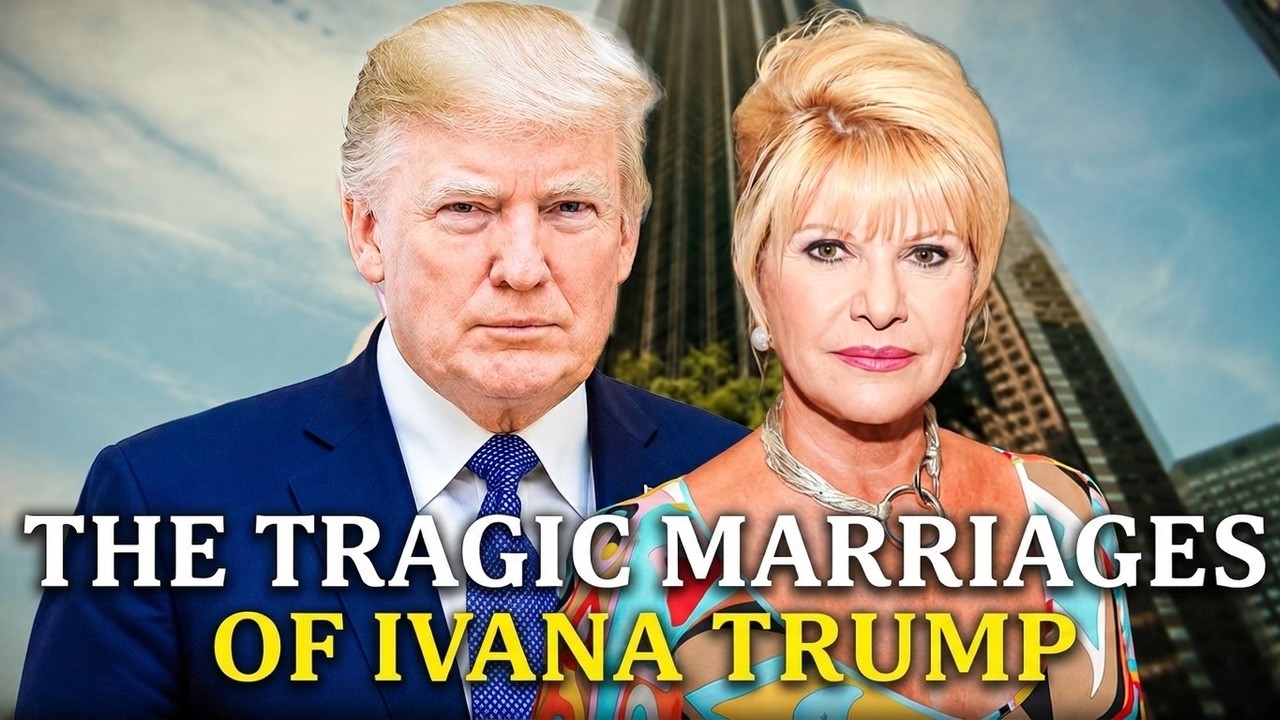
His name was Donald Trump. What followed didn’t feel like ordinary courtship. Flowers arrived at her Montreal apartment in numbers that turned her rooms into a florist’s window. He talked about the towers he wanted to build, the deals he was chasing, the city he intended to reshape.
To a woman who’d crossed an ocean chasing her own ambition, that hunger was familiar and magnetic. Less than a year after that first dinner, she agreed to marry him. They married on April 7th, 1977, at Manhattan’s Marble Collegiate Church, with Norman Vincent Peale presiding. The reception carried on at the 21 Club.
But before she could walk down the aisle, there was a document waiting for her signature. The prenuptial agreement arrived before the vows did, drawn up by Donald’s lawyers. In 1977, prenups were still unusual, faintly scandalous. She was asked to accept terms that spelled out exactly what she’d receive if it ended.
Friends later said she cried over it. But she signed, and then set out to prove she was worth far more than any contract allowed. She didn’t drift into the marriage as decoration. On the renovation of the old Commodore Hotel into the Grand Hyatt, the project that first put Trump on the map, she was hands-on with the design and the standards.
When Trump Tower opened in 1983, her fingerprints were everywhere, from the pink marble and brass of the atrium to the standards demanded of every doorman. She understood that luxury lives in the details. The children came quickly. Donald Jr.
was born on December 31st, 1977. Ivanka arrived on October 30th, 1981. Eric followed on January 6th, 1984. Ivana ran her children the way she ran everything, with schedules, standards, and very little patience for excuses.
She insisted they speak Czech with her and understand that the name they carried came with expectations. In 1988, Donald bought the Plaza Hotel for around $390 million and named her its president, famously at a salary of a dollar a year and all the dresses she could buy. She oversaw a renovation running into the tens of millions. For a young woman who’d arrived from Czechoslovakia barely a decade before, presiding over the most storied hotel in the city was a height few could imagine.
By the close of the 1980s, they read as invincible. But the trouble seeped in the way it does in marriages where both people are building empires. By the late 1980s, Donald and Ivana were running parallel operations. Her in Atlantic City and at the Plaza, him chasing the next headline.
He’d started needling her in front of guests. Then came a younger woman. Her name was Marla Maples, a Georgia-born actress and model in her mid-20s, all warmth and southern ease. They’d met around 1989, and the attraction was immediate and reckless.
In 1989, the Trumps went to Aspen for their usual Christmas holiday. What Ivana didn’t know was that Donald had arranged for Marla to be there too. The confrontation happened at Bonny’s, a restaurant halfway up Aspen Mountain. Marla told Ivana that she loved Donald and asked what she was going to do about it.
Ivana skied off fast, furious down the mountain. Within weeks, the story slipped its leash. New York in 1990 had two tabloids at war, and a billionaire’s marriage falling apart was exactly the fuel they ran on. On February 11th, 1990, the New York Post ran four words that would follow the marriage for the rest of its life: “Best sex I’ve ever had,” the headline shouted, quoting Ivana from the divorce filings.
The most private detail of a marriage had become street theater. Ivana was done being the wronged wife in silence. She filed on grounds of cruel and inhuman treatment, the sharpest language New York law allowed, and hired attorney Michael Kennedy. The prenuptial agreement had been revised four times over the marriage, the last signed in 1987 offering Ivana roughly $25 million.
Kennedy filed to have the whole agreement thrown out, arguing fraud and duress, that the numbers were built on hidden assets. The tabloids ran the divorce on the front page for 12 straight days, leaks coming from both camps. Ivana learned fast that a photograph of her leaving a restaurant, composed and unbothered, said more than any affidavit. The headlines meant to shame her began quietly to make her sympathetic.
The custody terms mattered to her in a way the dollar figures never quite did. When the papers were finally signed in 1991, the numbers landed like a verdict. Roughly $14 million in cash, the 45-room mansion in Greenwich, Connecticut, an apartment in Trump Plaza, and the right to use Mar-a-Lago for a month each year. She’d signed a prenup designed to keep her share modest, and she broke past it anyway.
But the quiet that followed wasn’t the freedom she’d pictured. She was Ivana Trump now, permanently, a brand fused to the man she’d just spent years fighting in court. So in 1992, she published her first novel, For Love Alone, a story about a European beauty who marries an American tycoon and watches the marriage curdle. It became a bestseller.
In 1996, she appeared in the comedy The First Wives Club, sweeping past the heroines to deliver one line: “Don’t get mad. Get everything. ” The theater roared. Then she built an empire under her own name: fashion lines, a fragrance called Ivana, jewelry, clothing, all sold through Home Shopping Television.
She was ready to believe in love again, this time with an Italian. Ricardo Mazzucchelli, an Italian businessman, courted her the old-fashioned way, seeming to see the person rather than the brand. In 1995, she married him. But a prenuptial agreement sat between them, and the sharpest wound was a confidentiality clause that felt like a muzzle to a woman whose entire second act ran on her story.
The marriage lasted barely two years before it fell apart into dueling lawsuits. Then came Rossano Rubicondi, an Italian actor and model some 23 years younger. On April 12th, 2008, Ivana walked back into Mar-a-Lago and married him on the grounds of the very estate she’d divorced her way out of, with Donald Trump himself hosting the affair. It was the most lavish wedding she’d ever thrown.
By the end of that same year, the marriage was over on paper. But what followed wasn’t a clean break so much as a long looping habit; they kept circling back, appearing together, splitting, softening, never quite letting go. In 2021, Rossano died of melanoma. He was just 49.
Ivana called him the love of her life. By her early 70s, Ivana lived mostly alone in her five-story townhouse on East 64th Street, decorated in gold and mirrors. She still dressed for the day, still did her hair, still walked her little dog. The husbands were gone, the children busy with dynasties of their own.
On July 14th, 2022, Ivana was found at the bottom of the staircase inside her townhouse. She was 73. The New York City medical examiner ruled it an accident, blunt impact injuries to the torso from a fall down the stairs. No scandal, no courtroom, no press conference, just a woman alone in a beautiful house and a set of stairs she’d climbed a thousand times.
Her funeral was held in Manhattan at St. Vincent Ferrer Roman Catholic Church. Her three children spoke. Then came the choice of where she’d rest.
She was buried at the Trump National Golf Club in Bedminster, New Jersey, on the grounds of a property owned by the man she’d divorced more than 30 years earlier. Her grave sits near the first tee, marked by a simple stone. Four husbands, four fresh starts, each one ending in convenience discarded, betrayal, litigation, or grief. And yet through every reinvention, she kept one thing: the name Ivana Trump, on her business empire, on her book covers, on her passport, on her headstone.
She divorced the man three times over, in court, in the press, in her own retellings. She never divorced the name. That was the one marriage she kept until the very end, the union to an identity rather than a person.






