The letters left Rome in the late summer of 1494, addressed to a castle on a lake seventy miles to the north, and the substance of them was this: if Julia Farnese went to her husband’s house at Bassanello instead of returning to the palace beside St. Peter’s, she would be cut off from the sacraments of the Church—and so would her husband, and so would her mother-in-law, who happened to be the Pope’s own cousin. He called her ungrateful. He called her perfidious.
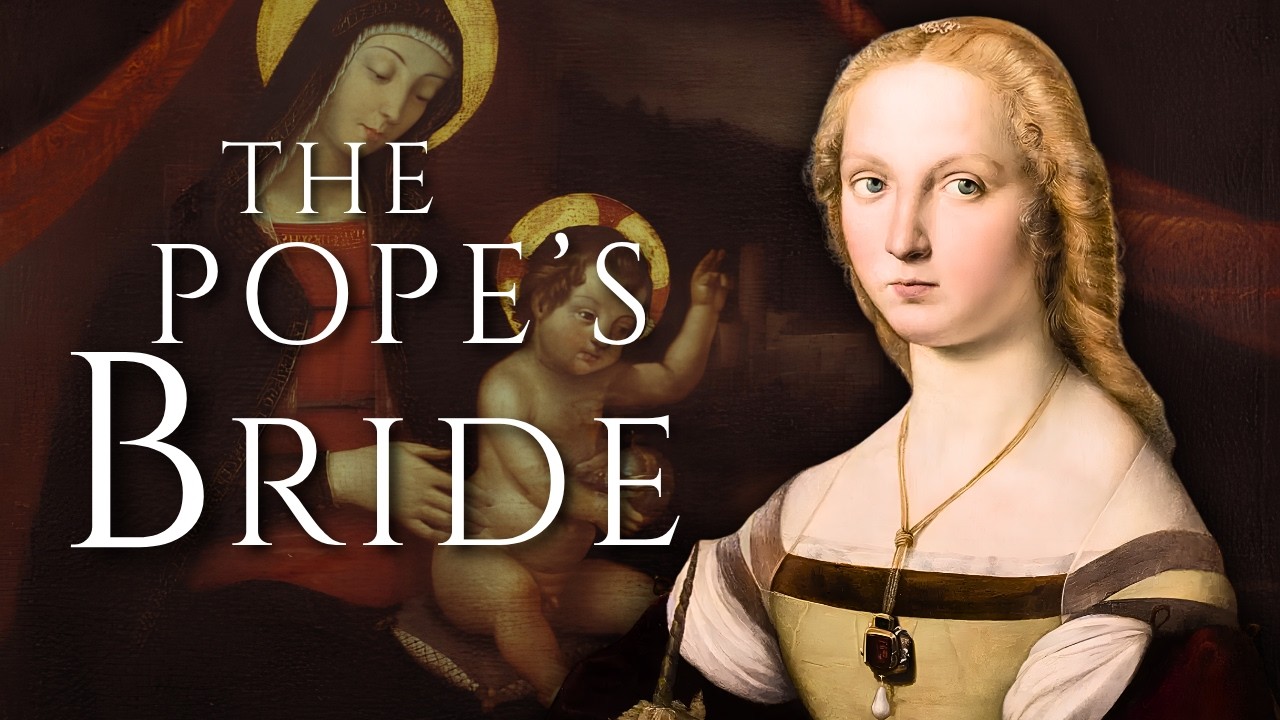
He was sixty-three years old, and he had been her lover since she was fifteen or sixteen. The marriage he was now threatening to damn her for honoring had been signed five years earlier in his own palace. Most of what can be said about what she looked like comes from a visit paid eight months before those letters by a Florentine churchman named Lorenzo Pucci, who wrote to his brother about a woman’s hair. Late December 1493, Pucci was in Rome on family business and went to pay a call at a palace that stood pressed against the flank of St.
Peter’s, close enough that you could walk from its upper rooms through a covered passage into the basilica, and from the basilica into the Pope’s own apartments, without ever stepping into the street. A servant showed him into a chamber with a fire going. A young woman sat near it. She was nineteen.
A baby girl, a little over a year old, lay beside her, and the girl, Pucci noticed, had the face of the Pope. Nobody in the room seemed to find that awkward. The young woman had her hair loose. Then she had it dressed in front of him, and while a maid worked through it, he watched it fall past her waist, past her knees, all the way down to her feet.
Afterward he wrote that he had never seen anything like it in his life. Over her hair went a headdress of fine linen, and over that a net so light it seemed made of air, gold thread worked through it. “The whole thing shone like the sun. ”
Her name was Julia Farnese.
Rome had a few names for her. People who liked her called her Giulia la Bella, Julia the Beautiful. People who did not called her the Pope’s whore. And someone in Rome writing a newsletter the following year came up with the one that outlived everyone: they called her the Bride of Christ.
The old man she belonged to was Rodrigo Borgia, and the papal name he had taken the year before was Alexander. He was sixty-two that winter. She was nineteen. Before Rome, before any of it, she came from water.
Lake Bolsena sits in the crater of a dead volcano about seventy miles north of the city, a big round sheet of water with two small islands in it, Bisentina and Martana. Around its rim ran a ring of little fortified towns that in the 1400s belonged mostly to one family: Capodimonte on the southern shore with a castle on the point above the harbor, Canino further west toward the sea, Gradoli, Valentano, Piansano, Marta. The Farnese held all of it. They were lords of the lake and of the woods behind it—wild country of oak and chestnut and wolves—and for a couple of centuries that was about the extent of what they were: country barons, soldiers for hire mostly.
If a pope or a duke needed men-at-arms, a Farnese would bring some. The island Bisentina was where they buried their dead. It is a small green hump of oak and cypress a mile or so off Capodimonte, with a Franciscan convent on it that the family had endowed and a chapel where the Farnese tombs were. On a clear day you can stand on the point at Capodimonte where the castle is and see the island sitting on the water like something left behind.
The other island, Martana, had an older story attached to it. In the sixth century, the Gothic queen Amalasuntha was imprisoned there by her cousin and strangled in her bath; the historian Procopius wrote it down, and the people around the lake had been telling it ever since. Julia grew up looking at both islands. She would ask on her deathbed to be taken back to the one with the tombs.
Julia was born there in 1474 or close to it. The records do not give a day, and they do not quite agree on whether it was Canino or Capodimonte. A legal document from 1489 says she was of marriageable age, and working backward from that, historians put her birth somewhere around 1474 or 1475. Her father was Pier Luigi Farnese the elder, lord of all those castles.
Her mother was Giovanella Caetani. And that name mattered more than the Farnese one did. The Caetani were old Roman aristocracy, dukes of Sermoneta, and they had already produced two popes, including Boniface VIII, the one who got slapped at Anagni. The blood on the mother’s side ran toward Rome, toward the papacy, toward the idea that a family could reach that high.
The blood on the father’s side ran toward horses and swords. She had a full house of siblings. Angelo was the oldest, born around 1464, and he married into the Orsini clan. Alessandro came next, born in 1468—the clever one, sent to Rome and then to Florence to study with the humanists at the Medici court.
A sister, Gerolama, married a Florentine named Pucci, and that marriage is why Lorenzo Pucci, Puccio’s brother, was standing in that room by the fire years later. And a sister called Beatrice went into a convent at Viterbo and eventually ran it as abbess. Julia was the youngest or near it. Their father died in 1487.
Julia was about thirteen. Before he went, he had made arrangements for her, the way a man of his class had to, and after he was in the ground, it fell to Angelo and Alessandro to carry those arrangements out. What Pier Luigi wanted for his daughter, and what the whole family had wanted for two generations, was Rome. The lords of Capodimonte had spent a long time yearning to come down out of the woods around the lake and into the rich city of the popes, and they had worked out, watching other families do it, that a sword would only ever take you so far.
What put down roots in Rome was a churchman’s robe—a cardinal in the family, better still, a pope. They had a churchman. Alessandro was clever and ambitious and had the right education. What they did not have was a patron, someone inside the Vatican with enough pull to hand a red hat to a boy from Lake Bolsena.
A red hat in those years went to a duke’s son or a pope’s nephew or a man who could pay for it. The Farnese were none of those yet. Here the story turns, and it turns on a woman named Adriana de Mila. She was Spanish by descent, from the same corner of Valencia as the Borgias, and she was a cousin of Cardinal Rodrigo Borgia, the vice-chancellor of the Church, one of the most powerful men in Rome and by contemporary reckoning among the richest.
Adriana had married into the Orsini, one of the two great baronial clans of the city, and had been widowed young. She had one son, a boy named Orsino, lord of a small place called Bassanello up in the hills north of Rome, not far from Farnese country. Adriana was, in the phrase one historian used, the confidante of Rodrigo Borgia—who added, a little sourly, that this was saying a great deal for a man who gave women his confidence only in bed. Whatever else she was to the cardinal, she was the person he trusted.
He had put his own small daughter into her house to be raised. That daughter was Lucrezia Borgia, and she was about nine years old. Orsino Orsini, Adriana’s son, was the husband chosen for Julia Farnese. He was close to her own age.
The documents describe him as squint-eyed, one eye turned so the two did not line up, and Rome, in the habit of nicknaming everyone, called him Monoculus or Cieco—the one-eyed, or Cieco the blind—and over the years the story grew until people were saying he was blind. The same sources describe him as awkward and lacking confidence, a young man without much presence. He had no father to guide him. He had his mother, and he had the cardinal who had been standing in for a father since he was small.
The marriage contract was drawn up in Rome on the 21st of May 1489, in the palace of Cardinal Rodrigo Borgia, the vice-chancellor’s own residence—a great block of a building near the Campo de’ Fiori that he had built for himself out of the profits of thirty years in the Church. It is still there on the Corso Vittorio Emanuele, rebuilt and renamed the Palazzo Pio–Farnese, and you can walk past the doorway where a fourteen-year-old’s marriage was signed away without anyone pointing it out to you. The Farnese brothers signed. Adriana signed for her son.
The dowry was small, somewhere around 3,000 florins by one reckoning and ducats by another, and not even in cash—the Farnese were plainly the poorer party at that table. Julia was fourteen or fifteen. The cardinal was fifty-eight. A year later, on the 9th of May 1490, the wedding itself was celebrated.
Same palace, a big crowd of nobles and prelates, the cardinal presiding as host and, in every way that mattered, as head of the family. Whether the whole thing was engineered from the start—whether Adriana and the Farnese brothers deliberately picked a compliant, unsure young husband so that a fifteen-year-old could be placed within reach of a fifty-eight-year-old cardinal with an honorable cover story—the documents cannot tell us. The scholar who knew the archive best said plainly that it cannot be established. What the documents can tell us is that by the following year, 1491, the affair was underway, and everyone close to it knew—Rodrigo Borgia himself, then the man she had been handed to.
He was born in 1431 in a town called Játiva in the kingdom of Valencia, and he came to Rome as a young man for one reason: his uncle had become Pope Callixtus III. The uncle made him a cardinal at twenty-five. A year later, he made him vice-chancellor, the office that ran the entire paperwork machine of the Church—every bull, every dispensation, every appointment, every fee. Rodrigo held that post for thirty-five years under five popes, and it made him enormously rich.
He built the palace near the Campo de’ Fiori. Contemporaries described his household as fit for a prince. He was a big, heavy man, and the people who wrote about him kept remarking on the same two things: he was charming, and he could not keep his hands off women. That was known thirty years before Julia was born.
In 1460, when Rodrigo was twenty-nine, Pope Pius II wrote him a letter that survives, and it is one of the more remarkable documents of the century: a pope scolding a cardinal for a garden party. Rodrigo had been in Siena. He had invited a group of the city’s young married women to a walled garden, told the husbands and fathers and brothers to stay outside, and spent the afternoon with the women in a manner the pope described as unbecoming. Pius wrote that there had been dancing without restraint, that none of the allurements of love had been lacking, and that Rodrigo had behaved as if he were a young layman rather than a cardinal.
He wrote that the whole of Siena was talking about it, that Rodrigo’s name was a joke in the streets, and that this was not how a cardinal of the Roman Church should be spending his time. Rodrigo apologized, kept his hat, and carried on. By the 1470s, he had settled on one woman, more or less permanently. Her name was Vannozza de’ Catanei.
She ran inns and property in Rome and did well out of it. Rodrigo arranged husbands for her, one after another—respectable men who could give her children a surname and look the other way. And between 1475 and 1482, she gave him four: Cesare first, then Juan, whom the Spaniards called Giovanni, then a daughter, Lucrezia, in 1480, then Gioffre, the baby. Rodrigo loved all four openly, and Rome talked about it.
And as they grew, he took them out of their mother’s house and placed them with people he trusted. That is how little Lucrezia ended up under Adriana de Mila’s roof, to be raised and educated by the cardinal’s cousin. And that is the house Julia Farnese married into. The girl from the lake is fifteen.
Her mother-in-law is the cardinal’s cousin and closest confidante. Her husband is a nervous young man who has looked to the cardinal as a father since he was a child. The cardinal’s own nine-year-old daughter is living in the same rooms. And the cardinal himself is the host of the wedding, the signer of the contract, the man whose palace they all keep walking in and out of.
Every road in that household went to Rodrigo Borgia. We do not know the day it started. Nobody wrote that down. What we have is what Orsino did in April 1491, less than a year after the wedding.
He fled, or he tried to. The record says he left Rome abruptly and in distress, telling people he was going on pilgrimage to the Holy Land, to Jerusalem—about as far from Rome as a Christian nobleman could plausibly go and still call it a religious act. He got as far as Florence, and there the letters caught up with him. His mother wrote.
His brother-in-law Angelo Farnese, who was also his close friend, wrote. And Cardinal Borgia wrote more than once—letters described in the sources as pressing and confidential, and containing arguments a good deal more persuasive than anyone else’s. We do not have the text. We have the result.
Orsino never saw Jerusalem. He turned around, came back to Rome, and went to live in the ancestral Orsini palace on Monte Giordano, a fortified pile on the bend of the Tiber. In January of 1492, the cardinal gave him a job—a military contract, a condotta, with a salary. And that salary went up steadily year after year for as long as Rodrigo Borgia lived.
Rome drew its own conclusions. The gossip was that Orsino had been bought. Later writers said the governorship of a castle called Carbognano, north of the city, was part of the price. Exact terms aside, a twenty-year-old husband who had tried to run to the other end of the Mediterranean came home, took the money, and did not try again.
He is one of the few people in this story who does not seem to have wanted any of it. He had a mother who had promised him to the cardinal’s plans before he was old enough to understand them, a wife chosen for reasons that had nothing to do with him, and an eye the city made jokes about. And the one time he tried to leave, everyone close to him wrote to tell him to come back. He came back.
Rodrigo Borgia was sixty the year Orsino gave up. Julia was sixteen. For a while, the arrangement ran quietly enough. Then in July of 1492, Pope Innocent VIII died, and everything Julia’s family had hoped for came within reach.
The conclave met in August. Twenty-three cardinals locked into the Sistine Chapel, and the story of what happened inside has been argued over for five hundred years. The version most often told comes from a Roman notary named Stefano Infessura, who kept a diary of city gossip and hated the Borgias. Infessura says Rodrigo bought it.
He says that on the night before the decisive vote, four mules loaded with silver were driven from the Borgia Palace to the house of Cardinal Ascanio Sforza, who controlled the Milanese block of votes, and that in the morning that block went to Borgia. He says Sforza was afterward given the vice-chancellorship, the Borgia palace itself, the castle of Nepi, a bishopric in Hungary worth 10,000 ducats a year, and more. A Venetian diplomat in Milan wrote to a colleague that the papacy had been sold by simony and a thousand villainies. An epigram went around the city: “Alexander sells the keys, the altar, Christ himself.
He has a right to—he bought them. ” That is the story. The other side is that mules are easy to invent; that nobody outside Infessura reports seeing them; that Ascanio Sforza had every reason to back Borgia without silver, since the alternative candidate, Giuliano della Rovere, was Sforza’s enemy; and that Rodrigo emerged as the compromise between two men who could not stand each other. Historians who are not fond of him still point out that no one has ever found a receipt.
What nobody disputes is the outcome. On the 11th of August 1492, Rodrigo Borgia was elected, and he took the name Alexander. When the announcement was made, he is supposed to have said, “I am Pope. I am Pope.
” Julia was eighteen. Her lover had just become the Vicar of Christ, the successor of St. Peter, the man who held the keys to heaven and hell. And her family, the country barons from the lake, had a foot inside the door of the Vatican.
The first change was where she slept. She did not go to live with her husband on Monte Giordano. Orsino stayed there or went up to Bassanello, and Julia moved with Adriana and with Lucrezia into a palace that a cardinal named Battista Zeno had lent to the new pope: the palace of Santa Maria in Portico. It stood right up against St.
Peter’s on the north side, and its attraction for Alexander was a passage. From the upper floor you could go through into the portico of the basilica, and from there into the church, and from the church there was a way through into the papal apartments. The whole route was under cover, with no Roman standing at a window with a pen. The Pope could reach his mistress, or she could reach him, without either of them being seen outdoors.
That was the house Lorenzo Pucci walked into: three women and a baby. Adriana managing things. Lucrezia, thirteen years old, already a married woman on paper. And Julia with her hair down.
Pucci’s letter goes through the visit in detail. He mentions that Julia had grown fuller in the figure since he had last seen her, and was, in his words, a most beautiful creature. He mentions the gowns in the Neapolitan fashion, and that Lucrezia sat with them and after a while went off to change her dress. He mentions the baby, and that the two women talked to him about her.
And he mentions, in a second letter a few weeks later, that he had been talking to a goldsmith who was making Julia rings worth a thousand ducats—and that meanwhile her brother the cardinal was so poor he did not know how to live. The life inside that palace can be pieced together from what the diplomats let slip. It was a house of women run by Adriana, with Lucrezia’s tutors and the household staff coming and going, and at the top of the stairs, the passage. The Pope came through it.
The sources do not say how often. What they do describe is what the palace became in the city’s eyes—a place you went to ask for things. Within a year of the election, by the summary the modern scholar gives of the dispatches, the house had become the regular stop for men in search of preferment and benefices, who presented themselves to Madonna Adriana and Madonna Julia the way they would once have presented themselves to a cardinal. She was nineteen.
She had the gowns in the Neapolitan cut and the gold-thread net for her hair, and a goldsmith making her rings, and men in the antechamber hoping to be mentioned. Whether she enjoyed it is one of those things the record leaves to you. She did not, as far as anyone can see, refuse it. Romans had lived with cardinals’ mistresses for generations.
Rodrigo Borgia’s own household of children had been a joke in the city for twenty years before he became pope. A pope with a mistress in a palace beside his own basilica, though—a young married woman with a baby going in and out through a private door—was new, or at least new enough that the city had to invent a word for it: the Bride of Christ. It was the sort of joke that only works if everybody already knows what the punchline means. That brother is the other half of this.
Alessandro Farnese had come to Rome years earlier and gone nowhere in particular. He had studied in Florence and come away polished, and then he had come back to Rome and got into trouble. The story, told in the standard accounts, is that in the mid-1480s, under Pope Innocent VIII, the young Alessandro was thrown into the Castel Sant’Angelo over a forged papal brief, and that he got out by being let down the outside of the castle wall on a rope and made for the lake. His sister was about to make that man a prince of the Church: a clever, penniless, twenty-five-year-old with a prison escape behind him and the manners of the Medici court.
Under Innocent VIII, Cardinal Borgia had managed to get him made an apostolic protonotary in July of 1491—a mid-level Vatican title with a small income. That was all a vice-chancellor could do for a boy from Bolsena. A pope could do more. Within a month of the election, on the 6th of September 1492, Alessandro was named treasurer general of the Church.
The next summer, a canonry at Viterbo. Then, on the 20th of September 1493, a year and a bit after his sister’s lover put on the white robe, Alessandro Farnese was made a cardinal of the Roman Church. He was twenty-five. He had almost no money and, in the words of the historian who studied him most closely, not much of a religious vocation either.
He was one of twelve. Alexander made a dozen cardinals that September in a single sitting, and the list was a scandal in itself: Cesare Borgia, the Pope’s son, eighteen years old; Ippolito d’Este, a prince of Ferrara, fourteen; Alessandro Farnese, the brother of the mistress; several Spaniards little known in Italy. The older cardinals fought it in consistory for weeks, and Giuliano della Rovere, the man Rodrigo had beaten for the papacy, walked out of Rome rather than sit through it, going to his fortress at Ostia and from there eventually to France, to tell the French king that the pope was a simoniac who ought to be deposed. Della Rovere’s flight to France was one of the threads that pulled a French army into Italy a year later, and that army would catch Julia on the road.
Rome did not need a historian to tell it what had happened. The satirical statue Pasquino, the battered old marble near Piazza Navona where Romans pinned anonymous verses, soon had a name for the new cardinal: Cardinal della Gonnella, the cardinal of the petticoat, the cardinal who got his hat from under a skirt. And a cruder version went around, a pun that turned his surname Farnese into a word for the female anatomy. That nickname followed him for forty years.
It followed him onto the papal throne. The baby by the fire first. Julia had given birth to a daughter on the 30th of November 1492, a few months after the election. The child was named Laura.
On paper, she was the daughter of Orsino Orsini, Lord of Bassanello, and that is how she was registered and how in public she was spoken of. But Lorenzo Pucci looked at her and saw the Pope’s face, and he was not the only one. Cardinal Alessandro, Julia’s brother, made a point of telling Pucci in private that December that the little girl was Alexander’s. Julia herself said the same thing later, when it was useful.
A cynic would notice that a pope’s natural daughter was worth a great deal more on the marriage market than a squinty baron’s daughter, so both of them had reasons to say it, whether or not they believed it. Against that, the Pope never claimed her. Alexander gave his other children everything—titles, duchies, husbands, wives, armies. He gave Laura nothing directly.
And in at least one of his letters, in the middle of a rage, he went out of his way to deny that he was her father. The Italian historian who spent her life on these people thought there was reason to believe Julia was still sleeping with her husband in this period as well as with the Pope. So the plain answer is that Laura might have been either man’s. She grew up in that palace.
She was raised by Adriana, played with Lucrezia, and lived her whole childhood next to the throne of St. Peter without anyone being able to say what she was to the man sitting on it. Around the same time, someone in Rome wrote the line. One of the handwritten newsletters that circulated among diplomats and gossips described Julia in 1494 as la sposa di Cristo, the Bride of Christ.
It is a phrase the Church used for nuns, for women who took the veil and gave themselves to God. Applied to the Pope’s mistress, it meant something else. The Vicar of Christ had a wife now, and here she was, in a palace beside his church, with a baby who looked like him. Alessandro, meanwhile, was a cardinal without a cardinal’s income.
The Vatican’s own accountants, reviewing the college some years later, put his revenue at about 2,000 ducats a year—which sounds like a lot until you learn that the richest of his colleagues drew many times that. A Venetian report from 1498 says that Madonna Julia’s brother, being a poor cardinal, had at one point seemed inclined to refuse the hat altogether, presumably because he could not afford to wear it. And yet in January of 1495, he bought a palace—the Roman residence of a cardinal named Pietro Ferriz on the Via Giulia side of the city—for 5,500 ducats. That building was the seed of what became the Palazzo Farnese, one of the grandest houses in Rome, the one that is the French embassy today.
Nobody has ever found where a man with 2,000 ducats a year got 5,500 in cash. The scholar who went through the accounts concluded without much hesitation that it was his sister’s money. Rings worth a thousand ducats; a palace worth five thousand. The girl by the fire was paying for the family’s climb with whatever it was the Pope was paying her.
She was also, by all accounts, at the center of things. In June of 1493, when Lucrezia, aged thirteen, was married off to Giovanni Sforza, Lord of Pesaro, the ceremony was held in the Vatican, and Julia was there. The papal master of ceremonies, a German named Johann Burchard, who kept a diary of everything that happened in the palace, recorded the day with his usual disapproval. He turns up in almost every scene from here on.
He was from Strasbourg, a careerist priest who had bought his way into the office of master of ceremonies, the man responsible for making sure every procession, every mass, every consistory, every funeral was done in the right order with the right candles. He was fussy and thin-skinned, and about as interested in the moral condition of the Borgias as a stage manager is in the private lives of the cast. His diary is mostly liturgy. Where it is not liturgy, it is the Borgias written down in the same flat Latin.
And that is what makes it terrible. Around 150 Roman ladies were invited to the wedding, and he notes they did not kneel to kiss the Pope’s foot as they should have, apart from the Pope’s daughter and one or two others. Afterward, there was a supper in the Pope’s apartments, and Burchard described sweetmeats being tossed into the bosoms of the ladies’ gowns. Lucrezia and Julia had grown up together in the same rooms—one the Pope’s daughter, the other his mistress, six years apart in age, and by every account they were close, and stayed close.
It is one of the odder friendships of the Renaissance: the woman who could have been the girl’s stepmother if the girl’s father had not been a priest. For about two years, that was the life: a palace beside the basilica, a covered passage to the pope, a daughter of uncertain fatherhood, a brother rising through the Church on money nobody could account for. Then, in the summer of 1494, Julia went home to the lake, and the whole arrangement nearly came apart. The trip started innocently.
In June, she rode north with Lucrezia to Pesaro on the Adriatic, where Lucrezia was finally going to live with the husband she had married the year before. From Pesaro, Julia wrote to the Pope. The letter survives in outline. It was written, the historians say, with her brother at her elbow, and what it did, in a tone of great affection, was to set out the deal: her devotion to His Holiness on the one hand, His Holiness’s kindness to her brother the cardinal on the other, the two things named in the same breath.
Then word came that Angelo, the eldest brother, was dying. Julia left Pesaro and rode to Capodimonte, the castle on the point above the lake, and she was there when he died in July. Then she stayed. She stayed past the funeral.
She stayed into August. And while she was staying, her husband Orsino, who had spent three years being quiet, sent word that he expected his wife to come to him at Bassanello, an hour’s ride away, and not to go back to Rome. You can see the whole family behind that message. Alessandro wanted something specific from the Pope: the legation of the Patrimony of St.
Peter, the governorship of the papal lands north of Rome, a post with real money attached, held at that moment by a young Medici cardinal, Giovanni, who would one day be Pope Leo X. Alessandro wanted it, and the way he chose to get it, according to the historian who reconstructed the correspondence, was blackmail. He let the pope understand that Julia would not be returning, that she would go, as a good wife should, to her lawful husband’s house. Orsino, in this account, was a pawn.
He agreed to play the jealous husband—and you cannot help wondering whether, for once, he did not have to act. Bassanello was his: a small hill town with a castle an hour from Capodimonte, and for three years he had lived there or on Monte Giordano while his wife lived beside the basilica, drawn his salary, and said nothing that anyone wrote down. Now, for a few weeks in the summer of 1494, the records show him doing the one thing a husband in Italy was supposed to be able to do without asking anyone: telling his wife to come home. The answer that came back to him was from the Pope, and it threatened him with hell.
Alexander’s answer came in letters that the historian who went through them in the archive called letters of fire. He was sixty-three. He was the pope. And what he wrote to a woman of twenty comes across in the historians’ summaries as the letter of a jealous old man who could not think straight.
He reminded the whole family of everything they owed him: the hat on Alessandro’s head, the salary Orsino drew. He accused them of the blackest ingratitude. He addressed Julia directly and called her ungrateful and perfidious—perfida. Then he did what only a pope could do.
He threatened her with excommunication. If she went to Bassanello, if she went to her husband’s bed instead of coming back to his, she would be cut off from the sacraments and from the Church, the censures falling automatically by the act itself. For a laywoman in 1494, that meant being barred from confession and communion, refused Christian burial, and turned away by any priest in Italy who knew her name. Adriana, too—Orsino, too.
Their property would be seized. Adriana got a letter of her own, with the same threat in it, addressed to the cousin who had managed his affairs for thirty years. And by one modern reconstruction of the correspondence, when he ordered Julia not to go to Bassanello, he warned her not to come back pregnant by that one-eyed man. And if that account is right, he disowned the little girl by the fire in the same sentence in which he insulted the girl’s legal father.
A twenty-year-old woman in a lake castle, her brother’s body barely cold in the family tomb on the island, holding a letter from the Vicar of Christ threatening to damn her if she sleeps with her own husband. The standoff lasted through the autumn, and what broke it had nothing to do with anyone at the lake. In November, the Medici were thrown out of Florence. The young cardinal’s family lost its city, and the pope was suddenly free to take the Patrimony away from him and give it to somebody else.
Alessandro got his legation, and Julia, the price of it, got on a horse and started south toward Rome. She never got there, not by that road. That autumn, while the Pope was writing to Julia about excommunication, a French army was coming down through Italy, and the men who captured her belonged to it. Charles VIII of France was twenty-four, small, oddly built, with a head that looked too large for his body, and he had convinced himself that he was the rightful king of Naples.
In September 1494, he crossed the Alps with something like 30,000 men, and Italy had never seen an army like it. The Italian states fought their wars with hired captains who preferred to maneuver rather than kill each other; Machiavelli would later sneer that whole Italian battles were fought with hardly a man killed. The French brought Swiss pikemen who did not take prisoners. And they brought artillery—bronze cannon on wheeled carriages pulled by horses—that could knock down a castle wall in hours where an Italian siege would have sat outside it for a month.
At a town called Mordano in the Romagna, the French guns opened a breach. The troops went in, and they killed everyone they found—men, women, and children. And the news of it went ahead of them like a smell. At Fivizzano in the Tuscan hills, they did the same.
Towns began opening their gates before the French arrived, just to avoid being Mordano. That was the army on the road between Lake Bolsena and Rome in November 1494. Julia set out anyway. She traveled with Adriana de Mila and with her sister Gerolama—three women and their servants on the old Roman road south from the lake toward Viterbo, the Via Cassia.
And somewhere near Montefiascone, the hill town on the southern shore that looks down over the whole lake, they ran into a French cavalry detachment under a captain named Yves d’Allègre. He took them. Local tradition places them in the Rocca dei Papi, the papal fortress at the top of the town, a stronghold the popes had used for two centuries as a summer refuge from Rome, with a view straight down over the water to Capodimonte and the Farnese castle on its point: three noblewomen—one of them the Pope’s cousin, one of them the Pope’s mistress. The third, Gerolama, was the sister who had married into the Pucci and whose brother-in-law had written the letter about the hair, and who now found herself locked in a fortress with the woman the letter was about.
D’Allègre sent to Rome for money: 3,000 ducats. Some sources say scudi, but the amount is the same, and it was a real sum—more than a year’s income for a cardinal as poor as Alessandro. And Alexander paid it at once. The Ferrarese ambassador in Rome wrote home about it, and his line is the one that gets quoted: that the Pope would have paid 50,000 to get her back a day sooner; that she was everything to him, his heart and his soul.
She was escorted back to Rome by French cavalry—some accounts say 400 horsemen, and the number is probably somebody’s flourish, but the escort is not in doubt. The French had every interest in delivering their ransom goods intact. At the gate of Rome, the Pope was waiting. He was sixty-three years old, and he had dressed for her in black: a black doublet with gold brocade, a belt in the Spanish fashion, Valencian boots, a sword and a dagger at his hip—the outfit of a young nobleman of the Spanish court, on a heavy man in his seventh decade who happened to be the successor of St.
Peter. The detail runs all through the older histories of the Borgias, and it goes back to the ambassadors’ dispatches. Whether every stitch of it is exact, that is how Rome remembered the day: the Vicar of Christ standing at the gate in a sword belt, waiting for a woman a French captain had just sold back to him. Charles VIII was in Rome himself within a month.
He did not have long, as it turned out. Four years later, in April of 1498, at his castle at Amboise, on his way to watch a game of tennis, he hit his head on the stone lintel of a low doorway, walked on, watched the game, and collapsed, and was laid on a pallet in a passage of the castle, and died there that night at twenty-seven. The man who had sold Julia back to the Pope went out of the world by walking into a door. The French entered the city on the last day of December 1494, and they came in at night by torchlight, and the entry took six hours: rank after rank of Swiss and Gascons and Scottish archers and German landsknechts, and the artillery train rumbling over the paving stones.
The Pope had gone into the Castel Sant’Angelo, the old round fortress on the river, and bolted the door. Somewhere in the city was Julia. Her brother had written two weeks earlier, on the 16th of December, to a man in his household named Sebastiano, instructing him to guard Julia’s jewels more carefully than his own life against the coming of the French. The cardinal’s first recorded thought was for the rings.
The city was not a safe place that month. French and Swiss soldiers were billeted in the houses of the Borgo and Trastevere, and where the householders objected, the householders were beaten or worse. The house of Vannozza de’ Catanei, the Pope’s old mistress, the mother of his children, was broken into by French troops and stripped. In the Castel Sant’Angelo, the Pope sat with a few cardinals and his son Cesare.
And while the French guns were being wheeled into position on the far side of the river, a section of the old castle wall gave way on its own and fell into the ditch, which both sides took as a sign of something. Where exactly Julia was in these weeks, the record does not say. Her jewels were in Rome, in her brother’s keeping. The palace by the basilica stood outside the castle and exposed.
The French were in the streets. And the last time she had met the French, they had put her in a fortress and sold her. Her brother’s man Sebastiano did his guarding of the jewels under those conditions. The French did not sack Rome in the end.
Charles lodged in the Palazzo San Marco at the foot of the Capitoline, and for two weeks the king and the pope negotiated with the river between them. Giuliano della Rovere, riding with the French, was urging the king to call a council and have Alexander deposed for simony. And Alexander, shut in the castle with Cesare and a handful of cardinals, understood that his crown depended on the mood of a twenty-four-year-old with 30,000 soldiers in his streets. He gave way on almost everything except the one thing that mattered.
Charles got free passage to Naples, the fortresses along the road, a cardinal as a hostage, and the Turkish prince Jem, the Sultan’s brother, whom the Pope had been holding as a diplomatic pawn. He did not get a council. Jem, as it happened, was dead within a month of leaving the Pope’s custody, of a fever at Naples, and Rome said at once that Alexander had poisoned him slowly before handing him over, so that the French would get the prince and not the use of him. In the middle of January, the king was received in the Vatican and knelt to the Pope, and Alexander raised him and embraced him.
And within the fortnight, the French marched south. The hostage was Cesare, nineteen years old, and he escaped within days, disguised as a groom, leaving behind a baggage train that the French discovered was nearly empty. The army reached Naples in February, and what the French found there, or brought there, was a disease. It broke out in the army at Naples in the spring of 1495, and nobody had ever seen it before.
The Italians called it the French disease; the French called it the Neapolitan disease. It started with a sore, usually where you would expect, and then it went away, and the man thought he was fine. Then a rash came out over the whole body. Then, in the worst cases, the flesh of the face began to go.
Noses collapsed. Ulcers opened on the scalp and did not close. The bone pain at night was described by the physicians who first wrote about it as unbearable. It traveled home with the army, and within a few years it was across Europe.
We call it syphilis. It walks into Julia’s household within a couple of years. Cesare Borgia caught it in 1497. His own doctor recorded the case, and by the end of his life, he was said to wear a mask in public to hide what it had done to his face.
The Pope’s son, the mistress’s friend’s brother, disfigured by the disease the Pope’s ransom-takers had spread. The French went home in the summer of 1495, fighting their way back north, and the crisis passed. The Farnese had what they wanted. Alessandro held the legation of the Patrimony.
Orsino had his salary. Julia was back in the palace beside the basilica. And it cost her. The historian who worked through the archive is blunt about this part.
The show of force, the blackmail from the lake, the three months of “ungrateful” and “perfidious”—all of it had bought the family the legation, and it had cost the Pope’s mistress the Pope. Nobody threw her out. She simply stopped being at the center of things. The legation that had been the whole point of the standoff was in Alessandro’s hands for less than two years.
By September of 1496, it had been taken from him and handed to Juan Borgia, the Pope’s favorite son, the Duke of Gandía. And Julia’s name goes quiet in the dispatches. She is twenty-two years old, and Rome has moved on. Losing a Pope’s favor did not look like anything from the outside.
She kept her rooms, Lucrezia’s company, Adriana’s protection, and her daughter. What changed is visible only in the dispatches, where a name that had come up in report after report for two years comes up less and less until the diplomats stopped bothering with it. She was still in the house. The years after the French left were the years when the Borgia court became the thing people mean when they say Borgia.
And Julia Farnese was living in the middle of it, in the rooms next door with Lucrezia and Adriana and her little daughter, while the men of that family started killing each other. Juan first—the Duke of Gandía, the son Alexander loved best, the one who had been handed the legation that Alessandro Farnese had blackmailed the Pope to get. Julia had known him since he was a teenager. He was twenty-one, handsome, vain, and by most accounts unpleasant.
In June of 1497, he had just been given command of the papal army and a string of new titles, and the pope was talking about carving a kingdom out of central Italy for him. On the evening of the 14th of June, Vannozza, his mother, gave a supper at her vineyard near the church of San Pietro in Vincoli, up on the Esquiline Hill. Juan was there. Cesare was there.
Their cousin the cardinal was there. The party broke up around dark, and the brothers rode back together toward the Vatican. And near the palace of Cardinal Ascanio Sforza, Burchard says, Juan reined in and said he wanted to go off on his own. He had a masked man with him.
The masked man had been coming to the palace almost every day for a month, and nobody knew who he was, and Juan had never said. He took one groom with him and a mule, and he sent the groom away with instructions to wait an hour and then go home. And then he and the masked man rode off into the streets near the Jewish quarter. That is the last time anyone admits to seeing him alive.
He did not come back that night. The Pope, Burchard says, assumed he had gone to some woman’s house and did not want to be seen leaving it in daylight. The next morning, he had still not come back, and now the Pope was worried. Then they found the groom.
He had been stabbed, and he was lying in the street, and he was still alive, barely, but he could not say anything useful, and he died shortly after. The mule turned up on its own with a stirrup cut through. And the Pope, the story says, began to fall apart. They dragged the river.
It took a day. Someone thought to ask along the banks whether anybody had seen anything, and that turned up a Slovenian timber dealer named Giorgio, who kept a boat near the hospital of San Girolamo, where the city dumped its rubbish into the Tiber. Giorgio had been sleeping in his boat that night to guard his wood, and he told them what he had seen. Around two in the morning, two men had come down to the water’s edge and looked around and then gone away.
Then a man on a white horse had come, with four men on foot, and across the back of the horse was a body—the head hanging one side and the legs the other—and the men on foot were holding it on. They took it to the place where the rubbish went in, and they swung it out and threw it in the river. The rider asked whether it had sunk. One of the men said, “Yes, my lord.
” Then the rider looked and saw the dead man’s cloak floating on the surface, and the men threw stones at it until it went under, and then they all went away. Somebody asked Giorgio why he had not reported it, and he said that in his time on that stretch of the river, he had seen more than a hundred bodies thrown in at that spot, and nobody had ever come asking about any of them. The Tiber was where Rome put things it wanted gone. The drowned, the murdered, the refuse of the markets—all of it went down the same brown water past the Castel Sant’Angelo and out to sea at Ostia, and the boatmen along the banks had learned not to look.
Julia Farnese lived in that Rome. A place where the rubbish outfall of the Tiber took a corpse a week, and it was not worth mentioning. They found Juan a few hours later, when a fisherman’s net caught him. He came up fully dressed in his doublet and cloak, his gloves still tucked into his belt, and his purse still on him with thirty ducats in it—so whoever had done this had not been after money.
He had nine wounds. One had gone in at the throat, right through, and the other eight were in the head and the body and the legs. His hands were tied. They washed him and dressed him in his best clothes and laid him out in the Castel Sant’Angelo.
And Burchard, who saw him there, wrote that he seemed almost more handsome than in life, as if asleep. That night, a procession carried him to his mother’s church, Santa Maria del Popolo, with 120 torchbearers walking ahead of the bier and the household of the Duke walking behind it weeping, and the bier was open so that the crowd along the way could see the face. The Pope, it was reported, could be heard weeping from inside the castle. He shut himself up from that Wednesday night until the Saturday.
Burchard says he neither ate nor slept and would not let anyone in. When he finally came out and spoke to the cardinals, he said, according to the record, that a greater grief could not have come to him; that he had loved the Duke beyond all measure; that if he had seven papacies, he would give them all to have his son back. He announced an investigation. It ran with great energy for about a week.
Then it stopped, and nobody was ever charged, and the pope never spoke of it again. In the same speech to the cardinals, he had said something else. He said that God had done this to punish him for his sins, and that he would reform the Church and himself. He set up a commission of six cardinals to draw up the reforms, and the commission met and drew up a document that would have stripped the papal court of most of its luxuries and the pope of most of his private life.
The document went into a drawer, and the court went on as before. The obvious names were said in whispers at the time and have been said out loud ever since. The Orsini, who had a blood feud with the Borgias and every reason. Giovanni Sforza, Lucrezia’s husband, who had been humiliated by the family.
Any number of husbands and brothers in Rome whose women Juan had gone after. And Cesare—Cesare, who was a cardinal against his will and wanted to be a soldier, and who now, with his brother in the river, became the family’s soldier by default. Within a year, he had thrown off his red hat—the first cardinal known to have done it—and taken his brother’s place at the head of the army. Whether he put the knife in is something you can weigh for yourself.
The Pope, who had every means of finding out, chose not to. The same summer, the family began to dispose of Lucrezia’s marriage, and that business ran through the palace where Julia lived. Giovanni Sforza had become useless. He had already run once.
On Good Friday of 1497, he had left Rome without permission and ridden for Pesaro without stopping. The story that came out of his own household afterward was that Lucrezia had warned him, through a servant, that her family meant to kill him. His family in Milan had backed the French, and a son-in-law from Milan was now a liability rather than an asset. The Pope wanted his daughter free to be married to somebody more useful.
The way out was annulment, and the ground the Vatican chose was that in four years of marriage, Giovanni Sforza had never once managed to consummate it; that he was impotent; that Lucrezia, at seventeen, was still a virgin. They asked her to sign a statement saying so, and she signed it. They asked him to sign one too, and he refused loudly for a while. He offered to prove his capacity in front of witnesses.
He pointed out that his first wife had died in childbirth—and that does not usually happen to the wives of impotent men. Backed into a corner, he said what has followed Lucrezia Borgia around for five hundred years. He said the Pope wanted her for himself. The incest story starts there—a humiliated husband in 1497, with an annulment being forced on him, saying the worst thing he could think of.
The Milanese ambassador reported it. The Roman gossips repeated it. Later writers, especially ones who hated the Borgias—and there was no shortage of those—added Cesare to the story and made a triangle of it. His cousin, the Duke of Milan, who needed the pope more than he needed a poor relation’s dignity, told him to sign, and eventually he did, keeping the dowry, and the marriage was declared to have never existed.
Lucrezia had gone into a convent on the Appian Way in June while the papers were being drawn up. In December of 1497, a commission of cardinals formally declared that she was intact, untouched, a virgin. Roman wits had a good deal to say about that. And while she was in the convent, if the ambassador’s gossip was right, she was pregnant.
Nobody was supposed to know that. But the man who carried letters between the convent and the Vatican was a young Spanish chamberlain of the pope’s named Pedro Calderón, whom everyone called Perotto. And in February of 1498, Perotto was found in the Tiber. Burchard, who chose his words carefully all his life, wrote that he fell into the river not of his own accord.
A few days later, the river gave up a second body: a woman named Pantasilea, who had been Lucrezia’s maid. The Venetian ambassador reported a story that Cesare had chased Perotto through the papal apartments with a sword, that the boy had run to the pope and clung to his robe, and that Cesare had stabbed him there, so that the blood spattered into the Pope’s face. Whether that happened or whether the ambassador was passing on a story, the boy and the maid were in the river within a week of each other. And a child was born that spring: a boy named Giovanni, whose mother was never officially named and whom Roman rumor gave to Lucrezia, and who grew up in the Vatican with two separate papal bulls explaining his parentage—one saying he was Cesare’s son, and one, kept secret, saying he was the pope’s.
Julia was in the palace for all of it. She was twenty-three. Her daughter was five. The girl she had grown up with was, if the gossip was right, in a convent giving birth to a child whose father had been fished out of the river.
And in Florence that same spring, a Dominican friar was burned for saying that the pope was no pope at all. Girolamo Savonarola had been preaching for years against the corruption of Rome, and after 1494 he had run Florence as something close to a theocracy, burning its paintings and its mirrors and its playing cards on bonfires in the main square. He preached that a man who lived as the pope lived could not be the Vicar of Christ, and he wrote to the kings of Europe asking them to call a council and depose him. Alexander tried money first, or something like money.
By the accounts from Florence, the pope let it be known that a cardinal’s hat was available if the preaching stopped. And Savonarola answered from the pulpit that he wanted no hat but a red one—the red of martyrdom. Alexander excommunicated him. And when Florence turned on the friar, the Pope’s commissioners went up and put him on trial.
He was tortured on the strapado, his arms tied behind his back and hoisted so that the shoulders were wrenched from their sockets, and then dropped over and over until he confessed to whatever they wanted. On the 23rd of May 1498, in the Piazza della Signoria, he and two other friars were stripped of their habits in front of the crowd. And the bishop performing the degradation told him he was separating him from the Church militant and the Church triumphant. And Savonarola, by the account of the apothecary Landucci who was there, corrected him.
“From the Church militant,” he said. “The other is not yours to give. ” Then the three of them were hanged from a gibbet built over a great pile of brushwood, and when they were dead or near enough, the fire was lit, and the crowd watched the bodies burn until they came apart. Boys threw stones at the pieces.
The ashes were shoveled into carts and tipped into the Arno, so that nobody could keep a relic. The man Savonarola had been preaching against was the man Julia Farnese had shared a bed with since she was fifteen or sixteen. Whatever she thought when the news came down from Florence, she did not write it down. Lucrezia was married again within weeks of leaving the convent.
The new husband was Alfonso of Aragon, Duke of Bisceglie, a natural son of the king of Naples, seventeen years old, and by the descriptions that survive, a beautiful boy. He arrived in Rome in July of 1498, and the wedding was held in the Vatican with the usual supper and the usual dancing. Lucrezia, who had signed a paper a few months earlier swearing she was a virgin, seems to have loved this one. The accounts from Rome agree on that much.
She was eighteen. He was seventeen. They had about two years. Cesare, meanwhile, had put down his hat.
In August of 1498, he stood up in consistory and asked to be released from the cardinalate, and the cardinals agreed. He went to France that autumn as the Pope’s envoy, carrying a bull of divorce for the French king, who wanted a new wife. And he came back the following year with a French bride of his own, a title—Duke of Valentinois—and a French army behind him. The syphilis had already started.
The Venetian ambassador described his face as marked by the disease, and from then on he was increasingly reported wearing a mask: a young man of twenty-four, hiding what was left of his looks. He had been called, people said, the handsomest man in Italy. Now he wore a mask and killed people. And in the middle of all this, quietly, Julia came back into favor for a while.
A Milanese diplomat in Rome named Cristoforo Guasco wrote home in August of 1499, and buried in his dispatch is the news that the old flame had flared up again. The Pope was sixty-eight. He had lost interest in her five years earlier. Now, for reasons nobody recorded, he wanted her near him again.
And the family saw the benefits at once. Orsino was given a fresh military contract. Alessandro, in April of 1501, was given the bishopric of Montefiascone—the very town where his sister had been held for ransom seven years before—together with the bishopric of Corneto down on the coast. The girl from the lake was twenty-five now.
She had been doing this for ten years. Two deaths came inside the same three weeks that summer, and one of them was Julia’s husband. A month before the first of them, on the 29th of June, a summer storm came over Rome in the afternoon, and a chimney or a section of roof on the Vatican palace came down through the ceiling of the room where the Pope was sitting. People in the room were killed.
The Pope was found under a heap of beams and plaster on his throne, alive, with the canopy over the chair having taken the weight of the fall, and he was pulled out with cuts to his head and a bad fright and nothing worse. Rome took it as a warning from heaven that had missed. On the night of the 15th of July 1500, Alfonso of Aragon, Lucrezia’s husband, was walking home across the square in front of St. Peter’s after supper.
It was late. A group of armed men came at him on the steps of the basilica. He was cut in the head, cut on the right arm, cut on the thigh, and left for dead. He was carried into the palace bleeding from all three wounds, and everyone assumed he would die.
He did not die. Lucrezia and Alfonso’s sister, Sancia, who was married to the youngest Borgia brother, Gioffre, set up a sick room in the Vatican itself, in the tower rooms, and nursed him themselves. They cooked his food with their own hands so that nothing could be put in it. They slept in the room.
Doctors were sent from Naples by the king—Alfonso’s own family—and no Roman physician was let near him. For a month, he lay there and slowly got better. The palace shared one suspicion about who had ordered the attack. Cesare, asked about it, said that he had not wounded the Duke, but that if he had, the Duke had deserved it.
And while the boy lay in that tower, on the 31st of July, Orsino Orsini died. He was at Bassanello, his own castle in the hills. He was not yet thirty. The scholarly record says nothing about how he died, only that he did, and that the cause is not known.
The story that grew up later, and that you will find in a hundred retellings, is that the ceiling of his bedchamber collapsed on him in the night and crushed him where he slept. There is no document for that. A month earlier, a roof had come down on the Pope in the Vatican, and he had walked away from it, and stories in Rome had a way of migrating from one house to another. What can be said is that nobody in Rome seems to have thought Orsino’s death needed investigating, and that a man in Orsino’s position dying suddenly in the summer of 1500, in the same weeks when Cesare’s men were finishing off a son-in-law, was the sort of thing Romans made their own jokes about.
However he died, the squint-eyed boy who had once tried to run to Jerusalem was dead, and Julia Farnese was a widow at twenty-six. Eighteen days later, they came for Alfonso. On the 18th of August, Cesare walked into the sick room. Lucrezia and Sancia were there.
He told them, according to the account that came out afterward, that the Pope wanted to see them, and the two women went. And when they came back, the door was shut. Inside, Cesare’s man Michelotto Corella—a Valencian who had been with him since boyhood and did this work for him—had a cord around Alfonso’s throat. The boy was nineteen.
He had spent a month healing. The wounds on his head and arm and thigh had closed. And a professional strangled him in his bed. Burchard wrote that the Duke, since he would not die of his wounds, was strangled in his bed.
The Venetian ambassador reported a remark attributed to Cesare: that what had not been finished at lunch would be finished at supper. Lucrezia, by the accounts of the ambassadors, screamed and could not be calmed. And within days, her father sent her out of Rome to the castle of Nepi, the Venetian adding that the Pope had grown tired of her weeping. From Nepi, she signed her letters as the most unhappy princess—la infelicissima—and the phrase turns up in her hand repeatedly in the months that followed.
A story went around afterward that Alfonso had tried to shoot Cesare with a crossbow from the window of the sick room, and that this was why he had to die. Cesare’s people put that about. Julia and Lucrezia had shared rooms since they were children. Now Lucrezia’s husband had been throttled in the palace where they had both grown up, and Julia’s husband had died in a castle in the hills within the same month.
And the man at the center of both households was still on the throne, still writing his letters. Still, if the Milanese diplomat was right, wanting the widow near him. She did not stay in the palace by the basilica. She went north.
In 1494, at the height of the affair, Alexander had granted Orsino the castle and territory of Carbognano, a small fortified town about forty miles north of Rome in the Cimini Hills, and had granted it jointly with Julia, so that on Orsino’s death, it came to her. She took possession of it. She lived there on and off for the next twenty years, and she ruled it herself, with no steward or male relative standing in front of her. The documents call her governor.
The local chronicle says she governed with a firm hand and a good deal of energy; that she was an able administrator; that she rebuilt the old fortress into something you could actually live in; and that she paid for a church, Santa Maria della Concezione, to be built in the town. Over the gate of the castle, she had her own name carved. It is still there: Iulia Farnesia. The girl who had been sold to a cardinal at fifteen was, at twenty-six, the lady of a town—answerable on paper to the Pope, and in practice to nobody nearby—with her name cut in stone above the door.
She went back down to Rome for some of what came next, and what came next was the last stretch of the Borgias. On the evening of the 31st of October 1501, the vigil of All Saints, Cesare gave a supper in his apartments in the Vatican. And Johann Burchard, the master of ceremonies who had spent a decade writing down things he wished he had not seen, wrote this one down too. Fifty women were invited.
Burchard calls them, in his Latin, honest prostitutes—meaning courtesans, the expensive ones. After supper, they danced with the servants and the guests, first in their clothes, and then without them. Candlesticks were taken off the tables and set on the floor, lit. Chestnuts were scattered among them.
And the women, naked, went about on their hands and knees picking up the chestnuts between the candles, while the pope and Cesare and Lucrezia sat and watched. Then, Burchard says, prizes were announced: silk tunics, shoes, caps—for the men who could perform the act with the courtesans the most times. And the performing was done there in the room, in front of everyone, and judged. The whole entry is a short paragraph.
Burchard does not moralize about it. He writes it the way he wrote down what candles were used at Vespers. Some historians doubt that Lucrezia was in the room, on the grounds that she was by then formally promised to the house of Este, and the Ferrarese envoys were in Rome watching her every move and would have reported it if she had sat and watched naked women crawl. Others take Burchard at his word.
He was, after all, the man whose job it was to know who was in which room. People have argued about that page for five hundred years. Some point out that Burchard was a dry, careful man who kept serving the popes for the rest of his life and never retracted a word, and that a forger, in their view, would have written something juicier. Others point out that a condottiere named Silvio Savelli, who received a long anonymous letter that winter cataloguing the crimes of the Borgias, mentions the courtesans at the supper but only says that they dined, not that they crawled.
The Savelli letter is a document in its own right. It runs for pages. It accuses the pope of having sold every office in the Church; of having had his own son killed; of incest with his daughter; of turning the palace of the Vicar of Christ into a brothel where courtesans came and went by the private doors. The pope, when the Savelli letter was shown to him, is said to have laughed and had it circulated.
Cesare did not laugh. A man who had been repeating such talk was arrested on his orders, and his hand was cut off, and the end of his tongue was cut out, and the tongue was hung from the little finger of the severed hand, and the whole thing was put on display at a window for the city to look at. Two weeks after the chestnuts, Burchard has another entry. On the 11th of November, some peasants were bringing mares through the Vatican gate, loaded with timber.
And the Pope’s grooms let four stallions out of the papal stables into the courtyard. And the stallions fought each other for the mares and then covered them. And the Pope and Lucrezia watched from a window above the courtyard, laughing for as long as it went on. Julia Farnese rode out of that household two months later, at Lucrezia’s side.
Lucrezia was being married a third time. The bridegroom was Alfonso d’Este, heir to the Duke of Ferrara, one of the oldest and proudest courts in Italy. The Este had taken an enormous amount of persuading and an enormous dowry, and even then the old duke had sent his own people to Rome to look at the girl before he would agree. On the 6th of January 1502, she left Rome for the last time.
Her father watched her go from a window, moving from window to window along the palace to keep her in sight as long as he could. She rode north with a train of something like a thousand people, through the Apennine passes in January, with the trousseau in carts behind and the Este agents riding alongside writing home about the gowns and the jewels for the old duke. And among the women closest to her were Adriana de Mila, who had raised her, and Julia Farnese, who had grown up in the same rooms. The three women who had shared the palace by the basilica in the year of Pucci’s letter were on the road together one last time, going the other way.
The Ferrarese who wrote about the arrival noticed her. She was twenty-seven, and she was still la bella to the people who wrote her name down. A pope’s mistress at a ducal wedding being a thing that needed explaining. Whether she went back to Rome afterward or straight to Carbognano is not clear.
What is clear is that the family did not stop collecting. On the 26th of November 1502, Alessandro Farnese was given the legation of the Marches—one of the richest governorships in the Papal States, a province of towns on the Adriatic that paid handsomely. The Petticoat Cardinal, at thirty-four, was finally rich. Cesare, that winter, was in the Romagna building his kingdom, and the way he built it is part of Julia’s story through her husband’s family.
The Orsini had turned against him. A group of his own captains—condottieri who had been fighting for him—had met at a place called La Magione and agreed to betray him, and among them were Paolo Orsini and the Duke of Gravina, also an Orsini, along with two other captains named Vitellozzo Vitelli and Oliverotto da Fermo. Cesare found out. He pretended to forgive them.
He negotiated. He embraced them. He invited them to join him at the town of Senigallia on the coast on the last day of December 1502, to celebrate the reconciliation. Five days before that meeting, he had shown the Romagna what he was.
His governor in the province, a Spaniard named Ramiro de Lorqua, had been ruling it for him with great brutality, hanging people at a rate that had made the towns quiet and hateful. And on the morning of the 26th of December, the people of Cesena came out into the piazza and found Ramiro there. He had been cut in two. The two halves of him lay on the paving stones, with a block of wood and a bloody knife set beside them, and no explanation was given.
Machiavelli, who was there, said the sight left the people at once satisfied and stupefied. Cesare had used the man and then displayed him, and the message went out ahead of him to Senigallia. They came. He greeted them warmly in the street, walked them into a house, and shut the door, and had them arrested.
That night, Michelotto took Vitellozzo and Oliverotto into a room and strangled them—by one account, seated back to back on a bench and done together. Vitellozzo, by one account, asked to be allowed to send to the pope for absolution before he was killed, and was not allowed. The two Orsini were kept alive for a few weeks, until Cesare had confirmation that his father had dealt with the rest of the family in Rome, and then they were strangled too, in a castle at Sartirano. Machiavelli was there at Senigallia as the Florentine envoy, and he wrote it up admiringly.
The Orsini in Rome were dealt with the same week. The Pope invited Cardinal Giovanni Battista Orsini, the head of the family, to the Vatican, and arrested him, and put him in the Castel Sant’Angelo. The cardinal’s mother sent food in to him every day for fear of poison. He died in February anyway.
The Romans said the Pope had sent him a cup of wine. When they carried him out to be buried, his face was said to be swollen and dark. And there was a story, passed on by the Venetian diplomats, that his mother and a mistress of his—the mistress dressed as a man to get into the palace—had brought the pope a pearl worth 2,000 ducats to buy the cardinal’s life, and that the pope took the pearl, and the cardinal died anyway. These were Orsino’s kin.
Julia had been married into this family for eleven years. And now the family she had belonged to was strangling its captains in castles and, if you believed the Romans, poisoning its cardinal in a cell. The money and the palaces were flowing to the Borgias, and in a quieter stream, to the Farnese. Romans believed the Borgias had a powder.
They called it cantarella. The stories about it are elaborate: that it was white arsenic mixed with something else; that it could be made to kill in a day or a month depending on the dose; that it was slipped into wine or dusted into sweetmeats. Three cardinals died inside a year in ways that fed it. Cardinal Ferreri of Modena went first, in the summer of 1502, and the Pope took his estate.
Then Cardinal Orsini in the castle. Then, in April of 1503, Cardinal Giovanni Michiel, a Venetian, a rich man, was taken with vomiting and died within two days, and the pope had his property inventoried and carried off before the body was cold—something over 100,000 ducats’ worth. Under the next pope, a few years later, Michiel’s own servant confessed that he had poisoned his master on Borgia orders, and was executed for it. The pattern people saw was simple.
A rich cardinal died. The Church inherited. The Church, in 1503, was Rodrigo Borgia—and the Pope himself was seventy-two. The Venetian ambassador reported that summer that he was vigorous and in good spirits, seeming to grow younger by the day—the last man in Rome you would have expected to die.
On the 5th of August 1503, the Pope and Cesare went to dine at a vineyard outside the walls belonging to a cardinal named Adriano Castellesi, who had lately become very rich. It was August, and August in Rome was fever season—the month when anyone who could afford to leave the city usually did. Within a week, he was ill. So was Cesare.
So was the cardinal who had hosted them. The version Rome told itself then and for centuries was that the wine at that supper had been poisoned; that the powder was meant for the host, a rich cardinal whose estate the Pope wanted; and that a servant had muddled the cups, and the Borgias had drunk their own cantarella. The version doctors would give now is that August fever in Rome was very often malaria, that the low ground around the city killed people every summer, and that a man of seventy-two and a man of twenty-seven both falling ill inside a week in the same hot month is roughly what you would expect. You can hold both versions in your head.
The Romans of 1503 certainly did. The Pope’s illness began with vomiting and fever. On the 12th, the doctors bled him a large amount, and he seemed to rally, and played cards with the cardinals from his bed. Then the fever came back.
His stomach swelled. On the 18th of August, he was given the last rites, and that evening, at about the hour of vespers, he died. Burchard was in the palace, and Burchard is the one who tells us what happened to the body afterward. The face began to change within hours.
By the morning, it had gone the color of a mulberry, or of dark wine, and was covered in bluish-black patches. The nose had swelled. The mouth was forced open by the tongue, which had grown so large it filled the mouth entirely and turned back on itself. The lips had puffed out, so that the lower part of the face looked, in Burchard’s words, more horrible than anything he had ever seen.
The belly swelled and kept swelling. The skin darkened from the neck down and began to peel. By the second day, one witness said the body was so bloated that it was as wide as it was long. They carried him into St.
Peter’s to lie in state behind a grating, and the people who came to see him could not stand near him. Then they moved him to a small chapel and left him there behind a barrier, and the guard would not go in. On the second evening, when it was time to put him in the coffin, the porters found that the coffin the carpenters had made for a large man was now far too small for what the large man had become. Six laborers were brought and two carpenters, and Burchard describes them working on the pope’s corpse the way you would work on a bale that would not fit a cart.
They took off the miter and rolled it up. They took the papal robe and wrapped it around the body and pushed. And when the pushing did not do it, they beat him with their fists, pummeling the swollen flesh down into the box. And while they did it, they made coarse jokes, Burchard says, about the pope and about what they were doing to him.
The lid went on, with the body unwashed, without a candle lit or a priest anywhere in the room. They buried him in a side chapel of the old basilica called Santa Maria delle Febbri, Our Lady of the Fevers. Romans noticed that the nine days of funeral masses that were owed to a dead pope were said with few cardinals in attendance. Later, when the old St.
Peter’s was pulled down to build the new one, the bones were moved, and moved again, and ended up with his uncle’s in the Spanish National Church in Rome, Santa Maria in Monserrato, under a plain monument. He had wanted a kingdom for his sons. He ended up on a shelf in a church for Spanish expatriates. Rome had an explanation for the color of the face.
A pope who had lived like that had made a bargain, and the devil had come for his side of it. People said they had seen a black shape leave the window of the room where he died—something like a large ape. People said seven devils had been in the room when he passed, one for each year or one for each deadly sin. The story varied.
The devil pope—the name was on Roman lips inside a week, and within a generation it had crossed the Alps, where the reformers in Germany took the Borgia pope as their standing proof that the papacy was the seat of Antichrist. Cesare, meanwhile, was upstairs, and Cesare was fighting for his life. He had the same fever, and his doctors tried to bring it down by force. They put him into a large jar of ice-cold water—the whole man—and held him there, and the shock of it was so violent that afterward the skin came off his body in sheets.
He lived. But while he lay there peeling, he understood exactly what his father’s death meant. And what he did about it is what keeps him from being just a strangler. He sent Michelotto down to the papal apartments before the death was announced, with orders to get the treasure out.
Michelotto put a dagger to the throat of Cardinal Casanova, the Pope’s chamberlain, and made him open the rooms, and carried off two chests holding something like 100,000 ducats in coin, and the silver, and everything else that could be moved, and left the doors open behind him. And by the time the cardinals came to seal the apartments, the servants had stripped what was left down to the hangings on the walls. The man Julia Farnese had spent fifteen years attached to ended as a swollen, black thing punched into a box by laughing porters, in an apartment his own son’s men had already looted. Where was she that August?
Carbognano, probably. She was twenty-nine. Her brother was in the conclave, in the red hat that Romans still called the petticoat, casting his votes and keeping his hat. He survived the conclave that elected Pius III, who lasted twenty-six days, and the conclave that elected Giuliano della Rovere as Julius II.
And della Rovere had hated the Borgias for thirty years, and had been the man Rodrigo beat in 1492. Julius would not sleep in the Borgia apartments. He would not use the rooms with the frescoes—the ones where, if you believe the old story, Pinturicchio had painted Julia’s face onto the Virgin, with the Pope kneeling in front of her. His master of ceremonies recorded that he would not live in rooms where he had to look at the painted face of that morirano—his word for the Spaniard—and he had the apartments closed up, and they stayed largely shut for the better part of three hundred years.
The Borgia Tower still stands, and the name is still on it, and Julius, who could have had the fresco plastered over, chose instead to leave it behind a locked door. Cesare lasted a while longer. Julius played him along, got the Romagna castles out of him, then arrested him and packed him off to Spain, where the Spanish king put him in a fortress. He escaped in 1506, climbing down a rope from a tower window, and made his way to Navarre, where his brother-in-law was king, and took service as a soldier.
On the 11th of March 1507, outside a town called Viana, he rode out alone after a party of enemy horsemen, outdistanced his own men, and was surrounded. They pulled him off his horse and killed him with lances and swords—more than twenty wounds by the count that was made afterward. And then, not knowing who he was, they stripped him down to the mask. They left him naked in a ravine, with a stone over his groin.
And when his own people found him, that is how he was lying. He was thirty-one. The man people had called the handsomest in Italy lay in a ditch with his ruined face turned up to the sky. They buried him in the church at Viana, under the altar.
A later bishop, offended that a man like that should lie in consecrated ground, had the tomb broken up and the bones moved outside, where for a long time they lay under the street in front of the church, walked over by everyone going in to mass. Lucrezia, in Ferrara, shut herself in her rooms when the news came, and was said to have called on his name over and over. She and Julia had watched him grow up. The della Rovere pope who would not sleep in the Borgia rooms turned out, oddly, to be the making of Julia’s daughter.
Laura Orsini was ten when Alexander died, and twelve when her mother found her a husband in 1505. The husband was Nicola della Rovere, Lord of Gallese, son of the new pope’s sister, Lucchina. Julius wanted it. He was looking for a way to make peace with the Orsini clan, and marrying his nephew to the daughter of an Orsini widow was a way to do it.
The dowry Laura brought was 30,000 ducats. Thirty thousand. Her mother had come to Rome with 3,000 florins that were not even paid in cash. The scholar who tallied up her life said that dowry was the most visible thing fifteen years in a pope’s bed had produced: a girl whose father nobody could name, married to the nephew of the pope who had hated the man Rome assumed was her father, with a fortune whose source Rome did not need explained.
Laura married the della Rovere boy, Lord of Gallese, a town in the same hills as her mother’s Carbognano, so that mother and daughter held neighboring places for a while. She had children with him, and she lived, as far as the record shows, a quiet life as a Roman noblewoman, and died around 1530, in her late thirties. And if she ever said anything about the old pope with her face, it has not survived. Julia did not go into a convent, and she did not disappear—which, in her position, she could have done.
Instead, she spent the reign of Julius II doing something that comes as a surprise after everything before it. She became useful. In 1509, when Julius and the Orsini were finally reconciled, a diarist in Orvieto named Tomaso de Silvestro noted that Madonna Julia had been one of the people who brokered it, going between the Pope’s people and her late husband’s family. The Pope’s former mistress, negotiating on behalf of her late husband’s clan with the Pope who had hated her lover.
Julius took what worked. She married again around then. The date wanders between 1506 and 1509, depending on who you ask. The man was a Neapolitan named Giovanni Capece Bozzuto, from one of the old seggio families of Naples, baron of a place called Afragola, just outside Naples.
And the one description of him that survives is a joke. Ludovico Cossa, a courtier writing to Isabella d’Este in Mantua, described the new husband as very rich, but not in goods—meaning, presumably, that whatever he had to offer did not show up in an inventory. Her biographer put it more plainly: by this point, Julia was wealthy enough to buy herself a husband. She was thirty-two or thirty-five.
It seems to have been the first time in her life that the choice of a man was hers. He lasted about eight years. Capece Bozzuto died in 1517, and once more the record has no cause. She did not marry a third time.
What she did was run Carbognano. The documents from these years, gathered up in the modern edition of her papers, are mostly the business of a small lordship: property, rents, grants, disputes. A governor of a papal town in those years had to keep a small garrison paid; hear the disputes that the local podestà could not settle; see that the salt tax and the hearth tax were collected and the pope’s share sent on; answer to the legate of the Patrimony; and keep the peasants from cutting down the wrong woods. And she did all of that across the reigns of Julius, then Leo, then Adrian—three popes who had nothing in common except that none of them ever removed her.
The place had been a plain fortress on a spur of rock, with houses clustered under the walls, and she rebuilt it into a proper castle, and she had the church built, and she had her name put over the gate. She kept a house in Rome as well, in the Arenula district near the river, next door to her brother’s palace—the one that had started as 5,500 ducats of unexplained money. And in 1512, she gave that house to Laura. She went back and forth: a widow in her thirties, then her forties, with a fortress in the hills, and a townhouse next to a cardinal, and a daughter married into the reigning pope’s family.
It is a remarkably soft landing for a woman Rome had called a whore in the street. Adriana de Mila, the mother-in-law who had arranged all of it, drops out of the story in these years. She had ridden to Ferrara with Lucrezia in 1502, and after that the documents go quiet on her, and historians have not been able to say for certain when she died. A woman who had spent her life managing other people’s secrets was, in the end, good at keeping her own.
Vannozza, the other woman, the Pope’s first mistress, outlived almost everyone. She kept her inns and her vineyards, and grew devout, and gave money to hospitals. And when she died in 1518 at seventy-six, the Pope’s own chamberlains carried her coffin, and Rome, which had watched her bury two of her sons, seems to have decided she had earned it. Her tomb slab in Santa Maria del Popolo names her the mother of Cesare, Duke of Valentinois; and of Juan, Duke of Gandía; and of Gioffre, Prince of Squillace; and of Lucrezia, Duchess of Ferrara—and does not name the father.
Nobody needed telling. The slab was moved in later centuries, and sits today in the portico of the church of San Marco at the foot of the Capitoline, where people walk past it on the way in. Lucrezia went the year after, in June of 1519, in Ferrara, at thirty-nine. She gave birth to a daughter who did not live, and then, as happened to so many women in that century, the fever set in—puerperal fever, ten days of it.
She wrote to Pope Leo X—the same Giovanni de’ Medici whose legation Alessandro Farnese had blackmailed the old pope out of, twenty-five years earlier—asking for his blessing and telling him that she had been a great sinner and hoped for mercy. She died on the 24th of June. Her husband, the Este duke, wrote that he could not stop weeping. She had been a duchess for seventeen years, a good one—the Ferrarese sources agree—and she had spent those years being a patron of poets and a builder of convents, and Rome went on telling the old stories anyway.
Julia had known her since she was nine. They had been raised in the same rooms, shared the same mother figure, watched the same men do the same things. If Julia wrote to Ferrara when she heard, the letter is lost. It had been the one relationship in her life that nobody arranged for her and that nobody paid for.
By then she was forty-five, and the Rome she came back to in 1522 was a very different city from the one she had been sold into. Leo X was dead. A Dutch pope, Adrian VI, had been elected—a severe, austere, schoolmaster of a man who kept a single Flemish housekeeper, ate what she cooked, was horrified by what he found in the Vatican, tried to reform it, and was hated for trying. He lasted a little over a year.
And in the palaces of the Farnese and the Orsini and the della Rovere, the children and grandchildren of the Borgia years were now the people running things. Her brother Alessandro was fifty-four, and one of the senior men in the College of Cardinals. He had children of his own by then—four of them, by a Roman woman named Silvia Ruffini, born while he wore the red hat—and the eldest, a boy named Pier Luigi after the old lord of the lake, was already showing signs of the man he would become. Rome had watched the Petticoat Cardinal, the man whose sister had bought his hat, set up a household of children exactly as the Borgia pope had done, and Rome had noticed.
The nickname never went away. It simply got older, like the man wearing it. She came back to Rome for good in 1522, and moved into her brother’s house. We know almost nothing about the last two years—and then a great deal about the last ten days, thanks to a will.
On the 14th of March 1524, in a room of the Farnese Palace that looked out over the little church of San Girolamo in the Arenula quarter, with a notary present and witnesses, Julia Farnese dictated her testament. She was forty-nine or fifty, and she said where she wanted to be buried. It was nowhere in Rome, in none of the great churches where her brother could have put up a monument. She asked for the Isola Bisentina: the little wooded island in Lake Bolsena, off Capodimonte, where the Farnese had their family tomb, in sight of Capodimonte, in sight of the hills she had been born under.
She wanted to go home to the lake. Nine days later, on the 23rd of March, she died. The cause is not recorded. Rome had been through plague the year before, under the Dutch pope, and whether she died of something like that or of something slower, nobody recorded.
The Venetian ambassador in Rome, Marco Foscari, mentioned it in his dispatch home the same day—one line among the week’s news, that Madonna Julia, sister of the Cardinal Farnese, had died in his house. Thirty years earlier, the Ferrarese ambassador had written that the Pope would pay 50,000 ducats for her. Now she got a sentence. Her brother, in whose house she died, left no record of what he felt.
He was fifty-six, and a cardinal in his position did not put in writing what he thought about the sister the whole city had been joking about since he was twenty-five. Whether she reached the island is another question, and it is one that took a strange turn a few years ago. In 2014, restorers working on the frescoes in the parish church at Carbognano—her town, the one she had ruled and rebuilt—opened up the floor of a side chapel, the chapel of the Resurrection, in the course of the work, and found bones: human remains, in a place where the town had long half-believed its lady was buried, in spite of what the will said. The bones were sent off to be dated.
Nothing conclusive came back, or if it did, nobody has published it. And so the last thing we know about Julia Farnese’s body is that it is either under the floor of a chapel in a hill town forty miles from Rome, or in a tomb on an island in a volcanic lake, and that nobody can say which. Her brother outlived her by twenty-five years, and the last act of the Farnese story is his, and it circles back to her in stone. In October of 1534, Alessandro Farnese was elected Pope.
He took the name Paul III. He was sixty-six, and the Petticoat Cardinal—the man who had been made a cardinal at twenty-five because his sister was sleeping with the pope—was now the pope himself. The joke that Pasquino had told forty-one years earlier had turned into the founding of a dynasty. He made his grandsons cardinals, two of them, at fourteen and sixteen.
He carved the duchy of Parma and Piacenza out of papal territory and gave it to his son Pier Luigi, the bastard, as a hereditary state. He called the Council of Trent. He excommunicated Henry VIII. He had Michelangelo finish the Last Judgment on the wall of the Sistine Chapel.
And he finished the Palazzo Farnese—the building that had started with 5,500 ducats of his sister’s money. Antonio da Sangallo the Younger had been rebuilding it since 1517, and when Sangallo died, the Pope handed the upper story and the great cornice to Michelangelo. The result is still one of the grandest palaces in Rome. The dynasty did not go smoothly.
Pier Luigi, the son, made himself so hated in Piacenza that in September of 1547, a group of local nobles walked into his citadel, stabbed him to death in his own rooms, and threw the body out of a window into the dry moat below, where the crowd found it and, by one account, hung it up by one leg for the town to see before it was cut down. The pope, nearly eighty, is said never to have recovered from the news, and died two years later. The duchy survived anyway. The Farnese ruled Parma until 1731.
A girl from a lake castle had been handed to an old man, and two hundred and forty years later, her family was still on a throne. Paul III’s tomb stands in St. Peter’s, to the left of the high altar, under the great dome. Guglielmo della Porta made it over nearly thirty years, and at its base are two reclining marble women, allegories—one called Prudence and one called Justice.
Prudence is an old woman. Roman tradition, going back to the sixteenth century, says she has the face of Giovanella Caetani, the pope’s mother, the old lady from the Sermoneta family. Justice is young, and the same tradition says she has the face of Julia. When she was first carved, she was naked, or nearly—a young woman lying back on one elbow, with her body turned toward the viewer—and she was, by the accounts that survive, a very good piece of carving.
Too good. Sometime around 1595, under a later pope, a bronze drapery, painted to look like cloth, was fitted over the statue from the waist down and across the breast. The story that went around, and that a Roman poet was still writing sonnets about in the 1800s, was that a man had been caught in the basilica doing something with the statue that a man should not do with a statue, and that after that, Justice had to be dressed. Whether that happened, or whether a pope simply looked at the pope’s sister lying naked in St.
Peter’s and thought better of it, the drapery is still on her. You can go and see it. Julia Farnese—or a version of her—lying at the feet of the brother whose hat she paid for, covered up by a later hand. The other picture of her is the one Vasari mentions, and the one people like best.
In his Lives of the Artists, written in the 1550s, Vasari says that Pinturicchio, painting the Borgia apartments in the 1490s, put Julia Farnese’s face on the Virgin Mary in a fresco over a door, and in the same picture painted the head of Pope Alexander adoring her—the Pope on his knees before his mistress, dressed as the mother of God. Vasari reports it as something he had heard. A portrait of the Pope does survive in those rooms, in the fresco of the Resurrection in the Hall of the Mysteries: Alexander in a gold cope, kneeling in profile at the edge of the scene, heavy-jowled, hands together, looking at the risen Christ. The Madonna with Julia’s face is another matter.
No such fresco can be pointed to in the rooms today. A fragment of a Madonna that surfaced in the 2000s, and was shown in Rome in 2017, was put forward as the missing piece, and the Vatican put out a statement saying it was no such thing. Art historians are still arguing about it. For our purposes, the story is enough.
Rome believed, within a generation of her death, that somewhere in the Vatican the devil pope had had himself painted worshiping her. No portrait of her that anyone can stand behind survives. A painting of a young woman with a unicorn, sometimes given to Raphael, in the Borghese Gallery, has been called Julia for a long time, on the strength of the unicorn—a Farnese emblem—and a resemblance nobody can check. Another version hangs in the Palazzo Farnese.
Neither one is her, or both are. And the woman with hair to the floor that Lorenzo Pucci saw by the fire in December of 1493 has no face we can look at. We have his letter. We have the Pope’s letters calling her perfidious.
We have the record of a ransom, a dowry, a will, a line in a Venetian dispatch, and a name cut over a gate in a hill town. The gate is the last of those. Iulia Farnesia, in capitals, in stone, over the door of a castle she rebuilt with money that had come to her the way it came to her. The marriage had been her brother’s doing.
The palace beside the basilica had been the pope’s. The ransom had been a French captain’s. The dowry for Laura had been a negotiation between a pope and a widow. The name over the gate she ordered herself, and paid for herself, and had cut where anyone riding up the hill would see it before they saw anything else.
She stays there, over the gate—and either under the chapel floor, or out on the island in the lake, depending on which story you believe, with the lake lying quiet in the crater of the dead volcano where she was born.






