On the evening of September 5, 1877, three thousand Lakota stood in a wide arc on the parade ground of Fort Robinson, Nebraska. They watched in silence as a tall, thin man with white braids walked between two soldiers. A red-tailed hawk feather was tied behind his head. He carried no rifle, no bow.
He had been promised a hearing, a chance to tell his side of the story. He had ridden nearly fifty miles in two days under a white flag to reach this moment. When he stepped through the door of the guardhouse and saw the iron bars on the windows, he understood that every promise made to him over the past four months had been broken. What happened in the next ten seconds would be argued over for the next hundred and fifty years.
What happened in the next twelve hours would mark, in the words of one army officer who stood there that night, the ebbing of an entire people. The man was born near Rapid Creek in what is now western South Dakota around 1840. His Lakota name was Tashunka Witko, written by most English speakers as Crazy Horse, though the literal meaning is closer to His Horse Is Wild. He belonged to the Oglala band of the Hunkpatila.
His father was a religious man. His mother died when he was young. He grew up quiet and watchful. By the time he became a man, he was something the older warriors had not seen in a generation: a war leader who never painted his face for battle, never boasted, never danced a victory dance.
He refused all his life to be photographed. Not a single verified image of him exists. He led from the front, on foot when necessary. Survivors of the Fetterman fight in 1866, the Wagon Box fight in 1867, and the Battle of the Rosebud in June 1876 all agreed he was the bravest man they had ever ridden with.
At noon on June 25, 1876, on the banks of a river the Lakota called the Greasy Grass and the United States Army called the Little Bighorn, he was among the men who surrounded Lieutenant Colonel George Armstrong Custer and the Seventh Cavalry. Two hundred sixty-eight soldiers did not come home from that hill. It was the worst defeat the army ever suffered in any war against a Native nation. Washington was shaken to its roots.
The story usually ends there, with the dust settling and Custer dead. But the story does not end there. It begins again. The morning after Little Bighorn, the great camp on the Greasy Grass knew it had to move.
Scouts reported more soldiers coming. General Alfred Terry and Colonel John Gibbon were less than a day north. The village of Lakota, Cheyenne, and Arapaho, numbering between seven and ten thousand people, split into smaller groups and scattered. Hunkpapa leader Sitting Bull headed north toward the Yellowstone.
The Cheyenne under Two Moons and Dull Knife went west toward the Big Horn Mountains. Crazy Horse moved south with hundreds of Oglala lodges toward the Powder River country he had known since boyhood. They thought they had won and the soldiers would withdraw as they always had. They were wrong.
News of Custer’s defeat reached the rest of the country on July 6, 1876, during the nation’s centennial celebrations. President Grant ordered every available regiment west of the Mississippi to the northern plains. General Philip Sheridan, who had once remarked that the only good Indian he ever saw was dead, was given absolute authority to break the resistance. The man he trusted most was a forty-year-old colonel from Massachusetts named Nelson Appleton Miles.
Miles was an arrogant, stubborn Civil War veteran with a near-religious conviction: the way to defeat the Lakota was not to chase them in summer when their horses were fat and their warriors strong. The way was to never let them rest, to pursue them into winter, to burn every camp, to kill every horse, to run them until cold and hunger made their arms useless. In late summer of 1876, the army began to execute that plan. On September 9, less than three months after Little Bighorn, a cavalry battalion under Colonel Anson Mills surprised a small Miniconjou village at Slim Buttes in what is now northwestern South Dakota.
American Horse was mortally wounded. Forty lodges were burned. Hundreds of buffalo hides, dried meat, and winter supplies evaporated. Crazy Horse arrived too late with hundreds of warriors.
He watched the smoke rise from the hills and understood for the first time that this was not the war his people had always fought. The soldiers were not going home. They were not waiting for spring. They would keep coming, in any season, in any cold.
Throughout October and November, Crazy Horse’s people moved from the Powder River to the Tongue, from the Tongue to the foothills of the Wolf Mountains in what is now southern Montana. They traveled at night, scattered their tracks, and ate horse meat when buffalo could not be found. Winter came brutally. By December the snow on the high plains was three feet deep in places, with temperatures between thirty and forty degrees below zero.
On November 25, a cavalry battalion under Colonel Ranald Mackenzie attacked Dull Knife’s Cheyenne village on the Powder River. They arrived before dawn, killed between twenty and forty people, destroyed nearly two hundred lodges, and burned everything: buffalo hides, dried meat, tipi covers, sacred bundles. The surviving Cheyenne fled into the snow with only the clothes on their backs. Many walked eleven days through the bitter cold to reach Crazy Horse’s camp in the Wolf Mountains.
When they arrived, the Oglala fed them what little they had. Crazy Horse made a decision that would have seemed impossible in other times. He sent a peace delegation north to Colonel Miles’s camp at the mouth of the Tongue River. Nine of his warriors carried a white flag.
They rode openly, under truce. As they approached the soldiers’ camp, a group of Crow scouts working for Miles attacked and killed five of them. The four survivors fled back to Crazy Horse’s village. When they told him what happened, Lakota and Cheyenne war leaders held a council and chose the only option they saw: attack the soldiers’ camp themselves.
What happened on January 8, 1877, became known as the Battle of Wolf Mountain. It was fought along the Tongue River, about four miles southwest of present-day Birney, Montana. Nearly six hundred Lakota and Cheyenne warriors under Crazy Horse and Two Moons faced about four hundred thirty-six soldiers under Colonel Miles. Snow covered the soldiers’ belts, and the temperature was recorded at twenty-eight degrees below zero that morning.
The army had two twelve-pounder Napoleon howitzers hidden under canvas and two ordinary-looking supply wagons, which the warriors did not know about. The fighting began at seven in the morning with a wave of mounted attacks from a long ridge the Cheyenne later called Battle Butte. The warriors dismounted and advanced through deep snow, but were driven back. They came again, were driven back.
They tried to turn the army’s flanks, were driven back again. Shortly before noon, the wagons were unlimbered. The cannons fired. Shells burst on the hills above the warriors, and survivors later said the snow itself seemed to explode.
Crazy Horse pulled his men off the battlefield. A severe blizzard set in by mid-afternoon, so heavy that the soldiers had to stop firing because they could no longer see the hills in front of them. By dusk the warriors were gone. Casualties on both sides were light.
The army counted three killed and seven wounded. The Lakota and Cheyenne never gave an exact number, but it was comparable. On the surface it looked like a draw. Crazy Horse knew the truth.
He had attacked Miles in the worst cold of winter with the element of surprise, and Miles had held the hill. The old way of war, the way he had fought his entire life, no longer worked. He returned to the village in silence. A few weeks later, in February 1877, Sitting Bull came to his camp and told him he and his people were going north to Canada, where Queen Victoria would protect them from the invaders.
He asked Crazy Horse to come with him. According to witnesses, Crazy Horse listened for a long time before answering. He said quietly that a Canadian winter was no warmer than a Montana winter, and that he did not want to be a stranger in a strange land. He stayed.
Sitting Bull rode north and crossed the line into Canada in May. Crazy Horse remained alone with his people in the Wolf Mountains, watching the last sunrise of their old life. By early March, messengers began arriving. Generals Crook and Miles both sent emissaries to his camp with promises.
Each commander wanted to be the one to bring in the great Oglala war leader. Spotted Tail, Crazy Horse’s maternal uncle, traveled the long distance north himself, carrying tobacco wrappers and news that an agency could be established for Crazy Horse’s people on the Powder River in their own country, where they could live in the old way. Then in early April, Red Cloud himself, the Oglala chief who had defeated the army on the Bozeman Trail a decade earlier, rode west with a hundred of his men and intercepted Crazy Horse’s column on the trail. According to accounts gathered later, Red Cloud sat with Crazy Horse on a blanket spread over the spring grass and said: everything is all right.
Do not be afraid. Come in. Crazy Horse gave his shirt to Red Cloud as a sign of trust. Then, group by group, the holdout northern Lakota began to come in.
On the morning of May 6, 1877, the head of the column appeared over the hill overlooking Fort Robinson, Nebraska. There were eight hundred eighty-nine people, including two hundred seventeen warriors and seventeen hundred horses. Crazy Horse rode at the head of his men, his face covered only by the dust of two thousand miles. The army officers expected a defeated rabble.
What they saw was something none of them had ever seen. The column descended in two long lines. The warriors rode with painted faces, but it was peace paint, not war paint. Their weapons were laid across the fronts of their saddles, and as they advanced, a quiet, deep song rose from their ranks.
It was the Lakota peace song. Five hundred voices joined it. The song carried half a mile across the plains, and one army officer watching the approach turned to the man beside him and said: by God, this is a victory march, not a surrender. Lieutenant William Philo Clark met Crazy Horse at the edge of the post.
Crazy Horse dismounted, stepped forward, and offered his left hand to Clark. Through an interpreter he said: my friend, I shake your hand with this hand because my heart is on this side. I want this moment to last forever. Then he laid down his Winchester.
Then his pistol. Then his warriors did the same behind him, in a long, slow, precise line that took nearly two hours to complete. The army described it as the largest single surrender of any Lakota band in the entire war. His surrender record, written by the soldiers that day, still exists in an archive in Nebraska.
One hundred forty-five lodges are named on it: The Dog, Little Big Man, Iron Crow, Touch the Clouds. Names of men who had fought him at Little Bighorn, at the Rosebud, at Wolf Mountain. Now they were laying down their weapons under a Nebraska sun on land that was not their land, trusting the word of men they had been killing six months earlier. For four months, that trust largely held.
Crazy Horse and his people built their village of one hundred forty-five lodges about four miles north of Fort Robinson along the White River. He did not move to the agency headquarters itself. He did not take rations from the agents’ hands as other chiefs did. He kept apart.
He hunted small game in the hills when allowed. He did not attend council meetings except when necessary. He sent his wife, Black Shawl, who was sick with tuberculosis and had been coughing blood for two winters, to see Dr. Valentine McGillycuddy, the post surgeon.
The doctor treated her kindly and gradually became one of the few white men at the post Crazy Horse trusted. The doctor later wrote that Crazy Horse was reserved, watchful, polite, and that his eyes were the saddest of any man he had ever seen. Captain John Bourke, who served as an aide to General Crook and saw Crazy Horse several times that summer, left a description that survives: about five feet eight inches tall, lithe and muscular, with a wrinkled face and prominent cheekbones, an expression of dignity but also gloom, stubbornness, perseverance, and sadness. Bourke ended his sketch with a sentence no one in 1877 would have written about an enemy unless they meant it: he was one of the greatest soldiers of his time and generation.
But while army officers studied Crazy Horse, two other men studied him from a different angle. Red Cloud and Spotted Tail had spent ten years securing their positions at the agencies. They had made compromises, taken ration cards and agency houses because they believed it was the only way to keep their people alive. Now this man, the last to surrender, the famous holdout, the warrior who refused to be photographed, was getting the army’s attention.
Officers visited his lodge. Officers gave him gifts. There was talk of making Crazy Horse chief of the entire Oglala nation. Red Cloud, who had been chief of the Oglala for fifteen years, did not like that talk at all.
Rumors spread that summer, quiet at first, then louder. Crazy Horse was planning to flee, he would take his men north and join Sitting Bull in Canada, he had a secret cache of rifles, he had said in his lodge that he would never live as a reservation Indian. None of it was ever proven. Rumors did not need to be true to spread.
They only needed to be repeated. In early August came a second blow. Crazy Horse married a second wife, a woman named Nellie Larrabee, half French and half Lakota, the daughter of a fur trader. She was, by all accounts, a complicated woman.
Black Shawl, who was dying, consented to the second marriage according to Lakota tradition, and Nellie moved into Crazy Horse’s tipi. Within days, rumors spread around the post that Nellie was a spy for the army, or a spy for Red Cloud, or simply ambitious and pushing Crazy Horse toward decisions he would not have made alone. Perhaps none of it was true. Perhaps the truth was that a great war leader, exhausted, surrounded by enemies from within his own people and without, had married a woman who eased his burden, and people talked as they pleased.
But Crazy Horse himself was changing that summer. Men who knew him well said he no longer slept well. He told two of his cousins about a dream he kept having. In the dream he stood on a high mountain peak, an eagle circling slowly above him, and then an arrow came from nowhere and the eagle fell dead at his feet.
He took the dream as an omen of his own death. He told his father, Worm, who was by then an old, wise man. Worm told his son to be careful. In mid-August, the soldiers came with a request.
The Nez Perce under Chief Joseph had broken from their reservation in Idaho and were fleeing east through Montana with the army in pursuit. The army wanted Lakota scouts. The army wanted Crazy Horse to join them. They offered him a horse, a uniform, a new rifle.
According to interpreter Billy Garnett, who was present, Crazy Horse refused at first, saying: I came here in peace. Even if my relatives pointed a gun at my head and ordered me to change that word, I would not change it. Lieutenant Clark was not satisfied. He pressed, he insisted, he came back twice more.
Finally, on August 31, 1877, Crazy Horse gave in and said he would go north to scout against the Nez Perce. Then, exhausted and resentful, he said one final sentence: I will go north and fight until all the Nez Perce are killed. The interpreter that morning was a man named Frank Grouard, a strange frontier character, half Hawaiian and half French, who had been raised among the Lakota. He had lived in Crazy Horse’s own camp years earlier, and there was bitter enmity between them.
What Grouard did next, according to another interpreter present, a Santee man named Louis Bordeaux, was a choice, not a mistake. Grouard turned to Lieutenant Clark and translated Crazy Horse’s words differently: he said Crazy Horse had said he would go north and fight until not a single white man was left. Bordeaux objected immediately, telling Clark that Grouard had mistranslated. Touch the Clouds, a Miniconjou chief present at the council, also objected, saying in plain Lakota that Crazy Horse had said nothing of the sort.
But Clark had already heard what he had heard. The damage was done. Four mistranslated words would cost a man his life. By the morning of September 2, the report reached General George Crook personally, who was at the agency that week for a separate council.
Crook was told that Crazy Horse planned to kill him at the next meeting and then lead a mass escape. The source of the warning was a Lakota man named Woman’s Dress, a nephew of Red Cloud. No one could prove whether Woman’s Dress believed what he was saying or was simply repeating rumors that served his uncle’s interests. Crook believed him.
Crook canceled the council. Crook boarded a train south to Cheyenne, Wyoming. Before he left, he wrote the order that would set events in motion over the next three days. He ordered Lieutenant Colonel Luther Bradley, commander of Fort Robinson, to arrest Crazy Horse.
He ordered Crazy Horse placed on a train under heavy guard and transported to a military prison far from the plains. The prison Crook had in mind was in a place Crazy Horse had never heard of: a fort on a small island in the Gulf of Mexico off the coast of Florida, called Dry Tortugas. A man who had spent forty years on the vast northern plains was to be exiled to a coral island in a warm sea, where he would never see a buffalo as long as he lived. On the morning of September 4, 1877, eight cavalry companies, four hundred infantrymen, and four hundred Indian scouts left Fort Robinson in two columns.
They marched toward Crazy Horse’s village, but somehow, the night before, word had reached the village ahead of them. The lodges were standing, cooking fires were burning, but the people were gone. Crazy Horse had loaded his sick wife, Black Shawl, into a horse-drawn wagon and left at sunset. He headed east, to find his uncle Spotted Tail at Spotted Tail Agency near Fort Sheridan, forty-three miles away.
Spotted Tail met him there on the edge of the camp the next morning. Behind him stood five hundred Brulé warriors. Spotted Tail did not raise his voice. He told his nephew he would not be allowed to start another war on his uncle’s land.
He told him his only choice now was to return to Fort Robinson and trust the soldiers’ word. Lieutenant Jesse M. Lee, the army officer in charge of Spotted Tail Agency, personally promised Crazy Horse that if he returned, he would be allowed to speak directly to the commander. He would be allowed to tell his story.
He would be heard. Crazy Horse looked at Lee for a long time. According to the interpreter, he finally said: I am alone. I cannot fight.
I will return, but you have given me your word. On the morning of September 5, 1877, a column of about three hundred warriors left Fort Sheridan and headed west. Crazy Horse rode at its head beside Lieutenant Lee. The day was bright and cold.
The grass was turning brown. Word spread among the agencies that Crazy Horse was coming. By mid-day, residents of the Red Cloud Agency, numbering between three and six thousand people, had gathered along the road to Fort Robinson. They lined both sides of the road in silence.
Old men, old women, warriors who had ridden with him at Little Bighorn. They were not cheering, not waving. They were saying goodbye, though no one in that line understood it yet. At one point along the ride, Crazy Horse spurred his pony ahead of his escort.
He stopped beside a small group of Lakota waiting by the roadside, and according to one account, someone handed him a knife. He tucked it into the pocket of his leather belt under his shirt and rode on. They reached Fort Robinson at sunset. Lieutenant Lee dismounted and went into the adjutant’s office to make his report.
He came back a few minutes later, his face changed. The promise he had made Crazy Horse that morning had been broken. There would be no hearing. Bradley would not see Crazy Horse.
The orders from Washington required his arrest at the post. Lee could not bring himself to tell Crazy Horse directly, so he handed him over to the guards. Captain James Kennington of the Fourteenth Infantry took Crazy Horse by the arm and spoke to him gently, saying they would go to a building where they could talk. The two young men walking on either side of Crazy Horse, his friends, did not yet understand what was happening.
The three of them, with the captain and a number of soldiers, walked across the parade ground toward a low wooden building on its eastern edge. It was the guardhouse, with one door and barred windows. Crazy Horse stopped about six yards from the door. Accounts differ on small details of what he saw inside, but they all agree on one thing: he saw men in irons, and he saw the bars.
He saw the locked cells. He understood suddenly that he had been deceived for the second time in three days. He turned. He pulled the knife from under his shirt.
In Lakota he spoke the words later recorded by two interpreters standing nearby: another trick of the white man. Let me go. Let me fight. Little Big Man, his old friend, seized him from behind to restrain him.
The struggle that followed lasted only seconds. Nearly fifteen men were crowded into the narrow space outside the guardhouse door. There was dust, shouting, Lakota voices calling out from a crowd of three thousand people surging toward the parade ground from every side. Exactly what happened in those few seconds, even eyewitnesses did not agree.
Some said it was the bayonet of an infantry guard named William Gentles. Others said it was Little Big Man’s grip on the knife that twisted in the chaos. Bourke, who interviewed Little Big Man at a Sun Dance festival four years later, believed the second account. Other officers, including Dr.
McGillycuddy, who arrived within two minutes, believed the first. But what no one disputed was this: when Crazy Horse fell to the dirt outside the guardhouse, he did not get up on his own. They tried to carry him inside the guardhouse. Lakota men surged from the crowd, brandishing weapons, and one army officer watching later said he thought for a moment the post would be overrun.
Touch the Clouds stepped between the soldiers and his wounded friend. He said clearly: Crazy Horse must not die in a cell. He repeated it three times, and after a long, slow look at the three thousand Lakota surrounding the parade ground on every side, the soldiers agreed. Instead they carried him to the adjutant’s office, a small wooden building twenty feet from where he had fallen.
They laid him on a buffalo robe on the floor. He refused to have his wound dressed. Dr. McGillycuddy came in with morphine.
He administered the morphine and examined the wound. He looked at Touch the Clouds, who had known the doctor for four months by then, and Touch the Clouds understood at once what the doctor was trying to convey without speaking. There was nothing to be done. They sent for Worm, Crazy Horse’s father, who was at Spotted Tail Agency.
Worm arrived shortly after sunset. He entered the adjutant’s office and sat on the floor beside his son. The two spoke quietly in Lakota for a long time. Outside, the lanterns were being lit.
Outside, three thousand Lakota stood in the darkness waiting, silent. Around eleven o’clock that night, Crazy Horse turned his head toward his father, and the doctor, sitting against the far wall, recorded what he heard him say: father, it is no longer in the people’s interest to rely on me. I am badly wounded. Tell my people they cannot rely on me anymore.
Worm leaned over his son and sang the Oglala death song in the low way it had been sung on the plains for as long as anyone could remember. The doctor recorded in his journal that Crazy Horse died five minutes before midnight on September 5, 1877. He was thirty-seven years old, perhaps a little younger. He had survived more than twenty major battles against the United States Army.
He had never been wounded in battle, not once. In his life he had lost the buffalo, the Black Hills, the Powder River, and the way of life he was born into. He was killed by a single soldier outside a wooden door in Nebraska, less than fifteen months after the greatest Lakota victory in the entire frontier war. Touch the Clouds walked out alone onto the parade ground under the lantern light.
He stopped in the middle of it, raised his hand, and sang the news in a voice that soldiers said carried half a mile across the hills. That enormous sound rising from the parade ground that night, over three thousand voices at once, was talked about by the men at Fort Robinson for the rest of their lives. A soldier from Indiana who had fought at Wolf Mountain in January wrote home that he had to walk to the far end of the post and hang his head because he could not bear to hear that sound. Touch the Clouds returned to the doctor’s office.
He stood looking at his friend for a long time, then said something the doctor recorded: it is good. He has been waiting for death, and now it has come. For three days no one knew what to do. The body lay in the doctor’s office covered with a blanket.
Worm sat outside the door, refusing food, water, and departure. On the third day, Lieutenant Colonel Bradley gave the order. Crazy Horse’s parents were allowed to take their son. They wrapped his body in a red blanket and placed it on a horse-drawn wagon.
On the morning of September 8, 1877, the small family procession left Fort Robinson and headed north and east toward Spotted Tail Agency, where they had been told they could mourn. From there, the trail of the body disappears. What is known with certainty is this: Worm and his wife took the body somewhere into the highlands east of the agency and buried their son in secret, telling no one where. There were two reasons.
The first was old Lakota custom, which required that the burial place of a great man be hidden so his spirit could rest in peace. The second reason, the new one that dated to 1877, was their distrust of the soldiers, who they feared would dig up the grave and put his remains in a museum. Such things had already happened in Washington and Chicago. So the family hid the grave.
The body is known to have been moved at least once, and years later, possibly many times. Horn Chips, Crazy Horse’s medicine man and close friend, told historian Walter Camp in 1910 that he had personally attended five different burials: first at Beaver Creek, then White Clay Creek, then White Horse Creek, then a high cave in the bluffs, and finally once more near a small stream in southwestern South Dakota the Lakota called Chanku Opi Wakpala, which English speakers call Wounded Knee. No one can say whether the bones remain at Wounded Knee. Those who knew among the Lakota have died, and those who know, if any remain, say nothing.
A highway marker in southwestern South Dakota points to at least four possible burial sites for Crazy Horse. The marker itself is honest: no one is sure, and perhaps that is how it will remain. The morning after Crazy Horse’s death, Captain John Bourke wrote a single sentence in his journal at Fort Robinson. It was that sentence, more than anything else said or written about that night, that endured: as Custer’s grave marked the high-water mark of Sioux power in the trans-Missouri region, so Crazy Horse’s grave marked the ebb.
It is a harsh sentence, but true. The Lakota who heard the news on September 6 had nowhere to go. Sitting Bull was in Canada and would not return for four years, and when he did, he was imprisoned on a reservation and killed by agency police on a cold December morning in 1890. Red Cloud lived another thirty-two years, but his influence declined year by year, and he died blind and poor at Pine Ridge in 1909.
Black Shawl, Crazy Horse’s first wife, lived until about 1927 at Pine Ridge in a small wooden house. According to those who visited her in her old age, she never spoke of her husband’s death to anyone, not once, even when asked. Nellie Larrabee remarried within a year and lived the rest of her life at Rosebud. Lieutenant William Philo Clark, who had accepted Crazy Horse’s surrender and called him friend, died suddenly in Washington seven years later at the age of thirty-eight.
Frank Grouard, the interpreter whose four words may have set everything in motion, lived another twenty-eight years and drew a government pension until his death. He never publicly admitted to mistranslating anything. Touch the Clouds, who stood by his friend and said Crazy Horse must not die in a cell, lived another twenty-eight years and died on the Cheyenne River Reservation in 1905, having outlived, by his own count, every man who rode with him at Little Bighorn. The agency where Crazy Horse surrendered, the Red Cloud Agency, was moved the very next year to a new site on the White Clay Creek in South Dakota.
It was renamed Pine Ridge. Fort Robinson was renamed as well and continued as a military post for another seventy years. In 1948 the army left, and it is now a state park. You can walk to the spot where the guardhouse once stood, and there is a stone marker on the grass that tells you plainly what happened there in September of 1877.
The building where Crazy Horse died was torn down long ago, but the parade ground remains. The wind still blows across it as it did that night. And if you stand there at sunset in early September, when the cottonwoods begin to turn, you can almost hear it. Almost.
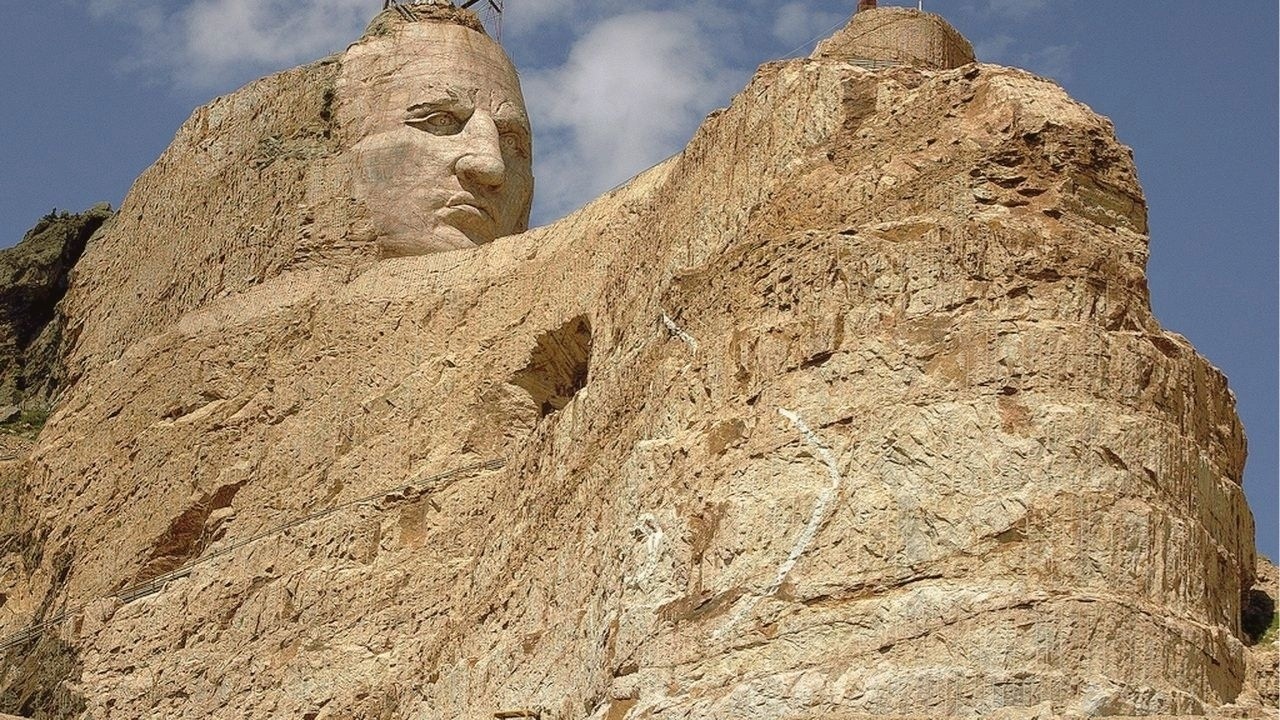
A man never defeated in battle was killed by a single soldier outside a wooden door in Nebraska on the night of September 5, 1877. His parents buried him in secret. The reason you have heard of him more than a century later is that the United States never decided what to do with his memory. There is a mountain in the Black Hills, a few miles from Mount Rushmore, that a sculptor named Korczak Ziolkowski began carving in 1948 at the request of a Lakota elder, Henry Standing Bear.
When it is finished, if it is ever finished, it will be the largest sculpture on earth. It will show Crazy Horse on horseback, arm extended, pointing east toward the land of his people. The face was completed in 1998; work continues on the arm. Crazy Horse himself, who refused to be photographed or painted, who refused to leave any image of himself at all, might not have approved.
But his nephew’s grandson, when asked about the mountain in an interview a few years ago, said something that still lingers: the likeness does not matter. It is the land that matters. Carve the land, for he is in it. In the high northern prairies, where the wind still moves through the cottonwoods, where the bones of one of the greatest soldiers of his time and generation lie in a place known only to the departed, the country he fought for his whole life still stands.
In the end, it is the country that holds him.






