In the summer of 1959, Billie Holiday lay dying in a New York hospital room, her body frail and her breath shallow. Police officers stood guard at the door—not to protect her, but to keep her under arrest. Even as life slipped away, she remained bound. Her bank account had been seized, and though she was known across continents, she lay destitute at forty-four years old.
Outside, her voice still poured from jukeboxes and radios, but inside that room, the world had reduced her to a prisoner. Her path to that narrow bed began in Baltimore in 1915, when she was born Eleanora Fagan to Sadie, a mother scarcely older than a child herself. Her father, Clarence Holiday, was a restless musician who drifted in and out of her life like a shadow. Poverty wrapped around her childhood.
Hunger was familiar, neglect common, and by the age of ten she had already known abuse that left scars invisible but deep. She was sent to a Catholic reform school, charged with being beyond parental control, and returned to streets that offered no gentler embrace. In her early teens, she worked where she could, often in the darker corners of that world, surviving however survival demanded. Music was her only solace.
She listened to Louis Armstrong and Bessie Smith on records and radios, and their voices seemed to lift above the grime of the city, offering something close to hope. When her mother moved to Harlem, Billie followed. There, in the smoky clubs of the early 1930s, she began to sing. Her voice was not large, but it carried a truth so naked that it silenced the chatter of glasses and pulled eyes toward her.
She bent notes, stretched words, and shaped phrases with instinct rather than technique. Musicians noticed. Word spread. She was no longer only Eleanora Fagan; she was becoming Billie Holiday.
Producer John Hammond heard her and arranged her first recordings. Soon she sang with Benny Goodman and Count Basie, and later with Artie Shaw’s band, a bold collaboration in an America still bound by segregation. Audiences in certain cities bristled at the sight of a black woman sharing a stage with white musicians. She was forced to use back doors, stay in inferior lodgings, and endure insults flung by those who had just applauded her.
Yet she continued, her voice carrying defiance as well as melody. It was during these years that she met tenor saxophonist Lester Young. He called her Lady Day, and she called him Prez. Their recordings together remain among the most cherished in jazz history, their instruments conversing as if they were the only two people in the room.
In 1939, Billie stepped onto the stage of Cafe Society in Greenwich Village and sang a song unlike any she had performed before. Introduced to her by Abel Meeropol, a teacher and activist, Strange Fruit was about lynching. The waiters stopped serving drinks. The room was plunged into darkness except for a single spotlight on her face.
She began quietly, and with each line the weight deepened. By the final line, the room was hushed, and when the last note dissolved, there was no applause, only silence, heavy and unbroken. She recorded the song, though many companies refused to touch it. When the recording was finally made, it traveled far beyond the club, becoming what some would later call the beginning of protest music.
It also made her enemies. Harry Anslinger, the powerful head of the Federal Bureau of Narcotics, saw her as a threat to social order. A black woman singing of lynching before mixed audiences could not go unanswered. Agents began to watch her, hound her, and wait for her to stumble.
Billie had already turned to heroin and alcohol as shields against her memories and the burdens of fame. The authorities exploited this weakness relentlessly. She was arrested in 1947 and sentenced to a year and a day in a West Virginia prison. When she emerged, New York denied her a cabaret card, the license required to perform in any club that served alcohol.
The very spaces that had nurtured her art were now forbidden. She could sing in concert halls, but the intimate rooms where her voice belonged were closed to her. Her private life brought little comfort. Men promised love but delivered betrayal, drained her earnings, introduced her deeper into addiction, and sometimes beat her.
She stayed, because the hunger for love, even in distorted form, was greater than the fear of pain. Her songs began to carry these bruises. Don’t Explain, written after a lover came home with traces of another woman, sighed rather than accused. God Bless the Child, born from an argument with her mother about money, became an anthem of weary self-reliance.
Good Morning Heartache greeted sorrow as an old companion. These songs were not mere performance; they were confession. In the mid-1950s, she turned to telling her own story. With journalist William Dufty, she produced her autobiography, Lady Sings the Blues.
The book was raw yet veiled, a performance in ink, shifting between truth and myth. It did not save her from her struggles, but it declared that she was more than rumor and arrest reports. Her late recordings carried a new kind of beauty. Her voice, roughened and cracked by years of strain, no longer reached for notes with youthful ease.
Instead, she bent them, held them, let them fall heavy with meaning. In 1958, she recorded Lady in Satin, an album wrapped in lush strings, but within that grandeur her voice stood naked and trembling. Listeners heard not decline, but humanity. She sang as though every note might be her last.
By the spring of 1959, her body could carry no more. Cirrhosis, heart disease, and fluid in her lungs brought her to Metropolitan Hospital in New York. Federal agents arrived at her bedside and placed her under arrest, claiming they had found heroin. They seized whatever money she had left and stationed guards at her door.
Only when her condition grew hopeless were the handcuffs removed. She died on July 17, 1959, at forty-four, not as a free woman, but as one still bound. Her funeral drew thousands. Musicians carried her coffin, and songs filled the service.
Lester Young had died only months before, and many whispered that the two were bound together in death as in music. The newspapers printed stories that mixed scandal and sorrow, but in homes across the country, listeners placed her records on turntables and wept in solitude. Her influence did not fade. Ella Fitzgerald honored her in interviews, Nina Simone carried forward her spirit of defiance, and later singers like Janis Joplin and Amy Winehouse bore the mark of her husky, vulnerable phrasing.
She had taught the world that imperfection could be beauty, that fragility could carry the greatest truth. Her life became myth, told and retold in biographies, plays, and films, often stripped of complexity. But the myth never fully captured her. The recordings still reveal the woman herself, imperfect, wounded, luminous, human.
Her story begins and ends in silence—the silence after Strange Fruit, the silence of a hospital room in 1959, the silence that follows when a record ends. Yet even that silence is not empty. It hums with the echo of her voice, reminding us that truth carried in song does not die when the body falters. It endures.
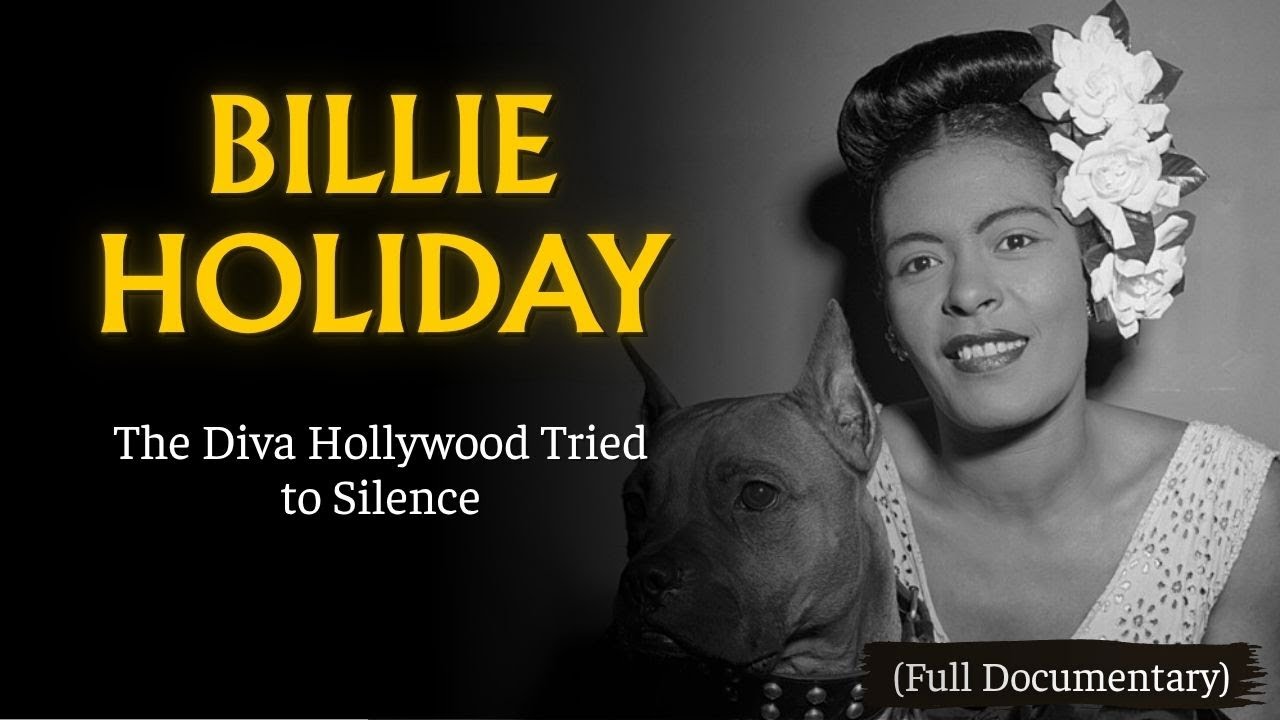
It transforms. It continues to speak. The stage is dark, the spotlight rises, and Billie Holiday steps forward, flowers in her hair, microphone before her. The first note falls, aching, trembling, beautiful.
It carries across time and silence, the sound of a life lived in both pain and beauty, the sound of resilience that could not be silenced, singing forever in the memory of the world.






