On a frozen morning in January of 1781, Banastre Tarleton looked across an open pasture six miles south of the flooded Broad River and saw exactly the ground his cavalry had been built for. No bogs, no swamps, no wetlands—just dry winter grass on a gentle ridge, a road running straight along its spine. He had chased Daniel Morgan for days through the rain-soaked Carolinas, and now the old fox had stopped to fight. Tarleton ordered his men forward at a trot.
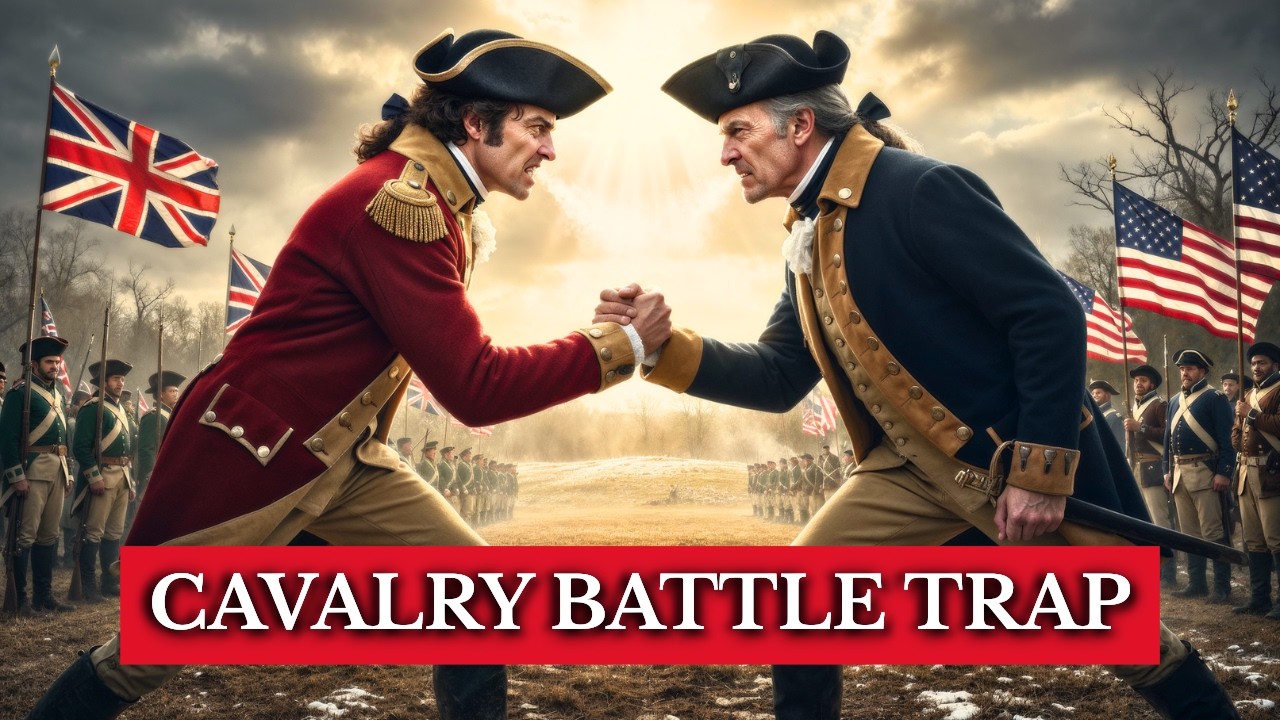
He would discover too late that the swamps had come for him a second time, and that this time they had hidden themselves under the grass. Three months earlier, in November of 1780, Tarleton had pushed his horses past the point of collapse through the trackless bogs of Clarendon County, South Carolina. For seven hours he had chased a man through marsh and gorge, through wetlands no cavalry was meant to enter. His dragoons were the most feared mounted force in North America.
They had ridden down armies. They had butchered men under flags of surrender. They had earned a name that made entire towns surrender at the sound of approaching hooves. And on that day, in those bogs, they failed.
The man they were chasing slipped into Ox Swamp and disappeared. Tarleton reined up, watched his exhausted mount steam in the cold air, and called the man a damned old fox. The name stuck. Francis Marion would be remembered as the Swamp Fox for the rest of American history.
Tarleton rode back to his camp and burned the farms of every patriot family within reach, because that is what a humiliated officer does when geography defeats him. To understand why Cowpens happened, you have to understand the war it grew out of. Not the war of muskets and bayonets that history books usually describe. The other war—the civil war fought in the back country of the Carolinas.
Neighbor against neighbor. Where the Continental Army was often a distant rumor and the real battles happened in barnyards, on country roads, in the dark. By the autumn of 1780, the southern theater of the American Revolution had collapsed into chaos. The Continental Army had suffered two of the worst defeats in its history.
At Charleston in May, an entire American garrison surrendered—the largest single American capitulation of the war. At Camden in August, the Southern Army under Horatio Gates was shattered in less than an hour. Militiamen fled the field at the first British bayonet charge. The British commander in the South, Lieutenant General Charles Cornwallis, looked at the wreckage of Patriot resistance and saw an opportunity to subdue the entire region.
His strategy was straightforward: establish a chain of fortified outposts across the Carolina backcountry, use them as bases for mobile columns that could ride out, crush local resistance, and ride back. Pacify the population through military pressure and political accommodation, recruiting Loyalist militia for the daily work of suppression. Then, once the South was secure, turn north and finish the war. It did not work the way he expected.
The backcountry was not the low country. The wealthy plantations of the coast, where Patriot elites supported the revolution, gave way as you moved inland to a different world. The backcountry was settled by Scots-Irish farmers, German immigrants, people who had come to America with their own grievances against the British Crown, or with no particular politics at all. Many had remained loyal to King George.
Many had not. Most simply wanted to be left alone. The British made that impossible. Officers in the backcountry, frustrated by the slow pace of pacification and the constant pinpricks of Patriot raiders, turned to intimidation.
They burned farms. They threatened families. They allowed their loyalist auxiliaries to settle old scores under the cover of military operations. Every burned barn produced a new patriot recruit.
Every threatened family produced a new informant for the rebel cause. In December of 1780 came a new American commander. Nathanael Greene, sent south by George Washington to take over what was left of the Southern Army, arrived at Charlotte, North Carolina on December 2nd. He found a force of roughly 2,300 men on paper, of whom only about 1,500 were present and fit for duty, and barely 800 properly equipped to fight.
Many huddled near campfires practically naked. He had no money, limited ammunition, militias whose enlistments would expire in weeks, and he was facing a British army that outnumbered him, outgunned him, and held every strategic position of value in the Southern colonies. Greene did something that by every conventional standard of military doctrine looked insane. He divided his army.
He sent Brigadier General Daniel Morgan west of the Catawba River with about 600 men, with orders to forage for supplies, protect patriot civilians from loyalist raids, and threaten the British strongholds in the western back country, particularly the fortified post at Ninety-Six. Greene kept the remaining force to the east where he could threaten Cornwallis’s main army. The conventional wisdom said you never divided an inferior force in the face of a superior enemy. Cornwallis would simply pick one wing and destroy it before the other could come to its aid.
Greene knew the conventional wisdom. He had read the same military manuals as every other officer of his generation. He divided his army anyway. His reasoning was subtle: by splitting his force, he forced Cornwallis to make a choice.
If Cornwallis concentrated against one wing, the other would be free to ravage British outposts and rouse the countryside. If he tried to attack both wings simultaneously, he would have to divide his own force, surrendering the numerical superiority that was his greatest advantage. Either way, Greene gained time. Cornwallis took the bait.
He kept his main force at Winnsboro, South Carolina, to watch Greene, and detached the most aggressive officer in his command to ride west and destroy Daniel Morgan. That officer was Banastre Tarleton. Tarleton was 26 years old in January of 1781. Born into a prosperous Liverpool merchant family—his father had been mayor of the city, his fortune built on the sugar and slave trades—he had attended Oxford and studied law at the Middle Temple.
When his father died in 1773, Tarleton inherited £5,000 and gambled most of it away in a single year. To save him from ruin, his mother helped him purchase a cornet’s commission in the 1st Dragoon Guards in April of 1775. He arrived in America later that year as a young cavalry officer. By 1780 he commanded one of the most feared military formations in North America.
His command was the British Legion—not a standard British regiment but a provincial unit raised in New York, New Jersey, and Pennsylvania, composed of American loyalists who had thrown in their lot with the crown. Light infantry, dragoons, and a small artillery component, all organized for speed. The Legion wore green coats rather than standard British red, a distinction that on the battlefields of the South became its own kind of warning. When a green-coated horseman appeared on the horizon, men knew what was coming.
Tarleton’s doctrine was simple: speed and shock. Find the enemy, charge before they could form, ride them down, pursue without mercy until the enemy ceased to exist as a fighting force. He had used it successfully at Monck’s Corner in April of 1780, at Lenud’s Ferry in May, at Camden in August. Each victory built his reputation.
Each victory made his next enemy more likely to break before contact simply because Tarleton was the one riding toward them. But the reputation had its real origin in a single afternoon in May of 1780. On a road outside a place called the Waxhaws, Colonel Abraham Buford, commanding a force of Virginia Continentals, was retreating north after the fall of Charleston. Tarleton, with a smaller but faster column, ran him down on the afternoon of May 29th.
What happened next became the subject of dispute for two centuries. The American account, supported by survivor testimony, claimed that Buford raised a white flag of surrender and that Tarleton’s dragoons ignored it, riding through the surrendering Virginians and cutting them down. The British account, including Tarleton’s own, claimed that during the parley a shot was fired that killed Tarleton’s horse, and that his men, believing their commander dead, fell into a fit of revenge he could not control. The numbers were not in dispute: 113 patriots killed, 150 severely wounded, many left on the field to die, a handful of prisoners taken.
It was less a battle than a massacre, and the name Waxhaws carried weight in the Southern campaigns from that day forward. It gave rise to a phrase: Tarleton’s Quarter. It meant no quarter. It meant a surrender that would not be honored.
It became the single most effective recruiting tool the Patriot cause possessed in the Southern colonies. Every man who heard the phrase knew what waited for him if he laid down his arms. Better to fight. Better to die fighting than to die surrendering.
The man chosen to face Tarleton could not have been more different. Daniel Morgan was 44 years old. Born in New Jersey to Welsh immigrant parents in July of 1736, he had left home as a teenager after a fight with his father and made his way south to the Virginia frontier, where he worked as a wagoner hauling supplies across the Appalachians. His men called him the old wagoner for the rest of his life.
He had grown into a man of enormous physical strength—six feet tall in an era when most men were several inches shorter—with a reputation for brawling that followed him from camp to camp. In 1755, during the French and Indian War, Morgan was working as a civilian teamster for General Edward Braddock’s army when an argument with a British officer turned violent. The officer struck Morgan first, hitting him with the flat of his sword. Morgan responded by knocking the man to the ground with a single punch.
For striking an officer of the king, regardless of provocation, he was sentenced to 500 lashes. In the typical case, that was a death sentence. The shock alone killed many men before the count was complete; those who survived often died of infection in the weeks that followed. Morgan was tied to a post and the drummer began to count.
Morgan counted along with him—out loud, every blow, watching the drummer with eyes the British soldiers present remembered for the rest of their lives. He survived. His back was permanently scarred. He claimed for the rest of his life that the British had miscounted, that they had only delivered 499 lashes, that the king of England therefore owed him one.
He told this story often, with a grin, to remind his men and himself that there was nothing the British could do to him that they had not already tried. He fought through the French and Indian War, through the early campaigns of the Revolution. He led riflemen at the disastrous American invasion of Quebec in 1775, where he was captured and held prisoner for nearly a year. He led riflemen at Saratoga in 1777, where his marksmen helped decide the most important American victory of the war’s first half.
By the time he came south in 1780 he was a brigadier general, and a man in serious physical decline. He suffered from sciatica that made riding agony, arthritis that swelled his joints, a scarred back that ached in cold weather. He was overweight, tired, beginning to wonder whether he had one more campaign left in him. But Morgan had something Tarleton did not: an intimate understanding of the men under his command because he was one of them.
He had hauled wagons. He had been flogged. He had spent his nights around campfires with frontier riflemen and Virginia militiamen and Maryland Continentals. And he knew, in a way an Oxford-educated cavalry officer could never know, what made these men fight and what made them run.
Tarleton moved fast. That was his doctrine, his identity. When Cornwallis gave him orders to find and destroy Morgan, he drove his men forward at a punishing pace through rain, mud, and cold that would have stopped a less driven commander. He built makeshift boats to cross the Enoree.
He found fords to cross the Tiger. He pushed through the Pacolet country with his legion strung out behind him, scouts pressing forward to find the trail of the American force he was hunting. Morgan, moving north away from Tarleton, was slower. His men were tired, his supplies running thin.
He had militia attached to his command, and militia, as every Continental officer knew, was unpredictable—brave one day and gone the next, their enlistments expiring at inconvenient moments, demanding to go home when their crops needed planting. To command militia was to command an army that might, at any moment, simply cease to exist. On January 16th, 1781, Morgan reached a place six miles south of the Broad called Hannah’s Cowpens. The place was named for a man named Hannah, who had once grazed cattle there.
It was a pasture, a clearing in the woods, a wintering ground for herds, with a road running through it called the Green River Road. It was not a fortress. It was not a defensive position in any conventional sense. There were no walls, no heights commanding the approaches.
By every standard of 18th-century military doctrine, it was exactly the kind of ground a defender should avoid. Morgan looked at it and decided to fight there. His reasoning, when he explained it later to a skeptical Nathanael Greene, was characteristic. The Broad River, six miles to his rear, was flooded.
If he tried to cross it under pressure from Tarleton’s cavalry, his rear guard would be caught on the banks and destroyed. If he kept retreating, his militia would melt away—and they would do so faster the further north he went, because the South Carolina and Georgia militiamen in his command were legally obligated only to defend their home states. Cross into North Carolina and they would desert in droves. Morgan needed to fight where his militia could not run.
The flooded Broad behind him would serve that purpose. There would be no retreat. The choice would be victory or annihilation. But he needed more than a position with no retreat.
He needed ground. And what he saw at Hannah’s Cowpens, when he walked the field on the afternoon of January 16th, was ground that almost no one else would have recognized for what it was. The geology of the battlefield does not appear in most accounts of the battle. It should.
It decided everything. The Carolina Piedmont is built on the inner Piedmont terrain—a stack of metamorphic rock thrust sheets pushed northwestward over each other hundreds of millions of years ago during the building of the Appalachian Mountains. Cowpens lies within the Six Mile Thrust Sheet, a layer composed of biotite gneiss, amphibolite gneiss, mica schist, and metagranite. The ridge at Cowpens is capped by weathered quartz muscovite schist.
It is permeable. Water drains quickly downward, leaving the surface dry and firm. The ridge is the eroded hinge of tightly folded geological structures that include the nearby landmark of Thicketty Mountain. On either side of the ridge, the geology changes.
The flanks are underlain by strongly foliated biotite gneiss—impermeable. Water does not drain. It collects. It pools.
It saturates the soil until that soil becomes what a soldier would call a bog. These flanking depressions are called swales. In summer, in dry weather, they are merely soft ground. In winter, after months of seasonal rains, a phenomenon called wet weather springs transforms them.
Water that has been collecting for months in the impermeable gneiss begins to emerge at the surface, seeping up through the soil, turning the swales into shallow marshes. Horses sink. Artillery wheels lock in the mud. Infantry formations lose their alignment as men stumble through the soft ground at different rates.
This was the ground Morgan saw on January 16th, 1781. A dry ridge running between two wet swales. A road running directly along the spine of the ridge, the only route across the field that did not pass through the saturated flanking ground. A natural bottleneck.
An attacker coming up the Green River Road would find himself unable to deploy laterally without entering the swales. It was a battlefield that would make Tarleton’s numerical advantages disappear. He chose his lines. He placed his men.
And he waited. The deployment Morgan designed is one of the most studied tactical arrangements in American military history—taught at West Point, analyzed in war colleges around the world. It has been called the only true double envelopment in the history of the American Revolution. What makes it remarkable is not just the geometry, but the psychology embedded inside that geometry.
Morgan put his men in three successive lines, all straddling the Green River Road, all on the dry ridge, all within sight of each other. The first line, furthest forward, was composed of about 150 skirmishers—elite riflemen from Georgia and the North Carolina back country, men who had been hunting with long rifles since they could lift one, men who could pick a squirrel out of an oak tree at a hundred yards. Their orders were specific. They were not to stand against the British charge.
They were to take cover behind trees, fire deliberate aimed shots, and target the officers. “Aim for the epaulets,” Morgan told them. “Bring down the men in the gold braid, then fall back in their own time to the second line. ”
The second line, 150 yards behind the skirmishers, was composed of about 300 militiamen under Colonel Andrew Pickens.
Pickens was a Presbyterian elder, a stern and quiet man who had been on parole to the British until a loyalist raid on his home convinced him to break his parole and rejoin the war. His militia were the men Morgan was most worried about—the men who had broken at Camden, who by Continental standards could not be relied on to stand against a determined bayonet charge. Morgan asked them for two volleys, just two. He told them to wait until the British were within 40 yards, to aim carefully, to fire deliberately, and then, after two volleys, to retreat—not to run, but to retreat in good order around the left flank of the third line, where they would reform behind the ridge.
The third line, another 150 yards back on the crest of the ridge itself, was composed of about 450 Continental regulars—Marylanders, Delawareans, a few Virginians. Professional soldiers hardened by years of campaigning, commanded by Lieutenant Colonel John Eager Howard. They were the anchor. They would not retreat.
They would stand. And behind them, hidden in a shallow depression behind the ridge, completely invisible to anyone advancing from the south, Morgan placed his cavalry. Lieutenant Colonel William Washington commanded about 80 dragoons of the Third Continental Light Dragoons, reinforced by about 45 mounted militia under Lieutenant Colonel James McCall. They were Morgan’s reserve—the hammer that would fall when the moment was right.
They would not be visible until that moment came. The deeper logic was psychological. Morgan was building a trap that worked by giving Tarleton exactly what Tarleton wanted to see. Tarleton’s doctrine was based on the assumption that militia would break.
He expected, when he looked across the field at Cowpens, to see militia fire a ragged volley and flee. He expected to charge after them and ride them down. Morgan was going to give him exactly that. He was going to show him fleeing militia.
He was going to invite the British charge, and then spring the trap. It was a defense built around the enemy’s assumptions about the defender. The night of January 16th was cold and clear. The moon was nearly full.
The temperature dropped toward freezing. Men huddled around campfires, eating what rations they had been issued, cleaning muskets, sharpening bayonets, talking in low voices about what the morning would bring. Daniel Morgan moved among them. He could not walk easily.
His joints, swollen from the cold and the accumulated punishment of three decades of campaigning, made every step a small act of will. But he moved anyway, from fire to fire. He talked to the riflemen first—told them to aim carefully, to choose their targets, to bring down the men with the gold braid, to fall back when they had done enough damage. He told them he had seen what they could do at Saratoga, and that he trusted them to do it again.
He talked to the militia next. These were the men he was most worried about. They knew it. Some had been at Camden.
They knew what they had done there. They had broken, had run before the British bayonet charge reached them, and their flight had cost an American army its life. They were ashamed. They wanted more than anything to be told they could redeem themselves.
Morgan gave them that. He explained the plan, their part of it. Two volleys. Just two.
Wait until the British are within 40 yards. Aim. Fire. Reload if you can.
Fire again. Then turn and retreat. Not run. Retreat.
Around the left flank of the third line, where the Continentals would protect them, where they would reform, and where, when the time came, they would return to the fight from a position of advantage. Any man who could load and aim a musket could fire two volleys. That was all. He, Daniel Morgan, would do the rest.
He told them about his back. He told them about the 500 lashes. He told them, with the grin his men knew so well, that the King of England owed him one lash and that he intended to collect it tomorrow with interest. The men laughed.
They had heard the story before. But hearing it the night before a battle from a man who could barely walk and who was about to ask them to stand in front of the most feared cavalry commander in America hit differently. It reminded them that the man asking them to stand had stood through things they could not imagine, and that he was still standing. He talked to the Continentals last.
He did not need to motivate them the way he motivated the militia. He told them simply what he expected. They were the anchor. They would receive the British attack.
They would hold. There would be no retreat for the Continentals. There would only be the line they had been given and the bayonets they carried and the discipline that had brought them through five years of war. Howard walked his own line that evening, checking positions, talking to his company commanders.
He was a Maryland gentleman, only 28 years old himself, but he had been in the army since 1776 and had fought at most of the major battles of the war. He carried the kind of quiet authority that did not need to shout because everyone around him already knew what he expected. The army did not have enough food. Morgan ordered the slaughter of several head of cattle from the local herds, and the men ate fresh beef cooked over open fires.
When Morgan finally lay down in his own tent, he did not sleep. He thought through the plan again, walked it in his mind from the first British contact with the skirmishers through to the final cavalry charge, looked for the places where it could go wrong. By dawn he had not slept. But he had done the work of a commander: thought through in advance the things that might happen in battle, so that when they happened, the response was already prepared.
Tarleton had marched his men through the dark, betting that speed would compensate for fatigue. Morgan had let his men sleep and eat and prepare, and used the time himself to think. Tarleton arrived at the field at first light on January 17th, 1781. He had been marching his men through the dark since two in the morning.
His infantry was exhausted. His cavalry mounts were tired. The men had not eaten a hot meal in days. But Tarleton saw, when the dawn light grew strong enough to read the ground, exactly what he expected to see.
An army deployed in the open. Militia in the front lines, easily recognizable by their lack of uniforms, their hunting shirts, their disordered formation. Behind them, what looked like a smaller force of Continental regulars. No fortifications.
No commanding heights. A piece of ground that looked like a gift. He did not see the swales. The dry winter morning had reduced their visible saturation.
To recognize the wet ground required either a geologist’s eye or the kind of close inspection that Tarleton, in his eagerness to attack, did not perform. He deployed quickly. Infantry across the meadow—the 7th Royal Fusiliers on the left, British Legion infantry in the center, light infantry companies extending the line to the right of the Green River Road. The first battalion of the 71st Highlanders, Fraser’s Highlanders, held in reserve.
His two 3-pounder grasshopper cannons in the center, light field guns designed for mobility. Fifty dragoons on each flank. The rest of the British Legion cavalry behind the infantry, ready to exploit the breakthrough Tarleton was certain would come within minutes. He did not bother with formal artillery preparation or careful reconnaissance.
He had marched all night to catch Morgan. He had caught him. He intended to finish the matter before breakfast. He gave the order to advance.
The British line moved forward at a trot. Drums beating, fifes playing, the light infantry on the flanks, line infantry in the center, Highlanders in reserve, cavalry waiting for their moment. By every standard of British military doctrine, it was a textbook advance—professional, confident, the kind of advance that had broken American armies at Long Island, at Brandywine, at Camden. The American skirmishers waited until the British were within 150 yards.
Then they began to fire. Not a volley—deliberate, individual riflemen, each picking his target, each squeezing his trigger when his sight settled on the chest of a British officer. At 150 yards, a marksman with a long rifle could hit a man-sized target with reasonable consistency. At 100 yards, he could hit a head.
They aimed for the epaulets, for the men with swords, for the men on horseback, for the men whose absence would cause the most damage to British command and control. In the opening minutes, the skirmishers killed or wounded an estimated 15 British dragoons and a substantial portion of the British officer corps in the advancing line. Sergeants found themselves suddenly in command of platoons. The British advance continued because it was disciplined, but the command structure had been damaged within the first quarter mile of contact.
The skirmishers, their work done, fell back as ordered, finding new positions behind trees, firing as they went, melting back through the gaps in Pickens’ militia line. The British came on. At 40 yards, Pickens’ militia opened fire. A musket volley at that range, delivered by men ordered to aim and trained to aim, was devastating.
The smoothbore musket was not accurate at longer ranges; it was a weapon designed for the moment when armies came within killing distance and the side that fired first and fired straight would win. At 40 yards, even militia could be deadly. They waited. They aimed.
The first volley went into the British line and dropped men by the dozens. The second volley, fired moments later, dropped more. Together they killed or wounded somewhere around two-thirds of the remaining British officers in the leading regiments, on top of the damage the skirmishers had already done. The British advance staggered.
Whole companies found themselves leaderless. And then, exactly as Morgan had planned, the militia turned and ran. Not in a rout—in good order, in the direction they had been told to run, around the left flank of the third line, heading for the rear where they would reform under the protection of the Continentals. To anyone watching, it looked like a militia route.
To anyone who had been at Camden, it looked like the moment when the American army began to come apart. Tarleton saw it. He saw exactly what he expected to see, and he ordered his army to charge. The British line broke into a run.
Their formations dissolved into a forward rush, men sprinting up the slope of the ridge, certain that victory was a hundred yards away, certain that the Continentals on the crest would break the moment the British bayonets reached them. They yelled. They cheered. They ran straight up the ridge, into the third American line.
Howard’s Continentals waited. They were not the men who had broken at Camden. They were the survivors of Long Island, of Brandywine, of Germantown, of Monmouth. They held their fire until the British, breathless and disorganized, reached close range.
And then they delivered a volley that should have shattered the British attack. It did not. There were too many British. They absorbed the volley and kept coming.
At that point Tarleton committed the Highlanders. Major Archibald MacArthur led them forward, ordered to swing wide around the American right and complete the envelopment. They were a hardened Scottish regiment, many speaking only Gaelic and depending on their officers for direction, wearing long trousers as a concession to the insect-infested south. But to execute their flanking order, they had to leave the dry ridge and descend into the swale on the American right.
The wet weather springs were active. The ground that looked like firm grass at a distance was, beneath the surface, saturated mud. The Highlanders, weighted down by 50-pound knapsacks, heavy red wool coats, muskets and bayonets, struggled through the bog. Their boots sank with every step.
Their formation lost its alignment. The maneuver that was supposed to be a swift flanking movement timed to coincide with the main assault slowed to a crawl. By the time they emerged from the swale, they were late, exhausted, out of alignment. The moment Tarleton had planned—the moment when the entire British force would strike the Continentals from front and flank simultaneously—had passed.
Howard saw the Highlanders coming. He ordered his rightmost company to face about and wheel to meet the threat. The order was misheard. The men closest to Howard understood it correctly.
The men further down the line heard only the first part of the command and assumed they were being ordered to retreat. The entire Continental line began to fall back. Morgan was at the rear when the third line began to retreat. For a moment he thought everything had collapsed.
He thought his Continentals, the anchor of his entire defense, had broken. He thought the battle was lost. Then he looked more carefully. The Continentals were not running.
They were retreating in perfect order, maintaining formation, walking back down the reverse slope of the ridge as if on a parade ground. There was no panic. There was simply a misunderstood order being executed with the discipline of veteran troops. Morgan made an instant decision.
Instead of trying to halt the retreat, he chose a new defensive position and rode forward to give new orders. The Continentals would halt there. They would face about. They would deliver a volley at close range.
And then they would charge. Meanwhile the British, watching the Continental line withdraw, made the assumption Morgan was praying they would make. They assumed the retreat was a rout. They assumed the battle was over.
They broke their own formations and ran forward in a disorganized mob, weapons in the air, voices raised in triumphant shout. They were no longer a coordinated military formation. They were a crowd—a crowd of men chasing what they believed was a beaten enemy up a slope toward what they believed was certain victory. Morgan rode along his line.
He waited until the Continentals had reached the position he had chosen. He waited until the British were close enough that the next thing he did would be a slaughter. And then he gave the order that has become one of the most quoted commands ever issued in American battle: “Face about, boys. Give them one good volley, and the victory is ours.
”
The Continentals’ 450 muskets came up in a single coordinated movement. The British, within 20 yards now, suddenly found themselves looking down the barrels of an enemy they had been chasing, and that was no longer running. There was a single moment of recognition, a moment of horror, and then the Continentals fired. The volley at that range was annihilating.
The leading British ranks went down in a single thunderclap of musketry. Men who had been running fell where they stood. The shouts of triumph turned in the same second into shouts of pain and terror. And before the British survivors could process what had happened, Howard ordered the bayonet charge.
The Continentals lunged forward. The hand-to-hand fighting was brutal and brief. The British, who moments earlier had been certain of victory, found themselves fighting for their lives. Some tried to stand.
Most broke. And at that exact moment, the cavalry hidden in the depression behind the ridge came out. William Washington, on his horse, leading the Third Continental Light Dragoons and the mounted militia under James McCall, came up over the ridge at a gallop. They crashed into the British right flank just as the Continentals were driving forward in the center.
From the other direction, Pickens’s militia, reformed in the rear after their planned withdrawal, came around the hill to strike the British left. The British found themselves attacked from three sides simultaneously. Front, right flank, left flank. The only direction they could retreat was back down the slope—and that direction was now blocked by their own broken units.
It was a double envelopment. Of all the things that almost never happen in 18th-century warfare, a double envelopment was perhaps the rarest. It required perfect coordination of multiple separate forces, perfect timing, an enemy who cooperated by attacking exactly where you wanted him to attack. It came together at Cowpens.
The British line collapsed all at once. Hundreds of soldiers, surrounded and seeing no escape, threw down their muskets and raised their hands. Whole companies surrendered en masse. The 7th Royal Fusiliers, one of the most distinguished regiments in the British army, gave up its colors.
The Highlanders, still trying to extract themselves from the swale, found themselves cut off with no path of retreat. Tarleton, watching from the rear with a cavalry he had not yet committed, tried to organize a counterattack. He ordered his Legion Dragoons forward. They refused.
They had seen the disaster. They had seen the front of their army disappear into a cloud of musket smoke and emerge as prisoners. They were not going to ride into the same trap. Tarleton screamed at them.
They sat their horses and did not move. He led the few who would follow him forward in a desperate rearguard action trying to cover the withdrawal and save the two grasshopper cannons. The cannons were lost. The crews were killed or captured.
The guns themselves were dragged off as trophies. And then, in the middle of the collapse on the Green River Road, two men found themselves alone together. William Washington was a second cousin of George Washington, a cavalry officer who had been chasing the retreating British and loyalist horsemen down the road far in advance of his own troopers—doing what he always did, leading from the front. He had outrun his own command.
He was alone on a road full of fleeing enemies, about to discover what that meant. Tarleton, riding the other direction with two of his officers, saw him. He recognized him. He had been chasing the American cavalry for months, and now the commander of that cavalry was alone in front of him.
Tarleton and his two officers wheeled and charged. The fullest contemporary account of what happened next came from John Eager Howard, who witnessed the engagement and recounted it years later to historian William Johnson in 1822. According to Howard, the three British officers advanced abreast. One of them—identified in some accounts as Cornet Thomas Patterson of the 17th Light Dragoons—struck the first blow at Washington.
Washington rose in his stirrups to parry with his own sword. The British blade came down with the full weight of a charging horseman behind it. Washington’s sword broke at the hilt. The blade snapped off and fell into the dirt of the road.
He was, in that instant, a man holding a useless metal handle in the middle of a road full of enemies, with the British officer lifting his saber for a second strike that would have ended his life. A young American came up behind him. Contemporary accounts describe him variously as Washington’s bugler, his trumpeter, his orderly, or his waiter. Most accounts place him as young—one source says 14 years old.
Later historical research, drawing on pension records and regimental rolls, has tentatively identified him as a black soldier named William Collin or Collins, though this identification is not certain. None of the contemporary descriptions explicitly note him as black. The identification rests on later accounts and on the famous 1845 William Ranney painting that depicted him as African-American, a depiction that may reflect Ranney’s assumption that waiters in this period were typically black men. What is not in dispute is what he did.
He leveled his pistol. He fired. The ball hit the British officer just as the saber was beginning its downward stroke. The officer’s arm fell limp.
The saber dropped. Washington was alive. A second British officer attempted a saber thrust at Washington in the same instant. This time it was Sergeant Major Perry of Washington’s own command, arriving at speed, who parried the blow and disabled the second attacker.
Tarleton himself arrived an instant later. He took his own swing at Washington. Washington parried with the broken hilt of his sword, the only weapon he had, and somehow turned the blow aside. Other American dragoons were arriving now.
Tarleton, seeing that he was about to be surrounded, reined up, turned his horse, and fled. As he rode away he turned in the saddle and fired his pistol back over his shoulder at Washington. The ball missed Washington but creased his knee and struck his horse. The animal staggered but did not fall.
Tarleton disappeared into the woods at the edge of the road, riding for his life, accompanied by the 54 dragoons of his legion who had managed to follow him out of the wreckage. It was the last act of the battle. By the time the smoke cleared, the British Legion as a fighting unit no longer existed. The 7th Royal Fusiliers had surrendered.
Fraser’s Highlanders had surrendered. The 17th Light Dragoons was destroyed. The two grasshopper cannons were in American hands. And Tarleton was riding north through the woods with 54 men, all that remained of a force that had set out a week earlier numbering more than a thousand.
The numbers, when finally counted, told a story almost impossible to believe. The British had brought approximately 1,100 men to the field; some sources put the figure as high as 1,200. Of those, approximately 110 were killed, including roughly 40 officers. 229 were wounded.
Between 529 and over 700 were captured, depending on the source, including 27 officers. The total casualty rate ran above 75% and may have approached 80. The British Legion ceased to exist. The 71st Highlanders ceased to exist.
The 7th Royal Fusiliers, a regiment that had been part of the British Army since the late 17th century, was effectively destroyed and lost its colors. The Americans lost 24 to 25 men killed and between 104 and 124 wounded. The official figures may understate the true total; modern analysis of pension and burial records suggests actual American losses may have been closer to 128. Either way, the casualty ratio was lopsided beyond anything conventional doctrine would have predicted.
A force outnumbered on paper, composed largely of militia who had broken in previous battles, commanded by a general so crippled by joint pain he could barely walk, had destroyed the elite of the British Southern Army in less than an hour. Tarleton rode hard for Cornwallis’s camp, arriving on January 18th or 19th. According to an account preserved by an American prisoner of war present in the camp, Cornwallis was standing with his sword in his hand when Tarleton delivered the report. He pressed his sword against the ground, leaned on it, and kept leaning until the steel snapped.
The account is hearsay, repeated by a single witness years later, and historians treat the specific image with caution. What is not in dispute is the broader fact: Cornwallis had just learned that the strategic foundation of his Southern campaign no longer existed. Major Archibald MacArthur, the captured commander of the 71st Highlanders, was less restrained. He told his American captors that the best troops in the British service had been sacrificed under the command of a boy.
The phrase was deliberate—an indictment of Tarleton specifically and of the broader culture of the British officer corps that had allowed a 26-year-old of purchased commission to command and lose the elite of the Southern Army. The strategic implications reached far beyond the loss of a thousand men. Tarleton’s Legion was the eyes and ears of Cornwallis’s army—the mobile force that could chase down Patriot partisans, escort supply convoys, screen the main army’s movements. Without it, Cornwallis was effectively blind.
The fast-moving war the Southern Campaign required had just had its primary instrument destroyed. Cornwallis made a decision. He would chase Morgan, catch him, recapture the prisoners, avenge the Legion. He needed to do this not just for military reasons but political ones—the news of Cowpens would shake every loyalist in the South and embolden every Patriot partisan.
But to chase Morgan he needed speed. And to gain speed he made the decision that would, in retrospect, mark the beginning of the end of the British war effort in the South. He burned his own supply train. His traveling forges, his extra wagons, his tents—the accumulated material support of a campaigning army—were set on fire on the morning of January 25th, 1781.
His army began to move north at the pace of light infantry, carrying only what each man could carry on his back. The race that followed has its own name in American military history: the race to the Dan. Greene and Morgan, having reunited their forces, retreated north toward Virginia, where they could cross the Dan River to safety. Cornwallis, with his stripped-down light army, chased them.
The pursuit lasted weeks, covered hundreds of miles, crossed the Catawba, the Yadkin, and finally the Dan. Twice Cornwallis nearly caught the Americans. Twice the weather intervened. Both times the Americans crossed a river just before a sudden winter storm raised the waters and rendered the fords impassable.
Cornwallis would arrive at the Catawba, find Greene gone, the river too high to cross. He would push his men through the rising waters at extreme risk and get across, only to find Greene already approaching the next river. At the Yadkin, the same thing. At the Dan, he found that Greene had crossed in boats positioned in advance and taken with them to the far bank, leaving Cornwallis on the southern side of an unfordable river with no way across.
The British general, exhausted, his army stripped of supplies, far from his coastal bases, turned his army around and marched back south. The race to the Dan was over. Greene had escaped. And Cornwallis had marched his army to a place from which it could not easily return to its bases in the Carolinas.
What followed was the Battle of Guilford Courthouse on March 15th, 1781. Greene, now reinforced, turned and faced Cornwallis. He used a defense in depth modeled on Morgan’s tactics at Cowpens—three successive lines, militia in front, Continentals in the rear. The battle was hard fought.
Cornwallis technically won. He held the field at the end of the day. But the cost was the destruction of a quarter of his army—roughly 500 British casualties out of an army that had begun the day at less than 2,000 effective troops. The British politician Charles James Fox, speaking to the House of Commons when the report reached London, made the comment that has come down to history: “Another such victory would ruin the British army.
”
Cornwallis, after Guilford Courthouse, did not have the strength to maintain a campaign in the Carolinas. He marched to Wilmington on the North Carolina coast where the Royal Navy could resupply him. From Wilmington, instead of returning to South Carolina, he made a fateful decision. He marched north into Virginia.
His reasoning, as he explained in correspondence with Henry Clinton, the British commander-in-chief in New York, was that Virginia was the source of the rebellion in the South, and if Virginia could be neutralized, the Carolinas would fall on their own. He moved his army to a small tobacco port on the York River called Yorktown. He established a base there. He waited for the Royal Navy to bring him supplies and reinforcements.
The Royal Navy did not come. The French fleet arrived in Chesapeake Bay and defeated the British fleet at the Battle of the Capes on September 5th, 1781. Cornwallis was cut off from the sea. Washington and the Comte de Rochambeau, moving from New York, arrived at Yorktown with a combined Franco-American army.
The siege lasted three weeks. On October 19th, 1781, Cornwallis surrendered. The chain of causation runs from a frozen pasture in South Carolina to a surrender ceremony on a Virginia field nine months later, and it runs through Cowpens. Take away Cowpens and the British Legion still exists.
Take away the Legion’s destruction and Cornwallis can pursue Greene more effectively. Take away the loss of the Legion and Cornwallis does not need to burn his supply train. Take away the burned supply train and Cornwallis does not lose his ability to sustain a campaign in the Carolinas. Take away the failure of the Southern Campaign and Cornwallis does not march into Virginia.
Take away the move into Virginia and there is no Yorktown. This is not the kind of clean counterfactual historians can prove. History does not work that way. There are too many variables.
But within the actual sequence of events, Cowpens is the moment when the foundation began to give way. Daniel Morgan, when the battle was over, sat down on a log near the field and began to laugh. His joints hurt. He could barely stand.
He had been awake for most of two days. But he had won. He wrote to Nathanael Greene that evening. The report was concise.
He gave the figures, the names of the units engaged, a brief description of his lines and the moment of the double envelopment. He did not boast. And then, at the end of the letter, he requested permission to retire from active service. His health, he said, would not allow him to continue.
Greene granted the request. Morgan rode home to Virginia in February of 1781. He never fought again. He lived out the rest of his life on his farm, suffering increasingly from joint pain and the consequences of decades of hard service.
He died in 1802 at the age of 66. His last public service was a brief tour as a Federalist Congressman from Virginia in the 1790s. The man who designed the most innovative tactical victory of the American Revolution, who broke the British Legion, who set in motion the chain of events that ended at Yorktown, retired after his greatest victory. The old wagoner had done what he came to do.
He went home. Banastre Tarleton lived a very different aftermath. He survived the war, returned to England in 1782, and became—in the way of failed British officers—a politician. He stood for Parliament from Liverpool and served in the House of Commons for many years.
He defended the slave trade and opposed abolition. He published a self-justifying memoir in 1787 in which he blamed the loss at Cowpens on his subordinates and on bad luck. He never apologized for Waxhaws. He never accepted responsibility for Cowpens.
He died in 1833 at the age of 78, having outlived nearly everyone who could contradict his version of events. His name remained in the United States a synonym for British military cruelty. In Britain it remained a synonym for a particular kind of failed dash—the brilliant young officer whose career peaked early and never recovered from a single catastrophic miscalculation. William Washington went on to a distinguished career in the Continental Cavalry.
He fought at Guilford Courthouse in March of 1781 and at Hobkirk’s Hill in April. His war ended on September 8th, 1781, at the Battle of Eutaw Springs, where his horse was shot from under him during a charge into a dense thicket. Pinned beneath the dying animal, he was bayoneted and taken prisoner. He spent the remainder of the war under house arrest in British-held Charleston.
After the war he married into a wealthy planter family, served in the South Carolina legislature, and lived out his life as a Southern gentleman. He died on March 6th, 1810. The story of the duel on the Green River Road became one of the founding legends of American cavalry tradition. The young American who saved Washington’s life, possibly named Collin or Collins, vanishes from the historical record.
If he was African-American, he may have served out the war as a free man, or died of disease in a Continental camp, or returned to slavery. We do not know with certainty his name. We do not know with certainty even his race. He fired one of the most important pistol shots of the Southern Campaign, and the historical record swallowed him whole.
There is something that has to be said about this, regardless of which specific man he was. The American Revolution was fought on the American side by an army that included thousands of black men. Some were free, some enslaved, some served as substitutes for white owners who paid them to take their places in the militia. Some served for promises of freedom that were sometimes kept and sometimes not.
They fought at Saratoga, at Monmouth, at Cowpens, at Yorktown. The historical record, written by white officers for white audiences, recorded their names only intermittently—only when something they did was too important to ignore. The man who saved William Washington was one of those soldiers. His reward from history was a footnote in someone else’s biography.
The deeper military lessons of Cowpens took time to enter formal doctrine. Morgan’s defense in depth was studied. The use of militia for limited, achievable tasks was noted. The cavalry reserve hidden behind the ridge became a standard example in cavalry textbooks.
The double envelopment itself was analyzed and discussed. What almost never appeared in the formal military histories was the geology—the wet weather swales, the dry ridge of quartz muscovite schist, the impermeable biotite gneiss beneath the flanking depressions. This was the unspoken element of the victory. Morgan did not just design a brilliant defense.
He found ground that would force the British to fight that defense on his terms. Other battles in the Southern Campaign demonstrated the same principle. Francis Marion’s swamp campaigns were exercises in geological warfare—Black Mingo, Tearcoat Swamp, the pursuit at Ox Swamp. The Battle of Raft Swamp in October of 1781, fought even after Yorktown, demonstrated the same lesson on a smaller scale.
Patriot cavalry under Major Joseph Graham caught a loyalist force on narrow causeways across a North Carolina swamp. The loyalists could not maneuver. Graham broke their formation and drove the survivors into the surrounding wetlands as night fell. The same geometry, the same principle, the same lesson.
Modern military academies still teach Cowpens. They teach it because the defense in depth Morgan designed is a model of how to use forces of unequal quality in a single coordinated operation. Each unit did what it was best at, and the combination produced a victory that no single one could have produced alone. They teach it because the use of terrain is a textbook case of force multiplication through environment.
They teach it because the psychological design of the trap, the deliberate construction of a battlefield that gave the enemy exactly what he expected to see, is a model of operational deception. Tarleton was not stupid. He was not incompetent. But he was predictable.
His doctrine was known. Morgan built a trap that depended on those expectations. The deeper lesson is that competence and predictability, taken together, are vulnerabilities. The battlefield today is a national park in northwestern South Carolina in Cherokee County, near the town of Chesnee.
The Green River Road still runs through it. The ridge is still there. The swales are still there. In wet winters, after heavy seasonal rains, the wet weather springs still activate, and the low ground on either side of the road still turns into the saturated marshes that doomed Fraser’s Highlanders two and a half centuries ago.
Visitors can walk the field. Interpretive signs explain what happened. The geology of the battlefield is described in brief in some of the interpretive materials, though it is rarely the main focus. Most visitors come to see the place where the battle happened, to stand where Morgan stood, to imagine the three lines of American troops on the dry ridge and the British advance up the Green River Road into the trap.
The battle lasted under an hour. The consequences lasted a country. A man named Hannah, who once grazed cattle on that pasture, gave his name to a piece of ground that would become one of the decisive locations of American history. He probably never imagined what would happen on the field he had cleared for his herd.
Tarleton did not read the terrain. He saw an open pasture, and he saw militia, and he saw what he wanted to see. He saw a chance for the kind of fast victory he had built his reputation on. He did not see the dry ridge.
He did not see the wet swales. He did not see the depression behind the hill where the American cavalry waited. He saw a battlefield. Morgan had seen a trap.
There is a phrase from the period that has come down in various forms, attributed to Morgan or Greene or the anonymous voice of military tradition. The British thought they had won the war when they took Charleston. They had not. They thought they had won the war when they won at Camden.
They had not. They learned slowly that the war could not be won by winning battles—only by destroying an enemy who refused to be destroyed. At Cowpens, the enemy did more than refuse to be destroyed. The enemy did the destroying.
Two and a half centuries later, the field is quiet. The interpretive signs explain what happened. The road is open to visitors. The swales, in dry weather, look like normal grass.
The ridge looks like any other ridge. But underneath the surface, in the impermeable layers of biotite gneiss, the water is still moving. The wet weather springs are still there. In a wet winter, if you walk the swales in January, you would still find your boots sinking into the saturated ground, the mud pulling at your ankles in exactly the way it pulled at Fraser’s Highlanders when they tried to execute their flanking maneuver and discovered, too late, that the ground was not on their side.
The geology has not changed. The lesson has not changed. Ground, properly read, is a weapon. Daniel Morgan understood this.
Banastre Tarleton did not. Between the two of them, in a single morning on a piece of pasture six miles south of the flooded Broad River, the future of an empire was decided. It ended nine months later at Yorktown. It began at Cowpens.
It began with a pasture, a ridge, two swales full of water, and a man who knew how to read what the earth was telling him. Sometimes the impossible is just geology waiting for someone clever enough to use it. Sometimes the swamps come for you twice. Sometimes the second time they hide under the grass.
And sometimes, when a young American dragoon arrives at exactly the right second with a loaded pistol, the second cousin of George Washington lives to fight another day, the British cavalry commander rides for his life into the woods, and the chain of events that ends an empire begins with three seconds of perfect timing on a country road in South Carolina.






