Eric Prince was twenty-seven years old when his father died. The year was 1995, and Edgar Prince, the patriarch of the Prince family of Holland, Michigan, collapsed from a massive heart attack in the elevator of his own office building. Edgar had built the Prince Corporation from a few machines in a rented garage into an automotive empire, a fortune rooted in a simple innovation: the lighted vanity mirror embedded in car sun visors. By the 1980s, his company was the largest employer in Holland, generating hundreds of millions of dollars annually.
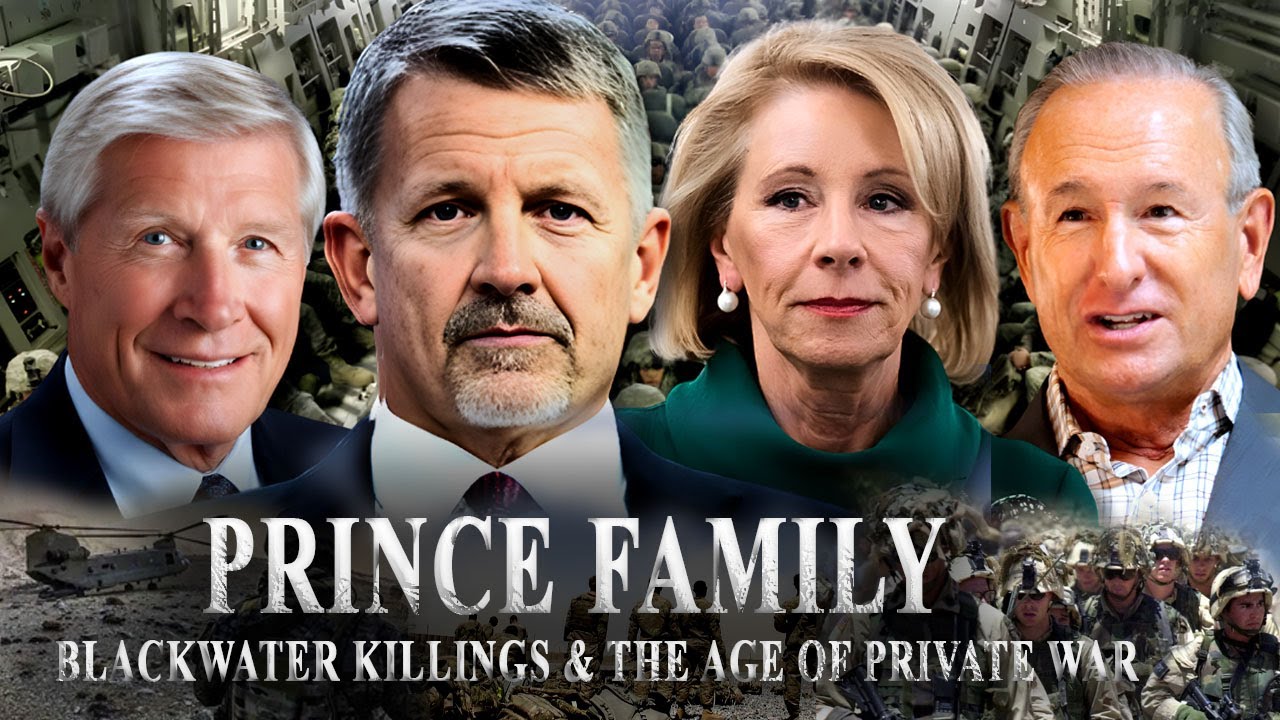
The family was royalty in Western Michigan, not only for its industrial success but for its role as architects of the Christian right, hosting figures like Ronald Reagan and George H. W. Bush in their home and pouring millions into organizations like the Family Research Council. Eric, the youngest of four children and the only son, was the heir apparent.
He had been raised on a worldview that fused free-market capitalism with evangelical Christianity, and he was obsessed with war. After three semesters at the Naval Academy, which he found stifling, he transferred to Hillsdale College, then joined the Navy and completed BUD/S, the most grueling training program in the military. He deployed with SEAL Team 8 to Haiti, the Middle East, and the Balkans. The SEAL teams validated his belief that elite units operating in the shadows could achieve what lumbering conventional armies could not.
When Edgar died, Eric left the Navy early to return home. In 1996, the family sold the Prince Corporation to Johnson Controls for $1. 35 billion in cash. Eric’s share was substantial, estimated at around $500 million.
He had no interest in philanthropy or politics like his sister Betsy, who would later marry Dick DeVos and become Donald Trump’s secretary of education. He wanted to remain in the world of special operations. He saw a market opportunity. The Cold War was over, the Clinton administration was slashing defense budgets, and the U.
S. military was shrinking just as the world was becoming more chaotic. In 1997, Prince purchased six thousand acres of the Great Dismal Swamp in Moyock, North Carolina, and poured his inheritance into building a private training facility. He drained the peat bogs, built world-class shooting ranges, and constructed mock cities for urban warfare.
He called the company Blackwater, after the dark, peat-stained water of the swamp. At its inception, Blackwater was not a mercenary army. It was a high-end service provider, renting ranges to SEAL teams and training local SWAT teams. But Prince’s vision was already expanding.
Watching the genocide in Rwanda and the chaos in the Balkans, he began asking why a private company could not stop a genocide for a fraction of the cost of a UN deployment. He was building a private military capability and waiting for a war. The first crack in the geopolitical ice came in October 2000, when al-Qaeda suicide bombers blew a hole in the USS Cole in Yemen, killing seventeen sailors. Prince pitched the Navy a rapid solution: Blackwater would build a mock ship in its swamp and train sailors to shoot small boats out of the water.
It was the company’s first significant government contract. Then came September 11, 2001. Prince drove his SUV to Washington and secured a meeting with the executive director of the CIA. He offered a turnkey security solution.
In early 2002, Blackwater received a secret, no-bid contract worth $5. 4 million to provide a twenty-man security detail for the CIA station in Kabul. Blackwater was no longer a training company. It was a private military contractor operating in a combat zone.
The CIA was impressed. Later in 2002, the Pentagon turned to Blackwater to protect Hamid Karzai, the newly installed president of Afghanistan. For the first time, the United States government outsourced the personal security of a foreign head of state to a private company. Afghanistan was the prologue.
The main event was Iraq. When the United States invaded Iraq in March 2003, the rapid military victory was followed by a catastrophic failure of planning. The Iraqi army was disbanded, the police collapsed, and the country descended into insurgency. In August 2003, the State Department awarded Blackwater a $27 million no-bid contract to provide personal security for L.
Paul Bremer, the head of the Coalition Provisional Authority. Under the terms of the contract and later under CPA Order 17, a law signed by Bremer himself, Blackwater contractors were granted immunity from Iraqi law. They could not be arrested by Iraqi police or tried in Iraqi courts. This immunity bred a culture of aggression.
Blackwater operators, paid up to $600 a day, viewed their mission in stark terms: the principal must survive at all costs. They drove aggressively, ramming Iraqi cars that got too close to their convoys. To the U. S.
government, they were indispensable, keeping every diplomat alive. To the Iraqi people, they were a death squad roaming the streets, answerable to no one. The turning point for the industry came on April 4, 2004, in the holy city of Najaf. The Mahdi Army, a Shia militia loyal to Muqtada al-Sadr, launched a massive coordinated assault on the Coalition Provisional Authority compound.
The compound was defended by a handful of U. S. Marines, some Salvadoran soldiers, and eight Blackwater contractors. The contractors, mostly former SEALs, took tactical command of the defense.
As ammunition ran low, Blackwater deployed its own helicopters from Baghdad to resupply the defenders. Private citizens paid by a corporation had engaged in a sustained high-intensity battle, commanded coalition troops, and utilized private air power. The distinction between security guard and soldier had evaporated. By 2006, Blackwater was virtually a fourth branch of the U.
S. military in Iraq. The State Department was completely dependent on them. But resentment among the Iraqi population was at a boiling point, and U.
S. military commanders were furious. Every time a Blackwater convoy raced through a village, shot up a car that got too close, and sped away, they left the Marines who patrolled that area to deal with the angry, grieving locals. General Peter Chiarelli, the commander of the multinational corps, famously commented, “Every time they go out, they create new insurgents.
”
The reckoning came on the morning of Sunday, September 16, 2007. A massive car bomb had detonated near the Green Zone, putting every security detail on high alert. Blackwater’s tactical support team, Raven 23, rolled out of the gates in four armored vehicles. They had ignored a direct order to stay put.
The team leader, Paul Slough, had radioed that they were moving out regardless. At approximately 12:08 p. m. , the convoy entered Nisour Square, a crowded traffic circle in the Mansour district.
A white Kia sedan, driven by a young medical student named Ahmed Haithem al-Jumaili with his mother Mahassin in the passenger seat, rolled slightly forward. To the turret gunner in the lead vehicle, a former Marine named Nicholas Slatten, the movement was a threat. He raised his sniper rifle and fired directly through the windshield, striking Ahmed in the head. The car, now carrying a corpse and a screaming mother, lurched forward.
The other gunners opened up with everything they had. The shooting didn’t stop with the Kia. The operators of Raven 23 fired in a 360-degree arc into the line of stopped cars, at a bus, at people fleeing their vehicles. They fired M203 grenade launchers into the intersection.
For fifteen minutes, Nisour Square became a killbox. When the shooting stopped, seventeen Iraqi civilians lay dead, including two children. Twenty were critically wounded. Raven 23 popped smoke grenades and sped back to the Green Zone, radioing in a report that they had been ambushed.
Iraqi investigators found no weapons in the civilian cars. The only brass on the ground belonged to American-made ammunition. The FBI later concluded that at least fourteen of the seventeen killings were completely unjustified. The massacre began the end of Blackwater.
Prince was summoned before Congress, where he testified defiantly, refusing to apologize. The Justice Department moved to indict the men of Raven 23, but the State Department’s initial decision to grant them limited immunity in exchange for their statements tainted the prosecution, and a federal judge threw out the first indictment. The brand became radioactive. In February 2009, Blackwater changed its name to Xe Services, then to Academi, and was eventually absorbed into a conglomerate called Constellis.
In January 2009, the State Department announced it would not renew Blackwater’s operating license in Iraq. The company that had been the face of the American occupation was kicked out of the country. In 2010, Prince stepped down as CEO and sold the company. He moved his family to Abu Dhabi, a country with no extradition treaty with the United States.
He built a secret private army of eight hundred Colombian mercenaries for Crown Prince Mohammed bin Zayed, a project that collapsed when it was exposed in the press. He founded Frontier Services Group, listing it on the Hong Kong Stock Exchange and offering security for China’s Belt and Road Initiative in Africa. He developed a plan to militarize American crop dusters into cheap counterinsurgency aircraft. When Donald Trump was elected president, Prince returned to the center of American power.
His sister Betsy DeVos was confirmed as secretary of education, and Prince launched a public campaign to privatize the war in Afghanistan, proposing to replace American troops with six thousand contractors commanded by a viceroy, modeled on the British East India Company. The plan was met with horror by the national security establishment and ultimately killed. During these years, Prince allegedly recruited former spies to run domestic intelligence operations against political enemies of Trump, and he pitched an $80 million plan to help warlord Khalifa Haftar conquer Tripoli, a scheme that collapsed when the mercenaries fled Libya by boat to Malta. As the Trump presidency ended, Prince lobbied intensely for one final prize: presidential pardons for the men of Raven 23.
On December 22, 2020, President Trump issued full unconditional pardons for Nicholas Slatten, Paul Slough, Evan Liberty, and Dustin Heard. The four Blackwater contractors convicted of the slaughter at Nisour Square walked free from federal prison. In Iraq, the pardons were received as a final devastating humiliation. The legacy of Blackwater extends far beyond the pardons.
The Wagner Group, the Russian private military company, operated as a near-perfect mirror image of Blackwater, allowing the Kremlin to project power while maintaining plausible deniability. In modern conflicts, both sides now routinely rely on contractors for logistics, intelligence, and combat support. The monopoly on violence that nation-states jealously guarded for centuries has been permanently fractured. Eric Prince remains a free man and a billionaire.
He launched a podcast called Off Leash and a smartphone company promising military-grade encryption. The family fortune, born in a garage in Michigan making car parts, has been laundered through the blood of the Middle East and emerged clean on the other side. The story of the Prince family is ultimately a story about the privatization of the American dream. Edgar Prince believed private enterprise could build a better sun visor.
His son believed private enterprise could build a better war. The tragedy is not just that Prince failed to deliver security. It is that he succeeded in destroying the idea that some things, justice, accountability, and the power to kill, should never be for sale.






