In the autumn of 1963, an Earth scientist went missing in a cave system in West Virginia, leaving behind university contracts, research equipment, and a note with three words for the people he left behind: “Do not follow. ”
The last recorded communication from this scientist arrived on December 3rd, 1963, when his university received a brief telegram stating that his research had uncovered significant cultural remains requiring immediate preservation protocol. After that, his trail faded into the Appalachian earth, and the story that emerged from his disappearance raised more questions than it answered. The scientist at the center of this case was Dr.
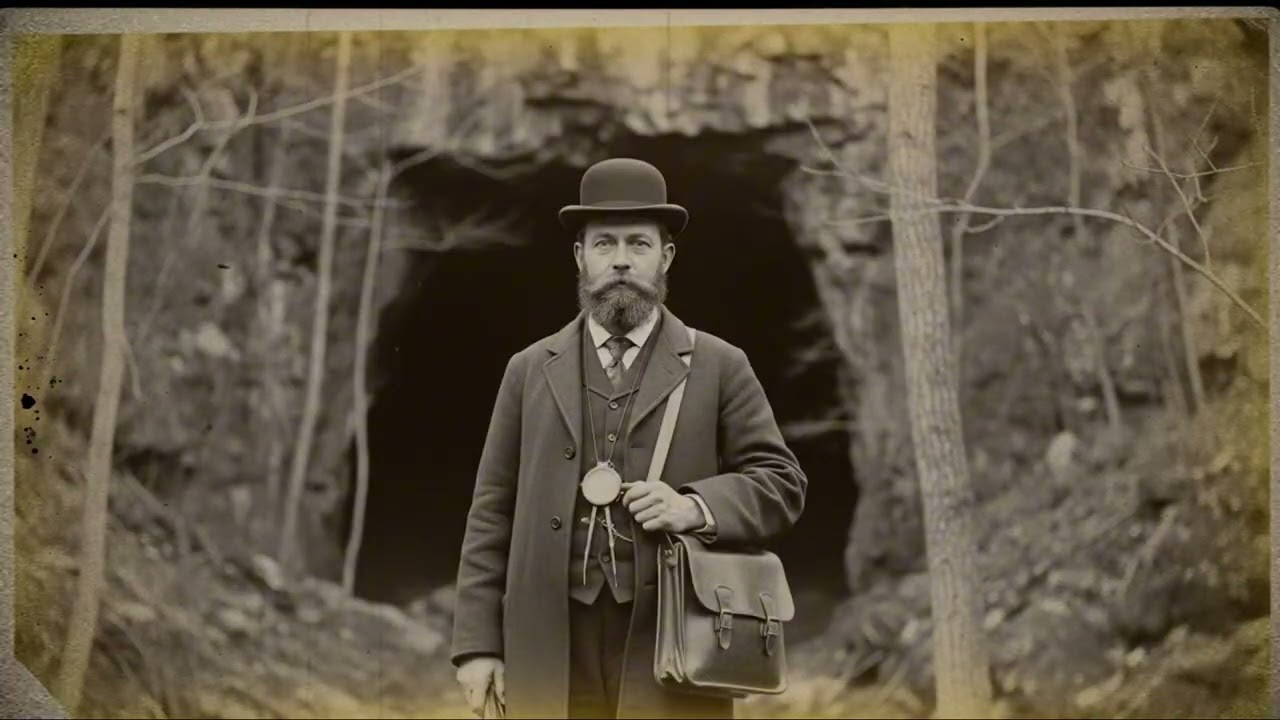
Lysander Hargrave, a professor who arrived in Pocahontas County, West Virginia in the autumn of 1963 carrying surveying equipment and a research grant from the National Speleological Society. His official mission was straightforward: document the unexplored cave systems beneath Seneca Rocks, a towering limestone formation that had attracted geologists for decades. The Smithsonian Institution’s records identify Hargrave as a specialist in karst topography and underground water systems. Colleagues described him as methodical, almost obsessively so, with a reputation for spending weeks alone in remote locations.
His previous expeditions had taken him through the caves of Kentucky and Tennessee, where his detailed maps had proven valuable to scientific communities and search and rescue operations alike. He was precisely the sort of researcher suited for the isolation and technical challenges that Appalachian cave systems presented. The nearest settlement to his research site was Riverton, where Hargrave took a room at the boarding house operated by Mrs. Cordelia Fenwick, a woman who later told county officials that the doctor kept regular hours and spoke little during meals.
Her handwritten ledger, discovered years later in the basement of the county courthouse, noted that he paid his weekly rent precisely on time and never requested additional services. According to parish records from St. Matthew’s Episcopal Church, he attended services sporadically but made little effort to engage with the longtime residents. To the locals, who viewed the newcomer with typical mountain reserve, he was just a quiet researcher who kept to himself.
The first indication that his research had taken an unexpected direction appeared in a letter dated October 15th, 1963, addressed to his department head at George Washington University. The correspondence, filed among university archives, mentions discovering structural anomalies inconsistent with natural formation patterns within what locals called Whispering Hollow Cave. His technical language remained precise, but colleagues who reviewed the letter decades later noted an unusual urgency in his request for additional time and funding. October 1963 brought unusually severe weather to the mountains, according to the Pocahontas Times, a weekly newspaper that covered the region.
Early snow fell before the leaves had fully turned, and temperatures dropped below freezing for three consecutive weeks. Local farmers reported that their livestock had begun to exhibit strange behavior, refusing to graze in fields adjacent to the forest where Hargrave conducted his research. The newspaper archives, preserved on microfilm at the West Virginia State Library, contained several brief mentions of these agricultural concerns, though no connection was drawn to the ongoing scientific work at the time. Mrs.
Fenwick’s boarding house ledger contains an entry from November 2nd, 1963, noting that Hargrave had failed to return for dinner, as was his custom. The entry, written in her careful script, mentions that his research materials remained in his room, suggesting he had not intended an extended absence. When he appeared the following morning, Mrs. Fenwick recorded that he consumed an unusually large breakfast but spoke not a single word.
Her notation indicates that his clothing showed signs of prolonged exposure to dampness and cold. The nature of Hargrave’s discovery within Whispering Hollow Cave becomes clearer through a series of telegrams he sent to various academic institutions during November 1963. These communications, preserved in the archives of three different universities, reveal his growing conviction that the cave system contained evidence of human modification dating back several centuries. His messages grew increasingly detailed, describing worked stone surfaces and what he termed deliberate architectural interventions within the deepest accessible chambers.
A particularly revealing telegram sent to the American Anthropological Association on November 18th, 1963 requested information about historical settlement patterns in the region. Hargrave specifically inquired about any records of religious communities or isolated groups that might have used caves for shelter or ceremonial purposes. The association’s response, found among his personal effects, provided limited information but suggested he contact local historical societies and church records for more detailed regional history. It was during this period that Hargrave began making contact with older residents of the surrounding valleys.
According to handwritten notes discovered much later in his research materials, he interviewed several families whose roots in the area extended back multiple generations. These conversations, conducted in the parlors of isolated farmhouses and around wood stoves in country stores, revealed a persistent local tradition of avoiding Whispering Hollow Cave, particularly during winter months. Ephraim Doulamer, an elderly man whose family had lived in the same valley since before the Civil War, provided Hargrave with the most detailed account of local belief surrounding the cave. According to notes in Hargrave’s careful handwriting, Doulamer described how his grandfather had warned against entering the cave system between the first snow and spring thaw.
The specific reasoning behind this prohibition had been lost over generations, but the warning itself had been passed down as firmly as any religious doctrine. Additional interviews documented in Hargrave’s field notebooks revealed similar patterns of avoidance among multiple families. Thessaly Milwood, whose homestead sat closest to the cave entrance, told the researcher that her family had never permitted their livestock to graze in the hollow where the cave opened. When pressed for specifics, she could only say that her mother had insisted the grass there never grew right and that animals would not remain calm in that particular area.
Hargrave’s research methodology during this period reveals his growing departure from purely geological concerns. His notebooks, written in a precise hand that became noticeably less steady as November progressed, document his decision to remain in the cave system for extended periods. These overnight stays, initially intended to monitor temperature and humidity fluctuations, gradually extended from single nights to periods of three or four days at a time. The last communication Hargrave sent to his university appeared in the form of a brief telegram dated December 3rd, 1963.
The message, preserved in department files, simply stated that his research had uncovered significant cultural remains requiring immediate preservation protocol. He requested an extension of his leave and additional funding for what he termed emergency documentation procedures. The telegram provided no additional details, and subsequent attempts by university officials to reach him received no response. Mrs.
Fenwick’s ledger entries for December 1963 paint a picture of increasing concern among Riverton’s small community. Hargrave continued to return to the boarding house at irregular intervals, but his behavior had changed markedly. She noted that he often appeared at meal times wearing the same clothes he had worn days earlier, and that he had begun requesting that his food be wrapped so he could take it with him rather than eating in the common dining room. More disturbing still were Mrs.
Fenwick’s observations about Hargrave’s physical condition during these brief appearances. Her careful notations describe a man who had lost considerable weight, whose hands showed persistent scratches and cuts, and who seemed unable to remain still for more than a few moments at a time. On one occasion, she recorded, he asked her several times within the span of an hour whether she had heard any unusual sounds coming from his room during his absence, despite the fact that he had not been in the building for three days. The cave system itself presented numerous challenges even for experienced spelunkers.
Whispering Hollow Cave extended nearly two miles into the mountain, with multiple chambers connected by passages that ranged from spacious corridors to narrow crawlways barely wide enough for a single person. The cave’s name derived from acoustic properties that caused even slight sounds to echo and multiply throughout the system, creating an effect that early visitors had described as resembling distant conversations. Hargrave’s field notes from this period reveal his fascination with these acoustic phenomena. He documented how normal sounds became distorted within the cave, how his own footsteps seemed to continue long after he had stopped moving, and how the movement of air through the passages created what he initially dismissed as auditory illusions.
His later entries, however, suggest a growing belief that these sounds followed patterns too consistent to be purely accidental. On December 15th, 1963, Thessaly Milwood contacted the Pocahontas County Sheriff’s Department to report that she had seen lights moving within Whispering Hollow Cave for three consecutive nights. According to the sheriff’s report filed in county records, Mrs. Milwood insisted that these lights appeared and disappeared in sequences that seemed too regular to be the result of normal cave exploration.
When deputies investigated the following day, they found evidence of recent human presence, but no sign of Hargrave or his equipment. The sheriff’s investigation revealed that Hargrave had been using an area deep within the cave system as a semi-permanent research station. Deputies discovered camping equipment, research materials, and surveying instruments arranged in what they described as an unnaturally organized manner. Most unsettling, according to the official report, was the discovery of Hargrave’s notebooks, which documented his activities up until the previous day but contained increasingly illegible handwriting and fragmentary observations.
Among Hargrave’s research materials, deputies found detailed maps of the cave system that extended far beyond any previously known passages. These hand-drawn charts depicted chambers and connecting tunnels that would require weeks of exploration to complete. Yet Hargrave had been working alone and had only been in the area for three months. The maps also contained notations in what appeared to be a mixture of geological terminology and symbols that none of the investigating officers could interpret.
The final notebook entries departed entirely from his previously clinical documentation style. These final pages, written in increasingly erratic handwriting, contained observations about temperature variations that followed no apparent pattern, descriptions of air currents that seemed to flow against natural gradients, and repeated references to structural modifications that he insisted could not be the result of normal geological processes. The sheriff’s investigation concluded on December 22nd, 1963, when Hargrave failed to appear for a scheduled interview. A search of his research site revealed that his equipment remained in place, but several key items were missing: his lanterns, rope, and the notebooks containing his most recent observations.
The cave entrance showed signs of recent use, but deputies were reluctant to conduct an extensive underground search without specialized equipment and personnel. On Christmas Eve 1963, Mrs. Fenwick reported that Hargrave had returned to the boarding house during the night and retrieved his personal belongings. She discovered this only when she noticed that his room, which had remained exactly as he left it, had been emptied of all clothes and personal items.
His scientific instruments and research materials remained untouched. Most remarkably, Mrs. Fenwick insisted that she had heard no sounds during the night and that the house’s doors and windows showed no signs of forced entry. A final entry in Mrs.
Fenwick’s ledger dated December 25th, 1963 records her discovery of a brief note left in Hargrave’s room. Written on university letterhead in his distinctive handwriting, the message simply stated: “Research complete. Findings require different preservation methods. Do not follow.
” The note bore no signature and provided no additional information about his intentions or whereabouts. The disappearance of Dr. Lysander Hargrave became a matter of official inquiry when George Washington University contacted local authorities in January 1964. University officials expressed concern that their researcher had failed to return from his approved leave and had not responded to multiple telegrams requesting updates on his progress.
The investigation that followed revealed the extent to which Hargrave had deviated from his original research proposal, but provided no additional clues about his fate. Federal involvement in the case began when the National Speleological Society requested access to Hargrave’s research materials and cave maps. A team of experienced cavers accompanied by geological specialists conducted a thorough exploration of Whispering Hollow Cave in March 1964. Their findings, documented in reports filed with multiple government agencies, confirmed that the cave system extended much further than previously known.
But they found no trace of Hargrave or his missing equipment. The federal investigation team did, however, discover evidence that supported some of Hargrave’s more unusual claims. Deep within the cave system, they documented areas where natural rock formations had clearly been modified by human intervention. These modifications, consisting primarily of carved handholds and smoothed passage walls, appeared to be quite old, but showed evidence of recent use.
Most significantly, the investigators found clear indication that someone had been using the deepest accessible chambers as a long-term living space. Among the items recovered from these deep chambers were several notebooks containing observations written in Hargrave’s distinctive handwriting. These final documents revealed that he had been living underground for extended periods, surviving on supplies cached throughout the cave system and emerging only briefly to gather additional resources. His entries during this period focused obsessively on what he described as architectural evidence of deliberate environmental modification.
Hargrave’s final entries described his growing conviction that Whispering Hollow Cave had been systematically modified over decades or possibly centuries to serve as a long-term shelter for individuals seeking complete isolation from the outside world. He documented evidence of primitive living spaces carved into the rock, waste disposal systems that channeled refuse deep underground, and what appeared to be deliberate sound dampening modifications that would allow inhabitants to move through the cave system without detection. Most disturbing were Hargrave’s observations about finding clear evidence that the cave had been occupied recently, possibly within months of his own arrival. His notes described discovering food supplies, bedding materials, and personal items that suggested multiple individuals had used the system as shelter.
However, he never encountered these inhabitants directly, leading him to conclude that they had withdrawn deeper into unexplored sections of the cave upon becoming aware of his presence. The federal investigation officially concluded in June 1964 with a report that acknowledged Hargrave’s disappearance as unexplained, but suggested that he had likely become disoriented in the complex cave system and perished from exposure or accident. This conclusion satisfied bureaucratic requirements, but failed to address the numerous inconsistencies in the evidence or explain why an experienced speleologist would abandon his equipment and continue exploring alone under dangerous conditions. Local residents remained convinced that the official explanation was incomplete.
Throughout 1964 and 1965, multiple individuals reported seeing lights moving within Whispering Hollow Cave during winter months, always following the same pattern that Thessaly Milwood had first observed. These reports, filed with county authorities, described lights that appeared to move through the cave system following specific routes and maintaining consistent timing that suggested purposeful human activity rather than natural phenomena. In the spring of 1965, a group of local men attempted their own investigation of the cave system. Led by Ephraim Doulamer, whose family had lived in the area for generations, this informal search party explored the upper chambers of Whispering Hollow Cave but retreated when they discovered clear evidence of recent habitation in areas that the federal investigators had described as unoccupied.
According to their account filed with the sheriff’s department, they found freshly used camping equipment and food supplies that had not been there during the previous year’s official search. The unofficial investigation by local residents revealed another troubling detail. Hargrave’s research station deep within the cave appeared to have been maintained and expanded since his disappearance. Equipment that had been removed during the federal investigation had been replaced with similar items, and the living space showed signs of ongoing use.
Most significantly, the investigators found additional notebooks containing entries dated months after Hargrave’s official disappearance, all written in his distinctive handwriting. These later notebooks, which were not turned over to official authorities, documented Hargrave’s continued research into what he had begun to describe as an intentional community of withdrawal. His entries suggested that he had made contact with individuals who had been using the cave system as a permanent refuge from the outside world and that he had been gradually accepted into their isolated society. His writing during this period showed no signs of distress or coercion, but rather described his growing appreciation for what he termed complete environmental independence.
The most recent entries in these unofficial notebooks, dated in early 1965, describe Hargrave’s decision to abandon his former life entirely and commit himself to what he called the authentic research. He wrote of destroying his university credentials, discarding his former identity, and embracing what he described as the only honest response to unnecessary civilization. These final entries suggested that he viewed his disappearance not as a loss, but as a necessary liberation from obligations that had prevented him from pursuing genuine understanding. Following the discovery of these additional materials, local authorities faced a delicate situation.
Hargrave appeared to have chosen his disappearance voluntarily. Yet he had abandoned professional and legal obligations without formal notification. The cave system clearly harbored individuals living outside normal social structures, but they appeared to be causing no harm and actively avoided contact with the outside world. Official intervention seemed both impractical and potentially disruptive to a situation that had reached a stable equilibrium.
The decision was made to seal the primary entrance to Whispering Hollow Cave and post warning signs prohibiting unauthorized access. This action, taken in late 1965, effectively ended official interest in Hargrave’s fate while acknowledging that the cave system posed potential dangers to inexperienced explorers. County records indicate that this solution satisfied federal requirements while allowing local authorities to avoid the complications that would result from attempting to force contact with the cave’s inhabitants. However, sealing the main entrance proved less effective than anticipated.
Within months, county workers discovered that the barriers had been carefully removed and restored multiple times, suggesting that the cave’s occupants possessed both the tools and skills necessary to maintain access while giving the appearance of compliance with official restrictions. Additional attempts to block the entrance were met with similar results, leading authorities to conclude that permanent closure was not practically achievable. By 1966, an informal understanding had developed between county authorities and the cave’s occupants. As long as no incidents occurred that required official intervention, law enforcement would not actively pursue investigation of the underground community.
This arrangement appeared to satisfy all parties involved, as subsequent years passed without reports of problems or conflicts. The cave entrance remained technically sealed, but local residents understood that this was a purely symbolic gesture. Mrs. Fenwick continued to operate her boarding house until 1967, when age and declining health forced her to sell the property.
Among her personal effects, discovered after her death, were additional letters that she had received from Hargrave during the first months following his disappearance. These communications, written on makeshift paper and delivered by unknown means, assured her that he remained safe and healthy, but could not return to his former life due to what he described as irreversible commitments to more important work. The letters to Mrs. Fenwick provided insight into Hargrave’s mental state during his transition from university researcher to permanent cave dweller.
He wrote of discovering a community of individuals who had each, for their own reasons, chosen to separate themselves entirely from conventional society. These were not, he insisted, disturbed individuals fleeing from personal problems, but rather people who had made careful, rational decisions to pursue what they considered a more authentic form of human existence. According to Hargrave’s descriptions in these letters, the cave community operated according to principles that prioritized environmental sustainability, intellectual inquiry, and personal autonomy above the material accumulation and social conformity that he had come to view as characteristic of surface society. Members contributed their individual skills and knowledge to the group’s welfare while maintaining complete freedom to pursue personal interests and studies.
The cave system provided both the physical shelter and social isolation necessary for what he described as genuine human development. Hargrave’s final letter to Mrs. Fenwick, dated in early 1967, thanked her for her kindness during his transition period and assured her that his choice had proven entirely satisfactory. He described his life underground as intellectually stimulating and personally fulfilling in ways that his university career had never provided.
Most importantly, he wrote, he had discovered that the questions that had driven him to academic study could be pursued more effectively in an environment free from institutional constraints and social expectations. The scientific community’s response to Hargrave’s disappearance evolved gradually from concern to puzzlement to eventual acceptance that a respected researcher had voluntarily abandoned his career for reasons that remained unclear. His published papers continued to be cited in geological literature, and his cave mapping techniques were adopted by researchers working in similar environments. However, his name gradually faded from active academic discussion as new generations of scientists pursued their own research without knowledge of his unusual fate.
Local memory of Hargrave and the Whispering Hollow Cave incident persisted longer among residents of Pocahontas County. Stories were passed down about the scientist who had disappeared into the mountain, but these accounts gradually acquired the characteristics of local folklore rather than historical fact. Younger generations heard abbreviated versions that emphasized the mysterious aspects of the case while omitting the documentary evidence that had established its factual foundation. In 1968, the Smithsonian Institution conducted a comprehensive review of Hargrave’s research contributions, treating his disappearance as a closed matter requiring no further investigation.
His work on Appalachian cave systems was acknowledged as valuable, and his research materials were transferred to permanent archives where they became available to future researchers. The official position treated his disappearance as an unfortunate accident that had prevented him from completing his studies and publishing his final conclusions. The cave entrance remained technically sealed throughout the late 1960s, but local residents occasionally reported seeing lights moving through the mountain during winter months. These observations were recorded in county files, but generated no official response, as authorities had accepted that the cave system’s occupants posed no threat to surface communities.
The informal arrangement that had developed proved durable, allowing both groups to coexist without conflict or unwanted contact. In 1969, the last documented attempt to investigate Whispering Hollow Cave was made by a team of researchers from West Virginia University. This group, working under federal archaeological permits, intended to document the cave’s cultural modifications and create a comprehensive map of the complete system. Their work was abandoned after discovering clear evidence that the cave remained actively inhabited and that its occupants were unwilling to permit outside documentation of their community.
The university researchers reported finding extensive modifications to the cave system that went far beyond anything Hargrave had documented. These included sophisticated ventilation systems, water management infrastructure, and living spaces that could accommodate a substantial population. Most remarkably, they discovered evidence of ongoing construction and expansion, suggesting that the underground community continued to grow and develop its environmental modifications. The researchers concluded that any attempt to study the cave system would require cooperation from its inhabitants, who had made clear their desire to remain undisturbed.
Throughout the 1960s, federal agencies periodically reviewed the Hargrave case as part of routine administrative procedures, but no new investigation was ever initiated. The case was eventually classified as a voluntary disappearance by an adult who had left clear evidence of his intentions and mental competency. This classification satisfied legal requirements while acknowledging that some questions about his fate would remain permanently unanswered. The final official document related to Hargrave’s case was a memorandum dated December 1969, noting that his university position had been officially terminated due to extended absence and that his personal effects had been transferred to the National Archives.
The memorandum noted that Hargrave’s research had contributed valuable information about Appalachian cave systems, but that his unconventional methods and ultimate disappearance prevented complete evaluation of his scientific contributions. As the decade ended, Hargrave had effectively transitioned from missing person to historical footnote, remembered primarily by a small number of local residents and archived in government files that would rarely be consulted by future researchers. His transformation from respected university scientist to voluntary cave dweller represented a type of life choice that challenged conventional understanding of professional obligation and social responsibility, making his case difficult to categorize within normal bureaucratic frameworks. The Whispering Hollow Cave system continued to show signs of habitation well into the 1970s, though direct contact between surface and underground communities became increasingly rare.
Local residents learned to recognize the subtle indicators that suggested ongoing activity within the mountain, but these observations were treated as private knowledge rather than matters requiring official attention. The informal arrangement that had developed during the 1960s proved remarkably stable, allowing both groups to maintain their preferred lifestyles without interference from each other. The case files related to the disappearance were transferred to regional archives in 1970, where they became part of the historical record of Pocahontas County. These documents, comprising sheriff’s reports, federal investigation summaries, and correspondence from various agencies, provided a comprehensive record of the official response to the disappearance, but offered little insight into Hargrave’s personal motivations or ultimate fate.
Researchers who later examined these files found them frustrating in their completeness yet ultimate inconclusiveness regarding the central questions of the case. The scientific equipment left behind in the boarding house room was eventually donated to the geology department at West Virginia University, where it was used by students learning speleological techniques. His personal books and papers were included in this donation, providing future researchers with access to his preliminary studies of Appalachian cave systems while revealing nothing about his decision to abandon this work in favor of permanent underground residence. Mrs.
Fenwick’s boarding house was converted to a private residence after her death, but the new owners discovered additional materials related to Hargrave’s stay that had been overlooked during the original investigation. These items were donated to the county historical society. However, the most significant items, Mrs. Fenwick’s letters from Hargrave describing his life underground, were never made public and eventually disappeared from the historical record.
As the 1970s progressed, the Whispering Hollow Cave case was gradually forgotten by everyone except those with direct personal connection to the events. County officials who had been involved in the original investigation retired or moved away, taking their detailed knowledge of the case with them. New law enforcement personnel were briefed on the cave’s restricted status, but given little background information about the reasons for these restrictions, leading to a gradual erosion of institutional memory regarding the underground community’s existence. The cave entrance remained sealed according to official records, but experienced local outdoorsmen understood that these barriers were maintained primarily for bureaucratic purposes rather than as genuine obstacles to access.
The underground community appeared to have developed effective methods for maintaining their isolation while accommodating the need to satisfy surface authorities that appropriate security measures were in place. By the mid-1970s, the Whispering Hollow Cave case had achieved a stable equilibrium that satisfied all parties involved while maintaining the ambiguities that made complete resolution impossible. Official records documented the disappearance and the discovery of an underground community, but provided no current information about the status of either. Local residents retained awareness of the cave system’s special characteristics while respecting the apparent desire of its inhabitants to avoid unwanted attention.
Federal and state agencies maintained nominal oversight responsibilities while avoiding active intervention in a situation that appeared to require none. The documentation that survived suggested that Hargrave had discovered something within Whispering Hollow Cave that changed his understanding of how human life could be organized and what constituted meaningful work. His writings described this discovery not as a rejection of civilization, but as an evolution toward what he considered a more authentic form of human existence. Whether this represented genuine insight or gradual psychological deterioration remained impossible to determine from the available evidence.
As the decade drew to a close, the transformation of Dr. Lysander Hargrave from missing person to historical figure was essentially complete. His name appeared occasionally in academic papers and local histories, but always as a reference to past events rather than ongoing concerns. The questions surrounding his fate had settled into permanent uncertainty, acknowledged but no longer actively pursued by any official agency or academic institution.
The Whispering Hollow Cave system remained as it had been throughout the decade: officially sealed, technically restricted, and practically accessible to those with sufficient knowledge and motivation to negotiate the informal arrangements that governed its use. The underground community continued to show subtle signs of ongoing activity, but these observations were treated as private knowledge rather than matters requiring official attention or public discussion.






