In the winter of 1964, on the swept concrete floor of a boat engine workshop in Fond du Lac, Wisconsin, a discarded American V8 engine lay waiting for a man who was not looking for it. William Martin-Hurst, the managing director of the Rover Company, had crossed the Atlantic to sell Rover engines and its promising gas turbine to the boss of Mercury Marine. The sale never happened, but his eye caught something abandoned on the workshop floor: a compact aluminium V8 that General Motors had cast off, having judged light-alloy engine blocks more trouble than they were worth. Martin-Hurst measured it.
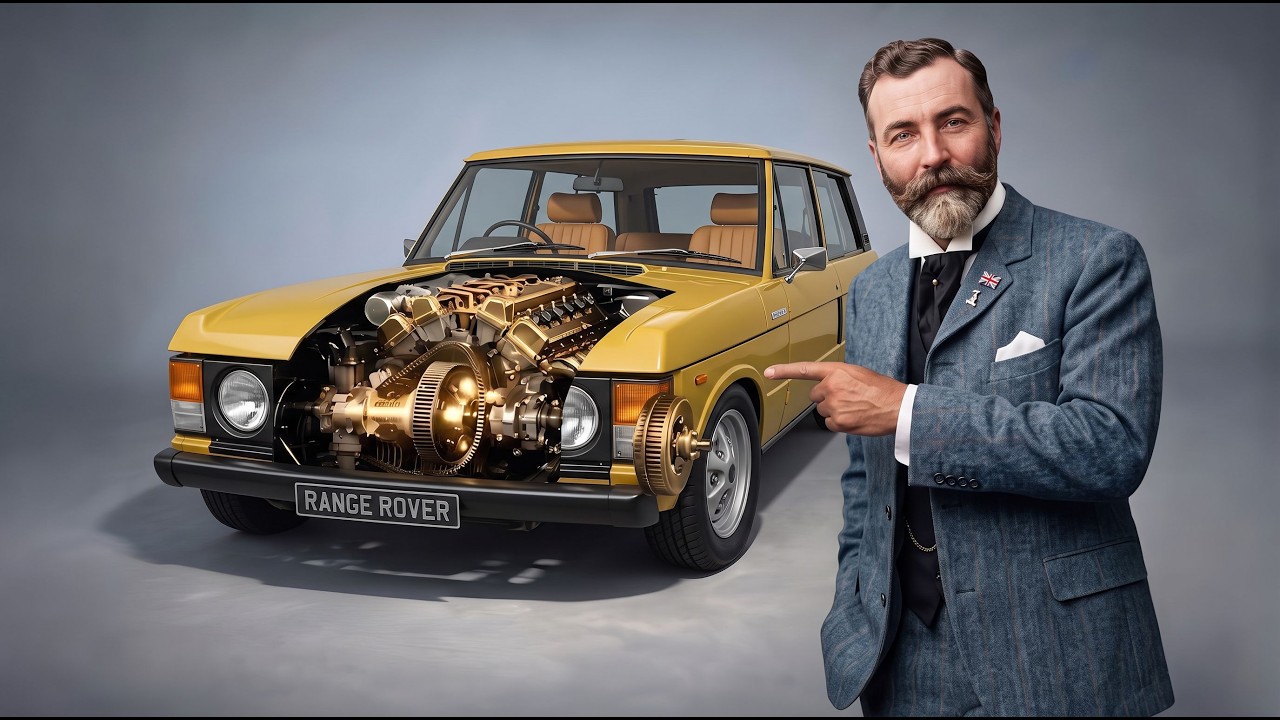
Barely larger than the four-cylinder Rover was already building and only about twelve pounds heavier, it was an entire V8 light enough for one man to lift. He bought the rights and the tooling on the spot. By January 1965, the engine belonged to Rover. That discarded American powerplant would become the beating heart of the greatest thing the British motor industry ever built.
Rover was then a byword for solid, tweedy respectability, known half-affectionately as Auntie Rover. The works at Solihull had begun as a wartime shadow factory built to turn out Bristol Hercules aero engines. When Coventry was flattened in the Blitz, Rover moved there and made it its own, and in 1948 launched the Land Rover, the plain, honest, go-anywhere tool that kept the company alive. But the ground beneath the firm was already moving.
By 1968, Rover had been swept into the vast, unwieldy British Leyland Motor Corporation, a conglomerate destined to become a national byword for strife and decline. All of that lay just ahead. For now, a young engineer was about to make magic nobody expected. His name was Charles Spencer King, known to everyone as Spen.
Born into the business, he had apprenticed at Rolls-Royce during the war, then joined Rover in 1945, throwing himself into the company’s most futuristic experiments. He was by every account a proper engineer, not a stylist. He would later admit he spent less than one-tenth of one percent of his time thinking about the appearance of the car that made him famous. His partner in turning his ambition into metal was Gordon Bashford, a chassis genius who had joined Rover as an apprentice at the age of fourteen.
By the mid-1960s, King and his colleagues had been watching a new breed of rugged, road-friendly American vehicles. So King set himself a simple, slightly mad ambition: take the true go-anywhere ability of a Land Rover and give it the ride, pace, and comfort of a proper road car. Not a farm tool that happened to be bearable, but a comfortable, capable car that happened to go absolutely anywhere. He made two decisions early that shaped everything.
The cast-off Buick V8 would provide smooth, effortless power. And against the settled instincts of the industry, the car would ride on long-travel coil springs rather than the cart springs of a working truck. That single stubborn choice gave the Range Rover enormous articulation over broken ground and a supple ride on tarmac. There was also permanent four-wheel drive through a central differential, close to a world first on a production vehicle, and disc brakes on every corner.
Everything came back to the same quiet conviction: a vehicle need not choose between capability and comfort. The famously clean, upright shape was never really styled at all. Bashford and King built plain, flat body panels to disguise what the machinery underneath was doing during secret testing, and management liked the disguise so much they refused to let it go. The camouflage became the car.
Even the name was a piece of theatre. Development prototypes wore badges reading Velar to conceal what they were. The true name, Range Rover, was credited to a stylist called Tony Poole. Inside, King was convinced buyers would be farmers, so he designed a cabin you could hose out, with vinyl seats and rubber mats.
The palace was, at the very start, a shed on wheels. It reached the press on the 17th of June 1970 and went on sale that autumn at a price of £1,998. For that, you got a two-door body, aluminium panels over a steel frame, disc brakes all round, a 135-horsepower V8, and permanent four-wheel drive on coil springs. Nothing had ever done both off-road capability and luxury.
In doing so, it did not join a class of car. It invented one. In 1971, barely a year after launch, it became the first motor vehicle ever exhibited inside the Louvre in Paris, placed there as an exemplary work of industrial design, even though King had barely styled it and designed it to be hosed out. But the Range Rover earned its legend in the worst places on the planet.
In December 1971, the British Trans-Americas expedition set off with two Range Rovers to drive the length of the Americas, some 18,000 miles. Between the continents lay the Darién Gap, 250 miles of swamp and jungle with no road at all, ground so hostile no vehicle in history had ever driven across it. For weeks the expedition winched the cars from tree to tree and built rafts to float them over rivers. They came out the other side in June 1972, the first vehicles ever to conquer the gap.
In 1974, a Range Rover crossed the Sahara. And in the winter that carried into 1979 came the moment that sealed the legend. A brutal new event had been dreamed up, a rally from Paris to Dakar across the Sahara. The car that won it outright was a secondhand Range Rover, ordinary and used, crewed by three Frenchmen.
A luxury vehicle bought off a forecourt won the world’s toughest desert race at its first attempt. For a while, the country understood the Range Rover exactly as King had imagined it, as a superb and serious tool for farmers and gamekeepers. Nowhere was that truer than on the royal estates. Queen Elizabeth II was a genuine enthusiast, photographed again and again at the wheel of her own Range Rovers across Balmoral and Sandringham, a monarch in a British 4×4 with mud on the sills and dogs in the back.
But something had begun to shift. In late 1980, Land Rover worked with a London coachbuilder to build a lavishly appointed prototype with soft leather where there had been vinyl, and lent it to Vogue magazine. Vogue took the car to Biarritz for a glossy fashion shoot, and readers wrote in not about the clothes, but about the car. Land Rover rushed out a run of a thousand specially trimmed cars, called them the In Vogue, and they sold out almost at once.
By 1985, Vogue had become the badge on the flagship Range Rover, and each passing year the hose-out farm truck grew grander. A four-door body arrived in 1981, an automatic gearbox in 1982, and real luxury came through the middle of the decade. There was one great market the Range Rover had never properly conquered. Land Rover had pulled out of the United States in 1974.
In March 1987, it went back in properly, and the arrival was a sensation. Jack Nicholson and Goldie Hawn wanted one. It became the most fashionable way in the world to own a piece of Britain. These were the peak years, roughly 1987 through 1992, with record profits and prestige never higher.
But underneath all the new sophistication, the car was still fundamentally the one King had drawn in the 1960s, with aging bones now more than twenty years old. And onto those bones, the company was bolting layer upon layer of modern electronics, fuel injection, anti-lock brakes, air suspension, all wired up with components from a great Birmingham supplier whose name was about to become the most famous liability in the trade: Lucas. To understand what went wrong, you have to go back to Joseph Lucas, who founded his company in 1872 selling lamps from a handcart. The nickname that would attach itself to his firm, the Prince of Darkness, was an American joke about British cars whose electrics failed after dark.
Lucas engineers were not fools, but quality control eroded by cost cutting. And the Range Rover was growing more electronically complicated by the year. The fuel injection that arrived in 1986 came from Lucas, and its engine management unit had real documented weaknesses. It was what mechanics came to call a closed box, with no proper way to plug in and ask the car what was wrong.
The electronics were a symptom of a deeper disease. In 1975, British Leyland had been taken into public ownership, a ward of the taxpayer. When Tony Gilroy took charge of Land Rover at the start of 1983, he made deep cuts to the engineering department, a fateful economy. The specification climbed and the price climbed, but the money to guarantee it all worked did not.
The Range Rover was being asked to become a Mercedes-Benz on the budget of a company that could barely keep the lights on. Then came the decisions that turned manageable weaknesses into a legend of unreliability. Having chosen luxury, Solihull chose to deliver it through ever more fragile electronics, and to take the car into America, the most unforgiving market in the world, at almost exactly the same moment another British car was curdling there. The reputation for toughness earned in the hardest terrain on Earth counted for nothing against survey scores compiled from suburban driveways.
The very things that made the Range Rover irresistible were the things that would, within a few short years, start to fail, and the trust that Solihull had won so hard was tested in the one place it had never been tested: the ordinary driveway on an ordinary Tuesday morning when the car simply would not start. None of this, however, is the true tragedy. In 1988, the government sold the Rover Group to British Aerospace, which had little appetite for the endless investment a car maker devours. On the 31st of January 1994, British Aerospace sold its controlling stake to the German giant BMW for £800 million.
The deal was driven by BMW’s chairman Bernd Pischetsrieder, a genuine enthusiast for British cars. The due diligence took, by many accounts, something like ten days. BMW failed to grasp how completely Rover had come to depend on its quiet partnership with Honda, and when Honda learned its partner had been sold to a rival, it felt betrayed and walked away. BMW poured billions into Rover, but the losses ran at something like £2 million a day.
In 2000, BMW gave up, broke the group apart, and sold Land Rover to Ford for £1. 85 billion. Ford meant to stay, and for a while it delivered. Then, in the financial storm gathering at the end of the decade, Ford needed cash, and it did what everyone before it had done.
It sold. On the 26th of March 2008, Ford agreed to sell Jaguar and Land Rover together to the Indian conglomerate Tata Motors for around $2. 3 billion. Under Tata, freed at last from the churn and the starvation, Land Rover flourished.
The thing that Britain had never quite managed to do for its own invention, fund it properly and steadily, was finally done by an owner half a world away. And here is the strangest turn. Solihull never died. Today it is one of the busiest, most advanced car plants in Europe, still turning out Range Rovers the whole world wants.
What is gone is the ownership. The profits, the decisions, the destiny of Britain’s greatest motoring idea now belong to others, and have for a very long time. The car is more successful than King ever dreamed. It simply is not Britain’s anymore.
There is a particular grief in the fact that the Range Rover Classic itself is now a treasured, appreciating classic, restored to factory condition by the very company that built it, wanted more now than it ever was when it was merely reliable transport. The mistake, if there was one, was never a wiring loom. It was a whole country’s slow failure of nerve. A brilliant idea, born half by accident out of a cast-off American engine and an engineer who could not be bothered with beauty, was handed from owner to owner by a country that could never quite afford the thing it had been clever enough to invent.
The Range Rover survived them all. It survives still, more successful than Spen King could ever have imagined, and no longer his or ours.






