Three million people a year walk onto the boardwalk in Santa Cruz, California, and no one pays a cent to get in. No gate, no ticket, no admission. It is the oldest amusement park in the state, and it has never charged anyone to set foot on it. Yet today, a working person who wants to rent a two-bedroom apartment near that boardwalk must earn eighty-one dollars and twenty-one cents an hour.
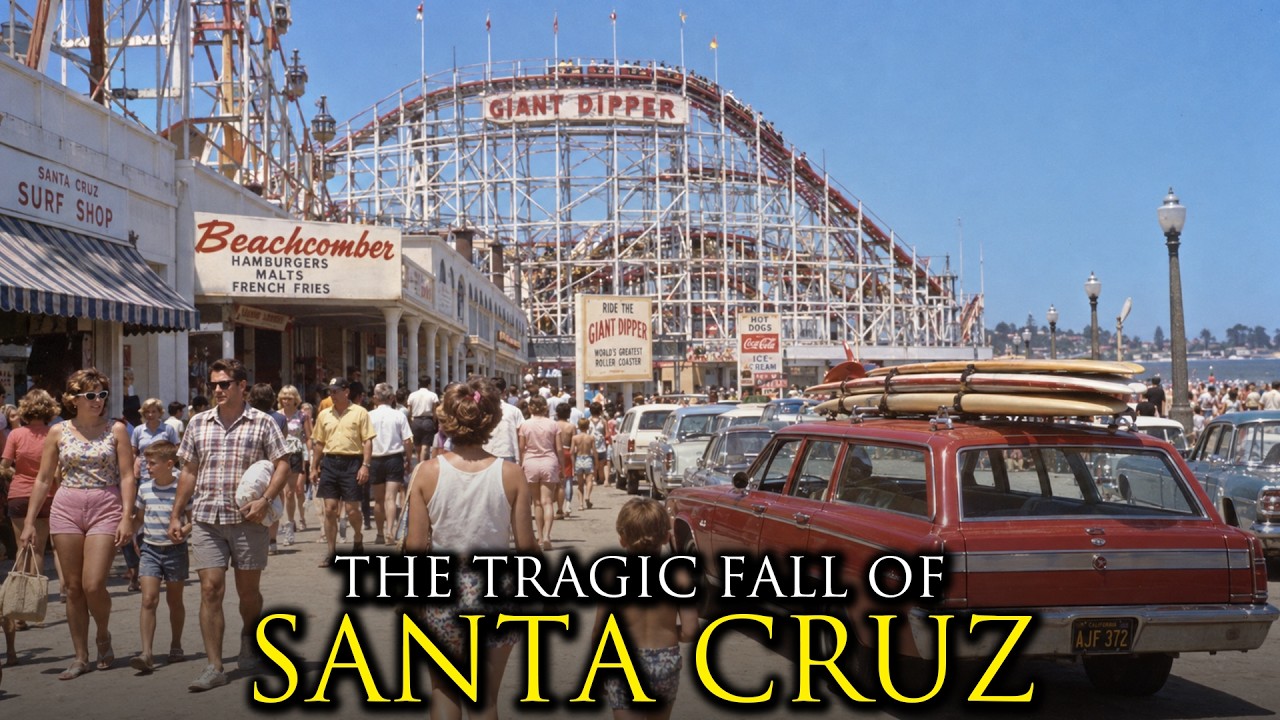
The average renter there makes twenty-two. Santa Cruz is not a place nobody wants to visit. Everybody wants to visit. What vanished is the other thing this town once sold: a cottage, a wage, and the right to stay.
The best view in Santa Cruz costs the price of a few ride tickets and lasts about twelve seconds. It comes at the top of the Giant Dipper’s first lift hill, seventy feet of white-painted timber above the sand, in the moment the chain lets go. From up there, the whole argument is visible at once. Off to one side sits the mouth of the San Lorenzo River, running out to sea between concrete banks.
Straight ahead lies a mile of public beach and a wooden wharf. Behind the park fence huddle the roofs of a few hundred small houses packed tight against it. And over all of it rise the hills where a man named Henry Cowell burned limestone into money and became the richest man in the county. Every one of those things was once something a working family could reach out and touch.
Most of them still look the same. Almost none of them belong to the same kind of people anymore. For roughly a century, that was the bargain here, and it was an unusually generous one. A cannery worker could walk to the sand in her apron.
A fisherman tied up at the wharf and slept four blocks from his boat. A schoolteacher on a schoolteacher’s salary could buy a two-bedroom cottage with a porch and a lemon tree within earshot of the roller coaster and pay it off before she retired. Nobody thought this was remarkable. In a town built on lime, gunpowder, redwood, and rockfish, the beach was simply where the workers went on Sunday.
The idea that a house near the ocean might be a financial instrument had not yet occurred to anybody. That teacher’s cottage is what this story is really about. The fortunes, the fires, the earthquake, the killings, the lawsuit over a nickname. All of it is the machinery that took the cottage away from her.
It began, as California towns do, with a mission, and it went wrong almost immediately. Mission Santa Cruz was founded on the twenty-eighth of August 1791, twelfth in the chain. In 1818, when a pirate scare emptied the mission, people from the warship came across the water and looted it, reportedly stripping the clothes off the saints. In 1857, an earthquake brought the mission down altogether, and the neighbors carried off the beams, the tiles, and the foundation stones until nothing of it was left.
The ground here has always been willing to take things back. What actually made money was limestone. In 1853, Isaac Davis and Albion Jordan began burning it in kilns above the town and within a few years ran the largest lime operation in California, producing the mortar that held brick and stone together while San Francisco, after the gold rush, went up as fast as men could stack it. A merchant named Henry Cowell lent them money.
In 1865 he bought Jordan’s half. In 1889 he took Davis’s share. By 1886, Cowell was reported to have the highest income in Santa Cruz County and sixty-five hundred acres of it. Turning limestone into lime meant days of furious heat, and the fuel was redwood, first-growth timber cut off the slopes above the quarries and hauled down by the cord.
The forest was not scenery. It was boiler feed. Alongside the lime came the sawmills and something stranger. The California Powder Works incorporated in 1861, when the Civil War cut California off from eastern gunpowder, and manufactured from May 1864 on a flat beside the San Lorenzo three miles upstream.
Over the fifty-odd years it ran, there were about fifty explosions and fires on that site. The worst, on the twenty-sixth of April 1898, killed thirteen men. People here learned to read the sound. One bang was a test.
Two meant somebody’s husband. Among the sawmills was the Grover Lumber Company, and in the summer of 1885 three unusual customers walked in. They were brothers and Hawaiian royalty: David Kawananakoa, Edward Keliiahonui, and Jonah Kūhiō Kalanianaʻole, sent to California to be schooled at a military academy in San Mateo. They wanted boards shaped in the pattern of the Olo, the long heavy board reserved in the islands for chiefs.
Grover’s men milled them from first-growth Santa Cruz Mountains redwood, as long as eighteen feet and weighing up to a hundred and seventy-five pounds. On Sunday the nineteenth of July 1885, the brothers carried those boards to the mouth of the San Lorenzo River and went surfing. The local paper recorded it with the flat courtesy of a society column, noting that the young Hawaiian princes were in the water enjoying it hugely and giving interesting exhibitions of surfboard swimming as practiced in their native islands. That sentence is the first known account of Polynesian surfing anywhere in the Americas, thirty years before Duke Kahanamoku made the sport famous at a rivermouth that was then a long, forgiving, dependable break.
The princes went home. Their boards ended up in a museum in Honolulu and did not return until an exhibition in 2015. The rest of the waterfront was working hard. A fisherman named Cotardo Stanaro arrived in 1874 from a village outside Genoa and began fishing commercially.
He sent for his family, they sent for their cousins, and by the turn of the century sixty Genoese families made up the Santa Cruz fleet. On a good morning in the early 1900s, close to a hundred boats came in to unload rockfish, sea bass, salmon, halibut, and albacore. The wharf, built in 1914, was the sixth on the site; the sea had already taken the other five. None of these were wealthy men.
Every single one of them lived within walking distance of his own boat. Then a promoter looked at the beach. Fred Swanton, born in Brooklyn in 1862, had the American gift for being early. He came west in 1883 holding a patent license for the telephone and sold it through most of California.
In October 1889 he built the area’s first electric company. He built an electric railway. In 1896 he led the investors who built California’s third hydroelectric plant up the coast. Here was a man who had spent fifteen years selling the sensation of a switch being thrown.
What he wanted next was a beach with the lights on. On the twenty-ninth of October 1903, Swanton and his backers founded the Santa Cruz Beach Cottage and Tent City Corporation with one hundred thousand dollars behind it. The money was not in a grand hotel. It was in volume, renting the sea by the week to people who had never been able to afford it.
The tents held little more than a bed and a washbasin. Four shared water closets served the whole lot, and guests were expected to eat in the company’s restaurants, which was the point. That is the invention this town handed the country, and it is easy to miss because it looks like nothing: the working family’s week at the ocean, priced so it could actually be bought. The centerpiece opened in June 1904 and was called, without a trace of irony, the Neptune Casino.
It was a two-story Moorish confection of restaurants, bandstands, and dance floors, with a heated saltwater plunge and a pleasure pier four hundred feet long over the surf, wired throughout, which in 1904 was the loudest thing a building could say. Trains brought day-trippers from San Francisco and San Jose. The beach at Santa Cruz was no longer merely a beach. It was a destination with a balance sheet.
It ran for twenty-two months. Then, on the morning of the twenty-second of June 1906, a fire started in the kitchen, and the wind off the bay had it before anyone could get near. Nine weeks earlier, San Francisco had shaken and burned. The insurance industry of the American West was in open panic, and the most valuable structure on the Santa Cruz waterfront carried no insurance whatsoever.
Swanton had put one hundred thousand dollars and three years into it, and it was gone before lunch. He did not wait for a settlement, because there would not be one. He got on the telephone, a device he had personally sold to half of California, and started ordering lumber. For the rest of that season he ran the amusements out of a circus tent pitched on his own ashes, and took the gate money anyway.
The foundation for a new casino went in that October. On the fifteenth of June 1907, less than a year after a total uninsured loss, the new casino, the new plunge, and the new boardwalk opened together under thousands of white electric bulbs, with something like eight thousand people watching. The plunge measured one hundred and forty-four feet by sixty-four, two tanks holding four hundred and eight thousand gallons, drained and refilled from the Pacific every single day, with a forty-foot slide into it. A town that had counted fewer than six thousand residents in the census of 1900 had built itself a heated indoor ocean.
In 1908 came a scenic railway. In 1911, Charles I. D. Looff, the great Danish-American carousel maker, installed the carousel that is still turning today, with hand-carved horses, a working ring machine, and a band organ built in 1894 that has 342 pipes in it.
That same year, Swanton opened the Casa del Rey, a three-hundred-room Spanish colonial hotel. In 1911, half a million dollars bought a small town. Santa Cruz now had both ends of the market, the canvas tent and the Palm Court, four hundred yards apart on the same stretch of sand. Underneath all of it sat one decision that has outlasted every man who made it.
The beach at Santa Cruz is public, and the amusement park built along its edge has never charged anybody a cent to come in. There is no gate. A family can walk the whole boardwalk, hear the organ, watch the coaster, and spend nothing at all, because the money is made on rides, food, games, and parking from the people who choose to spend it. Nearly every comparable operation in America eventually went the other way, toward a turnstile and an entry price that quietly works as a filter on who turns up.
Santa Cruz never did. It has survived every owner the beach has ever had and one hundred and twenty summers. By the end of this story, it is very nearly the only piece of the original bargain still standing. Swanton himself did not last.
In 1915 the beach properties passed to a new entity, the Santa Cruz Seaside Company. Swanton, who had electrified a county and rebuilt a burned resort in eleven months, was now a promoter without a resort. He was elected mayor in 1927 and served until 1933, through Prohibition and into the Depression, watching his real estate schemes come apart in his hands. He died in Santa Cruz on the third of September 1940.
It is the first clear instance of a pattern this town has never been able to shake. Santa Cruz has the idea. Santa Cruz builds the thing. And somebody else ends up holding the paper.
The thing everybody now pictures when they picture Santa Cruz went up in 1924, and it was not the Seaside Company’s idea either. Charles Looff’s son Arthur leased the ground and hired the roller coaster designers Frank Prior and Frederick Church. Their crew built the Giant Dipper in forty-seven days. It opened on the seventeenth of May 1924, painted white, and the ride has never been about speed.
It is about the first hill, the twelve seconds at the top of it, and the view. More than sixty-eight million people have taken that ride since. Nine years after it opened, it very nearly left town on the back of a truck. The Depression flattened business, and by 1932 the coaster was earning about a third of what it once had.
In the spring of 1933, Arthur Looff told the Seaside Company he would take the Giant Dipper apart, load it, and put it back up in Long Beach. For roughly ten weeks, the object that is now the symbol of Santa Cruz was a pile of numbered lumber with a moving date on it. On the fifth of June 1933, the Seaside Company bought the entire Giant Dipper Company outright, stock and all, and made the problem permanent. For nine months of the year, Santa Cruz was a small, damp, ordinary California town where the rent was low because nobody in particular wanted to be there in February.
That is what made the cottages affordable. Then the war interrupted things. In March 1943 the Navy leased the Casa del Rey and turned it into a five-hundred-bed convalescent hospital. Over three years, more than eighteen thousand servicemen were treated in a building designed for honeymoons and Sunday dinners, looking out at an amusement park that went on running.
The Navy handed it back in April 1946, and the hotel never recovered. By the 1970s, the finest building on the Santa Cruz waterfront had been converted into housing for the elderly. Something quieter was happening at the same time, and it did more damage than the war. The automobile finished off the excursion train.
A family that had once booked a week in a tent or a cottage because the journey itself ate a day could now drive over the mountains after breakfast, spend the afternoon on the sand, and be home for supper. Tent cities, cottage courts, and residential hotels along the California coast quietly stopped making commercial sense. The buildings did not vanish, though. They turned into cheap year-round rooms, which is precisely what kept a certain kind of person living within sight of the ocean for another forty years: the deckhand, the waitress, the retired cook, the man between things.
Santa Cruz had a great deal of that sort of housing. Almost none of it is there now. Then, on the twenty-second of December 1955, the river came for the town. Weeks of rain across the state had loaded the San Lorenzo watershed, and on the night before Christmas Eve the river left its banks and ran down Pacific Avenue three to four feet deep.
Accounts of the dead differ, but seven is the usual figure, though some sources say nine. Around twenty-eight hundred people were displaced. Nearly a hundred homes along the river were destroyed. The flood took the last Chinatown in Santa Cruz, whose residents left and never came back, because the flooded ground was cleared for a redevelopment scheme that put a supermarket, a drugstore, and a cinema where the community had been.
That was the second thing Santa Cruz lost permanently in one night, and it was the smaller of the two. The larger loss came out of the response. Between 1957 and 1959, the city of Santa Cruz and the United States Army Corps of Engineers channelized the lower two and a half miles of the San Lorenzo River. The willows and cottonwoods came out.
Rock levees went in. It worked in the sense that there has not been another 1955. But when it was done, the public looked at what they had bought and said, more or less unanimously, that their river was now a drainage ditch. And there is one line in that bill nobody itemized at the time.
The mouth of the San Lorenzo, the long, easy, dependable break where three Hawaiian teenagers had ridden milled redwood in 1885, did not survive the rebuild. The harbor finished it off. In 1962, Congress appropriated funds for jetties and dredging just east of the river mouth, and in 1964 the new small-craft harbor dedicated its first 360 slips. Rock jetties do to moving sand what a dam does to moving water.
The first surf spot in the continental United States was buried by a flood control project and a boat basin, by men trying to save the town. Meanwhile, the largest single land transaction in the county’s history was being negotiated over the old lime ranch. Henry Cowell’s last child died in 1955, and the family holdings passed to a foundation. In March 1961 the regents of the University of California chose that ranch as the site of a new campus.
Classes began in the fall of 1965. There were no dormitories yet, so the first students slept in forty-foot trailers parked in wagon-wheel clusters. The kilns that had mortared San Francisco now stood inside a university’s historic district. The campus has since become the standard local explanation for everything that followed: the university arrived, demand for housing exploded, and the town was never affordable again.
That chain gets asserted constantly, but a campus does not by itself create the least affordable rental market in the United States. Santa Cruz sits forty miles from San Jose over one mountain road. It is on the California coast, where building has been restricted by state law since the early seventies. Its own voters chose growth limits repeatedly and by large margins.
The university is one pressure among several. What the campus unambiguously did was add many thousands of people who all needed a bed to a town that had decided not to build any. Before any of that mattered, Santa Cruz went through something it has never entirely finished discussing. Between October 1970 and February 1973, over twenty-eight months, more than twenty-five people were murdered in and around the town by three unrelated men operating at the same time with no knowledge of each other.
John Linley Frazier killed an eye surgeon and his family in their own house above the town. Herbert Mullin killed almost at random, including a priest in a confessional. Edmund Kemper picked up hitchhiking students. At a press conference, a reporter handed the district attorney a phrase, and he repeated it back: right now, we must be the murder capital of the world.
It ran nationally. A beach town that sold sunshine spent two and a half years as the most frightening address in America. For a while afterward, property there was not hard to afford at all. What came next was a town deliberately trying to be lovely.
In 1968, Pacific Avenue was rebuilt as the Pacific Garden Mall, with curving lanes, planters, trees, brick, and benches. It worked. Downtown Santa Cruz in the seventies was one of the pleasantest streets in California, full of bookshops and coffee and buskers. And above nearly every storefront sat the cheap rooms that had been there since the twenties.
In the same decade, the city rewrote its general plan to protect single-family zoning across almost the whole town. In 1978, county voters passed Measure J, which drew a line around urban services, aimed to hold population growth to two percent a year, and required fifteen percent of new homes to be affordable. Every one of those decisions was popular. In close to fifty years, Measure J has produced somewhere around five hundred deed-restricted affordable homes, roughly ten a year in a county of a quarter of a million people, because a requirement only bites on homes that actually get built, and the rest of the measure was designed to make sure fewer of them were.
At four minutes past five on the evening of the seventeenth of October 1989, the Santa Cruz Mountains moved. The epicenter of the Loma Prieta earthquake was about ten miles from downtown, and the magnitude was 6. 9. Most of America watched it live because the World Series was starting in San Francisco, and most of America therefore remembers it as a San Francisco earthquake.
It was not. Santa Cruz sat on the fault. The Pacific Garden Mall sat on river sediment, and the buildings that had been made so charming were unreinforced brick from the 1890s. Three people were killed when those buildings came down.
Roughly half of the downtown commercial core was destroyed in fifteen seconds. More than thirty buildings were lost. The Casa del Rey came down too, damaged past saving, seventy-eight years after Swanton opened it and two decades into its second career as housing for old people. There is a parking lot on the site now.
For a city of fifty thousand, Santa Cruz lost around ten percent of a twenty-three-million-dollar general fund that year. In January 1990, the city appointed a thirty-six-member board to run the rebuilding, which jammed conservative business owners and left-wing activists who had spent a decade at each other’s throats into one room. Through that winter, about three dozen merchants sold goods out of tented pavilions pitched within a few blocks of the ruined avenue, under canvas in the rain. It had been eighty-four years since Swanton’s circus tent, and the solution was identical.
What eventually came back was straighter, safer, and more expensive. The Cooper House, the old county courthouse turned into the most beloved building downtown, was among the losses. So were 160 rental rooms for single occupants in the mall area alone, small plain rooms over shops, the cheapest legal beds in the city, rented by the month to fishermen and cooks and pensioners and people between things. They were never replaced, because nothing in the economics of coastal California after 1990 would ever produce a room like that again.
The earthquake demolished the buildings. The rebuilding demolished the rent. Then Silicon Valley came over the hill. Through the nineties and two-thousands, the Santa Cruz Mountains stopped being a barrier and became a commute.
By 2012, Apple, Google, Netflix, and Yahoo were running private coaches over Highway 17, fitted with Wi-Fi, so an engineer could work the whole way from Santa Cruz to San Jose and back without touching a steering wheel. A tech worker commuting out of the county earned a median income roughly thirty thousand dollars a year above somebody working inside it. Put those two people in the same auction for the same cottage, and the result is not in any doubt. The share of Santa Cruz residents renting rather than owning rose from fifty-three percent in 2000 to sixty percent in 2017.
The teacher’s cottage was still standing. It had simply stopped being for teachers. A starting teacher in Santa Cruz City Schools was on $63,634 for the 2023–2024 year, and it takes about thirteen years in a classroom to clear one hundred thousand. Landlords there commonly want to see monthly income of two and a half to three times the rent before they will look at an application.
A new teacher in Santa Cruz cannot qualify for an ordinary two-bedroom apartment in the town where she teaches. The district has lost around a hundred teachers since 2014 to the cost of living, and by one account, in 2022, ninety-five percent of the candidates it offered jobs to turned them down. The district is now building housing for its own staff at sixty to seventy percent of market rent, because there is no other way left to staff a school. And in the middle of it all, Santa Cruz lost the argument over its own name.
Jack O’Neill had opened his surf shop in 1959 and turned neoprene into something a surfer would actually buy. That did not help either. In November 2004, the Huntington Beach Conference and Visitors Bureau, four hundred miles south in Orange County, filed to register Surf City USA as a trademark. Within two years, the federal registrations came through.
In the fall of 2006, the bureau’s lawyers posted cease-and-desist letters to two small Santa Cruz shops over t-shirts that said Surf Santa Cruz, California, USA. The shop owners sued. The case ran more than a year and ended in January 2008 in a confidential settlement, all claims dismissed, with Huntington Beach holding the exclusive right to call itself Surf City, USA. That is how the place where American surfing began in 1885, on redwood cut in its own hills at a rivermouth its own engineers later buried in rock, came to need permission to use the phrase.
So here is what a cottage near the Giant Dipper costs now. In 2025, for the third consecutive year, the National Low Income Housing Coalition named the Santa Cruz metropolitan area the least affordable rental market in the United States. Not among the worst. The worst.
Renting a modest two-bedroom at fair market rent there requires an income of $168,920 a year, which is $81. 21 an hour. The average renter in Santa Cruz earns $22. 13 an hour.
That is 3. 7 full-time jobs worked simultaneously to rent two bedrooms. Two years earlier, the figure had been sixty-three dollars an hour. The gap is not closing.
It is opening. In October 2025, the county’s median home sale price was around 1. 1 million dollars, and that was after a fall of more than eight percent on the year. The people who do the summer work live in the beach flats, the tight grid of small houses directly behind the amusement park on the ground where Swanton pitched his tents.
It is largely Latino, largely renting, and largely employed within a quarter-mile of home. For twenty-five years, a patch of it was a community garden worked by about twenty Spanish-speaking families, most of them from Mexico and El Salvador, growing the food they could not afford to buy in the shops of Santa Cruz. The land belongs to the Seaside Company. In March 2015, the gardeners were told the lease would end that November.
Hundreds of people packed the council chamber on the twenty-seventh of October, and the council voted unanimously to pursue buying the land outright and keeping the garden permanently. What it actually signed in 2016 was a three-year lease on sixteen thousand square feet, with ten thousand handed back to the company and a sixty-day escape clause. None of which has hurt the boardwalk in the slightest. It draws close to three million visitors a year.
It employs about 750 people through the fall and winter and more than 1,600 in summer, four out of five of them students. It has better than forty rides, the largest arcade in Northern California, and thirty-one places to eat. It is the oldest amusement park in the state and the last major seaside amusement park left on the West Coast. The Giant Dipper and the Looff Carousel were both declared national historic landmarks in 1987.
In January 2025, the company settled a wage dispute with its own employees for $5. 9 million. And the admission price, 120 summers after Fred Swanton pitched a circus tent on the ashes of his own casino, is still nothing at all. The cheapest good day in California sits in the most expensive place in America to live.
The ocean, meanwhile, has begun collecting. On the fifth of January 2023, a six-foot tide met twenty-three-foot surf and tore the 166-year-old Capitola Wharf three miles down the coast cleanly in half, driving the debris through ten restaurants on the esplanade. In August 2020, a dry lightning storm, eleven thousand strikes in a single night, started the CZU fire, which burned about eighty-six thousand acres of the Santa Cruz Mountains and 1,450 buildings, and took much of the old growth at Big Basin with it. And on the twenty-third of December 2024, at about a quarter to one in the afternoon, 150 feet of the Santa Cruz Wharf dropped into the sea with three men standing on it.
They were there to inspect it, standing on a section left damaged by an earlier storm. Two of them were pulled out of the water, and the third swam ashore. The wharf reopened to the public thirteen days later. That is the sixth wharf on that site, and the sea has now taken a piece of the sixth.
From the top of the Giant Dipper on a clear afternoon, in the twelve seconds before the first drop, the whole of it sits in one frame. The concrete throat of the river where three teenagers went in on redwood in 1885. The repaired gap in the wharf. The hills where the lime kilns are now a historic district inside a university.
And the small bright roofs of the beach flats, where a house goes for more than a million dollars. Below, the 1894 organ is playing. The ring machine is still handing out brass rings to anyone with the nerve to lean out for one. The gate is still open, and it is still free.
And the chain lets go.






