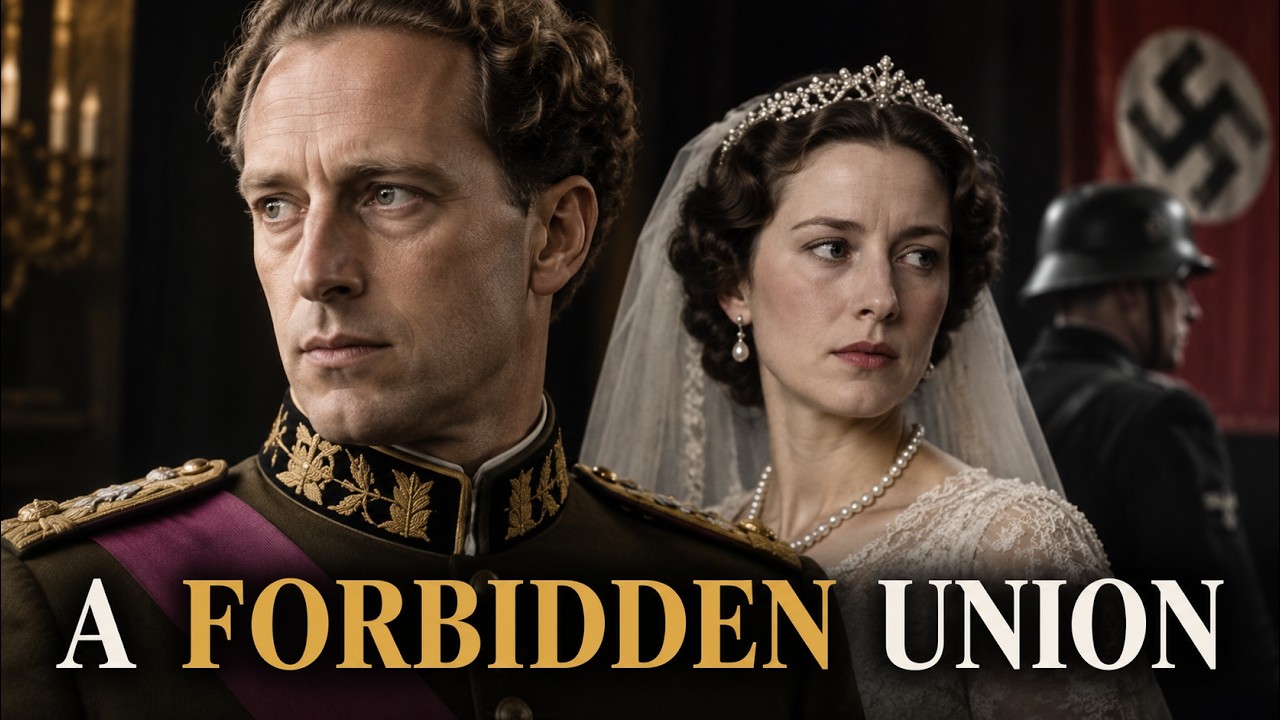
In December 1941, Belgians opened their newspapers and learned that their king had married again—months after the ceremony had taken place. Leopold III, the widower king who had shared his people’s captivity since the German invasion, had quietly wed Lilian Baels while the country was under Nazi occupation. The announcement did not create the crisis over his reign, but it gave that crisis a face and a date, and it changed how many Belgians saw the man who remained at Laken as a prisoner. Six years earlier, Leopold had lost Queen Astrid.
Her death in a car accident in Switzerland left him a widower with three young children. Astrid had occupied a prominent place in public affection, and the family tragedy became part of how people understood his kingship. When he married again, her memory stood in the background—a previous marriage remembered by a nation as well as by his family. Leopold had come to the throne in 1934 after the death of his father, Albert I.
His reign was still relatively young when Germany invaded Belgium in May 1940. The invasion created immediate military decisions, followed by a longer constitutional question. A monarch could be both commander of an army and head of state, but those responsibilities became difficult to reconcile once military defeat appeared unavoidable. The decisive disagreement with his ministers came before the second wedding.
During the fighting, Leopold refused to accompany the government out of the country. He wanted to remain with the army, while the ministers intended to continue the Allied war effort abroad. They could not agree on what defeat should require of him. The separation left the king in Belgium and the government on a route that eventually led to London.
The Belgian army surrendered on May 28th. The government maintained that this military act had not ended Belgium’s participation in the war. It also held that a king under enemy control could no longer exercise his constitutional functions. That distinction is essential to everything that followed.
The occupation put Leopold in a position where he remained king but could not govern in the ordinary way through ministers responsible for his acts. He was confined at Laken under German authority. The household remained a royal residence with familiar surroundings and family life, but its freedom was limited by the occupier. Different Belgians drew different meanings from that situation.
Supporters could see a king sharing the fate of people unable to leave. Critics could see a monarch separated from a government still conducting the war. Neither view was simply invented after the wedding. The phrase “prisoner king” became particularly powerful.
It linked his residence in occupied Belgium to the captivity experienced by soldiers. Yet the conditions at a royal house were plainly different from those in a prisoner-of-war camp. That difference did not need to mean Leopold was free to act as he pleased. It meant that any private decision revealing the continuation of ordinary family life could become politically sensitive.
Lilian Baels came from a Belgian family with public connections. Her father had been a minister and governor of West-Flanders. She was not a foreign royal bride brought in through negotiations between reigning houses. The marriage would therefore differ from Leopold’s first union in the role it could play publicly.
It joined a king to a woman from within his own country’s social and political world during an occupation that complicated every public connection. The wedding took place in two stages. The religious ceremony came first, on September 11th, 1941. The civil marriage followed on December 6th.
This reversed the sequence required in Belgium, where a religious wedding was supposed to follow the civil one. The order was more than an unusual piece of family planning. It exposed a king to criticism for failing to observe a rule that applied to other people. The constitutional point mattered because the king was a public institution as well as a bridegroom.
A secret ceremony might remain unknown for a time, but it could not permanently remove the questions created by the marriage. Once the union was announced, people could ask about the legal order of the ceremonies and the conditions in which they had occurred. The details gave opponents something more definite to discuss than rumors about his private life. Cardinal Van Roey’s announcement brought the news into public view in December.
The Belgian State Archives historical account dates the public disclosure to December 7th. Belgians learned that their king had remarried months after the first ceremony. The interval itself made the news startling. The household at Laken had undergone a change while the wider country had continued to see Leopold through the existing images of widower and captive.
Lilian was known as Princess of Rethy rather than Queen Lilian. Astrid’s children remained central to the succession, and the children of the second marriage were not presented as replacing them. The arrangement tried to distinguish Leopold’s new household from a new queen taking Astrid’s public place. That distinction limited one possible source of conflict.
It could not settle the broader question of whether this was an appropriate moment for the king to marry. For people who supported Leopold, remarriage could be understood as the rebuilding of a family after a long bereavement. His children had lost their mother, and he had remained a widower for years. A royal family did not cease to have private needs because its country was at war.
That was one possible way to understand the act. It did not oblige people enduring very different wartime conditions to receive the announcement in the same spirit. The reaction was especially damaging among people whose relatives remained prisoners of war. The State Archives account emphasizes resentment among Walloon and French-speaking sections of the population.
For critics, a king able to remarry did not fit the image of a captive sharing the circumstances of their absent husbands and sons. The comparison made the wedding a public question about solidarity, even though a wedding could not tell them everything about conditions at Laken. The king’s status now carried an awkward pair of claims. His inability to exercise public functions rested on being under enemy power.
At the same time, news from his household showed that significant private decisions were still being made. That did not legally prove he could govern again. Politically, however, it offered opponents a way to challenge the story through which supporters had explained his continued presence in Belgium. A civil marriage record gives the event a fixed place in that argument.
It identifies the ceremony at Laken in December, after the religious union in September. There is no need to invent a private exchange between Leopold and Lilian to see why the sequence mattered. The dates themselves became evidence. They could be set beside the public image of the king and the legal rule about the order of ceremonies.
Other disputes continued around him during the occupation. His relationship with the government in London remained troubled, and his political conduct was increasingly scrutinized. The wedding became one part of that larger record. Treating it as the single cause of his eventual abdication would erase the disagreement that had begun during the invasion.
It would also give a family decision sole responsibility for a crisis involving ministers, parties, regions, and the conduct of a war. In 1944, the Germans deported Leopold and his family. Their movement out of Belgium did not resolve the argument over his earlier decisions. It changed the immediate circumstances of captivity and left the country without him when liberation began.
His brother, Prince Charles, became regent. Belgium could restore its institutions while the question of the king’s return remained open. The monarchy continued through someone acting in his absence. American forces liberated the royal family in Austria in May 1945.
Leopold was no longer held by the defeated German regime. That did not automatically restore his ability to resume the throne. Political opposition stood between liberation and return. A government needed to work with the monarch, and the dispute made that difficult.
His private household had survived while his public position remained unsettled. For several years, the argument continued through negotiations and party politics. Belgium’s institutions had to decide whether a return would restore normal life or create further division. Supporters regarded the interruption of his reign as something that should end.
Opponents demanded a different outcome. The second marriage remained available as an episode through which each side could explain the distance between its view of the king and the view held by others. In March 1950, a popular consultation produced a national majority in favor of his return. The total was about 58 percent.
That figure appeared to offer a way forward, but the vote was uneven across the country. Support was stronger in Flanders and weaker in Wallonia and Brussels. A single national result therefore concealed regional divisions. Those differences would become visible again when the king actually returned.
Leopold came back to Belgium in July. His supporters could point to the consultation and parliamentary decisions allowing the restoration of his functions. His opponents responded with strikes and demonstrations. The act that was supposed to close the dispute instead brought it into the streets.
After years of absence, the country still did not have a shared answer to the question of whether his presence would unite it. The confrontation led to an arrangement transferring the exercise of royal powers to his son Baudouin. Leopold accepted that withdrawal in the summer of 1950. The following year he formally abdicated, and Baudouin became king.
These were separate steps—handing over functions first, then ending the reign. The distinction shows how the monarchy tried to continue while removing the person around whom the conflict had formed. Lilian’s marriage to Leopold continued after he lost the crown. Their private relationship had produced a lasting household even though the public position in which it began had ended.
She did not become a reigning queen beside a restored sovereign. The family future and the political future separated. That is a more precise outcome than the suggestion that one secret wedding instantly destroyed a throne. The wedding changed the crisis because it gave an existing argument a personal event people could picture.
A widower had remarried. A prisoner had held ceremonies at a royal residence. A monarch had reversed the required legal order. Each fact could be placed inside a different account of duty, family, and wartime solidarity.
The resulting conflict was about what Belgians expected their king to embody when ordinary political life had broken down. The final document was not the marriage register. It was the abdication in 1951, followed by Baudouin’s succession. Leopold retained the wife he had chosen under occupation while another member of the family took the public office.
The secret wedding had become a lasting part of the case against his return. The monarchy survived by giving Belgium a different king, and Leopold’s second marriage continued outside the reign in which it had begun.






