On September 11, 1999, Francis Doyle Whitmore walked out of the Eastern Shore Farmers Market in Queenstown, Maryland, loaded two canvas bags of groceries into the trunk of her Buick LeSabre, and drove away. She was 61 years old, three weeks shy of her 35th wedding anniversary. Her husband Bernard had planned a dinner at the restaurant where they had shared their first date, a surprise he had not yet told her about. He never got the chance.
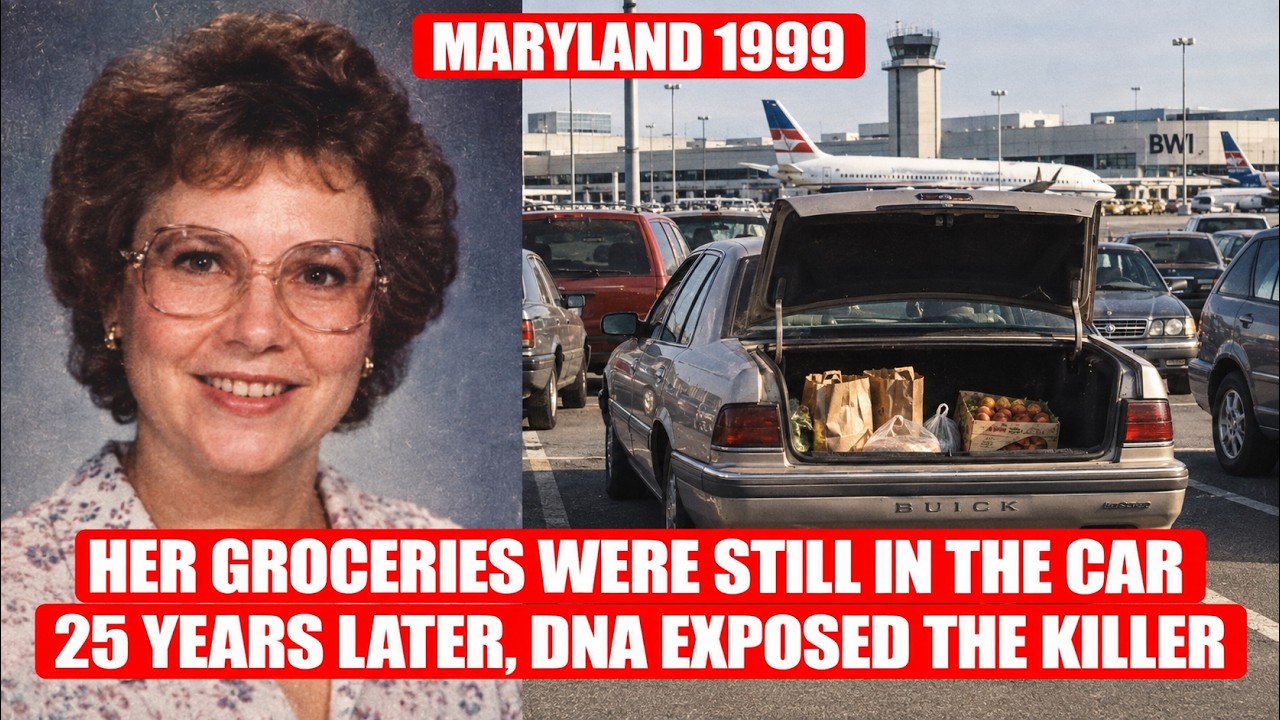
Francis did not come home that afternoon. Her Buick was found 48 hours later in the long-term parking lot at Baltimore-Washington International Airport. Her groceries were still in the trunk, the peaches she had bought that morning going soft in the September heat. Authorities concluded she had left voluntarily: a woman in her sixties, no sign of violence, a car at an airport.
Bernard Whitmore stood beside the Buick, looked at those grocery bags, and told a detective something that was written down and filed. Twenty-five years later, a young investigator in Annapolis read that note and understood it for the first time. Bernard had said Francis would never leave peaches to go soft. She would never waste food.
She did not leave. He was right. It would take 25 years, a genealogical DNA match, and the testimony of a man who had carried a secret across three decades to prove it. Queenstown was a small place, barely a thousand people, a community organized around the farmers market, the volunteer fire department, and the Methodist church at the top of Main Street.
People knew their neighbors across two generations. They attended the same funerals where they had attended christenings. They brought food when someone was sick and expected food in return. Francis Doyle Whitmore had taught third grade at Centerville Elementary School for 22 years before retiring in 1997.
She was the kind of teacher former students mentioned by name when asked who had made a difference. She had a garden behind the house on Holly Lane that she tended with the same patient precision she had brought to her classroom. She made her own jam. She sang in the church choir.
She and Bernard had no children of their own, but over 22 years of teaching she had accumulated what Bernard called a borrowed family of several hundred. On the morning she disappeared, Bernard was working in the yard when Francis left the house at 9:15. She told him she would be back by noon. The market ran Saturday mornings until one, and she had a list: peaches, late tomatoes, honey from a particular beekeeper whose stand she visited every week.
The vendor who sold her the peaches remembered her because she asked about his bees the way she always did. She paid with exact change the way she always did. She folded her receipt into her jacket pocket. She walked to the parking lot at 9:53, loaded her bags, and drove away from Queenstown.
By noon she had not returned. By two o’clock Bernard was making calls. By five he was at the Queenstown Police substation. That evening the Queen Anne’s County Sheriff’s Office opened a missing persons report.
The case was assigned to Detective Lyall Carver of the Queen Anne’s County Sheriff’s Office, a methodical man of 52 who had worked the Eastern Shore for 24 years and was known for the quality of his written records: precise, dated, nothing omitted. In the first weeks he pursued the investigation with full resources. Bernard was ruled out within 72 hours; he had been visible in his yard to two neighbors all morning, and his anguish was, in Carver’s professional assessment, entirely real. The airport angle was exhausted quickly.
No ticket had been purchased under Francis’s name. No record of any travel existed. No surveillance footage from 1999 survived long enough to be reviewed when the technology existed to review it usefully. What Carver had was a gap.
Francis had left the market at 9:53. The Buick had arrived at BWI at some point before it was ticketed at 2:15 p. m. on September 13th.
Between those two points there was nothing: no witness who had seen her on the road, no toll record. The Bay Bridge toll records from that day were preserved in a format the county’s technology could not process in 1999, a fact Carver noted and flagged. There was no transaction on her bank account or credit card after 9:53. The peaches were in the trunk.
The receipt was in the pocket of a jacket she had not been wearing when she disappeared, because the jacket was found folded on the back seat of the Buick. Two men were investigated formally. The first, a handyman who had done routine work at the Whitmore house the previous spring, could not precisely account for the morning of September 11th. He was interviewed three times.
Nothing connected him to Francis. He was set aside. The second was a man whose dark pickup truck had been seen by a market vendor parked at the edge of the lot that morning, a truck she noticed because it was not from around here. She could not give a plate number.
She could not describe the driver. The truck was never found. Carver submitted the case to the Maryland State Police Cold Case Unit in November 2001. On the summary page he wrote: “The airport placement is the question.
Someone put that car there. Francis Whitmore did not put that car there. ”
He retired in 2006. Before he left, he gave Bernard Whitmore his home phone number and told him to use it if anything came up.
Bernard used it twice, both times on leads that went nowhere. The file went back to the cabinet. Bernard kept the house on Holly Lane. He kept the garden, though it got harder to maintain as he aged.
He kept Francis’s choir seat empty at Christmas and Easter. He turned 70 in 2005, 80 in 2015. Well-meaning people told him it was all right to stop. He did not stop.
He still called the cold case unit twice a year. Francis’s remains were discovered in 2017, eighteen years after she disappeared, during a survey of a wetland parcel in Queen Anne’s County being assessed for conservation acquisition. A state environmental surveyor found them in a stand of phragmites at the edge of a drainage ditch two miles from the Eastern Shore Farmers Market, in the opposite direction from the airport. Someone had moved her car to BWI to send investigators away from the Eastern Shore.
Someone who knew the shore well enough to know how long the marsh would hold a secret, and who had been right about that for eighteen years. The medical examiner confirmed identification through dental comparison. The cause of death was consistent with blunt force trauma. The crime lab extracted a DNA profile from biological material recovered at the site, degraded but viable.
It was entered into CODIS in 2018 and produced no match. In 2022, the Maryland State Police received a federal grant earmarked for forensic genealogy analysis of cold cases with existing biological evidence. The Whitmore case was among the first selected. A forensic genealogist worked through the spring and summer identifying cousin matches distributed across Maryland, Delaware, and Virginia.
By September he had narrowed the candidate pool to three men of the right age and geography. By October he had one. His name was Victor Allen Slade. He was 68 years old.
He had grown up in Grasonville, four miles from Queenstown, and had spent most of his adult life on the Eastern Shore, working first in crab processing and later for 20 years in long-haul refrigerated trucking. Work that gave him the freedom of movement and the practical knowledge of how to route a vehicle to a distant location and return without leaving a record. In the autumn of 1999 he had been 45 years old, working a route that ran from Baltimore down through the shore twice a week. He had known the farmers market lot, the marsh road, and the long-term parking at BWI with the familiarity of a man who spent his life on those roads.
Detective Sharon Okafor of the Maryland State Police Cold Case Unit, assigned to the Whitmore case in 2021, drove to Chester, Maryland, on a Tuesday morning in November 2022. She carried a warrant authorizing a DNA sample and a file that Detective Carver had built 23 years earlier with the precision of a man who believed someone would eventually need to read it. Victor Allen Slade answered his door in work boots and a flannel shirt. He looked at the badge.
He looked at the warrant. He stepped back from the door without speaking. He sat at the kitchen table. He did not resist the swab.
When it was done, he looked out the window at the Chester River, visible through the back porch door, and said, “I drove past that market every week for years after. I don’t know why I did that. ”
He said nothing else until his attorney arrived. The DNA match was confirmed in December 2022.
Victor Allen Slade was arrested on January 14, 2023 at his home in Chester. Neighbors who had lived beside him for 11 years watched from their windows and doors as a man they had known as a quiet, self-contained presence, the kind of neighbor who shoveled the walk without being asked and returned borrowed tools the same day, was placed in handcuffs in the January cold and driven away. One neighbor told a local reporter, “He fixed my back fence last spring. He wouldn’t take money for it.
I offered twice. ”
The case built by Detective Okafor was extensive. The DNA from the recovery site matched Slade at a probability exceeding one in eight trillion. The Bay Bridge toll records that Carver had flagged in 1999 as unprocessable in their original format had been digitized by the Maryland Transportation Authority in 2015 as a routine archival project.
They showed a transponder registered to a refrigerated transport company passing eastbound toward the shore at 12:40 p. m. on September 11, 1999, and westbound toward BWI at 1:50 p. m.
The transponder was assigned to a truck whose driver log for that date listed Victor Allen Slade. He had crossed the Bay Bridge in both directions within the window between Francis leaving the market and the Buick appearing at BWI. He had moved her car. He had driven back across the bridge.
He had delivered the truck to a depot in Jessup that evening, signed out at 5:15, driven home, and as far as anyone knew, had dinner, watched television, and gone to bed. In October 2023, Victor Allen Slade entered a guilty plea in Queen Anne’s County Circuit Court to one count of first-degree murder. He was sentenced to life in prison. He made no statement at sentencing.
He looked at the floor. Bernard Whitmore, 85 years old, sat in the front row beside Francis’s younger sister, Margaret, who had driven from Delaware and held Bernard’s hand for the duration of the proceeding. When Slade was led from the room, Bernard did not move for a long moment. Then he reached into his jacket pocket and took out a folded piece of paper and held it without opening it.
Margaret asked him what it was. He said it was a grocery list. Francis had left it on the kitchen table the morning she went to the market. He had been carrying it in his jacket pocket for 24 years because he had not known what else to do with it.
He put it back in his pocket, stood up, and thanked Detective Okafor, who took his hand in both of hers and held it for a moment. Then he and Margaret walked out into the October morning. Francis Doyle Whitmore was 61 years old. She sent Christmas cards to students she had taught 15 years before because she thought about them and wanted them to know it.
She bought peaches from a man whose bees she asked about every week. She paid with exact change. She planned to be home by noon. Bernard had a dinner planned that he had never told her about.
Justice found Francis Doyle Whitmore after 24 years. It came through a man who built his records as if someone would need them someday, through a bridge toll digitized in 2015 by archivists who did not know it was evidence, through a genealogist who traced a family across four states, and through a detective who sat across a kitchen table from a man who had been driving past a farmers market for years and could not explain why. A grocery list stayed in a jacket pocket for 24 years because Bernard Whitmore did not leave behind things that belonged to his wife.
He was right not to.






