For more than seventy years, Elizabeth II stood at the center of British public life. She watched prime ministers come and go, met presidents, monarchs, and dictators, opened Parliament, traveled the world, and celebrated jubilees watched by millions. Yet despite all that attention, one thing remained hard to see clearly: Elizabeth herself. What did she actually feel?
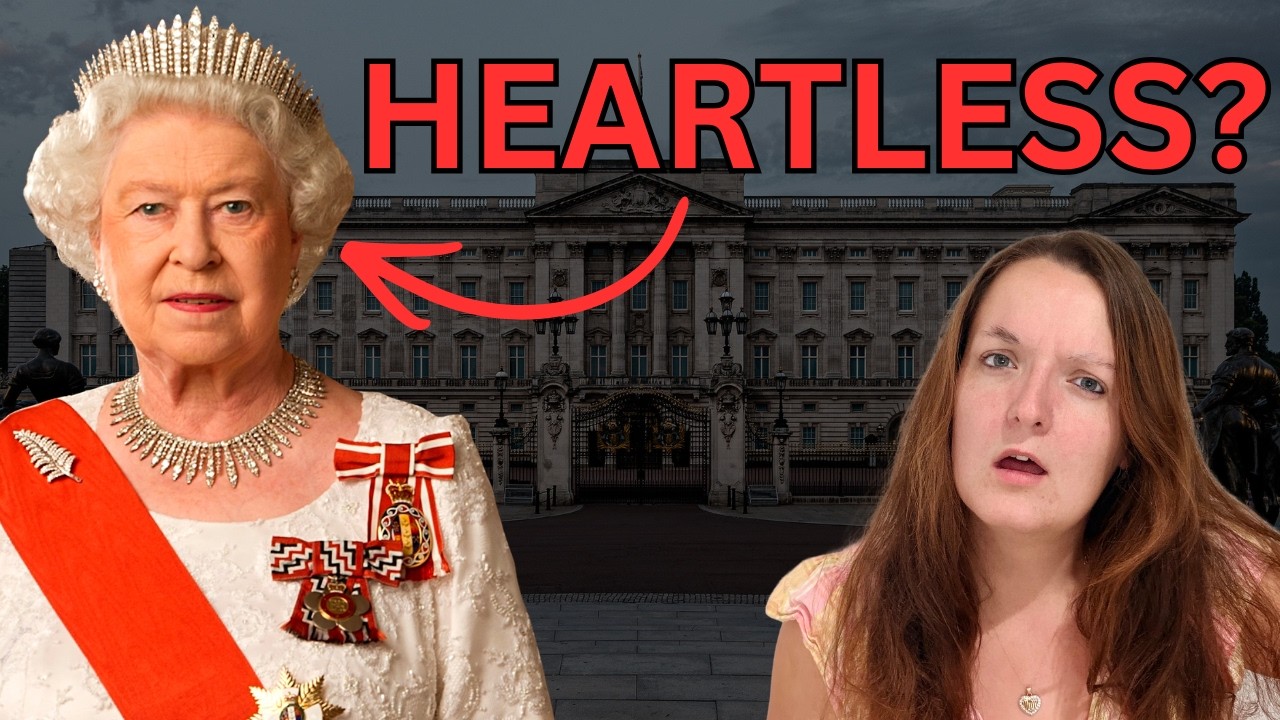
When she was angry, did she show it? When she was heartbroken, did she cry in public? When her children struggled, did she put motherhood before the crown? And when Princess Diana entered the royal family and found herself trapped in one of the most painful royal marriages of the twentieth century, was Elizabeth II truly cold-hearted?
Or had she simply spent her entire life learning that showing too much emotion was not something a monarch did? To answer that, it is necessary to go back to the beginning. Elizabeth Alexandra Mary was born in London on April 21, 1926. She was not expected to become queen.
Her father, Prince Albert, was the second son of King George V, and the throne was expected to pass to her uncle, Edward, Prince of Wales. Elizabeth was born into privilege, but not necessarily into the destiny that would eventually consume her life. She had a relatively sheltered childhood with her parents and her younger sister, Margaret. The royal family’s own historical records describe the household as close-knit, and Elizabeth was educated privately at home.
Everything changed in 1936. Edward VIII abdicated in order to marry Wallis Simpson. Elizabeth’s father suddenly became King George VI, and the ten-year-old girl became heir to the throne. In one moment she was a child; in the next, everyone knew she would one day be queen.
From that point on, her education became increasingly focused on the responsibilities of monarchy. She studied constitutional history and law, was tutored by her father and Henry Marten of Eton College, and received religious instruction from the Archbishop of Canterbury. During the Second World War, she experienced something else that would shape her character: duty. The young princess did not simply disappear into comfort while Britain was at war.
She and Princess Margaret remained at Windsor Castle, where they continued their education, took part in air raid drills, and lived under rationing. At eighteen, Elizabeth joined the Auxiliary Territorial Service. She trained as a driver and mechanic, and in 1945 she became the first female member of the royal family to serve as a full-time active member of the armed forces. The lesson was becoming clear.
The monarchy was not about what you wanted. It was about what was expected of you. And Elizabeth absorbed that lesson with exceptional thoroughness. In 1947, Elizabeth gave a speech that offered one of the clearest insights into the person she was becoming.
She was only twenty-one, and she made a striking declaration: “My whole life, whether it be long or short, shall be devoted to your service. ” This was not merely a pleasant royal address. It was an extraordinary statement of identity. Elizabeth was essentially saying that her life belonged to duty.
She was not promising to have a normal life and occasionally perform royal work. She was promising the opposite. Her entire existence would be dedicated to her service. This becomes extremely important when examining her later behavior as a mother and grandmother.
What happens when a person is trained to believe that duty must come before everything else? What happens when duty conflicts with emotion? What happens when your child needs you, but the institution needs the monarch? That was the dilemma Elizabeth faced again and again.
When Elizabeth became queen in 1952, she was only twenty-five. She had a husband and two small children, and suddenly her father died. Her life changed completely overnight. The royal family’s own account describes her rise as a transformation from a naval officer’s wife and young mother into a head of state.
But there was another transformation. Elizabeth became a public institution, and institutions do not cry. They do not throw tantrums. They do not break down in public.
They do not tell the world exactly what they are thinking. The queen developed an exceptionally controlled public persona. She smiled when it was appropriate. She waved.
She shook hands. She attended ceremonies. She gave speeches. She listened to politicians.
She maintained what became one of the most recognizable public faces in the world. To some, that composure was admirable. To others, it seemed cold. But emotional restraint is not necessarily evidence of the absence of emotion.
The fact that Elizabeth did not display her feelings publicly does not prove she did not have them. In fact, there are many examples of her expressing affection and grief in private and in carefully considered public statements. The problem was that the public rarely saw that private person. Perhaps that was the point.
This leads to one of the most controversial parts of Elizabeth’s life: motherhood. She had four children: Charles, Anne, Andrew, and Edward. The traditional picture of motherhood had changed considerably by the time Charles and Anne were born. Elizabeth was a mother, but she was also a queen, and the two roles did not always fit together easily.
Her first two children were born before she became queen: Charles in 1948 and Anne in 1950. Then Elizabeth became queen in 1952. Andrew was born in 1960, followed by Edward in 1964. Her experience of motherhood was thus divided between two completely different periods: before the crown and after it.
Once Elizabeth became queen, her working life became enormous. The royal family records that travel dominated much of her working life and that she made countless official visits across Britain and the Commonwealth. There were state visits, Parliament, meetings with prime ministers, military ceremonies, overseas tours, charitable engagements, diplomatic events, and thousands upon thousands of public appearances. She could not simply decide to take a year off and focus on being a mother.
She was queen, and the crown came with a job description that did not really include vacations. But here is the uncomfortable question: did her children sometimes feel that the crown was taking their mother away from them? Yes. There is substantial biographical discussion about emotional distance within the family, especially between Charles and his parents.
But again, it is important to distinguish between historical evidence and interpretation. It would be an oversimplification to say that Elizabeth did not love her children. There is evidence to the contrary. The royal family’s account describes her family as a source of strength and comfort throughout her life, and records that Elizabeth later expressed gratitude for the love and support of her children and extended family.
So perhaps the more interesting question is not whether Elizabeth loved her children, but why her way of expressing that love sometimes seemed emotionally distant. Part of the answer may lie in the generation she belonged to. Elizabeth belonged to a world where emotional restraint was considered a virtue. The queen was expected to be steady.
The queen represented continuity. The queen was not supposed to be the center of the story. And Elizabeth became exceptionally skilled at suppressing the individual woman behind the crown. Then came Diana.
Suddenly, the old rules of monarchy collided with a new kind of fame. Diana was young, beautiful, charismatic, emotionally expressive, and above all, she connected with people. She quickly became enormously famous. She was not just another member of the royal family; she was a global star.
She could enter any room and change its atmosphere. She hugged people. She spoke openly about difficult subjects. She showed her emotions.
She allowed the cameras to see her vulnerabilities, and that was completely different from Elizabeth’s persona. The queen had spent decades mastering the art of emotional control, and Diana became famous partly because she seemed to break through that barrier. The contrast between the two women could hardly have been greater. In 1981, Diana married Charles.
The wedding was spectacular, watched by millions around the world. But behind the fairy tale was a complicated married life. The couple separated in 1992 and divorced in 1996. Diana later gave her famous television interview in 1995, in which she spoke publicly about her unhappiness and the pressures surrounding her marriage and royal life.
The interview was seismic because Diana was not just discussing her private life. She was breaking one of the most important rules of the British establishment: do not talk about the family. For Elizabeth, secrecy and institutional stability were essential. For Diana, public candor had become part of her identity.
The result was an extraordinary clash. Diana wanted to explain what she was going through. The royal family wanted to protect the institution. Elizabeth was caught between being Charles’s mother, William and Harry’s grandmother, and the queen responsible for the stability of the institution.
There was no easy answer. There is much criticism about how the royal family treated Diana. There were disputes over titles. There were disagreements about her role after the divorce.
There was intense media scrutiny. Diana herself clearly felt that the royal institution did not fully understand or support her. But to say that Elizabeth hated Diana goes beyond what the evidence can prove. In fact, Elizabeth’s public response after Diana’s death tells a different story.
When Diana died in Paris on August 31, 1997, the public reaction was immense. Elizabeth initially remained at Balmoral with the two young princes, William and Harry. The public response became increasingly intense, and after five days, Elizabeth addressed the nation. The speech was striking.
She described Diana as an exceptional and gifted human being. She praised her warmth and kindness. She specifically praised her devotion to William and Harry. This does not sound like the language of someone who simply did not care.
But it raises another question: why did it take a national crisis for the queen to show this side of herself publicly? The aftermath of Diana’s death may have been the moment when Elizabeth’s carefully controlled public image came closest to breaking down. The country was in mourning. Flowers appeared outside royal residences, and the Union Flag flew at half-mast over Buckingham Palace.
The public wanted the royal family to acknowledge Diana’s importance, and eventually Elizabeth did. She spoke not only as a queen but as a grandmother. She spoke about grief. She praised Diana.
She acknowledged the public’s love for her and recognized the importance of Diana’s devotion to her sons. But the fact that so many people were angry with the royal family before that speech says something important about changing expectations of the monarchy. The British public had changed. Elizabeth’s model of monarchy was based on restraint.
The public increasingly expected authenticity. Diana understood that. Elizabeth’s generation did not always. Was Elizabeth emotionally restrained?
Certainly. Was she distant at times? There is substantial evidence and testimony supporting that interpretation, especially regarding aspects of her relationships with her children. Did her commitment to duty sometimes come at the expense of ordinary family life?
Most likely, yes. Did she struggle to respond to Diana’s very different approach to royal life? Certainly. But does any of that prove she was heartless?
No. Calling someone heartless is a judgment about their inner character. History is much better at telling us what people did than what they felt. We can see Elizabeth’s public behavior.
We can read her speeches and examine correspondence and historical records. We can listen to people who knew her. But we cannot enter her mind. Perhaps the most interesting conclusion is not that Elizabeth was heartless, but that she was trained to act as though her personal feelings came second to duty.
There is something almost tragic in that. Imagine learning at age ten that your future has already been decided. Imagine promising publicly at twenty-one to devote your entire life to service. Imagine losing your father at twenty-five and discovering that you are now responsible for the monarchy.
Imagine having children while becoming one of the most scrutinized people in the world. Then imagine spending seventy years being told, implicitly and explicitly, that the institution comes first. Elizabeth became exceptionally good at that, perhaps too good. The very emotional discipline that helped her survive decades of political crisis could make her seem cold when dealing with deeply personal family problems.
That is exactly why her relationship with Diana became so fascinating. Diana represented almost the opposite philosophy. She showed emotions, while Elizabeth controlled them. Diana spoke about them, while Elizabeth remained silent.
Diana connected with crowds through her vulnerability, while Elizabeth connected with them through her steadiness. Neither approach was necessarily simple, and neither woman can be reduced to a cartoon character. Perhaps the biggest mistake we can make when studying Elizabeth II is assuming that the woman we saw in public was the complete person. She was not.
She was performing an extraordinary role, and she performed it for seventy years. The official record of her reign describes an extraordinary working life: more than seven decades on the throne, thousands of engagements, countless visits, meetings with prime ministers, and relationships with hundreds of charities and public organizations. Her family remained an important part of her life. Her husband, Prince Philip, was, in her own words, her strength and stay.
Her children remained with her throughout her reign, and in her later years, her family members increasingly took on public responsibilities alongside her. So the real story may not be about a heartless queen, but about a woman who was exceptionally successful at separating Elizabeth the person from Elizabeth the institution, and sometimes those two versions of her seemed to be in conflict. Was Elizabeth II a cold-hearted woman? Judged by modern expectations of emotional openness, there are certainly moments when her behavior could seem strikingly cold.
Her relationships with her children were complicated. Her response to Diana was often criticized. Her public persona was famously disciplined, and she belonged to a generation in which restraint was almost a national sport. But history demands something more complex than an insult.
Elizabeth was a child who became heir to the throne unexpectedly, a young woman who lost her father and became queen at twenty-five, a mother who had to balance family life with an almost unimaginable workload, and a monarch who spent seventy years effectively saying: your feelings are private, and your duty is public. Perhaps that is the real lesson. The woman who seemed devoid of emotion may not have been at all. Perhaps she was simply exceptionally trained at hiding those emotions.
And when we look at Elizabeth II alongside Diana, we can see two completely different ideas of what the monarchy should be. One believed in restraint. The other believed in connection. One protected the institution with silence.
The other changed the institution by speaking about what was happening behind its walls. Under all the crowns, castles, ceremony, and headlines, there was something surprisingly ordinary: a family struggling with expectations, relationships, love, duty, and grief.






