In the winter of 1902, the most shocking sight in the Monte Carlo casino was not a losing bet but a woman’s condition. There, at the high-stakes table, sat Grand Duchess Anastasia Mikhailovna, a forty-two-year-old grandmother glittering in diamonds, her pregnancy unmistakable to anyone who cared to look. Everyone in the room knew the father could not be her husband. He had been dead for five years.
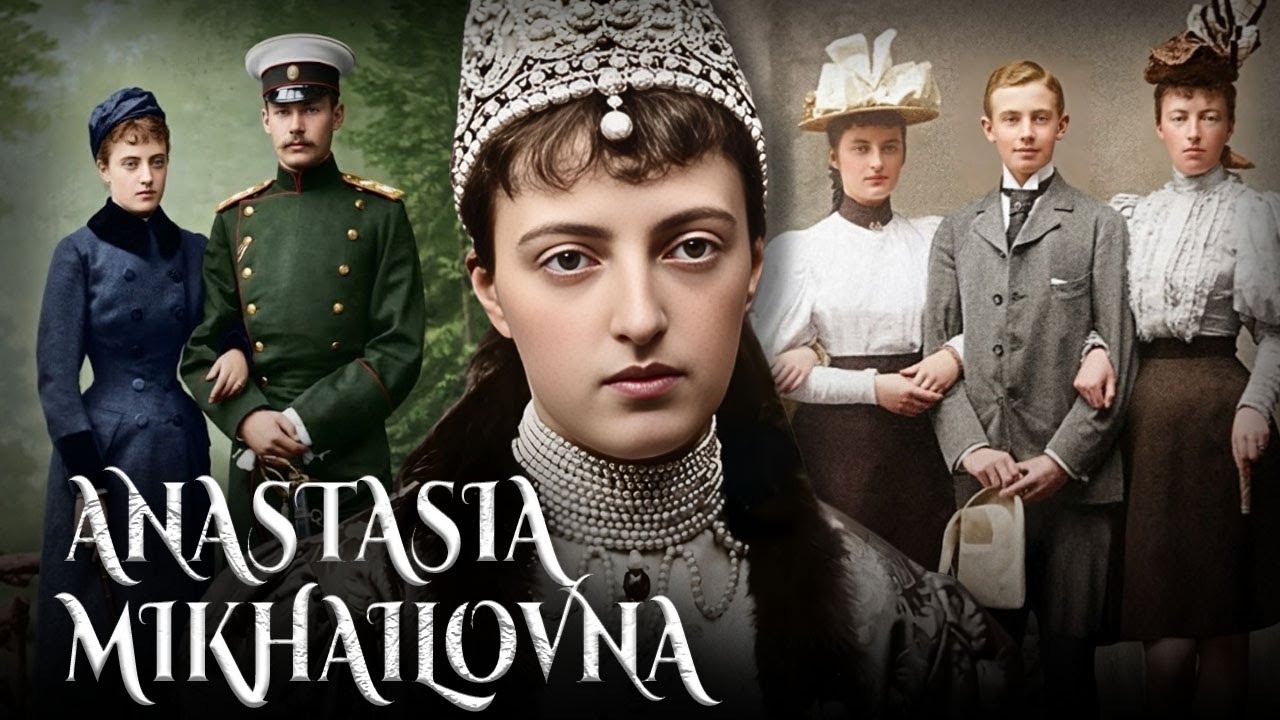
They called her the Grand Duchess of Darkness. To the Romanov family she was a storm, a woman who treated Europe’s moral codes like a doormat, boasted of her affairs, and gambled away fortunes with reckless abandon. She lived as though she were untouchable. History, however, has a cruel way of settling accounts.
How did this woman, who made emperors tremble at her audacity, end up losing her family, her fortune, and her homeland, left to die in silence in the very world she had tormented? Anastasia entered the world on July 28, 1860, at Peterhof Palace outside Saint Petersburg, a place of such excessive grandeur it seemed designed to crush human vanity. She was the second daughter and only girl among the seven children of Grand Duke Mikhail Nikolaevich, the younger brother of Tsar Alexander II. From her first breath, Anastasia was not merely a person.
She was a political asset of the Russian Empire, flesh woven from the blood of Peter the Great and Catherine the Great. Her cradle was lined with silk, her rattles were silver, and Cossack guards stood watch at her door, men who would have died before allowing a draft to touch her skin. But Anastasia was no conventional Saint Petersburg orchid. Her childhood was shaped by a radical shift in geography that would change her nature forever.
When she was only two years old, her father was appointed viceroy of the Caucasus. The family moved from the frozen, stifling formality of the capital to Tiflis, the present-day Tbilisi in Georgia. This was the empire’s wild frontier, a land of towering mountains, scorching heat, and fierce warrior cultures. Here, far from the suffocating protocols of the Winter Palace, Anastasia grew up nearly wild.
She was one of seven children, the only girl among six brothers. The Mikhailovichi, as this branch of the family was known, were famous for three things: their height, their arrogance, and their fierce loyalty to one another. Anastasia grew up climbing trees, riding astride instead of sidesaddle, and barking orders at her brothers. She was tall, dark-haired, and possessed an overwhelming physical presence, a raw vitality closer to the mountaineers of the Caucasus than to the Russians of the court.
She never learned the cunning arts and passive aggression of court ladies. She learned how to command. She was her father’s favorite, the sunshine of the viceroy who ruled with an iron fist. In Tiflis she was a princess in a fairy tale, adored by the locals, indulged by her parents, convinced the world existed solely for her pleasure.
The tragedy of a royal daughter is that childhood is merely a waiting room for the marriage market. The freedom of the mountains ended the moment she turned eighteen. In 1878, the machinery of dynastic alliance began to turn, and Anastasia was the cog to be fitted into place. Her parents, especially her mother, Grand Duchess Olga Feodorovna, a woman of immense ambition and strict German discipline, began the search for a husband.
This was not a search for love. It was a search for status. Anastasia was a Grand Duchess of Russia who brought with her a dowry that could bankrupt a small nation. She could not marry just anyone.
The list of candidates was short, and the selection was brutal. The man chosen for her was Frederick Francis III, heir to the Grand Duchy of Mecklenburg-Schwerin. On paper, it was a solid match. He was a future ruler of a German state, a Protestant, and a cousin of the Romanovs.
In reality, it was a pairing of a hawk with a hamster. Frederick Francis, known to the family as Paul, was a tragic figure. He was kind, gentle, and deeply cultured. But physically, he was broken.
He suffered from severe asthma, a weak heart, and a painful skin condition that forced him to hide from the sun. He was shy, reclusive, and terrified of noise. Anastasia, the boisterous Amazon from the Caucasus, looked at this fragile German prince and felt a cold knot in her stomach. He was everything she was not.
He embodied illness, silence, and withdrawal, while she embodied health, noise, and openness. When they met, there was no chemistry. He was overwhelmed by her presence; she was bored by him. But in the nineteenth century, boredom was not a valid reason to refuse a crown.
The wedding took place on January 24, 1879, in the Winter Palace. It was a scene of Byzantine splendor. Anastasia walked down the aisle in a gown of silver brocade so heavy she needed help to turn around. Dressed in imperial jewels, surrounded by thousands of candles and the chants of Orthodox choirs, with the Tsar standing as witness, cannons fired across the Neva.
It was the pinnacle of her life as a Romanov. But as she knelt beside Frederick Francis, who was struggling for breath as they exchanged rings, Anastasia was not entering a marriage. She was entering a prison sentence. The culture shock that followed was violent.
After the honeymoon, the couple traveled to Schwerin, the capital of her husband’s duchy in northern Germany. If Tiflis was a wild paradise and Saint Petersburg a glittering theater, Schwerin was a mausoleum. It was a small provincial town dominated by a gloomy neo-Renaissance castle on an island in the middle of a lake. The court was strictly Lutheran, fiercely conservative, and obsessed with economy.
The Germans looked at Anastasia with deep suspicion. To them, she was “the Russian. ” She was too loud, too tall, and dressed too vividly. She spent money with a carelessness that offended their Protestant sensibilities.
She refused to convert to Lutheranism, clinging to her Orthodox faith with a stubborn, demonstrative piety that alienated her husband’s family. She filled her apartments with icons and incense, creating a Slavic pocket inside the German castle. Her life in Schwerin was a suffocating routine of needlework, church services, and silent dinners. Her mother-in-law, the Dowager Grand Duchess Marie, was a stern woman who viewed Anastasia’s cheerful spirit as a moral failure.
Anastasia wrote desperate letters home to her brothers, describing the tomb-like silence of the castle, the terrible food, and the gray sky that seemed to press down on the turreted roof like a leaden lid. “I am dying here,” she wrote. “My soul is shrinking. ” She fulfilled her biological duty quickly and efficiently.
In the early years of the marriage she bore three children: Alexandrine, Frederick Francis, and Cecilie. She was a loving, if somewhat erratic, mother, but motherhood was not enough to fill the void of her ambition. She was a woman designed for a grand stage, forced to perform in a cramped closet. She began to act out in rebellion.
She spent lavishly on clothes she had nowhere to wear. She redecorated rooms that did not need redecorating. She picked fights with court officials over trivial breaches of protocol. But Anastasia was intelligent.
She soon realized that direct rebellion would only bring stricter confinement. She needed an escape route that could not be questioned, something no bishop or advisor could object to. She found it in her husband’s lungs. Frederick Francis’s asthma was real, and the damp, cold fog of the Baltic coast was torture for him.
He spent winters gasping for air, confined to his bed. Anastasia saw his suffering, and while she may have felt pity, she also saw opportunity. She began a tireless campaign of medical advocacy. She badgered the court physicians relentlessly, insisting the climate of Schwerin was killing the Grand Duke.
She argued that for the sake of the dynasty, for the sake of the air, they had to leave. Her solution was simple, elegant, and self-serving: the south, the Mediterranean. The Schwerin court resisted. A German ruler, they argued, must reside in Germany.
But Anastasia was a Romanov, and she knew how to move obstacles. She used her immense fortune to pave the way. She argued they would not abandon their duty; they would simply relocate the court for the health of the ruler. In the mid-1880s, she won.
The family began spending winters in Cannes, France. The moment the train crossed the border into southern France, Anastasia Mikhailovna underwent a radical transformation. As the gray German sky receded before the dazzling blue of the Riviera, the gloomy prisoner of Schwerin vanished, replaced by the radiant Grand Duchess. They purchased a magnificent property, Villa Vendome, nestled in the hills overlooking the bay.
For Frederick Francis, Cannes was a place to breathe. The warm, dry air eased the pain in his chest. He could sit in the garden and read his books in peace. For Anastasia, Cannes was a hunting ground.
Here, far from her disapproving mother-in-law and the rigid protocols of the German court, she built her own kingdom. The Riviera of the late nineteenth century was a playground for the European elite. Kings, princes, the wealthy, and artists gathered there to winter in luxury. It was a society based not on piety but on pleasure, and Anastasia was its natural queen.
She was a physical force. She played tennis with a ferocity that terrified her opponents. She was not the delicate player who floated the ball gently over the net; she played to win, sweating under her heavy skirts, screaming and lunging when she missed a shot. She embraced the new technology of the age, the automobile.
She bought the fastest cars available and drove them herself, tearing along the unpaved, dangerous Corniche roads at insane speeds, her scarf streaming behind her, leaving a trail of panicked pedestrians and scandalized aristocrats. But her greatest vice, the one that would define her, was the green felt of the gaming table. The Monte Carlo casino was the cathedral of the Riviera, and Anastasia became its high priestess. She discovered in herself a talent and hunger for gambling that bordered on obsession.
It was not just about the money, though she loved money; it was about the risk. In Schwerin, every day was planned, every interaction precisely controlled. At the roulette wheel, chaos reigned. There was the thrill of the unknown.
She would arrive at the casino late at night, dazzling in the Romanov emeralds, her entourage trailing behind her. She played roulette and trente-et-quarante, placing bets equivalent to a general’s annual salary. When she won, she threw lavish parties and bought champagne for the entire room. When she lost, she was terrifying, possessing the full Romanov temper.
There were whispers of her throwing scoops at the dealers, demanding the wheel be spun again, her imperial arrogance colliding with the rules of the house. But the casino management tolerated her because she was their main attraction. Tourists came just to see the Russian woman play. She was a spectacle, a force of nature.
Beneath the gold and adrenaline, however, there was a rotting core to her marriage. Frederick Francis was withering. He was becoming a ghost inside his own villa, a quiet invalid watching his wife’s excessive energy with a mixture of love and exhaustion. He knew he could not satisfy her.
He knew she was bored. He knew she was lonely in a way crowds could not cure. Anastasia loved her husband in her own way. She protected him, nursed him through his illnesses.
But she was a woman of voracious appetites, emotionally and physically. She was in her thirties, in the prime of her life, married to a man who seemed old in body if not in years. This disparity was a ticking time bomb. The freedom of Cannes was intoxicating, but it was also dangerous.
It stripped away the layers of protection and protocol that usually prevented royalty from destroying themselves. In Schwerin, Anastasia was watched by hundreds of eyes. In Cannes, she was the one doing the watching. As the nineteenth century drew to a close, she began to look for something more dangerous than a tennis match or a roulette wheel.
She began to look for a connection that felt real. She found it right under her husband’s nose. Villa Vendome was a bustling household full of servants, tutors, and aides. Among them was a man named Vladimir Paltov.
He was a commoner, Russian by origin, employed as the Grand Duke’s personal secretary. He was handsome, intelligent, and possessed the one thing Frederick Francis lacked: vitality. He was a man of the world, a man who spoke Anastasia’s language, literally and figuratively. It started slowly, an exchanged glance across the dinner table, a conversation in the garden that lasted too long, a drive in the car without the chauffeur.
Paltov behaved with respect, of course. He was a servant, and she was an Imperial Highness. But Anastasia never cared about boundaries. For her, boundaries were things for other people to respect.
The affair began in the sunny shadows of the villa. It was a reckless, foolish, magnificent transgression. For the first time since leaving Tiflis, Anastasia felt passion that matched the intensity of her own nature. She risked everything — her title, the future of her children, her husband’s honor — for the touch of a secretary.
As the new century dawned, whispers turned into noise. The servants talked. Society ladies gossiped behind their fans. Have you seen how the Grand Duchess looks at the secretary?
Have you noticed how late he leaves her room? Anastasia did not care. She was addicted to the adrenaline of the forbidden. She felt invincible.
She was the Tsar’s granddaughter. Who would dare say no to her? But biology does not respect rank. In the early months of 1902, Anastasia’s cycle stopped.
Then it stopped again. Morning sickness came, and her dresses began to tighten. She was forty-one years old. She was pregnant.
Her husband, the Grand Duke, had not shared her bed for years. The secret was out. The gilded cage she had escaped was replaced by a trap of her own making. Yet when she realized the truth of her situation, Anastasia Mikhailovna did not weep.
She did not plan a trip to a Swiss convent to hide her shame. She looked in the mirror, lit a cigarette, and decided to do the impossible. She would not hide this illegitimate child. She would make everyone accept him.
The scandal was not merely about betrayal; it was about timing. The tragedy, or perhaps the liberation, had begun five years earlier. On April 10, 1897, the fragile pillar of her life collapsed. Grand Duke Frederick Francis III suffered a catastrophic accident at the villa in Cannes.
The official report stated that while gasping for air during an asthma attack, he stumbled onto the balcony, climbed the garden parapet seeking a breeze, and fell to his death on the road below. Darker whispers suggested suicide. Whatever the truth, the barrier was gone. Anastasia was a widow at thirty-six.
She was free, but freedom was dangerous. Without a husband to defer to, she kept his personal secretary, Vladimir Paltov, by her side. And in 1902, the unthinkable happened. The Dowager Grand Duchess, mother of the reigning Grand Duke of Mecklenburg, was pregnant.
On December 23, 1902, in Nice, she gave birth to a healthy child. She named him Alexis Louis. The birth was a geopolitical disaster. In Berlin, Kaiser Wilhelm II was in a fury.
In Saint Petersburg, the Tsar was shocked. The Grand Duchess had given birth to an illegitimate child, a scandal that usually ended with a woman locked in a mental asylum. But Anastasia did not hide. She summoned her son, the young Grand Duke Frederick Francis IV, who ruled the state.
She did not ask for forgiveness. She gave him an order. She demanded he use his sovereign authority to legitimize his half-brother. Under immense pressure from his domineering mother, the young duke agreed.
He granted the boy the title Count of Vendome. With that, Anastasia wove her sin into the fabric of the ruling dynasty. She forced the legitimacy of her illegitimate son upon the nobility against their will. The funeral train that carried the Grand Duke’s body back to Germany was like a dismal iron serpent making its way north.
Anastasia traveled with it, dressed in deepest mourning black. She looked like a grieving widow, but behind her heavy veil, her mind was working without pause. She knew what awaited her in Schwerin. The funeral in the gloomy Schwerin cathedral was a cold, bleak affair.
The German relatives looked at Anastasia with icy eyes, but the real blow came from Berlin. Kaiser Wilhelm II had not attended the funeral merely to pay his respects. He had come to settle accounts. He blamed Anastasia for everything: for Frederick Francis’s misery, for the contamination of German noble blood, for the scandal of the Count of Vendome.
He looked at the arrogant Russian widow and decided he would not allow her to corrupt the next generation. Her son, Frederick Francis IV, had become Grand Duke in 1897 at the age of fifteen, making the family’s balance of power even more fragile. Wilhelm took the boy aside and poisoned him against his mother. He told him that Anastasia was a moral tumor, that her influence would destroy his reign just as it had destroyed his father’s life.
The decree came quickly. Anastasia was informed she was no longer welcome in Mecklenburg-Schwerin. She could keep her title of Dowager Grand Duchess. She could keep her money, which was mostly Russian.
But she could not live in the country. She was effectively exiled from the land ruled by her own son. Wilhelm went further. He insisted that her youngest daughter, Cecilie, the beautiful, tall girl being groomed as a bride for the German Crown Prince, be removed from her mother’s care.
Cecilie was to be raised the German way, far from the gambling tables and loose morals of the Riviera. Anastasia resisted. She screamed. She threatened.
She appealed to the Kaiser. But Tsar Nicholas II was himself disgusted by the scandal of the Count of Vendome. He offered her no support. The Romanovs, usually fiercely loyal to their own, disowned her.
Defeated, Anastasia retreated to the only place she had ever felt was home: France. She returned to Villa Vendome, but the triumphs of her early years had turned to ashes. She was a widow, an exile, an outcast. The lover, Vladimir Paltov, faded from view; he had served his purpose, and his presence was now a liability.
With her remained the young Count of Vendome, Alexis, a living reminder of the scandal that had cost her her kingdom. The years between 1905 and 1914 were a twilight existence for Anastasia. She was still fabulously wealthy. She still threw her parties in Cannes.
But the laughter was hollow. She became more aggressive, more erratic. Her gambling addiction spun out of control. The Monte Carlo casino became her true home.
She was there almost every night, a tall figure dressed in black. She often wore mourning colors even years later, perhaps as a dramatic gesture. She smoked heavily and bet sums that would make American oil tycoons blush. She became a caricature of the mad Russian aristocrat.
She commandeered the best tables in restaurants. She drove her cars at terrifying speeds through the winding streets of Nice and La Turbie, trying to escape the silence, trying to fill the void left by the loss of her power. She was also a mother watching her children drift toward the very machine she hated. Her daughter Alexandrine married the future King of Denmark and disappeared into the quiet dignity of the Scandinavian court.
Her favorite, Cecilie, had married the German Crown Prince, becoming the future Empress of the very nation that had exiled Anastasia. It was a bitter irony. Anastasia, the woman who hated Germany, was now the mother of its future Empress. When she visited Berlin for the wedding, she was treated with cold formal politeness, kept in the background like an embarrassing relative.
She watched Cecilie wave from the palace balcony, a prisoner in the same gilded cage Anastasia had spent her life trying to escape. But the world was changing faster than Anastasia could drive her car. Old Europe, with its emperors and casinos, was sleepwalking toward the abyss. In the summer of 1914, Anastasia was in London visiting relatives, enjoying the last great season of the Edwardian era.
Champagne flowed, orchestras played, and the aristocracy danced, unaware the music would stop forever. When news of the assassination of Archduke Franz Ferdinand spread in June, few thought it would lead to Armageddon. But Anastasia, with her sharp political instincts honed in the Caucasus and Saint Petersburg, felt the tremor. She hurried back to France, to her villa, to her sanctuary.
But sanctuary is a political concept, and war recognizes no borders. In August 1914, the guns of August roared. Germany invaded Belgium. Russia invaded Germany.
France mobilized. Britain declared war. Overnight, the map of Europe, which was essentially Anastasia’s family tree, burst into flames. Anastasia Mikhailovna, Grand Duchess of Russia, Grand Duchess of Mecklenburg-Schwerin, mother of the German Crown Princess and the Queen of Denmark, found herself in an extremely vulnerable position.
She was Russian by birth, and Russia was at war with Germany. She was German by marriage, and Germany was at war with France. She lived in France. To the French, she was a German spy.
To the Germans, she was a Russian enemy. To the Russians, she was a traitor who had married a German. She was surrounded. The French government, gripped by spy fever, looked at Villa Vendome with suspicion.
Who was this woman who spoke German to her maids, Russian to her children, and French to her butler? Why did she have a telegraph? Why was she sending letters to Berlin? During the First World War, her position in France became unbearable.
She withdrew to neutral Switzerland, living in Lausanne, while her family found itself split across enemy lines. She sat in her darkened drawing room, listening to the distant thunder of artillery, holding the hand of her illegitimate son, the Count of Vendome. The world she had played, deceived, charmed, and terrorized had finally collapsed. The wheel had stopped spinning.
For the first time in her life, Anastasia Mikhailovna did not know the odds of her own survival. The Great War was not just a geopolitical catastrophe for Anastasia; it was a personal dismantling of her identity. She was a woman who was only known by her connections. Suddenly, those connections were crimes.
She wrote desperate letters to her daughter Cecilie in Berlin, but they were returned or censored. She tried to send money to her brothers in Saint Petersburg, but the lines were cut. She became isolated in a way she had never known. The Grand Duchess of Darkness was just an old woman in a draughty villa, rationing fuel and wondering if her son was bombarding her brothers.
But as she stared at the dark Mediterranean, she did not know that the war was merely the beginning of the horror. In the East, a storm was gathering that would make the Kaiser’s wrath seem like a lover’s quarrel. The Romanovs were not just about to lose a war; they were about to lose their very existence. And Anastasia, safely ensconced in her French prison, would be forced to watch the extinction of her dynasty from the front row.
By 1915, her position in France had become unsustainable. The French government, paranoid and reeling from the trenches, could no longer tolerate the presence of a German Grand Duchess on the Riviera, even one who swore she hated the Kaiser. She was a security risk. Her letters were opened, her movements were tracked, and her very existence was an insult to the mothers sending their sons to die against German machine guns.
With a heavy heart, she packed her bags. She did not return to Russia; the road was blocked by war. She could not go to Germany; she was exiled from there. So she did what all displaced aristocrats did when the world was on fire: she went to Switzerland.
She settled into the neutral, sterile luxury of the Hotel Savoy in Lausanne. It was a gilded cage, far smaller than Villa Vendome, but safe from artillery shells. Here she lived a life suspended in surreal reality. The hotel was full of other displaced high-born refugees, deposed kings, fleeing princes, and spies of every nationality whispering in the lobby.
Anastasia held court in her suite, playing cards to pass the time, smoking heavily, and waiting for the telegraph boy to bring news that could save or destroy her. Her private war was as violent as the one raging on the Western Front. Her son, Frederick Francis IV, was a general in the German army commanding troops on the Eastern Front. Her brothers, Grand Dukes Nicholas and George Mikhailovich, were generals in the Russian army.
In the brutal arithmetic of 1916, her son was trying to kill her brothers, and her brothers were trying to kill her son. She sat by the window overlooking Lake Geneva, a newspaper in her lap, reading the casualty lists. Every German victory was a dagger to her heart for Russia. Every Russian victory was a terror for her son in Germany.
She was a mother and a sister, torn between the flags she was born under and the one she married into. She stopped sleeping. The vibrant, domineering woman who had terrorized casinos began to wither. Her eyes sank, and her hands trembled as she lit one cigarette after another.
But the war was only a prelude to the real nightmare. In 1917, the telegrams from Saint Petersburg stopped talking about victories and began talking about bread riots, then strikes, then abdication. The Russian Revolution did not begin with a thunderclap but with a collapse. When Tsar Nicholas II abdicated in March 1917, Anastasia was initially optimistic.
Like many Romanovs, she had been critical of the Tsar’s incompetence and Rasputin’s influence. She thought a constitutional monarchy or a republic might bring stability. She thought her family would be allowed to retire to their estates in the Crimea and live out their days in harmless seclusion. She was wrong.
The Provisional Government fell. The Bolsheviks seized power. Lenin arrived at Finland Station, and the revolution turned from gray to blood red. From her hotel room in Switzerland, Anastasia watched in helpless horror as the news seeped out.
The Romanov assets were confiscated. The palaces were looted. Her income, that vast, inexhaustible river of gold that had funded her gambling and her lifestyle, dried up overnight. She was suddenly a woman with extravagant tastes and a frozen bank account.
She began selling her jewels piece by piece. The emeralds went first, then the diamonds. Her teenage son, Alexis, watched her haggle with Swiss jewelers, trading away the inheritance of Catherine the Great for hotel bills. But money could be replaced.
Blood could not. In July 1918, a rumor reached Lausanne that the Tsar, the Empress, and their five children had been murdered in a cellar in Yekaterinburg. Anastasia refused to believe it. It was too brutal.
“They will not kill the children,” she insisted to her fellow exiles. “They are monsters, yes, but not that kind of monster. ” But the silence from the East grew louder. Then came the blow that shattered her.
Her two favorite brothers, Grand Duke Nicholas Mikhailovich, the family historian, and Grand Duke George Mikhailovich, along with their cousin Dmitri Konstantinovich, were arrested. They were not sent to Siberia. They were held in the Peter and Paul Fortress in Saint Petersburg, the very fortress whose golden spire Anastasia had admired from her nursery window as a child. Anastasia tried to intervene.
She used her connections, wrote to the Red Cross, wrote to writers and diplomats. She tried to exploit her German links, hoping the Kaiser would exchange prisoners. But the Kaiser was losing his own war, and the Bolsheviks were not interested in prisoner exchanges. They were interested in liquidation.
In January 1919, the news arrived. It was a cold, bleak morning in Lausanne. A messenger brought a report confirmed by British intelligence on January 28, 1919. Inside the walls of the fortress, her brothers had been led into the courtyard.
They were stripped to their shirts in the bitter cold. Grand Duke Nicholas, always the intellectual, was carrying his favorite cat. He tried to hand it to a soldier to look after. The firing squad shot them.
Then their bodies were thrown into a mass grave. Anastasia Mikhailovna, the woman who had defied the moral conventions of Europe, who had borne an illegitimate son and made him a count, that woman of iron will, finally broke. She collapsed in her suite. She did not scream.
She simply faded. The Romanov dynasty was not just a political system to her; it was part of her flesh and blood. It was the memory of her childhood in Tiflis. It was the smell of incense in the Winter Palace.
It was gone, erased completely. Her grief was compounded by the simultaneous collapse of her other world. In November 1918, Germany surrendered. The Kaiser abdicated and fled to Holland.
The German Empire dissolved. Her son, Frederick Francis IV, was forced to abdicate in Schwerin. Her daughter Cecilie, the Crown Princess who was destined to be Empress, became a mere citizen of a broken republic, living in a country torn apart by revolution and inflation. By 1920, Anastasia was the sole survivor of a shipwreck that had drowned everyone.
She was sixty years old. She had lost her brothers to firing squads, her husband to suicide or accident, her fortune to the wind, and her social standing to the war. She gathered the remnants of her life and decided to leave Switzerland. Her neutrality was suffocating.
She wanted to go home, but not to Russia, for Russia was a graveyard, and not to Germany, for Germany was a ruin. She wanted to return to Villa Vendome. She longed for the sun. She returned to France in 1921, but the Riviera had changed.
The pre-war elegance was gone, replaced by the frantic, desperate energy of the Jazz Age. The roaring twenties had begun, full of American heirs and war profiteers. Grand Dukes were driving taxis in Paris. Countesses were sewing lingerie.
Anastasia reopened Villa Vendome. It was covered in dust. The gardens were overgrown with weeds. She had to run it with a very small staff.
She no longer had the money for grand parties. She no longer had the money for high-stakes tables at Monte Carlo. Yet she still went, haunting the casino like a ghost, placing small bets with trembling hands. The fire in her eyes, once formidable, was dimmed by cataracts and grief.
She lived for her children now. She worried constantly about Alexis, the Count of Vendome, who was a young man of nineteen, a prince without a kingdom, a count of a duchy that did not exist. And she worried about Cecilie. Cecilie, once the golden girl of the German court, was now living a hard life in Potsdam.
Anastasia yearned to see her. But the French government was still hostile to Germans. Travel was difficult. In early March 1922, Anastasia was at her villa in Eze, a small hilltop village near Nice.
She was planning a party. Even in ruin, she could not stop being a hostess. She was organizing a costume ball for her friends, a last gasp of the old order. But the body does not forget what it has been through.
Years of stress, chain-smoking, excessive gambling, and grief had worn out her heart. She began to feel unwell. She blamed it on the food, on the weather. She refused to see a doctor.
“I am a Romanov,” she would say. “We do not get sick. We only die. ” On March 8, she received a letter from Germany.
It carried news of the sudden death of her son-in-law. Or perhaps it was a delayed confirmation of the horrifying details of her brother’s execution. The details are lost, but the effect was clear: the past had reached out one last time to strike her. She went to bed early on the night of March 10, complaining of a headache.
The Mediterranean wind rattled the windows of the villa. The lights of the casino flickered on the horizon, a beacon she could no longer reach. Anastasia Mikhailovna lay in her bed as the darkness of the room closed in. She was a woman who had lived three lives: the wild princess of the Caucasus, the prisoner of Schwerin, and the queen of the Riviera.
She had broken every rule. She had loved a servant. She had defied a Kaiser. She had outlived an empire.
But when she closed her eyes, she was not a Grand Duchess. She was just a tired woman longing for her brothers, longing for the sound of their footsteps in the hallway, longing for the smell of the pine forests of Tiflis. In the silence of the French night, she suffered a massive, catastrophic, and swift stroke. There was no time for a final bet.
When the maid entered the room on the morning of March 11, 1922, she found the Grand Duchess dead. The cigarette in the ashtray had burned down completely to ash, a long gray finger pointing at nothing. The funeral of Grand Duchess Anastasia Mikhailovna in March 1922 was a surreal study of diminished grandeur, a stark contrast to the noise and sparkle of her life. She was buried in Ludwigslust beside her husband, Frederick Francis III, the man she had tormented and manipulated, and whom she had ultimately outlived.
But the gathering at the grave was not a gathering of imperial power. It was a meeting of survivors. The mourners who stood in the biting German winds were the remnants of the First World War: deposed kings, exiled princes, bankrupt nobles who had lost their thrones, their fortunes, and their homelands. The woman who had once stopped traffic in Monte Carlo with her emeralds was laid to rest in a world that no longer needed emeralds, only bread.
The real drama of Anastasia’s death was not in the coffin. It was in the reading of the will. For decades, the “Grand Duchess of Darkness” had been the last financial refuge of her family. Her spending was legendary, her gambling losses astronomical.
But everyone assumed the Romanov well was inexhaustible. It was not. When the lawyers finally untangled the estate, the truth was shocking. The well had run dry.
The Bolsheviks had seized her Russian assets: the lands, the palaces, the imperial rents. The hyperinflation in Germany was devouring what remained of her Mecklenburg inheritance. Anastasia Mikhailovna, the woman who lived as though she owned the sun, had died leaving little more than a villa full of dusty furniture and a mountain of memories. This revelation hit hardest the one person who had no other safety net: her illegitimate son, Alexis, Count of Vendome.
At nineteen, Alexis was a young man built entirely from his mother’s defiance. He had grown up in luxury, educated by private tutors, treated as a prince in everything but name. With Anastasia’s passing, his protection evaporated. He was a count of a county that did not exist, the son of a Grand Duchess who had left him no fortune, and the half-brother of a Grand Duke who was now a common citizen.
The scene in the lawyer’s office must have been painful. Alexis stood opposite his half-brother, Frederick Francis IV, and his half-sister, Crown Princess Cecilie. They were the legitimate heirs, the ones who carried the royal blood. Even if they had lost their crowns, he was the mistake, the one who did not belong.
To be fair, the legitimate heirs did not cast him out. Frederick Francis IV continued to give him a small allowance, honoring the promise he had made to his mother, but the party was over. Alexis Louis de Vendome did not become a playboy of the Jazz Age. He faded into the gray, bleak obscurity of post-war Paris.
He lived his life as a quiet, somewhat tragic figure, a man carrying Romanov DNA who worked for a living, a living ghost of a scandal no one cared about anymore. If Alexis’s fate was to fade into silence, the fate of Anastasia’s favorite daughter, Cecilie, was a loud and painful fall. Cecilie’s story did not end in fairy-tale grandeur. The empire crumbled, her role evaporated, and she spent the rest of her life facing exile, loss, and the long shadow of defeat.
Anastasia had raised Cecilie to be an Empress. She was tall, elegant, and beloved by the German people. She had married the heir to the Hohenzollern throne, expecting to rule the greatest empire in Europe. Instead, she ruled over ruins.
When the German Empire collapsed in 1918, Cecilie’s life shattered. Her husband, Crown Prince Wilhelm, a vain and foolish man, followed his father, the Kaiser, into exile, leaving Cecilie alone in Berlin to face the wrath of the revolutionaries. She stood on the balcony of her palace, not waving to adoring crowds, but watching them burn the symbols of her family. Anastasia’s death in 1922 removed the last anchor connecting Cecilie to the old world.
Without her mother’s domineering, powerful love, Cecilie was lost. Stripped of her palaces, her servants, and the purpose she had lived for, the woman who was supposed to be Empress became a curiosity, a strange woman in a country house struggling to pay for fuel. The relationship between mother and daughter had always been complex: Anastasia the rebel, Cecilie the beautiful wife. But in death, their fates converged.
Both were women of immense ability, ground down by the gears of history. Anastasia tried to escape her fate at the roulette table. Cecilie tried to bear her fate with dignity. Both failed.
As the twenties rushed toward the thirties, the darkness that had consumed Anastasia’s fortune began to consume Cecilie’s spirit. She watched Germany, humiliated and broken, turn toward a new, darker power. She watched her sons drift toward the Nazi rhetoric, hoping to restore the monarchy, only to be exploited and then discarded. She lived to see another war tear Europe apart, to see her palaces bombed, to flee again, this time from the Soviets, carrying her few belongings in a suitcase, just as her mother had fled Villa Vendome.
The curse of the Romanovs she carried, the curse of extravagant wealth, excessive pride, and blindness to the turning of the times, passed to her daughter. Anastasia died of a stroke in a warm bed in France. Cecilie died years later, poor and broken, in a cold spa town in Germany, a remnant of an empire her mother hated but which had defined both their fates. The most terrifying part of the aftermath was not the poverty or the exile.
It was the silence. After the funeral in 1922, Villa Vendome was sold. The new owners had no interest in the Grand Duchess who had terrorized everyone. They painted over the Russian icons and hid them.
They destroyed the tennis courts where she had smashed balls with Amazonian fury. The Monte Carlo casino, practically her second home, did not put up a memorial plaque in her honor. They simply found new players to replace her. Anastasia Mikhailovna spent her entire life making noise: screaming, laughing, betting, demanding.
She was the sunshine of Tiflis and the terror of the Riviera. She believed her personality was enough to bend reality. But in the end, she left no monument. There is no hospital named after Anastasia, no foundation in her name.
There is only a grave in Germany where she never wanted to be buried, and a footnote in history books about a scandal everyone has forgotten. The illegitimate son lived a quiet life and died in 1976, taking with him the last living memory of his mother’s voice. The German daughter died in 1954, a refugee in her own land. The fortune is gone.
The power is gone. The scandal is gone. All that remains is the story. In the silence of the archives, one can still find the letters Anastasia wrote.
They are written in a large, bold hand, full of exclamation marks and underlined words. They scream from the page. They demand attention. Even from her grave, she tries to command us to look at her.
She seems to cry out: I was not like the others. I was alive. She was among a family of statues, and she was a living, breathing, sinning human being. She was the only Romanov who looked at the rules of the nineteenth century and said no.
She paid a heavy price for that no: isolation, mockery, and eventual oblivion. But for a few decades, she was the most free woman in Europe. As we approach the final chapter of her story, we must ask: was it worth it? Was the thrill of the bet worth losing the house?
Was the warmth of the Riviera worth the coldness of history toward her? Anastasia never answered that question. She simply placed her bets, spun the wheel, and let the ball fall where it may. Walking through the Monte Carlo casino today is like walking through a museum of ghosts.
The Belle Époque architecture still stands. The murals still look down from the ceiling with painted indifference, and the air still smells of money and despair. But the sound has changed. The quiet, terrifying clicks of the ivory ball have been replaced by the electronic beeps of slot machines and the chatter of tourists in jeans.
The grandeur has faded into banality. Yet if you stand very still in the salon, you might feel a sudden drop in temperature, a phantom cold draft smelling faintly of heavy Turkish tobacco and expensive perfume. It is the trapped spirit of the woman who once owned this room, who sat at the center of the table like a spider in a web of diamonds, daring the universe to take her money. History has largely forgotten Grand Duchess Anastasia Mikhailovna, overshadowed by the more famous tragedies of her family: the murdered Tsar, the hemophiliac heir, the false Anastasia.
She is just a footnote, often dismissed with a few insulting adjectives: eccentric, gambler, scandalous. But ignoring her means missing the essence of her existence. Anastasia was not just a colorful character. She was a diagnostic tool for the illness of the European aristocracy.
She was the fever that proved the body was dying. In the final analysis, her life forces us to confront an uncomfortable truth about the golden age of monarchy: the good died screaming, and the bad died in their beds. Consider the contrast between Anastasia and her relative by marriage, Empress Alexandra Feodorovna. Alex was the perfect royal wife.
She was pious, faithful to her husband, obsessed with her children, and morally stern. She hated gambling, hated frivolity, and spent her life in prayer. And what was her reward? She was slandered by her people, imprisoned by revolutionaries, and butchered in a cellar in Yekaterinburg.
Her virtue did not save her. It only made her a perfect victim. Anastasia, by contrast, was everything a royal woman was not supposed to be. She was loud, unfaithful, greedy, and selfish.
She neglected her duties in Germany to party in France. She betrayed her husband and legitimized the result. She spent a fortune that could have fed an entire city. And her reward was to live sixty-one years of unapologetic freedom.
She felt the warmth of the sun on her face every day. She loved whom she wanted. She died peacefully in her sleep, surrounded by silk sheets, having outlived the empires that tried to control her. In a Darwinian sense, Anastasia was the most adapted to survive.
She realized, perhaps instinctively, that the old rules of duty and honor were a suicide pact. She saw that monarchy was a play with a dwindling audience, and she decided that if the theater was going to burn, she might as well be in the bar having a drink when it happened. But this survival came at a terrible cost to those around her. This is the dark side of the Anastasia myth, the side that prevents her from being a feminist icon.
She bought her freedom with the suffering of others. She broke her husband’s heart to feed her vanity. She abandoned her duties in Schwerin, leaving her son to be raised in a court that hated him, making him ultimately weak and vulnerable to the Kaiser’s bullying. She raised her daughter Cecilie on the expectation of a fairy tale, setting her up for a devastating fall when reality asserted itself.
Anastasia was a narcissist of imperial proportions. She loved her children, yes, but she loved them as extensions of herself. When they pleased her, they were Romanovs. When they disappointed her, they were Mecklenburgers.
She used people like poker chips, playing them when they were useful, discarding them when the hand was lost. The Count of Vendome, her illegitimate son Alexis, was the clearest example. She bore him to prove she could. She gave him a title to prove she had won.
Then she left him with nothing but a name that meant nothing in a new world. Yet, despite her selfishness, there is something undeniably compelling in her refusal to be crushed. In an age when women were viewed as legal property, transferred from father to husband like livestock, Anastasia Mikhailovna refused to be owned. When the German court tried to silence her, she spoke louder.
When the Russian court tried to shame her, she met them with her fierce gaze. When her husband could not give her a child, she went out into the world and got one. She was a monster of independence and will. She tore up the script that was imposed on her as a silent German wife and wrote a new one in bold red ink.
It was a chaotic script, full of errors and missteps, but it was hers alone. Today, Villa Vendome in Cannes no longer exists. It has been divided into apartments or demolished for modern hotels. The tennis courts where she crushed balls before terrified opponents are now parking lots.
The world she lived in has faded so completely it seems like a hallucination. The Romanovs are saints in the Russian Orthodox Church, martyrs for a lost cause. The Hohenzollerns are ordinary citizens living quietly in Germany. The Grand Duchy of Mecklenburg-Schwerin is a trivia question.
But Anastasia remains a living, difficult, impossible ghost. She is the patron saint of all “difficult” women. She reminds us that history is not only made by those who follow the rules and sign the treaties. It is also made by those who overturn the table, spill the wine, and demand to be heard.
She was not a good woman. She was arguably a bad wife and a complicated mother. But she was alive in a graveyard of nineteenth-century monarchs, where everyone else was frozen in marble statues of duty and sacrifice. Anastasia Mikhailovna was a flash of flame, a burst of laughter, a cloud of cigarette smoke.
A woman who looked at the fading light of empire and did not pray for salvation. She bet on the unknown. And perhaps that is why her story still resonates, even as its details fade. We live in a world that constantly demands women be nice, be appropriate, achieve everything without making a mess.
Anastasia is the anti-heroine who reminds us that sometimes making a mess is the only way to prove you exist. She reminds us that reputation is a cage, and the only way out is sometimes to burn the whole house down. Picture her one last time, standing on the balcony of Villa Vendome in the twilight of 1921. The war is over.
The Tsar is dead. The money is gone. She is old. Her heart is failing her.
The cold mistral wind blows in from the sea. She lights a cigarette, her hand trembling slightly. She gazes at the lights of the coast below, like a necklace of pearls tracing the edge of the French shore. She hears the distant music from the casino, that siren call that had seduced her for forty years.
She knows the game is rigged. She knows the house always wins. She knows that death eventually collects all the chips, the emeralds, the titles. But she does not regret the bet.
She does not regret the scandal. She does not regret the boy Alexis, or the man named Vladimir. She takes a drag from her cigarette and exhales the smoke into the fading light. She whispers to the darkness: I played.
My God, how I played. The wind catches the ash and scatters it over the garden, over the sea, and over the ruins of a Europe too small to contain her.






