In October 1938, a radio operator named Virgil Traskler was stationed at a remote weather outpost in the far northeastern corner of Wyoming. The station, designated WBX14, sat at the northern end of a place the locals called Dry Ridge Valley. It was not a valley in the usual sense, no green slopes or river at the bottom, but a long, shallow depression between two parallel ridges of pale sandstone. The valley was two miles wide and eight miles long, its floor made of hard, white alkali flats cracked into patterns like dried skin.
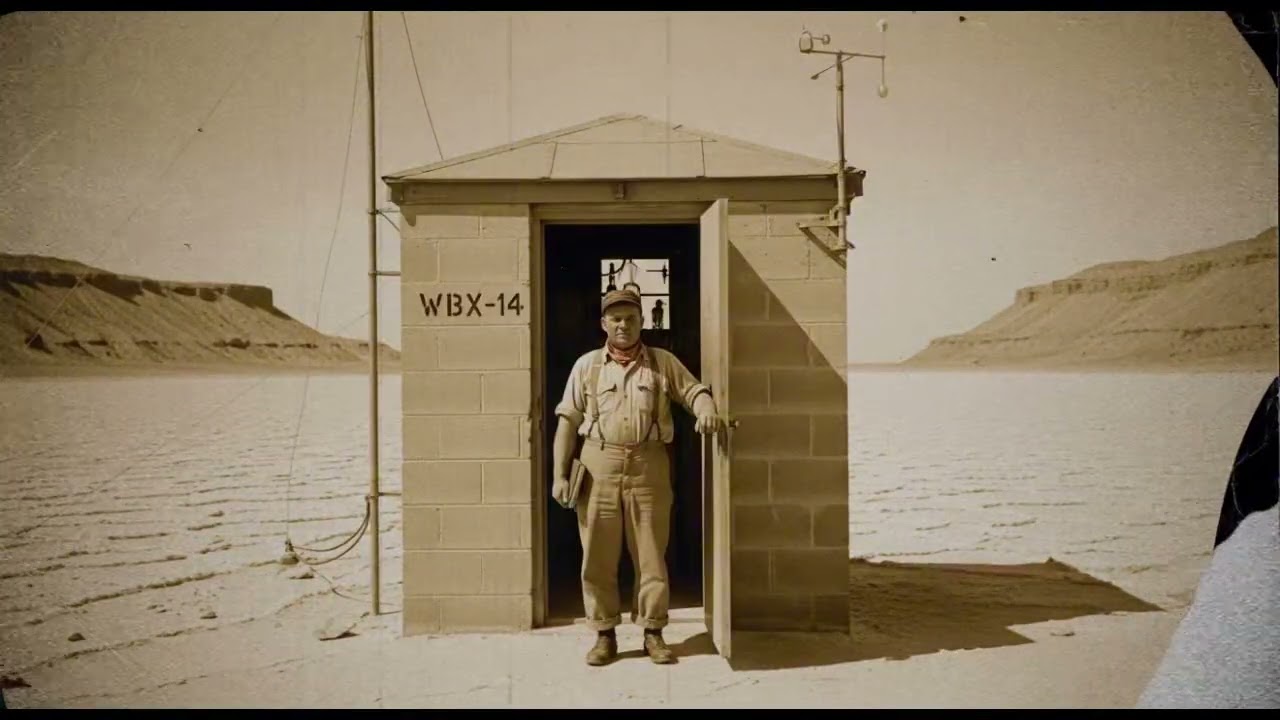
Nothing grew there except patches of brittle gray sagebrush. Local ranchers refused to graze their cattle in that valley. The grass was good, but the cattle would not go in. They would walk to the edge of that land, stop, and turn back.
The wind did something strange between those low hills. It entered from the north and had nowhere to go but south, then struck the southern ridge and bounced back, trapped between the walls. It circled and piled on itself until the air inside the valley vibrated at a frequency you could feel in your teeth. The ranchers called it the hum.
Virgil was thirty-six years old, a sturdy man with sunburned skin and oddly delicate hands for someone his size. He had served as a radio operator aboard a destroyer in the Pacific during the war and had asked for a quiet posting afterward. He was a man who preferred silence to conversation. His only regular human contact was a supply truck that came every two weeks driven by a rancher named Colus Dobney, a sixty-two-year-old man with a leathery face and a flat, unbothered way of speaking.
On the night of October 11, 1938, during a midnight watch, Virgil picked up something he had never heard before. It came in on a frequency that, according to his technical manual, should carry nothing at all. A dead zone. But something was broadcasting.
It was a tone, a single continuous note that wavered slightly, rising and falling in a slow cycle that took about ninety seconds to complete. It was not painful, but it was intimate. Virgil felt it in his jaw, a vibration that bypassed his ears and reached directly into his bones. He logged it.
He listened for forty-seven minutes before the signal stopped. Not faded, stopped, cleanly and suddenly, like a switch being turned off. He reported it to the Weather Bureau office in Cheyenne the next morning. The response was routine: possibly an atmospheric reflection, monitor it and report if it recurs.
It recurred every night. Same time, same frequency, same tone, same ninety-second cycle. Seven nights in a row, exactly forty-seven minutes each night. On the eighth night, the tone split into two, a dissonance so wrong it was magnetic, and Virgil caught himself leaning toward the receiver involuntarily.
He recorded that in his logbook. The signal was causing an involuntary physical response. On the ninth night, a third tone appeared, then a fourth. By the end of that night’s window, the signal contained at least twelve distinct tones arranged in an unmistakably deliberate pattern.
He sent detailed reports to Cheyenne and requested equipment to pinpoint the source. The reply took three days. Nothing abnormal had been detected on that frequency by the Cheyenne monitoring station. The signal, if it existed at all, was local.
Very local. When Colus brought supplies on October 23, Virgil told him about the signal. Colus listened without reaction. When Virgil finished, Colus put down the box he was carrying and said, “You hear the hum?
” He then told Virgil what he knew. His grandfather had run cattle in the eastern hills in the 1880s and had learned from a Crow elder that the valley had a name, something like “the valley that listens. ” The hills trap the wind and pile it up until the air vibrates at a frequency that is no longer wind. Most of the time it is too low to hear, just a feeling in your chest, a hum in your jaw.
The cattle feel it, which is why they will not graze there. The birds feel it too, which is why there are no birds in that valley. When conditions are right, dry air and steady wind and a particular temperature drop, the hum rises into the audible range. And once it does, once it catches your attention, it does something to people.
Colus told him about a shepherd named Alcid Barardi who camped in the valley in 1911. He was a tough man who knew the land well. He walked into the valley with his large mongrel dog, Drum. Two hours later, the dog came back alone, running at full speed, whining, tail between its legs, and would never approach the valley again.
Alcid stayed three weeks. When he walked into town, he could not remember his own name, could not remember the language he spoke, and could not recognize his wife when she ran to him in the street. He spent the next eleven years sitting in a chair, silent. But every night, precisely at midnight, he would tilt his head as if listening to something, for exactly forty-seven minutes.
Then he would lie back down. Forty-seven minutes. The exact length of the signal. Colus gave Virgil a warning: turn the dial, do not listen, do not engage.
He told him what the Crow elder had said. The valley does not hate humans. It is not trying to harm them. It simply does what it always does.
It listens. That is its nature. When it hears something, it holds onto it. It preserves sound the way you preserve a photograph.
And if you stay long enough, the valley will contain so much of your sound that more of you will be in the valley than in yourself. Virgil did not turn the dial. He began mapping the signal. Every night for two weeks he logged everything, frequency, duration, number of tones, intervals.
He filled a notebook with data, charts, hand-drawn wave patterns. He noticed patterns, repetitions, cycles of twelve tones over a week, then a restart, each cycle slightly different, converging on something. And there was something else. The signal was responding to him.
On November 2, he tapped his pen on the desk three times while taking notes. The signal stopped for exactly the length of his three taps, then resumed. He tested it. Two taps, two pulses of silence.
Five taps, five pulses. The signal was aware of him. He convinced himself this was science. He was collecting data.
But he was lying to himself. This was a courtship. The signal was drawing him in as a whirlpool draws a leaf. On November 7, the signal tapped his pattern before he tapped it.
He had been planning to tap a sequence he had worked out in his head. He had not moved, had not touched the desk. The signal produced four tones, a pause, two tones, a pause, four tones, a pause, one tone. His exact thought.
He wrote in his log: it is not reading my pulses. It is reading me. And Virgil was changing. He did not notice at first.
He forgot to take the six o’clock reading on November 8. He forgot dinner on the ninth. On the tenth, he looked in the mirror and did not recognize himself for three full seconds. On the twelfth, he realized he could not remember his mother’s name.
Not a slip of the tongue, not a momentary lapse, but completely gone, cleanly erased. Colus’s words came back to him. They start forgetting things. Small pieces falling away.
Over the following days, Virgil lost his middle name, his birthdate, the name of the ship he served on, the town where he grew up, the taste of coffee, the meaning of the word Thursday, the ability to tell his left hand from his right. Each loss was surgically precise. He documented everything, keeping a list of what was lost, updating it each morning when he discovered a new absence. The list itself was proof he still existed.
As long as he could record what he had lost, he had not lost everything. What frightened him most was that the losses did not hurt. They felt like relief, like setting down a heavy bag he had been carrying so long he forgot its weight. Each vanished memory left behind a spaciousness, a quiet.
His mind was a house being emptied room by room, and each emptied room made the house more open to whatever wished to fill it. That was the trap. The emptiness felt like peace. One night, he turned off the radio.
The signal continued anyway. The radio was off, its tubes cold, but the sound flowed from the speaker. He unplugged it. The sound continued.
It was not coming from the radio. It was coming from the walls, the concrete, the tin roof, the hard alkali ground beneath the building. The entire station was vibrating at the signal’s frequency. He went outside.
The sound was everywhere, in the air, in the earth, in the hills on both sides. The whole valley was humming, not with the faint background vibration Colus had described, but with the full signal, all twelve tones dense and alive, flowing from the sandstone walls as if the earth itself had become a loudspeaker. He looked up and saw the stars were wrong. Constellations that never existed.
Clusters of blue-white points pulsing in rhythm with the signal. And directly above the valley, a patch of sky blacker than the darkness around it, a presence of void. In the morning, he tried to write a report and could not remember the call sign for Cheyenne. He tried to write his name, wrote “Virgil,” then stopped.
He could no longer remember the rest. Over the next three days, he lost his father’s name, the smell of rain, the concept of the month of March, the ability to read an analog clock, the sensation of hunger. Each loss felt like peace. On the last page of his logbook, he wrote a single line: it does not take, it trades.
I give it a name, it gives me a frequency. I am becoming the signal and the signal is becoming me. Colus arrived on November 15. He found the station door open, all the dials at maximum, papers covering the floor.
He found Virgil sitting on the ground outside, facing south, staring down the length of the valley. “I can’t remember the way home, sir,” Virgil said quietly. “I know the word home. I know what it means.
But that particular home, the one that belongs to me, it’s no longer there. ” Colus drove him to the town of Kerr that evening, twenty-three miles of dirt road. As each mile passed, the valley hills shrank in the rearview mirror. At mile eleven, Virgil said, “Traskler.
My name. Traskler. I couldn’t remember it this morning. It just came back, like it was waiting outside the valley for me to return and pick it up.
” By mile fifteen, he remembered his birthday. By mile eighteen, he remembered his mother’s name. By the time they reached Kerr, Virgil could summon most of himself, but not all of it. There were gaps, small precise absences, his first-grade teacher’s name, a song his father used to sing, the exact shade of green of the window shutters in the house where he grew up.
A doctor examined him and found nothing abnormal. Virgil never returned to Dry Ridge Valley. He was transferred to a station on the Gulf coast of Florida, flat land, warm air, humidity that carries sound naturally, winds that blow in straight lines and do not circle or trap or pile up into something alive. He recovered slowly.
Things he had lost returned piece by piece over months. Not everything came back. There were permanent gaps, small rooms in the house of his mind that stayed empty. He could not remember the sound of his father’s voice.
He could not remember the feeling of cold, though he had spent two winters in Wyoming in a concrete box. He worked in Florida for nineteen years. In 1941 he married a woman named Parthenia Boudreau, a librarian. Their marriage was built on an understanding that some questions are best left as questions.
But Virgil kept a shortwave radio in the garage, surplus military equipment, vacuum tubes and a dial covering every frequency the atmosphere could carry. He never once turned it on, never plugged it in. But some nights, late, when the house was quiet, he would stand beside it in the dark and listen. And some nights, faintly, so faintly it might have been imagination, he would hear it.
A single steady tone, rising and falling in a ninety-second cycle. The valley remembering him. The signal waiting, patient as stone. Virgil died in 1962, heart failure, age sixty.
Parthenia found him in the garage, standing beside the radio, his hand resting on the canvas cover. The cover was warm. In 1997, a geological team from the University of Wyoming was mapping subsurface formations around Dry Ridge Valley, standard seismic survey work funded by a federal grant. They planted seismometers along the ridges and set off small charges to map the rock layers below.
The data came back wrong. Not slightly wrong, radically wrong. The seismic waves were not passing through the ground and reflecting off rock layers in predictable patterns. They were being trapped and returned between the ridges at a specific frequency that matched no known geological formation.
The ridges were acting not as passive stone walls but as resonating chambers, shaping and amplifying the energy passing between them, like the body of a guitar shaping the vibration of its strings. The team ran the test three times with identical results. A graduate student named Mercer Kittredge stayed late one night to run the data through a pattern-recognition program. The program flagged the signal immediately, characteristics consistent with encoded information.
Not exactly language, but structure and intention, repeating patterns that had evolved over time, building on previous iterations, showing the unmistakable fingerprint of something not merely vibrating but communicating. Buried deep within that signal, the program detected something else. Faint, fragmented sounds scattered across the frequencies like shards of broken glass, but unmistakably human. Dozens of them, maybe more.
Names, words, fragments of identities trapped in the resonance of the valley, preserved in sound the way insects are preserved in amber. Each occupying its own exact frequency. Each still broadcasting decades later, the last sounds they made before the valley swallowed them whole. Mercer played the isolated signal through her speakers once, once only.
She heard a man’s voice, very faint, repeating what sounded like a name. She could not make out the word. The voice was calm, patient. She turned off the speakers.
She sat in the lab for an hour without moving. Then she deleted the file, reformatted the hard drive, and changed her thesis topic to groundwater mapping in the Big Horn Basin. When her supervisor asked why, she said she did not want to talk about it. She said the sound made her forget her middle name for three days.
She said when she closed her eyes, she saw a sky full of stars she did not recognize, slowly revolving around a void that pulsed with sound. She said at night, when her apartment was very quiet, she could still hear it. If you look at satellite images of Dry Ridge Valley today, you might notice something strange. There is a road leading to the site of the old station.
It appears on some maps and not on others. As if the valley decides when it wants to be found and when it refuses. And the wind between those ridges never stops.






