On the morning of May 26, 1944, the submarine USS Harder slipped out of Fremantle, Western Australia, without ceremony. No band played, no speeches were given. Just the low growl of diesel engines and the smell of salt and oil. On the bridge, a thin man in a rumpled khaki uniform watched the coast disappear.
Samuel David Dealey was thirty-seven years old. In exactly eleven days, he would accomplish something no American submarine captain had ever done before. Nothing about him suggested legend. He carried a small Bible, rarely swore, and knelt by his bunk to pray when the boat was quiet.
He had a wife, Edwina, and three daughters in Dallas, Texas, whose photographs were taped inside his locker door. His officers described him as quiet, polite, almost shy at the wardroom table. But when the Harder submerged for battle, something changed. His executive officer later said it was the moment the mild man vanished and the hunter took his place.
The Harder was a Gato-class submarine, 311 feet of welded steel with ten torpedo tubes and a crew of eighty. Painted below her deck was her motto: Hit Em Harder. She was about to enter the most dangerous waters in the Pacific. In the spring of 1944, Japan was bleeding.
In the first five months of the year alone, the Imperial Japanese Navy had lost twenty-three destroyers. These fast, aggressive ships protected carriers, escorted oil tankers, and hunted submarines. Without them, a carrier became a floating coffin and a convoy became a funeral procession. Japan was on the verge of losing its fleet.
The man who had just taken command of the Combined Fleet, Admiral Soemu Toyoda, understood this perfectly. He had assumed command on May 3, inheriting a plan called Operation A-Go. It was Japan’s last real chance to crush the American fleet in one decisive battle. For A-Go to succeed, Toyoda needed his carriers.
For his carriers to survive, he needed his destroyers. For his destroyers to survive, he needed American submarines to stay away. But the American submarine force had been following an unwritten rule about Japanese destroyers ever since December 1941: do not fight them, run from them. The reason was simple.
A destroyer on the surface could make thirty-five knots; a submerged submarine could barely manage nine. A destroyer carried five-inch guns, sonar, and depth charges designed for one purpose: to crack a submarine’s pressure hull. Japanese destroyers had sunk American submarines in numbers no captain wanted to discuss. Direct submarine attacks on destroyers, ship against ship, torpedo against propeller, rarely succeeded.
Most who tried failed. Some died trying. The standing order was clear: if a destroyer found you, dive deep, go silent, and pray the depth charges missed. Samuel Dealey did not believe in that principle.
He never announced it. He rarely raised his voice. But on April 13, 1944, the world learned what he believed in. The Harder was on her fourth war patrol, cruising near Woleai Atoll, when a lookout spotted smoke on the horizon.
A Japanese destroyer, the Ikazuchi, had seen them and was closing at high speed. Every officer on the bridge expected the same command: dive. Instead, Dealey said two words: attack her. The men stared.
He did not repeat himself. The Harder turned her bow toward the oncoming destroyer. Nine hundred yards separated the two bows. The Ikazuchi was already hunting them with her four five-inch guns.
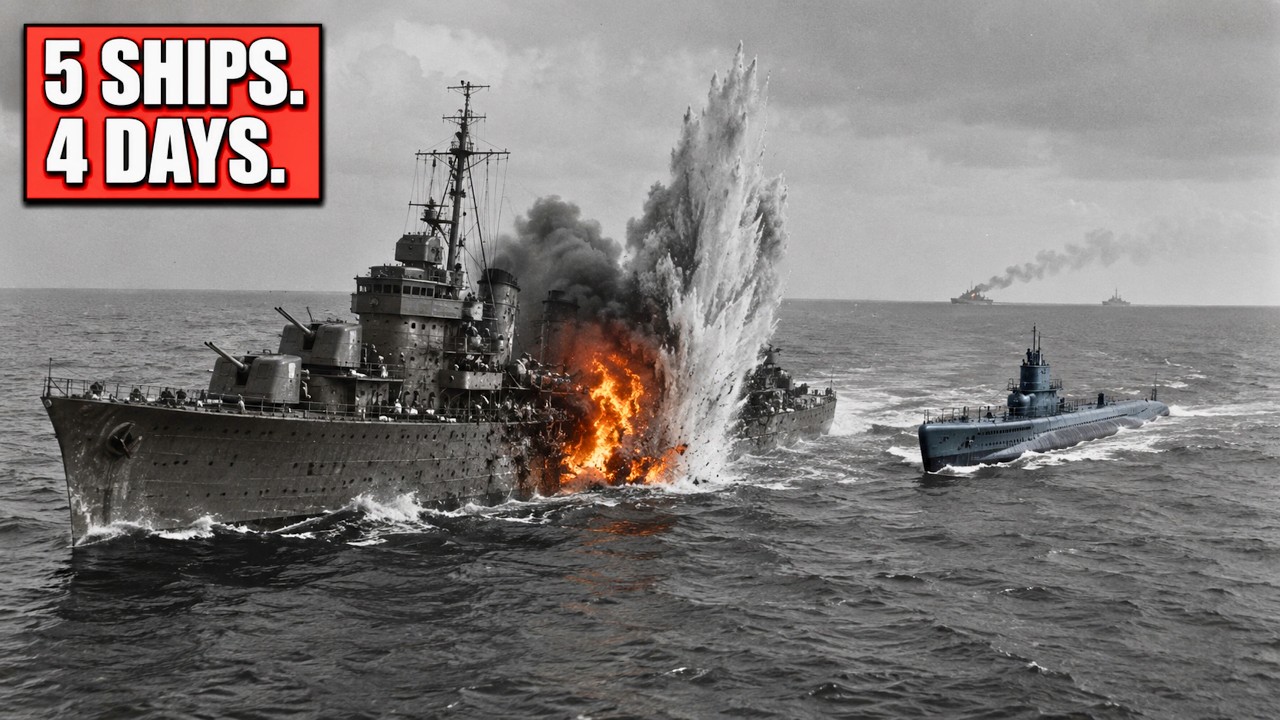
At nine hundred yards, Dealey fired four torpedoes in a fan pattern, then dove. Twenty seconds later, the ocean tore open above them. Two torpedoes hit the Ikazuchi. She broke apart, caught fire, rolled over, and was gone within five minutes.
More than two hundred Japanese sailors went down with her. That night, the Harder surfaced to send her contact report to Pearl Harbor. Dealey wrote it himself, using eight words: four torpedoes fired, one Japanese destroyer sunk. Those eight words spread through the Pacific submarine force within a week.
They went up on bulletin boards in officers’ quarters from Pearl to Brisbane. When Admiral Charles Lockwood, commander of Pacific submarines, read the report, he leaned back in his chair, took off his glasses, and laughed out loud for the first time in months. By late May 1944, American codebreakers in Pearl Harbor had cracked Japanese naval movement codes enough to understand what Admiral Toyoda was planning. The Japanese Mobile Fleet, under Vice Admiral Jisaburo Ozawa, was assembling at a place few Americans had ever heard of: Tawi-Tawi in the southern Philippines.
It was the perfect hiding spot, deep water surrounded by islands, close to Borneo oil fields. By mid-May, Ozawa had gathered his carriers, battleships, cruisers, and destroyers there. It was the largest concentration of Japanese naval power since Midway. Lockwood had no fleet to send against it.
The invasion of the Marianas was still weeks away. What he had was submarines. The orders that reached the Harder at Fremantle in mid-May never mentioned the word destroyer once. Dealey was told to proceed to Tawi-Tawi, observe, and report.
Then, buried in the operations appendix, was the primary mission of his fifth war patrol, one that most accounts of the Harder completely ignore. He had been sent to rescue six men: Australian coast watchers, British agents, local scouts, a small team of Allied operatives who had been hiding in the jungles of northeastern Borneo for months, reporting Japanese ship movements by secret radio. Their food was gone. They were being hunted.
On the night of May 26, the Harder sailed north through the Lombok Strait, across the Java Sea, into the narrow channels of the Sulu Archipelago. Every mile was under Japanese control. For nine days she ran submerged most of the daylight hours and surfaced at night, slipping through the gaps between Japanese patrol zones. On the ninth night, a rubber boat came out from the Borneo shore.
Six men climbed aboard, thin, hollow-eyed, silent. They ate their first hot meal in months in the Harder’s crew mess. Then Dealey turned the boat north, toward Tawi-Tawi and Ozawa’s fleet. Before dawn on June 6, 1944, the Harder surfaced to recharge batteries, fifteen miles north of the Tawi-Tawi anchorage.
The moon was bright. The sea was like glass. Dealey stood on the bridge with two lookouts. At 3,000 feet above, a Japanese patrol plane turned east.
The pilot saw something on the water, the bright line of a submarine periscope cutting through the silver waves. He reported it by radio. At Tawi-Tawi, the operations officer received the report at 03:00. An American submarine, fifteen miles north.
Course unknown. Speed unknown. The response was immediate. Three destroyers, Minazuki, Hayanami, and Tanikaze, slipped their moorings and raced through the strait at full speed.
Their guns were already trained. Samuel Dealey did not know they were coming. In that moment, the hunter had become the prey. At 06:47, the first destroyer’s mast broke the horizon.
Dealey saw it through his periscope, a single dark vertical line against the pale sky. Behind it, two more. Three ships in search formation, closing at high speed. He lowered the periscope, turned to the officer of the deck, and said one word: dive.
The klaxon sounded twice. The lookouts tumbled down the hatch. Dealey was the last man down, pulling the hatch closed over his head. The boat angled forward.
Water flooded the ballast tanks. Red battle lights replaced the morning sky. This was the maneuver that would make his name. Point your bow directly at the destroyer trying to kill you.
Wait until she is close enough that she cannot turn in time. Then fire your torpedoes straight into her face. If they hit, she shatters. If they miss, she rams you or drops depth charges on your exact position and crushes you like a tin can.
There was no middle ground. Dealey had done this before, off Woleai in April. But then, he had been the one to start the fight. This morning, the situation was reversed.
He waited. Ten seconds. The periscope barely touched the surface. The leading destroyer was at nine hundred yards now.
Seven hundred and fifty. He could see men on her forward gun. At seven hundred yards, he fired three torpedoes. He dove to three hundred feet.
The boat tilted thirty degrees. Men clung to anything they could hold. In the forward torpedo room, a young sailor stared at the ceiling as if he could see through the steel to the ship coming to kill him. Forty seconds.
That was how long the torpedoes would take to cover the distance. Forty seconds inside a submarine is a long time. Long enough for a man to remember his mother’s kitchen. Long enough for the exec to close his eyes.
Long enough for Samuel Dealey to fold his hands on the periscope handle, rest his forehead on his knuckles, and pray in silence. Then the ocean exploded above them. Two hits, perhaps three. The lights went out.
Emergency lamps flickered red. Somewhere, glass shattered. Above them, the Minazuki broke in two. Her bow section, driven by its remaining momentum, slid under the water.
Her stern rolled over, propellers still spinning in the air, and followed. In less than three minutes, 1,300 tons of steel and most of her crew were gone. The other two destroyers, confused, dropped depth charges randomly into empty water. Dealey brought the Harder back to periscope depth an hour later.
The horizon was clear. He stepped away from the lens. He did not smile. He did not celebrate.
He simply asked for a cup of coffee, walked behind the chart table, and sat alone. At Tawi-Tawi, the news reached Admiral Toyoda’s command staff at 09:00. The Minazuki was lost, presumed sunk. Toyoda had commanded the Combined Fleet for exactly thirty-four days.
He was a cautious, methodical man who did not like surprises, especially surprises that cost him destroyers he could not replace. He ordered six more destroyers into the water. Hunt the submarine. Destroy her.
He had no idea that the man in that submarine had already begun looking for his next target. At 03:12 on June 7, twenty-one hours after sinking the Minazuki, the Harder was on the surface, heading west at fifteen knots, charging batteries. The night was so dark the horizon had disappeared entirely. The radar operator had been staring at his screen for six hours.
On his third sweep, a sharp bright spot appeared. He said quietly into the intercom: radar contact, bearing one-nine-five, range eight thousand yards, closing at high speed. On the bridge, Dealey raised his binoculars toward a wall of blackness. The target was the Hayanami, a Yugumo-class destroyer that had been sweeping this area since 01:00.
Her crew was exhausted. They did not expect a hostile submarine to attack them on the surface in the dark, at full speed, head-on. That is exactly what Dealey was about to do. He advanced at full speed, steady on course, the diesel roar filling the night.
At 4,000 yards, the Hayanami’s radar picked up the contact. The officer of the deck assumed it was another destroyer returning to base. At 3,000 yards, the truth arrived. Submarine.
The captain was on the bridge in seconds, ordering full speed and a turn to attack. It was too late. At 2,300 yards, Dealey fired four torpedoes. Two hit the Hayanami near her aft magazine.
The explosion was immense. A column of white flame rose hundreds of feet into the sky, so bright that men on the Harder’s bridge, five thousand yards away, raised their hands to shield their eyes. The Hayanami’s stern tore off in a single ripping motion. The rest of the ship rolled ninety degrees and slid beneath the surface.
More than a hundred Japanese sailors were gone in under two minutes. Now Dealey ran. The radio room was already sending a contact report to Pearl Harbor: two destroyers, two days, and a description of the Japanese Mobile Fleet anchored at Tawi-Tawi, so precise that Admiral Lockwood carried it himself to fleet intelligence headquarters. Because the destroyers were never the objective.
The message was. With every torpedo fired, Dealey sent an intelligence report. With every attack he survived, he sent another radio signal describing what he had seen at Tawi-Tawi: Ozawa’s carriers, the battleship shadows, the screening cruisers, the movements. Each signal was decoded, plotted on a map in Pearl Harbor, and studied by the admiral who would command the American fleet in the coming battle.
Admiral Raymond Spruance, fifty-seven years old, quiet, precise, was preparing to fight the largest carrier battle in history. He did not yet know where the Japanese Mobile Fleet would appear. Every hour of intelligence he gained strengthened his fleet’s readiness. Samuel Dealey, sitting in a battered, leaking submarine in the Sulu Sea, was giving him those hours.
Admiral Toyoda was not thinking about intelligence. He was thinking about ghosts. Two destroyers in two days, sunk by the same submarine. He could not believe it.
In his mind, a cold conclusion was forming: there must be more than one. There must be a group. He pulled eight destroyers from convoy escort duty and organized them into hunter-killer groups. He told his staff that Tawi-Tawi was surrounded by American submarines and that the fleet was not safe.
He was wrong at that moment. There was only one American submarine in that stretch of water. But the mistake he made at his desk was about to move an entire fleet. On June 8, Dealey moved south toward the Sibuto Passage, the narrow strait between Tawi-Tawi and the northern coast of Borneo.
He knew the Japanese would intensify their patrols there. Before dawn on June 9, he was twelve miles southwest of Tawi-Tawi. He raised the periscope, looked, and went still. Every man in the control room knew from the length of that silence that something was wrong.
Directly ahead, spread across two miles of water in steady formation, four Japanese destroyers were actively pinging sonar. The sounds were so loud the sound operator could hear them without headphones. Dealey had only eight torpedoes left. Four destroyers.
He could fire at most one clean shot before the others converged and depth-charged him for hours. He chose the second destroyer in the line, the one steaming steadily. The others were zigzagging, making themselves harder to hit. At 06:12, it turned directly toward him.
He waited. Four thousand yards. Three thousand. At eighteen hundred yards, he fired three torpedoes.
All hit. The destroyer’s port side tore open along its entire length. The magazines exploded. Wreckage flew three hundred feet into the air.
She rolled over and vanished in ninety seconds. The other three destroyers converged on the Harder’s position. For the next two hours, Samuel Dealey and eighty men lived inside a steel drum being beaten by giant hammers. Twenty-three depth charges in the first ten minutes.
Then more. The lights went out. Emergency lamps came on. A pipe burst in the forward torpedo room and seawater roared in under tremendous pressure.
Men scrambled barefoot to wedge wooden plugs and rubber padding into the leak. Hull plates strained. Somewhere on the boat, a man was quietly reciting the Lord’s Prayer. Dealey stood at the chart table, both hands flat on the paper.
He did not move. He did not speak. He waited. After two hours, the destroyers withdrew.
That same day, Dealey did it again. At 14:00, a lookout spotted two masts. The Tanikaze, a Kagero-class destroyer, and an escort vessel were steaming in an irregular formation, searching for submarines. Dealey watched them for ninety minutes, studying the zigzag pattern.
Every eight minutes, the destroyers turned. Every eight minutes, for about thirty seconds, the leading destroyer exposed her side. Thirty seconds was enough. At 16:30, the Tanikaze turned at three thousand yards.
Dealey let her close. At two thousand yards, he fired four torpedoes at intervals of seventeen seconds. The first missed. The second hit near the bridge.
The third hit the forward magazine. The explosion was so violent that the Harder’s crew heard it clearly. The Tanikaze’s hull began to separate. She was gone in three minutes.
The escort wheeled and attacked, dropping depth charges on the approach. The Harder dove to four hundred feet. The charges exploded above and around them. The boat groaned.
A relief valve squealed. But nothing vital broke. After forty minutes, the escort gave up and withdrew. Two attacks.
One day. Two Japanese warships gone. Dealey raised the periscope. The sea was empty.
He walked the length of his boat, from forward torpedo room to aft engine room, silent, touching each man’s shoulder as he passed. Then he went to the wardroom, sat down, and finally allowed himself to close his eyes. Around this time, a lieutenant entered Vice Admiral Ozawa’s cabin at Tawi-Tawi with a file. Ozawa, fifty-eight years old, tall and thin, read it without expression.
He closed it and stared at the bulkhead. Four destroyers in four days, sunk by what he now believed was a group of American submarines infesting his anchorage. There was more, and worse. On June 11, American carrier aircraft would begin striking Saipan.
Ozawa knew this was the opening move. Operation A-Go had to be executed, but it was scheduled to begin later. His fleet was supposed to remain at Tawi-Tawi until June 14, coordinating with land-based air forces. Every hour he spent at Tawi-Tawi was another hour he might lose a carrier before the battle even began.
He picked up a pen and wrote the order. The Mobile Fleet would leave Tawi-Tawi one day early. June 13, not June 14. One day only.
It seemed like a short time. It was not. That single day meant his scout planes would not be fully fueled. His screening destroyers would not be fully reorganized after chasing the ghosts of the Harder’s attacks.
His coordination with land-based aircraft from the Philippines would be disrupted. He left in haste, and the consequences of that haste would carry him and his fleet to a battle for which they were not ready. Six days later, on June 19, that fleet met Spruance’s Fifth Fleet in the largest carrier battle in history. American pilots would call it the Great Marianas Turkey Shoot.
Three Japanese carriers were destroyed. Nearly three-quarters of Japan’s remaining carrier aviators were killed. They died because Ozawa arrived unprepared. He arrived unprepared because he left Tawi-Tawi a day early.
He left a day early because of the Harder. Samuel Dealey would never know any of this. On June 10, still in the Sulu Sea, he fought another action against two more destroyers. He fired his last five torpedoes.
He damaged one and missed the others. Neither sank, but the wartime after-action report listed both as probably sunk, which is how the number five entered the legend. He endured forty-two depth charges over ninety minutes at five hundred feet, maneuvering at two knots, breathing with difficulty, speaking not a word. He survived.
He took the Harder south out of Japanese waters to Darwin, and eventually back to Fremantle. On July 3, 1944, Admiral Lockwood was waiting on the pier. He pinned the Navy Cross on Dealey’s chest before Dealey had a chance to shower. He asked if Dealey could do it again.
Dealey answered in one sentence: give me torpedoes and I will sink ten. The official Navy citation would later credit the Harder’s fifth war patrol with sinking five Japanese destroyers in five short-range torpedo attacks. The number would be debated for the rest of the century. No one would argue about what he had done.
Because the destroyers were never really the story. The story was one man in a submarine in the dark, who changed the outcome of the largest carrier battle in history by making a Japanese admiral sit at a desk in a place called Tawi-Tawi and sign an order one day early. The Harder sailed from Fremantle again on August 5, 1944, on her sixth war patrol, this time as part of a wolf pack with two other submarines, Hake and Haddo. Their hunting ground was the western approaches to Luzon, the largest island in the Philippines.
On August 21, off Palawan Bay, the wolf pack intercepted a Japanese convoy of sixteen ships and sank four merchant vessels totaling 22,000 tons. The next day, the Harder and Haddo attacked three Japanese coastal defense ships and sank them all. By the evening of August 23, Haddo had expended all her torpedoes and signaled she was heading back to base. That left the Harder and the Hake patrolling together off Dasol Bay on the western coast of Luzon.
Neither Dealey nor the men on either submarine knew that Japanese intelligence had been tracking them for days. Radio intercepts during the Palawan Bay attack had given them a good idea where the wolf pack was operating. They had sent ships to Dasol Bay to meet them. Two small vessels, the coastal defense ship CD-22 and a minesweeper.
Neither was a destroyer. Neither was heavily armed. But both carried sonar and racks of depth charges. Their crews had been hunting American submarines for three days.
At 04:53 on the morning of August 24, 1944, the Hake submerged quietly four miles from a small island called Hermana Mayor on the western coast of Luzon. Through her periscope, her commander could see the Harder on the surface, four thousand five hundred yards to the south. The sound operator heard a contact, closing fast. The Hake dove deep and ran silent.
Her commander watched through the periscope as the two Japanese ships approached the Harder’s position. He tried once to send a radio warning. There was no reply. Either the Harder’s radio was shut down, or Dealey was already at the periscope, or he had already seen them, or he was already diving.
No one would ever know. At about 05:30, the Harder submerged suddenly. The Japanese ships were less than two thousand yards away. The CD-22’s sonar operator got a solid contact.
Range twelve hundred yards and closing. The commander gave the order. At 05:47, the CD-22 dropped her first pattern of depth charges over the Harder’s position, all set to explode at two hundred and fifty feet. At least three detonated within fifty feet of the pressure hull.
The hull cracked. In the aft torpedo room, water began to pour in, at a pressure no man could hold back with wooden wedges and prayer. Within ninety seconds, the Harder’s stern flooded. Her bow rose.
She hung for a moment at an angle between air and sinking. The captain ordered all ballast tanks blown. Emergency surface. Compressed air rushed into the tanks.
The submarine fought to rise. She could not. Too much water in her stern. At 05:52, the CD-22 dropped another pattern, closer still.
The pressure hull split in several places. Water flooded the control room. All electrical power was lost. The emergency lights went out.
Somewhere below six hundred feet, past the depth at which the Harder was designed to survive, she began to collapse. She disappeared in less than three minutes from the moment the first depth charge struck. The sound operator on the Hake heard the sound of a submarine dying. He did not describe it in his report.
Some sounds are not put in reports. On the surface, the CD-22 and the minesweeper circled for two hours, dropping more depth charges to be sure. When they finally left, they left behind a wide oil slick, pieces of wood, torn cork insulation, and the slow black surface of the South China Sea. No survivors were found.
Seventy-nine men went down with her. Samuel Dealey. The radioman who had earned a Bronze Star for the June destroyer sinkings. The executive officer.
The chief petty officer who had served over twenty years. The young sailor in the forward torpedo room. The cook. Farmers’ sons from Iowa, factory workers from Michigan, college students from California.
Sons, brothers, husbands, fathers. The oldest was thirty-seven. The youngest was nineteen. The Navy did not tell the American public what had happened to them for months.
Families received telegrams that said only that their son or husband was missing. Edwina Dealey opened her door in Dallas, Texas, on a September morning in 1944, to find a young officer standing on her porch with a piece of paper in his hand. She read it. She did not cry in front of him.
She thanked him. She closed the door. She went to the kitchen and put the kettle on. She had no idea whether her husband was dead, a prisoner, or drifting on a raft somewhere in the ocean.
Missing meant missing. Missing meant hope. For four months, she carried that hope. On January 2, 1945, the Navy Department officially declared the USS Harder lost with all hands.
Edwina Dealey read that telegram alone. In 1946, President Harry Truman placed the Medal of Honor ribbon around Edwina’s neck on the White House lawn. Her three daughters stood behind her in their best dresses. The citation said, in part, that Dealey’s brilliant record of sinking five vital Japanese destroyers in five short-range torpedo attacks was evidence of his daring combat spirit and indomitable leadership.
After the war, a joint Army-Navy evaluation committee reviewed captured Japanese records. They confirmed the sinking of three destroyers without a doubt: the Minazuki, the Hayanami, and the Tanikaze. They confirmed two more heavily damaged. The exact number in the after-action report never quite matched the records.
That almost never happens. But the men who were there, on both sides, knew. They knew it was enough. Because in that same summer of 1944, the Imperial Japanese Navy lost the Battle of the Philippine Sea.
Three carriers at the bottom. Nearly three-quarters of its naval air fleet destroyed. Japan never fought another balanced naval battle. Every battle that followed, from Leyte Gulf to Okinawa, was a slow bleed.
The submarine campaign, using tactics Samuel Dealey had pioneered, sank 214 Japanese warships and 1,300 merchant ships. By the final summer of the war, the Japanese home islands were starving. Their factories were silent. Their ships had no fuel.
On May 22, 2024, nearly eighty years after the Harder had slipped out of Fremantle on her fifth patrol, a survey ship led by a man named Tim Taylor and a nonprofit organization called the Lost 52 Project was working in an area of the South China Sea off the western coast of Luzon. They were using advanced sonar. They were looking for something specific. They found her at 3,750 feet, upright on the bottom, intact, the conning tower still clearly visible.
The depth-charge damage from the CD-22 was evident on her stern, exactly as the Japanese report from that day had described it. The Harder had been found at last. The United States Navy declared her a war grave. No one would disturb her.
No one would recover her. The remains of the seventy-nine men who died aboard her on August 24, 1944, would remain in their final resting place. But the families knew now. For eighty years, the children, grandchildren, and great-grandchildren of the Harder’s crew had only a name on a wall.
The Wall of the Missing at the American Cemetery in Manila. Their fathers were out there, somewhere in a cold, dark stretch of ocean, and no one could tell them where. Now someone could. Now, when a granddaughter in Ohio asks where her grandfather is buried, someone can unfold a map, put a finger on a spot in the South China Sea, and say: there he is.
He was there all along. In Arlington National Cemetery, in Section 59, there is a headstone for Samuel David Dealey. He is not buried beneath it. He never was.
The stone is a marker, a place, something his daughters could visit when they were girls, and when they grew up, and when they had grandchildren. On every August 24, some of them still come. They place flowers on the grass. They stand in silence for a moment.
Sometimes they bring children who never knew him, who cannot know him, though they understand some things the way children understand them. The quiet man from Dallas, Texas, who prayed before every attack, who loved his wife, who taught the young officers around him not to fear the sea but to understand it. The Japanese destroyer crews, sons of someone, doing their duty as they understood it. In the South China Sea tonight, at 3,750 feet, the USS Harder rests on the bottom in total darkness.
Seventy-nine men are with her. They are, as the old naval saying goes, on eternal patrol. They will not be forgotten, not as long as we remember how to tell the story.






