In the red-soiled hills above the town, the British and Indian soldiers of the garrison at Kohima looked across a stretch of ground so narrow it barely deserved the name of a battlefield. Between their trenches and the Japanese positions lay a grass tennis court, the garden ornament of a colonial official’s house, now the dividing line between two armies locked in some of the closest combat of the war. The men on one side of that court knew the orders they had been given. The men on the other side were about to discover something they had never expected to find.
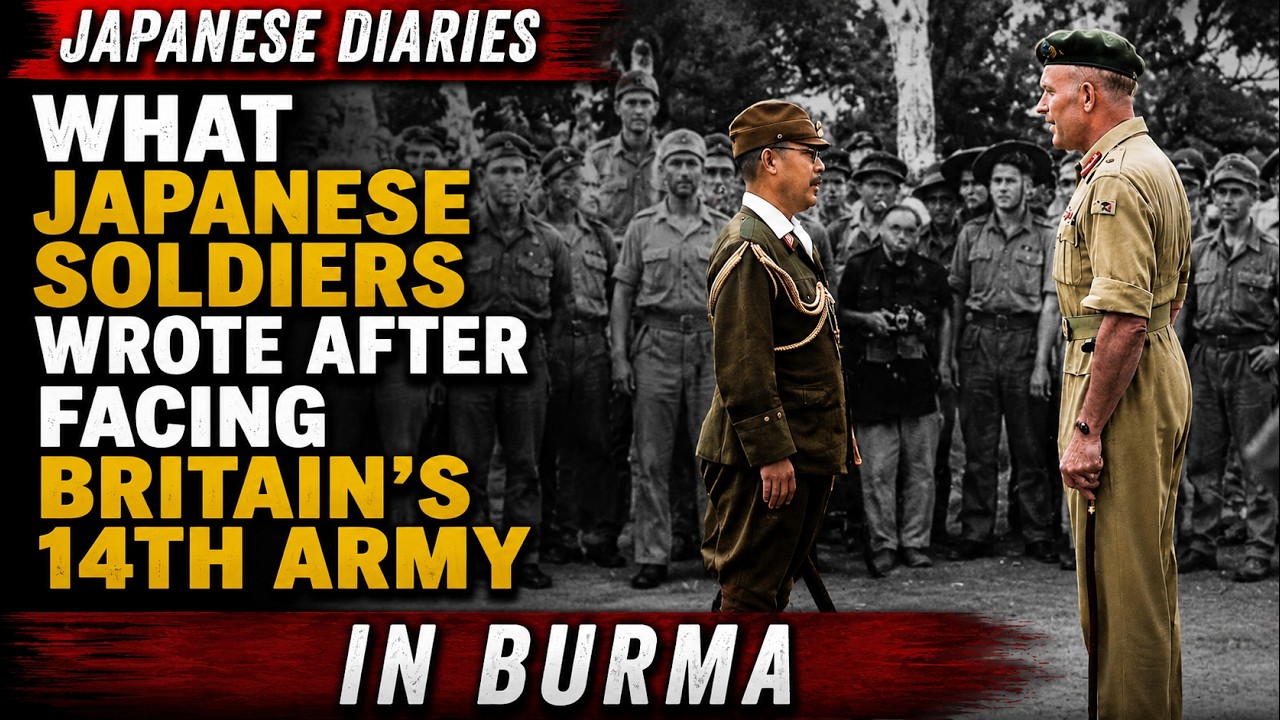
The Japanese soldier who fought in Burma in 1944 carried with him a set of assumptions forged two years earlier, and those assumptions would prove to be the ground on which the decisive battles of the campaign were lost and won. When the British and Indian forces advancing through Burma in the final stages of the war came across the positions the Japanese had held and then abandoned, they found among the wreckage a cache of documents that told the story of the campaign from the other side. The Japanese soldiers, like soldiers everywhere, had kept records of their experiences. Letters home that were never sent.
Diaries that documented the daily reality of what they were living through. Personal accounts describing what they faced and what they thought about it. When the positions fell, these documents remained behind. The British and Indian forces collected them, intelligence officers translated them, and what they contained was a body of testimony from the other side that recorded, in specific and personal terms, what the Fourteenth Army was doing to the Japanese forces it faced.
The Fourteenth Army had been given a label that stuck: the Forgotten Army. It was a description with some justification. The Burma campaign received less attention than the war in Europe, less glamour than the island-hopping battles of the Pacific, and less press coverage than battles closer to home. The Japanese testimony provides a record of the Fourteenth Army’s achievements from an unexpected direction: the accounts of the men it was defeating.
William Slim himself reportedly objected to the name, not because his men were not forgotten by the press and the public, which to a large extent they were, but because the label suggested his men were incompetent or beaten rather than simply under-covered. The Japanese had not forgotten them. The Japanese found them very much present and very much effective. The Japanese testimony is, among other things, evidence that the Fourteenth Army was not forgotten by the people who mattered most to its soldiers: the enemy they were fighting.
The expectations the Japanese army brought to Burma in 1944 were shaped by what it had encountered in 1942. That year, Japan had swept through Burma with a speed and efficiency that left the British and Indian forces reeling. The British withdrawal from Rangoon in March, the long retreats north through jungle and mountains to the Indian border, the collapse of coordinated resistance: all of it created a specific Japanese assessment of what the British and Indian forces were capable of and willing to do in this theater. What the Japanese commanders observed in 1942 was infantry that withdrew when their flanks were threatened, lost cohesion when Japanese forces appeared in unexpected places, and depended on roads and supply lines in ways that Japanese jungle infiltration tactics could reliably exploit.
The demonstrated ability of Japanese soldiers to move through jungle terrain that the British considered impassable gave Japan a specific tactical advantage that proved consistently decisive. Why would 1944 be any different? The 1942 experience had also produced a specific Japanese assessment of the Indian Army, the largest component of the Fourteenth Army. Japanese analysis suggested that Indian soldiers fighting for a colonial power lacked the motivational commitment that would sustain resistance under severe pressure.
The nationalist argument that Indian soldiers had no deep reason to fight for Britain fed a military assessment that Indian forces were potentially fragile under harsh conditions. That assessment, too, would be tested in 1944, and it would prove to be no more accurate. The specific assumption built into Operation U-Go, the Japanese offensive toward Imphal and Kohima that began in March 1944, was that the British and Indian forces would behave as they had in 1942. Threatened with encirclement, cut off from their supply lines, and facing Japanese forces in their rear, they would withdraw.
The strategic calculation of the offensive rested on this expected behavior. The Japanese commanders who planned U-Go were not planning against the Fourteenth Army that existed in 1944. They were planning against the Fourteenth Army as they assessed it in 1942. The gap between that assessment and the reality they would face was the ground on which the decisive battles of the Burma campaign would be fought.
In February 1944, before U-Go began, the Japanese forces in Arakan launched an offensive of their own. It was a characteristic Japanese encirclement, designed to isolate the British and Indian forces in the Arakan region from their supplies and force them to withdraw. The location that became the focus of the battle was an administration and supply area: a place where hospitals, supply depots, workshops, and headquarters were located, rather than primarily fighting troops. In previous campaigns, such locations had been completely vulnerable to the kind of attack the Japanese were launching.
The expectation was that rear-area personnel would be incompetent defenders and that the fighting troops would be forced to withdraw to protect them. Slim had issued different orders, in a specific and significant way. Units were to hold their positions when surrounded. They were to form a defensive perimeter and fight in place rather than attempt to withdraw.
Air supply would provide what they needed, and relief forces would come. The Battle of the Admin Box was the first test of this policy. The position was surrounded, and the Japanese penetrated the administrative area. Fierce fighting took place in the hospital area, in the supply depots, and in positions manned by clerks, drivers, and cooks who had been handed rifles and ordered to hold.
And they held. The Japanese accounts of the Admin Box document a specific surprise. The British and Indian forces did not withdraw. The defensive perimeter held.
Air supply sustained the force, and when support finally came, it came from troops who had not withdrawn and did not abandon their positions, but held long enough to turn the tactical situation. The diaries and accounts of Japanese soldiers in Arakan document this experience with remarkable precision. They had expected a withdrawal. What they found was a defensive perimeter that absorbed their attacks, received supply from the air, and held, waiting for them.
The intelligence consequences of the Admin Box were significant on both sides. For the Japanese, it should have indicated that the expected pattern of behavior, withdrawal when besieged, was no longer reliable. Whether this information was adequately processed before the planning of U-Go remains a question the postwar Japanese accounts do not resolve. For the Fourteenth Army, the Admin Box confirmed that the combat doctrine was successful.
Units would hold, air supply was effective, and the tactical method had been tested in real combat conditions and had worked. The most frequently mentioned feature in Japanese accounts of fighting the Fourteenth Army is not the persistence of the infantry, the effectiveness of the artillery, or the quality of fighting in any individual engagement. It is air supply. Japanese military doctrine and planning had not adequately accounted for an army that could be supported from the air even when completely surrounded.
The operating assumption in Japanese encirclement tactics was that cutting an enemy’s ground supply lines was decisive. An enemy lacking food, ammunition, and medical supplies would not be able to fight effectively for long and would be forced to break out or surrender. The Fourteenth Army, under Slim’s orders, when surrounded, held its positions and waited for air supply to maintain its cohesion. Transport aircraft carrying food, ammunition, medical supplies, and reinforcements landed or dropped supplies to the besieged positions regularly and in quantities that Japanese accounts describe with something combining respect and bewilderment.
The Japanese soldier who had cut the road, who had placed his unit across the enemy’s supply line, who had done everything doctrine required to starve the enemy and force a withdrawal, found that the enemy was eating, receiving ammunition and medical care, and fighting from a position supported by air, which his ground-level work had failed to suppress. The doctrine had been right about what cutting ground supply lines would achieve. It had not accounted for the possibility that the ground supply lines were not the decisive supply lines. The demands of air supply were enormous in terms of aircraft and organization.
Slim’s ability to control this resource, to ensure that besieged units were supplied, was one of the most important factors in the operational success of the Fourteenth Army. From the Japanese point of view, it was something their planning had not included and their tactics had no answer for. At Kohima, the fighting lasted from April to June 1944 and produced some of the most ferocious close-quarters combat of the war. The tennis court of the Deputy Commissioner’s house, which lay directly between the two sides’ positions at one stage of the battle, became a particular symbol of how close the fighting was.
British and Indian forces on one side, Japanese on the other, separated by the width of a tennis court. The Japanese accounts of Kohima document the intensity of the fighting and the unexpected resistance in specific terms. The assumption before entering the battle was that Kohima would be taken quickly. It was a small position strategically, a supply crossroads and access point, not a major fortress.
What the Japanese found was a garrison that refused to be defeated, and was later relieved rather than forced to withdraw. The relief of Kohima by the 2nd Division was itself evidence of the change in British and Indian military practice in this theater. The relieving force fought its way through until it reached the garrison. It did not stop, or reassess the situation, or withdraw when the difficulties of the terrain and Japanese resistance became clear.
The doctrine that had been absorbed, hold, resupply from the air, then relieve, was executed consistently. The Japanese accounts from the officers who led the attack on Kohima document their frustration at the gap between what they expected and what they encountered. They expected a position that would fall within days. They found a position that held for weeks and was then relieved by an advancing force their units could not stop.
The specific terrain of Kohima, the hills, the house area, the tennis court, meant that the fighting was inevitably close and inevitably attritional. There was no room to execute the flanking movements that had been decisive in 1942. The fighting became a direct assault against a defensive force that had nowhere to go, and that had received specific orders not to leave. Under those conditions, the efficiency of the individual soldier, his training, his confidence in his leaders and his military doctrine, and his belief that he would receive supplies and relief, were the decisive factor.
The Japanese accounts document in precise tactical terms what that confidence looked like from the other side of the defensive perimeter. The Battle of Imphal, fought from March to June 1944 and concurrent with the Battle of Kohima, was the larger operational objective of U-Go. The Imphal plain was the main British base area in northeast India. If it were captured, it would isolate large British and Indian forces and potentially open the door to invasion of India itself.
The Japanese encirclement of Imphal was achieved. Three Japanese divisions were massed for the attack. The IV Corps of the Fourteenth Army, besieged on the Imphal plain, held for about ninety days while receiving supplies from the air. The Japanese losses in the battles of Imphal and Kohima were among the heaviest suffered by any Japanese force in the war.
Estimates range from 50,000 to 60,000 soldiers killed, wounded, sick, or starved to death, out of a force of 80,000 who crossed into India. The retreat from Imphal through monsoon jungles without adequate supplies killed thousands more from disease and starvation. The diaries and letters recovered from those retreating Japanese soldiers describe conditions of almost unbelievable suffering. They also describe a force that pursued them relentlessly, refusing to allow them to stop or regroup, which would have given the retreating Japanese time to recover.
The pursuit of the defeated Japanese force after the relief of Imphal was a decision Slim made, and it was not an obvious or automatic one. A more cautious commander, after achieving a major defensive victory, might have stopped to reorganize, or waited for resupply, or consolidated the field gains, or allowed exhausted units to rest. Slim did not stop. The tactical calculation was specific.
Every day the pursuing force gave the retreating Japanese to increase the distance was a day the retreating force might regain some cohesion and become more difficult to destroy. Pursuit during the Japanese state of disintegration was more valuable than pursuit during Japanese reorganization. The Fourteenth Army followed the withdrawing Japanese south through Burma, maintaining a pressure that the Japanese rear guards found no way to relieve. The Japanese accounts of the small-unit rearguard operations that tried to slow the pursuing force while the main body withdrew document the difficulty of their position: holding against unrelenting pressure, under conditions of supply shortage that left them without the support their military doctrine assumed would be provided.
The gap between what Japan faced in 1942 and what it faced in 1944 has specific causes, documented by the Japanese testimony indirectly through its persistent surprise. Slim spent the period between the disaster of the 1942 retreat and the battles of 1944 building a different army from the same human elements. Training changed. Jungle warfare training was systematic and intensive, directed toward the specific conditions of the Burma theater rather than traditional infantry doctrine.
The units that could be decisive in jungle conditions were not just brave men in a forest. They were men who had learned to navigate without roads, to maintain tactical cohesion in close terrain, and to use the jungle as cover rather than treating it as an obstacle. The medical situation changed. Malaria had been destroying the effective strength of the Fourteenth Army during the early campaigns.
Slim enforced a strict regime of mepacrine, antimalarial tablets taken regularly, and made failure to take them a disciplinary matter. The malaria casualty rate dropped significantly. Troops who had been theoretically available but practically sick became actually available. The tactical doctrine changed.
Every unit and every officer was trained in the practice of holding fast in encircled positions, rather than withdrawing to protect flanks and supply lines. The confidence that air supply would sustain besieged positions was generated through the specific experience of the Admin Box, after seeing this doctrine succeed. Slim also addressed specifically the question of confidence in leadership. Soldiers who trusted that their commander would make decisions that did not waste their lives had a psychological foundation for holding in combat that soldiers who did not trust their leadership could not have.
Slim’s constant presence at forward positions, his habit of visiting units and speaking directly with officers and soldiers, and his honesty about the difficulties of the campaign all contributed to creating a specific kind of trust in the Fourteenth Army, which the Japanese accounts inadvertently document when they describe the ferocity of the defense and the cohesion of the units under attack. The Japanese accounts of the retreat from Burma, beginning with the lifting of the siege of Imphal in June 1944 and continuing through the campaigns of 1944 and 1945 that recaptured Burma, are among the most painful documents of the war. The retreat was conducted in monsoon conditions, through jungle, without adequate supplies, and under constant air attack and ground pursuit. The Japanese forces that had invaded India expecting rapid operational success found themselves retreating through terrain that their own tactics had identified as suitable for Japanese infiltration, and that terrain was now being used against them.
The network of roads and trails along which the Fourteenth Army advanced was the same network the retreating Japanese forces were fighting to use at the same time. The Japanese diaries describing the retreat record conditions confirmed by the British accounts of the Fourteenth Army’s advance from the other side. The Japanese forces were starving. Their supply system had collapsed.
They were suffering from disease. Illness was killing people in numbers that added to the battle losses at Imphal and Kohima. And they were under pressure from a force that had been trained between 1942 and 1944 specifically to maintain pressure under the difficult conditions of Burmese terrain. The crossing of the Irrawaddy River in early 1945, one of the most ambitious and successful river crossings of the war, executed by the Fourteenth Army against the Japanese defenders, produced its own body of Japanese testimony.
The deception operations preceding the crossing, which convinced Japanese commanders that the main effort was elsewhere, meant that the actual crossing initially met weak resistance. By the time the Japanese command redirected its forces, the Fourteenth Army had established bridgeheads on the far bank and was exploiting them forcefully in the decisive Battle of Meiktila. Among the most striking elements in the Japanese retreat documents is the repeated reference to Allied air presence. Aircraft that found Japanese columns on the limited road network and attacked them.
Aircraft that supplied the British and Indian forces pursuing the Japanese, while denying the Japanese forces the same supply resources. The disparity between a force with reliable air supply and one without it was visible at every stage of the retreat. The Japanese soldiers who crossed into India in March 1944 had not expected this disparity. By August and September, they could not escape its consequences.
The recapture of Rangoon in May 1945 effectively ended the campaign. The Fourteenth Army had fought the length of Burma from north to south, completing an advance that in size and difficulty was one of the most important and least recognized military achievements of the war. The postwar Japanese assessment of the Burma campaign, specifically of what the Fourteenth Army achieved, is documented in the testimony of surviving commanders and in the official histories later produced by Japanese military historians. General Mutaguchi, who commanded the forces in U-Go, acknowledged in his postwar writings that the operation had underestimated the British capacity for sustained resistance.
The causes of failure he identified included the air supply capability, which he admitted his planning had not adequately accounted for, and the changed quality of fighting in the British and Indian forces, which he admitted was not expected based on his 1942 experience. Accounts from other Japanese commanders add further dimensions to the picture. The common thread is surprise at specific characteristics: the willingness to hold encircled positions, the air supply that sustained those positions, the pursuit that followed the Japanese defeat without giving the retreating force time to reorganize, and the general quality of infantry fighting in jungle conditions for which they had received special training rather than merely being expected to cope. The official Japanese histories, compiled after the war from surviving records and the testimony of officers who experienced the campaign, add institutional context to the individual testimony.
They portray the Burma campaign as a failure of operational planning that underestimated an opponent who had specifically addressed the weaknesses revealed by the 1942 experience. This acknowledgment that the opponent had learned and adapted while Japanese planning had not is the most important element in the Japanese accounting, because it identifies the specific mechanism of defeat. The Japanese review of the Burma defeat was, in this sense, an unintentional testimony to the specific achievement of Slim. The characteristics that surprised the Japanese commanders are the characteristics Slim had specifically worked to develop.
The training, the doctrine, the medical system, the air supply organization, and the refusal to allow the retreats that would have confirmed Japanese assumptions: all of this produced an army that the Japanese commanders found in 1944 to be genuinely different from what they expected. What the Japanese soldiers wrote after facing the British Fourteenth Army in Burma is a specific kind of document: testimony from the losing side, given under conditions of defeat, about what they encountered and what was not what they expected to encounter. The constant elements in this testimony, air supply, the refusal to retreat when surrounded, the changed quality of jungle fighting, and the relentless pursuit of a defeated enemy, correspond to what Slim did and to what the Fourteenth Army became between 1942 and 1944. The Japanese testimony confirms, from an external perspective, what the British accounts of the campaign claim from an internal one.
The label of the Forgotten Army has been somewhat revised by subsequent historical attention, and the Burma campaign has been more fully recognized as the remarkable military achievement it was. What remains not fully appreciated is the specific mechanism of transformation: the work Slim and his officers and soldiers did between the 1942 retreat and the 1944 victories to build an army that could defeat the force that had humiliated them. The Japanese testimony documents the result of that work. It does not know what caused the change it documents.
It simply records, in the language of soldiers who expected one thing and encountered another, that something had happened to this army that they were not prepared for. That is the truest testimony possible to what the Fourteenth Army achieved.






