On the afternoon of July 27th, 1981, a six-year-old boy stood at a video game kiosk near the front of a Sears in Hollywood, Florida, watching a group of older boys take turns on an Atari. His mother had left him there for a few minutes while she walked to the lamp department a short distance away. When she came back, the kiosk was empty. The boy was gone.
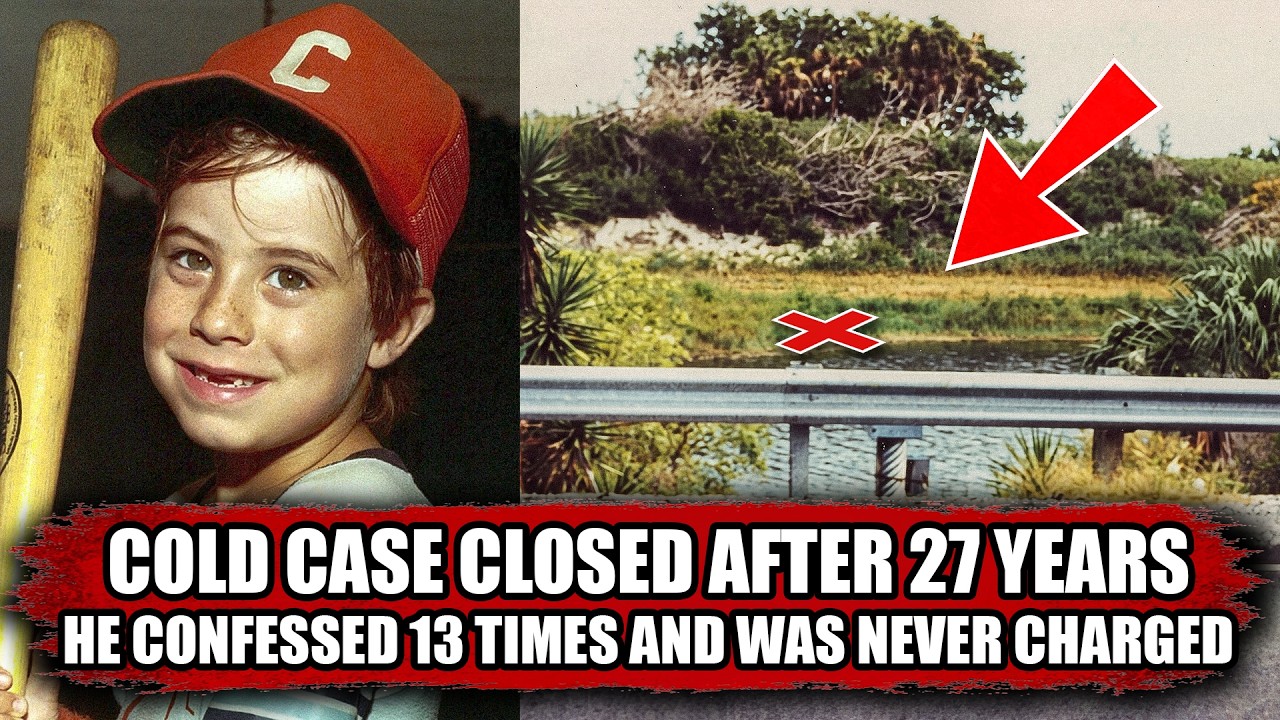
His name was Adam Walsh. Two weeks later, two fishermen pulled a child’s severed head from a drainage canal 130 miles to the north. The rest of him was never found. A drifter confessed to the killing, took it back, and confessed again over and over for more than a decade.
The evidence that could have proven it was lost by the police who collected it. The case stayed open for 27 years, and no one was ever charged with his murder until now. Adam John Walsh was born on November 14th, 1974, the only child of John and Revé Walsh. The family lived in Hollywood, Florida, a midsize city on the coast between Fort Lauderdale and Miami.
John was a partner in a hotel management company. Revé stayed home with Adam. By every account, they were an ordinary middle-class family living an ordinary life. Adam was six, outgoing, and full of energy.
He liked baseball and the beach and being outdoors. He was also, by the accounts of those who knew him, a shy and trusting boy, the kind who would follow an older kid’s lead and would not think to make a fuss. And like most six-year-old boys in America that summer, he was fascinated by video games. The Atari 2600 was the most wanted toy in the country, and department stores set up demo kiosks near their entrances to pull families inside.
That detail, small and ordinary, is what put Adam where he was on the last afternoon anyone saw him alive. On the morning of July 27th, 1981, Revé Walsh drove Adam to the Sears at the Hollywood Mall. Inside, near the toy department, a kiosk had an Atari 2600 set up for kids to play. Several boys, most of them older than Adam, were crowded around it, taking turns.
Adam asked if he could stay and watch. Revé said yes and stepped away to the lighting section a short distance off. She was gone about ten minutes. While she was away, a scuffle broke out among the older boys over whose turn it was.
A teenage Sears security guard came over and told the group to leave the store. He walked them toward the exit, and Adam, a shy kid who did not speak up that his mother was still inside, went with them. He walked out through a different door than the one he had come in through. When Revé came back to the kiosk, Adam was not there.
She had him paged over the store’s speakers. She searched the toy department, then the whole store, and no one had seen him. After more than an hour of looking, she called the Hollywood police. The response was slow, and part of the reason was the state of things in 1981.
Hollywood was a small suburban department, and there was no protocol for a child abduction like this. There was no Amber Alert. There was no national database for missing children. Officers walked the mall and the parking lots and found no trace of him.
And in a detail that would sting for decades, the Sears Adam vanished from sat directly across the street from the Hollywood police station. He had been taken almost within sight of the people now trying to find him. It took a full week for the FBI to get involved. At the time, the bureau typically only entered a missing child case when an interstate crime was suspected, and no one yet knew what had happened.
In that first week, the department took in hundreds of tips. Volunteers searched parks and canals and empty lots across Broward County. John Walsh went on television and begged anyone who had seen his son to come forward. Adam’s face went onto flyers, then onto broadcasts across South Florida, then across the state.
On August 10th, 1981, two weeks after Adam disappeared, two fishermen on a drainage canal along Florida’s Turnpike near a rural crossroads called Yeehaw Junction saw something floating in the water. It was the severed head of a child. Dental records confirmed it was Adam. He had been found roughly 130 miles north of the Hollywood Mall, in a remote stretch of central Florida with no obvious link to the family or the store.
The rest of his body was never recovered despite long searches of the surrounding swamp and canal. The medical examiner could not pin down a precise cause of death, but found evidence consistent with asphyxiation and concluded the boy had died several days before he was found. John Walsh later said that when he got the call, the world stopped. The search for his son was over.
The search for whoever killed him was just beginning. The investigation was troubled from the start. Hollywood police put a team on the case full time, and tips came in from across Florida and eventually the whole country. But this was a suburban force built for burglaries and traffic stops, not a nationally televised child murder, and it was quickly overwhelmed.
Multiple suspects were identified, questioned, and cleared. As is standard in a case like this, detectives first looked hard at the people around Adam. They focused for a time on a family friend who had been involved with Revé, on the theory that someone close to the family might have wanted to hurt them through the boy. He passed a polygraph, and investigators determined he could not have made the trip to where Adam was found.
He was ruled out. The lead detective, Jack Hoffman, chased leads for years. Dozens of men were looked at. Some had records.
Some had been near the mall that day. One by one, they were ruled out or set aside, and the investigation churned through names and came up with nothing. Then, more than two years after Adam died, a man sitting in a Jacksonville jail reached out to investigators with a story about a child. On October 21st, 1983, a 36-year-old inmate contacted investigators.
He was being held on an arson murder for setting fire to a Jacksonville boarding house in early 1982 and trapping a 65-year-old man inside, who died a week later of his injuries. He had a criminal record that stretched back to childhood, and he described himself as a serial killer, a drifter who had spent years crossing the country with another convicted killer. He claimed to have taken part in more than a hundred murders. Most of those claims would later be proven false, but this time he said he wanted to talk about a boy from the Fort Lauderdale area.
And this time he had details. He said he had been at the Hollywood Mall on July 27th, 1981. He said he saw the boy standing alone outside the Sears after the guards sent the group of kids out, and that he lured him into his car with the promise of toys and candy. He described the car in detail: a white 1971 Cadillac with a damaged bumper.
He said he drove north toward Jacksonville with the boy beside him, that Adam grew scared and started crying for home, and that he hit the child and knocked him unconscious. He said he pulled off onto an isolated road and killed him there. His description of how he decapitated the boy matched what the medical examiner had found. Over the following months, he confessed to the killing at least seven more times, including one recorded account that investigators considered the most detailed and disturbing of them all.
The man’s name was already known to police in other states as one half of the most prolific pair of confessors in the country. But the details he gave about Adam were specific in a way his other claims were not. For a moment, it looked like the case might be over. Then he took it back.
He said he had made the whole thing up, that he was not capable of killing a child. A day later, talking to the same investigator, he reversed himself again and said he had killed the boy and dismembered the body. Later in that very same interview, he changed it once more and said he had left the body whole. Over the years, the accounts of what he had done with Adam kept multiplying and contradicting each other.
He told one investigator he had buried the body near the turnpike. He told another he had burned it in his mother’s yard. He gave a version so grotesque that a relative who heard it became physically ill. No two tellings quite matched, and the body was never found in any of the places he named.
He described Adam’s hair color wrong. He described the clothes the boy had been wearing wrong. He said his traveling companion had been with him during the abduction, but police confirmed that man was sitting in a Virginia jail on the day Adam was taken and could not have been anywhere near Florida. This became the pattern for the next decade: he confessed, and he recanted, and each time the details shifted under him.
Each time, investigators were left with the same impossible question. Were they listening to a real killer describing a real crime, or a compulsive liar performing one? Later, he told an investigator why he kept taking it back. Every time he told them something, he said, they called him a liar until it made him angry enough to say he had never done it.
The state attorney’s office in Broward County reviewed everything and declined to file charges. Without physical evidence to back the confessions, and with a man whose word had been worthless in case after case, prosecutors said they could not win at trial. A jury would hear a proven liar, and there would be no weapon, no blood evidence, and no body to hold up beside his words. The case could not be made.
But there had been evidence once. That is the part of this case that is perhaps hardest to forgive. When the man first confessed in 1983, investigators found the white Cadillac he had described sitting in Jacksonville. They pulled sections of carpet from the floorboards, and the carpet had visible blood stains on both the front and the rear.
They recovered a machete he said he had used. In 1983, DNA testing did not yet exist, and basic blood typing came back inconclusive. So the carpet, the machete, and the car were logged, documented, and put into storage to wait for a day when science could read them. That day came.
The evidence did not. The bloodstained carpet vanished from the custody of the Jacksonville Sheriff’s Office. The machete went missing. The car was eventually sold for scrap.
By the mid-1990s, when DNA testing had finally advanced enough to identify whose blood was on that carpet, every piece of it was gone. The three things that might finally have named him for certain had all disappeared from police custody. Not burned in a fire, not lost to a flood, simply gone one by one, out of the hands of the people whose job was to keep them. And there was one more failure underneath that one.
The lead detective came to believe, despite the confessions, that this man had not killed Adam. He turned the investigation toward other suspects and chased those theories for years. None of them ever produced an alternative killer, or physical evidence, or a confession. The department spent years looking away from the one man who kept saying he did it, while the evidence that might have proven it decayed and then disappeared.
While the investigation stalled, Adam’s parents were doing something no grieving family had ever done at that scale. They were turning their son’s murder into a national cause. John Walsh became the most visible advocate for missing children in America. He testified before Congress.
He pushed lawmakers to build the systems that had not existed when Adam vanished. In 1982, a year after Adam’s death, Congress passed the Missing Children Act, requiring the FBI to enter missing children into its national crime database. In 1984, the Walshes helped found the National Center for Missing and Exploited Children, which became the national clearinghouse for these cases. Adam’s face became one of the first to appear on milk cartons, and his case helped drive the fingerprinting programs and the tighter store and school security that a generation of American children would grow up with.
In 1983, Adam’s story was made into a television film that aired on NBC and was watched by 38 million people. At the end of the broadcast, the faces and names of missing children scrolled across the screen, and tips from viewers brought several of them home. It proved something that had never been tried on that scale: television could find missing kids. Five years later, John Walsh took that idea and became the host of America’s Most Wanted, a program that ran for more than two decades and helped capture over a thousand fugitives.
In 2006, a quarter century after his son’s death, the Adam Walsh Child Protection and Safety Act expanded the National Registry of Sex Offenders and put the boy’s name into federal law once again. There was a bitter edge under all of it. John Walsh had built this out of the worst thing that could happen to a parent, and he never stopped believing his son’s own case had been botched. In a book he wrote years later, he described the investigation into Adam’s murder as the product of laziness, arrogance, and pride.
The boy whose head was found in a canal had changed federal law and built a national institution. His father’s face was on television across the country for 20 years, and his own murder was still unsolved. The most famous missing child case in America had no killer named, no trial, and no ending. The man who had confessed and recanted for years never faced a courtroom for Adam.
He had been sentenced to death twice for other murders, and both sentences were later reduced to life on appeal. His health failed in prison. On September 15th, 1996, he died of liver disease at the age of 49. His body went unclaimed, and he was buried in the prison cemetery.
Before he died, according to his niece, he told her one more time that he had killed Adam Walsh. She later carried that account to John Walsh himself. Some who studied the case saw weight in a deathbed admission made when a man had nothing left to gain from lying, and nothing left to gain from the attention he had chased his whole life. It was not the first time he had said it.
It was the last. He was never charged with the murder. Not once in thirteen years of confessions. His name was Ottis Toole.
Toole was a convicted serial killer and arsonist from Jacksonville, Florida, found guilty of six murders over his life. He had drifted for years alongside another killer, Henry Lee Lucas, and together the two of them had confessed to dozens of murders, many of which turned out to be invented. Investigators around the country came to see the pair as men who would agree to almost any crime put in front of them, and later reviews questioned whether either was the mass killer he claimed to be. That history was the single largest obstacle to charging Toole for Adam.
A man who had confessed to crimes he could not have committed made a terrible witness against himself, even when he was telling the truth. And by the time investigators had sorted the credible parts of his Adam Walsh confessions from the rest, the physical proof that might have backed them up was already gone. For 27 years, the question was never whether Ottis Toole was capable of killing a child. He was.
The question was whether the proof was strong enough to say he killed this one. And the answer kept running into the same wall the police had built themselves. In 2006, at Revé Walsh’s request, a retired Miami Beach homicide detective named Joe Matthews agreed to review the entire case. He spent close to three years working through a file that had grown to roughly 10,000 pages.
Among the material were 98 photographs taken of the inside of Toole’s Cadillac back in 1983, before the car was lost. According to Matthews, the photographs had never been developed or examined, and when he had prints made, one of them showed what he identified as the bloody imprint of a child’s face pressed into the carpet behind the driver’s seat. That claim became the most talked-about piece of the review, and also the most disputed. Some experts questioned whether the image showed a face at all, noting that the chemical used to reveal it can react to more than blood.
John Walsh himself said he could not bring himself to look at it. It was never tested against Adam, because the carpet it was photographed on had been gone for years. There was other support for the case against Toole. Witnesses had placed him and his white Cadillac in the Hollywood area in the days before Adam vanished.
For years, John Walsh had pointed to another detail: investigators searching Toole’s Jacksonville home had found a pair of green shorts and a sandal similar to what Adam had been wearing the day he disappeared. And in 1991, a witness came forward who said he had seen a boy who looked like Adam get into a Cadillac with a man matching Toole, and described a specific dent in the car that matched Toole’s. That detail about the dent had never been made public, which meant the witness could not have taken it from the news. Investigators considered that account one of the strongest pieces of corroboration in the entire case.
It was the kind of testimony that might have carried weight in a courtroom, if the case had ever reached one. It never would. On December 16th, 2008, 27 years after Adam Walsh was taken from a Sears, Hollywood Police Chief Chad Wagner held a press conference with John and Revé Walsh beside him. He announced that the case was officially closed, and that the department was satisfied Toole was Adam’s killer.
He was candid about what the case did not have. There was no DNA, no single piece of physical proof. “If you are looking for a magic wand,” he said, “one piece of evidence that settles it, it is not there. ”
Then Wagner did something departments rarely do.
He apologized. He told the Walsh family he was sorry for the investigative failures that had haunted the case for decades. And he acknowledged that his department had spent years chasing other suspects instead of the man who kept confessing. The closing was not a conviction.
It could never be one, because Toole had been dead for 12 years. It was a decision made by the department that it believed it finally knew the answer. Not everyone accepts it. Over the years, others have argued that a different killer, the serial murderer Jeffrey Dahmer, who lived in South Florida in 1981, could have been responsible, and some witnesses claimed to have seen him near the mall.
Dahmer died in prison in 1994, never charged in Adam’s death either. The closing named Toole. It did not silence the doubt. John and Revé Walsh stood beside the chief that day and said they could finally move forward, knowing the person who took their son had at last been named.
It had been 27 years since they walked into a Sears with Adam and walked out without him. What their son left behind is almost impossible to measure. The video game kiosk is long gone, and so is the Sears, and the mall itself was rebuilt under a new name. But the laws that carry Adam’s name are still on the books.
The center his parents built still answers a hotline that has taken millions of calls from people looking for children who vanished the way Adam did. An entire country learned to watch its children more closely because of what happened to one small boy at a store counter in the summer of 1981. And in a quiet final detail, Adam’s head, kept in a morgue as evidence for 27 years, was released for burial only when the case was at last declared closed. His case was closed, but it was never truly solved in the way the word usually means.
No court ever tested the answer the police arrived at. A man confessed and unconfessed until he died. The proof was thrown away by the people entrusted with it. And in the end, a department decided it had seen enough.
For the family that changed how America protects its children, that decision, imperfect and late, was the closest thing to an answer they would ever get.






