The slaughter of the German Air Force, April 17, 1944. A fighter airfield in northern Germany, headquarters of a group of Jagdgeschwader 1. A command car stops beside the operations hut, and out steps Lieutenant Werner Falk, nineteen years old, a recent graduate, freshly winged, with 112 hours in his flight log and an assignment order in his jacket pocket. Falk feels proud.
And rightly so. A year earlier, joining a fighter wing in the German Air Force meant joining the most celebrated brotherhood in the German army: the hunters, the knights, men with movie-star faces and oak leaves on their collars. He stands before the group commander, a twenty-six-year-old with the look of a hundred missions, salutes, and states his name. The commander does not write the name down.
He does not ask where Falk trained, or what he flew, or where his family came from. He looks at the flight log, 112 hours, perhaps twenty of them on the Messerschmitt 109, then looks out the window at a horizon scarred by anti-aircraft fire, and allocates Falk a bunk, and a wing position for tomorrow, and nothing else. No welcome, no questions. It is the clerk who explains things later, walking with Falk to his quarters, quietly, the way men explain things they have decided to stop feeling.
The commander stopped memorizing replacement names in February. In February, the group received eleven new pilots. Nine of them were dead before March. The clerk says: “The Americans come every day now.
” Not the bombers. The bombers are almost irrelevant. The fighters. Those silvery ones with the deep hum that chase you to your own runway and kill you on landing approach.
And those with the brown noses that dive out of the sun like a falling anvil and rake the mess hall at breakfast. There is no front line in the sky anymore, the clerk says. The sky itself has become enemy territory. The old pilots call the newcomers “buds,” and they do not memorize their names because names change too quickly and are not worth the trouble of remembering.
What Lieutenant Falk did not know, and could not have known standing on that runway with his 112 hours, is that he had not been sent to an air force. He had been sent to the receiving end of a decision. Four months earlier in England, an American general rewrote one sentence on the wall of a headquarters. That sentence turned American fighter power from an escort service into a weapon with a mission no air force had ever been given so explicitly.
Not to defend the bombers, not to win air superiority, but to hunt down the German Air Force itself wherever it existed until it ceased to exist. The Americans would carry out that sentence with two aircraft: the Thunderbolt and the Mustang, the hammer and the knife, and with cold arithmetic of pilots, fuel, and training hours, until by the spring of 1945 the German Air Force was, in the words of their own fighter general, “a corpse receiving supplies. ” This is not a story of a battle. Battles have two sides.
This is a forensic report on a slaughter: the systematic, deliberate annihilation of the German fighter force, and of the machine, the doctrine, and the men America mobilized to carry it out. The sentence hanging on the wall belonged to the Eighth Fighter Command of Brigadier General William Kepner. Throughout 1943, it read, in essence: “The first duty of the Eighth Air Force fighters is to bring the bombers back safely. ” It was a humane sentence, but it was strangling the air war.
Tied to the bomber formations, American fighters flew in close protection, defensive and reactive, surrendering all initiative. The German fighter controllers watched their radar screens and simply waited for the bomber escorts to reach the limit of their fuel and turn back. Then they fell on the unprotected bombers with rockets and cannons at will. During the Schweinfurt raids and the black autumn of 1943, this arrangement worked as a killing machine for American bomber crews, on a schedule controlled by the Germans.
In January 1944, Lieutenant General James Doolittle, the man who had bombed Tokyo from a carrier deck, took command of the Eighth Air Force, walked into Kepner’s headquarters, read the sign on the wall, and ordered it removed. The replacement sentence, by Doolittle’s own account, was the most important decision of his command: “The first duty of the Eighth Air Force fighters is to destroy the German fighters. ” Kepner asked if he meant it, if the fighters were truly free, and Doolittle meant it. Free to leave the bombers.
Free to fly ahead of the bomber stream and break up German formations while they were still assembling. Free—and this clause was the knockout blow—to chase German fighters down, out of the fight, through the clouds, to low level, into their landing patterns, over their runways, and destroy them there. The bombers were no longer, in the new calculus, the treasure the fighters protected. The bombers were the bait: the one target the Luftwaffe could not refuse to defend, and every day they flew, German fighter forces were forced to climb up to their deaths.
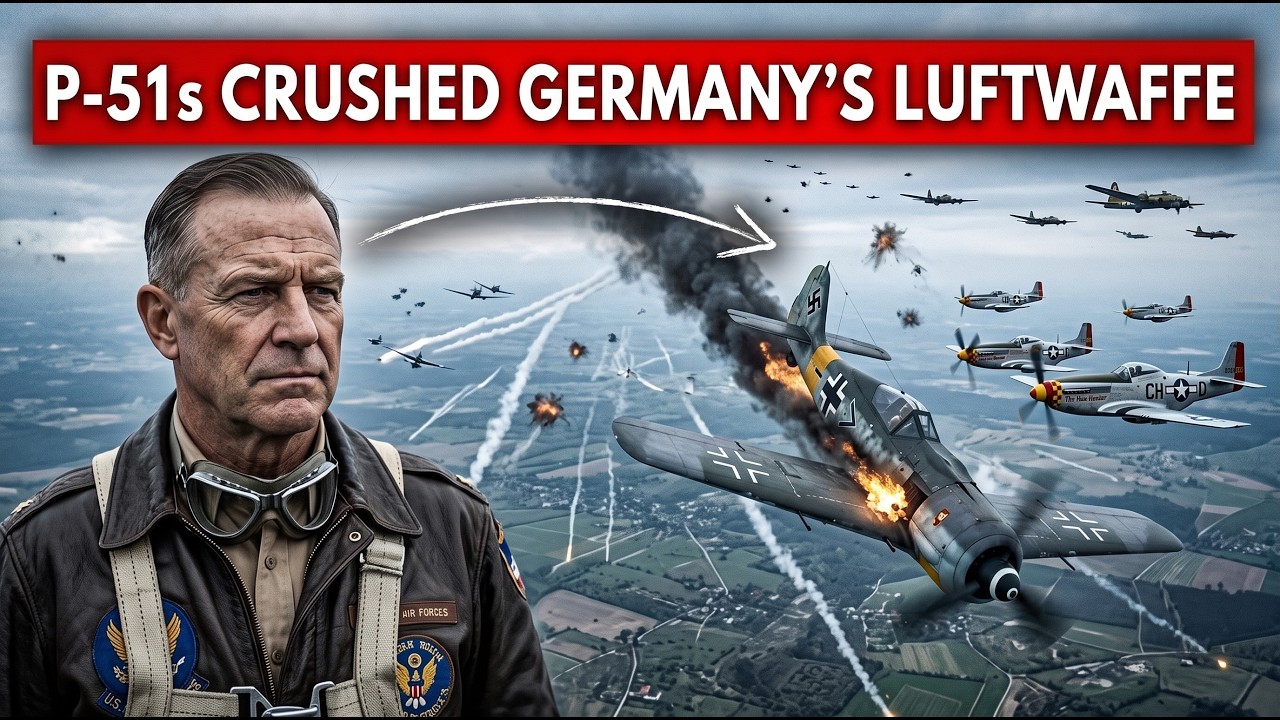
The instrument of the new doctrine came in two calibers. The P-47 Thunderbolt, seven tons of brutal radial-engine power, with eight fifty-caliber guns, unstoppable in the dive, dominated the medium ranges: the battles over Holland, the Ruhr, and northern France. Colonel Hubert Zemke’s 56th Fighter Group, known as the Wolf Pack, turned the Jagdgeschwader into the highest-scoring fighter group in the theater and pioneered the tactic of the distributed squadron sweep, clearing the field wide ahead of the bombers to meet German groups at their assembly points before they could attack. And from January 1944, arriving in numbers precisely on schedule for the doctrine, came the P-51 Mustang: the escort Göring had promised Germany would never exist, flying to Berlin and beyond on its wing tanks, faster at altitude than anything the Reich could send against it in strength.
The relay system was the core of the genius. Thunderbolts and Lightnings covered the outer rings and chased the flanks. The Mustangs took the long missions to the heart of Germany, where the German day fighter force was forced to fight over its own cities, factories, and homes. The Luftwaffe was granted no refuge in space or in time.
From the first week of the new doctrine, the exchange rate began writing the death certificate of the Reich. The Germans felt the change before they understood its extent. In the last week of February 1944, “Big Week,” the Eighth and Fifteenth Air Forces hurled themselves at the German aircraft industry for six consecutive days, and the Luftwaffe rose to defend it, exactly as the doctrine intended. The factories were bombed and repaired, production lines were dispersed and survived, but none of that was the real record.
The real record was in the air. In six days of maximum effort, the German day fighter force lost hundreds of aircraft, and something that could never be replaced or rebuilt: a sixth of its experienced fighter pilots, killed, wounded, or captured. The Americans also suffered heavy losses, especially in bombers. The difference—the entire war is contained in this difference—is that the Americans replaced their losses within weeks, while the Germans replaced theirs with Lieutenant Falk.
Then came Berlin. On March 4, Mustangs appeared over the capital of the Reich for the first time. On March 6, the Eighth Air Force fought the bloodiest air battle of its war on the way to the city. Sixty-nine bombers fell, a number that would have ended the campaign in 1943.
In 1944, it broke nothing. The escort was there all the way, and the German forces defending their capital that day lost fighters and pilots at a rate the Americans could sustain indefinitely, while the Germans could not sustain it for a single season. Göring said after the war that when he saw fighters with white stars over Berlin, he knew the war was lost. His pilots knew it slightly earlier, because the men dying were not the newcomers.
They were the irreplaceable ones. On March 2, 1944, Colonel Egon Mayer, commander of Fighter Wing 2, with 102 victories, the first to reach 100 entirely on the Western Front, and the tactical planner who had invented the head-on attack that was the Luftwaffe’s most effective weapon against bomber formations, fell into the grip of Thunderbolts near Montmédy and was killed. He was twenty-six years old. Every expert who fell—Mayer in March, the great Hans Philipp before him, name after name throughout the spring—took with him not just an aircraft but an entire school.
The accumulated experience that was supposed to teach the newcomers how to survive their first five missions. The German Air Force was not just losing pilots. It was losing its own memory. Adolf Galland, the General of Fighters, submitted a report to his superiors that spring in language that still exists in the records and that no propaganda ministry could repair.
The day fighter force had lost over a thousand pilots in the first four months of 1944. Among them were the best squadron, group, and wing commanders. Every mission was costing over fifty aircrew. The time had come, Galland wrote, when the force was on the verge of collapse.
In May 1944, one in four German fighter pilots became a casualty. In a single month, that is not an attrition rate; that is a half-life. On May 12, 1944, the American bombers, whose escort was now invincible, turned toward the target that turned the defeat of the German Air Force into its extinction: oil. Albert Speer, the Reich’s armaments minister, wrote that he would never forget that date.
That day, he said, “the technological war was decided. ” The synthetic fuel plants at Leuna, Pölitz, and their sisters began to collapse under the bombing, and with them died the essential substance on which any air force is built. German aviation fuel production collapsed during the summer of 1944, from about 175,000 tons in April to nearly a tenth of that by September. Follow the trail of fuel scarcity to its cruelest destination: the flying schools.
An air force bleeding out needs replacement pilots. Replacement pilots need training hours. Training hours mean fuel. Germany had nothing to offer, so the curricula were cut again and again, until boys arrived at front-line units in late 1944 with barely over a hundred hours of flight time.
Some with flight hours in single digits on the fighter in which they would die. Across the Channel, the American training machine, soaked in Texas sun and Oklahoma fuel and far from any enemy, was turning out tens of thousands of pilots a year, each with nearly 400 hours before combat, taught by veterans brought home specifically to instruct. The German Experten were never brought home. They kept flying until the war’s arithmetic caught up with them.
Günther Rall, with 275 victories, was severely wounded by Zemke’s Wolf Pack over Berlin in May. The survivors flew four missions a day on amphetamines and grief. Under the doctrine Doolittle had freed, the Americans drove their blade into the one place an air force cannot fortify: the ground. Returning from escort missions, fighter groups dropped to low level to rake airfields, anti-aircraft towers, fuel dumps, aircraft in hangars or factories or on trains.
It was, by the testimony of every pilot, the most dangerous mission of the air war. The light flak around German airfields killed and captured more elite American pilots than the Luftwaffe shot down in the air. Francis Gabreski himself, with 28 victories, was captured in July 1944 when his propeller clipped a German runway during a strafing attack. The Americans paid that price daily and deliberately, because the doctrine had completed its calculation.
A German fighter destroyed on the ground killed no bomber crew, trained no replacement, and taught no one but despair. By the end of the war, Eighth Air Force fighter groups had recorded more than 4,000 German aircraft destroyed on the ground. A second air force annihilated without a single air battle. The remnant of the German fighter force spent the last autumn of the war choosing between forms of suicide.
The first form was armor. Since escort missions made conventional attacks on bomber formations unsurvivable, the Luftwaffe built Focke-Wulf 190s in storm squadrons armored like flying fortresses. Their pilots swore in writing to close to point-blank range and ram the bombers if their guns failed. Against unprotected bomber formations, their results were catastrophic.
Over Oschersleben on July 7, 1944, a single Sturm attack tore apart an entire group of Liberators in minutes. But the armor that let them survive bomber fire made them slow targets for fighters. And the Mustangs always came. Time and again through the autumn, the escort groups hunted down those armored rams before or after their attacks and wiped them out to the last.
The courage of the Sturm pilots was real, but the doctrine that required it was only an arithmetic chart wearing a uniform. The second form was the future. The Messerschmitt 262 was the fastest fighter on earth by 100 miles per hour, and the Americans could not catch it in open sky. So they did not chase it in open sky.
They circled its airfields. The jets burned fuel too fast to loiter, and they landed on rigid schedules, so the Americans killed this revolution in its landing pattern, at low speed, over the fences of its bases. On November 8, 1944, Major Walter Nowotny, with 258 victories and commander of the first jet fighter unit, died in exactly this trap, crashing in sight of his own base while Adolf Galland stood on the ground watching. The jets destroyed bombers until the last week of the war, but they changed nothing.
There were never enough, they had no fuel, and no sky to breathe in. The 262 proved that technology cannot outrun arithmetic. The third form was Bodenplatte. On January 1, 1945, the Luftwaffe gathered everything it had hidden and saved, about 900 fighters, and launched a dawn surprise attack on Allied airfields.
They destroyed perhaps 300 Allied aircraft, most of them parked and empty, and replaced from stores within days. In return, the Luftwaffe lost nearly 300 aircraft, and here is the number that ends the story: 214 pilots in a single morning, including three wing commanders, six group commanders, and a number of squadron commanders greater than the training system could produce in half a year. The final great blow of the German fighter force was aimed at itself. After January 1, the Luftwaffe existed as weather exists: occasionally, locally, and without effect.
The final accounting reads like a coroner’s report, because that is what it is. From Doolittle’s decision in January 1944 to the surrender in May 1945, the American fighter force in Europe did not defeat the German Air Force in the traditional sense of one air force defeating another. It liquidated it. The Eighth Air Force fighter groups alone destroyed over 5,000 German aircraft in the air and more than 4,000 on the ground.
The Ninth and Fifteenth added thousands more. Measured against these numbers, the German day fighter force lost the equivalent of its entire front-line pilot strength several times over in the last sixteen months of the war, and by the end the average German pilot survived a strikingly small number of missions. Lieutenant Falk’s commander was not cruel when he refused to memorize names. He was accurate.
Galland, in captivity, delivered the eulogy with professional precision. He said, in essence, that the German Air Force had not been defeated in the air. In individual combat, his experts feared no one. Rather, they were outmatched by the enemy in manufacturing, training, fuel, and finally in combat doctrine: an enemy that realized before Germany that air war in the industrial age is not knightly heroism but a factory process with a casualty list.
Germany produced the greatest fighter aces in the history of aerial combat, men of a hundred victories, men of three hundred victories, because its pilots flew until death, and it needed them to become legends, because legends were the only commodity it could still produce. America deliberately did not produce men with 300 victories. It sent its ace pilots home at the peak of their skill to teach, and accepted that trade every time. Fewer legends, more graduates.
One system focused on stories. The other focused on results. The result came in the spring of 1945 over a Reich whose sky was so thoroughly American that training flights circled Berlin. Lieutenant Werner Falk is a composite figure, and it should be clear about that.
He represents the real replacement pilots of 1944, those youths of a hundred flight hours whose real records and loss cards fill the German archives, and whose real commanders—this is a detail documented in several units—actually stopped memorizing new names. The sign on Kepner’s wall was real, and so was the man who ordered it rewritten. Egon Mayer’s grave is real. The fuel figures are real.
Nowotny’s crash, with his commanding general watching helplessly from the airfield, is real. The 214 pilots the Luftwaffe sacrificed on the morning of January 1, 1945, were real, every one of them, and their air force never flew as a unified force again. The slaughter of the Luftwaffe was not a numerical accident. It was a decision carried out with two great aircraft, 30,000 trained hands a year, and one rewritten sentence: the coldest sentence in the air war, and the one that ended it early.
In April 1944, a nineteen-year-old German reported to an airfield, and no one knew his name, because the men across the Channel had already finished the calculations that made his name irrelevant. The kindest thing history can now offer the boys in the silver fighters, and the boys sent to erase them, is the thing their war denied them. Remember the names.






