On the afternoon of July 20, 1944, a 31-year-old major named Otto Ernst Remer was summoned to the Berlin residence of Joseph Goebbels. He had not come to make an arrest, though that had been the plan only hours earlier. Remer commanded the Berlin Guard Battalion, and under the orders he had received that afternoon, he was supposed to seal off the government quarter and seize the propaganda minister. Instead, Goebbels had gotten word that the young battalion commander was not fully committed to the coup, and he had asked for a meeting.
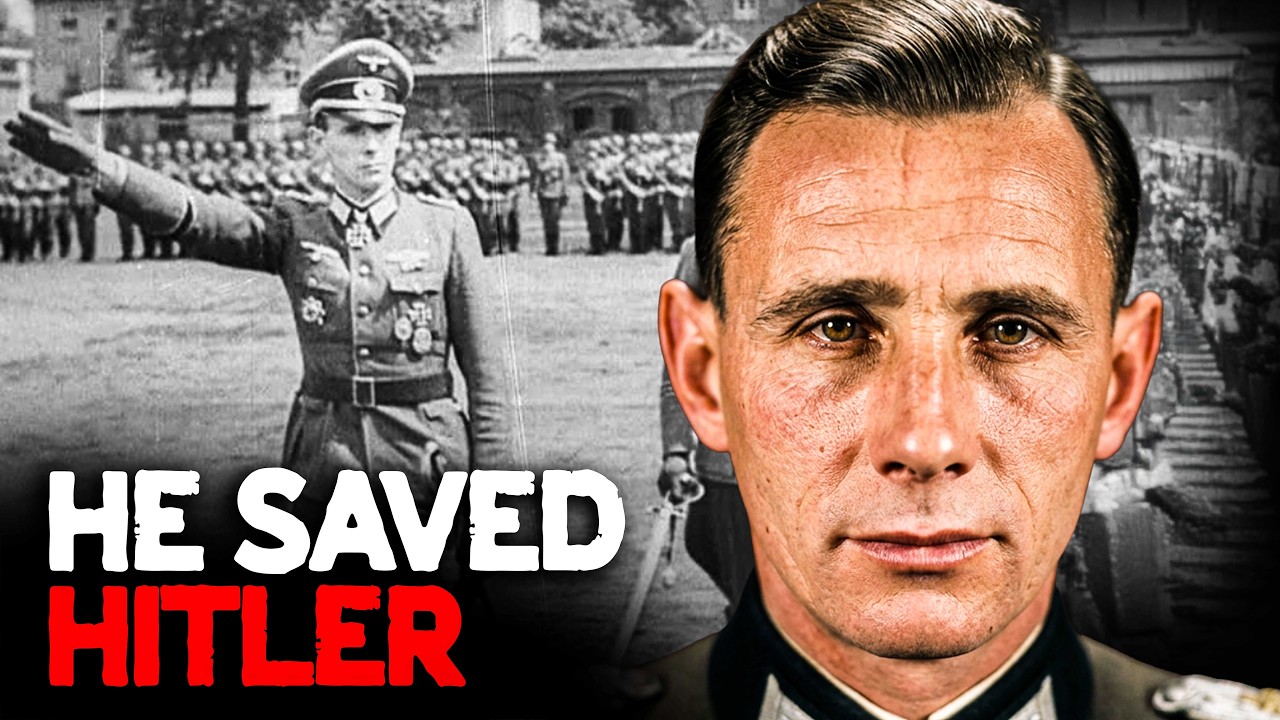
What happened in those rooms would decide the fate of the most serious attempt to kill Adolf Hitler. Goebbels arranged for Remer to speak directly with Hitler on the telephone. The voice with its distinctive Austrian accent was instantly recognizable. There could be no doubt that the man on the other end of the line was the Führer himself, which meant the Führer was not dead, which meant the entire premise of the conspiracy was a lie.
Hitler wasted no time. He promoted Remer on the spot from major to colonel, gave him direct authority over all military forces in Berlin, and ordered him to restore order and crush any resistance. It was one of the most consequential phone calls of the Second World War. Otto Ernst Remer was born on August 18, 1912, in the small northeastern German city of Neuruppin.
He entered the world in a Germany still ruled by the Kaiser, and he grew up breathing the poisoned air of German defeat: the humiliation of Versailles, the chaos of the Weimar Republic, and the mythology of the stab in the back, the lie that Germany had not lost the war on the battlefield but had been betrayed from within. It was a myth that would shape his entire adult life. He joined the Reichswehr in 1932, just months before Hitler became chancellor, and when the Wehrmacht replaced the Reichswehr in 1935, he was already a committed professional soldier. He was not a deep political thinker.
He believed that discipline, courage, and loyalty to the chain of command were the highest virtues a soldier could possess. His early career unfolded against the backdrop of Germany’s conquests. During the campaign in France in 1940, he served with distinction. On the Eastern Front, where Germany launched Operation Barbarossa against the Soviet Union on June 22, 1941, he proved himself repeatedly in the brutal fighting across Russia, Ukraine, and Belarus.
By 1942 he was commanding at battalion level. He received the Knight’s Cross of the Iron Cross in 1942, and in early 1944 he received the Oak Leaves, placing him among an exclusive group of Germany’s most decorated combat officers. Because of that record, he was assigned in early 1944 to command the Berlin Guard Battalion, officially the Wachbataillon Berlin, a ceremonial and security unit responsible for guard duties in the capital. He had approximately 2,000 men under his command, well armed, well trained, and positioned in the heart of Berlin.
In the plans of the July 20 conspirators, those soldiers were essential. The conspirators had modified an existing Wehrmacht emergency plan called Operation Valkyrie, and they had slotted Remer’s men neatly into their scheme. What they had failed to account for was the man who commanded those men and what he would do when the moment of decision arrived. The German resistance to National Socialism was not a single organization but a loose, shifting coalition of military officers, civil servants, diplomats, politicians, clergymen, and intellectuals.
Their motives were varied. Some were driven by moral revulsion at Nazi atrocities, some by patriotic concern that Hitler’s recklessness would destroy Germany, some by conservative disgust at the Nazi party’s vulgar disruption of traditional order. What united them was a willingness to risk their lives at a moment when the odds of success were vanishingly small and the consequences of failure were certain death. The military resistance centered in the Wehrmacht and stretched back to the earliest years of the regime.
General Ludwig Beck, the chief of the German general staff, had resigned in August 1938 in protest at Hitler’s planned invasion of Czechoslovakia, an act of moral courage almost without parallel in the senior ranks. He became the figurehead of the resistance, the man the conspirators intended to install as provisional head of state. He was 64 in 1944, plagued by stomach cancer. When the coup collapsed around him on the Bendlerstrasse, he chose death over capture.
Carl Friedrich Goerdeler, the designated Reich Chancellor, had built a distinguished career as a municipal administrator, serving as Lord Mayor of Leipzig from 1930 to 1937. He was a conservative, a deeply religious Protestant, and a fierce opponent of both Nazism and communism. He talked too freely and left too many paper trails. By the summer of 1944 the Gestapo had placed him under surveillance, and the pressure to act before the conspiracy was betrayed had become unbearable.
The man who transformed the conspiracy into an operational plan was Colonel Claus Philipp Maria Schenk Graf von Stauffenberg. Born on November 15, 1907, in Jettingen, Bavaria, he came from an ancient aristocratic family with deep roots in the Catholic faith and the German military tradition. He served with distinction in Poland and France, but what changed everything was his service in North Africa and on the Eastern Front, where he witnessed firsthand the systematic murder of Jews and Soviet prisoners of war. By 1943 he had reached a conclusion he expressed with characteristic clarity: Hitler was not just a bad leader making poor strategic decisions.
He was a criminal, and those who served him without resistance were complicit in his crimes. In Tunisia in April 1943, Stauffenberg’s vehicle was strafed by Allied aircraft. He lost his right hand, two fingers of his left hand, and his left eye, and sustained severe injuries to his remaining eye and right knee. During his long recovery, his commitment hardened into iron resolution.
By the summer of 1944 he had been appointed chief of staff to General Friedrich Fromm, commander in chief of the Reserve Army, a position that gave him regular access to Hitler’s military conferences and the ability to place a bomb close enough to kill him. The conspirators had tried and failed before. In 1943 a bomb hidden in brandy bottles on a plane carrying Hitler failed to detonate. By July 1944, with the Western Allies established in Normandy and Soviet forces pushing westward, they knew time was running out.
General Friedrich Olbricht, deputy commander of the Reserve Army, had worked with Stauffenberg to secretly modify Operation Valkyrie so the Reserve Army would be mobilized after Hitler’s death, not to maintain Nazi order but to overthrow it. SS and Gestapo installations would be seized, Nazi ministers arrested, and a new provisional government would negotiate an end to the war. Field Marshal Erwin von Witzleben was designated supreme commander of the Wehrmacht after the coup. He had been relieved of active command in March 1942 and had given himself fully to the conspiracy.
General Henning von Tresckow, the most morally uncompromising figure in the resistance, had been the Eastern Front conspirators’ most effective organizer. General Erich Hoepner, dismissed and humiliated by Hitler for ordering a retreat from Moscow without permission, was designated to replace Fromm as commander of the Reserve Army if Fromm refused to cooperate. On the morning of July 20, 1944, Stauffenberg flew from Berlin to the Wolf’s Lair in East Prussia, Hitler’s fortified headquarters buried deep in a forest. He carried a briefcase containing two British-made plastic explosive charges connected to a time fuse.
The plan had been to use both charges, but an interruption came before he finished arming them. He managed to arm only one. He placed the briefcase under the large oak conference table, as close as he could get it to Hitler’s position, and excused himself on the pretext of a telephone call. At 12:42 in the afternoon the bomb went off, shattering windows, blowing out walls, and sending a column of smoke into the summer sky.
Stauffenberg watched from about 200 meters and concluded no one could have survived. He and his adjutant, Werner von Haeften, drove to the airfield, bluffed past three security checkpoints, and were airborne within minutes. What Stauffenberg could not know was that the single charge had not killed Hitler. The officer standing next to him had instinctively moved the briefcase further under the table, shifting it behind the solid oak table leg, which absorbed much of the blast.
Hitler was hurled across the room, his hair set alight, his eardrums damaged, his arm burned, his trousers shredded, but he was alive. Four other men in the briefing room died of their wounds. Within hours Hitler was on the phone to Mussolini, displaying his shredded uniform as a trophy of miraculous survival. In Berlin, the conspirators were paralyzed by their inability to answer the one question on which everything depended: was the Führer dead?
Phone lines to the Wolf’s Lair still worked. Conflicting reports flowed in from multiple directions. In the crucial hours between the explosion and the collapse of the coup near midnight, they could not get confirmation, and their window of opportunity narrowed with every passing hour. Remer had moved his men into their assigned positions that afternoon, but he was thinking hard about what was actually happening.
The official story was that Hitler had been assassinated by the SS and that the Wehrmacht was taking emergency measures to prevent an SS takeover. It was plausible, given the well-known tension between the Wehrmacht and the SS, but Remer was not entirely convinced. Then came the meeting with Goebbels and the telephone call. Once he knew Hitler was alive, he acted with crisp efficiency.
He moved his forces to surround the Bendler block, the Reserve Army headquarters where the conspirators had gathered. Throughout the building, officers who had been wavering began switching sides. General Fromm, who had been placed under house arrest when he refused to support the coup, was released. In an act of naked self-interest, he ordered the immediate court-martial and execution of the main conspirators before they could be interrogated and reveal his own extensive prior knowledge of the plot.
In the courtyard of the Bendler block, under the headlights of military vehicles, an improvised tribunal condemned four men to death: Colonel Klaus von Stauffenberg, General Friedrich Olbricht, Colonel Albrecht Ritter Mertz von Quirnheim, and Stauffenberg’s adjutant, First Lieutenant Werner von Haeften. Just before midnight on July 20, 1944, they were shot by firing squad. Stauffenberg reportedly cried out “Long live sacred Germany” as the bullets struck him. The coup was over, and Otto Remer had stopped it.
The immediate aftermath was a blood-soaked reckoning. The Gestapo began mass arrests within hours. The People’s Court, the Nazi state’s instrument of judicial terror, was mobilized, and the man appointed to preside over the trials was Roland Freisler, a man who had turned courtroom procedure into a spectacle of degradation. He screamed at defendants, interrupted their testimony with contemptuous abuse, denied them access to their lawyers, and consistently delivered the verdicts the regime required: death.
The first major trial opened on August 7, 1944, just eighteen days after the failed coup. The defendants had been denied sleep, denied proper food, and stripped of their belts and suspenders specifically to ensure they would appear disheveled before the cameras Hitler had ordered to record the proceedings. Field Marshal Erwin von Witzleben stood before Freisler in that condition. Every time he tried to speak, Freisler drowned him out with screaming denunciations.
He was found guilty and hanged on August 8, 1944, at Plötzensee Prison, not shot as a soldier but hanged on a meat hook from a thin wire noose, a method chosen personally by Hitler to maximize suffering and deny any dignity. He was 62 years old. The execution was filmed for Hitler’s personal viewing. General Erich Hoepner attempted to defend himself with some spirit, arguing he had acted from patriotic conviction.
Freisler was unmoved. Hoepner was hanged at Plötzensee the same day, 57 years old. Lieutenant Peter Yorck von Wartenburg, a descendant of the famous Prussian field marshal, told the court that what united the conspirators was their rejection of the Nazi state’s claim that it had the right to demand total obedience regardless of the moral content of its orders. Freisler screamed and moved quickly to end that line of argument.
Yorck was hanged on August 8, 1944. He was 39. General Helmuth Stieff had provided the plastic explosive. He attempted to minimize his role, claiming he had been manipulated.
Freisler was not persuaded. Stieff was hanged at Plötzensee on August 8, 1944, at 43. General Paul von Hase, the military commander of Berlin, had sealed off government buildings and mobilized troops in support of the coup. He received the same verdict and was hanged the same day, at 58.
His nephew, bearing the same surname, was Dietrich Bonhoeffer, the theologian and pastor, who would face his own fate in the final weeks of the war. Carl Friedrich Goerdeler went into hiding when the coup failed. Within three weeks, on August 12, 1944, he was recognized and betrayed by a woman in a small East Prussian town. Under interrogation he talked extensively, providing detailed information about the conspiracy’s civilian networks.
Historians still debate whether this came from torture, psychological pressure, or a genuine belief that cooperation might moderate the regime’s response. He was tried in September 1944 and sentenced to death, but his execution was repeatedly postponed, possibly because the Gestapo wanted to keep extracting information, possibly because some SS figures saw him as a possible back channel to the Western Allies. Finally, on February 2, 1945, he was hanged at Plötzensee. He was 60.
General Carl-Heinrich von Stülpnagel, the military commander in France, did not hesitate when word reached Paris. Acting on the Valkyrie orders, he had approximately 1,200 SS and Gestapo personnel arrested, a stunning demonstration of what the coup could achieve if Hitler was actually dead. For a few hours Paris was effectively under military control. When word arrived that Hitler was alive, the situation reversed catastrophically.
Stülpnagel was ordered back to Berlin. Knowing what awaited him, he attempted suicide on the drive, shooting himself in the head. The bullet destroyed his eyes but did not kill him. Blind and in agony, he was interrogated, tried on August 30, 1944, and hanged the same day at Plötzensee.
He was 58. In his confused, dying state he had called out Rommel’s name, which would create enormous problems for the field marshal. Helmuth James Graf von Moltke was the intellectual soul of the resistance even though he consistently argued against assassination. He organized the Kreisau Circle, which met at his Silesian estate in 1942 and 1943, working out detailed plans for a post-Nazi Germany built on Christian social principles, federalism, and respect for human dignity.
He was arrested in January 1944 for warning a friend of his impending arrest. At his trial in January 1945, Freisler, struggling to find a specific crime, argued that Moltke’s crime was his Christianity and his belief that there were limits to what the state could demand of individuals. Moltke wrote to his wife from prison that Freisler had proven his point better than he could have done himself. He was hanged at Plötzensee on January 23, 1945.
He was 37. Adam von Trott zu Solz, a Rhodes Scholar at Oxford in the early 1930s, had used his diplomatic position to communicate secretly with Allied officials, trying to lay groundwork for a negotiated peace. He was hanged at Plötzensee on August 26, 1944. He was 35.
Julius Leber, a leading Social Democrat and Stauffenberg’s preferred choice for interior minister, had been arrested in early July after meeting with Communist Party contacts infiltrated by Gestapo informers. His arrest added to the pressure to act quickly before the entire network unraveled. He was tortured and hanged at Plötzensee on January 5, 1945. He was 53.
Hans-Bernd von Haeften, brother of Werner, who had died in the Bendler block courtyard, was hanged at Plötzensee on August 15, 1944. He was 38. His brother had been 29. Two brothers, two deaths, one family destroyed.
Admiral Wilhelm Canaris, head of the Abwehr, Germany’s military intelligence service, had pursued a double game of extraordinary audacity, using his position to shelter Jews, sabotage Nazi operations, and provide intelligence to the Allies. He was placed under house arrest after the coup. In September 1944 the Gestapo discovered a secret diary documenting his activities. He was moved through a series of prisons and ended at Flossenbürg concentration camp.
On April 9, 1945, four weeks before Germany’s surrender, he was stripped naked, led to a makeshift gallows, and hanged. He was 58. Germany’s defeat was already certain. His execution served no military purpose.
It was pure revenge. Hans Oster, Canaris’s deputy, who in May 1940 had passed information about Germany’s invasion plans to the Dutch military attaché in Berlin, was hanged at Flossenbürg the same day, in the same grim ceremony. He was 57. Dietrich Bonhoeffer was neither a military officer nor a career civil servant.
He was a Lutheran pastor and theologian. In June 1939 he traveled to the United States, where American colleagues had offered him a position, fearing for his safety. He spent only a few weeks there before returning to Germany, writing to a friend that he needed to share his country’s fate if he was to have any standing in its reconstruction. He was arrested in April 1943 and held in Tegel prison, where he continued to write with extraordinary productivity.
He was transferred to Buchenwald, then to Flossenbürg. He was hanged on the morning of April 9, 1945, the same morning Canaris and Oster died. Witnesses described him as calm and composed, conducting a brief worship service before being led to execution. He was 39.
The war ended in Europe less than a month later. Fabian von Schlabrendorff had personally carried the brandy bottle bomb onto Hitler’s plane in March 1943 and then coolly retrieved it before its failure was discovered. Arrested after July 20, he was subjected to torture of exceptional brutality, including devices that crushed his fingers. Despite this, he revealed remarkably little that the Gestapo did not already know.
He was brought before Freisler’s court, and then fate intervened. On February 3, 1945, while his trial was in progress, American bombers raided Berlin. A bomb struck the People’s Court building. Roland Freisler was killed, struck by falling debris while clutching Schlabrendorff’s case file to his chest.
Schlabrendorff survived, was freed by Allied forces in May 1945, became a judge on West Germany’s Federal Constitutional Court, and published his memoirs. He died in 1980 at the age of 72. Henning von Tresckow had known long before July 20 that the conspiracy might fail. When word reached him on July 21 that the coup had collapsed, he gathered his adjutant and spoke with a clarity that has become one of the most quoted statements of the resistance.
What mattered, he said, was no longer the practical result but the demonstration to the world and before history that the German resistance had dared to take the decisive step. He then went into no man’s land near the front lines and detonated a grenade against his own chest. He was 43. The wider circle extended far beyond the officers and politicians.
Hundreds of individuals were swept up in the Gestapo’s investigation. Under the Nazi principle of Sippenhaft, collective family responsibility, the wives and children of conspirators were arrested or sent to concentration camps. Stauffenberg’s wife Nina was arrested shortly after her husband’s execution and imprisoned, though she survived, liberated in Italy. Her four older children were taken from her and given new identities in an attempt to erase their connection to their father.
The youngest, Konstantze, was born in January 1945 while her mother was still in custody. Nina lived until 2006, dying at the age of 92, long enough to see her husband recognized as one of Germany’s greatest heroes at the very building where he had been shot. Freya von Moltke worked to preserve her husband’s legacy, moved to the United States, and died in 2010 at the age of 98. General Friedrich Fromm, who had ordered the execution of the conspirators to silence them, failed in his calculation.
Other witnesses survived. He was arrested within days, charged not with complicity but with cowardice for failing to actively resist the plot when he first became aware of it. He was executed by firing squad on March 19, 1945, at Brandenburg-Görden. He was 55.
The man who had tried to save himself by executing his colleagues ended up executed himself. Field Marshal Erwin Rommel, the Desert Fox, had not been part of the inner circle. He had expressed opposition to Hitler to several conspirators and indicated he believed Hitler’s removal was necessary, but had stopped short of endorsing assassination. He was wounded on July 17, 1944, when Allied aircraft strafed his staff car in Normandy, three days before the plot.
In October 1944 two Gestapo officers and two generals visited him at home and presented a stark choice: trial before the People’s Court, which meant execution and punishment of his family, or poison and a state funeral with an official story of death from his wounds. He chose the poison. On October 14, 1944, he got into a car with the Gestapo officers, swallowed the cyanide, and died within minutes. He was 52.
He was given a full state funeral, his death officially attributed to his injuries. Heinrich Himmler, the architect of the SS and the Holocaust, who had been appointed commander of the Reserve Army after the plot, went into hiding after Germany’s surrender. Captured by British forces in late May 1945, he bit down on a cyanide capsule hidden in a tooth cavity and died within hours. He was 44.
Joseph Goebbels, who had arranged the telephone call that crushed the coup, died in the ruins of the Berlin Chancellery on May 1, 1945. He and his wife Magda killed their six children, aged four to twelve, and then themselves. Goebbels was 47. The Nuremberg Tribunal established that following orders was not an adequate defense for participating in crimes against humanity.
Field Marshal Wilhelm Keitel, chief of the Wehrmacht High Command, offered the classic defense that he had been following orders. The Tribunal rejected it completely, ruling that military officers had an obligation to refuse criminal orders. Keitel was hanged on October 16, 1946, at the age of 63. After the war, Remer spent two years in Allied captivity and was released in 1947.
He could have quietly reintegrated into the emerging Federal Republic, as thousands of former Nazis did. But he was constitutionally incapable of the quiet moral recalibration that post-war German society required. In 1950 he co-founded the Socialist Reich Party, an explicitly neo-Nazi organization that rejected the Nuremberg trials, denied the extent of Nazi war crimes, and portrayed the July 20 conspirators not as heroes but as traitors who deserved everything they got. In state elections in Lower Saxony in May 1951 the party received 11 percent of the vote.
In October 1952 the Federal Constitutional Court ruled the party unconstitutional and ordered its dissolution, the first time the court had exercised its power to ban a political party. In 1952 a German court found that the July 20 conspirators had not been traitors but had acted in accordance with a higher moral obligation, and it sentenced Remer to prison for his statements. It was a landmark judgment, one of the first major legal decisions to establish the legitimacy of the resistance. Remer appealed and continued his activities.
Through the 1950s and 1960s he remained active in extreme right-wing circles, connected to the international network of former Nazis in Spain, Argentina, and Syria. In the 1970s he shifted his attention toward Holocaust denial, distributing pamphlets that denied the existence and use of gas chambers at Auschwitz and other camps. In 1992 a court in Munich convicted him of incitement to hatred for his Holocaust denial activities and sentenced him to 22 months in prison. The conviction was upheld on appeal in 1993.
Rather than surrender, Remer, now in his early eighties, left Germany for Spain. He settled in Marbella, where he continued to give interviews to sympathetic publications and correspond with neo-Nazi organizations. His views had not softened with age. He remained convinced that Hitler had been a great leader betrayed by weak subordinates, that the Holocaust was a lie, and that the July 20 conspirators were traitors who deserved their fate.
Otto Ernst Remer died in Marbella on October 4, 1997. He was 85. He was buried in Spain, far from the German soil that had defined every major aspect of his life. Germany’s historical memory has moved strongly toward honoring the conspirators.
The Bendler block, where Stauffenberg and his colleagues were shot, has become the German Resistance Memorial Center. Each July 20 a ceremony is held there. New recruits to the Bundeswehr take their oaths in ceremonies that reference the tradition of the conspirators, locating the moral foundation of the new German military in the example of those who refused to follow criminal orders rather than in the tradition of those who followed them loyally. Stauffenberg’s face appears on stamps and coins.
Streets, schools, and barracks carry his name. Remer’s story raises uncomfortable questions about the millions of Germans like him who served loyally and without evident moral reservation, skilled professionals doing their jobs in service of a state that had removed the normal categories of moral judgment from their daily duties. He was not an evil man in the ordinary psychological sense. He was a product of his culture, training, and time.
The tragedy of his story is not that he made a wrong decision on the afternoon of July 20, 1944. It is that the values that led to that decision also led him to spend the rest of his long life defending and propagating an ideology of hatred and denial. He had every opportunity in a free and democratic Germany to reflect and to acknowledge the moral complexity of his role. He chose instead a path of increasingly extreme denial, culminating in criminal conviction and flight from justice.
That choice, made freely over more than four decades, is the most important fact about Otto Remer, more important even than his decisive role in the most dramatic single day of the German home front during the Second World War.






