On August 14th, 1987, Edgar Rosenberg checked into a Philadelphia hotel under a name that was not his own. Joan was three thousand miles away in Los Angeles. He left no note explaining what had really been happening between them, no explanation of why their partnership had become something else entirely. Hours passed before anyone thought to look for him.
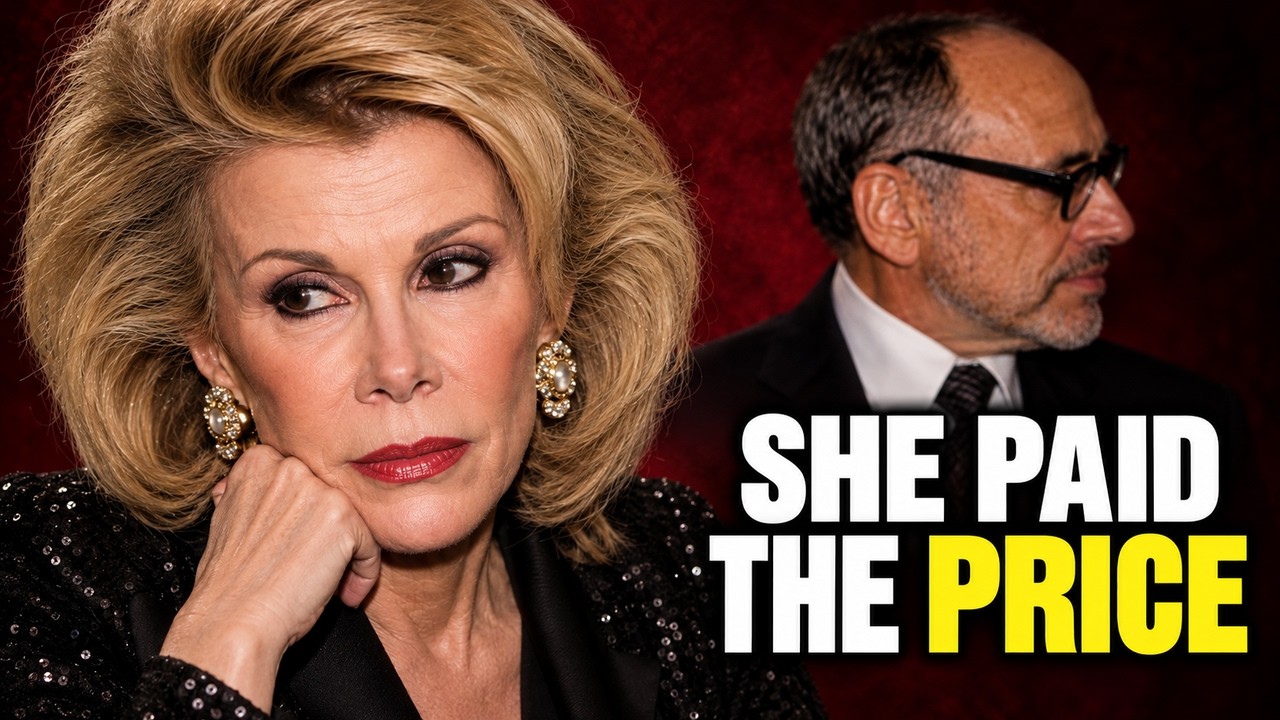
By the time the call reached Joan, it was already too late to ask why. The story America believed for decades was simple: the husband of the most famous female comedian in the country had cracked under the weight of her success and taken his own life. The tabloids wrote it as tragedy. Friends whispered about control, about money, about a marriage that looked nothing like what the public saw.
To understand what really happened in that marriage, you have to go back to the beginning. Joan Alexandra Molinsky was born in Brooklyn in 1933, the daughter of Russian Jewish immigrants who had climbed into the middle class and intended to stay there. Her father was a doctor. Her mother, Beatrice, kept a pristine home and expected her daughters to marry well, speak softly, and never make a scene.
Joan did not fit. She was loud, funny in ways that made people uncomfortable, and obsessed with performance. At Barnard College she studied English and theater, but her parents treated it as a phase. After graduation they expected her to find a respectable husband and settle into the life they had built for her.
Instead, she moved into a walk-up on the Upper West Side with roommates and started chasing stage work. Her mother stopped speaking to her for months. Her father told friends his daughter was resting between jobs. By 1958, Joan was deep in the Greenwich Village comedy circuit, a world of basement clubs, smoke-filled rooms, and audiences who heckled for sport.
She bombed constantly. Her act was too feminine, too nice, too much like the girl her mother wanted her to be. Male comics ignored her, or worse. Bookers gave her the dead slots after midnight when half the crowd had already left.
She rewrote her material every night, testing lines in front of mirrors, recording herself on a reel-to-reel tape deck she could not afford. The rent was always late. She slept on friends’ couches and ate one meal a day. Some nights she walked home from a club at two in the morning and cried the whole way, wondering if her parents had been right.
But she kept going back. She started writing sharper, meaner, more honest material. She stopped trying to be likable and started trying to be funny. The audiences still did not laugh much, but she could feel something shifting in the room.
A tension that had not been there before. Then a man walked into a club and saw something everyone else had missed. Edgar Rosenberg was everything Joan was not. British accent, tailored suits, a producer’s resume with actual credits.
He walked into that club in 1962 and watched her work the room like she was defusing a bomb, one joke at a time. Most men saw a woman failing. Edgar saw a weapon nobody knew how to aim yet. He came backstage, introduced himself, and told her she was going to be famous.
Joan, who had been performing for five years to rooms that barely clapped, looked at this stranger and believed him. Their courtship moved fast. Edgar took her to dinners she could not afford, introduced her to managers who had ignored her for years, rewrote her material with a sharper edge. Joan had spent much of her twenties alone in her parents’ apartment, watching other comics get discovered.
Edgar made her feel like the wait was over. She was not just falling in love. She was falling into a partnership that felt like rescue. They married in July 1965 at city hall.
No big ceremony, no family drama, just a quick exchange of vows between sets. Edgar became her manager the same week. One contract for marriage, another for representation, both signed within the same forty-eight hours. On paper, it made sense.
Joan had the stage presence, the timing, the willingness to say what other comics would not. Edgar had the connections, the strategy, the ability to get her into rooms where decisions were made. He booked her tighter, pushed her harder, negotiated every dollar like it was the last one they would ever see. But from the beginning, the lines blurred.
When Edgar gave notes on her act, was he her husband or her boss? When Joan resisted a booking, was she his wife or his client? They never stopped to ask. The work consumed them both, and the marriage became the scaffolding that held the career upright.
On February 17th, 1965, Joan walked onto the Tonight Show set for the first time. She did six minutes about her dating life, her body, her desperation, and Johnny Carson laughed so hard he had to take off his glasses. She got a standing ovation from the crew. Edgar watched from the green room and knew everything was about to change.
She came back two weeks later, then once a month, then every few weeks for the next twenty-one years. Carson made her a regular guest host in 1983, the first woman to sit in that chair. Joan’s fee went from $350 per set to $5,000 per appearance. Edgar renegotiated every eighteen months.
He booked her club dates around the Carson tapings, built a touring schedule that kept her on the road forty weeks a year, turned down offers he thought were beneath her. Joan trusted him completely. She did not read contracts anymore. She just performed.
By 1970, Joan Rivers was a household name. Edgar Rosenberg was the man behind her, invisible to the public, indispensable to her. But as Joan’s star rose, the arrangement shifted. Joan signed nothing without him.
She took no meeting alone. Friends watched Edgar’s hand tighten around every decision, every dollar, every yes and no. When they asked her about it, Joan’s answer never changed: he protects me. He handles the ugly part so I can be funny.
What the public did not see was how much Joan had begun to sacrifice to keep the peace. Melissa was born in January 1968. Joan became a mother at thirty-four in the middle of a tour that never stopped. She would do a late show in Vegas, fly home to New York, spend thirty-six hours with the baby, then leave again.
Edgar insisted they travel as a family. Joan carried Melissa through airports at two in the morning, smiling for the cameras, exhausted behind the eyes. She never complained, not to reporters, not to friends. To admit the marriage was fraying would mean admitting Edgar was fallible, and she could not afford that.
The 1970s belonged to Joan Rivers. She appeared on the Tonight Show ninety-three times between 1965 and 1986, more than any other guest. She sold out Carnegie Hall. Her comedy albums charted.
Edgar managed it all. From the outside, the partnership looked flawless. But the cracks were forming in private. Friends would call Joan and Edgar would answer.
Sometimes the message never arrived. Colleagues noticed he vetted every invitation, every collaboration, every new relationship in Joan’s orbit. Anyone he did not trust, anyone he thought might pull her in a different direction, got quietly shut out. He called it protection.
Joan called it devotion. But the pattern was unmistakable. Edgar was not just managing her career anymore. He was managing her world: who she spoke to, who she trusted, what she believed about herself.
NBC came to Joan in 1982 with an offer she had been chasing her entire life: her own late-night show. But Edgar had a condition. He would produce it, control the budget, the writers, the guests, the whole operation. NBC would not agree.
They wanted their own team, their own structure. Edgar told them no deal. Joan watched the opportunity slip away. She had been the permanent guest host on Carson for years, proved she could carry an audience, done everything right.
The door closed. She told herself he was protecting her from a bad arrangement. But something inside her cracked that year. Four years later, a different network came calling.
Fox was launching brand new and wanted a late-night show to go head-to-head with Carson. They wanted Joan. This time they agreed to Edgar’s terms. The Late Show starring Joan Rivers.
Her name, her stage, Edgar producing. It was everything the NBC deal had promised, but with one problem: taking it meant declaring war on Johnny Carson, the man who had made her career possible. Fox wanted an answer fast. Joan hesitated.
Edgar did not. He saw the offer as vindication. He pushed. Joan signed.
She made a decision that would haunt her for the rest of her life. She did not call Johnny first. Johnny Carson did not hear it from Joan. He read it in the trades.
His protégée, the woman he had given twenty-five permanent guest-host slots in a single year, had signed with a competing network, and she had not called. He picked up the phone once, not to Joan, to his producers. The message was simple: she’s banned. No goodbye episode, no farewell montage, no final walk to the couch.
She was erased. The press ran with it: Joan Rivers, the ambitious climber who stabbed Carson in the back. America had its villain. But Johnny never asked why she took the deal.
Six months before the Fox contract, Edgar had sat Joan down in their Beverly Hills living room. He told her it was time to decide: stay loyal to Johnny and remain the permanent substitute, or take the Fox offer and finally run her own show. He framed it as empowerment. Joan heard it as an ultimatum from the man she had promised to protect.
She signed the Fox contract, believing she was choosing her husband’s vision over Carson’s approval. She thought she was saving their partnership. The Late Show starring Joan Rivers premiered on October 9th, 1986. The NBC offer had come with five million dollars over three years; Fox was offering six times what Carson paid, plus her name in the title.
Edgar negotiated the contract personally. The final deal was eighty-seven pages long. Joan signed on page fifty-three. Edgar signed every page.
That first night, 7. 9 million viewers tuned in. Solid for a startup network, but not the Carson-killer Fox had promised advertisers. By week three, the audience had dropped to 4.
2 million. By January, they were at 2. 8 million. The reviews were sharp.
Variety called it uneven. The New York Times noted that Edgar’s producing choices felt amateurish, that the show lacked the rhythm of a real late-night program. Edgar fired the first producer after six weeks. The second lasted nine weeks.
The third producer quit after Edgar screamed at her in front of the entire staff. Joan watched it happen and said nothing. The show’s budget was $185,000 per episode. Edgar demanded set redesigns every month.
He spent $340,000 on changes in December alone. Fox executives started holding meetings without him. Joan’s monologues on Fox were shorter than her Tonight Show sets; Edgar thought they were too long and cut them down. The audience could feel her rushing.
In February 1987, Fox moved the show from 11:00 p. m. to 11:30 p. m.
Edgar found out by reading Variety. He called Barry Diller at six in the morning and threatened to walk. Diller did not return the call for three days. On May 15th, 1987, a Friday, Fox sent a single executive to Joan and Edgar’s office at 4:30 p.
m. He handed Edgar a letter and left without sitting down. Edgar was fired as executive producer. Fox offered to keep Joan as host, give her a new team, a fresh start.
Edgar was not invited back. The man who had managed Joan’s career for twenty-two years, who had walked away from Carson to build this with her, was being removed from his own show. Joan was given twenty-four hours to decide: stay with Fox and lose Edgar, or walk and lose everything they had risked. She quit the show that weekend.
The press called it loyalty. Her agents called it career suicide. The firing destroyed Edgar. He stopped getting out of bed before noon.
He would sit in their townhouse in his robe at three in the afternoon, circling jobs he would never apply for. No network would touch him. The Fox firing had made him radioactive. Joan started booking herself again, club dates in Atlantic City, guest spots on game shows, anything to keep money coming in.
But every time she came home with a check, he would ask how much, then go silent. He saw her success as his failure. He was the man who had lost their show, who had bet everything and come up empty. In the weeks leading up to August 1987, Edgar started making jokes his friends did not know how to laugh at.
He talked about checking out early, about how much easier things would be if he were not around. Joan’s manager later said Edgar gave him a watch, no occasion, just handed it over mid-conversation. He stopped returning calls. Joan suggested therapy.
Edgar refused. Everyone around them felt that terrible quiet before something breaks. Joan and Edgar spoke on the phone the night before he died. Joan told interviewers the conversation felt normal, even hopeful, that he talked about plans for the following week.
But people close to the couple remembered a different version. Joan confided to a friend that Edgar had sounded distant, distracted, like he was already somewhere else. She could not pin it down at the time. Just a feeling.
The hotel maid found him at 2:47 p. m. on August 14th. Edgar Rosenberg, sixty-two, in a bathtub at the Philadelphia hotel.
The coroner listed the cause as a prescription drug overdose combined with alcohol, mostly Valium. Joan got the call before 6:00 p. m. Pacific time.
She was in the Beverly Hills house, the one they had mortgaged to fund the Fox show. Melissa was in New York. Joan did not call her daughter, her agent, her lawyer, or her publicist. She walked upstairs, locked the bedroom door, and turned off the phone.
Staff heard nothing from the room for eleven hours. No crying, no calls, no movement, just silence on the other side of a locked door. By morning, the photographers were camped on the lawn. The New York Post ran the headline “J’s Hubby Suicide” in seventy-two-point type.
The Daily News went with “Rivers of Tears. ” The subheads were worse: career over marriage, ambition over love, the woman who destroyed Johnny Carson destroys her own husband. The cameras stayed for four days. Joan did not leave the house.
Once a tabloid reporter knocked on the door and asked if Joan had any comment about her husband’s death. No one answered. The funeral was held six days later at a chapel in Glendale. Fewer than forty people attended.
Joan wore black Chanel and oversized sunglasses she never removed, not even inside. Melissa, nineteen years old, sat beside her and held her mother’s hand through the entire service. Joan did not give a eulogy. She did not speak at all.
No one from NBC came. No one from Fox. Most of Joan’s comedian friends stayed away. Edgar was buried at Mount Sinai Memorial Park under a flat granite marker.
Joan stood at the graveside for less than three minutes. Then she turned, walked to the car, and left without looking back. She would never visit the grave again. Joan blamed herself.
In the journals she kept in those first months, she wrote the same lines over and over. She knew Edgar was fragile. Years later she admitted out loud that she should have walked away, should have chosen him over the show, over the career, over all of it. She believed with a certainty that never softened that Edgar died because she did not stop.
Three weeks after the funeral, Joan’s accountant sat her down and showed her the numbers. Edgar had been hiding the collapse for months. They were thirty-seven million dollars in debt. He had made deals she never saw, borrowed against earnings that did not exist, mortgaged their future to keep the show afloat.
The house, the jewelry, the cars, all of it was collateral. Joan had $1,100,000 in liquid assets. She was not grieving in private; she was grieving while staring at bankruptcy papers. Nineteen days after Edgar’s funeral, Joan Rivers walked back on stage in a casino in Atlantic City.
The spotlight hit her face and the audience went silent. She launched into her act as if nothing had happened. She performed forty-seven shows in sixty days. She worked 312 days in 1988: casino gigs for $25,000 a night, corporate events for $40,000, college shows for $15,000.
She took every offer. In private, she was unraveling. She could not sleep. She could not eat.
Melissa moved back home and watched her mother pace the house at three in the morning, rehearsing bits. Joan saw therapists. She refused medication. She told one of them she felt like she was performing every moment of her life, even when no one was watching, that she did not know where Joan Rivers ended and the act began.
Then someone from Edgar’s past came forward with a story that changed everything. A former colleague of Edgar’s reached out. He had a letter Edgar had written years earlier, before they were married. In it, Edgar described his own struggles with depression, his fear of failure, his belief that no matter what he achieved, it would never be enough.
Joan read it alone in her bedroom, and for the first time since Edgar’s death, she understood that the man she had married had been carrying something she never fully saw. Edgar Rosenberg was thirty-seven when he met Joan in 1959. He had been married twice, managed a TV show in South Africa that did not last, and arrived in New York with big ideas but no portfolio. Friends from that era remembered him as charming, educated, always talking about the next deal.
But nothing stuck. Joan was climbing, and Edgar attached himself to her trajectory. By the 1970s, he was her manager, her producer, the man who negotiated every contract. He built his identity around Joan Rivers Incorporated because he could not build one of his own.
Joan, in the quiet years after his death, started to see the pattern. He had not cracked under the weight of her fame. He had cracked because without it, he was invisible. Joan’s therapist used a word she had never applied to herself: codependent.
Edgar needed her success to feel like someone. Joan needed his control to feel safe. It was mutual dependence dressed up as devotion. When Fox fired them both in 1987, it did not just kill the show.
It severed the only thing holding the marriage together. Joan would later admit that Edgar did not fall apart because he lost his wife’s career. He fell apart because he lost his reason for existing. The truth was more complicated than the public story.
Edgar had relationships with men throughout their marriage, discreet and private. Joan knew about some of them. Friends from the 1960s said Edgar had been open about his sexuality before he met Joan. But in 1965, gay men could not produce television shows, could not negotiate network contracts, could not be taken seriously.
Joan gave Edgar legitimacy: a wife, a family, a public life. Edgar gave Joan a partner who would never compete with her, never upstage her. The codependency was not romantic. It was professional.
Joan put it in writing in 1997 in her memoir. She admitted she had known the marriage was crumbling years before his death, that she had felt trapped between her career and his ego, that she had thought about leaving. She said she had stayed out of guilt, out of fear of what people would say, out of the belief that a good wife did not abandon her husband when he was struggling. She had let Edgar manage her because it was easier than admitting the truth: she did not need him anymore.
By 1990, Joan was hosting QVC jewelry shows and selling a million dollars’ worth of brooches in a single hour. She wrote three best-selling memoirs in five years. She returned to standup with material so raw it made her early Carson sets look polite. She did it all without a manager.
The QVC deal had started as a humiliation for $500,000; the first show sold $1,800,000 in product. By 1993, Joan had paid off the debt, every dollar. She bought back her house, her jewelry, her contracts. She called her accountant at eleven at night the night the final payment cleared.
She did not celebrate. Joan turned Edgar’s suicide into material. She joked about it in her standup, in her memoirs, on late-night TV. “My husband killed himself,” she would say, pause for the gasp, then deliver the punchline.
“At least he left a note. Most men can’t even do that. ” She mined widowhood for twenty-five years, joking about dating after suicide, about cleaning out his closet, about the hotel room in Philadelphia. Some critics called it catharsis.
Others called it desecration. Joan did not stop. In 2010, Joan agreed to let a film crew follow her for a year. The resulting documentary, Joan Rivers: A Piece of Work, showed Joan at seventy-six, still doing 200 gigs a year, still terrified of being forgotten.
She kept a calendar on her desk and circled the empty dates in red ink. Offstage, she ate dinner alone most nights. She walked through her mansion talking to portraits of Edgar, asking him for advice, asking him why he left. In one unguarded moment, Joan admitted something she had never said publicly: she resented Edgar, not just for the suicide, but for everything that came before it.
She said she loved him and hated him in equal measure, and that the two feelings never left her. What Joan told a handful of close friends years later was something she never said on camera. In the months before Edgar’s death, he had asked her to walk away. Not just from Fox, from all of it.
He wanted them to disappear, buy a house somewhere quiet, live like normal people. Joan said no. She told him she needed the work, needed the stage, needed the validation that came from making strangers laugh. Edgar heard that as a choice: her picking comedy over him.
Joan tried to explain that performing was not optional for her, that it was survival. But Edgar was drowning, and survival for him looked like silence. That refusal was the real secret she carried. Joan spent the next twenty-six years asking herself if she could have saved Edgar by walking away.
Her therapists told her no, that Edgar’s depression was clinical, that it had roots she could not reach. She never believed them. She carried the guilt like something permanent and structural. It became the engine of her work ethic.
If she stopped, she would have to sit with the silence Edgar had wanted all along. Melissa Rivers grew up in the shadow of two ghosts. Joan leaned on her daughter in ways most mothers never would, sharing everything: the fear of going broke, the panic before every show, the nights she could not sleep. Melissa became confidant, therapist, business partner, all before she turned thirty.
Joan would call her three times a day, sometimes more. Melissa started therapy in 1995. She told Joan she could not remember a time when her parents were not fighting about work. Joan said that was not true.
Melissa asked her to name one day. Joan could not. In a 1997 interview with the New York Times, Joan said Edgar had been her manager, her producer, and her husband, in that order. The reporter asked if she regretted that.
Joan said no. Then she said yes. Then she changed the subject. In 2003, Joan found Edgar’s letters.
He had written her fourteen letters over the years, sealed and dated, the first from 1982 and the last from August 12th, 1987, two days before he died. She read them all in one sitting. One letter from 1985 said he felt invisible, that Joan’s career had consumed him, that he did not know who he was without her success, that he loved her and resented her in equal measure. The August 12th letter was three pages.
He apologized for the Fox disaster. He said he tried to build something for both of them and destroyed everything instead. He said he was tired. He said she would be better off.
Joan told Melissa about the letters in 2006. Melissa asked if she could read them. Joan said no. Melissa asked again in 2010.
Joan said maybe someday. She never did. In the 2010 documentary, Joan said Edgar made every decision for twenty-two years: where she worked, what she said, who she fought. The camera holds on her face for eight seconds.
She does not cry. In a 2012 interview with Howard Stern, Joan said Edgar had been gay, that she had known before they married, that they had an arrangement. Stern asked why she married him. Joan said because he loved her work.
In 2013, Joan told an interviewer she still consulted Edgar on big decisions, that she would ask him what to do out loud in her office. The interviewer asked if he answered. Joan said, “Sometimes. ”
On August 28th, 2014, Joan collapsed during a routine throat procedure at a clinic in Manhattan.
She was eighty-one, still working 200 dates a year. Her throat seized. Oxygen stopped reaching her brain. She was placed on life support.
Melissa had to decide whether to remove it. A week later, Joan died surrounded by family without ever waking up. In the months following Joan’s death, Melissa gave interviews, and in nearly every one she said the same thing: her mother never forgave herself. Joan believed she had killed Edgar, not figuratively, not in some abstract way.
She believed her ambition, her refusal to stop, her need to be on stage had destroyed him. Melissa described finding her mother alone at three in the morning staring at old photos of Edgar, described the way Joan’s hands would shake when someone mentioned his name. It was not grief. It was guilt compounded over twenty-seven years, hardened into something unbreakable.
In 2015, Melissa released excerpts from Joan’s private journals. They were not journal entries. They were letters. Joan wrote to Edgar: apologies for jokes she made that week, arguments about decisions he would have hated, confessions about how tired she was, how empty the applause felt, how she could not stop even though stopping might have saved him.
She kept writing until the day she went into surgery. Twenty-seven years of one-sided conversation. The final entry was written eight days before she died, in her apartment overlooking Central Park. The handwriting was shaky, the ink dark.
It was four sentences long. “I chose comedy over you. I’d do it again. I’m sorry.
I’m not sorry. ” It was not addressed to anyone. Edgar had been dead for twenty-seven years, but she was still talking to him, still explaining, still defending a choice she had made in 1965. After Joan’s death, Melissa went through her mother’s belongings.
In Joan’s wallet, tucked behind the credit cards and the lipstick-stained tissues, she found a photograph. Joan and Edgar on their wedding day in 1965. Young, hopeful, dressed in white, his hand on her waist, her smile genuine, the whole future ahead of them. Joan had carried it every day for forty-nine years, through the Fox contract and the betrayal, through the lawsuits, the bankruptcy, the suicide, through ten thousand stages and a million jokes about bad husbands and worse marriages.
The marriage’s legacy was not the success. It was the cost. Joan became the biggest female comedian in America. Edgar became the man who made it possible.
And neither of them ever figured out who they were without the other. Joan kept one photograph on her desk until the day she died. Not a publicity still, not a red carpet shot, a small square from 1965. She built her career on the wreckage of their love.
But she never stopped carrying the photograph.






