The air in Charleston that November carried the scent of magnolia and decay. The city stretched along the Carolina coast like a jewel built on bones. Its cobblestone streets were polished by the feet of the enslaved; its grand homes were whitewashed to hide the blood in their foundations. Fortunes rose on rice and cotton, and men measured their worth in human flesh.
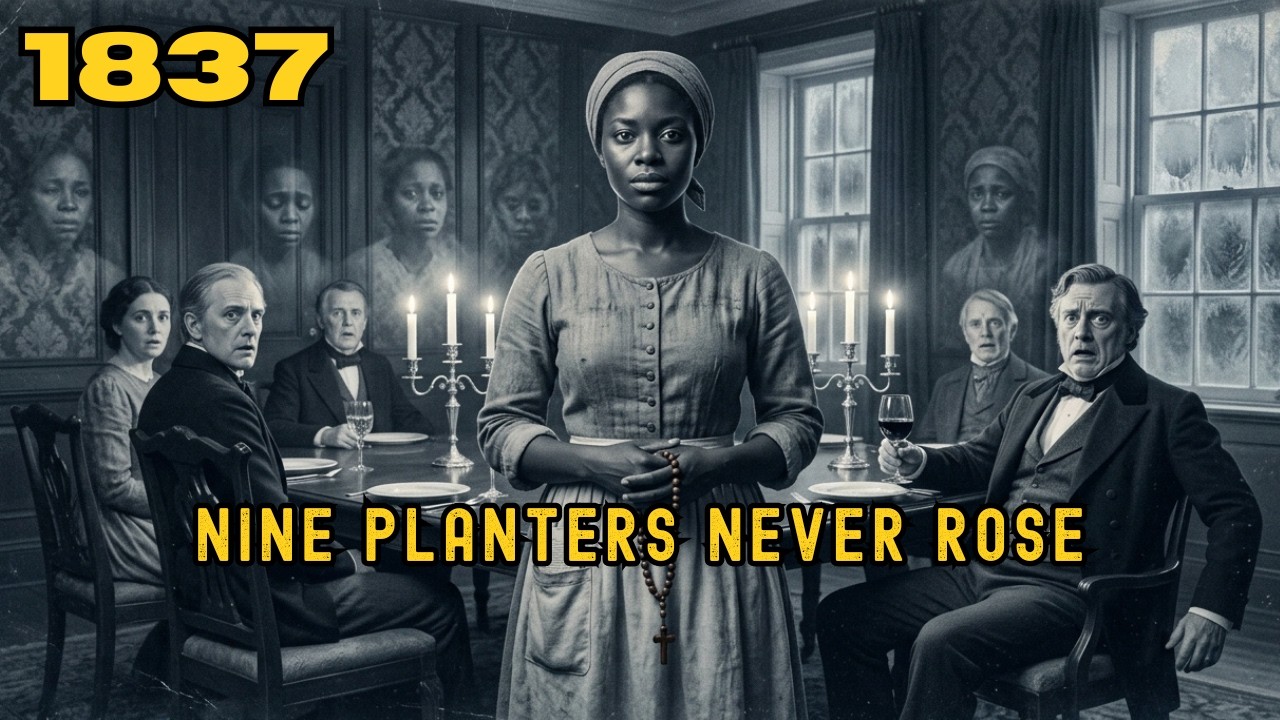
Colonel Harrison Mathison stood on the balcony of Oakridge Hall surveying his estate with the satisfaction of a king. The plantation sprawled across three thousand acres of South Carolina lowlands, its fields worked by two hundred souls who had no names that mattered to him. The main house rose like a monument to his dominance: three stories of imported marble and cypress wood, crowned with a widow’s walk that offered views of both the Ashley River and the misery that funded it. Tonight the colonel would host the most exclusive gathering of the season.
Nine men, the wealthiest planters in the Charleston district, would dine beneath his roof, celebrating another prosperous harvest and the unshakeable order that guaranteed their wealth. The invitations had been sent on cream-colored paper sealed with crimson wax. Each man who received one understood this was not merely a supper. It was a congregation of power.
Inside the mansion, the enslaved household staff moved with practiced silence. They had spent three days preparing for this evening, polishing silver until it gleamed like moonlight, pressing linens until they bore no wrinkles, arranging flowers cut from the colonel’s private garden. The dining room had been transformed into a cathedral of excess: a table that could seat twelve draped in Belgian lace, candelabras imported from Paris, crystal glasses so delicate they sang when touched, china painted with pastoral scenes that bore no resemblance to the reality beyond the windows. Cecily moved through these preparations like a ghost.
She was twenty-four years old, though her eyes carried the weight of twice that many years. Her skin was the color of mahogany, and despite the rough fabric of her dress and the scarf that bound her hair, there was something in her bearing that unsettled people: a quiet dignity that refused to be broken, a beauty that persisted despite every effort to crush it. She had been the colonel’s housemaid for six years, ever since he purchased her from a plantation in Virginia. What happened in those years lived in the shadows of Oakridge Hall, in the servants’ quarters where women whispered and wept, in the colonel’s private chambers where screams went unanswered.
Cecily had learned to move without sound, to anticipate needs before they were spoken, to make herself invisible while remaining always present. But invisibility was its own kind of power. “Cecily. ” The voice belonged to Mama Ruth, the head cook, a woman whose hands had fed three generations of Mathisons and whose back bore the scars of their gratitude.
“The colonel wants the supper service to be perfect tonight. Says these men are discussing important business. Says any mistakes will be paid for in blood. ”
Cecily nodded, her fingers adjusting the placement of a fork.
“It will be perfect, Mama Ruth. I promise you that. ” Something in her tone made the older woman pause. She studied Cecily’s face, the calm set of her jaw, the strange light in her eyes.
“Child, what are you planning? ”
“Justice,” Cecily whispered. “I’m planning justice. ”
Before Mama Ruth could respond, the sound of carriages on the gravel drive announced the arrival of the guests.
Through the dining room windows they could see the procession: nine men in tailcoats and top hats stepping down from carriages, attended by their own enslaved drivers. These were the men who ruled Charleston, not through elected office, but through wealth so vast it bent the law to their will. Colonel Mathison greeted each arrival personally, his voice booming with false warmth. There was Judge Cornelius Blackwood, whose courtroom had sentenced more enslaved people to death than any other in South Carolina.
Beside him stood Reginald Pemberton, owner of four plantations and a thousand human beings. Then came the Ashford brothers, twins who had built their fortune on the Charleston slave market, where families were divided and sold like livestock. Edmund Fairfax arrived next, a banker who financed the purchase of human cargo from Africa. Samuel Thornton, whose rice fields were notorious for their mortality rate.
Dr. Nathaniel Cross, who performed medical experiments on enslaved women without their consent. Walter Grimshaw, a shipping magnate who had grown wealthy transporting human beings in the holds of his ships. And finally Josiah Weatherby, the youngest of the group, but no less cruel: a man who had recently purchased the plantation adjacent to Oakridge and had already earned a reputation for savage punishments.
They gathered in the parlor first, drinking brandy from the colonel’s private reserve, their laughter echoing through rooms built by hands they would never acknowledge as human. They spoke of politics and profits, of the troublesome abolitionists in the North, of their plans to expand their empires further west. They spoke as gods speak, casual in their certainty, blind to the fragility of their power. Cecily served them drinks on a silver tray, her eyes downcast, her movements precise.
Not one of them truly saw her. They never did. To them she was part of the furniture, functional, forgettable, beneath notice. But Cecily saw everything.
She noted how Judge Blackwood’s hands trembled slightly from too much drink. She observed Reginald Pemberton’s tendency to adjust his collar when nervous. She watched Dr. Cross’s eyes follow the younger housemaids with predatory interest.
She catalogued their habits, their weaknesses, their sins. At eight o’clock a silver bell chimed, summoning them to the dining room. The table was a masterpiece. Nine places had been set with mathematical precision.
At the center a roasted goose rested on a bed of herbs, surrounded by dishes that represented the finest of southern cuisine: oyster stew, she-crab soup, hoppin’ John, cornbread, collard greens, sweet potato pie. The wine had been decanted into crystal decanters, ruby red in the candlelight. The men took their seats, the colonel at the head of the table, his guests arranged by rank and favor. As they settled in, Cecily and two other housemaids, Sarah and Dinah, began to serve the first course.
“A toast,” Colonel Mathison announced, raising his glass. “To prosperity, to order, to the preservation of our way of life. ”
“Hear, hear. ” The men echoed, their glasses catching the light.
They drank deeply. The wine was French, imported at great expense, aged in oak barrels for twenty years. It tasted of cherries and smoke, of distant vineyards and old money. The men savored it, their conversation turning to the familiar rhythms of boasting and business.
But as the meal progressed, something began to shift in the room. It started with the air itself growing heavier, thicker, as though the walls were closing in. The candles seemed to burn brighter, their flames stretching toward the ceiling in perfect stillness. No draft moved through the room, though all the windows had been closed against the November chill.
Judge Blackwood was the first to notice. He paused mid-sentence, his fork suspended over his plate. “Does anyone else feel strange? ”
“Strange how?
” Edmund Fairfax asked, though his own voice carried an unusual tremor. “The air,” the judge said slowly. “It’s too still. ”
Samuel Thornton laughed, but the sound was forced.
“You’re imagining things, Cornelius. Too much brandy before supper. ”
Yet one by one the men began to shift uncomfortably in their chairs. The food before them, which moments ago had seemed so appetizing, now appeared somehow wrong.
The meat glistened too darkly. The greens seemed to pulse with their own color. The wine in their glasses caught the candlelight in ways that made them think of blood. Cecily stood in the corner, her hands folded before her, her expression serene.
When Colonel Mathison beckoned for more wine, she moved forward smoothly, refilling his glass with practiced grace. “Excellent supper, Mathison,” Reginald Pemberton said, though he had barely touched his food. “You always did know how to entertain. ”
“Only the best for Charleston’s finest,” the colonel replied, but his smile didn’t quite reach his eyes.
He too had begun to feel it: that wrongness in the air, that sense of something watching from the shadows between the candles. Dr. Cross cleared his throat. “I propose another toast.
To the continuation of our traditions. May no northern interference ever disrupt the natural order of things. ”
Again glasses were raised. Again they drank.
And as they did, the temperature in the room seemed to drop ten degrees in an instant. Frost began to form on the edges of the windows, impossible in November, yet undeniable. The men saw it and felt a collective unease settle over them like a shroud. “What the devil—” Josiah Weatherby began, but his words were cut short by a sound.
It came from somewhere in the house, or perhaps from nowhere at all: a low humming, barely audible at first, then growing gradually louder. It was a woman’s voice, singing in a language none of them recognized, the melody ancient and mournful. The men exchanged glances, their earlier confidence evaporating like morning dew. “Mathison,” Judge Blackwood said quietly, his face pale.
“Who else is in this house? ”
The colonel’s jaw tightened. He rang the small bell beside his plate, summoning Cecily. She appeared instantly, as though she had been waiting just beyond sight.
“Who is singing? ” he demanded. Cecily’s expression remained perfectly neutral. “No one is singing, sir.
Perhaps it is the wind. ”
“There is no wind,” Walter Grimshaw snapped. “The air is dead still. ”
“Then perhaps,” Cecily said softly, “it is something else.
”
The way she said it, with such calm certainty, sent a chill through the room that had nothing to do with the frost on the windows. Colonel Mathison stood abruptly, his chair scraping against the floor. “This is absurd. It’s nothing but—” He stopped.
They all stopped. Because the singing had changed. Now they could hear words, clear as church bells, rising from somewhere beneath them, from the foundation of the house itself. “Wade in the water, wade in the water, children.
”
The spiritual. The forbidden song. The one enslaved people sang in secret, the one that carried messages of escape and hope and divine judgment. “Make it stop,” the colonel ordered, his voice no longer confident, but edged with something that might have been fear.
Cecily tilted her head slightly, as though listening to a voice only she could hear. “I cannot stop what has already begun, sir. The supper is served, and everyone at this table will finish what they’ve been given. ”
Before anyone could respond, the candles flickered once, twice, and then burned with an intensity that hurt to look at directly.
In that brilliant, terrible light, the men saw something that froze the blood in their veins. The walls of the dining room seemed to pulse with shadows: not random darkness, but forms, figures, hundreds of them pressed against the wallpaper like souls trapped behind glass. Faces emerged from the patterns, eyes wide, mouths open in silent screams, hands reaching toward the men at the table. They were the dead, every enslaved person who had died on these plantations, in these fields, under these men’s authority.
They had come to witness. They had come to bear witness. And they had come to feast on something other than food. The Ashford brothers tried to stand, but their legs wouldn’t obey.
It was as though invisible hands pressed down on their shoulders, holding them in place. Walter Grimshaw grabbed for the door handle, but his arm moved as if through water, slow, dreamlike, useless. “What have you done? ” Colonel Mathison roared at Cecily, his face purpling with rage and terror.
“What witchcraft is this? ”
Cecily stepped forward into the candlelight, and for the first time since any of them had known her, she smiled. It was not a cruel smile, but it was absolutely without mercy. “Witchcraft?
” she repeated softly. “No, Colonel. This is simply a reckoning. Every drop of wine you’ve drunk tonight was blessed by the hands of those you’ve wronged.
Every morsel of food was prepared with prayers you don’t know and can’t understand. This supper has been years in the making. ”
Judge Blackwood’s hands clawed at his throat. “Poison!
” he gasped. “You’ve poisoned us! ”
“Not poison,” Cecily said, her voice carrying a strange resonance now, as though others spoke through her. “Truth.
You’re being fed the truth of what you’ve done, and your bodies cannot digest it. Your souls are choking on the weight of your own sins. ”
Dr. Cross tried to speak, but blood began to trickle from the corner of his mouth.
His eyes widened in horror as he looked down at his hands. They were changing, the skin turning gray and cracked, as though decades of rot were accelerating in seconds. “You wanted to know what happens to the bodies you broke? ” Cecily continued, walking slowly around the table.
“You’re about to learn. Every whip mark, every brand, every violation, you’ll feel them all before this night is through. ”
Reginald Pemberton’s chair began to rock, though he sat perfectly still. His eyes rolled back, and when he spoke it was not his voice, but a child’s, high and terrified.
“Mama, where’s Mama? They sold Mama away. Please, I want my Mama. ” He was reliving it, reliving the moment he separated a six-year-old boy from his mother, selling them to different plantations, never to see each other again.
The memory was no longer abstract. It was immediate, visceral, consuming him from the inside out. Samuel Thornton’s hands seemed to be engulfed in invisible flames. He beat them against the table, but there was no smoke, no actual fire, only the sensation: the exact pain of the branding iron he had used on countless human beings, marking them as property.
“Stop this,” Colonel Mathison commanded, but his voice cracked. “I order you to stop. ”
Cecily laughed, a sound like wind through empty houses. “You have no authority here anymore, Colonel.
Not in this room, not on this night. The Lord has prepared his own feast, and you are not the guests. You are the meal. ”
Edmund Fairfax convulsed in his chair, foam forming at his lips.
His eyes saw things no one else could: the holds of his ships packed with human cargo, the bodies thrown overboard when disease spread, the profits calculated while children wept in darkness. All of it flooded through him at once, a lifetime of inflicted suffering reflected back tenfold. The singing grew louder, coming from everywhere and nowhere. Other voices joined it, not just one spiritual but dozens overlapping, creating a chorus of lamentation and judgment that shook the crystal glasses and rattled the china.
“Go down, Moses, way down in Egypt land. Swing low, sweet chariot, coming for to carry me home. Didn’t my Lord deliver Daniel? Then why not every man?
”
Josiah Weatherby, the youngest, wept openly. “I’m sorry,” he sobbed. “I’m sorry. I’m sorry.
I’m sorry. ”
But Cecily shook her head. “Sorry is a word. It changes nothing.
It heals no wounds. It returns no stolen lives. Your sorry arrives too late and means too little. ”
The shadows on the walls pressed closer, and now the men could see individual faces clearly.
There, the old man Samuel Thornton worked to death in the rice fields, his lungs destroyed by the water and heat. There, the woman Dr. Cross experimented on, her body violated in the name of medical science. There, the children the Ashford brothers separated from their families, their innocence shattered for profit.
Walter Grimshaw’s eyes locked onto one shadow in particular: a young man, no more than twenty, who had died chained in the hold of one of his ships. The young man’s eyes met his, and Grimshaw felt his chest constrict, as though those same chains now wrapped around his own heart. “Please,” Judge Blackwood whispered, all his courtroom authority dissolved into naked terror. “Please, have mercy.
”
Cecily knelt beside him, her face level with his. “Did you have mercy when mothers begged you not to sell their children? When men pleaded for their wives? When the innocent stood before your bench and you sentenced them to death for the crime of wanting freedom?
” She stood again, her voice hardening. “You will receive the same mercy you gave. Exactly the same. ”
The colonel made one last desperate attempt to rise, to fight, to reclaim his power, but his body betrayed him, collapsing back into the chair.
His hands gripped the arms of his seat, and as they did, he felt something in his palm: a string of beads, cool and smooth. Cecily’s rosary. “How? ” he gasped, looking at his hand in confusion.
He hadn’t taken it. She hadn’t given it to him. Yet there it was, wrapped around his fingers like a serpent. “I left it for you,” Cecily said.
“Something to hold onto as you pass from this world to the next, though I don’t think you’ll find comfort where you’re going. ”
The temperature dropped further. Ice crystals formed in the wine glasses. The men’s breath came out in white clouds, and one by one their struggles began to cease.
Not because they chose to stop fighting, but because something else was taking over. Their faces twisted into expressions of pure terror, eyes wide and staring at things beyond the visible world, mouths opened in silent screams. Their bodies remained upright in their chairs, but whatever animated them, whatever made them human, was being systematically extracted, consumed, judged, and found wanting. The candles burned brighter still, their light becoming almost unbearable.
In that terrible illumination, the dining room transformed. The walls seemed to fall away, revealing endless fields of cotton and rice, rows of cabins, auction blocks, whipping posts, all the infrastructure of their empire of cruelty laid bare. And standing in those fields, beside those cabins, surrounding those auction blocks, were thousands of witnesses: the dead and the living, all those who had suffered, all watching this moment of accounting. Cecily walked to the head of the table where Colonel Mathison sat frozen, the rosary burning cold in his hand.
She leaned close to his ear and whispered, “Do you know what your last thought will be, Colonel? Not of your wealth, or your power, or your legacy. It will be the simple, terrible understanding that every life you destroyed mattered just as much as yours. That every person you bought and sold was as fully human as you ever were.
That recognition will be the last thing you feel before the darkness takes you, and it will follow you into whatever comes next. ”
The colonel’s eyes met hers, and in that final moment he did understand: the full, crushing weight of what he had done, what he had been, fell upon him all at once. His mouth opened, but no sound emerged. Only a single tear tracked down his cheek.
Then his eyes went glassy and still. One by one the others followed. The Ashford brothers slumped forward simultaneously, their heads hitting the table with dull thuds. Edmund Fairfax simply stopped breathing, his chest ceasing to rise, his heart giving up its rhythm.
Dr. Cross clawed once more at his throat, then went rigid. Samuel Thornton’s head fell back, his mouth open in a final silent scream. Walter Grimshaw and Josiah Weatherby collapsed within seconds of each other, their souls fleeing bodies that had become unbearable prisons.
Reginald Pemberton was last, his child’s voice fading to nothing as death claimed him. The dining room fell absolutely silent. Nine men sat around the table, their supper barely touched, their wine glasses still half full, their bodies positioned as though merely resting. But their faces told the truth: each wore an expression of ultimate horror, of confrontation with something beyond their comprehension, beyond their capacity to endure.
Cecily stood in the center of it all, untouched, unmoved. The shadows on the walls began to fade, the faces receding back into darkness, their witnessing complete. The singing quieted to a whisper, then to nothing. The candles returned to their normal flame, casting the room in softer light.
Behind her, the door to the kitchen opened. Mama Ruth stood there, her old eyes taking in the scene with a mixture of awe and fear. “Is it done? ” she asked quietly.
“It’s done,” Cecily confirmed. “And what happens now? ”
Cecily removed her apron, folding it carefully and placing it on a side table. “Now we leave.
We were never here. This supper happened without us. These men dined alone on their pride and their cruelty, and it killed them. ”
“They’ll come looking for someone to blame,” Mama Ruth said.
“Let them look,” Cecily replied. “They’ll find locked doors and no signs of entry. They’ll find food that shows no trace of poison. They’ll find nine bodies with no marks of violence.
What will they conclude? That these men were struck down by God himself? ”
“Perhaps. That hardly helps them.
”
Sarah and Dinah emerged from their hiding places in the kitchen, their eyes wide. “What do we do? ” Sarah whispered. “You do nothing,” Cecily said firmly.
“You were in the kitchen all night. You heard nothing, saw nothing. When the bodies are discovered tomorrow, you will be as shocked as anyone. You will tell the truth: that these men had supper, that everything seemed normal, that you were dismissed before the meal was finished.
There’s no lie in that. ”
“And you? ” Mama Ruth asked. “Where will you go?
”
Cecily moved to the window, looking out at the dark fields beyond. “North. There are networks, safe houses, people who help those who escape. I’ll find them.
”
“They’ll hunt you. They’ll say you’re a murderess. A witch. ”
“Let them say what they want,” Cecily said.
“I know what I am. I’m the answer to prayers spoken in darkness, the justice delayed but not denied, the reckoning that comes when the weight of sin becomes too heavy for the earth to bear. ” She turned back to face them. “I’m free.
Finally, truly free. ”
She crossed to Colonel Mathison’s body one last time, gently extracting her rosary from his frozen hand. The beads were cold to the touch, but as she held them they seemed to warm, to pulse with a light only she could see. She kissed the cross and tucked it into her pocket.
“Go,” she told the others. “Return to your quarters. Sleep if you can. Tomorrow, when the sun rises and the world discovers this, remember you are innocent.
The guilty have already faced their judgment. ”
Mama Ruth stepped forward, pulling Cecily into a brief, fierce embrace. “You walk with God, child. Whatever else they say about you, you walk with God.
”
“I walk with the memory of everyone who didn’t survive long enough to see this night,” Cecily replied. “That’s burden enough. ”
She slipped out through the servants’ entrance into the November darkness. The stars overhead were sharp and cold, indifferent to human suffering and human justice alike.
Somewhere in the distance she heard the Ashley River moving, endless and patient. She thought of all the bodies those waters had carried, all the tears they had absorbed, all the prayers whispered on their banks. Behind her, Oakridge Hall stood silent, its windows glowing with candlelight. Inside, nine men sat at an eternal supper, their feast of pride transformed into their final meal.
Cecily walked quickly, keeping to the shadows, following routes she had memorized over years of servitude. She knew every path through these grounds, every place to hide, every weak point in the fences that bordered the property. She had been patient, planning this night for so long that it had become part of her very breath, woven into her prayers and her dreams. The poison had not been hemlock or arsenic or any substance that could be detected by doctors.
It had been something far more subtle and far more powerful: the accumulated weight of spiritual debt made manifest, the bills of justice finally called due, the wages of sin paid in full. She had spent six years learning old knowledge from Mama Ruth, who had learned it from her grandmother, who had learned it from women stolen from Africa and forced into bondage: knowledge of herbs that opened doors between worlds, of words that bound and freed, of rituals that called upon powers older than Charleston, older than America, older than the very concept of slavery itself. Every ingredient in tonight’s meal had been blessed with the names of the dead. Every sip of wine had carried prayers for judgment.
Every candle had been anointed with oil mixed from bark stripped from trees where enslaved people had been hanged. The house itself had been prepared, marked with symbols invisible to the master’s eyes, but clear as daylight to those who knew how to see. She had no name for what she had done, only certainties. Magic?
Perhaps. Justice? Absolutely. The line between the two had become irrelevant.
As she reached the edge of the property, Cecily paused and looked back one last time. The great house rose against the night sky, seemingly peaceful, betraying nothing of the horror within its dining room. By dawn, servants would arrive to clear the breakfast dishes and would instead find a scene from a nightmare. By noon, Charleston would be ablaze with rumors and fear.
By evening, the story would be everywhere: nine powerful men, all dead, no explanation, no survivors. They would search for her, of course. But Cecily had allies they didn’t know about: the Underground Railroad, abolitionists both black and white, Quakers who believed slavery an abomination, free black communities in the North who would hide her and protect her. She had names, addresses, secret signals.
She had a network built on hope and resistance and the simple revolutionary belief that freedom was a birthright, not a privilege. The rosary in her pocket grew warm against her hip, as though offering comfort. She thought of the prayer she had repeated every night for six years: “Lord, grant me the strength to endure, the wisdom to wait, and the courage to act when the moment comes. ” That moment had come.
She had endured. She had waited. And she had acted. Now she would do something else she had not dared to dream of.
She would live. Cecily turned her back on Oakridge Hall and began walking north toward the Ashley River, toward the network of safe houses and sympathetic souls, toward a future that was uncertain but entirely her own. Her footsteps made no sound on the dirt road. The November wind picked up, carrying the scent of freedom: salt from the ocean, pine from the forests, possibility from the horizon.
Behind her, in the dining room of Oakridge Hall, the candles continued to burn. They would burn all night, casting their light on the tableau of the dead, illuminating the final supper of Charleston’s masters. And when they finally guttered out in the cold light of dawn, the darkness that remained would be absolute. The overseer’s son found them at sunrise.
Thomas McKinnon was seventeen, lean and sunburned, with his father’s hard eyes and his mother’s reluctant conscience. He had been sent to Oakridge Hall to collect a document the colonel had promised his father, some legal paper regarding property boundaries. He arrived at first light, when the mist still hung over the Ashley River like a curtain between worlds. The first thing he noticed was the silence.
Plantations were never silent at dawn. There should have been the sounds of the enslaved beginning their day: the crack of the overseer’s whip, the clang of bells calling workers to the fields. But Oakridge was quiet as a graveyard, wrapped in an unnatural stillness that made Thomas’s horse nervous. The animal snorted and pranced, refusing to approach the main house until Thomas dismounted and led it by hand.
The front door was unlocked. That alone was strange. Colonel Mathison was paranoid about security, obsessed with the threat of slave uprisings, always careful to bolt every entrance. Thomas pushed the door open and called out, his voice echoing through the entrance hall.
No response. He stepped inside, his boots loud on the marble floor. The house smelled wrong: not the usual scent of beeswax and tobacco, but something else, something sweet and rotten at once, like flowers left too long in a vase. “Colonel Mathison?
” he called again. Still nothing. Thomas made his way through the house, checking the parlor, the library, the colonel’s study. Everything appeared normal: furniture in place, papers neatly stacked, brandy decanters on their shelves.
But there were no people. Not the colonel, not the house servants, not the dozens of enslaved people who should have been starting the day’s work. Then he saw the dining room doors standing half open. Even from the hallway, he could see the candles.
They had burned down to stubs, wax pooled on the table and floor, but somehow a few still flickered with small flames. The morning light streamed through the windows, making the scene inside look almost theatrical, deliberately staged for maximum impact. Thomas approached slowly, some instinct warning him that whatever lay beyond those doors would change his life forever. He was right.
The nine men sat as though in conversation, their positions casual, their wine glasses placed before them. For a moment, a single blessed moment, Thomas thought they were merely asleep, that this was some elaborate joke or drunken conclusion to the evening’s festivities. Then he saw their faces. The scream that tore from his throat brought the household running.
Kitchen staff emerged from the outbuildings, field workers came from the cabins, everyone drawn by the sound of pure animal terror. They crowded into the hallway, pressing toward the dining room, until Mama Ruth, always the voice of authority among the enslaved, pushed through and stopped them all with a raised hand. “Don’t,” she said firmly. “Don’t go in there.
You don’t need those pictures in your head. ”
But of course they looked anyway. How could they not? And what they saw would fuel nightmares and whispered stories for generations.
Sarah was the one who finally pulled Thomas out of the room. He was standing frozen, his face pale as milk, his eyes fixed on the bodies. She gripped his arm and led him to the parlor, where she made him sit while his mind tried to process what he had witnessed. “I need to— someone needs to—” Thomas couldn’t complete a thought.
His hands shook violently. “I’ll send for the authorities,” Mama Ruth said, taking charge with the efficiency of someone who had managed crisis after crisis in her seven decades of life. “Dinah, run to the McKinnon plantation. Tell the overseer what’s happened.
Sarah, ride to town, fetch Sheriff Collins. Move quickly, both of you. ”
The women ran. Within an hour, Oakridge Hall was swarming with people: the sheriff and his deputies, the local doctor, neighboring planters who had heard the news and come to see for themselves.
They filled the house with noise and speculation, their voices carrying the edge of panic barely held in check. Dr. Ambrose Strickland was the first medical professional to examine the bodies. He was a slight man in his fifties, meticulous and methodical, known throughout Charleston for his steady hands and scientific mind.
But when he emerged from the dining room after thirty minutes of examination, his face was gray and his hands trembled as he reached for the whiskey Sheriff Collins offered. “Well? ” the sheriff demanded. Horace Collins was a large man with a sheriff’s star pinned to his vest and a reputation for brutal efficiency in maintaining order.
“What killed them, doctor? ”
Strickland drank deeply before answering. “I— I don’t know. ”
“You don’t know?
” Collins’s voice rose with incredulity. “You’re a doctor, for God’s sake. What do you mean you don’t know? ”
“I mean exactly that,” Strickland said, his professional composure reasserting itself, though his eyes remained haunted.
“There are no signs of violence, no wounds, no marks, nothing to suggest they were struck or strangled or shot. Their food shows no evidence of poison. I’ve examined the remains on the plates, smelled the wine, checked for any common toxins. Nothing.
”
“Then what killed them? ” demanded Robert Ashford, brother to the twins who now sat dead in the next room. He had arrived within the hour, having been fetched from his own plantation. His face was twisted with grief and rage in equal measure.
“If I had to make a professional judgment based purely on their physical presentation,” Strickland said carefully, “I would say they died of fright. Extreme terror. Their hearts simply stopped from the stress of whatever they experienced in their final moments. ”
The room erupted in disbelief and argument.
“That’s impossible! ” someone shouted. “Nine healthy men don’t just die of fright. ” “What could frighten them so badly?
” a third asked. “They were the most powerful men in Charleston. ”
Sheriff Collins raised his hands for silence. “Everyone, calm down.
Doctor, are you seriously suggesting that nine grown men died because they were scared? ”
“I’m suggesting,” Strickland said with forced patience, “that their bodies show all the signs of extreme physiological stress consistent with terror. Elevated heart rate, constricted blood vessels, respiratory distress. Whatever they saw or experienced in their final moments literally frightened them to death.
”
“But what did they see? ” Robert Ashford demanded. “The room is empty. The doors were locked from the inside.
The windows are secure. Nothing and no one could have gotten in or out. ”
It was a valid point. The dining room had been examined thoroughly.
Every window locked from within. Every door secured with bolts that could only be fastened from inside the room. If someone had attacked the nine men, they would have had to lock themselves in with them, and no such person was present. “Where are the servants?
” Sheriff Collins asked suddenly, his lawman’s instinct finding a new direction. “Where are all the enslaved people who work in this house? ”
Mama Ruth stepped forward. “We’re here, Sheriff.
We’ve been here all morning. ”
“I mean last night. Where were you last night during the supper? ”
“In the kitchen and servants’ quarters, sir.
The masters dismissed us after serving the meal. Said they wanted privacy for their business discussions. ”
“And you didn’t hear anything? No sounds of distress?
No cries for help? ”
Mama Ruth’s face remained impassive. “No, sir. We heard nothing.
The dining room is far from the kitchen, and the masters wanted their conversation to remain private. We stayed where we were told to stay. ”
Collins studied her face, looking for signs of deception, but Mama Ruth had spent seventy years perfecting the mask of servitude. She revealed nothing she didn’t choose to reveal.
“What about the girl? ” Robert Ashford interjected. “The colonel’s housemaid, the pretty one. Cecily, I think her name was.
Where is she? ”
The question dropped into the room like a stone into still water, sending ripples of suspicion in every direction. Mama Ruth didn’t hesitate. “I don’t know, sir.
She’s not here. ”
“Not here? ” Collins pounced on this immediately. “What do you mean, not here?
Where did she go? ”
“I couldn’t say, sir. She must have left during the night. Her bed wasn’t slept in.
”
The room exploded with new speculation and accusation. Here, finally, was something concrete: a missing person, a potential suspect, a direction for their fear and anger to flow. “She did this,” Robert Ashford announced with absolute certainty. “That slave girl killed my brothers and these other good men.
It’s obvious. ”
“How? ” Dr. Strickland asked reasonably.
“I’ve told you there’s no evidence of poison or violence. How exactly did she kill them? ”
“Witchcraft,” someone whispered, and the word hung in the air like smoke. Sheriff Collins scoffed.
“We’re not going to entertain superstitious nonsense. This is 1837, not the Dark Ages. ”
But the whisper had been spoken, and once voiced, it could not be unspoken. Witchcraft.
The word passed from mouth to mouth, growing in intensity and certainty with each repetition: slaves practicing dark arts, calling upon African spirits, using unholy powers to strike down their masters. It was exactly the kind of explanation that made sense to people desperate to make sense of the incomprehensible. “Find her,” Robert Ashford commanded, as though he had the authority to give such orders. “Search every slave quarter in Charleston.
She couldn’t have gotten far. ”
Sheriff Collins considered this. “I’ll put out notices and organize search parties. But I remind you all that we have no evidence this woman committed any crime.
She may simply have fled in fear after discovering the bodies. ”
“She discovered nothing,” Mama Ruth said quietly. “She was gone before anyone found the masters. She left before dawn, while it was still dark.
”
“How do you know that? ” Collins asked sharply. “Because I saw her room this morning. Her things are gone.
Her extra dress, her head scarf, her Bible. She didn’t run in panic. She packed and left with purpose. ”
This revelation only deepened the suspicion against Cecily.
Why would she leave unless she had something to hide? Why pack and plan unless she knew what was coming? Thomas McKinnon, who had been sitting quietly in shock, finally spoke. “There was something on the table.
” Everyone turned to stare at him. “What did you say? ” Sheriff Collins demanded. “Words,” Thomas repeated, his voice stronger now.
“Carved into the wood near the colonel’s place. I saw them before I— before I ran out. ”
The men rushed back to the dining room, though most stopped at the doorway, reluctant to enter that space again. Sheriff Collins and Dr.
Strickland approached the head of the table where Colonel Mathison sat frozen in his final moment. They looked at the polished oak surface, and there they were: nine words scratched into the wood with some sharp implement. The letters were crude but clear, written in something dark that might have been wine or might have been blood. The Lord prepares his own feast of justice.
The words were biblical in cadence, apocalyptic in implication. Collins traced them with his finger, noting how deep they went, how much force it would have required to carve them. “When were these made? Before the meal or during?
” No one could answer. The table had been set before the guests arrived, but had anyone looked at its surface closely enough to notice fresh carvings? And if the words had been carved during the meal, why hadn’t any of the nine men reacted or stopped the person doing the carving? “This is a message,” Dr.
Strickland said. “A deliberate statement. ”
“From whom? ” someone asked.
But they all knew, or thought they knew: from Cecily. From the enslaved. From those who had been silent so long that their silence had been mistaken for acceptance. From voices that had been ignored so thoroughly that their owners had forgotten they existed.
“I want every enslaved person in Charleston questioned,” Robert Ashford announced. “I want to know who helped her, who knew about this plan, who is hiding her now. And when we find her—and we will find her—she’ll hang for this. ”
“If she did this,” Sheriff Collins cautioned, “we still have no proof.
”
“The proof is in that room! ” Ashford shouted, pointing toward the dining room. “Nine dead men and one missing slave girl who clearly hated the colonel. What more proof do you need?
”
“Evidence that she actually killed them,” Collins replied evenly. “Hatred isn’t murder, and disappearance isn’t guilt. I’ll conduct a proper investigation. ”
But even as he said it, Collins knew the investigation’s outcome was essentially predetermined.
Charleston society needed someone to blame, needed a story that made sense, needed to reassure itself that their system of control hadn’t simply collapsed under its own moral weight. Cecily would be that story, whether she was guilty or not. Word of the deaths spread through Charleston like wildfire. By midday, crowds had gathered outside Oakridge Hall, kept back by hastily organized militia members.
Newspapers began printing special editions, their headlines screaming about mysterious deaths and missing slaves. The story grew with each retelling: some said the men had been poisoned with voodoo potions, others claimed they’d been cursed with African hexes, still others whispered that God himself had struck them down for their sins. The enslaved community of Charleston heard the news with complex emotions. Publicly, they expressed shock and concern, performing the expected rituals of mourning and sympathy.
Privately, in moments stolen from their masters’ watchful eyes, they shared different thoughts entirely. In the slave quarters of plantations surrounding Oakridge, the story was received with a mixture of terror and elation. Terror because they knew the deaths would bring increased scrutiny, harsher punishments, more brutal enforcement of already brutal controls. But also elation, because nine of the worst men in Charleston were dead.
Whatever else it meant, it meant those particular men could hurt no one ever again. And underneath it all, threading through the whispered conversations and coded spirituals, was a single name spoken with something approaching reverence: Cecily. What she had done, how she had done it, whether she had done it at all — these questions mattered less than what the story represented. Cecily had become a symbol, a legend forming in real time, a tale of resistance and retribution that would be told and retold until fact and myth became inseparable.
By nightfall, the bodies had been removed from Oakridge Hall and prepared for burial. Nine families mourned their dead, held wakes that drew Charleston’s elite together in displays of grief and solidarity. Speeches were made about the fallen men’s contributions to society, their business acumen, their strength of character. The parts of them that had made them who they were — the cruelty, the exploitation, the casual inhumanity — were carefully edited out of these eulogies.
The funeral would be held in three days, once family members from more distant locations could arrive. The church was already preparing for what would be the largest memorial service in Charleston’s history. Meanwhile, the search for Cecily intensified. Sheriff Collins organized search parties, sent riders to every plantation within fifty miles, contacted authorities in Savannah and Richmond and other cities where a fleeing slave might try to hide.
Rewards were posted: one hundred dollars for information leading to her capture, two hundred for her return alive or dead. But Cecily seemed to have vanished as thoroughly as if the earth had swallowed her whole. In the slave quarters of the McKinnon plantation, where Thomas had finally returned after giving his statement to the sheriff, an old woman named Esther hummed quietly as she prepared the evening meal. She was eighty if she was a day, brought over from Africa as a child, still carrying memories of a life before bondage.
Thomas’s younger sister Margaret came to the kitchen seeking comfort. She was fifteen, kind-hearted in a way that constant exposure to slavery’s brutality hadn’t yet crushed. “Esther,” she said softly, “is it true what they’re saying? That Cecily killed those men with witchcraft?
”
Esther continued stirring her pot, her movements steady and sure. “I wasn’t there, Miss Margaret. Can’t say what happened. ”
“But you knew her, didn’t you?
She visited here sometimes when she came to the market. ”
“I knew her,” Esther confirmed. “Good girl. Quiet.
Faithful. ”
“Then how could she do such a terrible thing? ”
Esther finally looked up, her ancient eyes meeting Margaret’s young ones. “You ever wonder, Miss Margaret, what makes something terrible?
Is it terrible when nine men prosper from the suffering of thousands? Or is it only terrible when those nine men face consequences? ”
Margaret blinked, confused by the question. “I— I don’t understand.
”
“I know you don’t, child, and maybe that’s a blessing. ” Esther returned to her cooking. “But I’ll tell you this: sometimes what looks like witchcraft is just the world setting itself right. Sometimes what looks like murder is just justice arriving late.
And sometimes the most terrible thing isn’t what happened in that dining room. It’s everything that happened before, in the fields and auction blocks and whipping posts, that nobody called terrible at all. ”
Margaret left the kitchen more confused than when she’d entered, but Esther’s words stayed with her, planting seeds that would grow slowly over years. That night, as Charleston settled into uneasy sleep, a woman walked along a forest path thirty miles north of the city.
She moved confidently despite the darkness, following trails marked in ways only certain people knew how to read: a specific arrangement of stones, a pattern of moss on trees, symbols carved into bark at eye level. Cecily had been traveling for two nights and a day, sleeping in hidden spots during daylight hours, moving only when the stars were bright enough to guide her. She had crossed the Ashley River at a shallow point known only to those who needed to know, had navigated through swamps that would have swallowed less knowledgeable travelers, had passed plantation boundaries without triggering the alarm systems designed to catch runaways. She was not alone in these woods.
Others moved through them too: conductors on the Underground Railroad, abolitionists who risked their lives to guide people to freedom, free black men and women who remembered their own escapes. They formed a network of resistance so secret that most of Charleston didn’t even know it existed, operating in the spaces between the law’s attention, in the darkness that slavery depended on but couldn’t fully control. At a crossroads marked by an ancient oak tree, Cecily found what she was looking for: a small cabin, seemingly abandoned, its windows dark. She approached carefully, making a specific bird call that sounded natural but carried coded meaning.
The door opened silently. Inside, a white woman in her forties stood with a lantern. Her name was Rachel, and she was a Quaker, part of a religious community that believed slavery was a sin against God and humanity. She took one look at Cecily — exhausted, hungry, but unbroken — and nodded.
“Welcome, friend,” Rachel said in the traditional Quaker greeting. “Thou art safe here. ”
Cecily stepped inside, and for the first time in six years she felt truly safe. Not because she was beyond pursuit — Charleston would hunt her for months, maybe years — but because she was free.
Free in ways that had nothing to do with geography and everything to do with finally, finally being accountable only to herself and to God. “Thou must rest,” Rachel said, leading her to a small room with a bed, blankets, water for washing. “In two days we’ll move thee to the next station. But tonight, rest.
”
Before Cecily slept, she knelt beside the bed and pulled out her rosary. The beads were warm in her hands, as they always were now, as though they held some heat from that night in the dining room. She prayed, not for forgiveness — she had nothing to be forgiven for — but in thanksgiving: for strength received, for justice delivered, for freedom earned. And she prayed for all those still in bondage, still suffering, still waiting for their own moment of deliverance.
Because what had happened at Oakridge Hall was just one act in a much larger story. One reckoning among millions still owed. One small crack in a system that seemed unbreakable, but was already fracturing under its own weight of sin. Cecily slept that night deeply and without nightmares.
Behind her, Charleston buzzed with fear and anger and speculation. Ahead of her lay a long journey north, through slave states and free states, through danger and possibility, toward a life that was finally, truly hers. But she had learned to be patient. She had learned to wait.
And she had learned that justice, when it finally came, was worth any price. The funeral procession moved through Charleston like a black serpent, winding from the cathedral to the cemetery on the city’s edge. Nine hearses, each pulled by four horses draped in mourning cloth, carried the bodies of men who had been buried in individual ceremonies but whose families had demanded this collective show of solidarity and strength. The entire white population of Charleston seemed to have turned out: planters and their wives in silk mourning attire, businessmen with black armbands, politicians who saw opportunity in tragedy, clergy who spoke of God’s mysterious ways while carefully avoiding any suggestion that God’s ways might include judgment.
The enslaved were forced to line the streets, heads bowed in required displays of grief, though their eyes told different stories to those who knew how to read them. Sheriff Horace Collins watched the procession from the steps of the courthouse, his eyes constantly scanning the crowd. It had been five days since the deaths at Oakridge Hall, five days of intensive investigation that had yielded nothing but frustration: no poison in the food, no signs of violence on the bodies, no witnesses to anything unusual, and no trace of Cecily, who had vanished as completely as if she’d never existed. “She’s long gone,” his deputy, William Turner, said beside him.
Turner was young, ambitious, and convinced he knew everything. “Probably in New York by now, or Canada. We’ll never find her. ”
Collins didn’t respond immediately.
He was a methodical man who had spent twenty years as sheriff, and his instincts told him there was more to this case than a simple murder, if murder it even was. Dr. Strickland’s final report had been frustratingly inconclusive, listing the cause of death as catastrophic cardiac failure of unknown origin. The medical examiner in Charleston had reviewed the findings and reached the same non-conclusion: nine healthy men had died simultaneously of heart failure with no identifiable cause.
“What do you make of the carving? ” Collins asked. “The words on the table. ”
Turner shrugged.
“Religious nonsense. Slaves are always going on about God and judgment and such. Probably thought it sounded impressive. ”
“‘The Lord prepares his own feast of justice,’” Collins quoted from memory.
“That’s not religious nonsense. That’s a statement of purpose. An explanation, even. ”
“Explanation of what?
That some slave girl killed nine men with prayer? ” Turner’s voice dripped with skepticism. “Come on, Sheriff. They were poisoned.
The doctor just can’t figure out what poison was used. Give it time, and science will identify the toxin. Then we’ll have our answer. ”
But Collins wasn’t so sure.
He had examined that dining room himself, had spent hours trying to understand what had happened there. And the more he looked, the less sense it made through conventional means. The room had been locked from the inside; he had verified that personally. Every window was secure, every door bolted in ways that required someone inside the room to fasten them.
If Cecily had poisoned the men, she would have had to serve the poison, then somehow lock herself in with them as they died, then escape from a sealed room without leaving any trace. Unless she’d never been in the room at all during the deaths. Unless the poison, if poison it was, had been administered hours earlier, programmed to kill at a specific time. But that raised other questions.
What poison worked that way? What substance could remain dormant in the body for hours, then suddenly trigger nine simultaneous heart attacks? Dr. Strickland had consulted every medical text available, had reached out to colleagues in Boston and Philadelphia, and no one could identify such a substance.
Which left only two possibilities that Collins could see. Either there was a poison so exotic and unknown that modern science couldn’t detect it, or something else entirely had killed those nine men. Something that had nothing to do with conventional toxins and everything to do with what the enslaved were whispering about in their quarters late at night: words like conjure, and retribution, and the hand of God. Collins didn’t believe in supernatural causes.
He was a rational man, a practical man, a man of the Enlightenment who trusted in evidence and natural law. But he was also honest enough to admit when evidence failed him, when natural law seemed insufficient to explain what he had witnessed. “We should question the other house slaves again,” Turner suggested. “Apply some pressure.
Someone knows something. ”
“We’ve questioned them three times already,” Collins said. “Their stories don’t change. Cecily served the meal.
The men dismissed the servants. Everyone stayed in their quarters until morning. No one saw anything, heard anything, knows anything. ”
“Then they’re lying, or they’re telling the truth and there’s nothing to know.
” Turner looked at him sharply. “You’re not actually considering that this was what? Divine intervention? An act of God?
”
“I’m considering,” Collins said carefully, “that we may never know what happened in that room. And that the not knowing might be the entire point. ”
Before Turner could respond, a commotion erupted near the middle of the funeral procession. Collins pushed through the crowd to find its source.
A woman had collapsed — or appeared to have collapsed — causing several of the mourners to stop and assist her. But as Collins got closer, he realized it wasn’t a collapse. The woman, a slave from one of the downtown households based on her clothing, was standing perfectly upright. Her eyes rolled back in her head, her voice raised in a strange, rhythmic chant.
“She’s having a fit,” someone said. “She’s possessed,” someone else whispered. Collins reached the woman just as she began to speak, her voice high and keening, the words tumbling out in a mixture of English and what sounded like African languages, phrases that made no linguistic sense but carried emotional weight that hit like physical blows. “The feast is finished,” the woman proclaimed, her voice suddenly clear and strong.
“The table is set for judgment, and the guests have taken their seats. Nine men dined on pride, and pride was poison in their mouths. They drank from cups of cruelty, and cruelty stopped their hearts. The Lord prepared his feast, and they ate their fill of justice.
”
The crowd around her gasped and drew back. This was too close to the words carved into Oakridge’s dining table, too similar to be coincidence. “Who are you? ” Collins demanded.
“What’s your name? ”
The woman’s eyes focused on him, but they weren’t her eyes. They were distant, seeing things beyond the visible world. “I am the voice of what was silenced.
I am the witness to what was hidden. I am the reminder that every debt comes due, every sin finds its reckoning, every wrong waits for its rightening. ”
“Seize her! ” Robert Ashford commanded, pushing forward from the procession.
“This is Cecily’s work. She’s put this woman up to this. ”
“Cecily is gone,” the woman said, and now her voice was her own again, confused, frightened, unaware of what she had just said. “Cecily is free.
Cecily walked out of bondage and into the arms of grace. You’ll never find her, never catch her, never punish her for the punishment she delivered. ”
Collins gripped the woman’s arm, but gently. “What’s your name?
” he asked again. “Dinah,” she whispered. “Dinah from the Cooper household. I— I don’t know what just happened.
I don’t know what I said. ”
And Collins believed her. Whatever had just spoken through her, it hadn’t been her own voice or her own will. He had witnessed possession before, or what people called possession: moments when the mind seemed to step aside and let something else speak through the body.
Usually it was dismissed as hysteria or trickery, but Collins had seen too much in his twenty years as sheriff to dismiss anything outright. “Take her home,” he told the white family who owned her. “She’s ill, confused. This is no crime.
”
But Robert Ashford wasn’t satisfied. “She’s spreading sedition, making threats. She should be whipped for disrupting this sacred ceremony. ”
“She’s sick,” Collins repeated firmly, “and whipping a sick woman solves nothing.
Take her home. ”
The procession resumed, but the atmosphere had changed. What had been a somber display of power and grief had become tainted with unease. The cracks were showing — in the funeral itself, and in the social order it represented, and in the certainty that white Charleston was trying so desperately to maintain.
As the mourners reached the cemetery and began the burial rites, storm clouds gathered on the horizon. The wind picked up, carrying the smell of rain and something else, something that made horses nervous and caused dogs to whimper. The clergy hurried through their prayers and the families rushed through their final farewells, all of them wanting to finish before the weather broke. But nature, like justice, operates on its own schedule.
The rain began just as the first casket was being lowered into the ground. Not a gentle rain, but a deluge: violent, sudden, drenching everyone within seconds. Thunder cracked so loud it seemed to split the sky. Lightning illuminated the cemetery in flashes of white light that turned the scene into a series of stark snapshots: mourners running for cover, gravediggers struggling with mud, caskets slowly disappearing into earth that seemed eager to reclaim them.
Within ten minutes the cemetery had emptied, except for the workers who had no choice but to remain. They finished the burials in pouring rain: nine graves filled and covered, nine monuments yet to be erected. When they were done, the oldest among them, a man named Josiah who had been grave digging for forty years, stood in the downpour and looked at the freshly turned earth. “The land don’t want them,” he said to his fellow workers.
“Can you feel it? The earth itself don’t want these men. ”
And though none of them would have said it aloud in white company, they all felt the truth of his words. The cemetery seemed wrong now, tainted, as though nine graves of poison had been planted in its soil.
Meanwhile, in the safe house forty miles north of Charleston, Cecily sat at a table with three other fugitives and a free black man named Samuel, who served as one of the railroad’s conductors. They were planning the next leg of the journey: through South Carolina and into North Carolina, through forests and swamps, using routes that had been refined over decades of dangerous work. “The search for you is intense,” Samuel said, spreading a hand-drawn map on the table. “Every patrol is looking for a woman matching your description.
We’ll need to be especially careful. ”
“I can change my appearance,” Cecily offered. “Cut my hair, dress as a boy. ”
Samuel considered this.
“That might help, but your face is distinctive. Someone who’s seen the descriptions might still recognize you. ”
One of the other fugitives, a young man named Isaiah who had escaped from a Savannah plantation, spoke up. “Is it true what they’re saying — that you killed nine white men?
”
Cecily met his eyes steadily. “I don’t know what you’ve heard. ”
“They say you’re a conjure woman, that you called down judgment from heaven, that you poisoned them with prayers. What do you believe?
”
His voice was intense. “I think nine of the worst men in Charleston are dead, and you’re alive and free. I think that’s a miracle either way. I think you’re a hero.
”
“I’m not a hero,” Cecily said quietly. “I’m just someone who decided to stop being a victim. ”
“That’s what makes you a hero,” Isaiah insisted. “You did what we all dream of doing.
You made them pay. ”
Samuel raised a hand for calm. “What matters now is getting you north safely. The ideology can wait until you’re beyond their reach.
”
But Cecily knew the ideology couldn’t wait. News of what had happened at Oakridge Hall was spreading through the enslaved community like wildfire, carried by house slaves who could travel between plantations, by free black sailors who moved between ports, by the invisible network of communication that white people didn’t even know existed. The story was growing with each telling. In some versions, Cecily had poisoned the wine with a potion learned from African wise women.
In others, she had called upon spirits of the dead to drag the nine men to hell. In still others, she had simply prayed, and God himself had struck them down. The truth — that she had spent six years learning old knowledge, preparing specific rituals, timing everything perfectly, using methods that straddled the line between natural and supernatural — was both more complex and more simple than any of the stories. But the stories mattered more than the truth.
The stories were becoming tools of resistance, seeds of hope, weapons of psychological warfare against a system built on terror and dehumanization. If enslaved people across the South began to believe that their masters could be struck down by divine judgment, that cruelty eventually met its reckoning, that justice might arrive in unexpected forms — well, that belief alone was dangerous to the institution of slavery. That belief could spark rebellions, inspire escapes, undermine the psychological control that was just as important as physical control in maintaining the system. White Charleston knew this, which was why the search for Cecily had become about more than finding one fugitive.
It had become about crushing a narrative before it could take root, about proving that white power was still absolute, about demonstrating that resistance, no matter how mysterious or supernatural its appearance, would ultimately fail. “They’re offering a large reward,” Samuel said, bringing Cecily’s attention back to practical matters. “Two hundred dollars. That’s enough to tempt even those who might otherwise help you.
”
“Then we trust no one we don’t have to,” Cecily said, “and we move as quickly as possible. ”
They finalized the plan. They would leave at nightfall, traveling in a group of four that could more easily be explained as escaped slaves from different plantations who had banded together. Samuel would guide them for the first two nights, then pass them to another conductor who would take them further north.
The journey would take weeks, maybe months, and every day carried the risk of capture. But Cecily had spent six years planning one night of justice. She could certainly manage a few weeks of careful travel. As darkness fell and they prepared to leave, Rachel came to say goodbye.
The Quaker woman embraced Cecily, then pressed something into her hand: a small leather pouch. “What is this? ” Cecily asked. “Money,” Rachel said.
“Fifty dollars. It’s not much, but it will help once thou reaches the north — for food, for lodging, for a new start. ”
Cecily’s eyes filled with tears, the first she had allowed herself since leaving Oakridge Hall. “I can’t accept this.
It’s too much. ”
“It’s not enough,” Rachel replied. “Not nearly enough to repay what was stolen from thee. But it’s what I have to give, and I give it gladly.
Thou art precious in God’s sight, Cecily. Never forget that. No matter what they said about thee, no matter how they treated thee — thou art precious and beloved and worthy of every good thing. ”
The words broke something open in Cecily’s heart: some wall she had built to survive, some protective numbness that had let her endure six years of horror.
She wept then, really wept, her body shaking with sobs that carried all the grief and rage and trauma she had been holding back. Rachel held her, rocked her, whispered comfort in the darkness. And when the storm of emotion finally passed, Cecily felt lighter somehow, as though the tears had washed away some of the weight she carried. “Thank you,” she whispered.
“For everything. For risking your life to help me. ”
“We are all children of God,” Rachel said simply. “What I do for thee, I do for Christ.
Now go with my prayers and my blessings. And when thou art safe in the north, when thou hast built a life for thyself, remember those who remain in bondage. Speak for them. Fight for them.
Never let the world forget. ”
Cecily promised she would. Then she joined the others, and they slipped into the darkness, following Samuel’s lead along paths known only to those who needed them most. Behind them, Charleston continued its search, its rage, its desperate attempt to make sense of the incomprehensible.
Ahead of them lay freedom: dangerous to reach, hard to maintain, but infinitely precious. Cecily touched the rosary in her pocket, felt its familiar warmth, and walked forward into whatever came next. Three weeks after the deaths at Oakridge Hall, a young reporter named Daniel Whitmore arrived in Charleston from Boston. He was twenty-six, ambitious, and convinced that he could uncover the truth behind what northern newspapers were calling the mystery of the poisoned planters.
Daniel worked for The Liberator, William Lloyd Garrison’s abolitionist newspaper, and he had been sent south with a specific mission: investigate the deaths, find evidence of the system’s corruption and violence, and write a story that would galvanize the abolitionist cause. His editor had been explicit: “We need something that makes slavery real to people who have never seen it. Make them feel it. Make them care.
”
Charleston welcomed Daniel the way it welcomed all northern journalists: with surface politeness masking deep suspicion. He took a room at the Charleston Hotel, introduced himself to local authorities, and began conducting interviews. Sheriff Collins was his first stop. “I appreciate you taking the time to speak with me,” Daniel said, notebook in hand, pencil ready.
“I’m trying to understand exactly what happened that night at Oakridge Hall. ”
Collins studied the young man across his desk: earnest, idealistic, naive. “You’re from Boston? ”
“Yes, sir.
”
“Then you should understand that we don’t take kindly to northern interference in our affairs. ”
“I’m not interfering,” Daniel said carefully. “I’m reporting. There’s been extensive coverage of these deaths in northern papers, but most of it is speculation.
I want to present the facts. ”
“The facts? ” Collins repeated. “Very well.
The facts are nine men died under mysterious circumstances. We have no definitive cause of death. We have a— a slave who may or may not be involved. That’s it.
That’s everything we know. ”
“What about the carving on the table? ” Daniel asked. “The religious message?
”
“What do you make of that? ” Collins leaned back in his chair. “I make of it what I make of it. You’ll draw your own conclusions regardless of what I say.
”
“I’m not here with a predetermined narrative, Sheriff. I genuinely want to understand. Do you? ”
Collins’s tone sharpened.
“Or do you want a story that confirms what you already believe? That slavery is evil? That slaves are noble victims? That their masters got what they deserved?
”
Daniel flushed. “I do believe slavery is evil. I make no apology for that. But I’m still here to report truthfully.
”
“Then report this truthfully,” Collins said, leaning forward. “This city is terrified. Not because nine men died, but because no one can explain how or why. That uncertainty has torn away the illusion of control.
People are questioning whether their slaves might poison them, curse them, kill them in ways they can’t detect or prevent. That fear is more dangerous than any actual murder, because it undermines the entire social structure. ”
“Perhaps that structure deserves to be undermined,” Daniel suggested. Collins smiled without humor.
“You see, you came here with your conclusion already written. You’re just looking for quotes to support it. ”
“That’s not fair,” Daniel protested. “I’m trying to understand all perspectives.
”
“Then understand this,” Collins said. “I’ve been sheriff here for twenty years. I’ve seen the best and worst of humanity. I know that slavery is brutal and unjust.
I also know that the nine men who died were pillars of this community — fathers, husbands, leaders. Their deaths have left families grieving and a city unstable. Whatever you write, remember that real people are suffering here. Not symbols, not political points, but actual human beings.
”
Daniel wrote this down, then asked, “Do you think Cecily killed them? ”
Collins was silent for a long moment. “I think something happened in that dining room that defies conventional explanation. Whether Cecily was responsible, whether it was poison or prayer or divine judgment — I genuinely don’t know.
And I’m not sure anyone ever will. ”
Daniel interviewed others: Robert Ashford, who raved about witchcraft and demanded Cecily’s execution; Dr. Strickland, who remained frustratingly scientific and inconclusive; several enslaved people who told him nothing useful, their eyes carefully neutral. And finally, Mama Ruth.
She agreed to speak with him in the kitchen of the McKinnon plantation, where she was helping prepare the evening meal. Daniel sat at the worn wooden table while she kneaded dough, her hands moving with practiced efficiency. “Did you know Cecily well? ” he asked.
“Well enough,” Mama Ruth replied. “What was she like? ”
“Like anyone who suffered and survived. Strong.
Careful. Patient. ”
“Do you think she killed those men? ”
Mama Ruth’s hands never stopped their work.
“I think nine men are dead, and the world is not worse for their absence. ”
Daniel leaned forward. “But did she do it? Was it murder, or something else?
”
“What’s the difference? ” Mama Ruth asked. “If a man beats you every day for six years, and one day you defend yourself and he dies, is that murder? If a system grinds you down until you have no choices left, and you make the only choice available, is that murder?
Or is it survival? The law would say it’s murder, regardless of circumstances. ”
“The law,” Mama Ruth said with something like contempt. “The law says I’m property.
The law says my children can be sold away from me. The law says my body belongs to whoever owns the paper that claims me. So forgive me if I don’t put much stock in what the law says about murder. ”
Daniel wrote frantically, knowing this was gold: the authentic voice of the enslaved speaking truth to power, giving him exactly the kind of material his editor wanted.
But as he wrote, he felt a growing discomfort. Was he exploiting this woman’s pain for his story? Was he any different from the plantation owners who exploited her labor? “Why are you helping me?
” he asked suddenly. “You could refuse to talk to me. ”
Mama Ruth finally looked at him directly. “Because someone needs to tell the truth, and it might as well be you.
You’ll probably get it wrong. Northern white folks usually do, even the well-meaning ones. But maybe you’ll get some of it right. Maybe someone reading your words will understand something they didn’t before.
”
“What should they understand? ”
She shaped the dough into loaves, her movements steady and sure. “That slavery doesn’t end with death. That it’s not just about the physical chains.
It’s about what it does to souls — the souls of the enslaved who have to endure it, and the souls of the enslavers who have to justify it. Those nine men didn’t just die that night. They’d been dying for years, piece by piece, every time they chose cruelty over compassion, profit over humanity. What happened in that dining room was just the final symptom of a disease that had been eating them alive all along.
”
“That’s quite a metaphor,” Daniel said. “It’s not a metaphor,” Mama Ruth replied. “It’s the literal truth. Slavery destroys everyone it touches.
The only difference is that we’re destroyed by what’s done to us, and they’re destroyed by what they do. The method might be different, but the outcome is the same: broken souls, twisted humanity, lives wasted in service of an evil system. ”
Daniel wrote this down word for word, knowing it would form the centerpiece of his article. But he also knew that his readers in Boston, comfortable, distant, abstract in their opposition to slavery, would struggle to really understand what Mama Ruth was saying.
How could you convey the soul-deep weight of bondage to people who had never experienced it? How could you make them feel the suffocation of being owned, the violation of being property, the constant erosion of being treated as less than human? As he prepared to leave, Mama Ruth added one more thing. “You want to know if Cecily killed those men?
Here’s what I’ll tell you. Whether she did or didn’t, whether it was poison or prayer or perfect timing — those men received exactly what they deserved. And if there’s a God in heaven, and I believe there is, then that night was his justice, finally, finally arriving. You can quote me on that.
”
Daniel did quote her, though he knew it would cause controversy. His article ran in The Liberator three weeks later, under the headline “The Charleston Reckoning: Mystery, Murder, and the Moral Bankruptcy of Slavery. ” The piece was everything his editor had hoped for: visceral, emotional, politically charged, and deeply critical of the plantation system. Daniel described the deaths in detail, quoted extensively from his interviews, and concluded that whether or not Cecily had poisoned the nine men, the real poison was slavery itself, and the real victims were the thousands held in bondage, not the nine masters who died.
The article was reprinted in abolitionist papers across the North, discussed in parlors and churches, used as evidence in speeches and sermons. It made Daniel’s career and contributed to the growing moral outrage that would eventually lead to war. But in Charleston it had a different effect. The city saw Daniel’s article as a betrayal, as northern aggression disguised as journalism.
The quotes from Mama Ruth were treated as evidence of sedition, and she was questioned extensively by authorities trying to determine if she was part of a larger conspiracy. She endured this with the same patience she brought to everything, giving nothing away, revealing nothing useful. The article also intensified the search for Cecily. If northern abolitionists were championing her as a hero, then southern authorities were determined to prove that she was a criminal.
The reward was increased to five hundred dollars — a fortune by any standard, enough to tempt even the most reluctant informant. But Cecily remained beyond their reach. By the time Daniel’s article published, she was in Pennsylvania, living under a new name in a small Quaker community that asked no questions and offered complete protection. She had cut her hair short, dressed in simple clothes that drew no attention, and was learning to read and write in the community school.
At night she continued to pray with her rosary, though the prayers had changed: no longer prayers for strength to endure or courage to act, but prayers of thanksgiving, and prayers for those still in bondage. She thought often of Mama Ruth, of Sarah and Dinah, of all the people at Oakridge Hall who had known what she was planning and had said nothing, had covered for her, had protected her with their silence. She also thought about the nine men. Not with satisfaction or guilt, but with a kind of settled recognition that justice — real justice, not the perverted version practiced in Charleston’s courts — had been served.
They had spent their lives dealing death in small, legal ways, and death had come for them all at once. The mathematics of it felt correct somehow, balanced, appropriate. One evening Rachel came to her with a newspaper: the copy of The Liberator containing Daniel’s article. “Thou art famous,” Rachel said with a gentle smile, “or infamous, depending on who’s doing the telling.
”
Cecily read the article carefully, noting what Daniel had gotten right and what he had misunderstood. He had captured the facts well enough, but he had missed the spiritual dimension entirely: the years of prayer and preparation, the way old knowledge had been passed down through generations, the specific rituals that had opened doors between worlds. “What will you do now? ” Rachel asked.
“Now that thou art free and safe? ”
Cecily considered the question. She was twenty-four years old, free for the first time in her adult life, with an education beginning and possibilities opening. She could disappear into anonymity, build a quiet life, never speak of what had happened.
But Mama Ruth’s words echoed in her mind. “When thou art safe, remember those who remain in bondage. Speak for them. Fight for them.
”
“I’ll tell my story,” Cecily said. “Not the story they’re telling in Charleston. And not the story Daniel told in this article. My story, in my own words.
I’ll speak at abolitionist meetings. I’ll help others escape. I’ll do whatever I can to dismantle the system that tried to destroy me. ”
“That’s dangerous,” Rachel warned.
“Speaking publicly will make thee an even bigger target. ”
“Everything is dangerous,” Cecily replied. “Slavery was dangerous. Escaping was dangerous.
Living free in a world that wants to drag you back to bondage is dangerous. But silence is more dangerous still. Silence lets them pretend that we’re content, that the system works, that everything is fine. My voice — our voices — are weapons against that pretense.
”
Within a year, Cecily would be speaking at packed halls across the North, her story becoming one of the most powerful testimonies of the abolitionist movement. She would help dozens of others escape via the Underground Railroad, would raise money for the cause, would become a symbol of resistance and resilience. But that night, sitting with Rachel in the quiet of a Pennsylvania farmhouse, she was simply a woman who had survived, who had struck back, and who was learning to build a life in freedom. She touched the rosary in her pocket, felt its eternal warmth, and said a prayer for everyone who was still fighting, still enduring, still waiting for their own moment of deliverance.
Charleston in the spring of 1838 was a city changed. On the surface it functioned as it always had: the markets busy, the plantations productive, the social hierarchy maintained through force and custom. But underneath there was a tremor, a fault line of fear running through the white population that no amount of denial could completely suppress. They called it the Oakridge paranoia.
It started small. Planters examining their food more carefully, making their enslaved cooks taste dishes before serving them, purchasing chains and locks for dining room doors. Then it escalated. Some plantation owners hired food tasters, as European nobility once did.
Others insisted on preparing their own meals, trusting no one. Still others simply ate less, their appetites destroyed by anxiety. The enslaved community watched this paranoia with complex feelings. On one hand, the increased suspicion made their lives harder: more punishments for minor infractions, more restrictions on movement, more interrogations about loyalty.
On the other hand, the fear itself was a victory. For once, the masters were the ones who were afraid. Robert Ashford had become obsessed with finding Cecily. In the six months since his brothers’ deaths, he had spent thousands of dollars on private investigators, bounty hunters, and informants.
His plantation suffered from neglect as he poured himself into the search, convinced that capturing Cecily would somehow restore order and meaning to a world that had been fundamentally disrupted. He had traced her as far as North Carolina, where a conductor on the Underground Railroad had been captured and, under torture, revealed that he had helped a woman matching Cecily’s description. But the trail went cold after that. She had vanished into the network of safe houses and sympathetic communities that stretched north toward freedom.
On a humid May evening, Ashford sat in the study of his plantation house, staring at maps and reports, when his overseer knocked on the door. “Sir, there’s something you should see. ”
“What is it? ”
“Another one.
”
Ashford’s blood ran cold. “Another what? ”
“Another carving. Just like Oakridge.
”
He followed the overseer to the main house’s dining room, where his enslaved house staff stood gathered along the walls, their faces carefully neutral. On the long mahogany table, imported from England at great expense, fresh words had been carved into the wood. The seeds have been planted. The harvest will come.
“When was this done? ” Ashford demanded. The overseer shook his head. “No one knows.
The table was fine this morning. The staff swears they were in and out all day, cleaning, and no one saw anything. ”
“Someone saw something,” Ashford snarled, turning to face the house slaves. “Someone here knows who did this, and you will tell me, or you’ll all be whipped until someone does.
”
An older woman named Patience stepped forward. She was sixty, had served the Ashford family for forty years, and had a dignity that even brutality couldn’t quite extinguish. “Mr. Ashford, sir, we truly don’t know.
But I’ll tell you what I think, if you want to hear it. ”
“Speak,” he commanded. “I think,” Patience said carefully, “that what happened at Oakridge Hall didn’t begin with Miss Cecily and didn’t end with those nine men. I think it’s something bigger — a reckoning that’s been building for two hundred years.
And I think no amount of searching or whipping or punishing is going to stop what’s coming. ”
“You’re talking nonsense,” Ashford said, but his voice lacked certainty. “Am I? ” Patience met his eyes directly, a dangerous thing for an enslaved woman to do, but she seemed beyond caring.
“How many carvings have appeared across Charleston in the past month? Six? Seven? How many planters have reported strange events in their homes?
How many have woken to find symbols painted on their walls, or their locks mysteriously opened, or their property damaged in ways that make no sense? ”
Ashford knew she was right. The phenomenon had spread beyond Oakridge Hall. All across the Charleston district, plantations were experiencing what people were calling hauntings: unexplained events that ranged from simple vandalism to complex and troubling occurrences that suggested either organized resistance or something supernatural.
“It’s a conspiracy,” Ashford insisted. “A network of slaves working together to terrorize their masters. ”
“Maybe,” Patience said. “Or maybe the dead have finally gotten tired of being silent.
Maybe all those souls you worked to death in the fields, all those families you separated, all those bodies you broke and discarded — maybe they’re making themselves known. Maybe the Lord really is preparing his feast, and you’re all on the menu. ”
Ashford struck her. It was instinctive, born of rage and fear and the desperate need to reassert control.
Patience fell to the floor, blood trickling from her lip, but she didn’t cry out. She just looked at him with something like pity. “You can hit me,” she said quietly. “You can hit all of us.
But you can’t hit what’s really haunting you. You can’t whip a guilty conscience, or chain up your own fear, or lock away the knowledge that what you’ve done is evil and the bill is coming due. ”
Ashford raised his hand to strike her again, but the overseer caught his arm. “Sir, that’s enough.
She’s valuable property. Don’t damage her unnecessarily. ”
The phrase “valuable property” applied to a human being brought Ashford up short. He looked around the room at the faces watching him: his enslaved workers, people he had owned for years whose names he barely knew, whose humanity he had spent his life denying.
And for just a moment he saw them clearly — not as property, but as people. People who hated him. People who were watching him destroy himself with fear. People who knew something he didn’t.
He fled the room. That same evening in Philadelphia, Cecily stood before a packed audience at Mother Bethel African Methodist Episcopal Church. She was one of several speakers at an abolitionist rally, and she had learned over the past months how to use her voice to maximum effect. “They want you to believe that slavery is natural,” she said, her voice carrying to the back of the hall.
“That some people are born to serve and others to rule. They want you to believe that we’re content, that we’re better off enslaved than free, that our masters are kind and benevolent. ” She paused, letting the silence build. “But I stand before you as proof that every word of that is a lie.
I stand before you as a woman who was enslaved for twenty-four years, who was beaten and violated and treated as less than human. And I tell you now: we were never content. We were never grateful. Every single day we dreamed of freedom.
Every single night we prayed for deliverance. And when deliverance came, we seized it with both hands, no matter the cost. ”
The audience leaned forward, hanging on every word. “You’ve heard the stories about Oakridge Hall,” Cecily continued.
“About nine men who died during a supper. The newspapers called it mysterious. They called it unexplainable. They called it witchcraft and conspiracy and divine judgment.
” She smiled, and there was something fierce in it. “And maybe it was all those things. Or maybe it was simply this: justice arriving late, but arriving nonetheless. The enslaved people of Charleston have been crying out for justice for two hundred years.
We have been praying, pleading, begging God to see our suffering and respond. And that night, God answered. ”
The church erupted in applause and amens. “But the story doesn’t end with those nine deaths,” Cecily said, her voice cutting through the noise.
“It begins there. Because what happened at Oakridge Hall sent a message throughout the South: a message that the enslaved are not powerless, that resistance is possible, that justice can come in unexpected ways. That message is spreading like fire through dry grass, and no amount of punishment or intimidation will put it out. ”
After the speech, people crowded around her: former slaves sharing their own stories, abolitionists pledging support, curious citizens asking questions.
Among them was a young black man named Frederick, who had escaped from Maryland two years earlier and was now working as a ship’s caulker while speaking at abolitionist meetings. “That was powerful,” he said when he finally reached her. “You have a gift. ”
“Not a gift,” Cecily replied.
“Just the truth spoken plainly. ”
“May I ask you something? ” Frederick’s voice dropped lower. “Did you really do it?
”
“Did you kill those nine men? ”
Cecily looked at him carefully. “What do you think? ”
“I think,” he said slowly, “that whether you did or didn’t, the story serves a purpose.
It gives hope to those still in bondage. It puts fear in the hearts of slaveholders. It demonstrates that the system isn’t as unshakeable as it pretends to be. ”
“Then does it matter whether I actually did it?
” Cecily asked. “Or does it matter more what people believe I did? ”
Frederick smiled. “You’re wise beyond your years.
”
“I’m not wise,” Cecily said. “I’m just a survivor who learned that silence is a form of death, and speaking is a form of resistance. ”
They talked late into the night, comparing experiences, sharing strategies, building the kind of solidarity that would eventually become a movement. Frederick would go on to become one of the most famous abolitionists in American history, and years later he would credit Cecily as one of his early inspirations.
But that night they were just two people who had escaped, who had found their voices, who were using those voices to tear down the system that had tried to destroy them. Back in Charleston, the paranoia continued to escalate. More carvings appeared on more tables. More strange events were reported.
And slowly, inexorably, the white population began to fracture. Some, like Robert Ashford, doubled down on brutality, convinced that harsher punishments would restore control. They whipped more frequently, restricted movement more severely, separated families with cold efficiency. Others began to question the system itself — not publicly, that would have been social suicide, but privately, in conversations with trusted friends, in moments of solitude.
If slavery required this much fear and violence to maintain, was it worth maintaining? If the enslaved hated them this much, was that not proof that the system was fundamentally unjust? These questions were dangerous, because once asked, they couldn’t be unasked. They planted seeds of doubt that would grow slowly, but surely, over the next decades.
Sheriff Collins watched all of this with a weariness born of long service. He knew the city was changing, knew the old order was cracking, knew that what had seemed permanent and natural was revealed to be fragile and constructed. But he was too old, too entrenched in the system, to do more than observe and document. One evening he visited the cemetery where the nine men were buried.
Their graves were well maintained, marked with elaborate monuments paid for by their families, but something about the site felt wrong: unwelcoming, cursed. As he stood there in the fading light, he noticed something he hadn’t seen before. The grass on the graves wasn’t growing normally. It was patchy and brown, as though the earth itself was rejecting what had been planted in it.
Collins knelt and touched the soil. It was cold, unnaturally so, given the warmth of the May evening. And when he pulled his hand back, his fingers were stained with something dark that might have been dirt, but looked disturbingly like blood. He left the cemetery quickly, his heart pounding, his rational mind trying to explain what his instincts knew couldn’t be explained.
The land didn’t want them. Josiah the gravedigger had been right. The earth itself was rejecting these men, refusing to let them rest, keeping their poison contained but not absorbed. That night Collins wrote a letter to his sister in Virginia, telling her everything: the deaths, the investigation, the growing paranoia, his own creeping certainty that something beyond natural law had occurred at Oakridge Hall.
He wrote, “I have been a man of law and reason my entire adult life, but I am forced to conclude that there are forces in this world that obey neither law nor reason. Whether we call it justice or judgment, or simply the accumulated weight of sin becoming too heavy to bear, something happened here that defies explanation. And I suspect it’s only the beginning. ”
He sealed the letter, but never sent it.
Some truths were too dangerous to commit to paper. The summer of 1838 brought unusual heat to Charleston: temperatures so extreme that even the most hardened residents sought shade and rest. The air was thick and still, pressing down on the city like a physical weight. In the slave quarters, people whispered that the heat was supernatural, that hell itself was rising to claim what it was owed.
In July a massive fire broke out in the warehouse district near the Cooper River. It started in a building owned by one of Edmund Fairfax’s business partners, a man who had continued Fairfax’s work of financing slave purchases. The fire spread quickly, consuming three blocks of warehouses before it could be contained. When investigators examined the origin point, they found words painted on an interior wall, visible now that the structure had burned away: “What was built on blood will burn in flames.
”
No one was ever charged with arson. How could they be? The enslaved workforce that might have had motive also had alibis: they were too carefully monitored, too restricted in movement, to have physically set such a fire without being seen. Unless, of course, they had help.
Unless the network of resistance was larger and more organized than anyone had imagined. Or unless — and this was the possibility that haunted Charleston’s white population — something beyond human agency was at work. Something that didn’t need physical bodies to light fires, carve messages, or deliver justice. Robert Ashford’s obsession with finding Cecily had destroyed his health.
He had lost weight, stopped sleeping regularly, and developed a persistent cough that his doctor couldn’t explain. His plantation was hemorrhaging money, his reputation was suffering, and his surviving family members were begging him to let the search go. But he couldn’t. Catching Cecily had become the only thing that gave his life meaning.
If he could bring her to justice, if he could prove that she was just a criminal and not some avenging angel, then maybe, maybe the world would make sense again. In August he finally got a lead. A bounty hunter named Crawford claimed to have spotted a woman matching Cecily’s description in Philadelphia. The woman had been speaking at abolitionist meetings, telling a story that sounded very much like what had happened at Oakridge Hall.
Ashford immediately hired Crawford and three other men to go north and capture her. He gave them authorization to use any means necessary, including violence. He didn’t care about the legality. Pennsylvania was a free state, and capturing fugitives there was technically kidnapping, but he was beyond caring about such niceties.
“Bring her back alive,” he instructed. “I want her to stand trial. I want her to hang in Charleston, in front of everyone, as proof that resistance is futile. ”
Crawford and his men headed north.
Cecily had been warned. The Underground Railroad had eyes and ears everywhere, and word of the bounty hunters traveled faster than the hunters themselves. By the time they reached Philadelphia, she was already gone, spirited away to a farm in upstate New York where she could continue her work in relative safety. But the attempt on her freedom had consequences.
The abolitionist community rallied around her, and her story gained even more prominence. Newspapers across the North published accounts of the “Charleston Angel”: a woman who had struck down her oppressors and then escaped to freedom, who now spoke truth to power at every opportunity. The southern press responded with fury, calling her a murderer, a terrorist, a tool of northern aggression. The rhetoric on both sides became increasingly heated, and the divide between North and South widened with each passing month.
Cecily watched all of this with mixed feelings. She was glad her story was being heard, glad it was contributing to the cause. But she also knew that she had become more symbol than person, that people on both sides were using her for their own purposes without really knowing or caring who she actually was. Late one night, unable to sleep, she sat by a window looking out at stars scattered across a sky unpolluted by city lights.
She thought about the nine men, about Oakridge Hall, about the life she had left behind, and she wondered if she had made the right choice. Not about leaving — that was never in question; freedom was worth any price — but about the violence. About using methods that straddled the line between natural and supernatural. About taking justice into her own hands instead of trusting it to God and time.
The rosary in her hand grew warm, as it always did when her thoughts turned troubled. She prayed quietly — not asking for forgiveness; she still believed she had nothing to be forgiven for — but asking for clarity, for peace, for the strength to continue the fight without being consumed by bitterness. And as she prayed, she heard something. Not a voice exactly, but a presence.
The same presence that had filled the dining room at Oakridge Hall, that had witnessed the deaths and the justice and the reckoning. It spoke to her in ways beyond words, but if translated to language, it would have said something like: “You were my instrument. You answered prayers that had been prayed for two hundred years. What you did was hard and terrible, but it was also necessary and just.
Do not doubt. Do not falter. The work is not finished. ”
Cecily opened her eyes, and the stars seemed brighter somehow, as though offering confirmation from the heavens themselves.
The work was not finished. It would not be finished in her lifetime. But she would continue it faithfully: using her voice instead of poison, her testimony instead of ritual, her freedom as living proof that resistance was possible. In Charleston, autumn brought no relief from the summer’s heat.
The paranoia that had gripped the city for months had settled into a new normal: a permanent state of suspicion and fear that colored every interaction between enslaved and enslaver. But the resistance continued. Small acts and large ones, coordinated and individual, natural and supernatural. A planter woke to find all his horses released from their stables.
Another discovered his account books had been destroyed — years of records turned to ash, though no fire had been lit. A third found himself unable to enter his own dining room; something invisible but tangible blocked the doorway, and he eventually had the entire room walled off rather than face whatever dwelt within it. The most dramatic event occurred in October. On the anniversary of the deaths at Oakridge Hall, someone — no one ever determined who — organized a mass prayer meeting in the slave quarters across Charleston.
At precisely midnight, hundreds of voices rose in spiritual songs, the sound carrying across the city like a wave. They sang “Go Down, Moses” and “Wade in the Water” and all the coded songs of resistance and hope. They sang loud enough to wake every white household in Charleston, sang defiantly despite the inevitable punishments that would follow. And as they sang, strange things happened.
Lights appeared in windows of houses known to be empty. Shadows moved through streets where no one walked. The smell of magnolia blossoms — impossible in October — filled the air. And at Oakridge Hall, which had been abandoned since that terrible November night, every window suddenly blazed with candlelight, though no candles had been lit, though no one living occupied its rooms.
Sheriff Collins stood in the street watching Oakridge glow like a beacon in the darkness and felt his carefully constructed worldview crumble completely. He had spent his career believing in evidence and reason, in causes that could be identified and effects that could be explained. But there was no explaining this: no rational accounting for how an abandoned house could light up with no source of flame, or how hundreds of enslaved people could coordinate such perfect timing without being discovered, or how the air itself could carry the scent of flowers that weren’t blooming. He thought about the letter he had written and never sent to his sister, thought about all the things he had witnessed and tried to rationalize over the past year.
And he realized that he’d been fighting a losing battle — not against criminals or conspiracies, but against something far more fundamental. He had been fighting against truth. The truth that slavery was an abomination. The truth that it could not stand indefinitely.
The truth that justice, though it might be delayed, would eventually arrive with interest compounded. Collins went home that night and wrote a new letter, this one to the governor. In it he outlined everything he had witnessed, everything he had learned, and everything he had come to believe. He concluded with a recommendation that would end his career but save his soul: “The institution of slavery has become untenable — not because of northern interference or abolitionist agitation, but because it is fundamentally evil, and evil eventually destroys itself.
What we witnessed at Oakridge Hall was not an isolated incident, but a preview of what will come if we do not change course. I urge you, Governor, to consider emancipation before judgment arrives for all of us. ”
He sent the letter knowing it would be ignored, knowing he would be dismissed as having lost his mind, knowing his pension and reputation would be forfeit. But he sent it anyway, because some truths were more important than comfort or security.
Cecily continued her work in the North: speaking at churches and meeting halls, helping others escape, contributing to the cause. Years passed — five, then ten, then fifteen. The tensions between North and South grew, erupting finally into war in 1861. When news reached her that shots had been fired at Fort Sumter, she wept — not tears of joy, but tears of grief for all the suffering that would come, all the deaths that would be required before the system finally fell.
During the war she worked with the United States Colored Troops, helping to recruit and support black soldiers fighting for their freedom. She saw young men march off to battle, their faces shining with hope and determination. Too many of them didn’t return. But some did.
And when the war ended, when the Thirteenth Amendment was ratified, when slavery was finally legally abolished, Cecily allowed herself a moment of celebration tempered by sorrow. The system had fallen, but at what cost? Six hundred thousand dead. The South in ruins.
Families destroyed. Trauma that would echo for generations. Had it been worth it? She didn’t know.
She only knew that it had been necessary. In 1875, nearly forty years after that night at Oakridge Hall, an elderly woman made her way back to Charleston. She traveled under a different name, her hair white now, her face lined with age, but her eyes still carried that same fierce light. She went to Oakridge Hall, which still stood empty.
No one had ever been willing to buy it or live in it. It had become a landmark of sorts, a tourist curiosity, a place where curious people came to peer through dusty windows and speculate about what had happened there so long ago. Cecily stood at the gate, looking at the house where she had spent six years in bondage, where she had planned and executed justice, where she had begun her journey to freedom. It looked smaller now, less imposing.
Time and neglect had stolen its power, revealing it for what it had always been: just a building. Just wood and stone and glass. The evil it had contained had never been in the structure itself, but in the people who had occupied it, in the system it had represented. She walked around to what had once been the servants’ entrance, pushed through an unlocked door, and made her way through rooms thick with dust and memories.
She found the dining room, its windows still allowing in enough light to see by. The table was gone, sold or removed long ago, but she could see where it had been, could picture perfectly that final supper: those nine faces frozen in terror, that moment when justice had finally, finally been served. She knelt where the table had stood and said a prayer — not for the nine men; they had received all they would receive from her — but for everyone who had suffered under slavery, everyone who had died without seeing freedom, everyone whose names had been forgotten but whose souls still mattered. When she finished, she noticed something on the floor: words scratched into the wooden boards, so faint she almost missed them.
We remember. She didn’t know who had carved them, or when, or how many people had added their own marks over the years. But she understood their meaning. The dead remembered.
The survivors remembered. History remembered, even when it tried to forget. Cecily placed her rosary on the floor, in the center of where the table had been. It was time to let it go.
Time to allow the past to finally rest. The beads glowed one last time in the dusty sunlight, then seemed to settle into stillness. She left Oakridge Hall and never returned. She lived another ten years, continuing her work, telling her story, fighting for justice in all its forms.
When she died in 1885, she was surrounded by friends and family: people who loved her, people who knew her full story, people who understood that she had been both victim and warrior, both wounded and weapon. Her obituary in northern papers called her a hero. Southern papers barely mentioned her death at all. But in Charleston, in the slave quarters where stories were told and memories preserved, her name was spoken with reverence.
The children and grandchildren of those who had known her heard the tale of the woman who had struck down nine of the city’s most powerful men, who had walked out of bondage into freedom, who had proven that resistance was possible and justice inevitable. The story grew with each telling, acquiring details that were more myth than memory. But the core remained true: evil had been punished, the oppressed had been vindicated, and one woman’s courage had changed the world in ways both visible and invisible. Oakridge Hall stood empty for another fifty years before being torn down in 1925.
When workers demolished the dining room, they found something strange beneath the floorboards: nine small bundles wrapped in cloth, each containing a handful of earth, a few dried herbs, and a scrap of paper with a name written on it. The names were those of the nine men who had died. The foreman who found them was a black man whose grandmother had been enslaved at Oakridge. He looked at those bundles and understood immediately what they represented: the physical component of the ritual Cecily had performed, the earthly anchor for the spiritual work that had been done.
He didn’t report them to authorities. Instead, he took them to the Ashley River and, after a brief prayer, threw them into the water. Let the river carry them away, let them be dispersed and dissolved, their power finally spent. The site where Oakridge Hall had stood remained empty for decades.
Various developers tried to build there, but each project failed: financing fell through, construction accidents occurred, workers refused to continue. The land seemed cursed — or blessed, depending on your perspective. Eventually, in the 1970s, the city designated it as a historic site and built a small memorial there: not to the nine men, whose names were mentioned only in passing, but to the enslaved people who had lived and worked at Oakridge Hall, whose labor had built the plantation, whose suffering had funded Charleston’s prosperity. A plaque was installed with these words: “On this site stood Oakridge Hall, where hundreds of enslaved people were held in bondage.
We remember their names, their lives, their resistance, and their hope. May we never forget what they endured, and may we always work toward the justice they never received. ”
Below those words, someone had scratched an addition — not officially sanctioned, but allowed to remain: “The Lord prepares his own feast of justice. ”
Tourists who visit the site sometimes report strange experiences: the smell of magnolia blossoms when none are blooming, the sound of distant singing, the sensation of being watched by benevolent presences.
Historians dismiss these as imagination or suggestion. But those who know the full story understand differently. Oakridge Hall is gone. The nine men are long dead.
Cecily has passed into history. But what happened there — the reckoning, the resistance, the justice delivered through means both natural and supernatural — that remains. It remains in the stories told by descendants of the enslaved. It remains in the broader movement toward justice that continues still, unfinished, but persistent.
It remains in the understanding that systems of oppression, no matter how powerful they seem, contain the seeds of their own destruction. And it remains in the simple, terrible truth that every wrong eventually finds its reckoning, every debt eventually comes due, and every soul that cries out for justice is eventually heard. The supper at Oakridge Hall lasted one night, but its consequences echo still, through generations and across centuries: a reminder that the most macabre feast in history was not the meal itself, but the system that made it necessary. Nine planters eliminated.
No survivors. But countless descendants liberated by the courage of one woman who decided that enough was enough, who chose justice over submission, who proved that even the most powerful could be held accountable. Charleston tried to forget. But the land remembers.
The water remembers. The descendants remember. And on certain nights, when the magnolia blossoms bloom and the wind carries songs from distant shores, those who listen carefully can still hear the echo of that final supper: the clink of glasses, the whisper of prayers, and the sound of justice arriving at last.






