The sound came from inside the house, muffled but unmistakable. It was a cry, or perhaps a lament, both restrained and desperate. Thomas Brennan turned back toward Jonathan Ashford, hoping for an explanation, but the patriarch merely squinted and slowly shut the door. The click of the lock being engaged echoed like a last warning.
Thomas climbed down the mountain more slowly than he had ascended it. For days afterward, that sound would plague him, creeping into his daytime thoughts and his nighttime dreams. He knew he shouldn’t have heard it. He knew he shouldn’t have been there at all.
Thomas Brennan was a young merchant from eastern North Carolina, new to the remote communities of Haywood County in the fall of 1924. He had come to the Asheford estate on business, an old debt from the sale of tools that had never been settled in full. He had never heard the rumors about that family, and his ignorance would cost him dearly. The mountain communities of western North Carolina were essentially cut off from the outside world in those years.
The only means of communication were perilous narrow paths that wound between densely forested peaks. Families living in these isolated areas adhered to the traditions of their ancestors, upholding practices that went all the way back to the first European settlers to enter those hostile territories. On the higher slopes, where the rocky soil made agriculture difficult, the Asheford family occupied a vast estate. They were renowned for being reticent and for avoiding needless interaction with neighboring communities.
The family had been born and had died in those mountains for generations, fostering a seclusion that was almost legendary. Jonathan Ashford, the patriarch, was a powerful man who seldom came down from the mountains. When he did, it was always out of dire need, to exchange animal hides for necessities at the store in Westville. Local traders said he had eyes that seemed to see right through people, a piercing gaze that made even the bravest turn away.
Even more mysterious was his wife Margaret, a quiet, pale woman who was never seen to smile. On a chilly October morning, Thomas ascended the trail that led to the Asheford property. The mist shrouded the valleys in a spectral veil, and the surrounding trees, with their twisted branches, appeared to be watching him. He followed hazy directions marked on trees and stones for nearly four hours before he reached the property.
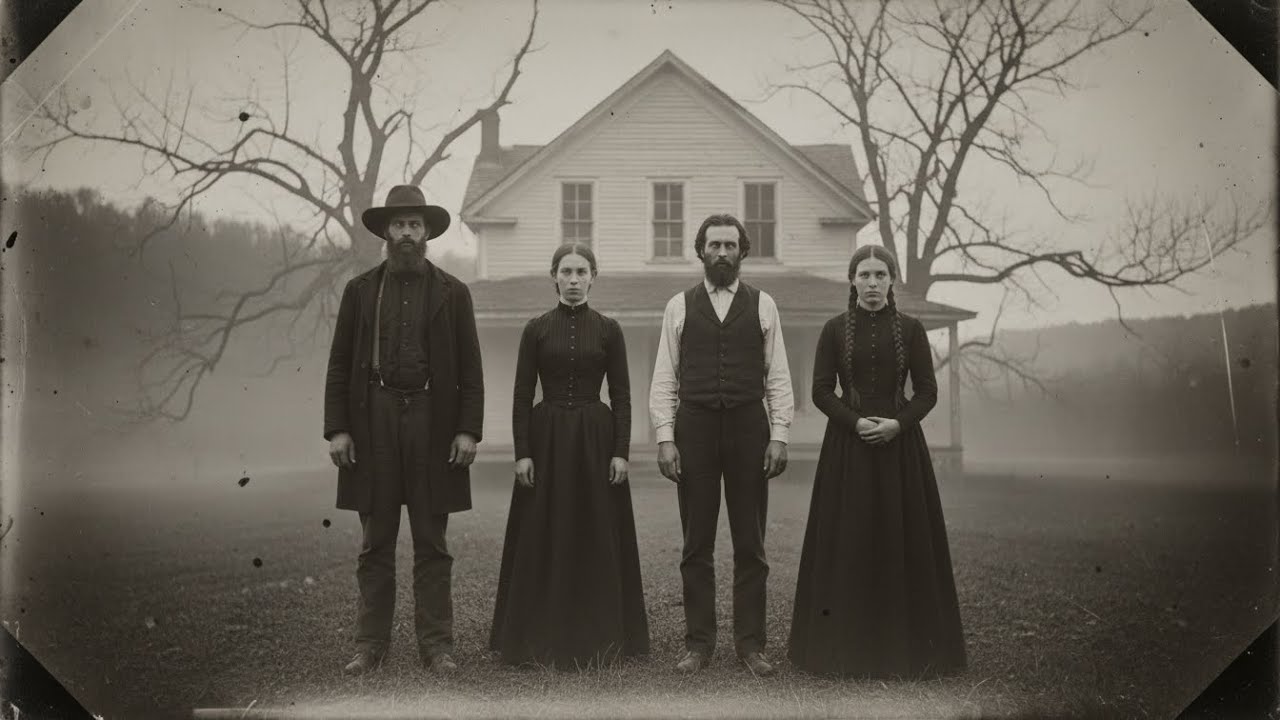
A shiver went down his spine when he finally saw the main house. He couldn’t explain the heaviness in the air, but there was something seriously wrong with that place. The house was a sturdy two-story building, larger than he had anticipated, with small windows that looked like vacant eyes. A number of smaller structures surrounded it, creating a kind of family complex.
The utter silence was what bothered him most. There were no bird songs, no animal sounds, just the wind whistling through the wooden buildings. Thomas knocked, and the sound resonated oddly in the dense air. Just enough of Jonathan Ashford’s face was visible through the door, and his intense gaze caused Thomas to take an uncontrollable step back.
There was no greeting, just a tense silence. Thomas mentioned the outstanding debt as the reason for his visit, but his words seemed to be lost in the thick air. Jonathan said he would settle the issue on his next visit to the village, but he did not extend an invitation. There was an authority in his deep, almost growling voice that could not be questioned.
It was impossible for Thomas to remain silent about what he had seen on that mountain. Over the next few days, he visited the tavern in Westville, where the men congregated to exchange rumors and stories after work. His discomfort was evident. His hands shook a little as he held his glass, and his eyes constantly strayed to the window, as though he thought something would appear out of the shadows.
One evening, an elderly man named Samuel Hartley approached him. Samuel had spent decades getting to know the mountains and their families, and he was well respected in the area. Observing the young merchant’s agitation, he decided to speak. He told Thomas what he knew, speaking softly enough for only Thomas to hear.
Samuel explained that the family had come to those mountains a century ago, escaping from something no one was certain of. They established their own remote world in the highest and most hostile places, where no one else wanted to live. Over the years, the Ashfords created traditions and customs entirely different from society at large. They upheld their own laws, rulings, and systems of justice, independent of the county government.
Samuel said that occasionally, out of necessity or curiosity, people had attempted to get in touch with the family. Some came back upset, talking about odd things they had heard or seen. Others simply decided never to bring up the subject again, as though they had made a silent commitment to forget what they had observed. There was an unspoken rule in the area.
The Ashfords stayed in their mountains in exchange for no one interfering in their affairs. Thomas asked if anyone had attempted to look into it further, if the county authorities knew anything. The elderly man merely shook his head slowly. The mountains were vast, and the law’s reach was constrained.
Furthermore, the Ashfords had never directly caused issues for the village, so there was no official reason for anyone to go up there. But there was more. According to Samuel, an itinerant pastor had decided to share the gospel with the remote mountain families in 1911. He was a resolute individual who believed he could bring spiritual redemption to people living in remote areas.
He brought his Bible and his beliefs to the Asheford property, thinking he would be received favorably. Three days later, he came back a totally different person. His hair had turned white. He refused to talk about what he had seen or felt up there, and his eyes were vacant.
He departed the area a few months later and was never seen again. Thomas became increasingly certain that someone inside that house needed assistance. He started surreptitiously asking questions around the area, talking to farmers, merchants, and even the local blacksmith who occasionally provided the Ashfords with tools. Every conversation added a piece to the puzzle.
Strangers were never permitted to stay very long on their land. The Ashfords never brought other family members to the village and carried out their transactions swiftly and alone. The blacksmith mentioned something particularly interesting. Jonathan Ashford had occasionally ordered heavy, sturdy chains and locks that were inappropriate for a modest rural property.
When asked about their purpose, Jonathan would give evasive answers, stating only that he needed to keep his possessions safe from wild animals. But the blacksmith had his uncertainties. Those chains were designed to support something far more powerful than any local animal. Thomas began to form a theory, an explanation that, despite its unsettling nature, appeared to be the only one that made sense.
What if someone was being held captive on that property? What if the wail he had heard came from someone being detained against their will? He knew he couldn’t just return there and demand explanations. Any direct approach could endanger his own life.
He needed a strategy, a way to observe the property covertly and a way to collect evidence. The moon was merely a slender crescent when Thomas made his second trip to the Asheford estate. He deliberately picked a night without a full moon, knowing that darkness would be his greatest ally. He carried only a hunting knife, more for psychological protection than for actual use, a notebook to document any discoveries, and a tiny flashlight he would use very carefully.
The climb at night was far more terrifying than it had been during the day. The darkness seemed to magnify every sound from the forest. He moved slowly, taking nearly five hours to reach the edge of the property. Thomas paused to watch the buildings through the thick undergrowth.
Some of the main house’s windows were lit. Smoke rose from one of the chimneys. Someone was awake, even at that hour. He decided not to go straight to the main house.
Instead, he circled the edge of the property, hiding among the trees, taking in the smaller structures. There was a sizable barn, presumably for tools and supplies. A building that appeared to be a workshop had a broken window revealing an extinguished forge. Then there was a tiny, remote cabin partially built into a rocky hillside, nearly obscured by vegetation.
It had a heavy wooden door reinforced with metal bars, and no windows were visible. Unlike the other buildings, this was something made expressly to hold something or someone. Thomas pressed his ear against the cabin’s wooden wall. At first, all he could hear was the forest and the wind.
But after several minutes of complete quiet, he finally heard it. Breathing, heavy and erratic. There was a living, breathing person inside. He attempted to look through tiny gaps between the wooden planks, but the interior was completely dark.
He thought about knocking on the door, trying to communicate with whoever was inside, but the risk was too high. He decided to back off, record his observations, and consider his next course of action. As he was leaving the cabin, he heard two individuals speaking in low tones, approaching. Thomas froze, his entire body tense.
He threw himself behind a cluster of thick bushes, burying himself in the leaves, trying to slow his fast breathing. As the voices became more distinct, he identified one as Jonathan Ashford’s. The two men came to a stop very near his hiding place. Jonathan was accompanied by a younger man, most likely a member of the household.
Jonathan made reference to maintaining customs and preserving the family legacy at all costs. The other man’s voice sounded doubtful as he asked a question. They had taken an oath, Jonathan said firmly. No external law mattered more than the blood of the family.
Then Jonathan said something that chilled Thomas to the bone. They had to make sure everything was secure for the night in the cabin. The two men headed straight for the building where Thomas had been only minutes earlier. Jonathan removed a large key from his pocket and pushed open the heavy door.
For a brief moment, the interior was illuminated by a dim flashlight beam, but Thomas couldn’t see what was inside. There were muffled voices, a few words he couldn’t understand, and then the door was carefully closed and locked again. Jonathan instructed the younger man on matters related to the night watch. He brought up shifts, designated check-in times, the importance of keeping their guard up at all times.
They appeared to be protecting something very precious, hazardous, or both. Thomas waited at least thirty minutes before he dared to move. When he finally got up, his body ached from the awkward position. He knew he had pushed his luck past all reasonable bounds.
He had to leave right away. But now he had the confirmation he needed. Someone was being detained in that cabin. Someone the Ashfords were fiercely protective of.
The journey down the mountain was one of sheer terror. Every shadow seemed to hold danger. He essentially ran the remaining portions of the trail, only decelerating at dawn when he finally saw the village’s first lights. He was exhausted, branches had scratched his face, and bushes had torn his clothes.
But he had accomplished what he had set out to do. Over the next few days, Thomas was constantly agitated, wondering what to do next. He knew that merely reporting a locked cabin and strange noises to the authorities would not suffice. He needed something more tangible.
But every day that passed meant this person continued to be imprisoned. It happened during one of those restless nights. Thomas had an unexpected guest. There was a knock on his rented room above the grocery store, three gentle but insistent knocks.
He opened the door to find a woman he had never seen before. She had dark hair in a plain bun, eyes that betrayed deep fatigue, and a youthful appearance, possibly in her early twenties. She looked anxiously around the deserted corridor and asked to come in. She identified herself as Elenora.
Her next words confirmed all of Thomas’s worst suspicions. She had fled the Asheford estate just two nights prior, after living in those mountains for years. Elenora spoke softly, stopping frequently to listen for any noise that might suggest she was being followed. She was not born in the mountains.
She had arrived in 1919, taking a position as the family’s governess. A job in return for room and board seemed like a fair offer at the time. But she saw right away that something was seriously wrong there. The Ashfords followed laws that defied all reasonable civilized reasoning.
Everyone on the property was completely under the family’s control, including when they were allowed to eat, sleep, work, and even speak. There were penalties for any deviation. Elenora only mentioned periods of seclusion in the cabin Thomas had found. She had been imprisoned there for days after attempting to challenge one of Jonathan’s directives.
Jonathan Ashford believed they were the defenders of a long-standing custom that had to be protected from the corruption of the modern world. He viewed isolation as a sacred obligation rather than a choice. All residents of the property were required to abide by this strict code, whether they had come voluntarily or by accident. Elenora said the immediate family was not the only people residing on the property.
Some had been brought there as distant relatives over the years. Others, like her, had come by accident and were never able to get away. Elenora also brought a serious caution. Jonathan knew that someone had been on the property that night, even though he wasn’t certain who it was.
He was more paranoid than ever, and surveillance had increased. Even worse, he intended to relocate some of the individuals he maintained on the property to even more isolated mountain areas where they would be impossible to find. There was not much time left. Thomas and Elenora went to the county seat the next day to speak with the sheriff.
A man named William Garrett served as sheriff of Haywood County, renowned for his fairness and practicality. He listened with increasing interest as Thomas and Elenora shared their story. At first there was doubt in his eyes. But as Elenora gave detailed information about the land, the buildings, and the occupants, his face changed.
Garrett posed a number of questions, testing the account’s consistency. He was interested in names, dates, and precise locations. Elenora answered all of the questions with an accuracy that could only come from someone who had actually lived through it. The sheriff reclined in his chair and considered the circumstances.
He acknowledged that he had heard rumors about the Ashfords over the years, but he had never had sufficient hard proof to support a formal investigation. Elenora’s testimony changed things. Garrett explained that it would not be easy to plan an expedition to that property. The terrain was challenging, the location remote, and he would need to assemble enough men to handle a potentially hostile family.
He also needed to proceed legally. He said he would take action, but he needed a few days to prepare. Three days of nearly intolerable stress went by. Elenora hardly ever left her room.
Thomas brought her water and food and tried to talk to her to take her mind off the fear that was always visible in her eyes. He learned more about the way of life on that property, details that painted an increasingly unsettling picture of control and isolation. According to Elenora, the Asheford family had a strict hierarchy with Jonathan at the top making all of the crucial decisions. His word was unchangeable law.
It was treasonous to question his orders, not just against him, but against the whole lineage of the family. He was always talking about how their traditions were pure, how the outside world had lost the genuine values his ancestors had brought from far-off places. The family engaged in odd customs. Everyone was required to attend nightly ceremonies.
Elenora was kept in a separate room during the most crucial parts and couldn’t describe exactly what happened, but she saw and heard chants in a language she didn’t understand. The next morning, grim looks were on everyone’s faces, as though they were reaffirming a long-standing agreement they would uphold for generations to come. What scared Elenora most was the Ashfords’ unwavering belief that they were acting morally. They didn’t act with needless brutality.
They acted with deliberate coldness, as though they were simply carrying out assigned tasks. Jonathan sincerely thought he was keeping something holy and safeguarding his family. It was impossible to reason with him, or with any close family member who held similar views. Sheriff Garrett was quietly planning his expedition.
He enlisted four dependable men, all with mountain experience. The official story was that they were looking into reports of suspicious activity in the area. They didn’t specifically mention the Ashfords until they had hard proof. Garrett showed up at the grocery store on the morning of the fourth day.
It was time to go. He explained that Elenora should stay in the village, safe. Garrett didn’t want to endanger her again, and her presence might complicate matters. Despite her reluctance, Elenora forced Thomas to swear he would do everything in his power to assist the individuals who remained.
Six men set out at first light. For the first few kilometers they rode horses, but when the trail got too steep, they began walking. Thomas acted as guide, remembering the route he had taken two times before. As they neared the property, Garrett ordered everyone to reduce speed and noise.
Before making an official announcement, he wanted to observe and gain an understanding of the situation. Through the trees, they could see the main house and surrounding buildings. It appeared to be a typical Ashford morning. People were going about their daily lives.
The sheriff chose a straightforward approach. He had the legal right to be there, and there was no use in trying to surprise them. They came out of the forest and headed for the main house. With his sheriff’s badge prominently displayed, Garrett led the way.
Nearly instantly, people halted their activities and turned to face the group, their expressions ranging from shock to fear. Before they even reached the door, Jonathan Ashford appeared. In the bright daylight, he was perhaps even more formidable than Thomas remembered. His gaze swept over the group, stopping momentarily on Thomas, before focusing on the sheriff.
There was no fear in his posture, only a kind of weary resignation, as if he knew this moment would eventually come. Garrett gave a formal introduction and stated he was there to investigate serious claims regarding the property’s living conditions. Jonathan listened in silence, his face an impenetrable mask. When the sheriff finished, he simply asked if he had a warrant.
Garrett admitted he didn’t, but argued he had enough testimony to justify his presence and could return with a warrant if necessary. Jonathan considered this for a long moment before finally shrugging and gesturing that they could go inside. The house was dark and claustrophobic inside, with heavy furniture and thick curtains blocking most of the natural light. There was a musty smell, and something else, something Thomas couldn’t identify but that made his stomach churn.
Garrett began asking questions, requesting to see every area of the property, to speak with everyone who lived there. Jonathan cooperated with a disturbing calm, as if he had nothing to hide. But when Garrett mentioned the secluded cabin, something shifted in the air. Jonathan tensed, his jaw visibly clenching.
He said that structure was only used for storage, that there was nothing of interest there. Garrett insisted. After a long, uncomfortable pause, Jonathan agreed to show him the place. But there was an urgency in his movements now, as if he were trying to think of something quickly.
The group reached the cabin’s heavy door, and Jonathan pulled the key from his pocket with slow, deliberate movements. His hands trembled slightly as he unlocked the door, the first sign of real emotion he had shown since they arrived. The sheriff pushed open the door, revealing the dark interior. It took a few seconds for his eyes to adjust to the lack of light, but when they did, what he saw inside that cabin changed everything.
It wasn’t simply storage, as Jonathan had claimed. It was a makeshift cell, with chains attached to the walls and a thin mattress on the floor. There were clear signs that someone had spent significant time there. Marks on the walls.
Personal belongings scattered about. And in the farthest corner, huddled as if trying to disappear into the shadows, was a human figure. Someone who had been forgotten by the outside world, but not by the Ashfords. It was a frail, thin woman, with disheveled hair covering part of her face.
She didn’t look up when the door opened, as if she had given up hope of any change in her situation. Garrett entered slowly, speaking in a low, reassuring voice. He identified himself as sheriff and explained that she was safe now, that no one would hurt her. The woman finally looked up.
Her eyes were filled with deep confusion, as if she had forgotten a world existed beyond that wooden structure. She didn’t speak. She just stared at Garrett with a blank expression that broke the hearts of everyone present. It was then that Jonathan finally spoke.
His voice was tired but firm. He explained that the woman was his younger sister, Rebecca. He said she had become mentally ill years ago, in 1920, and had begun exhibiting behaviors that endangered herself and the family. Jonathan claimed that keeping her in that cabin was a form of protection rather than cruelty.
For her own sake, she needed to be contained. The family didn’t have the funds to enroll her in any far-off institution. They took care of their own in the mountains, in their own way. Garrett’s disbelief grew.
He made the point that regardless of the situation, there were proper ways to handle health concerns, and that it was never acceptable to keep someone in such cruel conditions. Jonathan merely shook his head, claiming the sheriff didn’t comprehend. The rules of the outside world didn’t apply there. The families cared for their members in different ways.
Tension rose. The other Ashford family members had gathered at a distance, observing with solemn looks. Garrett announced that Jonathan and possibly other family members would be held accountable, and that Rebecca would be brought to the village for appropriate care. Jonathan took a step forward, his stance changing from defensive to menacing.
He claimed the sheriff was abusing his power and that he would not permit them to take a member of his family. The tension was broken by Rebecca. She started talking, her voice surprisingly clear despite its lack of use. She expressed her desire to go outside, to see the unobstructed sky, and to feel the wind on her face without any walls surrounding her.
Everyone was silenced by her words. Even Jonathan appeared affected, a change in his expression visible. Garrett took advantage of the moment to gently restate his position. He clarified that Rebecca had the freedom to decide her own fate, and that no one would suffer needless harm.
She had every right to leave if she so desired, but she was also free to stay with the family. Jonathan remained silent for a considerable amount of time, seeming to engage in an internal conflict between his beliefs and the reality he was being forced to face. At last, he took a step back and gave a nod. Rebecca was free to leave.
But he insisted that the sheriff tour the rest of the property and speak with all of the residents, so that Garrett would realize his family wasn’t made up of monsters, but individuals attempting to uphold a way of life they felt was right. Garrett agreed, realizing that understanding the full circumstances was crucial. Hours of heated discussions and unsettling disclosures ensued. As Garrett and his men were shown around the property, they encountered a variety of people living in circumstances ranging from austere to problematic.
Over the years, some distant relatives had moved there voluntarily, while others had been forced to. Some employees stayed because they had nowhere else to go. Others, like Rebecca, were kept for reasons the family deemed acceptable, reasons that clearly violated the boundaries of ethics and law. A pattern emerged.
Under the guise of family custom, the Ashfords operated under a system of total control. Jonathan sincerely thought he was acting in everyone’s best interests, maintaining a system that, in his opinion, upheld law and order and safeguarded the weak. But this protection came at the expense of personal autonomy, freedom, and the fundamental dignity every person is entitled to. Thomas was both fascinated and horrified.
He had assumed he would only encounter evildoers detaining people, but the truth was more nuanced and unsettling. The Ashfords were not monsters in the conventional sense. They were individuals who had established their own remote society with distinct laws and a warped, nearly unrecognizable definition of family. The sun began to set over the mountains.
Garrett assembled his group to determine their course of action. Rebecca and anyone else who wanted to go would accompany them down. As for Jonathan and the major family members, there would be legal repercussions, but Garrett understood that the particulars of this case would make prosecution extremely difficult. As they prepared to descend with Rebecca and a few other people who had chosen to leave, Thomas couldn’t shake the feeling that he was only touching the surface of something much deeper.
The descent was quiet. Rebecca walked between two of Garrett’s men, who helped her when the trail got difficult. She appeared dazed, her gaze fixed on the horizon as though she were experiencing the world for the first time, or perhaps recalling her life before confinement. Jonathan Ashford trailed behind the group, under covert surveillance.
He kept his dignified, upright posture, but something was broken in his eyes now, a slow realization that the world he had worked so hard to create was falling apart. They arrived in the village at night. Word spread swiftly, and people gathered in the streets, curious, whispering about what had transpired in the mountains. Elenora waited in front of the grocery store.
When she saw Rebecca, her face shifted from relief to sympathetic sadness. She approached slowly and spoke quiet words only Rebecca could hear. Garrett arranged temporary lodging for Rebecca and the others, making sure they had food, clean clothes, and a secure place to sleep. He also briefly detained Jonathan, primarily for his own safety, as rumors were starting to upset the local population.
Garrett knew he had a long way to go before he could properly resolve the legal situation. Over the next few days, Westville became a hub of interest and conjecture. Every discussion about the Ashfords added new information or theories. Some expressed empathy, claiming the family was merely attempting to uphold their customs in a world changing too quickly.
Others, outraged by the conditions Rebecca and others had been kept in, called for severe justice. In the center of this storm, Thomas was frequently approached by people who wanted to hear his account. He made an effort to answer truthfully, but he came to realize that no single story seemed to adequately convey the full scope of what he had seen. How could he describe the atmosphere there?
How could he portray the complexity of a family that caused so much suffering while sincerely thinking they were doing the right thing? Spending a lot of time together, Elenora and Rebecca found solace in the company of someone who genuinely understood them. As the days passed, Rebecca began to speak more, sharing fragments of memories from her pre-cabin life. She talked about a time when she had hope for the future, when she was free to walk in the mountains and assisted with household chores.
But she had undergone a transformation. Jonathan saw the need to question the rules as dangerous rebellion and restlessness as illness. Jonathan’s account of what happened was not totally contradictory. He maintained that Rebecca had started acting violently, threatening to flee and become disoriented in the mountains, putting the family’s safety at risk.
He saw the cabin as an essential remedy, a means of ensuring her safety until she calmed down. He didn’t seem to care that this had been going on for years, that she had never had a chance to get well or get the help she needed. Garrett interviewed all parties for hours, attempting to get a comprehensive picture. He learned that the tale of the Asheford family was even more difficult than he had thought.
They had brought a worldview already regarded as extreme when they arrived in the mountains to escape persecution elsewhere. Generations of seclusion only strengthened these ideas, producing a microcosm in which accepted social norms were completely irrelevant. Garrett was most struck by Jonathan’s total conviction. His actions showed no malice, just resolute belief that he was carrying out his responsibility as the leader of the family.
He spoke of accountability, of the need to make sacrifices, of the importance of maintaining the integrity of the lineage and the traditions. Even though his values appeared irrational and cruel to others, it seemed as though he lived in a parallel reality where they made perfect sense. Rebecca found it difficult to adjust to life away from the mountains. Thomas began spending time with her, showing her simple sights around the village.
They met in the afternoons. Every encounter was both strange and familiar to Rebecca, as though she were rediscovering a world from a previous existence. She was curious about everything, devouring knowledge with a hunger that made it clear how many years she had missed. One afternoon, while strolling by the village’s river, Rebecca paused to observe the water as it flowed.
When she was younger, before everything changed, she loved that river. She recalled swimming there during the sweltering summers, helping to wash clothes on the banks, and dreaming of one day following the river wherever it led, exploring what was on the other side of the mountains. Thomas came to see that Rebecca was more than just a helpless victim of Jonathan’s oppression. She was a complicated individual who had been gradually broken down, each day in the cabin taking away more of her essence until nearly nothing was left.
The healing process would take a long time and might never be finished. But there was also hope. The possibility of reconstructing something, even if it differed from what might have been. Meanwhile, other Ashford family members who had stayed on the property began to come down to the village, either to talk to Jonathan or just to find out what had happened to Rebecca.
Their presence increased tensions, as many villagers perceived the whole family as involved in Jonathan’s behavior. But discussions with these family members exposed a more complex reality. Many had lived under the same control system, obeying commands out of fear of repercussions, or because they had no other option, or because they truly believed what Jonathan had said. Jonathan’s wife, Margaret Ashford, was among the last to descend.
She was a tragic figure, a woman who had lived for decades next to a man whose beliefs profoundly influenced her life. When she spoke during Garrett’s interview, her voice was hesitant and low, as though she had forgotten how to voice her own thoughts. She acknowledged that she was aware of Rebecca, had witnessed her sister-in-law’s decline over time, but she never questioned Jonathan’s justification. Perhaps more unsettling than Jonathan’s act of conviction was her quiet complicity, demonstrating how control systems maintain themselves through everyone’s complacency.
The legal matter remained complex. Garrett sought precedent for such an uncommon case, consulting authorities in larger cities. The answers were consistently ambiguous and inadequate. Technically, Jonathan had kept someone against her will in appalling conditions.
But he was a family member, claiming to act in their best interest. In family situations, especially in isolated areas where law enforcement had historically been lax, the laws of the time provided few protections. Months passed, and a new normal began to take hold. Rebecca secured employment at the neighborhood laundry, a simple position that gave her a sense of purpose and social interaction.
Her nightmares persisted. She still had days when she was overcome with sadness, but she also experienced genuine joy and small triumphs that helped her get back on her feet. After a while, Jonathan was released with strict guidelines. He went back to the mountains, but he no longer had control over the family.
Many members decided to stay in the village or relocate, attempting to build lives free from the influence of customs that had taken hold. Even among those who chose to remain with Jonathan, the dynamics had irrevocably changed. Winter descended upon the mountains of North Carolina, covering the peaks with snow and transforming the trails into perilous roads. This was Rebecca’s first cold season in freedom after years of confinement.
Every snowflake that touched her face felt like a small miracle. She had begun to smile from time to time, a tentative, shy, but sincere smile. Elenora had emerged as a key figure in the community. She created a safe space for people who had experienced family control systems, organizing informal events where they could talk about their experiences without fear of judgment.
Her silent strength encouraged others to face their own history and look for better ways forward. Thomas discovered that the encounter had changed him. What had started as a simple business issue had evolved into something that changed his purpose. In addition to providing his services as a merchant, he began visiting other isolated mountain communities, discreetly observing family dynamics and looking for signs of trouble.
It was a heightened awareness that tradition and seclusion can sometimes mask unsettling truths. On one of these excursions, Thomas came across a family living in somewhat smaller-scale circumstances than the Ashfords. Instead of taking direct action, he shared his observations with Sheriff Garrett, who conducted an investigation with the same diligence he had shown in the Ashford case. While not all circumstances were as severe, they all showed nuances in the ways that distant families created their own laws and hierarchies of power.
Spring brought rebirth, not just to nature, but to those affected by the previous year’s events. Rebecca had made great strides, forming genuine friendships in the village and taking up hobbies she had lost while confined. She discovered she had a knack for gardening, spending hours caring for a small plot of land behind the house where she lived. The plants responded to her patient attention, flourishing under her care.
One afternoon, Rebecca invited Thomas to go hiking with her, not to the Asheford estate, but just to walk the trails she had known as a young woman. She wanted to return to the mountains. Thomas hesitated, fearing it would trigger painful memories. But Elenora supported the idea, stating that Rebecca had to reclaim those spaces, to turn frightening places into peaceful ones.
They ascended slowly. Rebecca paused often, taking in details she apparently remembered. She pointed out particular trees, small streams, and rock formations from her childhood. She talked about how the mountains were her home, not her prison, how she used to run along those trails fearlessly.
When they arrived at a natural lookout point with a view of the valleys below, Rebecca watched for several minutes without saying anything. Then she began talking about forgiveness. Not the simple kind that ignores wrongdoing, but the sophisticated kind that recognizes pain while attempting to let go of grudges. She admitted she was still angry with Jonathan, and most likely always would be, but she also realized that harboring that anger would only prolong her imprisonment.
On the way back down, they met one of the younger Ashford family members. Thomas had seen the boy briefly during the initial investigation. The interaction was tense at first, neither party knowing exactly how to proceed. Then Rebecca began talking, asking about the family and conditions on the property.
The young man replied that Jonathan had changed since the incident. He appeared to be questioning many of the beliefs he had once preached with such conviction. He spoke less and secluded himself more. The family was now smaller.
The people who stayed were attempting to strike a balance between upholding their customs and admitting that some of them needed to change. Summer brought visitors from farther-flung areas who had heard tales of the Asheford family’s ordeal. Some came out of morbid curiosity, seeking dramatic details. Others came with more genuine goals, wanting to learn about the workings of remote communities and how to support others who might be experiencing similar circumstances.
In one of these discussions, a visitor shared that he had heard similar tales from other mountainous areas, not just in the Appalachians, but in remote places across the nation. Families that had established their own systems out of the public eye, some harmless in their oddities, others disturbingly transgressing moral boundaries. Thomas realized that what he had found was not unique, but rather a recurring pattern where tradition and seclusion come together with unequal power. Elenora proposed that instead of using their experiences as sensationalism, they should record them honestly so that others might be able to spot warning signs.
She began writing, filling notebooks with reflections on her own experience and the psychological systems that prevent people from escaping even when they are able to. Her intention was to start discussions about autonomy, consent, and the boundaries of family power, not to disparage traditional families or remote communities. Rebecca started writing as well, though privately. She processed fractured memories of her time in the cabin in a journal, attempting to make sense of events that, in hindsight, frequently seemed unreal.
Some entries were surprisingly hopeful; others were heartbreakingly depressing. When she shared a few pages with Thomas, he was struck by how well Rebecca was able to express such nuanced emotions. Her gift for words had been suppressed for years, but it had never entirely vanished. As the year went on, little Westville had quietly changed.
There were more candid discussions about problematic traditions and healthy boundaries, a heightened awareness of issues of autonomy and family control. People’s perspectives on family, loyalty, and the costs of belonging gradually changed, not through radical metamorphosis, but through gradual shifts. Rebecca’s story sat at the center of this change, a silent reminder that behind every custom and family structure are people with goals, anxieties, and desires, rights that must never be overlooked or repressed. Two years had passed since the morning Thomas had first ascended to the Asheford estate.
The mountains themselves hadn’t changed. But the people who lived there had undergone transformations that continued to reveal themselves over time. In the village, Rebecca had grown to be adored, her metamorphosis serving as silent evidence of human resilience. In addition to the laundry work, she now assisted with the village’s small library, organizing books and occasionally reading to people who had never had the chance to learn.
Seeing her surrounded by stories had a profoundly symbolic meaning. After years of being denied her own story, she now helped others access theirs. Thomas noticed that Rebecca had acquired a unique talent for recognizing those who carried their own hidden burdens. She could identify that aloof gaze, that specific hesitancy that came from living under continual surveillance.
He witnessed her begin polite conversations with visitors or residents who appeared to be carrying invisible burdens, offering them understanding and presence rather than advice. Elenora turned her informal gatherings into a more formal setting where people could share stories about complex family relationships. The church provided the space, and the group met once a week. The numbers were small at first but steadily increased.
Some were daughters who had been compelled to give up their own goals to meet family expectations. Young people who struggled against customs they believed stifled their individuality. Some men who realized they had continued harmful patterns without challenging them. Thomas kept moving through the mountains, but his role had changed.
He was now more than just a perceptive trader. Remote communities were beginning to trust him. Along with supplies, he brought news from the outside world, stories of other families who managed to preserve important customs while removing negative elements. Some families met him with suspicion, perceiving him as a threat to their way of life.
Others met him with cautious curiosity, asking questions about options they had never considered. On one of these excursions, Thomas came across a circumstance that uncannily mirrored the Asheford case. Younger members of an isolated family in Madison County had started to question their practices. Unlike Rebecca, there was no physical prison.
But there was an equally powerful psychological one, a structure of obligation and guilt that made it difficult to imagine life outside that restricted family circle. Thomas spent days conversing with various family members, asking questions rather than passing judgment, questions that encouraged introspection. He told Rebecca’s story, emphasizing her path of healing and rediscovery rather than grisly details. He talked about how family could be a source of support without turning into a cage, how customs could be upheld without putting people in jail.
He noticed a change in the younger members’ eyes, a realization that there were more options than those that had been presented as the only ones. Sheriff Garrett had established a reputation for understanding the intricacies of cases involving remote families. Authorities from neighboring counties consulted him when similar situations arose. He shared not only legal aspects but also the sensitivity required to deal with communities deeply mistrustful of outside intervention.
Garrett emphasized the importance of striking a balance between coercive practices and truly chosen traditions, which required more subtlety than the law usually provided. In the mountains, Jonathan Ashford had become a nearly spectral figure. Seldom did he come down to the village, and when he did, it was only for absolutely necessary reasons. People who saw him remarked on how much he had aged, how his hair had turned white, how his movements carried a weight beyond mere physicality.
He reportedly sat alone at a natural lookout point near his home for hours, staring at the valleys as though looking for answers the mountains would never offer. Margaret Ashford had made a different choice. After a while, she left the estate and moved into a modest home outside the village. Many people saw her as complicit in Rebecca’s years of suffering, making her initial presence extremely uncomfortable.
But Margaret made no attempt to defend herself. She simply lived a quiet life, taking in odd sewing jobs and staying mostly out of sight. Rebecca was the one who ultimately reached out, beginning difficult but essential discussions about accountability, silence, and the nuanced ways individuals participate in harmful systems. These conversations developed gradually over several months, during brief, cautious meetings where every word was carefully considered.
Margaret never asked for forgiveness directly, as if she knew she had no right to make such a request. Rather, she listened and let Rebecca express her anger, sorrow, and confusion over how someone who was supposed to keep her safe had permitted so much pain. Slowly, a sort of understanding developed between them, not necessarily forgiveness, but an acknowledgment of shared humanity and frailty. The village had begun to attract visitors who weren’t morbidly curious, but rather researchers, social workers, and even some educators who wanted to understand how small communities handled difficult problems of family autonomy and tradition.
At first, Thomas objected to this attention, concerned that it would turn Rebecca’s experience into a spectacle. But Rebecca herself decided to participate in some discussions, offering her perspective when she thought she could have an impact. At one of these discussions, a young woman who assisted families in transition was present, people departing from strict family structures or remote religious communities. Rebecca’s explanation of the psychological effects of living under continual control impressed the young woman.
She described how the brain adjusts to impossible situations by fabricating stories that justify the unacceptable. Rebecca explained that there were moments when she truly believed Jonathan was doing what was best for her, how the defenses her mind had constructed allowed her to live another day, week, or year. Thomas came to see that the story was about more than just Rebecca and the Ashfords. It was about broader patterns that recur in different settings and places.
He began exchanging letters with individuals in other areas who had witnessed or experienced comparable circumstances. Each letter offered a different perspective, highlighting the particularities of each case as well as the commonalities among them. An examination of the lines separating family and individual freedom, tradition and oppression, protection and control. The third anniversary of Rebecca’s freedom was quietly commemorated.
Elenora arranged a small dinner for the people who had played a crucial role in her journey. As the group sat around the table, they considered how much had changed. In a brief but firm voice, Rebecca expressed her gratitude, for both the physical intervention and the ongoing support that had enabled her to not only flee but to genuinely rebuild her life. As Rebecca spoke, Thomas noticed that she was not the frail person who had been removed from that cabin, but a woman who had discovered strength she didn’t know she had.
She still had scars, visible in the way she avoided enclosed dark spaces or flinched at sudden noises. But she had learned to live with them, to accept them as part of her past without allowing them to define who she was now. The conversation eventually turned to the future. Elenora talked about her intention to publish her writings as a resource for people working with survivors of controlling environments.
Rebecca said she would like to visit other communities in the future and share her story in a way that might give those still trapped hope. Thomas spoke of extending his trade routes to more remote settlements, continuing to serve as a link between different worlds. Garrett disclosed that he was working with lawmakers to create better procedures for investigating complex family circumstances, strategies for intervention that respected cultural autonomy while protecting those at risk. The work was slow and frequently frustrating, but he thought it was necessary.
Thomas thought about how a simple business trip had evolved into something that had drastically changed the course of several lives. He recalled the sound he had heard years prior, that muffled lament. The distinction between seeing and truly perceiving, between hearing and truly listening, between suspecting and acting was something many would have overlooked. Justice and change were made possible by those slender edges.
Eventually, under the starry mountain sky, the group scattered. Thomas strolled leisurely, enjoying the cool night air and the now calm rather than menacing silence. He pictured Jonathan still in the mountains by himself, his trembling convictions, and experienced a complicated sadness rather than rage. Not only had Jonathan created a prison for Rebecca, but he had also imprisoned himself with ideas that did not permit change or development.
Unlike Rebecca, he might never escape. Eventually, Thomas left the village, needing to travel beyond those well-known mountains. Not because he wanted to forget, but because he wanted to understand. He brought with him a deep awareness of the frailty of the walls we erect around ourselves, and the ways in which custom and seclusion can create realities incomprehensible to the outside world.
Rebecca remained in the village, building a life of her own. She never married and never felt the need to start a family after living under the crushing weight of one. Instead, she found meaning in chosen relationships, friendships she kept, and volunteer work. She became a silent reminder that fresh starts were possible, even after the most severe losses.
By the time Jonathan Ashford died, the forest had gradually taken back the estate. Buildings that once held sinister secrets collapsed from neglect and time. The cabin where Rebecca had been kept vanished entirely, swallowed by vegetation, as if nature were attempting to erase that memory. In her later years, Rebecca would sometimes climb the paths that had led to her rescue.
She never reached the summit, always pausing at a secluded spot where she could see the mountains extending to the horizon. There she thought about everything that had happened to her, the time lost and the time gained, the scars that would never fully fade, and the strength she had discovered within herself in unexpected places. She sometimes thought of Jonathan, not with the fierce resentment of her early freedom, but with something more nuanced, a mixture of sorrow for the life he had wasted on inflexible beliefs, and the realization that he, too, had been imprisoned by his own convictions. The wind continued to blow through the mountains, unaffected by the human dramas it witnessed.
The seasons changed. The trees grew. The stories were told and retold around village hearths, details shifting and becoming exaggerated until it was impossible to tell fact from fiction. Maybe that was for the best, allowing those who had experienced the actual events to keep their experiences private.
The mountains stood as silent witnesses to everything that had occurred and everything that would happen. They had seen families come and go, customs born and die, secrets buried and discovered. And they would keep watching, unchanging, as future generations struggled with their own conflicts between custom and liberty, family and individuality, the security of the familiar and the fear of the unknown.






