In 2006, a polling firm asked American internet users a deceptively simple question: which search engine satisfied them the most, not which one they used most often. The answer was not Google, which already handled more than half the country’s searches. It was not Yahoo, still the second largest. The winner, rated highest in customer satisfaction among all residential search services in the United States, was a website called Dogpile.
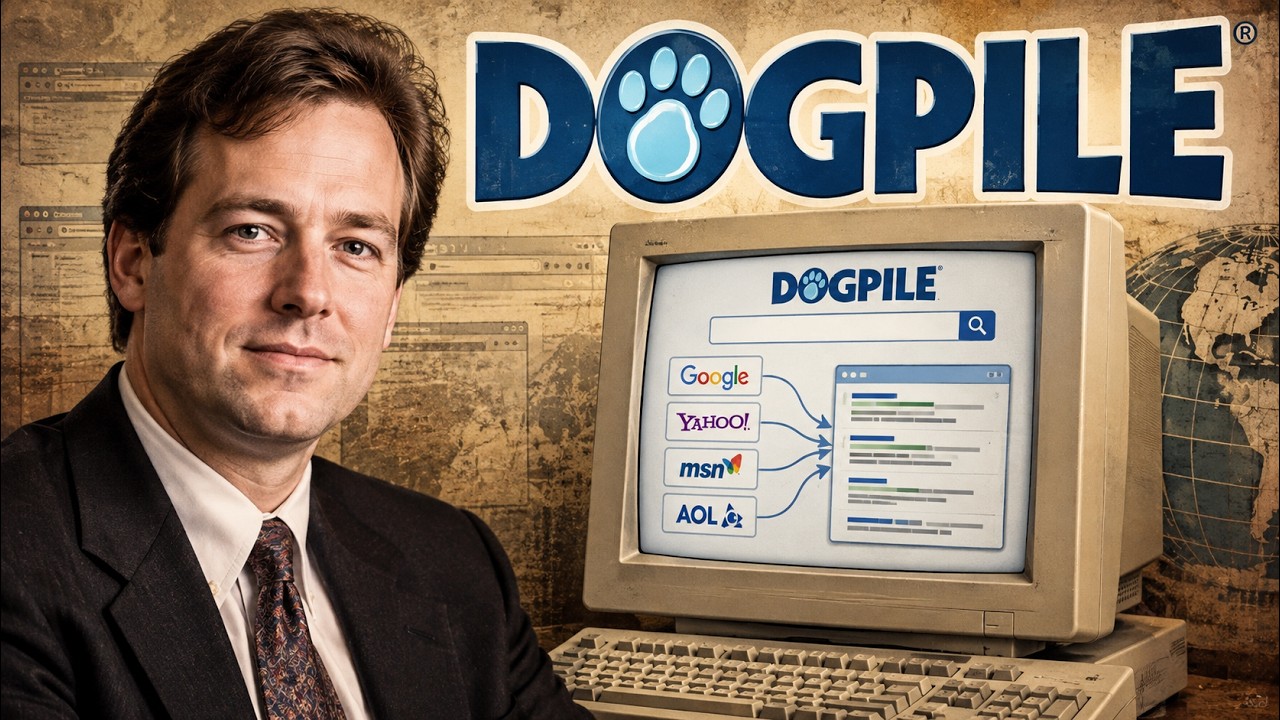
It won again the following year. The name came from the schoolyard pile of bodies that lands on the kid at the bottom of a recess tackle, and the logo was a cartoon dog named Arfie who sat above a search bar with a single button that read “Go fetch. ” You typed your question, clicked the button, and the results came back not from one engine but from all of them at once, merged into a single list with duplicates stripped out. The story of why such a tool existed begins with the internet of the mid-1990s, a world almost unrecognizable today.
There was no default search engine and no verb for searching. AltaVista, launched in December 1995, was the closest thing to a serious full-text engine, fast and ambitious, but its ranking algorithm was primitive, sorting results largely by keyword frequency so that a page stuffed with repeated terms could outrank the authoritative source. Lycos indexed even fewer pages. Excite attempted conceptual search and frequently guessed wrong.
Infoseek was useful only for narrow questions. Yahoo was not a search engine at all but a hand-curated directory; if a site had not been manually reviewed and added by an editor, it did not exist in Yahoo’s version of the internet. Studies estimated that even the best engine indexed roughly 16 percent of the publicly accessible web. A researcher, librarian, or journalist had to open multiple browser windows, retype the same query into five or six engines, wait for results over a dial-up modem, and compare the lists by hand.
Aaron Swartz, the man who would solve this problem, was none of the archetypes history usually assigns to internet pioneers. He was not a computer scientist or a Silicon Valley engineer. He was a research attorney whose livelihood depended on completeness, and the tools available to him kept failing in the same specific way: he would search one index and get one set of results, search another and get a completely different set, with no way of knowing whether the one critical document he needed sat in a third. From that professional frustration came a simple idea.
What if a single tool queried all the indexes at once, combined what they returned, eliminated the duplicates, and delivered one merged list? Dogpile launched in November 1996. It sent each query simultaneously to Yahoo’s directory, Lycos, Excite, WebCrawler, Infoseek, AltaVista, HotBot, and others, then collected the results and presented a unified view. The technical term was metasearch: a search engine that did not crawl the web itself, built no index, and stored no copy of any page.
There was never a Dogpile bot. It sat one layer above the engines that did the crawling and aggregated their output. It was not the first of its kind. Eric Selberg, a graduate student at the University of Washington, had built MetaCrawler in 1994 as a PhD project and launched it publicly in July 1995; by late 1996 it was handling over 150,000 queries per day.
MetaCrawler was the academic proof of concept. Dogpile was the consumer product that took it further, wrapped in the personality of a cartoon dog and a button even a first-time user understood. In an age when most search companies desperately wanted to become portals that kept users trapped on their home pages, Dogpile wanted you to find what you were looking for and leave. The first years brought genuine growth.
Dogpile appeared in internet guidebooks, in reference lists compiled for librarians and paralegals, and in the forwarded email chains that served as the web’s discovery mechanism. Its users were disproportionately the people who understood the fragmentation problem from daily experience: researchers, lawyers, and academics who knew that no single engine gave them everything. The value was functional, and the loyalty was real. But the field was crowded.
Mama. com, Ixquick, Kartoo, and MetaCrawler all competed, and every metasearch engine shared a structural weakness none of them discussed publicly. They had no proprietary index, no exclusive content, no unique advertising inventory. Their entire existence depended on continued competition among multiple engines returning meaningfully different results.
If that competition ever collapsed, the metasearch layer would lose its purpose. Every metasearch engine was, in a sense, betting against its own success. In August 1999, a company called GoToNet acquired Dogpile, putting the two most recognized metasearch engines in America under one roof. In January 2000, GoToNet announced it had added Google to the list of engines queried by both MetaCrawler and Dogpile.
Google was young, small, just one name among many. Adding it was a routine operational update. Nobody realized they had just added the company that would, within five years, make their entire product category irrelevant. That July, with the dot-com bubble already deflating, InfoSpace acquired GoToNet in an all-stock deal valued at roughly $4.
2 billion. InfoSpace was a Bellevue, Washington company founded by Naveen Jain, a former Microsoft executive who told the press his company would one day surpass Microsoft, Intel, and Cisco combined. At its peak it held a market capitalization of $31 billion. The collapse that followed was among the most dramatic implosions of the dot-com era.
By June 2002, the stock had fallen from a peak of $1,305 per share in March 2000 to $2. 67, a decline of 99. 8 percent. That same year, investigations revealed the company had used controversial accounting to report profits of $46 million when it had actually lost $282 million.
Jain and his wife had sold more than $200 million worth of their own shares during the boom. In 2003, a federal judge ordered Jain to pay $247 million for violations of insider trading rules, the largest penalty of its kind in American history at the time; the case was eventually settled for $105 million, though Jain denied all liability. Jain was forced off the board in December 2002. Dogpile survived the purge.
The cartoon dog had no stock options and no opinion about accounting fraud. For a few more years, the tool behind the button still had a purpose. The golden age of Dogpile ran from roughly 2005 to 2008, and its legitimacy was backed by peer-reviewed research. A 2005 academic study commissioned by Dogpile and conducted by researchers at the University of Pittsburgh and Pennsylvania State University tested a straightforward hypothesis: did the major search engines show you the same results?
They took 10,316 real queries, ran each through Google, Yahoo, and Ask Jeeves, and compared the first page of results. The answer was no. Only 3. 2 percent of those first-page results appeared on all three engines.
Nearly 85 percent appeared on only one engine and nowhere else. The search engines were not showing you the same internet. They were showing you three different ones. An expanded study using 12,570 queries across four engines found 1.
1 percent overlap; a 2007 follow-up measured 0. 6 percent. The divergence was growing wider over time, and the strongest possible case for metasearch was being stated in the language of academic rigor. Dogpile offered comparison view, letting users see, engine by engine, where each result came from, with color-coded highlights identifying which results were unique to Google, which came only from Yahoo, and which appeared on multiple sources.
No major engine would ever have built such a feature, because it exposed the incompleteness of its own index. Dogpile could, because that incompleteness was its entire reason to exist. Arfie caught misspellings, suggested corrections, displayed trending searches, and could even be downloaded as a desktop widget that launched search directly from your screen. The tagline was all the best search engines piled into one.
In 2008, Dogpile partnered with Petfinder and launched a program where a portion of advertising revenue from every search was donated to animal welfare charities; users raised over $360,000 for animals simply by searching through Dogpile instead of going directly to Google. The alignment between brand and cause felt natural. But the people raising that money were a shrinking population, and the reason had a name. Google arrived in September 1998, founded by two Stanford PhD students named Larry Page and Sergey Brin.
Their foundational insight was PageRank, an algorithm that ranked results not by keyword density but by the number and quality of links pointing to each page from other pages. A page was important if important pages linked to it. It worked with a clarity that made the previous generation of search engines look primitive overnight. Google’s results were not incrementally better; they were categorically, transformatively better.
The interface completed the argument. While every competitor raced to become a cluttered portal stuffed with newsfeeds and widgets, Google offered a white page, a logo, a search bar, and two buttons. It loaded instantly on dial-up. The austerity was confidence.
The product behind the search bar was so good that nothing else on the page was necessary. You could tell within three searches that Google was different. Within ten, you stopped checking the other engines. Within a hundred, you had forgotten they existed.
That is what killed metasearch. Not a corporate failure, not a bad product decision, not a scandal or a lawsuit. It was a single search engine so good, so fast, so consistently useful, that users stopped experiencing the fragmentation metasearch was designed to fix. The problem did not go away.
It became invisible. And invisible problems do not sustain businesses. The 2005 overlap study was never refuted. Different engines still return different results.
But by 2026, Google handles over 5 trillion searches per year, roughly 90 percent of global search traffic, over 94 percent on mobile, and over 97 percent in India. When a single engine processes 90 percent of all queries on Earth, the argument for searching all the engines and merging the results is an argument nobody has the patience to hear. Dogpile proved that the search engines disagreed. Google proved that most users did not care as long as the one they were using worked well enough.
The corporate aftermath tells its own story in declining sale prices. In 2012, InfoSpace acquired TaxAct, renamed itself Blucora, and became a financial services firm with no connection to search. Dogpile, MetaCrawler, and WebCrawler became minor entries on a balance sheet dominated by tax preparation software. In 2014, MetaCrawler was merged into zoo.
com, a children’s search engine; Eric Selberg’s PhD project, the founding work of consumer metasearch, reduced to a redirect on a kids’ website. Then, in July 2016, Blucora sold the entire InfoSpace search portfolio, Dogpile, MetaCrawler, WebCrawler, and HowStuffWorks, to a company called OpenMail for $45 million in cash. The number is the story. InfoSpace paid $4 billion for GoToNet in 2000.
Sixteen years later, the entire portfolio sold for $45 million. OpenMail renamed itself System1, a publicly traded advertising company whose brand portfolio includes Dogpile. The footer on dogpile. com now reads InfoSpace Holdings LLC, a System1 company.
And yet, if you visit dogpile. com today, the cartoon dog is still there. The search bar is still centered on a clean page. The homepage tagline reads “Searching the web since 1996.
” The button still says “Go fetch. ” Type a query, and results arrive, pulled from Google and Yahoo and Bing, deduplicated and merged into a single list, exactly as Aaron Flynn designed it thirty years ago. There is no Dogpile crawler. There never was one.
The site remains, in its architecture and its purpose, exactly what it has always been: a layer on top of other people’s engines, a middleman, a referee in a game where the players have been reduced to one. Dogpile did not lose the search wars. The search wars ended, and the winner had no use for a referee. Dogpile did not fail.
The world it was built for disappeared.






