The copper tool came out of a mining pit in Michigan and went to a laboratory. The lab returned a date of 8,500 years old. Hold that number, because it breaks something. That tool was already ancient when the first pyramid in Egypt was still only an idea in someone’s head.
It was already old when the first word was ever written down in Mesopotamia. And it was made by a person standing on American ground thousands of years before the history books say anybody on this continent knew how to work metal at all. It is not a lump. It is not a rough scrap someone banged flat.
It is shaped. It is planned. The back end has been folded into a hollow tube so a wooden handle could slide inside and grip tight. That is not the work of a beginner.
That is the work of someone who had already made a hundred of them. So the question has been sitting under Michigan this whole time. If nobody in America was supposed to know metal yet, then whose hands made this? This is the story of that tool, and of the pits it came out of.
It is the story of people who were told for two hundred years that their own ancestors could not possibly have built what lay at their feet. And it is the story of a moment, only a few years ago, when a lake full of mud finally said otherwise. Before the tool, you need the ground. Find Michigan on a map.
There is a strip of land that pushes out into Lake Superior like a bent finger. That is the Keweenaw Peninsula. It is cold there, and quiet, and the winters are long and mean. And under that thin soil is something almost nowhere else on Earth has.
Most copper in the world is trapped inside rock. You need furnaces and fire and a great deal of chemistry to pull it out. Not here. Here it is native copper, sitting in the ground already almost pure, about 99 percent clean metal.
You can lift a piece out, strike it with a stone, and you are holding a blade. It is the easiest metal on the planet to pick up and use. And somebody found it a very long time ago. Now go fifty miles out into the lake, to an island called Isle Royale.
Walk one ridge on that island and you start seeing holes in the ground. Not a handful of them—more than a thousand. Some are shallow scoops. Others drop twenty meters straight down into solid rock.
They do not wander. They follow the copper veins through the stone the way a doctor traces a vein under skin. Somebody sat with this rock long enough to learn the way it thinks. The first man to look at all this and go quiet was named Samuel Knapp.
The year was 1848. Knapp worked for a mining company near the Ontonagon River. He found an old dip in the ground filled in with dirt and figured it was nothing. He told his men to dig it out.
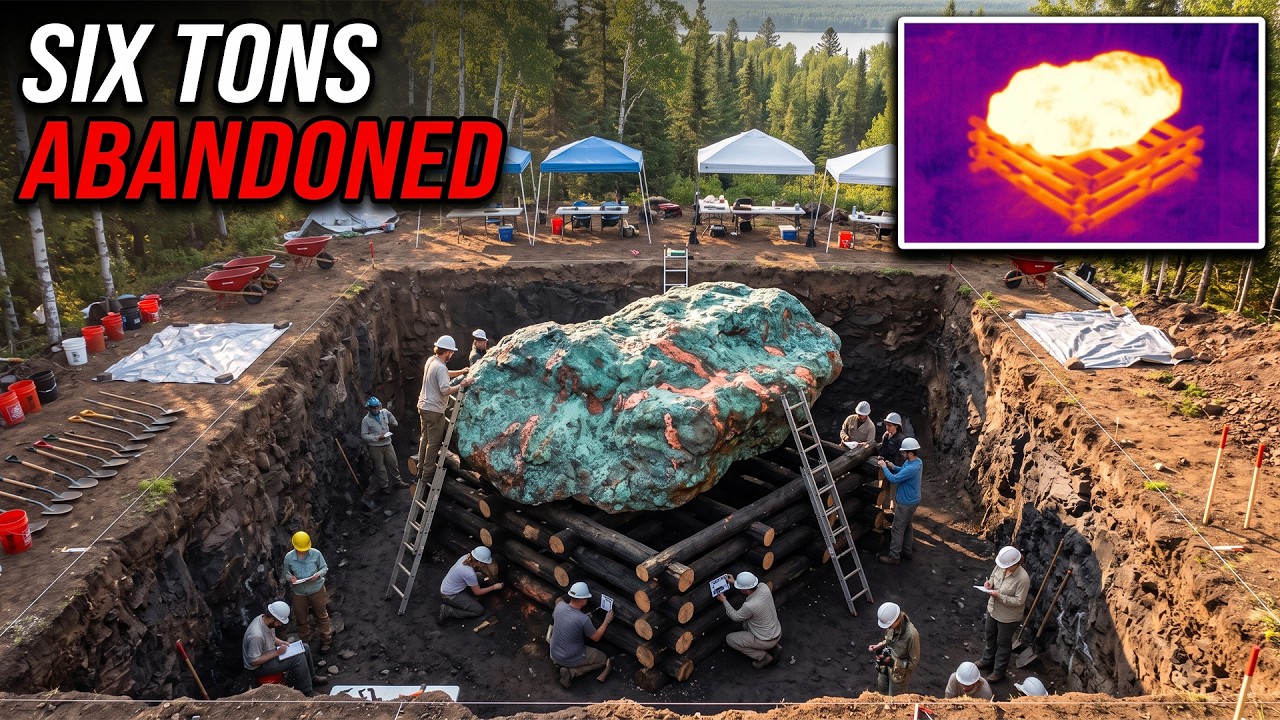
Eighteen feet down, the shovels hit metal. One single mass of pure copper, ten feet long, three and a half feet across, over six tons of it. But the weight is not the part that should raise the hair on your arms. That copper was not lying on the floor of the pit.
It had been lifted. It was sitting on a platform of oak logs stacked into a crib, built by human hands to hold that weight up off the ground. Somebody had raised six tons of metal out of the earth and then walked away and left it there. The wood was still under it, rotted so soft it crumbled like wet peat, and on the log ends were cut marks, clean once, about two and a half inches wide, made by a tool.
Knapp had not found a mine. He had found a job somebody stopped doing and never came back to finish. And here is what happened next, the part that repeats everywhere in this field. The find was written up.
It was talked about for a season. Then it was filed. No one ever answered the question it asked. The pit was eventually worked over by the modern company, and the evidence went with it.
The report survived. The meaning did not. That pattern is not a one-time accident. There are dozens of documented finds like this one—different states, different decades, different kinds of evidence—and almost all of them follow the same four steps.
Found. Recorded. Questioned. And quietly put in a drawer.
It is a habit, and it has a cost, because two hundred years of that habit is how a real discovery turns into a rumor. The diggings themselves were real. The scale was real. Nobody serious has ever argued otherwise.
A geologist named Charles Whittlesey mapped these pits and published his report through the Smithsonian in 1863. He wrote one sentence that has haunted this story ever since: “An ancient people took copper from the shores of Lake Superior. And history gives no account of him. ” That line lit a fire that is still burning today.
But listen closely to what the man actually said. He did not say these people were magic, or foreign, or gone. He said he did not know who they were. Two hundred years later, we finally do.
The copper objects that come out of this region are not what most people picture when they hear “Stone Age. ” There are knives, fish hooks, needles, awls for punching through leather, curved blades for scraping hides. And then there is the spear point. Some of these points have a socket.
The back end is not flat. It is rolled into a hollow tube so a wooden shaft can be pushed inside and lashed down tight. Archaeologists give this shape a name: the Witri type 1A. Here is why that shape matters so much.
You cannot make a socket by hitting a lump of copper and hoping. You have to hammer the metal out into two thin wings, then fold both wings over at a clean ninety-degree angle and hold that same angle evenly down the whole length of the tube. Try that with a stone hammer and no furnace. It is slow.
It is exact. And it goes wrong easily. Hit cold copper too many times and the metal turns hard and brittle and snaps in your hands. That is not an opinion.
That is physics—unless you know the trick. The trick is to heat the copper in a fire and let it cool slowly. The metal relaxes. The tiny grains inside rearrange themselves, and it goes soft again.
Then you can hammer more. Then it hardens again. Then you heat it again. That process has a name: annealing.
And this is where the story stops being about old rocks and starts being about people who were genuinely, seriously smart. When modern researchers sat down and recreated these tools by hand, they counted the rounds. A toggle harpoon head took roughly ten cycles of heat and hammer. One curved knife took about twenty-two.
Twenty-two rounds of the same patient loop. Heat it. Work it. Wait for it.
Do it again. Nobody falls into that by luck. That is a method. That is something you get taught by a person who was taught by a person before them.
And the metal backs it up. When ancient copper artifacts from this tradition are studied under a microscope, the grain structure inside shows the heating and working happened over and over. It also shows the fires were kept under roughly 650 degrees, which an open wood fire can do—if you know exactly what you are watching for. They were controlling temperature thousands of years ago with no thermometer and no dial, only eyes and experience.
So how old is all this, really? For most of the last century, the answer was about 3,000 years. It was a tidy number. It fit the textbooks, and it upset nobody.
Then it started sliding, because copper does something unusual. It kills bacteria and fungus. So the small scraps of wood and cord tied onto these tools never rotted away. They stayed pressed against the metal for thousands of years, waiting for somebody to ask.
In 2021, a research team went back and looked at more than fifty radiocarbon dates from these objects and ran fresh ones of their own. The oldest reliable tool came back at roughly 8,500 years old. And then came the mud. A researcher named David Pompeani did something clever.
When you mine copper and heat it, tiny traces of lead drift into the air and settle into nearby lakes, layer on layer, year on year. A lake floor is a diary that nobody can edit. So the team drilled into the lake beds and read it. The pollution begins about 9,500 years ago.
Which means this was never a few people making beads. This was an industry running for thousands of years, and it places the people of the Great Lakes among the earliest metal workers anywhere on this planet. Now, this is where the story usually gets stolen. Because the moment you say “ancient” and “advanced” and “America” in the same breath, somebody always arrives to insist it must have been outsiders.
Visitors. A lost civilization that sailed in, took what it wanted, and sailed home again. There is a claim that 500,000 tons of copper went missing from these pits—over a billion pounds—and ended up feeding the Bronze Age across the ocean. Here is where that number was born.
Two men wrote it down in 1961. They guessed the size of an average pit. They guessed the percentage of copper inside it. They guessed how many pits there were.
Then they multiplied the guesses together. That is the entire source. An archaeologist named Susan Martin went through that math piece by piece and showed that every single value in it was an estimate stacked on another estimate. And when scientists actually fingerprint Bronze Age copper from the Mediterranean, the chemistry keeps pointing at mines on the island of Cyprus.
Michigan has never matched, not in one published study. There is no missing copper, and there is no lost fleet. There is something far better than that. Because the Ojibwe never lost this story.
They were simply never asked properly. Copper in this region was never only metal. It was power. It belonged to Mishipeshu, the great being of the water, the one who guards what lies underneath.
A French missionary wrote down one of these accounts back in the 1600s. Men took copper from an island, and the water came for them. Two centuries later, an ethnographer sat with a chief who kept a piece of copper wrapped and guarded and called it hair from that same being. People carried it.
People wore it. People were buried with it, including their children. Does that sound like a metal nobody understood? Does that sound like a people who forgot what was in their own ground?
They did not forget. We stopped listening. And then we called the silence a mystery. So why were we ever told the miners were unknown?
This is the uncomfortable part, and it deserves to be said plainly. In the 1800s, there was a very popular idea in America called the Mound Builder myth. It said the great ancient works of this land were built by some vanished race. Anybody at all—so long as it was not the native people living right beside them.
It was not a harmless story. It was used to argue that the land had already been taken from somebody else once, so taking it again was no crime. It helped justify removal. A government scientist named Cyrus Thomas finally took the myth apart in 1894.
But the shape of it never died. It only moved house. Every time someone insists these miners must have come from somewhere far away, they are repeating a two-hundred-year-old argument without knowing whose argument it was. Now, to be fair, there is a real version of this complaint.
Science does sometimes fight a new date far longer than it should. For decades, the rule was that nobody lived in the Americas before about 13,000 years ago. Researchers who found older sites were laughed at. A rock shelter in Pennsylvania.
A site in Chile. Reputations took real damage for it. Then human footprints in New Mexico were dated to between 21,000 and 23,000 years old. People pushed back hard.
Then two separate teams tested the site two completely different ways and got the same answer. The old story broke. But look at how it broke: not with shouting, but with mud and seeds and patient people who kept measuring. Which is exactly what finally happened in Michigan.
Here is what the record will not say out loud, all in one piece. First, these pits were dug by people who were already expert when they started, not people fumbling toward an idea. Second, the dates have been quietly pushed back again and again—from 3,000 years to 6, to 8,500, to a pollution signal at 9,500. Each time the number moved, it was absorbed without anybody stopping to say what it now means.
Third, and hardest: if this is one of the oldest metalworking traditions on earth, then the whole picture of ancient America that most of us were handed in school is not slightly off. It is upside down. And fixing it means rewriting a great deal of what has already been printed. The pits are still there, on that ridge on Isle Royale.
The forest has grown back over the holes, and there are trees standing inside them now, with roots threading down through broken rock. In 2021, that ground was finally named a National Historic Landmark. The hammerstones are in museums, most of them in storage, in boxes rather than on display, their purpose understood and their meaning postponed. The oak logs Knapp found are gone.
But the cut marks on them were real. And somebody made those marks with their own hands. And a small copper tool with a folded socket is sitting in a collection somewhere right now, saying nothing, waiting for the rest of us to catch up. Because the answer was never that strangers came here.
The answer is that eight and a half thousand years ago on this continent, people looked at a rock, worked out fire, worked out heat, and taught it to their children, who taught it to their children, who taught it to theirs, for thousands of years before most of the world had even begun. They were not visitors. They were never a mystery. They were home.
And their descendants are still here, still asking for their things back.