In the summer of 1923, on a hill at the eastern edge of Memphis, a half-finished mansion of pink Georgia marble rose against the sky. The man who ordered every stone placed there walked to the gate, handed the keys to his creditors, and never lived in the house. His name was Clarence Saunders, and he had built it for his three children. He was also the man who invented the modern grocery store, the kind nearly every American would enter ten thousand times.
Five months earlier, he had borrowed ten million dollars and gone to war with Wall Street over the stock of his own company. For a few hours on a March morning, he had won that war completely. Now, in August, he was signing away everything: the company, the cars in the driveway, the marble mansion on the hill, all of it to the men he owed. The stock he had staked his life on was soon to be sold at public auction for one dollar a share.
The following year, he would be declared bankrupt. This is the part almost no one remembers. The name still hangs above storefronts in a thousand American towns, but the grocer who first put it there has been forgotten. Saunders opened his first store in Memphis in 1916.
At the height of his success, he owned more than a thousand stores and became one of the richest men in the American South. The marble mansion he was building for his children was expected to cost more than a million dollars before the roof was even laid. The ten million he borrowed in the spring of 1923 went toward one purpose: buying up shares of his own company faster than Wall Street could sell them short. It worked beyond anyone’s expectations.
By mid-March, he held roughly ninety-nine percent of every share the company had ever issued, and the speculators who had bet against him were trapped. Unable to find a single share anywhere except in his hands, they drove the price to one hundred twenty-four dollars. On paper, he had beaten every one of them. This entire story turns on one question: how could a man who owned ninety-nine percent of his own company, who had cornered all of Wall Street and left them helpless to pay, lose everything within a year?
The fall cannot be understood without knowing how high the rise had been. Saunders was born in 1881 in a poor county in Virginia, the son of a family that owned almost nothing. He began work as a boy, keeping accounts in a rural grocery. Buying food in those years was slow business.
A customer handed a list across the counter, a clerk walked among the shelves, gathered each item, weighed it, entered it in a credit ledger, and sent the order out. Stores carried the cost of credit and wages, and the young man behind the counter began to think the whole thing was built backwards. What if the customer walked around himself? What if the counter were removed entirely, every item priced on the shelf, and people carried baskets and served themselves?
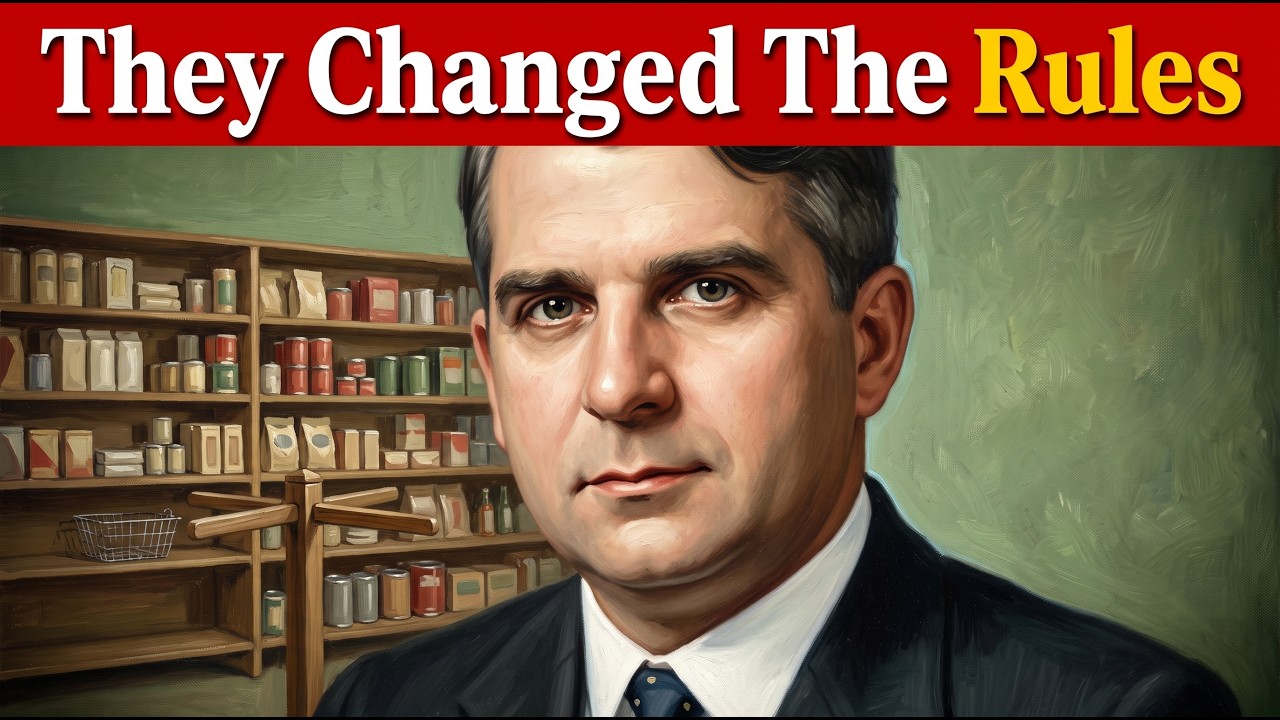
In September 1916, he opened the first store based on that idea at 79 Jefferson Street in Memphis and called it Piggly Wiggly. It was a single small room, just over a thousand square feet. The customer passed through a turnstile at the front and followed a twisting path through four aisles of open shelves, finding more than six hundred separate items, each marked with its price. There were hand baskets and a checkout station at the end.
No employee fetched anything. It was so strange that people came just to watch, and that was the beginning of the way the whole world would buy its food. He filed for a patent on the entire method that autumn, and the government granted it the next year, a patent for the idea of a store that let customers serve themselves. The patent office called the thing a self-serving store.
Instead of keeping the invention behind closed doors, he sold the right to use it to other grocers, one store after another, one town after another. It spread across the country as no business method had before. Grocers who had mocked the idea of a store without clerks soon paid for the right to copy it. By the early 1920s there were about 1,268 of his stores, hundreds owned outright by the company and the rest run by other grocers who paid for his method, together selling nearly a hundred million dollars of groceries a year.
In the winter of 1922, the company was listed on the New York Stock Exchange. The boy from rural Virginia had become richer than anything he had grown up imagining, and he began building the marble mansion to prove it. Then Wall Street came for him. In late 1922, a group of speculators decided the company was bloated and the stock overpriced, and they began selling short, borrowing shares and selling them on the bet the price would fall.
The stock traded near fifty dollars. Under selling pressure it slipped below forty, down near thirty-nine. To a man who had made every dollar he owned with his own hands and ideas, short selling looked like an attack on his life’s work. In his eyes, a group of northern financiers was reaching down to Memphis to bring down a company they had never built, profiting from its collapse.
He decided to fight them on their own ground, and the weapon he chose was the one that would destroy him. He set out to corner his own stock. The plan was simple and immense at once. If he bought nearly every share in existence, the short sellers who had sold shares they did not own would have nowhere to repurchase them except from him, at whatever price he chose.
To do that he needed liquidity no retailer had ever possessed, so he borrowed on a scale no retailer had ever dared. Through the broker Jesse Livermore, one of the most famous bears on Wall Street, whom he hired to buy on his behalf, and through banks in Memphis, Nashville, New Orleans, Chattanooga, and St. Louis, Saunders gathered nearly ten million dollars. Southern banks were lending a local hero the money to wage war on New York.
It was extraordinary for a retailer to try to buy an entire public company from the open market with money he had no right to lose. Every fortune he had built in seven years was now pledged to a bet on a single stock. He began buying quietly at first, share after share, lifting the stock off the bottom and gathering it into one man’s hands. He did more than buy in silence.
Working through Livermore and the southern banks, he kept buying as the price rose, so that every increase he caused cost him more to buy the next block. Still he pressed on, determined to take every outstanding share before Wall Street realized what was happening. Money flowed out in every direction. Every share he pulled from the market was a share the short sellers could not recover without coming to him, and every dollar he spent was borrowed against the stores, the equipment, and finally the marble house itself.
He was mortgaging everything he had built to win a battle over a number on a ticker tape. For a time, the number went exactly where he wanted. The trap was ready to close by the third week of March. Saunders had gathered about 198,000 of the 200,000 shares the company had ever issued, almost ninety-nine out of every hundred, with almost nothing left for anyone else to buy.
On the morning of March 20, 1923, he executed his plan. He announced that he wanted delivery of the shares he had bought, including roughly 42,000 shares the short sellers had sold without owning, and he wanted them at once. The short sellers were now obligated to produce shares that did not exist outside Saunders’ own safe, and to get them they had to buy them back from the only man who held them. The price did what cornered markets always do.
Every order the trapped sellers placed pushed the price higher, because the only shares available were the ones the man from Memphis chose to sell. The price climbed in a nearly straight line. Within a few hours of the market opening, a single share was worth more than three times what the sellers had paid to borrow it, and there was no ceiling except the one Saunders himself set. He had every reason to believe he had already won.
The exchange rule was clear. A man who sells a stock short must deliver it the next day, and if he cannot, the buyer may purchase it in the open market and send him the bill. With Saunders holding every share, that bill would be enormous, and the short sellers would have no choice but to pay whatever he demanded. He began telling people he would set a price far above anything the stock had ever traded at and make the sellers pay every cent of it.
On paper, he was about to extract a huge fortune from the New York bears, a wholesale grocer from Memphis collecting money from the men who ran the market. The stock opened that morning around seventy-five dollars. Within a few hours it touched one hundred twenty-four. The men who had sold short at forty were facing losses of eighty dollars or more per share, and the only way out led directly to a grocer from Memphis who could set his own price.
During those few hours on March 20, a man who had started in a country store had executed complete control over a national stock and caught the professionals of Wall Street in their own trap. The war was won. The men who had reached down to Memphis were at his mercy. Then, before the closing bell, the ground shifted beneath him, from a direction he never thought he needed to defend.
The New York Stock Exchange, the very institution whose listing had made his shares worth cornering, intervened. Late in the day it suspended trading in the stock. The quoted price, which had reached 124, fell back toward 82 while officials conferred, and word spread that the Exchange’s governors were meeting behind closed doors to decide what to do about the man who had cornered one of their listed stocks. It was their market, their listing, their rules, and the rules were about to change.
Saunders had prepared for every move the speculators could make. He never imagined the governors would change the rules of the game while he was winning it. What they decided ended the corner in a single stroke. On March 22, two days after the squeeze, the New York Stock Exchange struck the stock from its list entirely and changed the one rule the whole corner depended on.
Instead of forcing the short sellers to deliver the next day, the Exchange gave them until the following week to find the shares and deliver them. That week was the key to the entire game. They were given time, and time was the one thing that could save them. The Exchange’s justification was that the corner harmed the public and the market, that with every share in one man’s hands there was no true price and no fair way for a short seller to cover.
Saunders saw it differently. The Exchange had been happy to list his company and collect its fees, and the bears had been free to attack his stock for months. The rule had become unbearable only now that a man from Memphis had turned their game against them and stood ready to take their money. He believed the governors had put on the other team’s jersey at the final whistle, and he said so to anyone who would listen for the rest of his life.
With the extra time, the trapped short sellers no longer had to come to Saunders at all. He owned about ninety-nine percent of the stock, but not every share. The shares he did not own sat in small holdings scattered across the country. Given a week instead of a day, the short sellers spread out and bought those scattered shares wherever they could find them.
Every share they found elsewhere was a share they did not have to buy from the man in Memphis. The squeeze collapsed. The price the shorts had to pay, which Saunders had meant to drive far higher, sank back to ordinary levels. On March 23, he was forced to accept a settlement.
The short sellers who could not deliver paid him one hundred dollars a share and walked away, a fraction of what he had intended to collect. The settlement ended the corner without giving Saunders anything close to the mountain of money he had borrowed to build it. The numbers against him gave no mercy. He had borrowed nearly ten million dollars to build the corner.
The hundred dollars a share from the settlement, and the stores he began hurriedly selling, were nowhere near enough. He had won in the trading room, but it bought him nothing he could use, because he still could not convert his cornered shares into money faster than his debts were coming due. The moment the Exchange granted the shorts their week, the ten million became a debt with no fortune behind it. By summer, the debts were due and there was no way to pay them.
The largest single obligation was a payment of two and a half million dollars due on September 1, 1923. Saunders sold stores in Chicago, Denver, and Kansas City, tearing apart the empire he had spent seven years building. Still he could not pay. Every asset he owned was already pledged against the ten million he had borrowed.
The stores, warehouses, equipment, cars, and the half-finished marble house on the hill in Memphis were collateral for a debt he could no longer cover. The arithmetic deserves to be stated plainly. At the height of the events on March 20, the 198,000 shares Saunders controlled, at the price of 124 they had reached, were worth more than twenty-four million dollars on paper. It was an enormous fortune, but he held it for a single morning.
Once the Exchange struck the stock from its lists, those shares had no market and no buyer at any real price. When they were finally sold, they went at public auction for about one dollar a share. The block of stock that had been worth over twenty-four million dollars in March was worth, by the simplest measure, less than two hundred thousand dollars. That was the gap the rule change opened beneath him.
Against ten million borrowed stood a 2. 5 million dollar payment he could not make. The house made the loss tangible in a way no ledger could. It had been meant as the family seat for generations, pink Georgia marble, over thirty thousand square feet, with grounds planned for a private lake, a golf course, a shooting range, and an indoor bowling alley.
He had called it Cla-Le-Clare, joining his children’s names, so the house itself would announce for whom it was built. When he handed it to the creditors, the marble was on the building, but the family never moved in. In August 1923, Saunders surrendered. He turned over his assets to his creditors: his stock, his cars, the remains of his property, and the big pink house on the heights of East Memphis that he had never lived in.
He signed away the company that carried his idea and the house that carried his name, keeping almost nothing. The final numbers came quickly. The cornered shares were auctioned publicly at one dollar a share. When the debts were counted, Saunders was said to owe about five million dollars more than his surrendered assets could cover.
In the year after the surrender, the courts finished what the Exchange had started, and the man who invented the grocery store was declared bankrupt. But a man who had worked his way from behind a Virginia grocery counter was not willing to sit still in bankruptcy. Barred from using the name he had made famous, Saunders opened a new chain of stores in 1928 under the defiant title Clarence Saunders, Sole Owner of My Name, betting that the public would follow the man rather than the old brand. For a moment his fortune grew, and it looked as if he might come all the way back on the strength of his name alone.
Then came the Great Depression at the end of the decade, and by about 1930 the Sole Owner stores failed as well, and his second fortune went the way of the first. Years later he tried again with an automated store called Keedoozle, where the customer used keys and coins, the machine gathered the groceries and sent them along a conveyor belt. It never worked the way he imagined. As late as 1949, the man who had been bankrupt twice was predicting the opening of a thousand automated stores across the country, selling five billion dollars of groceries a year.
He was still chasing the idea of reinventing the store, confident almost to the end of his life that the idea would make him rich again. The strange grace at the heart of the wreckage is this: the only thing Saunders built that was meant to last, the marble mansion he never lived in, is the only thing that survived the ruin. When his creditors were finished with him, the big pink house on the heights of East Memphis passed into the possession of the city of Memphis. The city did not tear it down and did not sell it to another family.
In March 1930 the city opened the mansion to the public as a museum, free of the man whose fortune had built it, open to the people who had shopped in his stores. Memphis called it the Pink Palace, and still calls it that today. The irony is deep. He built the house to be a private family seat, walled off with its own lake, golf course, and shooting range, a place to tell Memphis that the grocer had arrived.
The city did the opposite. It opened the gates and filled the rooms intended for three children with schoolchildren from across the county, turning the fortress into a public place. It still stands there, nearly a century later, the house a grocer built for children who never lived in it, now owned by the whole city, a museum of science and history where schoolchildren pass through rooms meant as bedrooms. In one of those rooms, the city keeps the thing that ties the entire story into a single knot: a full-scale replica of the first store from 1916, the turnstile, the four aisles, the open shelves with a price on every item, rebuilt inside the marble house that the store paid for and the gamble lost.
A visitor expecting the mansion of a rich man finds in its middle a small grocery store. The beginning and the end of the story stand in the same building. Saunders died in Memphis in October 1953 at the age of seventy-two of heart failure. He had spent the thirty years after the collapse chasing the store that would restore his glory.
The fortune never returned. The empire was gone and the mansion was gone. What he left behind was an idea, an idea that slipped out of his hands and went on to reshape the world without paying him a cent. Every supermarket on earth, every aisle where a shopper pushes a cart, every price tag on an open shelf at every checkout, all of it rests on the design a ruined man in Memphis recorded in 1916 and then lost at the gambling table.
The self-service store became the ordinary way the world buys its food, in every country, under thousands of names, and the man who patented it died owning none of it. What survived was the company, bought, sold, and run by other men, carrying the old name into a future that had no place for the man who thought of it. From the whole towering structure he had built, the stores, the franchise, the fortune, the house, the founder kept nothing. The lesson that lies beneath the pink marble is not a lesson about a clever grocer.
His idea was sound, and on that morning the market did exactly what he wanted it to do. What destroyed him was the shape of the thing itself. He built his entire financial position on borrowed money, ten million dollars of it, and staked the outcome on a rule he did not own and could not defend. The leverage carried him to the edge of an enormous fortune, and a committee with no seat for him decided he would not cross it.
A man may be right about everything he can see and still be destroyed by the one thing he cannot. The only winner who outlasted everyone was the city. Memphis took the unfinished mansion the family could not keep, gave it to the public, and still holds it. The palace survived because it left his hands.
Because it was taken from him in the worst hour of his life, it became a museum, and his first store lives on inside it. And so the house stands in Memphis, pink against the sky, open to anyone who wishes to walk through it, with the first store inside, rebuilt board by board, its turnstile and four aisles and marked shelves that changed the way the whole world shops for food. The children for whom the house was named grew up somewhere else, his fortune scattered among banks and short sellers and the auctioneer who hammered down the great block of shares at one dollar apiece.
The man who invented the grocery store, who for a few hours in March 1923 held all of Wall Street in his grip, walked away from the marble mansion he had built and never went back.