At noon on the tenth of September 1898, a woman traveling under an assumed name walked along the pier of the Mont Blanc landing stage in Geneva, heading toward a steamship, accompanied by a countess. A man stepped out from in front of her and struck her once in the chest. She got up. She walked up the gangway to the ship.
And on board, she fainted. When she regained consciousness, the question she asked was about herself. “But what has happened to me? ”
She had been the most measured woman in Europe.
Most people know Elisabeth, Empress of Austria, as a set of numbers. A waist measuring fifty centimeters, a weight that she supposedly never allowed to exceed fifty kilograms. These numbers circulate through a relative of hers who wrote to a publisher, and through the articles that have cited them ever since. None of it is documented in a weight record ever shown to readers.
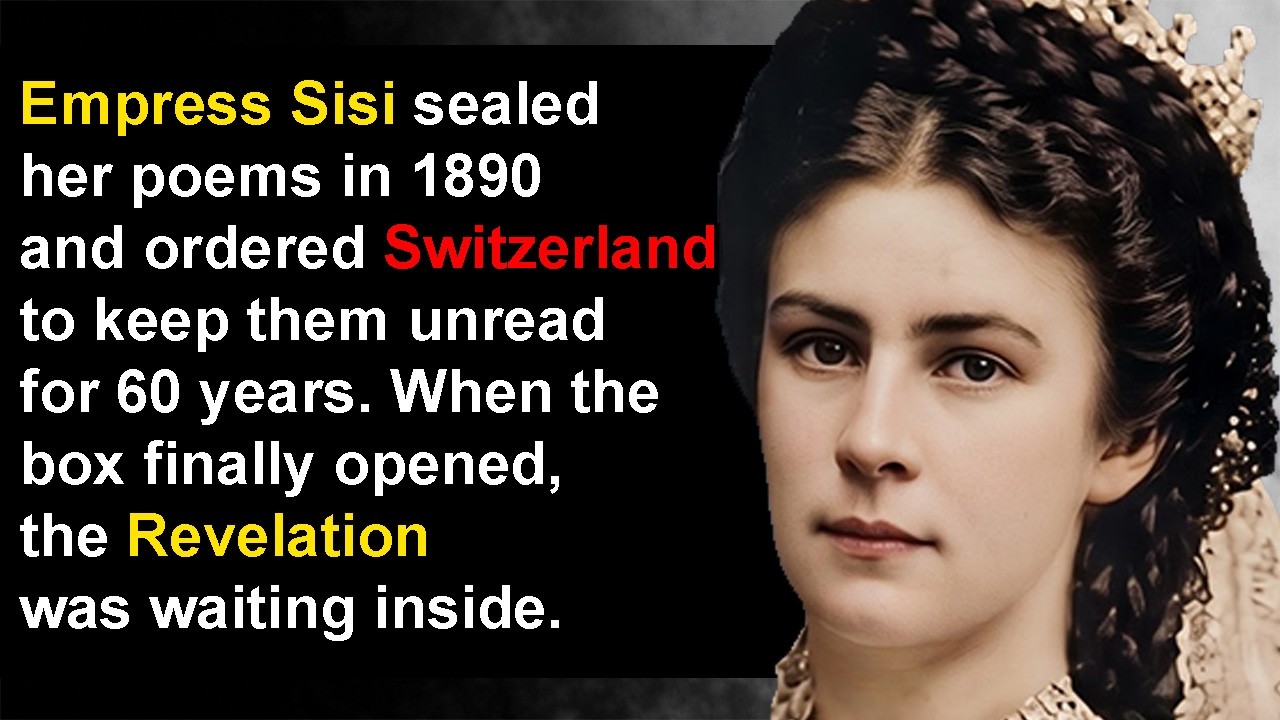
Eight years before Geneva, she had sealed an iron chest, directed it to the head of a foreign state, and specified a period of time that would outlast everyone who had known her. She was the one who chose what went into that chest. No one else had ever chosen what went into the story of her body. The obsession does not begin with her.
It begins as an ornament on the culture of thinness that her century took seriously, and that people who came long after her death continued to embellish. Some of them worked in cinema. The Hofburg Palace Museum names Ernst Marischka’s films of the 1950s as the makers of this fairy tale. In that version, trouble only arrives at the end.
A second layer was added later when an English-language documentary promoted her as a modern princess born a century before her time. No one had called her that while anyone who had actually met her was still alive. She was born in Munich at the end of 1837, the daughter of a Bavarian duke. The family had prepared a candidate for the young Emperor of Austria, and it was not her.
It was her older sister Helene. At Bad Ischl in the summer of 1853, Franz Joseph chose the other one. Elisabeth was fifteen. They married in Vienna the following spring.
She was sixteen. Her husband was twenty-three. And the court surrounding him had a timetable. The timetable wanted children.
Sophie, then Gisela, then Rudolf. Three births within four years, and the first of them did not live to see the last. During a journey through Hungary, Sophie died. She was two years old.
Gisela, who traveled with her, fell ill in the same rooms but recovered. Elisabeth was nineteen. At the end of 1860, her doctors placed her on a ship bound for Madeira. The reasons they gave were coughing, sleeplessness, and loss of appetite.
The word illness was not among the reasons they gave. Her diet, however, is documented in the papers of that year, and it appears as one of three things. A doctor found it important to note it down before sending an empress out of the country. Everything anyone else knows about her diet came later, and arrived through one relative.
She was Marie Louise von Wallersee, her niece, who worked as a writer for a publisher. From her came the idea of the warm olive oil baths. The mask lined with raw veal cutlets. The wet towels wrapped around the body to preserve the waist measurement.
A writer returned to review all of this in 2023 and arranged the whole system. In those accounts, the diet included pressed meat juice, a little milk, egg whites whipped with salt, oranges when she wanted them, and violet ice cream. Her hair was washed once a month with raw eggs and brandy for three hours, with a language tutor in the room to keep her occupied, and the number of fallen strands was counted afterward. One day, the niece says, the olive oil arrived hot enough to boil, and her aunt survived a terrible death resembling what many Christian martyrs had undergone.
That is a sentence written to be read aloud in front of strangers. The daily weight falls in the same pattern. The scale three times a day, to make sure the number fifty was never exceeded. Brigitte Hamann traced those numbers in 1982 and doubted part of what she traced.
She estimated the waist measurement at between 62 and 65 centimeters, while saying at the same time that this number cannot be compared with modern measurements at all. The 2023 writer took the same material and read it as a record of an eating disorder. Neither is careless. Both work from the niece’s account and the magazines, and the two ends of the chain meet on the same page of Hamann’s book.
Her husband wrote to her about her body himself. The letters span thirty years. She kept returning to the subject of her health again and again, and in one of them he tells her she has become far too thin. Whatever that marriage had become, he was watching.
In 1862, from Venice, she wrote to her brother-in-law, Ludwig Viktor, with a special request. She told him she was making an album of beauties, and that she wanted photographs of women to include in it. Further requests were sent through the foreign minister and two Austrian ambassadors. What she collected reached eighteen albums containing about two thousand photographs, each measuring roughly six by nine centimeters.
Three of those albums were devoted to beauties alone. They remained in private hands until 1978 and reached Cologne by 1994. An empress collected two thousand faces of other women. Then she stopped allowing anyone to photograph her own face.
There is no late photographic campaign of her face, for the simple reason that she stopped sitting for the camera. So the face that represents her is a painting, and that painting has a history. Franz Xaver Winterhalter had been working in Vienna since 1864. The painting everyone knows, where the diamond stars are fixed in her hair, is dated the following year.
She was twenty-seven. That image is thirty-three years older than the woman who stepped onto the steamship in Geneva. In Buda in June 1867, she was enthroned as Queen of Hungary. The Holy Crown was fixed above her right shoulder.
The crown was not placed on her head. She had replied in Hungarian two days before that. Two men told the world what that meant, and they were not writing for the same audience. Egon Caesar Conte Corti published in 1934, after he had been given access to the family’s private papers, and with surviving family members watching his work, for an audience whose empire had dissolved sixteen years earlier.
He presented them a faithful marriage and a queen who decided Hungary’s fate. Hamann published forty-eight years later, watched by no one, and presented a separate married life. A Hungarian loyalty that was genuine, and a woman who was not the cause of the Compromise at all. Her personal viewpoint is hard to reach.
Marie Valerie, the youngest daughter, kept a diary for twenty years, and a daughter’s diary remains a daughter’s diary. The letters she wrote to Ida Ferenczy, the reader who had come to her in 1864, sit in a private collection whose owner does not open its doors. What anyone reads instead are the German copies prepared for Corti in the 1930s. Thirty-seven of those letters are written in Hungarian in her own hand behind that door.
More than fifty letters exist as German copies because Corti had them printed for himself. Beatrix Mair returned to the complete correspondence and published it in 2020, reporting that the original Hungarian copies remain closed. Her own voice still lives in someone else’s handwriting, and the woman who made the greatest effort in this work said so in print. Gödöllő was gifted to her after the coronation.
She married off Gisela at sixteen, the same age her own mother had been. And on the thirtieth of January 1889, Rudolf was found dead at Mayerling with Mary Vetsera. In the year after the burial of her son, she wrote the instructions concerning the chest. Even if we set the niece aside entirely, an objection remains.
The three men who examined her in Geneva wrote that her subcutaneous tissues were underdeveloped on a body measuring 172 centimeters. She had been writing poetry for years by that time, and the poetry was full of isolation and farewell. The doctors who write for the public, and some historians with them, read that body and those poems together and conclude anorexia. And no court of the nineteenth century would have produced the medical record that this demands.
Expecting it is a way of winning the argument automatically. That objection concerns her body and may well be right. The claim here is narrower and concerns two numbers. They have a chain of custody rather than a source, and the chain ends at a page no one can vouch for.
Before Geneva, there was Corfu. A palace was built for her there between 1889 and 1891. The furnishings bore the dolphin mark. She told Constantine Christomanos, the Greek reader who recorded what she said during the 1890s, that she wanted to be buried on the island.
Christomanos printed his book in 1899, months after she was killed, and a book like his sells better with a grieving empress inside it. His melancholy is worth what a man selling a book is worth, except that she had written the same verses of farewell ten years earlier, with no publisher waiting for any of them. He had a market. The poems had no market.
The man who attacked her from the front was Luigi Lucheni. What he used appeared that same afternoon at entrance number three, Rue des Alpes. It was a triangular file with a wooden handle ten centimeters long. Popular accounts prefer to call it a dagger.
Her death was announced at two-ten. Her body returned to the hotel five minutes later. At two o’clock the following afternoon, three men worked on her corpse for fifty minutes on the orders of the examining magistrate. Hippolyte Gosse, Auguste Reverdin, and Louie Mégevand.
They opened the chest and nothing else. They traced the path of the blade at 85 millimeters through the third intercostal space, the fourth rib, the left lung, the pericardium, and the left ventricle. They recorded her height, her dark brown hair, her grey-blue eyes, her sound teeth. They recorded no weight.
An English page about Lucheni claims the official papers from that afternoon were destroyed. They were not. Roland Cesty printed the two Vienna copies in 2024 and established from them exactly how she died. That sentence is wrong.
And it is wrong in the way that keeps a measurement alive. By removing the one thing that contradicts it. The Hofburg Palace has maintained a museum for her since 2004, and the list of rooms exceeds three hundred objects. Her parasols and fans and gloves.
A glass of milk in her travel case. A traveling pharmacy. Her beauty recipes. Her death certificate.
The coronation dress there is a replica. The diamond stars are only a reconstruction. Her beauty recipes are in that building. No one has been able to inspect those rooms for a weight book, because the inventory has never been published.
Which leaves us with the chest. The chest was with her brother Karl Theodor in “Ko. ” Eduard von Steiger, President of the Swiss Confederation, signed for its receipt in Bern on the third of July 1951. Fifty-three years after the death of the woman who had directed it to him from the harbor pier in Geneva.
And inside, in her own hand, were the poems. Not a weight book, not a record of days, but cycles of poetry with titles like “Nordsee-Lieder” and “Winterlieder,” and a mixed volume for 1888. They imitate Heine. They are harsh toward the court and harsh toward the monarchy she sat atop.
She did not leave them to her husband’s family. The instructions she wrote in 1890 placed sixty years between the writing and any reader, and the Swiss kept the deadline exactly. They were revealed at the end of 1980. An edition followed in 1984, then Hamann’s own version in 1997.
Under a title describing the whole work as a poetic diary. The money the book earned went, exactly as she had directed, to the United Nations refugee agency. The poems are not good, and Hamann said so herself. What they actually are is a long stretch of writing about Elisabeth of Austria by the only person who had been in the room the whole time.
That exceeds any numbers that could ever be shown. She had asked to be buried by the sea at Corfu if it were possible. She was placed in the Imperial Crypt in Vienna, in plot number 143, under a Latin inscription that mentions Munich, Vienna, Buda, and Geneva. The officials who refused her request pointed out that Geneva has a lake.
Hungary asked for her, and the answer was refusal. Her instructions concerning her burial were rejected. Her instructions concerning her writings were carried out with exactness. The woman her niece describes is not the same woman those three men wrote about.
Was Elisabeth of Austria suffering from an illness her century had no name for? Did her family treat those symptoms as mere vanity? Or did she push the usual beauty regime of her court to its extreme? And was she diagnosed a century later?
Based on the words of a relative who wrote for a publisher.






