The message that reached Patton’s headquarters on the morning of March 2, 1945, had been typed the previous day, while the planners in Paris were still doing their math. It ordered him to bypass the city of Trier, because capturing it without reinforcements was considered impossible. Patton took the paper, read it, and began to chuckle. Then he erupted into a loud, booming laugh that carried through the building.
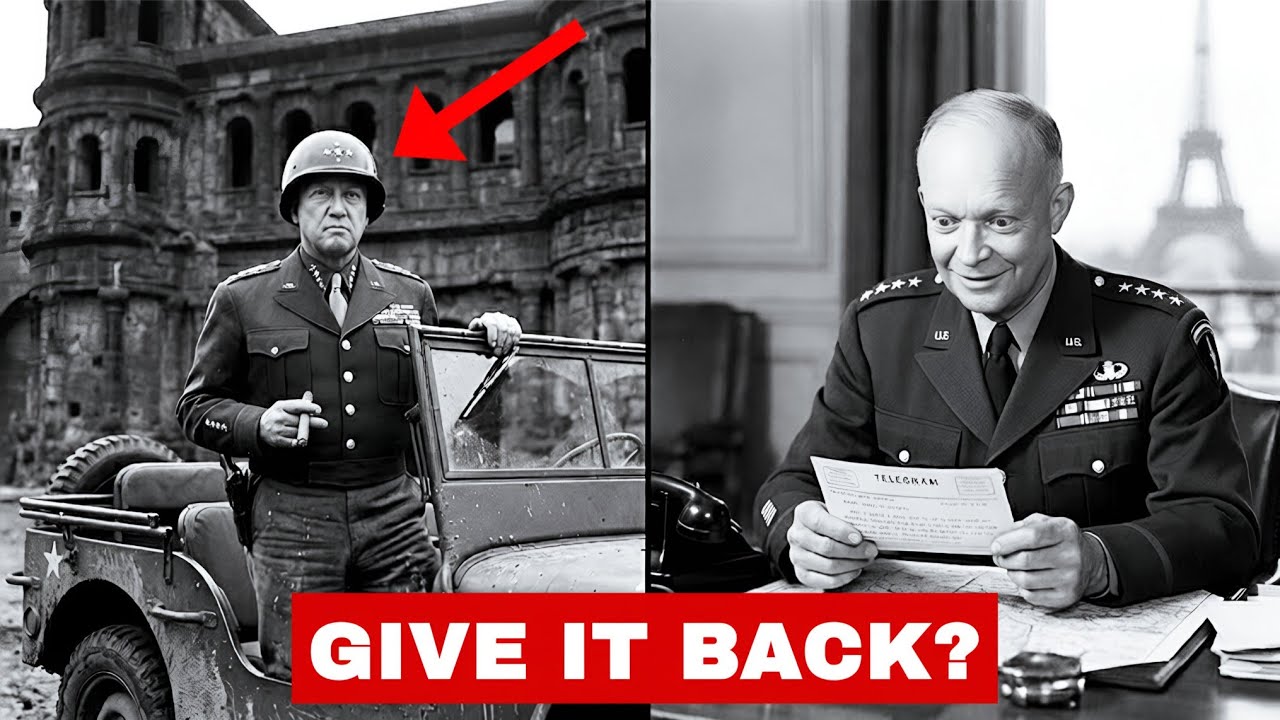
The irony was perfect: the bureaucracy was so slow, and his army so fast, that the orders were obsolete before they were even delivered. He turned to his staff and remarked that the planners thought he needed four divisions for the job. Then he sat at his desk, picked up a pencil, and wrote the reply that would stun the Allied High Command. “Have taken Trier with two divisions.
Do you want me to give it back? ” He handed the paper to the radio operator with instructions to send it directly to General Eisenhower at Versailles. The road to that moment ran through a winter that had turned Europe into a freezing soup of mud and slush. In early 1945, the Allied advance had slammed into the Westwall, the jagged scar of concrete and steel the Germans called the Siegfried Line.
It was not a mere trench system but a multi-layered zone of death stretching nearly 400 miles to guard the fatherland. Hitler’s engineers from Organization Todt had poured a third of the Reich’s total concrete production into the barrier, creating a warren of 20,000 bunkers and pillboxes designed to become the tomb of the Western Allies. Between the Saar and Moselle rivers lay a supplementary line known as the Orscholz Switch, a belt of fortifications two miles deep that blocked the gateway to the Rhine. To the bureaucrats at Supreme Headquarters Allied Expeditionary Force in Paris, the Orscholz Switch was a mathematical impossibility that would swallow any army attempting a direct assault.
Eisenhower and his planners counselled a broad front approach with methodical logistics. Patton saw it differently. He recognized that a defensive line is only as strong as the morale of the men inside the bunkers. He sensed that the German Wehrmacht was beginning to fracture internally, and that speed was the only currency that truly mattered in modern warfare.
He turned to his most aggressive corps commander, General Walton Walker, whom he affectionately called his bulldog, and gave the order to punch a hole through the Switch. Walker was a man of visceral intensity who never asked if a mission was possible, only when it would begin. The soldiers of the 10th Armored Division, known as the Tiger Division, and the 94th Infantry Division, called the Pilgrim Division, faced the three F’s of combat: fatigue, frustration, and fear. Fatigue came from constant harassment fire that rained down every thirty minutes, disrupting rest and threatening supply trucks.
Frustration was born of the environment itself, as tanks sank to their axles in mud and trucks stalled on icy slopes. Fear was a constant shadow, deepened by the sight of comrades losing limbs to bouncing betty mines or being vaporized by high-velocity 88-mm shells fired with terrifying accuracy from the heights. Despite the conditions, Patton insisted on what he called armed reconnaissance, a philosophy of aggressive defense that kept the enemy constantly off balance. On February 19, 1945, the Third Army launched its sledgehammer against the Orscholz Switch.
American tanks roared forward to smash into the dragon’s teeth while combat engineers ran through sheets of machine gun fire to blast gaps in the concrete obstacles. The 94th Infantry Division, a unit Patton had previously scolded for its high rate of non-combat casualties, was now proving its mettle in the most grueling pillbox-to-pillbox fighting of the war. Men crawled through minefields using bayonets to probe the freezing mud, knowing a single mistake would trigger a lethal explosion. At SHAEF headquarters in Paris, anxiety was palpable as staff officers watched the Third Army move only inches at a time while casualties mounted on the maps.
Eisenhower’s staff feared Patton was getting bogged down in a trap that would drain the fuel and ammunition needed for Field Marshal Bernard Montgomery’s upcoming crossing of the Rhine in the north. The rivalry between Patton and Montgomery was a constant source of friction. Patton believed Eisenhower consistently prioritized British needs over American audacity. The planners began drafting orders to halt Patton’s operation, viewing his drive toward the ancient city of Trier as a reckless gamble that defied military doctrine.
Trier sat at the apex of the Saar-Moselle triangle, a vital road junction and a symbol of German history, founded by the Romans two thousand years earlier. Allied intelligence described it as a natural fortress surrounded by steep hills and protected by the swift current of the Moselle River. The Germans had issued desperate orders to hold the city to the last man, flooding the approaches and rigging its bridges with tons of high explosives. Intelligence experts estimated that capturing such a fortified urban center would require at least four full divisions and result in catastrophic casualties.
Patton was a combat artist who understood that timing was more important than numbers. He knew that if he waited for the perfect conditions the planners demanded, the Germans would only have more time to reinforce their positions and turn Trier into a charnel house. He drove to the front lines personally, standing in the mud to scream at his tank commanders to keep moving at all costs. He sensed hesitation from his superiors and knew an order to stop was likely on its way from Paris.
Rather than waiting for the hammer of bureaucracy to fall on his momentum, he decided to present Eisenhower with a done deal. The 10th Armored Division, known for its motto “Terrify and Destroy,” was chosen to lead the final dash toward the city. Its tanks were mostly M4A3E8 Shermans, the famous Easy Eights, equipped with 76-mm guns that provided the mobile firepower necessary to overrun German positions before they could consolidate. Fighting alongside them were the infantrymen of the 376th Regiment, who had already cleared hundreds of pillboxes in the preceding days.
The German defenders were a mix of exhausted Volksgrenadier units and fanatical Hitler Youth armed with Panzerfausts, but they were being overwhelmed by the sheer velocity of the American advance. As the tanks of the 10th Armored reached the hills overlooking Trier on the night of March 1, they saw the ancient city lying in total darkness below. The primary obstacle was the Moselle River. The success of the entire campaign now hinged on a single structure that had stood for two millennia.
The breakthrough at the Orscholz Switch had revealed the insanity of the environment Hitler had created to protect the Reich. Every concrete block of the dragon’s teeth was anchored to a reinforced mat sunk meters into the ground to prevent engineers from easily blasting them away. The pillboxes were often camouflaged as ordinary houses with walls fourteen feet thick that could withstand everything but a point-blank hit from the largest artillery. That Patton’s two divisions were breaching all of this in just a few days remains an enduring mystery to military historians who analyze the math of the campaign.
As the message to halt was being typed in Paris, the Tiger tanks were already warming their engines for a surprise night attack. The German High Command, believing the terrain of the Eifel Mountains was too difficult for armor to traverse quickly, was caught completely off balance. They had prioritized the defense of the Rhine, leaving Trier to be held by a collection of remnants from twenty-six different divisions. Patton’s insistence on keeping moving was not just a mantra but a recognition that a retreating enemy is most vulnerable when denied the time to dig in.
Organization Todt had utilized hundreds of thousands of forced laborers to ensure every road was covered by interlocking fields of fire, yet the American doughs of the 94th Infantry paid for every foot of ground gained in blood and exhaustion. They had to link bridgeheads under fire and scale cliffs peppered with snipers to secure the heights overlooking the city. Their partnership with the armor of the 10th Division was the foundation upon which Patton’s tactical theories were turned into reality. Patton’s historical perspective gave him a sense of destiny.
He viewed himself as a reincarnated warrior continuing the conquests of the Roman legions he so admired. He intended to reach the Rhine and cross it before Montgomery could even launch his meticulously planned operation in the north. Taking Trier was his Alesia, his Austerlitz, and he was not about to let a slow-moving bureaucracy stop him from claiming his prize. On the night of March 1, the 10th Armored Division perched on the hills overlooking the city.
Below them lay the birthplace of Roman emperors in a heavy, ominous silence, illuminated only by the occasional flare of a German sentry. The mission was as simple as it was terrifying: seize the city under cover of darkness and capture a bridge across the Moselle before the Germans could vaporize it with tons of prepared explosives. Lieutenant Colonel Jack J. Richardson, a man who mirrored Patton’s combat intensity, led the charge with a mandate that prioritized audacity over survival.
If the German defenders succeeded in blowing the bridges, the American tanks would be stranded on the wrong side and the infantry would be slaughtered trying to cross in rubber boats under the fire of hidden machine gun nests. There were three main bridges spanning the river, but by the time Richardson’s column approached, two had already been reduced to rubble by the retreating Wehrmacht. That left only one chance for victory: the Römerbrücke, or Roman Bridge, a marvel of ancient engineering built by the Roman Empire in 16 BC. It had survived two thousand years of history, including the marches of Napoleon’s Grand Army, but it was now packed with Nazi dynamite.
Richardson ordered his men to issue artillery preparation to maintain the maximum element of surprise. At 0200 hours, the American engines roared to life, a mechanical growl that echoed off the steep valley walls. The tanks smashed through roadblocks on the outskirts and raced down the winding medieval streets, their steel treads sparking on the ancient cobblestones. German sentries fired magnesium flares, and suddenly the night was lit with a ghastly glow as machine gun fire erupted from the windows of half-ruined houses.
The Tiger tanks did not stop to engage. They kept moving with a relentless momentum that shattered the psychological cohesion of the German defense. As the lead tank turned a corner and spotted the Roman Bridge, Richardson saw German engineers frantically working to ignite the demolition fuses. He shouted the order to cut them down, and his crew opened fire with their .
30 caliber machine guns, killing the demolition team before they could push the plunger. A platoon of infantry jumped from the back of the tanks and sprinted onto the bridge, their boots echoing on the ancient stones. They expected the ground to open up beneath them at any second, vaporizing them in a blast of TNT. But the explosion never came.
Whether the German commander hesitated or a stray bullet had severed the wire, the bridge remained intact. The Americans reached the far side, cut the demolition wires with their bayonets, and fired a green flare, the signal that the gateway was secure. Within minutes, the heavy Shermans were rumbling across the Roman stones, their weight supported by arches that had stood since the time of Augustus. The roar of the engines signaled the total collapse of the German Seventh Army’s resistance in the sector.
Once the tanks were inside the city proper, the Germans surrendered in droves, realizing their natural fortress had been breached with a speed they could not counter. By dawn on March 2, the American flag was raised over the Porta Nigra, the massive Roman gate that now overlooked a city conquered by the fastest army in history. Later that morning, Patton stood in his headquarters smoking a cigar and listening to the victory reports when the aide walked in with the order from Paris. After the reply went out, the message reached Eisenhower at Versailles and caused a massive stir among the staff.
Eisenhower, a man who carried the weight of the entire Allied cause on his shoulders, reportedly could not help but smile when he read Patton’s arrogant but undeniably brilliant words. He knew he could not punish a general for winning a major victory under budget and ahead of schedule. He folded the telegram, put it in his pocket, and issued a new directive: “Congratulations. Keep moving.
”
The capture of Trier accelerated the end of the war by weeks, opening the gateway to the Rhine and allowing Patton to launch his dash into the heart of Germany. In the period following the city’s fall, the Third Army wrested over 6,000 square miles of territory from the enemy and captured over 140,000 soldiers, effectively eliminating the German Seventh and First Armies as cohesive fighting forces. The human cost of the campaign remained stark behind the headlines. The 10th Armored Division suffered over 4,000 battle casualties during its time in Europe, with 642 men killed in action.
The 94th Infantry Division saw even heavier losses, with 1,087 men killed and nearly 5,000 wounded. They had fought through a landscape of concrete and steel, often clearing hundreds of pillboxes in a single day of close-quarters combat. The disparity between the SHAEF casualty estimate of 2,000 dead for the seizure of Trier and the actual final count of 55 remains one of the most striking testaments to the power of tactical instinct. Logistical friction also played a massive role in Patton’s decision-making.
By March 1945, Allied supply lines stretched hundreds of miles back to the ports in France, and every gallon of fuel was a precious resource. Patton knew that if his advance stalled, his fuel allocations would be redirected to Montgomery or Devers. To ensure the Third Army remained the priority, he had to maintain a constant state of offensive action, demonstrating that he could achieve greater results with fewer resources. The capture of Trier with just two divisions was a logistical triumph as much as a tactical one, proving that a lean and aggressive force could overcome a numerically superior but demoralized defender.
The capture of Trier yielded vast quantities of enemy supplies and equipment, but more importantly, it yielded 8,000 prisoners from twenty-six different enemy divisions. Many of them were older Volksgrenadiers or young recruits, exhausted and disillusioned, surrendering in droves once they realized their retreat had been cut off. The loss of Trier was a sign to every German soldier in the sector that the end was near. For the soldiers of the Third Army, the story of the telegram became a source of intense pride, making them feel part of an unstoppable historic epic that defied the rulebook.
The preservation of the Roman Bridge, saved by the quick thinking of Jack Richardson and the bravery of his tankers, stood as a symbol of the thin line between victory and catastrophe. Had the bridge blown, Patton’s gamble would have failed, and history might have remembered him as a reckless commander who led his men to slaughter. Instead, the capture of Germany’s oldest city proved that the Patton method worked better than the cautious approach favored by the Allied High Command. The Roman Bridge itself, which has stood for two thousand years, remains a physical monument to the victory.
It survived the legions of Rome, the knights of the Middle Ages, the armies of Napoleon, and the dynamite of the Third Reich, finally allowing American Shermans to pass into history. The fact that it still stands today is a testament to the speed and precision of Task Force Richardson and the outlaw army of General Patton. As the war entered its final months, the story of Trier became a legendary chapter in Patton’s biography, proof that strategic assumptions were no match for the instinct of a warrior.
The defiant seizure of the oldest city in Germany remains a masterpiece of mobile warfare, and the “Give it back” telegram one of the greatest lines in military history.






