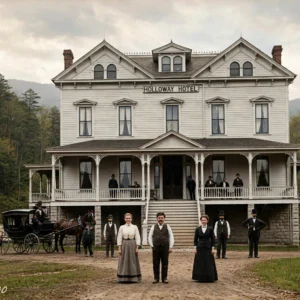
Thin November sunlight fell across Barnabas Fletcher’s desk as he slid the rental papers forward, and the woman across from him produced crisp bills from her leather satchel with the casual ease of someone accustomed to financial security. She paid six months’ rent in advance for the old Kensington Place, a two-story farmhouse that had stood empty for nearly a decade, ever since its owners had simply vanished one winter night in 1917, leaving behind breakfast dishes on the table and savings untouched beneath a floorboard. Fletcher, a methodical man who prided himself on accurate records, asked for references or a previous address. She provided an address in Little Rock that, when later investigated, corresponded to a boarding house that had burned down in 1925.
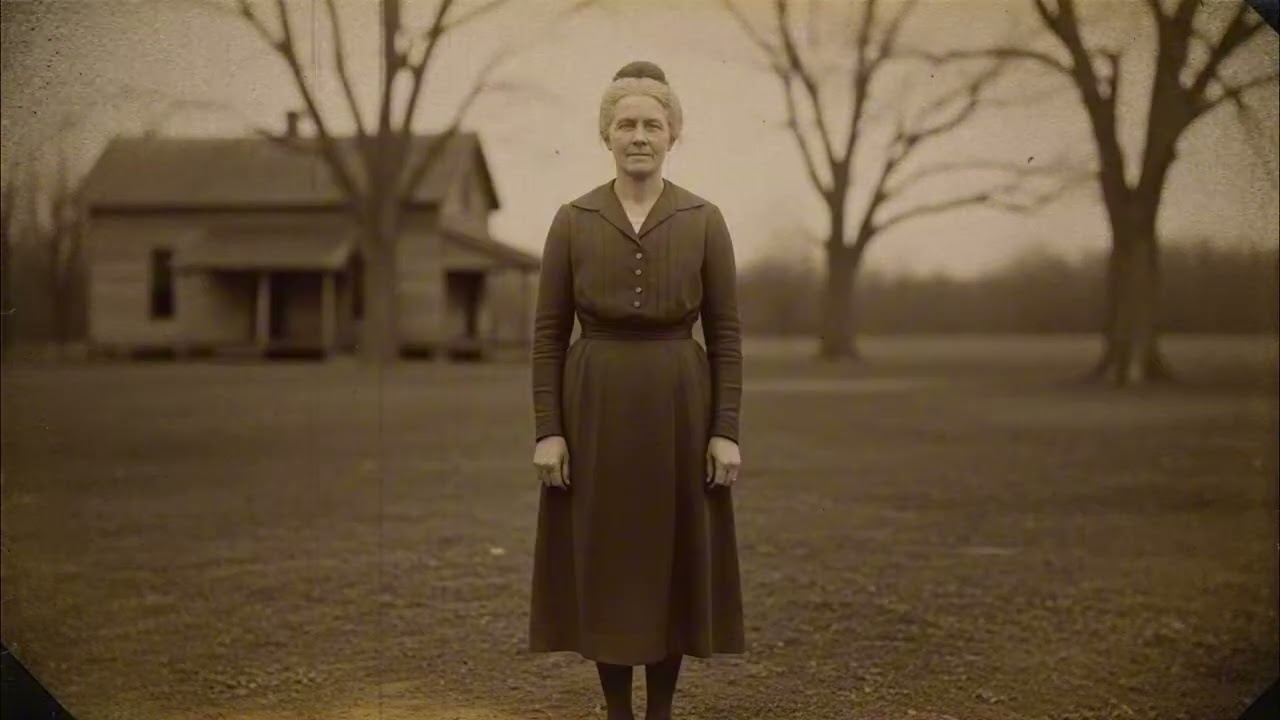
The woman who claimed to have been its proprietress had no memory of anyone matching her description. Something about her manner discouraged further inquiry. Not hostility or evasiveness, but a calm certainty that suggested she had anticipated every possible question and prepared answers that would satisfy without revealing anything of substance. She called herself Cordelia Whitmore, a widow who had arrived in Jasper, Arkansas, three months earlier with nothing but that single satchel and a story that satisfied no one.
The Ozark Mountains of 1927 were a place where people minded their own business. The Great War had taken sons from nearly every hollow and ridge, leaving behind a generation of widows and broken men who understood the weight of unspoken grief. In such a place, one more widow should have blended into the fabric of quiet suffering that defined the region. But Cordelia Whitmore was not like the other widows of Newton County.
She appeared to be somewhere between forty and fifty years old, though her precise age seemed to shift depending on the light and the observer’s attention. Her hair, worn in a simple bun, was the color of pewter, neither blonde nor gray. Her clothes were well-made but unremarkable. Most unsettling were her eyes, pale blue to the point of appearing almost colorless in certain light, giving her gaze a quality that made extended conversation difficult.
During her first weeks in Jasper, she established a routine that was both visible and mysteriously incomplete. She appeared in town twice a week, always on Tuesdays and Fridays, arriving in a black Model T Ford that she drove with mechanical precision. Her purchases at Hartwell’s general store were methodical and practical: flour, salt, preserves, lamp oil, and other necessities for a solitary existence. She spoke when spoken to, answered direct questions with polite brevity, and volunteered no information about her past, her deceased husband, or her plans for the future.
Isadora Hartwell, whose family had operated the general store for three generations, made several attempts to draw the newcomer into conversation. “Folks around here like to know their neighbors,” she would say, arranging items on the counter with deliberate slowness. “Winter’s coming, and these hills can be mighty lonely for someone not used to the isolation. ” Cordelia would nod politely and reply that she was quite comfortable with solitude, thank you, and was there anything else she might need for her order.
Other customers noticed unusual patterns. Hosea McNeel, a dairy farmer south of town, observed that she always paid with exact change, suggesting remarkable calculation or careful planning. Prudence Ashworth noted that Cordelia never made impulse purchases or asked about items not already on her list, behavior that struck experienced retailers as almost unnaturally disciplined. The Reverend Matias Crowley, who had served the Jasper Methodist congregation for twelve years, made two pastoral visits during Cordelia’s first month in residence.
He found the house well-maintained but strangely impersonal, as if it were being occupied rather than lived in. Cordelia received him with perfect courtesy, offering coffee and apologizing for her inability to attend Sunday services due to an unspecified chronic condition that made travel difficult on certain days. When he asked about her spiritual needs, she assured him her relationship with the Almighty was quite satisfactory as it stood. What troubled Crowley, and what he would later document in a letter to the Methodist Conference headquarters in Little Rock, was not what Cordelia said but what she failed to say.
In a region where personal history was often painful, residents had developed subtle ways of acknowledging shared suffering without requiring explicit disclosure. Cordelia seemed unfamiliar with this social language, responding to gentle probes with blank courtesy that suggested not secretiveness but genuine incomprehension. When Crowley finally asked directly about her late husband, she paused for an unusually long time before responding that he had been a good man who had provided well for her future security. When pressed for details, she replied that such specifics were painful to discuss.
By November, her closest neighbor, Jeremiah Pike, who farmed the adjacent property, had begun noticing patterns that defied explanation. Lights in the farmhouse followed an irregular schedule bearing no relationship to sunrise and sunset. Sometimes the house would remain dark for days, only to blaze with illumination throughout an entire night. On other occasions, he observed a single light moving from window to window in a systematic pattern, as if someone were conducting a thorough inspection of the premises.
Pike had fought in the trenches of France and had developed a heightened awareness of his surroundings. His observations were detailed and methodical, recorded in a journal he maintained to manage the lingering effects of his wartime experiences. More peculiar were the sounds that carried across the hollow between the two farms. On windless nights, when sound traveled with unusual clarity through the mountain air, Pike reported hearing what sounded like furniture being moved or rearranged.
The sounds would continue for hours, always stopping abruptly at what Pike estimated to be exactly three in the morning. When he mentioned this to Cordelia during a chance encounter at the general store, she listened with polite attention and remarked that old houses often settled in mysterious ways. Pike’s wife, Dorcas, initially dismissed her husband’s concerns as manifestations of his struggle with sleep disturbances. But she began to share his uneasiness when their livestock started behaving oddly.
Their horses, normally calm animals, became restless on nights when the sounds were most pronounced. The family’s hunting dogs, bred for courage, refused to venture in the direction of the property after dark. Prudence Ashworth, the county’s unofficial social coordinator, made several attempts to incorporate Cordelia into the community’s social networks. She organized a harvest social at the Methodist church hall and personally delivered an invitation.
Cordelia accepted graciously but failed to attend. When Prudence inquired the following week, Cordelia explained that she had experienced one of her difficult days. The pattern repeated with invitations to quilting circles, church suppers, and seasonal gatherings. Cordelia would accept with apparent pleasure and never appear, always providing a vague excuse.
Prudence enlisted other community members to observe the widow and gather information. This informal network revealed disturbing inconsistencies. Cordelia’s claim to be recently widowed was contradicted by the fact that she showed no signs of recent grief, wore no mourning jewelry, and displayed none of the emotional fragility that typically accompanied fresh bereavement. Her purchases suggested someone setting up housekeeping for the first time rather than someone continuing an established domestic routine.
Winter arrived early that year, bringing heavy snows that isolated the mountain communities for weeks. In late December, during a brief break in the weather, Jeremiah Pike made the difficult journey to the Kensington Place to check on the widow’s welfare. He found her in good health and well supplied with provisions, though he noted that the house seemed colder inside than outside, despite evidence of recent fires. When he offered to help with wood splitting, she declined with thanks, explaining that she preferred to maintain her independence.
During his visit, Pike noticed details that contributed to his growing uneasiness. The house, while clean and orderly, showed signs of systematic reorganization that seemed unnecessary for a single occupant. Furniture had been moved from its logical positions, creating awkward arrangements that served no apparent purpose. Several rooms appeared completely unused, with dust covers on furniture and heavy curtains blocking all natural light.
As he prepared to leave, he asked casually about the sounds he had been hearing. Cordelia paused in the doorway, her pale eyes focusing on something beyond his shoulder. “What sort of sounds? ” she asked.
When Pike described the furniture moving noises, she nodded slowly and said she had been rearranging some items that had belonged to her late husband. She was still deciding what to keep and what to dispose of. The hesitation before her final words was slight but noticeable. The winter of 1927–1928 was particularly severe, and by February the Kensington Place had been cut off from town for nearly six weeks.
When the snow finally melted enough to allow travel, Isadora Hartwell persuaded her husband Caleb to check on the widow. They found the road passable and approached the house with trepidation. Cordelia answered their knock promptly, appearing healthy and alert despite her extended solitude. She invited them in for coffee and seemed genuinely pleased to have company.
Both visitors noticed that several rooms appeared completely empty, as if the furniture had been removed entirely. When Isadora commented on the sparse furnishings, Cordelia explained that she had found many of the previous owner’s belongings too melancholy for daily use and had stored them elsewhere. Caleb Hartwell noticed that all the windows had been covered with heavy fabric, creating an atmosphere of perpetual twilight even at midday. Cordelia explained that bright light often triggered episodes of her condition.
The conversation was strangely stilted. Cordelia asked questions about community news and winter conditions but offered no reciprocal information. She seemed particularly interested in learning about any travelers who might have passed through the area, any strangers seen in town, any unusual incidents during her absence from regular community contact. As winter gave way to spring, Cordelia’s behavior became increasingly erratic.
Her trips to town became unpredictable in both timing and frequency. Sometimes she would appear three times in a single week, making small purchases that seemed insufficient to justify the journey. Other times she would disappear for weeks, leading residents to wonder whether she had left entirely. During one town visit in late March, Prudence Ashworth noticed that Cordelia had lost significant weight, her clothes hanging loosely on an increasingly frail frame.
When Prudence expressed concern, Cordelia smiled and explained that she had been simplifying her diet as part of a personal discipline. Her complexion had become noticeably paler, giving her an almost translucent quality. Her movements had become more deliberate and calculated. Most disturbing was a change in her voice, which had developed a hollow quality that made her words seem to come from a great distance.
Reverend Crowley made another pastoral visit in early April, motivated by reports of her declining condition. He found her in the garden behind the house, kneeling among rows of freshly turned earth. She had planted what appeared to be an enormous garden, far larger than would be practical for a single person, with rows extending well beyond what the poor mountain soil could reasonably support. The rows were oriented in geometric patterns that bore no relationship to optimal sun exposure or drainage, creating an effect more like a ceremonial arrangement than a productive vegetable garden.
When Crowley commented on the ambitious scope, Cordelia explained that she was preparing for visitors. She expected quite a large gathering later in the summer and wanted to ensure adequate provisions. When he asked about the nature of this gathering, she merely smiled and returned to her work, patting the soil with her hands in a manner that struck him as oddly ceremonial. The guests, she said, were old friends who had promised to visit once the weather improved and travel became easier.
Through the spring and into summer, the garden showed no signs of growth despite adequate rainfall. Instead of green shoots, the carefully tended rows remained bare earth, as if nothing had been planted at all. More disturbing were the structural modifications that became apparent as the leaves thickened. Several second-floor windows appeared boarded up from the inside.
A section of the wraparound porch had been enclosed with rough lumber, creating a room with no apparent entrance or windows. Most peculiar of all were narrow trenches dug around the perimeter of the house, forming concentric circles that extended into the surrounding woods. The work required to dig such extensive earthworks would have been substantial, yet no one had ever seen workers or equipment on the property. When visitors commented, Cordelia offered practically plausible explanations about drainage and structural reinforcement.
In July, Barnabas Fletcher received a visit from two men claiming to be relatives of Cordelia Whitmore. They identified themselves as her late husband’s cousins and explained that they had been searching for her since receiving news of his death. They had traced her through several cities in Arkansas but had lost her trail in Little Rock. When Fletcher described the woman who had rented the Kensington Place, the men exchanged glances and asked to see any documentation she had provided.
The men were dressed in respectable traveling clothes and carried documentation supporting their claims. They spoke knowledgeably about family history and displayed photographs that allegedly showed Cordelia with their cousin at various family gatherings. When they examined the rental agreement and the Little Rock address, they announced that there had been some mistake. According to their information, Cordelia Whitmore had died in St.
Louis in 1925. Her husband had indeed passed away, but Cordelia herself had succumbed to complications from influenza the following winter. They had death certificates and correspondence with the funeral home to prove their claims. The revelation that the real Cordelia Whitmore had been dead for more than two years created a situation Fletcher was unprepared to handle.
The men requested directions to the Kensington Place and left immediately, despite his suggestion that they might wait until morning. When they failed to return to town the following day, Fletcher organized a small group to check on their welfare. The men’s automobile, a late-model Buick sedan in excellent condition, was found abandoned on the road approximately a quarter mile from the house. Their luggage, wallets, cash, and important papers remained undisturbed.
The engine started easily, and the fuel tank was half full. The only item missing was a leather portfolio that Fletcher remembered seeing them carry. A search of the immediate area revealed no trace of the men, though searchers reported finding what appeared to be the remnants of a large fire in the woods behind the Kensington Place. The ashes were cold and scattered, making it impossible to determine what had been burned or when.
When the search party approached the house to question Cordelia, they found the property deserted. Her Model T Ford was nowhere to be seen. The house appeared to have been vacated hastily, with personal belongings scattered, yet certain valuable items were missing, suggesting a departure planned well enough to allow for the removal of important possessions. Inside, the searchers discovered conditions that defied explanation.
The rooms that had appeared empty during previous visits were now completely barren, with walls and floors that appeared to have been scrubbed clean. In the basement, which none of the previous visitors had seen, they found a series of small chambers connected by narrow passages, creating a maze-like structure beneath the house. The walls of these chambers bore markings that appeared to be tally marks, arranged in groups and extending from floor to ceiling. The chambers were precisely built with careful attention to ventilation and drainage that suggested long-term planning.
In what had once been the main basement room, searchers found a collection of personal items belonging to various individuals: jewelry, pocket watches, spectacles, and other small valuables. None matched descriptions of possessions belonging to Cordelia, and several bore initials or engravings identifying people with different surnames. Most unsettling was a leatherbound ledger containing a detailed record of names, dates, and locations spanning several years. The ledger entries were written in a precise feminine hand that presumably belonged to Cordelia.
Each entry contained a name, a date, and a location, followed by brief notations in a code or shorthand that no one could decipher. The dates spanned from 1923 to 1928, and the locations included cities throughout Arkansas, Missouri, and Tennessee. The final entry, dated three days earlier, contained only a question mark where a name should have been. Sheriff Tobias Hartwell, Caleb’s brother, arrived from Jasper to investigate.
The systematic modifications to the building, the strange collection of personal items, and the detailed ledger suggested long-term planning and deliberate concealment. Hartwell had served as sheriff for eight years and had investigated numerous cases typical of rural law enforcement, but the scope of the evidence exceeded his experience. The interstate nature of the locations in the ledger suggested criminal activity requiring coordination with law enforcement in multiple states. His investigation revealed that the rental agreement was technically invalid since Cordelia had provided false information.
Her lease payments had been made with bills bearing sequential serial numbers, suggesting they had been obtained in a single large transaction. The Little Rock address corresponded to a building that had burned down, but city records showed no one matching her description among the former residents. Cross-referencing the dates and locations in the ledger with newspaper reports and missing persons cases revealed a pattern stretching across three states and four years. In each case, individuals had vanished without explanation from communities where a woman matching Cordelia’s description had been present for periods ranging from several weeks to several months.
The victims included traveling salesmen, itinerant workers, elderly persons without close family connections, and individuals with histories of transient behavior. Each disappearance had been noted but not extensively investigated due to the apparent likelihood of voluntary departure. The investigation attracted federal attention when Hartwell’s report reached the state capital. A team of investigators from Little Rock arrived to examine the evidence.
Forensic examination of the basement chambers revealed traces of human habitation suggesting the spaces had been used to confine individuals for extended periods. The investigation revealed that Cordelia Whitmore was one of at least six different identities used by the same woman over a four-year period. In each case, she had presented herself as a recently widowed woman seeking a quiet place to recover from her loss. Her targets were invariably small, isolated communities where strangers were noted but not closely scrutinized, and where disappearances could be attributed to normal rural mobility.
What particularly puzzled investigators was the apparent lack of financial motivation. While the woman had clearly supported herself through theft from her victims, the amounts seemed insufficient to justify the elaborate operation. The systematic modifications to her temporary residences, the careful recordkeeping, and the ritualistic elements suggested motivations transcending material gain. Dr.
Cornelius Thorne, a specialist in criminal psychology from the University of Arkansas, was consulted. His analysis described what he termed systematic predatory behavior driven by psychological rather than economic factors. The elaborate preparations, the ritualistic elements, and the careful documentation suggested someone who derived satisfaction from the process itself. His report, filed in September 1928, concluded that the woman demonstrated an unusual combination of organizational skills and psychological detachment that allowed her to maintain her activities over an extended period without detection.
The search for the woman continued for several months, with authorities following leads throughout the Midwest and South. Several potential sightings were investigated, but none resulted in apprehension. The case gradually faded from active investigation as other priorities demanded attention. The fate of the two men who had disappeared while searching for Cordelia was never determined.
Their families confirmed their identities and their stated purpose. Their claims about Cordelia Whitmore’s death in St. Louis proved impossible to verify, as records from that city had been destroyed in a courthouse fire in 1926. The Kensington Place remained empty after the investigation concluded.
The basement modifications were sealed by order of the county authorities, and the house was eventually boarded up. By 1935, it had become little more than a landmark to be avoided. In 1943, during a survey of abandoned properties for potential war-related use, county officials discovered that the Kensington Place had been destroyed by what appeared to be a deliberately set fire. The basement had been filled with stones and debris, making it inaccessible.
No investigation was conducted into the fire’s origin. The case files were transferred to state archives in 1950, where they remained until 1963, when a researcher named Dr. Margaret Stillwell requested access for a study of unsolved crimes in rural Arkansas. Her cross-referencing of newspaper reports, police records, and cemetery records identified at least fifteen additional communities where unexplained disappearances had coincided with the presence of mysterious widowed women.
The pattern suggested that Cordelia Whitmore was part of a larger network of individuals engaged in similar activities, or alternatively that a single person had operated under even more identities than originally suspected. The expanded investigation revealed a criminal operation of unprecedented scope, extending from Texas to Pennsylvania. Dr. Stillwell’s research was never completed.
In December 1963, she failed to return from a research trip to examine records in a small town in northern Arkansas. Her abandoned automobile was found on a rural road with her research materials still inside. The local sheriff’s investigation found no evidence of foul play, and Stillwell was classified as a missing person. Her research notes, seized as potential evidence, were subsequently lost during a reorganization of the state archives in 1965.
Jeremiah Pike, who had been Cordelia’s closest neighbor, lived until 1954 and never spoke publicly about his experiences. In his personal papers discovered after his death, he recorded his belief that something fundamental about the woman had been wrong from the beginning, though he could never articulate exactly what had troubled him. His final entry on the subject concluded simply: “Some folks ain’t meant to be understood. They’re meant to be avoided.
”
The question of what became of the woman known as Cordelia Whitmore remains unanswered. Whether she was captured under a different identity in another state, whether she died in obscurity, or whether she simply discontinued her activities cannot be determined from available evidence. Criminal psychology experts who have studied the case have suggested that individuals with her apparent capabilities rarely cease their activities voluntarily. The compulsive nature of her behavior, combined with her demonstrated skills in deception, suggests she would have continued until forced to stop by capture, death, or circumstances beyond her control.
The hollow where the Kensington Place once stood remains empty today. The original foundations can still be traced among the undergrowth. Property records show that the land has changed hands several times over the decades, but no permanent structures have been built on the site. Local residents attribute the continued vacancy to collective memory of the events that occurred there.
And sometimes in the quiet hours of a mountain evening, when the wind carries sounds across the ridges and hollows in ways that defy logical explanation, residents of Newton County still pause to listen, wondering whether the footsteps they hear moving through the darkness belong to neighbors they know, or to strangers who smile too much and answer too few questions.