The desert air did not carry heat alone. It carried the suffocating weight of an empire on the brink, and in London, thousands of miles from the sand, Winston Churchill gripped a map with knuckles gone white. In the field, General Bernard Montgomery stood motionless, ignoring the frantic cables that demanded a miracle. The question hanging over both men was whether his refusal to be hurried was cold, calculated brilliance or a reckless gamble that risked the entire war effort.
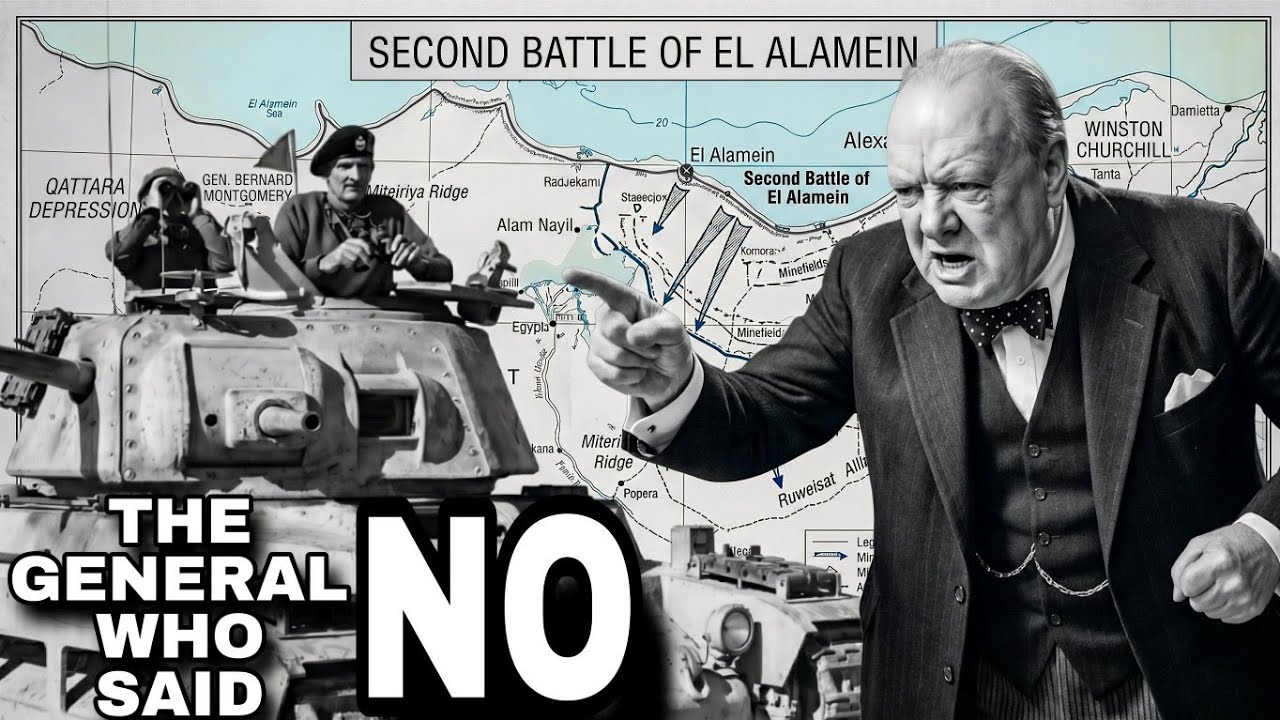
The answer would be decided at the dawn of the Second Battle of El Alamein, the most pivotal battle in North Africa. The summer of 1942 was a season of profound anxiety for the British Empire. Singapore had fallen. The humiliation of the Channel Dash had left the public deeply despondent, and the global strategic map seemed to shrink with every passing week.
As Prime Minister and Minister of Defense, Churchill faced a Parliament increasingly skeptical of his grip on military affairs. The desert campaign had become the crucible of British reputation, and General Claude Auchinleck had been dismissed for daring to suggest his forces were not ready for an offensive until September. Churchill demanded speed. He demanded victory.
He needed a triumph that would silence his critics and reassure the United States that Britain remained a formidable partner against the Axis. When the opportunity for a new commander arose following the tragic death of Lieutenant General William Gott, the eyes of the leadership turned toward Bernard Montgomery. He arrived in Cairo on August 13th, 1942, and his first act was one of psychological dominance. He did not ask what was possible.
He decreed what was necessary. He ordered that all plans for retreat be incinerated. To the men of the Eighth Army, this was not just a directive; it was a total transformation of their tactical identity. Montgomery understood that morale was the most finite resource in the desert, and he communicated his vision with an arrogance that served as a shield for his methodical, rigid approach to planning.
He saw the battlefield as a chess game where the primary goal was the preservation of his assets until the odds were overwhelmingly in his favor. This cautious, almost stifling adherence to preparation became the primary friction point between him and his political masters. Churchill visited the front on August 23rd, fresh from arduous negotiations in Moscow with Joseph Stalin. He wanted to see the spark of offensive action.
Instead, he saw a commander still building his inventory of armor and ammunition. The engagement at Alam el Halfa, which took place from August 30th to September 7th, provided a stark illustration of Montgomery’s methodology. Rommel attempted a daring maneuver to outflank the British positions, but Montgomery had anticipated the movement and prepared an immovable defense. The Axis forces were checked, their momentum bled dry against dug-in British armor.
A more conventional general might have pushed for an immediate, high-risk counterattack to capitalize on the confusion. Montgomery chose to hold his ground. He viewed the battlefield as a scientific problem where the variables were controlled, not an opportunity for romantic maneuvers. The decision preserved his strength, but it infuriated Churchill.
The Prime Minister had spent the war fighting against the tide of catastrophe, and he saw Montgomery’s reluctance to pursue as a failure of spirit. He believed the war could be shortened by daring; Montgomery believed it could be won only by exhaustive logistics. The weeks following Alam el Halfa were marked by a tense, silent struggle between London and Cairo. Churchill’s desk in Downing Street became a place of frequent, frustrated outbursts.
He questioned why his generals could not find a way to finish the struggle. He felt the weight of the global conflict on his shoulders, while Montgomery felt the weight of every tank and every artillery shell under his command. It was a clash between the strategic necessity of the statesman and the tactical reality of the field commander. Montgomery worked with meticulous, almost mathematical precision, demanding more men, more fuel, and more time for training.
He was building an engine of destruction, but to observers in London, it looked like a machine that refused to start. The tension mounted as October approached. Every day of delay felt like a betrayal of the political goal to assert British military independence before American forces arrived in North Africa. When the offensive finally began on the night of October 23rd, it was a display of calculated force.
A massive artillery barrage tore through the darkness, signaling that the period of preparation was over. Montgomery’s plan was to grind down the Axis defensive lines through sheer attrition. He expected a difficult, prolonged engagement, a test of will and logistics. He told his staff to prepare for a ten-day struggle.
Yet by October 28th, the situation had developed into the very crisis Churchill feared most. The operation seemed to be losing its initial kinetic energy. The lines were not moving as fast as the public or the politicians expected. It was during this fragile moment that rumors reached London, exacerbated by the interference of Foreign Secretary Anthony Eden, who questioned the progress of the Eighth Army during a casual evening drink with the Prime Minister.
Churchill was prone to fits of intense, immediate reaction, and the news that the Tenth Armored Corps was being withdrawn to form a reserve triggered a surge of panic in Downing Street. He viewed the move as an admission of defeat. He suspected his generals were playing a defensive game while he demanded a decisive blow. He drafted a telegram to General Harold Alexander, his commander-in-chief in the Middle East, that was blistering in its condemnation.
It was the kind of communication that could end careers and shatter the confidence of an entire army. He believed the offensive was petering out, that the opportunity to end the threat of the Axis in North Africa was slipping away. He gathered his advisers to push his message of distrust, feeling that his own authority was on the line as much as the military situation in the desert. General Sir Alan Brooke, the Chief of the Imperial General Staff, stood as the final barrier between the Prime Minister and an act of catastrophic political interference.
Brooke knew Montgomery better than anyone. He understood that the temporary withdrawal of troops was a deliberate tactical repositioning for a subsequent, more powerful strike. He had to defend that strategy against a Prime Minister operating on emotion and incomplete information. The confrontation at the heart of the British military command was visceral.
Brooke found himself in the impossible position of mediator between a demanding statesman and a stubborn general, all while carrying the burden of the war’s ultimate success. He pushed back against the drafting of the telegram, arguing that if the command structure were undermined at the critical moment of battle, the entire desert campaign could collapse. The misconception persists that El Alamein was a singular, spontaneous stroke of genius. In truth, it was a battle that almost dissolved into disaster due to a profound lack of trust between the political architect in London and the military technician in the field.
Churchill, weighed down by the burden of leading a nation on the brink, demanded the immediate gratification of victory. He viewed the battlefield not just as a location but as political theater, where every tank movement was a message to the world. Montgomery, conversely, treated the conflict as an engineering problem. He recognized that the desert was an unforgiving space where haste served only the enemy.
He needed total superiority in artillery, armor, and air power before he would commit his men to a final push. This was the core of their discord. Churchill wanted a hero to deliver a miracle; Montgomery insisted on delivering a calculated certainty. Imagine the alternative.
Had Churchill forced a premature escalation, the British Eighth Army would likely have exhausted its critical fuel reserves and shattered its armor against the deep defensive minefields known as the Devil’s Gardens. The Axis under Rommel would have exploited the chaos, likely stabilizing the front and retaining control of the vital ports, which would have kept the Mediterranean closed to Allied shipping for months, perhaps years longer. The delay was not a sign of weakness. It was a desperate, quiet necessity to stockpile the millions of rounds of ammunition and thousands of gallons of fuel required to sustain a continuous, crushing offensive.
Montgomery was not just fighting Rommel. He was fighting the constraints of the desert itself, ensuring that once the dam broke, the flood would be irreversible. Major General Freddie de Guingand, Montgomery’s Chief of Staff, became the anchor of the field command during those harrowing days. He acted as a shield against the barrage of messages and political inquiries that seemed designed to destabilize operational focus.
He observed that the primary obstacle was not the enemy’s defensive line but the growing anxiety within the cabinet. When foreign dignitaries and ministers began whispering doubts in Churchill’s ear, de Guingand saw the command staff tighten their grip. They operated in a world of absolute, unsparing logic. They knew their only currency was victory, and they refused to spend it until the outcome was all but guaranteed.
To blink in the face of political pressure was to fail the men on the ground. The turning point was hidden within the electronic chatter of the Axis armies, intercepted and decrypted by the brilliant minds at Bletchley Park. On the night of October 28th, Churchill received a decrypted message sent by Rommel himself to the German High Command. The message described the situation as grave in the extreme.
This was the breakthrough. It provided the ultimate objective verification that Montgomery’s agonizingly slow attrition strategy was in fact working. The enemy was crumbling. The panic that had held Churchill in its grip suddenly vanished, replaced by the realization that his general had been right all along.
It was a masterstroke of intelligence that saved the command structure from a catastrophic self-inflicted wound. This intelligence-led vindication turned the atmosphere of 10 Downing Street upside down. Churchill, who had been on the verge of issuing a career-ending rebuke, suddenly found himself the champion of his commander. He recognized the potential for a narrative of redemption and triumph.
He leaned into the victory with his characteristic booming energy, already crafting the rhetoric that would define El Alamein as a watershed moment for the Allied cause. Operation Supercharge was the final blow that followed the period of intense, agonizing preparation. Montgomery gathered a multinational force, including Commonwealth troops fighting for their survival. He organized the movement of over 350 field guns, creating a concentration of firepower unprecedented for the desert theater.
The planning was exhaustive, accounting for every meter of the advance, ensuring that the infantry and armored units were perfectly synchronized. He did not launch Supercharge because he felt it was time. He launched it because the logistics dictated that the enemy was finally broken. The patience he had displayed for seven long weeks was about to yield its result.
The battlefield became a theater of pure kinetic pressure. The Axis lines, already strained by the preceding days of attrition, were forced to contend with an offensive that did not stop. Montgomery pushed his divisions forward with a relentless consistency that gave Rommel no time to recover his balance. The integration of air power, artillery, and ground troops created a synergy that overwhelmed the defensive capabilities of the Axis forces.
It was a calculated, deliberate, and final destruction of the enemy’s defensive integrity. The Eighth Army had been transformed from a reactive force into a proactive, dominant machine, all under the watchful, rigid eye of a commander who refused to be hurried. Victory was confirmed on November 4th, 1942, as the Axis front collapsed and the retreat began in earnest. Churchill, ever the master of the public narrative, seized the moment.
He spoke to the world, framing the event not merely as a battle won but as a turning point in history. The declaration that this was the end of the beginning resonated because it was true. For the first time, the Allies had achieved a sustained, definitive victory that would never be reversed. The political crisis in London evaporated, replaced by a surge of national pride.
Churchill’s premiership was secure, and Montgomery had cemented his reputation as the man who could deliver the triumph that everyone else had failed to produce. The victory at El Alamein, however, was merely the prologue to the wider conflict. With the Mediterranean lines beginning to reopen, the strategic focus shifted toward the next phase of the war. Churchill found his standing in Parliament restored, and the dissent that had plagued him in the summer of 1942 faded as news of the victory spread across the globe.
He had gambled his prestige on the ability of his military commanders to produce a win, and he had been rewarded. Montgomery, meanwhile, transitioned from a commander constantly questioned to a national hero. The friction between them, though settled by this success, would remain a permanent feature of their working relationship. They were two men of immense ego and different visions, and the success of the campaign had validated both in their own ways.
The logistical miracle that made El Alamein possible was a masterclass in the mobilization of an empire. Across thousands of miles of sea and land, the supply lines reached out, delivering the tanks, the fuel, and the ammunition the Eighth Army required. Every element of the strategy had been predicated on this flow, and Montgomery’s constant demand for more was, in retrospect, a reflection of the reality of modern industrial warfare. He knew that if he ran out of momentum, the enemy would recover, and the opportunity for a decisive victory would be lost.
This logistical reality was often invisible to those watching from London, who viewed the war through the lens of political necessity rather than the constraints of a desert environment. One must consider the psychological burden Montgomery carried. He was aware that he was the focal point for the Prime Minister’s frustrations. Every request he made was treated with suspicion, and every delay was interpreted as a sign of incompetence or lack of spirit.
Yet he did not falter, and he did not abandon his methodology. He remained insulated within his command structure, relying on his staff to maintain the integrity of his vision. The ability to resist pressure from the highest levels of government was perhaps his greatest tactical strength during this period. It was a form of leadership that required as much fortitude as being on the front lines themselves.
Churchill’s nature was to be at the center of the action. He was not a man to sit in London and wait for news. He needed to be involved, to consult, to argue, and to push. This inherent desire for intervention was a double-edged sword.
While it energized the British war effort, it also introduced a layer of uncertainty and volatility that challenged the stability of the military command. The fact that the command structure survived the tension of late October 1942 is a testament to the professionalism and resilience of officers like Brooke and Alexander. They were the ones who managed the Prime Minister’s energy and protected the field operations from the political consequences of his moods. The Battle of El Alamein taught the Allies that victory was a product of synchronization.
It was not enough to have superior numbers. One had to have the right timing, the right support, and the right leadership. The experience gained during the struggle served as a blueprint for future operations in the war, particularly in the later stages of the campaign in Europe. It shifted the philosophy of the British Army toward a model of overwhelming, integrated force that left little to chance.
This was the legacy of the conflict that had begun with such uncertainty and friction in the summer of 1942. The impact of the defeat on the Axis side was as profound as the victory was for the Allies. It shattered the illusion of the invincibility of their commanders and signaled a fundamental shift in the theater of operations. The loss of resources, the damage to the infrastructure of the defense, and the psychological impact on the morale of the army created a situation that could not be reversed.
For Rommel, the loss at El Alamein was the beginning of a long, difficult retreat that would continue until the end of the war. It was the moment the strategic balance of the desert was permanently altered. Consider the contrast between the environment and the machinery of war. The desert, with its vast, featureless terrain, demanded a specific type of combat unlike anything experienced in Europe.
The logistical lines were long and vulnerable. The heat was unforgiving, and the lack of cover made every movement a tactical risk. The generals had to manage the challenge of moving large armored formations through sand and rock while ensuring that the men remained combat ready. Montgomery’s ability to turn this environment to his advantage was a key element of his success, and it was something he prioritized in his planning and training from the first day he took command.
The role of the individual soldier in this struggle cannot be overlooked. They were the ones who carried the weight of the decisions made in the command tents. They were the ones who operated the guns, repaired the engines, and moved the supplies under the intense sun. Their endurance and their belief in the mission were the final crucial factors in the outcome of the battle.
Montgomery knew this, which is why he put so much effort into communicating his vision directly to the troops. He wanted them to feel that they were part of a team, and that their individual actions were contributing to a larger inevitable victory. The debate over the pace of the advance remains one of the most interesting aspects of the campaign. Would a faster strike have achieved more?
Or would it have led to a premature collapse of the British lines? The answer lies in the limitations of the technology and the environment. Speed in the desert often came at the cost of logistical cohesion. A commander who moved too fast risked being cut off or finding himself without the necessary support to hold his gains.
Montgomery’s slow, deliberate approach was a way to mitigate these risks. It was a choice between the potential for a quick, high-risk win and the reality of a slow, high-probability victory. The intelligence success of the Ultra program changed everything. It provided a level of certainty previously impossible to achieve in wartime.
Being able to read the enemy’s internal communications turned the fog of war into a clearer picture of intentions and vulnerabilities. It allowed commanders to make decisions with a level of confidence that would have been reckless without it. In the case of El Alamein, it was the ultimate tool for overcoming the political and tactical anxiety of the moment, and it remains one of the most significant strategic assets of the war. The clash between Churchill and Montgomery was a struggle between two men who were both essential to the victory.
Without Churchill’s political will and his refusal to consider any outcome but triumph, the war effort might have faltered. Without Montgomery’s tactical caution and his demand for logistical dominance, the army might have been wasted in premature, disorganized attacks. Their rivalry was the friction that produced the heat necessary to win the battle. They were fundamentally different people, but they were bound together by the mission and the stakes of the conflict.
In the end, the command structure survived because the pressure of history shaped the actions of those at the top. The records and personal accounts of those who were there keep the memory of the event alive. It is a testament to the fact that history is not just a collection of dates and figures, but a series of decisions and struggles made by people under extreme pressure. The legacy of the battle is a story that has been told many times, yet it remains one of the most compelling narratives of the war.
It was the moment the tide began to turn, and it was a validation of the sacrifices made by so many in the quest for a secure world. It was a victory won not just on the battlefield, but in the command centers and the halls of power where the will to endure was tested and proven.






