Christmas 1854 was coming, and in the master’s houses on Maryland’s Eastern Shore the tables were being laid, the candles lit, the ribbons hung. In the cabins by the marshlands, the same date meant something else entirely. For four years the Fugitive Slave Act of 1850 had hung over the whole nation, law that let a southern master pursue a runaway into a free state and reclaim a body on the strength of a signed paper, without the accused’s testimony, without a jury. In the official texts it was framed as restoring order, protecting property.
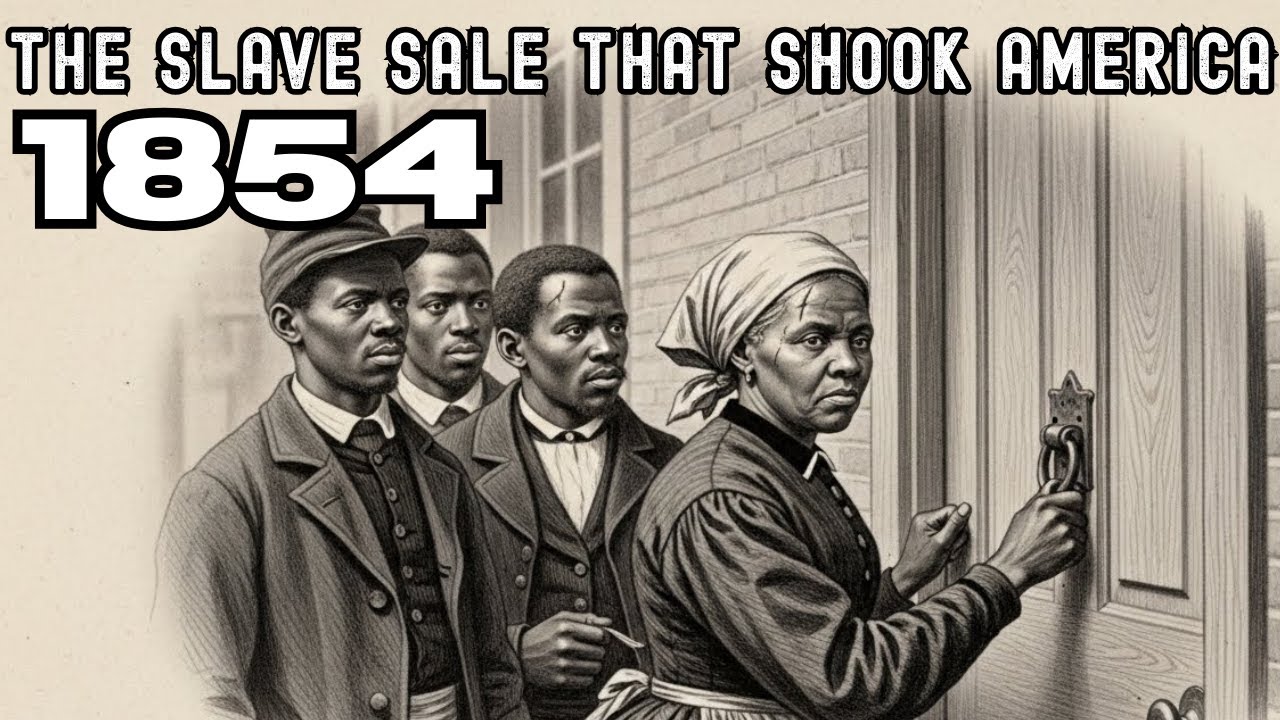
In the wooden cabins, people whispered of patrols, of hounds, of chains. Tucked away in an archive was a thin sheet, almost translucent from repeated handling, dated December 1854. It encoded a pending succession, ordering that assets be liquidated immediately after the holidays. The phrase was mundane, capable of referring to cattle, tools, furniture, men, women.
The law drew no distinction. All were listed in the same inventory, and everyone knew what a post-Christmas sale meant: the wagons, the chains, the figures vanishing into the deep south, the names that no one would dare speak aloud again. That was when the rumor began, first in hushed tones, then in more precise fragments. On a plantation in the Poplar Neck region, three men stood on the brink of being sold.
Ben, Henry, Robert. Three brothers, three sons of a woman named Rit, whose back had already bent beneath so many harvests. The sale, it was said, was set for just after Christmas, because the master or his creditors needed ready coin and these men would fetch a good price. In the mouths of owners they were sturdy subjects, marsh-hardened laborers.
In the mouths of their kin they were sons, husbands, brothers who might vanish forever. The archives yield no scene of dispute, no desperate gesture. They record the abstract worth of a body on a market. Fear leaves scarcely a trace.
Far away, in a northern city, a woman heard these rumors. Her name was now Harriet Tubman. In southern documents she still appeared as Araminta Ross, a wanted fugitive, with details of her height, her gait, her scars. In the abolitionist newspapers of the North she was beginning to be called a conductor on the clandestine pathway known as the Underground Railroad.
Two worlds, two registries, two portraits of the same woman. For some, she was a financial loss, a thief of property. For others, she embodied silent resistance. Harriet lived in Philadelphia, working, saving, and regularly returning south to bring others north.
She knew precisely what the law promised her if she were recaptured: prison, chains, resale, perhaps worse. But a tenacious debt haunted her. In 1849, during her own escape, two of her brothers had turned back, terrified at the thought of abandoning those who depended on them. She alone had continued toward Pennsylvania.
Since then, every Christmas, every census, every death recorded in a Maryland register could mean the disappearance of a beloved face. When the rumor of a post-Christmas sale reached her, it was not abstract information. It was a countdown. To understand the woman who would act on that rumor, one had to look back to the years when her name did not yet exist.
In the Maryland registries she first appeared as Araminta, often shortened to Minty. There was no birth certificate, no record of hour or weight. Sometimes, in the margin of an inventory, one found a girl, Minty, valued at about five dollars, lost in a list of pigs, harnesses, furniture. The place was Dorchester County, on Maryland’s Eastern Shore, a region of marshes, forests, and rivers emptying into the Chesapeake Bay.
In the light of legal texts it was merely one district among others, where slavery was legal, regulated, protected. Her parents were named Ben Ross and Rit Green. In the master’s documents they became negro man, negro woman Rit, followed by an approximate age, a market value. Ben, a carpenter and woodsman, was hired out from plantation to plantation, his name circulating on lease contracts like that of a specialized tool.
Rit, more closely tied to one family, saw her children born under a simple and implacable legal regime: partus sequitur ventrem, the child follows the womb. Any child born of an enslaved woman was enslaved, regardless of the father, regardless of affection. Minty’s childhood left few traces in the county columns that counted her as property. The age at which she was sent to watch children set muskrat traps in the marshes, the blows she received when she fell asleep exhausted on a kitchen bench, none of this appears in the registries.
But a single episode traversed her life like a scar. As a teenager, in a store, she was struck on the skull by a metal weight thrown by an overseer who had aimed at another slave. The store ledgers might record the breakage of goods that day. They say nothing of the blood, the weeks of pain, the fainting spells and visions that witnesses would later describe.
The unofficial archives of the body were not encoded in the county registers. In the notary pages everything seemed stable, ordered. Plantations changed hands, heirs divided lots, the value of subjects was estimated by age, strength, skills. In Minty’s nights something more unstable churned: the acute awareness of belonging to someone else by a mere accident of birth.
She learned to move in darkness, to distinguish the silhouettes of trees, to recognize from afar the shape of a white house where she must not be seen. The leases moved her from one place to another. In her memory, these were roots being inscribed, landmarks, distances, a hollow path where one could hide. In 1849, the county records began to mention more frequently the name of the master who still owned her.
His health was declining. His debts were mounting. In the neutral language of legal acts, it was expedient to realize certain assets. In the cabins, everyone understood what this meant.
When death or bankruptcy threatened an owner, the bodies of enslaved people became the primary currency of exchange. Minty told her kin she would never allow herself to be sold south. The word south did not merely designate a cardinal point. It evoked Louisiana, Mississippi, cotton fields where conditions were reputed to be even harsher, where one vanished.
In 1849, the decision to flee germinated. She spoke in hushed tones with her brothers Ben and Henry, who felt the same threat. On the chosen night, she used all she had learned, the geography of Maryland carried in her memory, the tree lines, the marshes where footsteps left fewer traces. Her brothers followed, torn between fear and hope.
Behind them they left parents, spouses, children. Ahead lay only the unknown. As the hours passed, Ben and Henry’s resolve fractured. They had immediate attachments, wives, young children, aging parents who depended on their strength.
In the logic of the slave system, this was one of its chief weapons: chaining not only bodies but bonds, making any escape an act of guilty abandonment. The brothers panicked, insisted on turning back, fearing the escape would end in the gallows or the whip, and their loved ones punished in their stead. Fear prevailed. They returned to the familial enclosure.
From this first aborted attempt, Minty drew a radical conclusion. If she waited for everyone to be ready, for fear to recede on its own, she would be sold, carried away, broken. She chose to depart again, alone. Once she crossed the Pennsylvania border, she was no longer legally the same person.
When she finally reached free territory, after days of walking and makeshift shelters, she reportedly looked at her hands, wondering if they were truly those of a free woman. The break was decisive. She had saved her life, but she had had to leave her family’s behind. In Philadelphia, freedom was not absolute.
Pennsylvania laws prohibited slavery, but networks of informants and slave catchers remained active in free black neighborhoods. Like many fugitive black women, she worked as a domestic, a cook, a laundress. Her income was modest, but every coin saved became a form of moral capital, enough to pay a messenger, to help someone else. In abolitionist circles, she appeared not as an isolated heroine but as part of a fabric of women and men who in kitchens, cellars, and attics organized discreet assistance to those fleeing.
In 1850, the Fugitive Slave Act weighed heavily on that work. Every northern official was now legally obligated to assist in the arrest of fugitives. A fugitive’s testimony held almost no weight before the federal commissioners who heard these cases; a simple affidavit from a master was often enough to send a man, woman, or child south. The safe haven had shifted from the North toward British Canada, where slavery was abolished and American authorities could not legally reclaim fugitives.
It was in this context that Harriet, in turn, became a conductor. Her returns to Maryland left broken traces. Here, a wanted notice increased the reward, describing her as extremely dangerous to property. There, an owner complained in a letter that this woman had already taken several of his best subjects.
In sale records, some names vanished, not because they had been purchased but because they had evaporated from the column, replaced by a dash. In the plantations, masters described her as a witch, unable to acknowledge that a fugitive black woman was repeatedly outwitting their system. In black communities, she became living proof that captivity was not an absolute fate. By 1854, when the rumor threatening her brothers reached her, Harriet was no longer the former Minty who had fled alone.
She was a seasoned conductor who had learned to read maps, to negotiate with delays, to guess when patrols were fewer, to discern in the columns of a southern newspaper the signs announcing an upcoming sale. When she learned that Ben, Henry, and Robert were to be sold after the holidays, she knew what to do. One piece of that operation is missing from the file. No archive box preserves the letter that journeyed from the North to the Eastern Shore in December 1854.
Yet several testimonies converge: Harriet sent a coded message to a free black man named Jacob Jackson, a veterinarian, to warn her brothers and set the time of their escape. Jacob appears in official sources at the periphery of the white world. In some county records he is a free negro, owner of some property, working with animals. His profession gave him access to diverse plantations; masters needed him for their horses, oxen, and dogs.
Maryland law limited his rights and monitored his movements, but it recognized his freedom. That fragile freedom made him a precious link in a clandestine chain. Harriet could not simply write: Flee, I am coming for you. A letter addressed directly to enslaved people would be intercepted, opened, read.
So the letter that reached Jacob seemed to be nothing special, perhaps addressed to him on a benign subject, a request about animal care, a seasonal greeting. At the end, in a phrase that seemed pious and innocuous, the message was hidden. When the good ship of Zion comes along, be ready to step aboard. To the uninitiated, it was a biblical allusion common in sermons.
To Harriet’s brothers, it was a precise command: when the opportunity arises, do not miss it. The letter had to reach Jacob, who had to understand the code and find a way to pass the message to the brothers without drawing the master’s attention. No judicial record shows a trial against Jacob for complicity in escape. That silence may mean extreme prudence, luck, or contempt for a free black man deemed secondary.
It does not lessen the danger. Every word he spoke, every gesture to meet the brothers privately, could have become proof of sedition. Harriet could neither read nor write. The letter was likely drafted at her request by someone else, an abolitionist, a church member, a literate free black woman.
The archives do not record who. The pen scratched the paper, the letter was folded, sealed, addressed, and entrusted to the impersonal flow of mail. At each stage, a white postal employee handled it unaware that it carried an invisible threat to the slave system. Sale announcements sat beside that vanished letter.
In Maryland newspapers of late 1854, among columns of political news and market prices, one finds regular, almost mechanical inserts: public sale, after the holidays, auction of a complete property, land, cattle, slaves. The timing was no accident. For a long time, the holiday season had been a privileged moment to organize estates. Agricultural work slowed.
Markets were more easily held. Debts could be settled. Sales were planned just after Christmas, as a matter of course. The brothers’ master, or several co-heirs, faced financial difficulty.
Lands were mortgaged, creditors pressed. Among the solutions, the sale of a few adult enslaved people was the primary option. Those who by age and strength could bring in the most were chosen: men in their thirties, accustomed to harsh work, reputed for resilience. Ben, Henry, and Robert were inscribed on the list, not as persons but as units of value.
The law required public announcements, deadlines, payment terms. It said nothing about informing the interested parties. Enslaved people learned their fate through rumor, an overheard phrase, an allusion to those who will depart after the holidays. From the cabin’s perspective, Christmas was entirely different.
It could be one of the rare times of year when enslaved families received a relative leave, an exceptional permission to visit other plantations. Masters granted passes that allowed some to travel to see relatives. These handwritten documents, signed by a white hand, became for a few hours precious shields against patrols. It was on this narrow allowance that Harriet would rely.
If her brothers obtained permission to leave the plantation where they worked and to go where their mother still lived, a space opened up, one where they would not be under the direct surveillance of an overseer, where they could disappear before anyone knew whether they had fled or simply been delayed on the road. The date of December 24, 1854 bears no special mark in the Maryland registers. On preserved pages one reads only ordinary transactions, a delayed payment, a court closure for the holidays, a note of leave granted to certain enslaved people. Nowhere is it written: night of escape, conspiracy rendezvous.
Yet in the Poplar Neck region several trajectories would converge in the shadows. The brothers arrived at their mother’s home bearing their written permissions. Rit’s joy was mingled with a silent anguish. She knew, in a way that bypassed documents, what this visit signified: perhaps the last before the sale.
The meeting between Harriet and her brothers appears in no official report. No clerk noted the words exchanged. But what transpired was a negotiation, a moral debate, a resumption of the 1849 conflict. The brothers were no longer as they had been before.
The prospect of sale pressed upon them; they had seen other men chained and taken south. Yet they were not only sons and brothers. Some were husbands and fathers. To leave was to escape the sale, but it was also to leave wives and children to the master’s wrath.
Harriet’s arguments were simple and relentless. If they did not leave now, the sale would send them so far that all chance of reunion would disappear. She could not ease what hurt most: the idea of looking one last time at those they could not take. The archives record only the result.
In the lists of fugitives, there are traces of these men who left Poplar Neck in late 1854. In abolitionist memoirs, the account of a successful operation where Harriet snatched her brothers from sale recurs as a motif. Between those two poles lay the human substance of the night: hesitation, suppressed tears, hands clasped too tightly at the moment of parting. At an agreed moment, when the master’s house was occupied by supper and song, the meeting transformed into a departure.
The passes, meant to bring the brothers back to their place of work the next day, ceased to be mere administrative documents. For a few more hours they became a screen that blurred the tracks. As long as the dates they bore were not exceeded, the absence could be explained. Past that deadline, they would become fugitives.
Harriet knew she had only one night’s head start. The hours that followed bear no name in the registers. The night was cold; whether there was snow or rain mattered little. What mattered was that darkness covered the paths, that every broken branch could betray a passage.
Ben, Henry, and Robert had worked the day before, then walked to their mother’s plantation. Fatigue weighed on them, but they had to carry it without succumbing. Harriet set a rhythm the archives never recorded, neither too fast to exhaust those she guided nor too slow to risk a patrol. She knew where the dogs passed, where roads were heavily guarded, where the marshes offered a screen.
In her memory, the territory was made of embankments, ditches, thickets, old stumps she recognized by touch. Above their heads the law did not sleep. Even if the brothers reached Delaware and then Pennsylvania, they would remain, in the eyes of the federal government, escaped property. The journey was organized in segments: progress, then freeze, then listen.
None of these stops had a name. No hour was noted. Yet in the memory of those who survived, they would become fixed points: the wood where a branch cracked and everyone thought they heard a horseman, the ditch where one of them slipped soaked to the knees, the clearing where for an instant the sky cleared and a star pointed north. From time to time they glimpsed the distant light of a white house where Christmas was being celebrated in the usual sense.
A few hundred meters away, the property in question moved forward, bent, silent. On the morning of December 25, the absence on the plantation would be noted. At first a delay, an extended visit, was presumed. As the day advanced, doubt turned to certainty.
Someone retrieved the passes, verified the dates, read the signatures. Then the master or his representative took up the pen to record the fact. This simple gesture transformed the escape into stolen property. But the fugitives were still ahead of the ink.
They moved faster than the words that would designate them. The group crossed into Delaware, a slave state but also home to free blacks and abolitionists, a dangerous transition zone. The Fugitive Slave Act applied fully there. Yet for those walking it was a psychological threshold, the feeling of having left the direct circle of their former masters’ surveillance.
In this uncertain space, the human relays of the Underground Railroad assumed their full importance. The network had no rails or schedules; it was made of men and women who agreed to violate the law to offer a roof, a meal, a direction. In Wilmington, one name constantly appears: Thomas Garrett, a Quaker iron merchant. He would be prosecuted and fined heavily for aiding fugitives.
He continued anyway. It is probable that Harriet’s group at some point crossed paths with him or others like him. The archives do not allow exact footsteps to be followed, but the scene repeated itself night after night: a door opened discreetly, figures entered soaked and exhausted, few questions asked, food prepared, dry clothes found. The children of the house learned to look away and remain silent.
The destination was Philadelphia, where a portion of the northern abolitionist effort was concentrated. Upon arrival, the brothers were legally no safer than in Delaware; federal commissioners sat there, slave hunters operated there. But the city offered active black churches and activists who had learned to thwart the maneuvers of southern agents. Harriet introduced her brothers to contacts, found places to house them, organized the continuation of their journey.
She had to explain the dangers of the city, the necessity of remaining hidden, of changing their names, of trusting certain strangers, white Quakers and pastors who had placed themselves on the other side of the law. Yet crossing the Mason-Dixon line was not enough. Since 1850, the Fugitive Slave Act extended the shadow of slavery far beyond it. In recent years Harriet had seen fugitives torn from black communities in the North.
Philadelphia was a stopover. For her brothers to truly escape, another border had to be crossed: that separating the United States from British territory. It was toward Canada West, later Ontario, that the gaze of fugitives and their helpers now turned. Slavery was abolished there, and American authorities had no right to reclaim fugitives.
Black communities had already formed in Windsor, Toronto, and St. Catharines. Church registers, censuses, and Canadian civil acts progressively recorded these arrivals, names sometimes distorted, origins noted as Maryland, Virginia. As Harriet prepared this new stage, the South continued to reclaim her.
In Maryland, advertisements offered rewards for the capture of Ben, Henry, and Robert, described by complexion, stature, and marks. Sometimes an additional sum was promised for information on the woman known as Harriet, also Minty or Araminta, accused of stealing others’ property. As the articles were printed, the distance between these words and the bodies they designated grew. The crossing into Canada West often occurred via the Niagara region.
On one side lay the American city of Buffalo; on the other, Fort Erie or other points on the Canadian shore. Testimonies speak of boats crossing by night, of figures hurrying along the banks, focused on one fact: once foot was set on the other side, status changed. Canadian archives no longer classified these men as fugitive slaves, but as new arrivals. In St.
Catharines, church registers and civil censuses in the early 1850s show the names of black families from the United States, mentions of marriages, baptisms, deaths, places of origin. These documents of administrative dryness carried an inverse significance: where southern registration fixed a person in the status of a slave, here it fixed them within a community of free people. Harriet herself settled for a time in St. Catharines, a base between her journeys south.
Once this threshold was crossed, the question was no longer how to escape capture, but how to live, far from everything known. Legally, Ben, Henry, and Robert had won. No American wanted notice could reach them. But the same texts said nothing of the cost: knowing that one could not, without danger, return to the lands of the Eastern Shore, see the cabin of one’s childhood, embrace one’s aging mother.
Canadian censuses in the following years record these men becoming laborers, farmers, carpenters. Church records note the baptisms of children born free, whose birth certificates mentioned no servile condition. Yet in the memories of those concerned, nothing was normal. Every winter, every holiday, could recall the starting point: a Christmas night, a sale narrowly averted.
What remains of that Christmas of flight today is scattered. In the official archives of Maryland, the name of Benjamin Ross, Harriet’s father, appears in a biographical notice mentioning his life as a slave and later as a free man settled in Poplar Neck. But the night Harriet returned to seek her brothers is absorbed into a larger narrative. Major biographical syntheses recall that after her own flight she undertook approximately thirteen missions that enabled some sixty enslaved people to gain freedom, that she earned the nickname Moses of her people, that she served during the Civil War as nurse, spy, and scout.
In that overall picture, Christmas 1854 sometimes appears as one example among others: at Christmas, she returned to Maryland to free her three brothers. More focused sources delve deeper. Popular history articles recount the news of a sale planned after the holidays, the coded letter to Jacob Jackson, the rendezvous in Poplar Neck, the Christmas escape, the subverted message about the good ship of Zion. But these accounts remain peripheral, published on websites dedicated to local history and thematic walks, not in grand national histories of slavery.
On Maryland’s Eastern Shore, a tourist and historical route called the Harriet Tubman Underground Railroad Byway follows roads, marshes, and hamlets linked to her life. Within this framework, the night of Christmas 1854 has found its place. Local associations and the state park dedicated to Harriet now organize every Christmas Eve commemorative walks on a portion of the path Harriet and her brothers are believed to have taken. The announcements speak of a freezing night, men and women hidden in a cornfield or a wood awaiting the signal for departure.
The National Museum of African American History and Culture recalls that on Christmas Eve 1854, Harriet Tubman returned to the Eastern Shore to liberate her brothers. Educational blogs encourage families to speak of this night with their children. In Canada West, in St. Catharines, the Salem Chapel, a British Methodist Episcopal Church where Harriet and other refugees worshiped, is today a national historic site, its panels explaining the city’s role as a terminus of the Underground Railroad.
Thus the event that for Harriet’s family constituted a turning point, the difference between being sold after Christmas or crossing the Canadian border, is today inscribed in a landscape of plaques, brochures, and commemorative walks. Yet if one returns to the grand syntheses of American slavery, the contrast is striking. Where local commemorations dedicate an entire program to this night, national histories sometimes grant it a sentence, sometimes nothing at all. Grand narratives prioritize numbers, the number of missions, the dates of laws, the battles of the Civil War.
Harriet Tubman embodies resistance to slavery as a whole. But this symbolization flattens the plurality of moments, reducing episodes like Christmas 1854 to interchangeable examples. To remember that night is to restore to a date, a calendar, a specific family the place that grand narratives often deny it. It is to recognize that behind the phrase she saved approximately sixty people, there were particular Christmases, aborted sales, diverted permissions, mothers embracing their sons in a dark cabin, knowing that by morning their names would no longer be read in the same column of registers.
The archives give us clues, a sale notice, a mention of fugitives, an inscription in a Canadian register, but they are silent on what these people felt upon hearing one December evening that there would be a sale after the holidays. That silence is not merely a technical accident due to lost or burned documents. It is also the product of a choice: not deeming worthy of record what transpired in the cabins, on the paths, in the bodies of those who endured the law rather than signing it. Christmas 1854, from the point of view of the authorities, was an incident in the management of an estate, a delay in a succession.
From the point of view of Harriet, Ben, Henry, Robert, and Rit, it was an irreversible rupture. The only thing still offered to us is the responsibility for what we do with this knowledge. In our own calendars of holidays and consumption, we can choose to leave these Christmases of flight in the shadows, or to let them modify, at least slightly, the way we speak of the season. At the end of this narrative, there is no triumphant conclusion, no simple moral.
Only a question, posed in the silence where the documents cease. Now that we know there were stolen Christmases and stolen memories, what will each of us do with that night of 1854 when, on our own walls, the date of December 24 returns?






