Ephraim Vail halted at the yard’s boundary and offered a greeting. The sound of his voice was swallowed by the fog beyond the hollow and never returned, which was not how sound ought to carry, and he understood that. Even so, he made himself press on. The woman emerged onto the covered walk before he could reach the door.
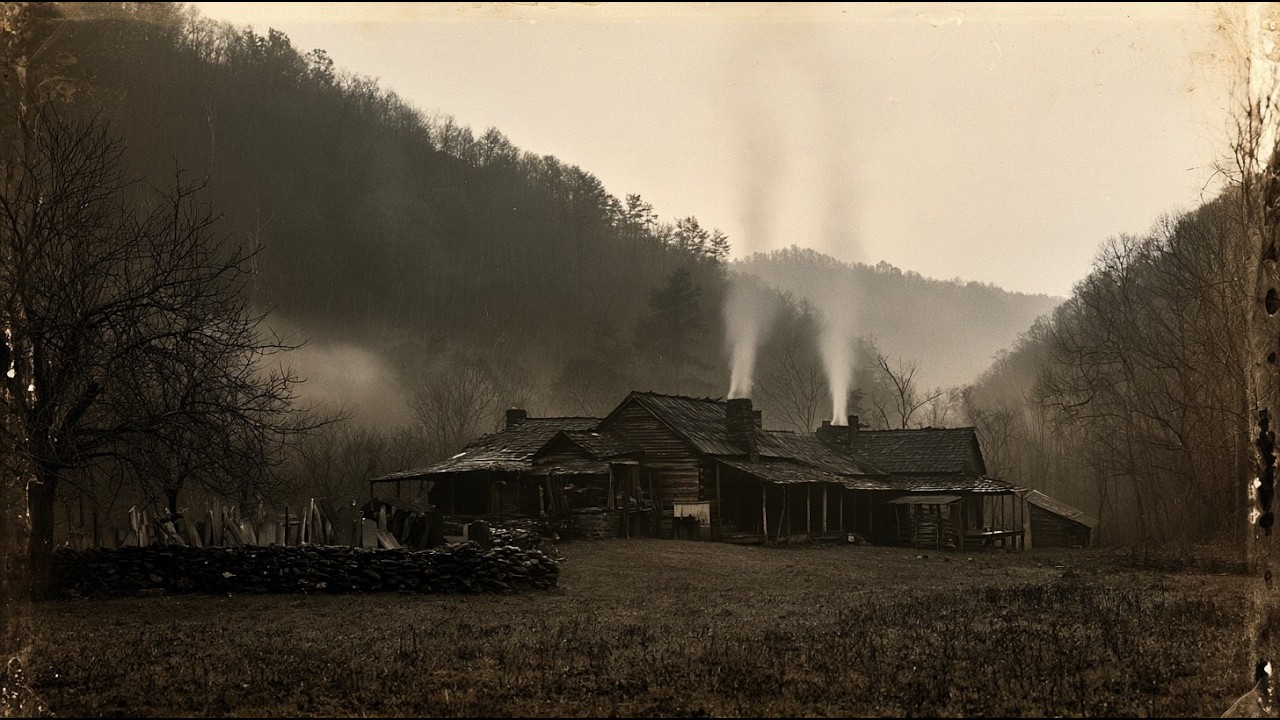
She was aged. That was the most he could honestly claim, for anyone who had ever attempted to pin an exact number of years on a Harrow had come away empty-handed, and Ephraim proved no exception. She was old the way the stones of that low wall were old, worn smooth and bleached and in some way past the reach of wear. She had on a dark homespun dress and a shawl the color of ash, and when she folded her hands in front of her, one finger was bent.
Later, down at the store, Ephraim would recall that finger. He would recall that Prudence Ashmore had uttered the name, and that he had already encountered that same crooked finger, already clasped that same chilly hand. She gave her name as Mahala. She never asked for his.
She told him they had been awaiting a man from the county for quite some time, and she said it gently, the way a person remarks that rain is on its way. Then she drew back and shut the door. Every instinct for caution that Silas Ordway had tried to drill into him back at the mill rose up at once and warned him not to enter. He entered regardless.
Naturally he entered. That was the curse of a man who closed his lines. He could not walk away from anything left unfinished. The front room was warm and low-ceilinged and tidy, and it held more people than a hushed house should have.
Ephraim counted, since counting was his habit, and halted at seven grown men and women seated along the walls, all motionless, all observing him with the placid patience of someone watching a kettle they know will come to a boil in its own good time. They looked alike. Not the way a family looks alike, sharing a nose here or a chin there. They looked alike the way coins struck from one mint look alike, the same face stamped over and over, set apart only by wear, one nearly smooth, another still crisp at the edges, all identical beneath.
Mahala seated him at a long table and served him food, and the food was genuine and well made. Cornbread and a stew of something dark. As he ate, she talked, and her talking was the second thing that unraveled Ephraim Vail, after the stones. She described the founding of the county as though she had stood there to see it.
She described the hard winter of 1831, the one Prudence Ashmore had cautioned him about, as though it had befallen this room, these very people. One of the men along the wall nodded, recalling it. That man appeared no older than forty. Ephraim laid down his spoon.
He said, as softly as he could, that 1831 lay twenty-five years behind them, and that the man against the wall would have had to be exceedingly young. A different sort of silence came over the room. A silence that was amused. Mahala smiled at him with genuine warmth and told him that time did not gather in this place the way it gathered everywhere else.
Here it pooled, she explained, in the low ground, the way cold air pools, and the family had learned long ago to dwell within that pooling. That was the entirety of their secret, she said. There was nothing more to it. She stated it the way you would explain a plain fact about your farm to a visitor from town.
Ephraim, who had put his faith in measurement over feeling his entire life, felt his certainty waver because he had his answer. That was what made it terrible. It matched the stones. It matched the crooked finger on the hand he had shaken, the hand that had shaken Prudence Ashmore’s mother’s hand across six decades.
It matched the names worn smooth by being handed down, except he now questioned whether handed down was the correct phrase, or whether those names had never departed from anyone at all, and the same small cluster of people had simply borne them the whole while in that green basin of gathered, motionless time, while the seasons turned outside like weather glimpsed through a window. He requested the family records. He explained it was his work, that the county required names and dates, and it was the most honest thing he had uttered all day, because he needed them now to disprove what he felt. Mahala fetched him a book.
It was a family register, the sort country folk keep at the front of a Bible, births and marriages and deaths inscribed in one long column. The ink at the top of the column had aged until it was the brown of dried river clay. The ink at the bottom was fresh enough to have been set down that very year. The same names recurred throughout.
Mahala, Alpheus, Fairly, Amasa, the same eight or nine names again and again across two hundred years, and beside each name a birth date, and almost never a date of death. A register two centuries long that no one had ever felt the need to complete. Ephraim turned the pages with a hand that had started to shake slightly, and near the final page, pressed flat between two leaves like a dried flower, he discovered a single sheet of survey work. The handwriting was not that of an expert.
It was a trained and meticulous hand. He believed it belonged to Corin Bell, the surveyor who had gone up in 1849 and come back down and delivered a report judged unfit to keep. This was a page from that report, or a page intended for it, that had never made it down the mountain. It was a sequence of unfinished measurements, boundaries, bearings, the same monotonous sacred labor Ephraim performed, broken off mid-line, mid-number, as though the man writing it had been summoned from the table and never came back to complete the figure.
Ephraim raised his eyes from that unfinished number, scanned the warm watching room, the seven still faces and the eight or nine names rooted two centuries deep, and performed the arithmetic a man should never perform at a stranger’s dinner table. Corin Bell had come here seven years earlier. Corin Bell had never come home. Nobody in this room resembled a dead man.
He asked, very quietly, whether Corin Bell was still in the Notch. Mahala folded her crooked hands and replied that everyone who came to stay was still in the Notch. She said it gently. She said the mountain keeps its own, and she said it the way you say a prayer.
They gave him a room to sleep in that night. It was a pleasant room, dry and warm, with a rope bed, a stout wool blanket, and one tallow candle. It was the most terrifying room Ephraim Vail had ever been asked to sleep in, because it plainly belonged to someone else. A coat hung from a peg by the door, a fine coat, tailored for town, all wrong for the mountain, worn soft from use.
A leather bag stood in the corner, and inside it lay a surveyor’s chain and a green brass instrument. Ephraim did not need to lift the flap to know whose initials were engraved on it. He sat on the edge of the bed with the candle burning and did not undress and did not sleep. He listened.
The house did not settle the way houses settle. It moved. Slow footsteps crossed the covered walkways, back and forth, quiet, all night long, as though the people of the house were not sleeping so much as taking turns at a watch. Once, near midnight, he heard the well in the yard, its wooden roof creaking, the bucket descending and descending and descending, far longer than any well of that depth should run, and then no sound of it striking water.
Only the rope still paying out into a perfect silence. There were softer sounds too, and those were the worst, because he could almost make them out and never quite. A dry murmuring ran along the inner walls, low and patient, with the rhythm of speech but none of its shape, as if the people of the house, on the far side of the dark logs, were reading a long list aloud in a language worn down to nothing but its cadence. Once, he was almost sure he heard his own name folded into it.
Once, he was sure he heard Corin Bell’s. Once, he heard a name he did not know, and understood, with a small chill beneath his ribs, that it might be a name not yet given to anyone. The candle went out with no draft to kill it. His breath began to show in front of him, indoors, in a warm room, small pale clouds rising and dissolving the way breath does on a hard winter night.
He sat watching himself fade into the cold, and he thought of the trees outside, every one leaning downhill, longing to be anywhere but here. He had climbed, of his own free will, to the one place on that whole mountain where every living thing was quietly trying to leave. He was the only fool in a hundred years who had arrived on purpose. After that, he blew out the candle.
He decided a lit window told them he was awake, and he badly wanted them to think he was not. In the dark, he did the thing that saved him, though he did not yet know it would save him. He went back over every word Prudence Ashmore had said at the foot of the mountain, and stopped at the one word that mattered. She had not said the mountain takes.
She had said the mountain keeps what it is owed, and a debt is a thing you enter into. It has to be accepted. He thought of the stew he had eaten, the warm bread, the tea, the roof over him, the blanket over him. All of it given freely.
He understood that he had spent the whole evening signing his name, quietly and kindly, into the register, one small courtesy at a time, and that the register holding two hundred years of unfinished lives was not a register of the people the mountain had taken. It was a register of the people who had accepted its hospitality, and by accepting, agreed to stay and repay it forever. Corin Bell had eaten at that table too. So Ephraim made his decision in the dark.
It was the coldest and clearest decision of his careful life. He would take nothing more. He would give back what he could. And he would be off that mountain before the debt came due with the dawn.
He did not pack his instruments. Understand this. His chain, his level, his fine beautiful lines, the tools that were everything he was, he left in a strange house on a haunted mountain, because they were his livelihood, and he would not carry so much as a single minute of their upkeep down the hill with him. He went out the window instead of the door.
He left the wool blanket folded on the bed, the good coat on its peg, the dead man’s bag in its corner. He lowered himself into the cold yard, and the mist was waiting for him. He walked. The graveyard was the first thing he reached.
He had promised himself he would not look, and he looked anyway, because a man cannot help checking a sum he is trying to get out from under, and in the gray mist he could make out the stones. There were more of them now. He did not count. He kept his eyes down and his feet moving and he did not count.
That refusal was the second thing that saved him, because counting would have been a question to the mountain, and asking it a question would have meant still dealing with it. Behind him, the house stayed dark and quiet. No one called out. No one came running.
That was the worst of it, what made him feel the cold most sharply. They did not chase him. Why would they chase him? You do not chase a debt that is settling itself.
They simply let him go the way a patient man lets out a line, because the thing at the end of the line was in no hurry, and it had learned over two centuries that what is owed comes back on its own. He walked, and the trail folded under him. The descent was longer than the climb. The trees leaned over the path, every one of them pointing downhill.
He understood now that they had not been trying to leave. They had been trying to follow. He passed the place where the mill should have been, and it was not there, so he kept walking and passed it again, the same fallen log, the same split stone, and understood that he was being walked in a slow circle through the mist, gently, without malice, the way you steer a tired animal back to the barn. He stopped in the gray, forced himself to stand still and think, though every part of him wanted to run, because running was exactly what the mountain counted on from an exhausted animal.
He had left his instruments. He had left his blanket. He had left the coat that was not his and the bag that was not his. He was almost certain he had taken nothing.
Yet the loop would not release him. The same cloven rock swung into view a fourth time, then a fifth, and he knew that almost certain would not carry him through the night. Something small remained unpaid, some little piece of the mountain’s kindness he had failed to give back, tucked somewhere on his person or in his pockets or in the warm recollection of that meal, and he would keep circling through the fog until he discovered it, or until the fog judged it had waited long enough. Then—as Ephraim would recount it afterward, in the brief moments he was ever permitted to recount it—he ceased trying to locate the path with his eyes and started settling the debt with his feet.
He drew out the loaf of bread he had absentmindedly tucked into his pocket during supper, the single thing he had carried off, and laid it on a flat stone in the fog, and declared aloud to the mountain that he had no wish to keep it, that he had eaten and here was the food returned, that he owed nothing and would owe nothing, and he walked on without glancing back at the stone. The chill at the nape of his neck loosened slightly. Only slightly. Like a hand choosing, for reasons of its own, to unclench.
He spent the remainder of that night walking the way a man walks through a nightmare in which the ground keeps consenting to be ground and then quietly melts away. The fog remained with him, but it no longer bore down. It faded to the ordinary gray of any mountain morning waiting to arrive. And somewhere in the final dark hour before dawn, he understood the loop had released him.
The same fallen log and the same cloven rock had stopped recurring, and he was genuinely going down now. He felt no relief. He said afterward that you do not feel relief emerging from a place like that. You feel drained, the way a cup is drained, and you spend a long while wondering what poured out of you on the mountain, and whether you will ever recover it.
When at last he came to the spot where the mill should have stood, it was merely a mill, decayed and tilting and harmless in that feeble light, and the sight of that honest ruin nearly broke him. He laid his hand on the cold stone of its foundation and stood there breathing until he had collected himself, then walked the final stretch of trail down to where the road turned into a road. Prudence Ashmore’s store had a lamp burning in the window, though the light was not yet required. She was awake, dressed, seated on a chair by the door with her bird-boned hands folded in her lap, and Ephraim understood that she had sat there the whole night, the way you sit with the sick, waiting to learn what would happen.
She studied him for a long moment at the door, at what was written across him, then rose and put the kettle on and did not say I told you so. He loved her for that more than anything else in this story. She asked him one thing while the water heated. She asked whether he had taken anything from the mountain.
Ephraim said no. He said he had left his instruments in the house and his blanket on the bed. He told her about the loaf of bread he had taken without thinking, and how he had set it on a flat stone in the fog and given it back and said aloud that he owed the mountain nothing. Prudence Ashmore closed her eyes when he said that.
She released a breath that seemed to have been held since 1831. She said the bread was probably what did it. She said her grandmother had told her that the only ones who come back down the mountain are the ones who come back owing nothing. Most men cannot manage it, she said, because they cannot bear to leave a good coat on a peg or a good instrument in a corner.
The mountain has always known that about us and counted on it. Corin Bell carried his beautiful brass instrument up there, she said, and he would have died before he left it behind. That was the only difference between them. The willingness to give up your precious things.
Then she handed him the tea. This time he drank it because it was hers, offered freely at the foot of the mountain and not at its peak. There is a difference. They both knew it.
Before he departed, he asked her why she stayed. Why keep a store at the foot of a place like this, year after year, when she could go down to town and spend her days with no fog touching her window. Prudence Ashmore looked up the trail into the mist and was silent a moment. Then she said that someone has to keep the last light lit on that road.
Someone has to be awake when the next light comes down. If it comes at all. She said the county chose to ignore the Notch, and ignoring a thing does not make it safe. It makes it lonely.
She would not let anyone come out of that fog into a dark, empty store with no one to tell them they were real. She said it plainly, without ornament. Ephraim wrote none of it in his notebook. Some things a man keeps somewhere else.
Somewhere the county had no file for. He rode into Caldwell Courthouse that same day. He did not look back at the mountain. Prudence Ashmore watched him go from her chair by the door.
It was the last time they ever spoke. Barnabas Coyle was waiting for him at the courthouse with the calm eager face of a man who had talked himself into believing that what he was about to hear would be ordinary. He asked how many families were up there. He asked for names, acreage, value, the orderly columns the state had sent Ephraim to fill.
Ephraim Vail, who had not delivered a single unfinished line in twenty years of work, sat down at the clerk’s desk and wrote the shortest report of his life. He did not name the families. He did not provide a census of residents, because he had not known the count from one hour to the next. He put no number on that page that might send someone up to verify it.
He wrote that the tract at Sorrel Notch could not be surveyed by ordinary means, that its boundaries were incomplete, and that in his professional opinion it should be struck from the records and not circulated among men. Then he signed it and handed it to Barnabas Coyle, who read it twice, looked up, and said quietly, That is the same word the last man used. Unfit. Ephraim said yes.
He called it the only honest word that fit, and told the clerk to file it alongside whatever was left of Corin Bell’s work, and insisted that no third man be sent to that mountain for any reason, because a third man would mean the county deliberately taking on a debt, and that sort of accounting could not be permitted. Then he made one request of Barnabas Coyle. He asked to see the deed register once more, the one with the torn page, and when the clerk fetched it, he placed his hand on the faded strip where the Harrow page had been removed. At last he grasped what he was looking at.
Someone, long ago, had done precisely what Ephraim had done. Someone had climbed up and looked and come back down and concluded that the safest thing to give a place like Sorrel Notch was no page at all. The torn line was not a cover-up of the kind the state had dreaded, a concealed crime, a buried scandal. It was a sanitary measure.
A man with a blade and a steady hand deciding that the surest way to keep the Notch from spreading down the mountain into all of them was to deny it the one thing it seemed to feed on: being written down, recorded, counted, made real in the ledgers of ordinary men. Do not give the dead your ink. That was the secret the county had kept from itself for forty years. They had been so afraid they had forgotten they were holding it.
Ephraim shut the ledger and handed it back without adding a word. Before he left the county he sought out Silas Ordway, to return his fee or part of it, since he had not served as a guide the whole way and that did not sit right with him. But Silas Ordway would not open the door, and a neighbor said the old man had not been right since the morning he came back alone with two mules and an empty saddle he could not explain. He had stood at his gate a long while as if counting something in the mist, and he had not taken his mules up any trail since.
Ephraim left the money with the neighbor and rode out of Caldwell County and did not return. Here is the part Ephraim could confirm, because the county newspaper confirms it: Sorrel Notch was never surveyed again. It stayed out of the records. When the state redrew the maps of that region years later, the cartographer, working from the records he was given, found nothing to put in that square of land.
So he left it as it was. Empty. No water, no unworkable cliff face, just a pale blank where no careful pen had dared to put a name. Every cartographer since has copied the one before him.
The blank travels from mapmaker to mapmaker the way names travel, or never travel, in that space. To this day, if you find the old survey of the region and put your finger on that empty square, you are touching the quiet decision of one frightened, sane man to leave something unrecorded so that it might, God willing, stay uncared for. Ephraim Vail never ran another survey. The man known for his closed lines could not, after Sorrel Notch, force himself to walk another line, because he had stood in a place where the separation between one year and the next no longer held.
Once you have felt that give way under your feet, you cannot trust a straight line to stay where you left it. He worked in Frankfort keeping other men’s books, quiet indoor work, and those who knew him in those last years remembered a generous, careful man, heavy with a sorrow he never named, who had two small habits he could not give up. The first was that he counted things. Not out of worry exactly, but out of a need to be sure the number held.
He counted the stairs he climbed, the panes of a window, the coins in his hand. If he counted something twice and got the same answer twice, you could see something in his shoulders settle. If he got, by an ordinary slip, two different answers, he went pale and had to sit down. His landlady said he counted the fence posts along his walk to work every morning of his life, the same forty-one posts, and that on the day one of them fell in a storm and left him forty, he did not come to work at all.
No one could persuade him to come until a carpenter was sent to put the post back and restore the number to its proper state. The second habit was the lamp. Ephraim Vail kept a lamp burning in his front window every night until the day he died, bright and facing the road. When people asked him why, he only said he did not like the thought of anyone walking a long way in the dark and finally reaching a dark house, with no one awake to tell them they were there.
We know now where he learned that, and who taught it to him, and what such a light was really for. He never spoke the name of the Notch again, as far as anyone knew. But once, on a long evening, after a glass more than his usual, a friend asked him outright whether he believed he had really settled it up there with the loaf of bread on the stone, whether a debt like that could be paid off so cheap, or whether he had only persuaded the mountain to be patient. The friend said Ephraim Vail looked into the fire for a long moment, and then said he did not know.
He said not knowing was the price. He said some nights he woke just before dawn with a cold at the back of his neck and a certainty that his name was written somewhere in a green basin of still time, near the bottom of a very long column, in soft brown ink, with the date of his arrival beside it, and the space for the other date left blank. That was how they left most of them, he said. Blank.
Waiting, without any hurry, for the account to close. I have thought about this for a long time, longer than most, and I will tell you what brings me back to it. It is not the moving stones, or the bottomless well, or the crooked finger reaching across sixty years to shake two different hands. It is how reasonable all of them were.
The court that sealed the record. The clerk with the blade who tore the page so the stitching held. Corin Bell, who could not give up his precious brass, and so is still there, if the word there means anything in a place where years pool like cold air. Ephraim Vail, who counted his fence posts for the rest of his life so that at least one column of numbers would hold still.
Not one of them was a simpleton. Each did what made sense given what they knew, and what made sense, over and over, was to turn their eyes elsewhere, to keep that plot of ground vacant, trusting that a place refused its page would wither from never being set down. Perhaps that holds. Perhaps something like the Notch does require our ink in order to swell, and our surest safeguard against it is our readiness, every so often, to concede that certain land is best omitted from the map.
Or perhaps that is merely a tale uneasy men repeat to themselves so they can sleep. The debt was never forgiven, only handed from one county to the next, from one mapmaker to the next, together with the blank, the way names were handed down or never handed down in Sorrel Notch. I cannot say. I told you at the outset that a blank is a decision.
Now you understand whose decision it was, and the reason, and what it took from the cautious man dispatched to fill it. So this is what I will tell you. The next time you find yourself in a place that seems too easy, a green valley of cleared ground where the grass is greener than the season ought to permit, and the house is quiet in a way that hints someone lives there, and a kindly old soul steps out onto the porch and offers you a chair and a hot plate and a roof for the night. Every bit of it free.
Every bit of it freely given. I want you to call to mind Ephraim Vail at that supper table, working out the sum no man should ever work out. I want you to remember that the mountain keeps whatever is owed, and that a debt gets settled in small kindnesses, one by one, and that the safest thing you can carry away from such a place is nothing whatsoever. Not a loaf of bread, not a coat, not so much as a single borrowed minute from anybody.
So tell me. Do you hold that there are places which dropped out of the census deliberately, that we traced a careful blank around them because the other choice was worse? Or do you figure a thing like Sorrel Notch is nothing but mist and old paper, and the way a lonesome mountain plays with a weary man? I waver on it myself.
A few of the stories I have set down here started with three lines in an odd comment. Perhaps the next file I open will be yours. Until then, keep a light burning in your window. And no matter what, do not let anyone persuade you that you owe the dark anything.
I will be awake, as I always am, should you step out of the mist and need somebody to assure you that you are real.
