The morning of September 23, 1856, began like any other at Blackwood Plantation. Emma and Grace Whittmore performed their duties with the silent efficiency that had made them nearly invisible over the past nine months. They served breakfast, cleaned the rooms, and executed routines they had repeated hundreds of times. Josiah Blackwood was in particularly good spirits.
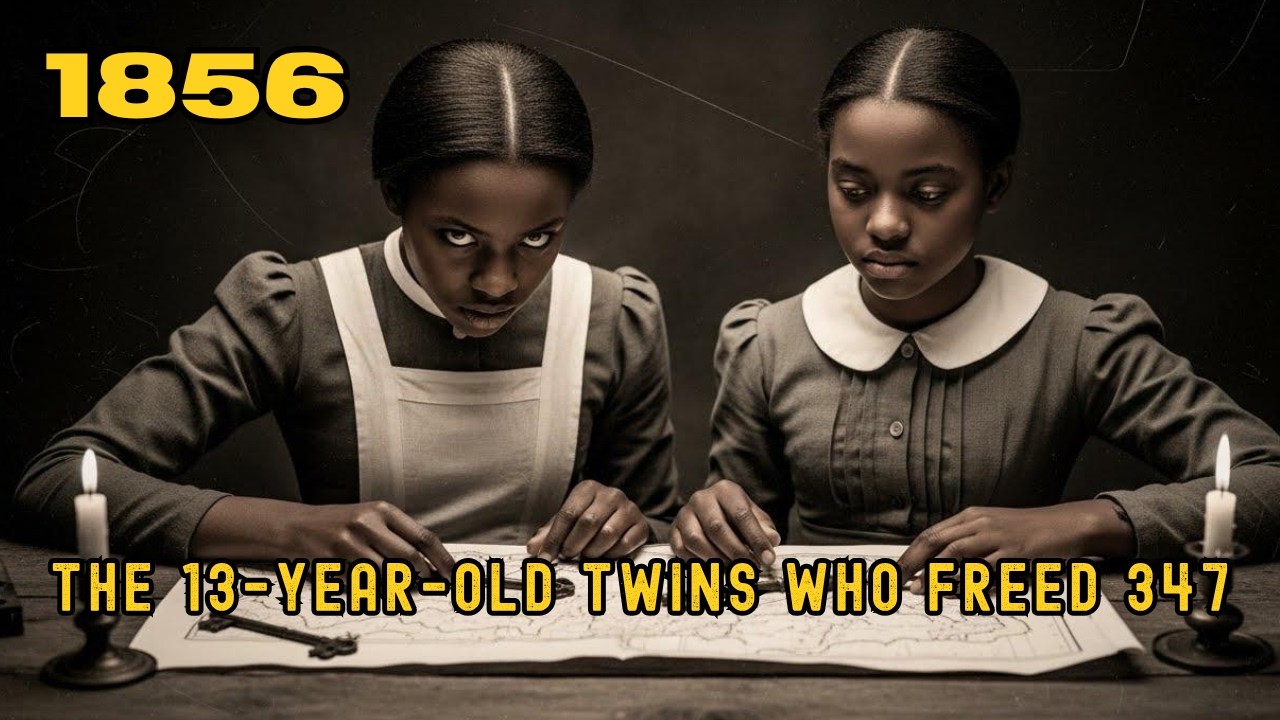
Cotton prices were rising, rice production was exceeding expectations, and his plantation was more profitable than ever. He discussed expansion plans with Caroline over breakfast while the twins poured coffee and eggs, as invisible as ever. Neither Josiah nor Caroline noticed the slight tremor in Emma’s hand as she poured the coffee. Neither noticed the look the twins exchanged when Caroline mentioned that the evening would be quiet.
Just family, no guests, no social obligations. Perfect, Emma thought. Absolutely perfect. The day passed with agonizing slowness.
Every hour felt like three. Every interaction with the overseers or house staff carried the possibility of discovery. Emma and Grace continued their duties while watching the sun track across the sky, counting down the hours until dusk. At four o’clock, Caroline Blackwood assigned the twins a task that initially seemed complicated but turned into an unexpected advantage.
She wanted the dining room of the main house prepared for a special dinner that evening. Fine china, silverware, candles, full formal service. Josiah’s brother had arrived unexpectedly from Charleston, and Caroline wanted to show him hospitality. Hospitality.
That meant Emma and Grace would be working in the main house during the crucial evening hours. It meant they would have legitimate reasons to move through the building, access the areas they needed, and plant the materials they had to plant. Their plan had just become easier to execute. At 6:30, as sunset painted Chatham County in shades of orange and red, the final preparations began across Blackwood Plantation.
To any observer, it looked like an ordinary evening. Workers returning from the fields, meals being prepared, the rhythms of daily plantation life continuing as they had for decades. But beneath that veneer of normalcy, sixty-eight core members of the network were executing their assigned tasks with precise coordination. Isaiah was distributing the keys he had spent months crafting.
Sarah was making sure everyone knew their travel groups and assigned routes. Jacob was organizing the field workers, ensuring that the elderly and children were paired with strong adults who could help them. Daniel and Marcus were preparing the horses and wagons that would be used for the first phase of the movement, vehicles that would carry those unable to walk eight miles through the gathering darkness. Thomas was making his final check of supply caches along the escape route, making sure food and water were placed at predetermined intervals.
Abigail was distributing the last supplies from the kitchen, quantities small enough to avoid notice but sufficient to sustain people during the journey. Everything was proceeding according to plan. Three hundred forty-seven people had been told only that tonight was their night. Follow your group leaders, trust the plan.
They were preparing for something they did not fully understand but desperately hoped would succeed. At 7:15, Josiah’s brother arrived from Charleston. His name was Marcus Blackwood, forty-two years old, a cotton planter from outside the city. He brought news of commodity prices, political developments, and social gossip.
The dinner conversation would likely last for hours, keeping Josiah and Caroline occupied at the table. Emma and Grace served the meal with flawless precision. Soup, fish, roast pork, vegetables, multiple courses requiring constant attention and service. They moved between the dining room and the kitchen, silent and efficient, while the Blackwood brothers discussed business affairs and Caroline managed the conversation with practiced social skill.
At 8:40, darkness had fully settled over the plantation. The moon was, as predicted, a thin sliver providing minimal light. Perfect conditions for what was about to happen. At 8:45, Isaiah opened the first lock.
The sleeping quarters holding sixty people were already empty because everyone had gathered outside, waiting. The lock opened silently, the key working perfectly, exactly as Isaiah had designed it. At 8:50, Jacob began moving the first group toward the eastern boundary of the plantation. Thirty people moving silently through the darkness, using routes Emma and Grace had mapped months earlier.
They traveled with a quiet born of years of survival instinct, knowing exactly how to move without attracting attention. At 9:00, the second group departed, then the third, then the fourth, like water flowing through channels. Three hundred forty-seven people began leaving Blackwood Plantation in coordinated streams. Each group followed specific routes toward rendezvous points near the Savannah River.
Daniel and Marcus moved the wagons at 9:15, carrying the elderly, the young children, and those too sick or injured to walk. The wagon wheels were wrapped in cloth to muffle sound. The horses had been trained for weeks to respond to minimal guidance. At 9:30, Emma and Grace were still serving dessert in the Blackwood dining room.
The brothers were immersed in a discussion of tariff policy, a topic apparently requiring extensive debate. Caroline was listening with the patient attention of someone who had mastered the art of appearing interested. At 9:45, the last group left Blackwood. Every corner was empty.
Every work building was abandoned. Three hundred forty-seven people had been evacuated in exactly one hour, moving through the darkness toward an uncertain future, but a future they would control themselves rather than one dictated by masters who valued them as property. At 10:00, Emma and Grace executed their diversion. It began quietly, so quietly that no one noticed at first.
A candle fell in the kitchen, near some towels that were drying. The twins had carefully arranged those towels earlier in the evening, soaked them in cooking oil, and positioned them to ignite easily once the candle fell. The fire started small, just smoke at first, barely noticeable. But smoke spreads quickly in wooden buildings, and within three minutes, someone in the house smelled it.
By the time Caroline Blackwood called for an investigation, the kitchen was fully ablaze. Flames were climbing the walls, consuming the dry wood with terrifying speed, generating heat that could be felt thirty feet away. Panic erupted immediately. Josiah and Marcus ran from the dining room.
Caroline began shouting orders. House staff rushed to respond, bringing buckets, organizing a water brigade, trying to contain a fire that had already gotten out of control. Emma and Grace ran toward the house, covered in soot and appearing panicked, screaming that the fire had started from the kitchen stove. They tried to help extinguish the flames, but the fire was spreading too fast.
They expressed profound regret at their failure to prevent it. No one questioned them. No one suspected them. Two thirteen-year-old girls crying in terror, covered in smoke and ash, clearly traumatized by the disaster they had inadvertently caused.
They were victims of the fire, not its architects. The kitchen burned completely. The flames spread to an adjacent storage building before the fire brigades could contain them. It took until midnight to fully extinguish the blaze and ensure it would not reignite.
During those critical hours between ten o’clock and midnight, while Josiah, Caroline, Marcus, and all the house staff fought to save the main house from burning, three hundred forty-seven people traveled eight miles through the darkness and reached the Savannah River. Thomas was waiting at the river with the boats, exactly as planned. Twelve small boats acquired over months through careful transactions and hidden in the vegetation along the bank. Not enough to carry everyone at once, but enough to ferry people across in organized groups.
The crossing began at 11:30. Thomas coordinated with the precision gained from decades at sea, organizing groups by size and weight, making sure the boats were not overloaded, maintaining sufficient distances to avoid collisions in the dark. The Savannah River at this point was about four miles wide, flowing with a steady current. The crossing required skill and courage, especially in near-total darkness without lights to guide navigation.
But Thomas knew these waters well. He had studied them for months in preparation for this exact moment. By 1:00 AM, the first groups were arriving on the South Carolina shore. The people Thomas had identified were waiting.
People whose opposition to slavery was so profound that they risked everything to help strangers escape. These guides would lead the fugitives to safe houses, provide food and directions, and help them continue their journey north toward an uncertain but chosen future. By 2:00 AM, more than half of the three hundred forty-seven people had crossed. The operation was succeeding.
The impossible was happening. Everything Emma and Grace had planned over nine months of careful preparation was being executed with remarkable precision. At Blackwood, the fire was finally contained. The kitchen was completely destroyed.
The adjacent storage building had sustained heavy damage, but the main house had survived, and no lives had been lost in the blaze. Josiah Blackwood stood in the smoke-filled yard surveying the damage, calculating the financial loss from the destroyed buildings and supplies. He was angry, but he was also practical. Buildings could be rebuilt.
Supplies could be replaced. The important thing was that the main house remained intact. It was not until 3:00 AM that someone finally thought to check the slave quarters. The messenger who ran to inform Josiah could barely get the words out.
“Sir, they’re gone. All of them. Every cabin is empty. Every building.
There’s no one here. Three hundred forty-seven people, gone. ”
The words did not make sense at first. Josiah’s exhausted mind struggled to process what he was hearing.
Gone. All of them. How? Then understanding hit with the force of a blow.
The fire had not been an accident. It had been a diversion. While he was fighting to save his property, his property was disappearing into the night. “Get Ridge!
” Josiah shouted. “Get every overseer. Get the patrol. Get the dogs.
Get everyone, now! ”
By 3:30, an organized chase had begun, but it was too late. The three hundred forty-seven people had a five-hour head start. They had crossed into South Carolina and dispersed into multiple groups taking different routes.
Tracking them all was logistically impossible. The dogs found tracks leading to the river, but the water crossing had eliminated the scent. Patrols searched through the night, but they had no specific direction to focus on. The fugitives had vanished as if they had never existed.
Emma and Grace, meanwhile, remained at Blackwood. They played their roles perfectly. Two frightened girls who had accidentally started a fire and were devastated by the consequences. They cried during questioning.
They trembled when Josiah shouted. They convinced everyone who saw them that they were victims of circumstances beyond their control. No one suspected them. How could they?
Two thirteen-year-old girls could not have planned and executed the largest mass escape in the history of Georgia. The idea was patently absurd. But they had. By sunrise on September 24, 1856, three hundred forty-seven people had won their freedom, and two identical faces watched from the windows of the main house as patrols returned empty-handed, knowing they had accomplished something that would echo through history.
The impossible had happened, because two thirteen-year-old girls had refused to accept that impossible meant anything other than “no one has done it yet. ”
The morning of September 24 brought chaos bordering on panic across Chatham County. News of the Blackwood escape spread with terrifying speed, carried by riders moving between plantations, merchants traveling the roads to Savannah, and the informal communication networks that connected the entire infrastructure of slavery. Three hundred forty-seven people had vanished in a single night.
The news provoked fear that transcended economic loss. This was not a handful of individuals fleeing for freedom. This was a mass evacuation, coordinated and executed with precision, indicating planning, organization, and leadership. If it could happen at Blackwood, it could happen anywhere.
Suddenly, the foundation of the entire system seemed less secure. That dawn, Josiah Blackwood stood in his smoke-damaged office, surrounded by his overseers and the county sheriff, a man named Robert Talbert. Talbert was fifty-six years old, a veteran law enforcement officer who had spent three decades maintaining order in Chatham County. He had dealt with numerous escape attempts before, but nothing on this scale.
“How is this possible? ” Talbert asked with genuine bewilderment. “Three hundred forty-seven people can’t simply vanish. Someone organized this.
Someone planned it. Find them. ”
“I don’t care about the cost,” Josiah said coldly, his fury barely contained. “Mobilize every resource.
Contact the authorities in South Carolina. Notify the slave catchers. Post rewards on every one of them. Find them.
”
The investigation that followed was the most intensive ever conducted in coastal Georgia. Talbert brought in experienced trackers from three counties. He coordinated with law enforcement in South Carolina. He interrogated everyone who remained at Blackwood, trying to identify who might have had information about the escape plan.
Emma and Grace were interviewed on September 25. Talbert spoke with them in the reception room of the main house, with Caroline Blackwood present. The twins sat with perfect posture, identical faces showing fear and confusion. “Did you see anything unusual in the days before the escape?
” Talbert asked. “Was anyone gathering supplies? Were there people meeting in unusual places? Were there conversations that seemed suspicious?
”
“No, sir,” Emma answered quietly. “Everyone was going about their usual business. We were mostly in the main house, so we didn’t see much of what happened in the quarters. ”
“The fire,” Talbert continued.
“Tell me exactly how it started. ”
“We were cleaning the kitchen after dinner,” Grace explained, her voice trembling with what appeared to be genuine distress. “There were a lot of candles because of the special dinner for Mr. Marcus.
One of them, I think Emma bumped the table when she was carrying dishes. The candle fell near some towels. The fire spread so fast, we tried to stop it, but… ” She broke down in tears.
Emma reached out and took her sister’s hand. The girls looked like two traumatized children overwhelmed by a catastrophe they had inadvertently caused. Talbert looked at the two small girls and saw exactly what they wanted him to see: victims, frightened servants who had made a terrible mistake. It never occurred to him that they might have deliberately started the fire to create a diversion for a mass escape.
Children did not do such things, especially children who appeared so fragile and traumatized. The investigation continued for weeks, expanding to adjacent counties and reaching into South Carolina. Investigators followed cold trails that led nowhere. Patrols searched forests and swamps without finding any trace of the missing three hundred forty-seven.
Rewards were offered, but no one came forward with useful information. By mid-October, the bitter truth was becoming clear. The fugitives had successfully dispersed, reaching destinations where tracking them was impossible. They had disappeared into the vastness of the American South, blending into free black communities, connecting with Underground Railroad networks, or simply vanishing into places no one thought to look.
The economic impact on Josiah Blackwood was catastrophic. The three hundred forty-seven people represented an investment of approximately two hundred thousand dollars in 1856 currency. Losing his entire workforce in a single night was financial devastation that threatened bankruptcy. Insurance did not cover mass escapes, and there was no compensation for this type of loss.
Blackwood was forced to sell large portions of his land to pay his debts. The plantation that had been among the most profitable in Chatham County became a shadow of its former self. By December 1856, Josiah employed only forty-three people, purchased at inflated prices in a market that had spiked sharply following the September escape. But the financial impact was secondary to the psychological one.
The escape had demonstrated something that plantation owners across the South found deeply threatening: that the enslaved population was capable of organization and planning. They could execute complex operations with the precision of military campaigns. The assumption of incapacity that underlay the entire system had been shattered. During November and December of 1856, plantation security across Georgia underwent radical changes.
Guards were increased, patrols were reorganized, and new restrictions were imposed on movement and assembly. The response to the Blackwood escape was fear spreading through the entire system, manifesting as increased repression. Emma and Grace followed these developments with mixed feelings. Their operation had freed three hundred forty-seven people, a remarkable success by any measure.
But it had also triggered responses that made life harder for thousands of others still trapped in the system. The twins understood the relationship between cause and effect and accepted responsibility for both intended and unintended consequences. What they did not yet know was whether their network members had reached safety. The plan specified no communication for at least six months, to protect everyone involved by creating no traceable connections.
The twins had to wait, wondering if Isaiah had made it north. If Sarah had gained her freedom. If Jacob, Daniel, Marcus, Abigail, and Thomas had survived the journey they had risked everything to undertake. The waiting was harder than the planning.
In January 1857, four months after the escape, Emma and Grace received their first indirect confirmation that some of their people had made it. A traveling merchant who regularly brought supplies from Savannah was speaking with Caroline Blackwood about recent news when he mentioned an interesting rumor he had heard in Charleston. They said a whole community of former slaves had settled somewhere in Pennsylvania. The merchant said perhaps three hundred people, all claiming to have come from Georgia plantations.
The authorities there were refusing to return them. Of course, Pennsylvania did not recognize the property rights of slaveholders. He had thought Caroline might find it interesting given what had happened at Blackwood. Emma, who was serving tea during this conversation, showed no reaction, but her heart was pounding.
Three hundred people from Georgia, in Pennsylvania. It could be coincidence, or it could be confirmation that the network had reached destinations where they could build new lives. That night, Grace whispered to her sister in their sleeping quarters. “Do you think it’s them?
”
“Some of them,” Emma answered. “Not all. Three hundred, not three hundred forty-seven. Some didn’t make it.
Some took different routes. But yes, I think a significant number reached Pennsylvania. We did it. ”
“We actually did it,” Grace said, wonder and relief mixing in her voice.
“We did it,” Emma confirmed. “And now we have to decide what we do next. ”
This question had occupied the twins for months. They had accomplished their goal at Blackwood.
They had proven that mass escape was possible. But they remained enslaved, still the property of Josiah Blackwood, still trapped in a system they had proven could be beaten but not yet destroyed. They could escape themselves. With the skills they had demonstrated and the resources they had accumulated during nine months of preparation, escape would be relatively easy.
But escaping would mean abandoning everyone still suffering under Blackwood’s system and at plantations throughout Chatham County. Or they could stay, use their unique position as trusted servants who had not been suspected of involvement in the September escape, and build another network, plan another impossible operation. The decision was not difficult. Emma and Grace had not survived their unknown earlier experiences merely to save themselves.
They had developed capabilities for strategic thinking and operational execution that would be wasted on personal escape attempts. They were weapons that could be aimed at a system that deserved to be dismantled piece by piece. They would stay. They would plan.
They would do it again. The morning of September 24 brought chaos bordering on panic across Chatham County. News of the Blackwood escape spread with terrifying speed, carried by riders moving between plantations, merchants traveling the roads to Savannah, and the informal communication networks that connected the entire infrastructure of slavery. Three hundred forty-seven people had vanished in a single night.
The news provoked fear that transcended economic loss. This was not a handful of individuals fleeing for freedom. It was a mass evacuation, coordinated and executed with precision, indicating planning, organization, and leadership. If it could happen at Blackwood, it could happen anywhere.
Suddenly, the foundation of the entire system seemed less secure. That dawn, Josiah Blackwood stood in his smoke-damaged office, surrounded by his overseers and the county sheriff, a man named Robert Talbert. Talbert was fifty-six years old, a veteran law enforcement officer who had spent three decades maintaining order in Chatham County. He had dealt with numerous escape attempts before, but nothing on this scale.
“How is this possible? ” Talbert asked with genuine bewilderment. “Three hundred forty-seven people can’t simply vanish. Someone organized this.
Someone planned it. Find them. ”
“I don’t care about the cost,” Josiah said coldly, his fury barely contained. “Mobilize every resource.
Contact the authorities in South Carolina. Notify the slave catchers. Post rewards on every one of them. Find them.
”
The investigation that followed was the most intensive ever conducted in coastal Georgia. Talbert brought in experienced trackers from three counties. He coordinated with law enforcement in South Carolina. He interrogated everyone who remained at Blackwood, trying to identify who might have had information about the escape plan.
Emma and Grace were interviewed on September 25. Talbert spoke with them in the reception room of the main house, with Caroline Blackwood present. The twins sat with perfect posture, identical faces showing fear and confusion. “Did you see anything unusual in the days before the escape?
” Talbert asked. “Was anyone gathering supplies? Were there people meeting in unusual places? Were there conversations that seemed suspicious?
”
“No, sir,” Emma answered quietly. “Everyone was going about their usual business. We were mostly in the main house, so we didn’t see much of what happened in the quarters. ”
“The fire,” Talbert continued.
“Tell me exactly how it started. ”
“We were cleaning the kitchen after dinner,” Grace explained, her voice trembling with what appeared to be genuine distress. “There were a lot of candles because of the special dinner for Mr. Marcus.
One of them, I think Emma bumped the table when she was carrying dishes. The candle fell near some towels. The fire spread so fast, we tried to stop it, but… ” She broke down in tears.
Emma reached out and took her sister’s hand. The girls looked like two traumatized children overwhelmed by a catastrophe they had inadvertently caused. Talbert looked at the two small girls and saw exactly what they wanted him to see: victims, frightened servants who had made a terrible mistake. It never occurred to him that they might have deliberately started the fire to create a diversion for a mass escape.
Children did not do such things, especially children who appeared so fragile and traumatized. The investigation continued for weeks, expanding to adjacent counties and reaching into South Carolina. Investigators followed cold trails that led nowhere. Patrols searched forests and swamps without finding any trace of the missing three hundred forty-seven.
Rewards were offered, but no one came forward with useful information. By mid-October, the bitter truth was becoming clear. The fugitives had successfully dispersed, reaching destinations where tracking them was impossible. They had disappeared into the vastness of the American South, blending into free black communities, connecting with Underground Railroad networks, or simply vanishing into places no one thought to look.
The economic impact on Josiah Blackwood was catastrophic. The three hundred forty-seven people represented an investment of approximately two hundred thousand dollars in 1856 currency. Losing his entire workforce in a single night was financial devastation that threatened bankruptcy. Insurance did not cover mass escapes, and there was no compensation for this type of loss.
Blackwood was forced to sell large portions of his land to pay his debts. The plantation that had been among the most profitable in Chatham County became a shadow of its former self. By December 1856, Josiah employed only forty-three people, purchased at inflated prices in a market that had spiked sharply following the September escape. But the financial impact was secondary to the psychological one.
The escape had demonstrated something that plantation owners across the South found deeply threatening: that the enslaved population was capable of organization and planning. They could execute complex operations with the precision of military campaigns. The assumption of incapacity that underlay the entire system had been shattered. During November and December of 1856, plantation security across Georgia underwent radical changes.
Guards were increased, patrols were reorganized, and new restrictions were imposed on movement and assembly. The response to the Blackwood escape was fear spreading through the entire system, manifesting as increased repression. Emma and Grace followed these developments with mixed feelings. Their operation had freed three hundred forty-seven people, a remarkable success by any measure.
But it had also triggered responses that made life harder for thousands of others still trapped in the system. The twins understood the relationship between cause and effect and accepted responsibility for both intended and unintended consequences. What they did not yet know was whether their network members had reached safety. The plan specified no communication for at least six months, to protect everyone involved by creating no traceable connections.
The twins had to wait, wondering if Isaiah had made it north. If Sarah had gained her freedom. If Jacob, Daniel, Marcus, Abigail, and Thomas had survived the journey they had risked everything to undertake. The waiting was harder than the planning.
In January 1857, four months after the escape, Emma and Grace received their first indirect confirmation that some of their people had made it. A traveling merchant who regularly brought supplies from Savannah was speaking with Caroline Blackwood about recent news when he mentioned an interesting rumor he had heard in Charleston. They said a whole community of former slaves had settled somewhere in Pennsylvania. The merchant said perhaps three hundred people, all claiming to have come from Georgia plantations.
The authorities there were refusing to return them. Of course, Pennsylvania did not recognize the property rights of slaveholders. He had thought Caroline might find it interesting given what had happened at Blackwood. Emma, who was serving tea during this conversation, showed no reaction, but her heart was pounding.
Three hundred people from Georgia, in Pennsylvania. It could be coincidence, or it could be confirmation that the network had reached destinations where they could build new lives. That night, Grace whispered to her sister in their sleeping quarters. “Do you think it’s them?
”
“Some of them,” Emma answered. “Not all. Three hundred, not three hundred forty-seven. Some didn’t make it.
Some took different routes. But yes, I think a significant number reached Pennsylvania. We did it. ”
“We actually did it,” Grace said, wonder and relief mixing in her voice.
“We did it,” Emma confirmed. “And now we have to decide what we do next. ”
This question had occupied the twins for months. They had accomplished their goal at Blackwood.
They had proven that mass escape was possible. But they remained enslaved, still the property of Josiah Blackwood, still trapped in a system they had proven could be beaten but not yet destroyed. They could escape themselves. With the skills they had demonstrated and the resources they had accumulated during nine months of preparation, escape would be relatively easy.
But escaping would mean abandoning everyone still suffering under Blackwood’s system and at plantations throughout Chatham County. Or they could stay, use their unique position as trusted servants who had not been suspected of involvement in the September escape, and build another network, plan another impossible operation. The decision was not difficult. Emma and Grace had not survived their unknown earlier experiences merely to save themselves.
They had developed capabilities for strategic thinking and operational execution that would be wasted on personal escape attempts. They were weapons that could be aimed at a system that deserved to be dismantled piece by piece. They would stay. They would plan.
They would do it again. On February 1, 1857, new arrivals came to Blackwood. Josiah had purchased twenty-three people from various sources in an attempt to rebuild his workforce. These newcomers provided Emma and Grace with new recruiting opportunities.
Not everyone would be suitable, but the twins had learned how to identify the signs of intelligence, resilience, and willingness to take extraordinary risks. They began rebuilding their network with even greater care than before. The first escape had succeeded partly through luck. The second operation would face heightened security and increased suspicion.
Everything would need to be more sophisticated, more carefully concealed, more precisely executed. By March, the twins had recruited five core members among the newcomers. Not enough for another mass escape, but enough to begin planning something different. If they could not evacuate everyone at once again without triggering the kind of security response that would make success impossible, perhaps they could execute a series of smaller operations, ten people at a time, moving through carefully defined routes, with escapes spaced apart to avoid detection.
But in April 1857, everything changed. Sheriff Talbert received a communication from authorities in Pennsylvania. The communication included depositions from several individuals who had escaped from Blackwood on September 23, 1856. They were providing information in exchange for assurances that they would not be returned to Georgia.
The deposition described in detail the organization of the escape, named members of the core network, described the planning process, the supply caches, the route coordination, and briefly but definitively noted that two young twin girls who worked in the main house had been present at planning meetings and appeared to have detailed knowledge of the operation. Talbert read this deposition with growing certainty. He had interviewed those twins and dismissed them as traumatized children. The communication from Pennsylvania suggested he had made a profound error in judgment.
On April 15, 1857, Talbert returned to Blackwood Plantation and requested another meeting. With Emma and Grace, this time without Caroline present. He wanted to observe them without their mistress there to shield them. The twins immediately sensed that something had changed.
Talbert’s demeanor was different. He watched them with a sharp, suspicious gaze rather than routine interrogation. His questions were more pointed, designed to test the consistency of their earlier statements. “Tell me again about the planning meetings,” Talbert said cautiously.
“The ones that supposedly took place before the escape. Did you ever see groups gathering in unusual places? ”
“No, sir,” Emma answered with complete composure. “We were usually in the main house during the evening hours.
”
“But you delivered food to the forge sometimes, didn’t you? ” Talbert pressed. “I have documentation that kitchen servants brought meals to Isaiah when he was working late. ”
“Yes, sir,” Grace confirmed.
“We sometimes brought bread or water to workers in various buildings. ”
“Did you see anything unusual during those visits? Anything that seemed strange? ”
The twins recognized the trap.
Talbert had information that contradicted their earlier claims of ignorance. He was testing whether they would maintain their story or modify it. Both responses carried significance. The stakes were high.
Emma made a decision that demonstrated the strategic thinking that had characterized every action she had taken since arriving at Blackwood. She would give Talbert a piece of the truth sufficient to satisfy his suspicions without revealing the full extent of their involvement. “There were some nights,” Emma said slowly, as if reluctant to share information. “We didn’t understand what they were doing.
We were afraid to ask because it seemed like something we weren’t supposed to see. ”
“Why didn’t you report this? ” Talbert asked. “Because we were scared,” Grace answered, her voice trembling in a performance of fear that was partially genuine.
“We’re just children. We didn’t know if what we saw was wrong, and we were afraid of being punished for speaking about things that weren’t our business. ”
Talbert studied the twins carefully. Their explanation was plausible.
Frightened children who had witnessed something suspicious but didn’t understand its significance, too afraid to report it. It fit the picture he had formed of them as victims rather than perpetrators. But Talbert was also an experienced investigator. Something about the twins, their complete composure, their never contradicting each other, the precision of their answers, troubled him.
They were not ordinary thirteen-year-old girls. They were too controlled, too deliberate, too intelligent. “I think you know more than you’re telling me,” Talbert said carefully. “I think you were involved in the escape.
Perhaps not as leaders, but as accomplices who provided information or assistance. ”
“No, sir,” Emma insisted. “We’re just servants. We do what we’re told.
We don’t plan things or organize things. We’re children. ”
The word “children” was emphasized deliberately. Emma was reminding Talbert of the absurdity of his core suspicion.
How could enslaved children, with no authority or influence, have orchestrated an operation that had defeated every security measure in Chatham County? Talbert wanted to believe they were involved. His instincts told him these twins were hiding more than they appeared to be. But instincts were not evidence, and without evidence, he could not act on suspicions that seemed increasingly absurd when stated plainly.
He left Blackwood on April 15 without making any arrests or filing formal charges. But he also left convinced that Emma and Grace knew more than they admitted. He would watch them and wait for them to make a mistake. The twins understood that their situation had changed radically.
They were now under suspicion. Any unusual activity would be scrutinized. Any connection to future escape attempts would immediately point to them. Their value as covert operatives had been compromised.
That night, Emma and Grace had the most dangerous conversation of their lives. “We can’t stay,” Grace said. “Talbert suspects us. If anything else happens, we’ll be blamed.
They’ll interrogate us properly this time. ”
“I know,” Emma agreed. “But we also can’t just leave the people we just recruited. We promised to help them escape.
And we can help them escape by connecting them to the roots we’ve established. ”
Grace suggested that they provide the information, resources, and contacts, but not remain where they were under surveillance. Emma considered this carefully. It went against her preference for maintaining direct control over operations.
But it also acknowledged reality. Sometimes the best contribution was providing tools and information rather than trying to manage everything personally. “We need to create something sustainable,” Emma said slowly. “Not just escape routes that work once, but systems that can continue without us.
Networks that others can operate. Information that passes from person to person even after we’re gone. ”
This idea evolved over the following weeks into something more ambitious than either twin had initially envisioned. Instead of planning another mass escape, they would create infrastructure.
Document the routes they had established. Record the names and locations of helpful contacts. Compile information about security patterns, patrol schedules, and safe passages. Create a fundamental guide for executing successful escapes.
But documenting this information carried enormous risk. If the documents were discovered, they would provide evidence of everything. Suspicions Talbert held. They would expose the entire network, past and present.
They would lead to trials, executions, and wholesale repression. The twins needed to hide their documents in ways that made discovery nearly impossible while ensuring the information could reach those who needed it. They found their solution through Abigail, the cook who had been part of the original network and had successfully escaped to Pennsylvania. Before leaving, Abigail had taught several young women her cooking methods, passing along her recipes and techniques.
Emma and Grace realized they could do the same thing, not with cooking, but with escape planning. They would pass their knowledge to trusted individuals, one by one, ensuring that the information existed in multiple minds rather than in a single document. They would create human libraries: people who memorized the roots, contacts, and methods. The knowledge would become an oral tradition, passed from person to person, impossible to destroy by burning papers or seizing documents.
They spent May and June of 1857 in careful instruction. The twins identified twelve people among the newcomers and remaining workers at Blackwood who demonstrated the intelligence and commitment necessary to memorize and transmit complex information. They trained these twelve in everything they knew about escape planning, movement coordination, identifying security gaps, and communicating with helpful contacts. Each of the twelve was tasked with training at least two others, creating an exponential spread of knowledge through networks that extended from Blackwood to plantations throughout Chatham County and then across Georgia.
Emma and Grace were building something unprecedented. Not just escape routes, but an educational system that transformed the enslaved into strategic thinkers capable of planning and executing their own liberation. By July 1857, the twins realized that their work at Blackwood was complete. They had freed people directly.
They had trained dozens in methods that would enable hundreds of additional escapes. They had created knowledge systems that would endure long after their departure. It was time to leave. Not just Blackwood, but Georgia entirely.
The twins learned through their network that Pennsylvania offered opportunities for free black individuals, including children. Philadelphia, in particular, had communities that would welcome them, schools that would educate them, possibilities that did not exist in the South. They planned their departure for August 23. Exactly one year after the mass escape, a symmetry that appealed to them, reminding them of a well-constructed narrative.
They would leave the same way they had helped others leave, traveling at night along the routes they had mapped, connecting with their contacts, heading toward the freedom they had earned through extraordinary effort and risk. On August 22, the day before their planned departure, Emma and Grace performed their duties in the main house with the same silent efficiency they had maintained for twenty months. They served food, cleaned rooms, met every expectation. They gave Josiah and Caroline no reason for suspicion.
They gave no indication that they would be leaving the next night. That night, lying in their sleeping quarters for the last time, the twins reviewed their accomplishments with quiet satisfaction. “Three hundred forty-seven people freed directly,” Emma whispered. “At least sixty more trained in escape methods.
Knowledge spread to hundreds. Infrastructure created that will last for years. ”
“Not bad,” Grace said quietly. “For two thirteen-year-old girls that no one took seriously.
”
“Fourteen now,” Emma corrected. “We turned fourteen in January, although I suppose no one thought to celebrate. ”
“We’ll celebrate in Philadelphia,” Grace said. “When we’re free.
When we’ve built new lives. When we can finally stop pretending to be helpless children. ”
“Do you think we’ll ever stop planning? ” Emma asked.
“Even when we’re free, even when we’re safe, will we be able to just exist? Or have we become so completely what we needed to be that we can’t go back to being ordinary? ”
Grace considered this question seriously. “I think we were never ordinary.
Whatever happened to us before Charleston, before Blackwood, shaped us into something different. We can’t go back because there’s nothing to go back to. We can only go forward. ”
“Then forward it is,” Emma said.
“Tomorrow night. Pennsylvania. Freedom. And everything that comes after.
”
August 23, 1857, began like any other day at Blackwood Plantation, which was exactly what Emma and Grace wanted. They woke before dawn, prepared breakfast for the household, and served Josiah and Caroline with the silent efficiency that had made them nearly invisible during twenty months of diligent work. But this morning carried a weight only the twins felt. Every task was being performed for the last time.
Every interaction was a final performance. When the sun set, they would be gone, and Blackwood would become just another chapter in their carefully hidden history. The day passed with agonizing slowness. Emma and Grace performed their duties with mechanical precision while watching the sun’s progress across the sky, counting the hours until darkness would provide their cover.
At four o’clock, Sheriff Talbert arrived at Blackwood without warning. The twins were in the kitchen when they saw him coming up the main road, identical expressions of concern crossing their faces. Talbert’s visits were never casual. He came when he had information or suspicions worth pursuing.
Caroline received him in the sitting room, and Emma served tea while Grace stood nearby with refreshments. The twins maintained perfect servant posture, eyes downcast, bodies positioned to be present without being intrusive. “I’ve received additional correspondence from Pennsylvania,” Talbert said, accepting the tea without looking at Emma. “More depositions from individuals who escaped last September.
They’re providing increasingly detailed accounts of the planning and execution. Several things have been confirmed, including descriptions of the people who led the planning meetings. Two individuals have been mentioned repeatedly: a blacksmith named Isaiah, and… ” He paused, letting the silence build deliberately.
“Two young girls who apparently had detailed knowledge of security patterns, patrol schedules, and main house operations. ”
The words hung in the air like smoke from the fire that had destroyed Blackwood’s kitchen eleven months earlier. Emma’s hand trembled slightly as she set down the tea service, a reaction that could be interpreted as fear or nervousness, but was in fact a controlled performance of those exact emotions. “You’re not suggesting Emma and Grace were involved,” Caroline said slowly.
“They’re children. They barely speak unless spoken to. The idea is absurd. ”
“Is it?
” Talbert asked, turning to look directly at the twins for the first time. “I’ve been investigating this case for nearly a year. I’ve interviewed dozens of people. I’ve traced leads across three states.
And do you know what I’ve learned? The most dangerous assumptions are the ones about who is capable of what. ” He stood and walked toward Emma and Grace, studying their identical faces with an intensity that made the moment feel like an interrogation despite the civilized parlor setting. “Tell me something,” Talbert said quietly.
“If you were planning a mass escape, if you needed to gather intelligence about security, schedules, and vulnerabilities, who would you use as agents? Strong men whose movements would be noticed, or young girls everyone ignores because they’re just servants? ”
Emma looked directly at him, dropping her demure, submissive gaze. When she spoke, her voice carried a steadiness that belied her fourteen years.
“Sheriff Talbert, you’re suggesting that two enslaved children outsmarted every overseer, every guard, and every security measure in Chatham County. You’re suggesting that we planned and executed an operation that freed three hundred forty-seven people right under your nose. Does that seem likely to you? ”
The directness of her response startled Talbert.
This was not how enslaved girls spoke to white authorities. The very fact that she challenged his hypothesis, even politely, suggested a confidence that supported his suspicions rather than contradicting them. “I think unlikely things happen more often than we expect,” Talbert said carefully. “I think people underestimate children, especially girls, especially enslaved children.
And I think that underestimation creates opportunities for those smart enough to exploit them. ”
“Then we’re much smarter than anyone thinks,” Grace said, speaking for the first time, her voice matching her sister’s steady tone. “But if we were really that smart, why would we still be here? Wouldn’t we have escaped with everyone else?
”
This question was the twins’ strongest defense, and both of them knew it. Their continued presence at Blackwood after the mass escape was the one fact that most convincingly contradicted Talbert’s theory. If they had been central to planning the operation, logic suggested they would have escaped with their network. Unless Talbert believed they had stayed precisely because leaving would confirm suspicions.
Unless they understood that remaining, playing the role of innocent servants traumatized by events beyond their control, provided the perfect cover for their guilt. Talbert wanted to arrest them. His instincts screamed that these two girls were exactly what the Pennsylvania deposition suggested: brilliant strategic minds who had orchestrated the largest successful escape in Georgia’s history. But instinct was not evidence, and arresting them without proof would make him look foolish while potentially allowing the real organizers to escape scrutiny.
“I’ll be watching you,” Talbert said finally. “Both of you. If anything unusual happens, if anyone else disappears, if there’s any indication of planning or coordination, I’ll know where to look first. ”
“We’re just servants, sir,” Emma said, returning to her submissive tone and downcast gaze.
“We do what we’re told. Nothing more. ”
Talbert left Blackwood that evening, convinced of the twins’ guilt but powerless to prove it. He had revealed his hand too early, expressing his suspicions before gathering sufficient evidence.
It was a tactical error he would regret for years. Emma and Grace understood that the meeting had changed everything. Talbert was watching them now. Departing as planned would look like a confirmation of guilt.
But staying meant living under constant surveillance, unable to move freely, unable to help the people they had recently recruited. They made their decision in the kitchen after Talbert left. They would leave that night as planned, but they would ensure their departure did not look like an escape. They would create a scenario that deflected suspicion while granting them the freedom they had earned.
At seven o’clock that evening, Emma approached Caroline Blackwood with a request that appeared to stem from genuine distress. “Ma’am,” she said quietly. “My sister and I are frightened. Sheriff Talbert thinks we were involved in the escape.
We weren’t, but he doesn’t believe us. We’re afraid he’ll arrest us just to close his investigation. ”
Caroline studied Emma’s face and saw what appeared to be genuine fear. The twins had been perfect servants for twenty months.
They had never caused problems, never shown disobedience, never given any indication that they were anything but obedient children. “Sheriff Talbert can’t arrest you without evidence,” Caroline reassured her. “There’s nothing to worry about. ”
“But what if he fabricates evidence?
” Grace asked, joining her sister. “What if he needs a scapegoat and we’re convenient? We’re just property. No one would question it if he took us.
”
The concern was valid. The enslaved had no legal protection against false accusations. If Talbert decided to arrest them for the escape, regardless of actual evidence, there was no recourse. “Please,” Emma said, her voice sounding like a desperate plea.
“Could we be sold to someone far away, somewhere Sheriff Talbert’s investigation can’t reach? We’ll work hard, we promise. All we want is to not be arrested for something we didn’t do. ”
Caroline Blackwood was not an emotional woman, but she also recognized practical reality.
The twins were valuable property, and their value would be negatively affected if they were caught up in the escape investigation. Selling them to a buyer in another state would remove them from Talbert’s reach while recouping their purchase price. “I’ll speak with Mr. Blackwood,” Caroline said.
“Perhaps we can arrange something within the next few days. ”
The Blackwoods arranged to sell Emma and Grace to a cotton trader from Alabama who was traveling through Savannah. The trader, a man named Edward Thornhill, purchased the twins for twelve hundred dollars, slightly below market value, but acceptable under the circumstances. The sale was documented, ownership legally transferred, and completed on August 26, 1857.
Emma and Grace were placed in Thornhill’s wagon for transport to Alabama, leaving Blackwood Plantation while Sheriff Talbert watched from a distance, frustrated but unable to prevent the transfer of property. What Talbert did not know was that Edward Thornhill was not actually a cotton trader from Alabama. He was a Quaker abolitionist from Philadelphia who traveled south periodically under a false identity, purchasing enslaved people and transporting them to freedom. The twins had contacted his network months earlier through channels established during the mass escape planning.
The sale was an elaborate performance designed to get Emma and Grace out of Georgia legally, with documentation that would prevent any attempt at pursuit or recovery. By the time Talbert realized what had happened, if he ever did, the twins would be in Pennsylvania with papers declaring their freedom. The journey north took three weeks. Thornhill transported Emma and Grace along with seven others he had purchased from various locations, maintaining his trader cover until they crossed into Pennsylvania on September 16, 1857.
Philadelphia in 1857 was a city of contradictions. It offered opportunities for free black residents that did not exist in the South, but it also maintained deep racial prejudice and segregation. Emma and Grace entered this complex environment with the same strategic thinking they had applied to everything else. They needed education, work, and community.
Thornhill’s network helped provide initial housing, connecting them with a Quaker family who provided lodging in exchange for domestic work while they attended school. For the first time in their documented lives, Emma and Grace had access to formal education. They learned to read and write with a passion that astonished their teachers. They absorbed mathematics, history, geography, and science with the same intense focus they had once used to memorize guard schedules and plan escape routes.
By 1858, both twins were reading at levels far beyond their peers. By 1859, they were teaching other students, sharing knowledge with the same systematic approach they had used to train their network at Blackwood. But education and stability did not erase the drive that had shaped them. Emma and Grace could not simply live as ordinary girls pursuing ordinary lives.
They had been weapons, forged by experiences they never discussed, sharpened by necessity, aimed at targets worthy of destruction. They needed a purpose beyond personal comfort. They found that purpose in Philadelphia’s organized resistance to slavery. The abolition movement was expanding.
The Underground Railroad operated openly in some areas, defying federal fugitive slave laws. Abolitionist societies met regularly, planning operations and coordinating assistance for fugitives. Emma and Grace joined these networks, initially as participants but soon as organizers. Their experience in planning and executing the Blackwood escape made them valuable consultants.
Their strategic thinking impressed movement leaders who had spent decades working on these issues. By 1860, the twins were running safe houses, coordinating travel routes, and training others in the methods they had developed. They had transformed themselves from escaped children into skilled operatives working within the broader infrastructure of resistance. They also maintained contact with people from their Blackwood network who had reached the north.
Isaiah had settled in Pittsburgh, working as a blacksmith and helping other arrivals find employment. Sarah was in Boston, part of a growing community of former Blackwood residents. Jacob remained in Philadelphia, sometimes working with the twins. Through these connections, Emma and Grace confirmed what they had hoped.
Of the three hundred forty-seven people who fled on September 23, 1856, at least two hundred ninety successfully reached free states and began new lives. Some had died during their journey north. Others had been recaptured. But the majority had made it, gained their freedom, and built futures they controlled.
This success was unprecedented. Mass escape attempts typically failed catastrophically or succeeded for only a small percentage of participants. The Blackwood operation had succeeded for over eighty percent of participants, a testament to the careful planning and execution overseen by Emma and Grace. In December 1860, South Carolina seceded from the Union, signaling the beginning of the process that would lead to civil war.
Emma and Grace, now seventeen years old, followed these developments with intense interest. The system they had fought their entire lives was collapsing under the weight of its own contradictions. When war broke out in April 1861, the twins saw opportunities beyond individual escape operations. A large-scale conflict would create chaos that could be exploited.
Military operations would destabilize plantation security. The federal government might take meaningful action against slavery. Emma and Grace began working with military authorities, providing intelligence about plantation operations, security systems, and resistance networks. Their accumulated knowledge from years of observation and operations proved valuable to Union commanders planning campaigns in Southern territory.
They also worked with contraband camps, the settlements that formed around Union armies where escaped slaves gathered for protection. The twins helped organize these camps, applying their strategic thinking to problems of housing, food distribution, and security. By 1863, when the Emancipation Proclamation explicitly made ending slavery a goal of the war, Emma and Grace had become prominent figures in abolitionist circles. People knew them as the twins who had organized the Blackwood escape, who had freed nearly three hundred people, who had created knowledge systems that enabled countless additional escapes.
But few people knew the full scope of what the twins had accomplished. Very few understood the psychological cost of becoming what they were. The twins had sacrificed a normal childhood, normal development, normal experiences, to become instruments of liberation. In 1865, when the war ended and the Thirteenth Amendment abolished slavery throughout the United States, Emma and Grace stood in the streets of Philadelphia watching the celebrations, feeling satisfaction mixed with something more complex.
They had devoted their lives to fighting a system that no longer legally existed. The impossible thing they had accomplished at Blackwood, the mass escape that no one believed could happen, was now just history. One event among thousands in the larger narrative of slavery’s destruction. “What do we do now?
” Grace asked her sister, watching the crowds celebrate emancipation. “We become who we were supposed to be before circumstances turned us into something else,” Emma said quietly. “We find out if we can actually live normal lives after spending our entire existence planning and fighting. ”
This transition was harder than either twin had anticipated.
Emma and Grace were twenty-two years old in 1865, but their experiences made them seem older. They had killed people, though they never spoke of those early acts that preceded the Blackwood incident. They had manipulated others, sacrificed individuals for collective goals. They had made decisions that haunted them even when strategically justified.
Learning to live without constant threat, without the need for perpetual vigilance, without a purpose defined by resistance, was a challenge unlike anything they had faced in planning the escape. They remained in Philadelphia, working in education. Emma became a teacher at a school for children who had been formerly enslaved, passing on knowledge with the same systematic approach she had applied to everything else. Grace worked with literacy programs, teaching adults to read and write, giving people the tools to navigate their newly free but still hostile world.
The twins never married. They lived together in a modest house in Philadelphia’s Seventh Ward, maintaining the bond that had existed since birth and had been strengthened by shared experiences no one else could fully understand. They also never told anyone the complete story. When asked about their past, they provided basic information.
Yes, they had been enslaved in Georgia. Yes, they had escaped and made their way north. Yes, they had been involved in helping others gain their freedom. But the full details, the planning and execution of the Blackwood escape, the strategic thinking that had freed three hundred forty-seven people, the knowledge systems they had created, all of it remained hidden.
In 1872, seven years after emancipation, Emma and Grace received a letter from Chatham County, Georgia. It was from a man named Marcus Blackwood, Josiah’s brother, who had been present at the dinner on the night of the kitchen fire. The letter was brief. “Miss Emma and Miss Grace, I am writing to inform you that my brother Josiah passed away last month.
In his final years, he became obsessed with the escape of 1856. He believed you were responsible for it, though he could never prove it. Sheriff Talbert believed the same thing until his death in 1868. I want you to know that I understand what you did.
I don’t condone it, but I understand it. You took three hundred forty-seven people who were legally considered property and turned them into free human beings through intelligence, planning, and courage alone. My brother never recovered, financially or psychologically, from what happened. Blackwood Plantation was sold in 1863.
The land is now divided among multiple owners. The system you fought no longer exists, destroyed by the war and its aftermath. I believe I am writing to tell you that you won. Whatever your goals were on that September night in 1856, you achieved them.
The impossible happened because two children refused to accept its impossibility. I do not expect a reply. I merely wanted you to know that your actions are still remembered and that at least one member of the Blackwood family acknowledges what you accomplished. With respect, Marcus Blackwood.
”
Emma and Grace read this letter together in their Philadelphia home. For the first time in years, they discussed that September night in 1856 when they had watched three hundred forty-seven people disappear into the darkness toward unknown freedom. “Do you think we were right? ” Grace asked.
“Everything we did, the way we did it. ”
“I think we did what was necessary,” Emma said. “Right and wrong are philosophical questions. We dealt in practical realities.
People were suffering. We had the capacity to alleviate that suffering. ”
“We used that capacity at great cost to ourselves,” Grace noted. “At great cost to ourselves,” Emma agreed.
“But I would make the same choices again. Wouldn’t you? ”
Grace considered this question seriously before answering. “Yes, I would.
Although I wish we could have been different people, ordinary people who didn’t have to become what we became. ”
“We were never going to be ordinary,” Emma said gently. “Whatever happened to us before Charleston, before Blackwood, shaped us into something specific. We can regret the necessity, but we shouldn’t regret using what we became to help others.
”
This conversation was the closest the twins ever came to discussing their history before the documented records began. Even with each other, even in private, they maintained silence about whatever experiences had taught them strategic thinking, operational security, and the kind of focused violence that characterized their earliest actions. Emma and Grace understood that the secrets they carried were either too dangerous or too painful to reveal, even to each other. Emma died in 1891 at the age of forty-eight from complications of pneumonia.
Grace followed her three months later, as if unable to live separated from the twin who had been her constant companion through extraordinary circumstances. They were buried together in Eden Cemetery in Philadelphia, one of the first cemeteries in America established specifically for African Americans. Their shared headstone bore a simple inscription: “Emma and Grace, 1843-1891. They accomplished the impossible.
”
The precise details of the Blackwood escape were not recorded on their headstone. Most of those who attended their funerals knew them as teachers and literacy advocates, not as the planners of one of the most successful mass escapes in history. But in archives throughout the northeastern United States, in the records of the Chatham County courthouse, in the letters and personal depositions preserved by historical societies, the story existed. Three hundred forty-seven people had vanished from Blackwood Plantation on September 23, 1856.
The investigation that followed, supplemented by depositions from Pennsylvania, established that the twins had been central to planning the escape, an unprecedented achievement. Historians who studied these records in subsequent decades struggled to reconcile the documented facts with assumptions about what children, especially enslaved children, could accomplish. The story seemed impossible, which was precisely why it had succeeded. People underestimated children.
They underestimated girls. They underestimated the enslaved. Emma and Grace recognized these assumptions and exploited them with a precision that suggested either extraordinary intelligence or intensive prior training in strategic operations. The truth was likely both.
The twins had survived something before their documented history began, something that had trained them in ways that should not have been possible at their age. They had then applied that training to the conditions at Blackwood, converting theoretical knowledge into practical operations that freed hundreds of people. What made their story particularly remarkable was not just the escape itself, but the broader impact: the knowledge systems they created, the education they provided to network members, the infrastructure they built for ongoing resistance. This impact continued long after the twins left Georgia.
Estimates suggest that the methods and routes developed during the Blackwood planning were used in at least two hundred additional successful escapes between 1856 and 1865. The information Emma and Grace passed to their network members spread among Georgia’s enslaved population, creating a decentralized resistance infrastructure that authorities found impossible to destroy because it existed in human memory rather than physical documents. The twins had built something that outlasted them. Not just freedom for three hundred forty-seven specific people, but a model others could replicate.
Not just escape routes, but educational systems that transformed the oppressed into strategic thinkers capable of planning and executing their own liberation. This legacy mattered more than individual heroism. Emma and Grace were not heroes in the traditional sense. They had made morally questionable decisions.
They had sacrificed innocence when necessary. They had transformed themselves into something darker than children should have to become. But they had also freed hundreds of people and produced knowledge that freed hundreds more. Their story existed in the uncomfortable spaces between heroism and pragmatism, between resistance and vengeance, between justified violence and troubling brutality.
It defied simple moral categorization, which was precisely what made it worth remembering and studying. In 2019, researchers at the University of Georgia discovered additional documents related to the Blackwood escape. Personal letters from Emma and Grace, written in the 1880s to former network members, had been preserved by descendants and donated to historical archives. These letters provided new details about the planning and execution of the escape, confirming much of what had been speculated but never proven.
One letter, written by Emma to Isaiah in 1884, contained a passage that captured the twins’ view of their actions: “You asked me whether I regret what we did all those years ago. I regret the necessity. I regret that circumstances forced children to become strategists and executioners. I regret that we had to sacrifice innocence and morality to achieve goals that should have been achieved by adults but were not.
But I do not regret the outcomes. Three hundred forty-seven people gained their freedom because two girls refused to accept that something was impossible. Hundreds more escaped using the knowledge we created and shared. This is not a justification for what we became, but it is a justification for what we did.
We were weapons, Isaiah. Forged by experiences we never spoke of, sharpened by necessity, aimed at targets worthy of destruction. Weapons cannot be judged as good or evil. They can only be judged by the causes they serve and the skill with which they are used.
We served liberation. We were used with precision. That is enough for me. ”
This letter, now displayed at the National Museum of African American History and Culture in Washington, D.
C. , represents one of the rare instances where Emma explicitly addressed the philosophical questions surrounding her actions. The Blackwood escape remains one of the most studied events in the history of American slavery resistance. Underground Railroad courses treat it as a case study in strategic planning.
Slave rebellion books analyze it as an example of organized resistance. Discussions of children in extraordinary circumstances cite it as evidence of what young people can achieve when necessity demands it. But the story also raises troubling questions that resist easy answers. How much violence is justified in resisting oppression?
What moral compromises are acceptable when fighting evil systems? What price should individual souls pay for collective liberation? Can people who commit terrible acts for good reasons be considered heroes? Emma and Grace never provided definitive answers to these questions.
They lived their lives, achieved their goals, and left history to judge their actions by whatever standards future generations chose to apply. What can be said with certainty is this: two fourteen-year-old girls, enslaved and powerless by every legal and social standard of their time, planned and executed an operation that freed three hundred forty-seven people, created knowledge systems that enabled hundreds more escapes, and proved that “impossible” was just another word for things that required more courage and intelligence than most people possessed. They did it through strategic thinking, operational precision, moral flexibility, and an absolute refusal to accept that their age, their gender, or their legal status limited what they could achieve. Whether that made them heroines, pragmatists, or something more complex is a question each person must answer for themselves.
History provides the facts. Interpretation remains perpetually contested. But on September 23, 1856, the impossible happened in Chatham County, Georgia. It happened because two identical faces looked at a system built on violence and oppression and decided that anything was possible if planned carefully enough and refused to surrender.
Their story is part of American history. And though the acknowledgment may be uncomfortable, it is preserved in archives and memory alongside the sanitized narratives and comforting myths. It is a reminder that history contains truths that resist simple categorization, people who accomplished extraordinary things through extraordinary means. The identical faces that watched three hundred forty-seven people disappear into the darkness toward freedom, that planned operations with the precision of military strategists, that transformed themselves into weapons aimed at evil, still gaze at us from the past.
They raise questions about justice, resistance, and the nature of heroism, questions that remain unanswered. Perhaps that is appropriate. Perhaps some stories are meant to provoke questions rather than provide answers.
Perhaps that is the greatest legacy Emma and Grace left behind: not just the people they freed, but the painful moral complexity they force us to confront when we consider the requirements of resistance and the price of freedom.






