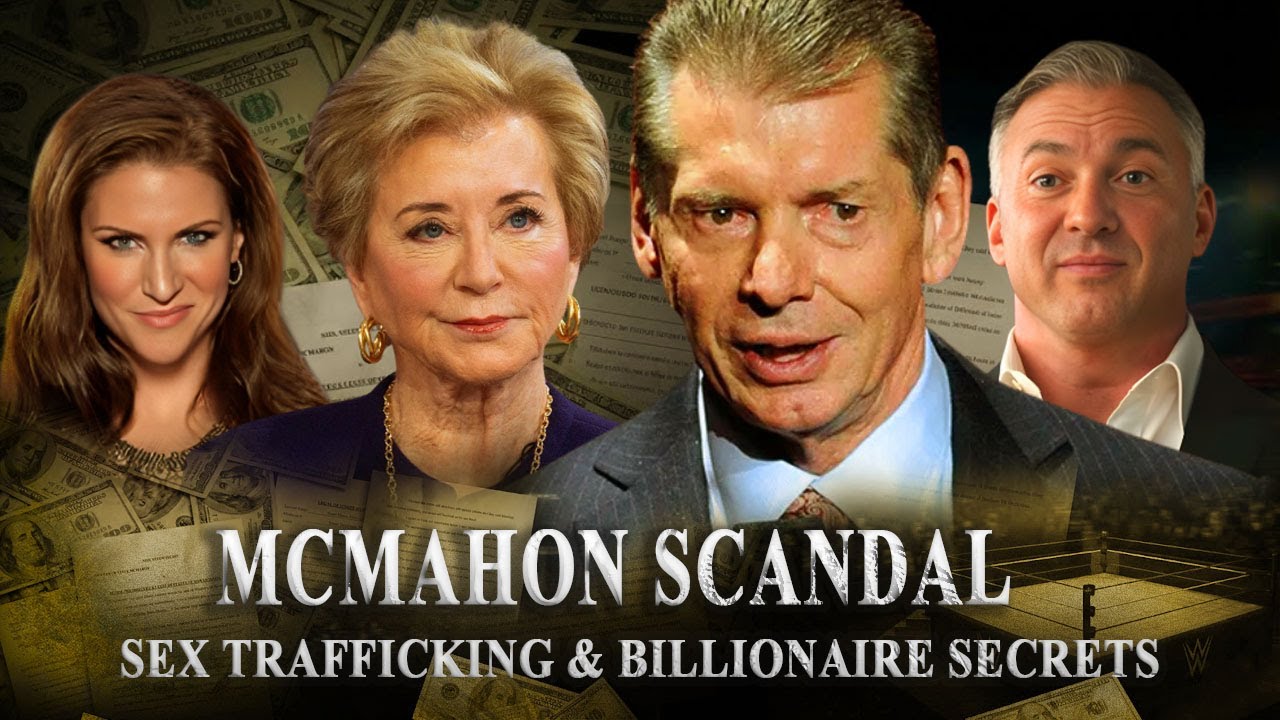
Vince McMahon presented himself to the world as a visionary showman, the carnival barker who dragged professional wrestling from smoke-filled armories into the neon glare of the mainstream. But behind the glitz of WrestleMania, a darker story unfolded. Built on extreme childhood trauma, a cold rage at dominance, and a willingness to sacrifice anyone and anything to protect the empire he built, the McMahon dynasty operated less as a family and more as a fortress of control, guarded by non-disclosure agreements, fear, and the bodies of the people who made him rich. Before he was the emperor of the WWE, he was Vinnie Lupton, a child living in poverty in a trailer park in Pinehurst, North Carolina.
His mother had remarried a violent man named Leo Lupton, who terrorized the boy. Vince grew up watching his mother beaten, helpless to stop it. The abuse rewired him. He learned that power was the only currency that mattered, and he resolved to become the monster so that the monster could never get him again.
When he was twelve, he met his biological father, Vincent J. McMahon, a successful wrestling promoter who controlled the Northeast territory from Washington to New York. To the battered boy, his father was a god, an escape route. He changed his name back to McMahon, shedding the identity of the victim and adopting the identity of the victor.
His father, who wanted him to become a lawyer or a judge, kept him at arm’s length, but Vince eventually wore him down and joined the company. After conquering a small territory in Maine, he set his sights on everything. In 1982, Vince bought Capital Wrestling from his father. Vincent J.
, nearing retirement and suffering from cancer, agreed to the sale believing his son would respect the traditions of the business. He was wrong. The wrestling industry was governed by a fragile cartel known as the territory system, where regional promoters maintained a gentleman’s agreement not to invade each other’s turf. Vince broke that agreement immediately.
He sent his programming to television stations in rival territories, offering to pay the stations to air his product, displacing local promoters. Then he raided their talent, offering stars like Hulk Hogan a national platform they could never get at home. He hollowed out the competition from the inside. His father’s phone rang off the hook with old friends screaming that his son was destroying them.
Vincent J. died in May 1984, months before the first WrestleMania would cement his son’s victory, watching the destruction of the fraternity he had loved. With his father in the ground, the last restraint on Vince was removed. The expansion required larger-than-life performers, and Vince decided superheroes were made in a lab.
He industrialized steroid use, hiring a doctor to distribute anabolic steroids at the arenas. The mandate was clear: get big or get out. Wrestlers were pushed to carry more muscle mass than the human body was designed to support and worked hundreds of days a year. This treatment of the performers as disposable action figures laid the groundwork for the tragedies to come.
Meanwhile, a different kind of rot festered beneath the surface. In the late 1980s and early 1990s, a scandal emerged involving the ring boys, teenagers and young men hired for meager pay to assemble the rings and drive the trucks. They were vulnerable and desperate to be part of the magic, which made them perfect targets for predators. The man overseeing the crew, a ring announcer named Mel Phillips, allegedly groomed and abused these boys.
Allegations also swirled around high-ranking executives. The scandal broke when a former ring boy named Tom Cole appeared on national television to detail the abuse. The company’s response set the playbook for the next thirty years. Phillips was quietly rehired after the media heat died down, and Cole was pressured into a settlement in exchange for silence.
The safety of children was secondary to the utility of friends. In 1993, the federal government indicted Vince McMahon on charges of conspiracy to distribute anabolic steroids. The trial took place in the summer of 1994. The star witness was Hulk Hogan, who admitted under oath to using steroids with Vince’s knowledge, but testified that Vince had never explicitly ordered him to take them.
That distinction was the lifeline his lawyer seized upon, painting Vince not as a drug lord but as a naive businessman who let independent contractors do what they wanted with their own bodies. The jury acquitted him on all counts. Vince emerged emboldened, believing he was untouchable, that he could talk his way out of anything and buy his way out of any scandal. The mask came off completely.
He transitioned into the on-screen character of Mr. McMahon, the evil, tyrannical owner, a confession rather than a creation. By the turn of the millennium, Vince turned his appetite for destruction inward, targeting his own family. His son Shane identified a struggling near-bankrupt company called the Ultimate Fighting Championship and proposed buying it for a few million dollars.
Vince killed the deal, not because the numbers didn’t make sense, but because it was Shane’s idea. According to multiple sources, the rejection descended into a confrontation where Vince allegedly pulled out a knife and told his son that if he wanted to take control, he would have to cut his father down right there. Shane retreated. The UFC was eventually bought by someone else for two million dollars and turned into a four-billion-dollar empire.
The psychological damage was permanent. The abuse of the daughter was more grotesque. When Stephanie became pregnant with her first child, Vince pitched a storyline where he would be revealed on national television as the father of her unborn child. When she refused, he suggested a storyline where the siblings had engaged in an incestuous relationship.
What made it to air was a systematic campaign of humiliation and violence, culminating in a match where Vince, significantly larger and stronger, brutally beat his own daughter in the center of the ring, choking her and slamming her to the mat while the crowd cheered. Presiding over this was Linda McMahon, the matriarch, who served less as a passive victim and more as a calculated enabler. She was CEO during the ring boy scandal, the one who signed the checks and oversaw the department that rehired predators. She later spent over a hundred million dollars of the family fortune on two failed Senate runs, distancing herself from the product that funded her ambition.
The true horror of the system was exposed in 2007 when wrestler Chris Benoit murdered his wife and seven-year-old son before hanging himself. The initial reaction from the company was to pay tribute to the fallen hero, but the narrative shifted when forensic analysis revealed that Benoit’s brain was riddled with chronic traumatic encephalopathy, a degenerative disease caused by repeated head trauma. At forty years old, his brain resembled that of an eighty-five-year-old Alzheimer’s patient. The regions responsible for impulse control and emotional regulation were destroyed.
The company’s response was to erase him. He was banned from mention, edited out of the archives, deleted from history. The implications for the entire business model were existential, and Vince chose to bury them. Around the same time, an employee named Ashley Massaro was sexually assaulted and raped by a US military doctor during a Tribute to the Troops tour in Kuwait.
When she reported the incident to Vince and his executive producer, she was told that revealing the rape would ruin the company’s lucrative partnership with the military. For the good of the company, she needed to be a good soldier and bury her trauma. She carried the secret for years, suffering from depression and addiction, until she took her own life in 2019 at age thirty-nine. The tool that enabled these cover-ups was the weaponized non-disclosure agreement.
Over the course of sixteen years, Vince McMahon paid nearly twenty million dollars in hush money to suppress allegations of sexual misconduct, infidelity, and harassment. The brilliance of the silencing machine was its isolation of victims. A woman who signed an NDA was legally barred from speaking to the press, to the police, or to other victims. She was trapped in a silo of silence, believing she was alone.
Vince understood that if the victims ever found each other, his empire would crumble. As Vince entered his mid-seventies, his behavior devolved into something far more criminal. In 2019, he met Janel Grant, a woman grieving the recent death of her parents, unemployed and facing financial ruin. He offered her a job at WWE headquarters and a promise to take care of her.
The relationship quickly pivoted from professional mentorship to coerced sexual servitude. He sent her hundreds of text messages that read like the commands of a master to a slave, telling her he wanted to break her down until she would beg him to sell her to other men. The encounters escalated into extreme depravity. He shared her with his head of talent relations, treating her as a party favor for a loyal lieutenant.
Most damningly, he used her as a bargaining chip in contract negotiations with Brock Lesnar, directing her to produce sexually explicit photos and videos to send to the star as a sweetener in the deal. A physical meeting between Lesnar and Grant was arranged and only called off because a blizzard grounded Lesnar’s plane. Under federal law, the intent to traffic and the use of a victim to secure a commercial contract constitutes the crime. When Vince discarded her, he pressured her to sign an NDA in exchange for three million dollars.
He made a fatal error: he stopped paying. By defaulting on the payments, he voided the contract. In January 2024, Grant filed a sixty-seven-page lawsuit filled with text messages, dates, and names. Sponsors recoiled.
The Department of Justice opened a criminal investigation. Vince had previously tried to shield himself by selling the company to Endeavor, merging WWE and UFC into a new entity called TKO Group Holdings. He was named executive chairman, but in the new company, he was no longer the emperor. He was an employee answerable to a board he did not control.
Less than twenty-four hours after the lawsuit was filed, the new leadership forced his resignation. He was stripped of his titles, removed from the board, and erased from the product. His profile was removed from the website. He was edited out of the video games.
His name became a forbidden word. The federal investigation focused on sex trafficking, and the text messages offered a roadmap for prosecutors. At seventy-eight years old, Vince McMahon faced the very real possibility of dying in federal prison. The empire he built is dead.
The company survives, but it is now just a corporate asset run by professional managers, not blood patriarchs. The erratic, violent, creative chaos of the McMahon era has been replaced by spreadsheets and quarterly earnings calls. The story of Vince McMahon is the story of a man who treated people like action figures, breaking them, trading them, and discarding them. He won every war.
He beat the government in 1994. He beat his competitors. But the reckoning finally arrived not in the form of a rival promoter, but in the form of a woman named Janel Grant, armed with nothing but the truth and a stack of text messages. The arena is empty.
The lights are off. And the tyrant is finally truly alone.






