The key turned in the lock. Ninety minutes stood between a quiet afternoon tea and a global media meltdown, and John F. Kennedy Jr. knew that every second inside that room had to be earned.
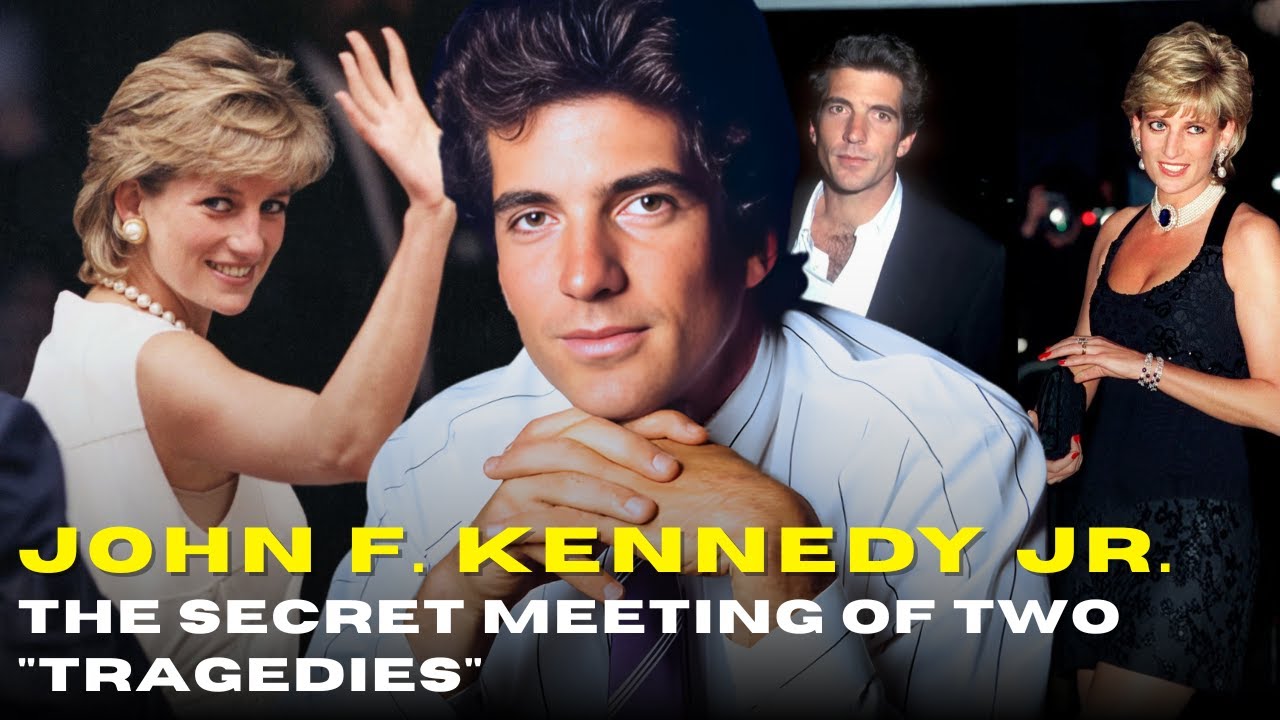
In the sweltering July of 1995, behind the heavy oak door of Room 3311 at the Carlyle Hotel, one of the most secret meetings of the century was taking place. While photographers chased them across two continents, John and Princess Diana were hiding in plain sight. They had not been brought together by fate, but by a shared, urgent need for someone who understood the prison of fame. To get there, the most eligible man in the world had to shed his identity and slip through a service elevator reeking of garbage.
A desperate maneuver to secure 5,400 seconds of privacy with the only other person on earth who truly understood what it meant to be a living legend. Yet what drove John toward that grimy service entrance was something far stronger than editorial ambition. He was fascinated by the idea of Diana, not merely as a cover star, but as a mirror reflecting his own image. In her, he saw the painful echo of his mother.
Jackie and Diana had been the century’s defining fashion icons, distinct yet similar, like secular saints, sanctified through their suffering within powerful, complicated families. From a distance, John felt a strange protective bond with the British princess. Every time he saw photographers surround her car or aim their lenses at her terrified face, it stirred painful memories of his own childhood, the feeling of his mother’s hand tightening around his as she pulled him through the camera flashes. He understood the hunt because he had been the prey his entire life.
A delicate approach was required. No official channels, no letters on embossed John F. Kennedy Jr. stationery to Buckingham Palace where they would be intercepted and torn apart by courtiers.
They had to use the back channels, the network of friends that oiled the lives of the elite. An initial inquiry was sent, a subtle probe that traveled through a complex web of New York and London luminaries. The message was simple: John F. Kennedy Jr.
would like to have tea with the Princess of Wales. The magazine cover was not mentioned at first, that would have been aggressive. He simply asked for a meeting. To everyone’s surprise, the response was not a flat refusal, but a hesitant one, perhaps tinged with curiosity.
Diana was due to visit New York in July, staying at the Carlyle. The coincidence was too perfect to be chance. The Carlyle was Kennedy territory, practically John’s backyard. It seemed the universe was conspiring to bring them together in one place.
Still, the terms of any potential meeting were strict. Total secrecy was non-negotiable. If one word leaked, if a single photographer learned that John F. Kennedy Jr.
was headed to Diana’s suite, the meeting would be canceled instantly. The media hysteria was dangerous, even physically so, given the frenzy that surrounded them both. In the days leading up to the appointment, John was uncharacteristically anxious. Those closest to him noticed a change.
He was usually the most confident man in any room, someone who could disarm a hostile journalist with a smile or a self-deprecating joke. But this time was different. He was about to meet the one woman in the world who could overshadow him. He was about to enter a room where his name, Kennedy, would not be the most interesting thing about him.
He obsessed over the details. What would he wear? Not one of his beautifully tailored suits, that would be too formal, like a business deal. But not his usual casual clothes either.
He had to strike a balance, respectful yet undeniably masculine. He also had to contend with the ghosts of the past. Going to the Carlyle to meet a forbidden woman carried deep Freudian resonance for John. He was walking in his father’s footsteps, entering the same building where the legend of John F.
Kennedy’s infidelities had been written. And in a strange psychological twist, he was about to court, professionally at least, a woman widely considered his mother’s successor. The layers of meaning were suffocating. He was not just a magazine editor trying to sign a cover model.
He was a son trying to understand his legacy, seeking validation from the only woman on the world stage who operated at his altitude. The morning of the meeting dawned hot and bright. The humidity had not broken. New York was suffocating.
At the offices of George magazine, the tension was palpable. RoseMarie Terenzio, John’s protector and advisor, reviewed the plan one final time. It was like a heist movie script. John could not use the front entrance of the Carlyle on Madison Avenue.
The doormen there were vigilant, yes, but the sidewalk was public property, and photographers were permanently stationed there, waiting for Diana to emerge. If John went in the front, a photographer would radio his colleagues: “Kennedy is entering the lobby. ” Then, when he didn’t come out for an hour, and Diana didn’t either, the conclusion would be instant. The story would be on the front page of the New York Post before he left the building.
No. He had to go in underground. The plan was to enter through the side entrance on 76th Street, the loading dock used for linen deliveries and room service carts. It was humiliating.
The heir to American Camelot would have to sneak in among the trash bins. As the appointed hour approached, John made his final preparations. He chose a simple but elegant outfit. A crisp white shirt, perhaps slightly open at the collar, dark pants, and a baseball cap pulled low to shadow his eyes.
He had to look like a delivery man, an off-duty employee, no one. He checked his reflection in the mirror. His face usually opened every door in the world. Today, it was a liability.
He had to tamp down the Kennedy charisma, mute his own glow, and become invisible. He left his office and stepped into the bright New York sun. The city was loud, a cacophony of car horns and jackhammers. Oblivious to the secret history about to be made, he moved quickly, his heart perhaps beating faster, a mix of adrenaline and fear coursing through his veins.
This was not just a meeting. It was a collision of galaxies. Inside the suite, Princess Diana was waiting. She paced the thick carpet, checking her appearance in the ornate mirrors.
She was nervous too. She had met presidents, popes, and kings. But John F. Kennedy Jr.
was different. He was the living embodiment of the American dream. She wondered what he wanted. She wondered if he was like the others, wanting a piece of her soul to sell in a new market.
Or maybe, just maybe, he was the one person who might actually understand the language of her life. John arrived at the designated corner. He looked left, then right, searching for the glint of a camera lens. He saw nothing but the indifferent hustle of the city.
He ducked his head, adjusted his cap, and slipped into the shadows of the Carlyle’s service entrance. The heavy metal door clanged shut behind him, sealing off the noise of the world. He was in. The ascent was about to begin.
The service entrance on East 76th Street was a portal to another world. When the heavy steel door closed, the roar of Manhattan’s humid afternoon was abruptly cut off, replaced by the cold, unpleasant scent of industrial cleaning supplies, damp linen, and a lingering hint of burnt coffee from the kitchens. For a man who had spent his entire life being welcomed through the front doors of palaces, the White House, and the world’s most exclusive clubs, standing in the fluorescent-lit purgatory of a loading dock was a disorienting, grounding experience. He was no longer the most handsome man alive, the title People magazine had burdened him with.
He was, by any measure, an outsider, a good-looking delivery boy carrying a secret package. He adjusted the brim of his cap, pulling it down tight on his forehead. The disguise was flimsy. No sunglasses and hat could hide a face etched onto the currency of American fame.
But in the dim light of the service corridor, it would have to do. A hotel employee passed him, pushing a cart laden with clattering silver room-service trays. The worker did not look up. In the system of the Carlyle, discretion was not just a policy, it was a survival instinct.
The staff were trained to see everything and record nothing. John was just another shadow in a building built on shadows. He pressed the button for the freight elevator. The weight of the moment felt immense.
In the silence, his own breathing sounded too fast, too shallow. He was acutely aware of the absurdity of the situation. Here he was, the heir to America’s closest thing to royalty, sneaking past garbage bins to meet the woman dismantling the British monarchy. It was a scene from a spy movie, or perhaps a farce.
But beneath the absurdity, a cold stream of adrenaline ran through his veins. This was not just a business meeting for George magazine. It was an encounter with a legend. The elevator arrived with a hum, its metal gate revealing a vast, worn interior designed to carry grand pianos and steamer trunks, not imperial publishing hopes.
John stepped inside. The elevator operator, a man whose face had been carved by years of silent observation, gave a single nod. No words were exchanged. He knew the destination.
The gate closed, like the jaws of a trap, and the slow ascent began. As the elevator groaned upward, passing the floors where tourists paid fortunes to sleep in the same space as the elite, John felt the weight of the impending meeting settle on him. He was about to meet Diana. The name alone carried a particular allure.
He tried to picture her. Not that glossy, polished image on the cover of Vanity Fair, but the woman herself. He thought of his mother, Jackie. He remembered the distinct, electric tension that filled a room when she entered, a mix of awe and terror she inspired in strangers.
He wondered if Diana possessed that same terrifying magic. He wondered if he, of all people, would be immune to it, or if he would be as captivated as the shopkeepers and schoolteachers who wept at the sight of her. The smell of the elevator, a mix of floor wax and last night’s dinner, was a sensory reminder of the mundane reality that supported the luxury above. The numbers on the brass dial climbed slowly.
10, 20, 30. With each floor, John shed a layer of his public persona. He could not be John-John, the charming, fun-loving prince of New York, in that room. That was a mask he wore for the cameras.
To truly connect with Diana, he had to offer her something rarer. Authenticity. He had to be just John. The elevator shuddered to a stop on the thirty-third floor.
The operator opened the gate. “3311,” he whispered, gesturing toward the end of the hall. John thanked him, his voice gruffer than usual, and stepped out. The transition was jarring.
From the industrial grime of the elevator to a world of quiet, beige luxury. The hallway was silent, the thick carpet muffling his footsteps. Elegant, understated artwork lined the walls, and sconces cast a warm golden light. It was a vacuum, a hermetically sealed environment that neither the chaos of New York nor the chaos of Diana’s life could penetrate.
He walked down the hall, counting the numbers. 3309, 3310, and there it was, 3311. The door was ordinary, identical to every other door in the hotel. Yet behind it sat the most sought-after woman on earth.
John paused. He took a deep breath, holding it for a second to steady his racing heart. He checked his shirt one last time, making sure he didn’t look disheveled from the street heat. Then he raised his hand and knocked.
Three sharp raps. The next seconds stretched, elastic and tense. He heard a faint rustle of fabric from within. Then the door opened with the click of a lock.
If John had expected a fragile, broken bird, the woman who stood before him dispelled that illusion instantly. Diana was tall; that was the first impression that dominated. She was statuesque, standing almost eye-to-eye with him in her heels. She wore a simple, elegant suit in a cool cream color that accentuated her slender figure.
Her blonde hair fell in that famous, gravity-defying sleek style. But it was her eyes that struck him like a physical blow. They were clear, piercing blue, larger and brighter than any photograph could convey. They were eyes that had seen too much, carrying a blend of exhaustion and undeniable curiosity.
For a moment, neither of them spoke. They simply looked at each other, two people whose faces were among the most reproduced images in human history, finally seeing the originals in perfect clarity. It was a moment of mutual recognition, a silent acknowledgment of the absurdity of their existence. “Hello,” Diana said.
Her voice was deeper than he expected, a warm, husky contralto carrying the accent of the British aristocracy, but softened by genuine shyness. She stepped back, opening the door wide. “Please, come in. ”
“Your Royal Highness,” John said, or perhaps he just said “Diana.
” Accounts differ. But the tone held a different kind of charm. He took off his cap, revealing his thick, dark hair, and crossed the threshold. The door closed behind them.
For the next ninety minutes, the outside world ceased to exist. Room 3311 was spacious, bathed in the soft, diffuse sunlight of a Manhattan afternoon. The windows looked out over the vast green expanse of Central Park and the jagged skyline beyond, a view that turned the city into a silent, glittering toy. But John had no interest in the view.
The room felt familiar, perhaps eerily so. There were no aides, no enthusiastic publicists, no lurking security guards. They were alone. The emptiness of the suite amplified their presence.
It felt like a stage where the actors had forgotten their lines. Diana moved with a fluid, athletic grace, gesturing for him to sit on one of the plush sofas. “I’m so glad you came,” she said, a glint of mischief in her eyes. “I heard the service elevator is a unique experience.
” John let out a deep, quiet laugh that eased the tension. “It’s certainly cleaner than the subway,” he joked, unleashing the charming smile that had captivated millions. “Although a food cart almost hit me on the ground floor. ”
Diana smiled, and the transformation was stunning.
When she smiled, the sadness in her eyes seemed to evaporate, replaced by a radiance that lit up the room. Diana’s charm was a weapon, a mass seduction tool she wielded with immense skill. “I’m so sorry about that,” she said, sitting across from him, tucking her legs beneath her in a surprisingly spontaneous gesture. “But you know how it is.
If they saw us together… ” She didn’t need to finish the sentence. The world would explode. “Exactly,” John finished for her.
The energy in the room was complex. It wasn’t just the sexual tension that was undeniably present, that low-frequency hum that vibrates between two people accustomed to being the most desired objects in any room. It was deeper than that. It was the tension of scrutiny.
John found himself studying her, looking for any flaw in her presentation. He noticed the slight tension in her jaw, the way her fingers fidgeted with the edge of her jacket, signs of the constant anxiety she lived with. He realized she was doing the same to him, scanning his face for Kennedy arrogance, comparing him to the legend of his father. He had come here with a bag full of mock-ups and a presentation for George magazine.
He planned to talk about politics, about the intersection of fame and civic duty, about giving her a platform to redefine herself. But sitting there, looking at the woman who was his British counterpart, the presentation suddenly felt trivial. “It’s strange,” John said, leaning forward, elbows on his knees, his posture open and engaged. “I feel like I’ve known you for a long time.
Or at least, I know the version of you that everyone thinks they know. ”
Diana’s expression softened, the fatigue lifting a little more. “Diana the two-dimensional,” she said with a bitter edge. “She’s very popular.
I’m not sure I like her very much. ” “I have the same problem with John,” he admitted. “He’s a great guy, doesn’t have a care in the world. I’m not like him.
”
This was the turning point. In just two sentences, they had bypassed diplomatic formalities and reached the core of their shared experience. Both were prisoners of their own names. The conversation that followed was not the interview John had prepared for; it was a confession.
Diana poured him tea from a silver service on the coffee table. The simple domestic scene, the Princess of Wales pouring tea for the son of a president, was strange, yet it grounded them. As she handed him the cup, their fingers brushed. It was a fleeting touch, but charged.
John noticed her hands. Her nails were perfectly manicured, but he saw the bitten skin around one, a small human flaw hinting at nights spent pacing floors, stifling tears. She asked him about New York, about his life in the city. She was eager for details of his freedom.
“Do you ride a bike in the city? ” she asked in wonder. “In traffic, with the cameras? ” “It’s the only way to escape them,” John said.
“If you keep moving, they can’t get the focus right. You have to be faster than the shutter speed. ” Diana nodded, her eyes distant. “I try to run,” she whispered.
“But their cars are always faster. ”
The atmosphere shifted from polite curiosity to a deep, sad familiarity. They began swapping stories of the chase. John told her about the photographers who camped outside his apartment in Tribeca, the way they shouted his name to provoke him, how he learned to look through them as if they were glass.
Diana countered with stories of London, of lenses poking through the hedges of Kensington Palace, of feeling watched even as she slept. It was a dark bonding, a competition of scars. But it was also intoxicating. There is nothing more powerful than finding someone who speaks your secret language.
For Diana, John was a discovery. He wasn’t just handsome; he was empathetic. He listened with an intensity that made her feel seen, not as a headline, but as a human being. He didn’t interrupt.
He didn’t offer platitudes. He just held her with his dark, warm eyes, absorbing her words. For John, Diana was a shock. He had expected a nervous, difficult, demanding woman, the unstable one the British press loved to portray.
Instead, he found a woman of immense charm and intelligence, someone who could laugh at the absurdity of her life, with a sharp wit beneath her delicate exterior. He realized, suddenly, that she was far more dangerous than he had imagined, not because she was crazy, but because she was real. As the sunlight moved across the room, lengthening the shadows, the professional pretext for the meeting began to dissolve entirely. The George magazine presentation remained in his bag, untouched.
The conversation drifted into sensitive personal territory. They talked about their mothers. John spoke of Jackie’s fierce protectiveness, her silence, her dignity. “She saved us,” John said quietly.
“She built this wall around us so we could be normal. ” “I tried to build a wall,” Diana said, her voice cracking slightly. “But they tore it down. They tore it down brick by brick.
” John looked at her, and in that moment, his desire to recruit her for his magazine was replaced by a simpler, more primal instinct: a desire to save her. Or perhaps, just to be with her, to stay in this quiet beige room where the world couldn’t touch them. The freight elevator of the Carlyle had carried more secrets over the decades than cargo. While the front entrance was a stage for arrivals, the service entrance was the artery of reality.
Through these very corridors, Mick Jagger had been smuggled to avoid screaming fans, and high-stakes art dealers had brought masterpieces wrapped in brown paper to show reclusive billionaires. But John F. Kennedy Jr. ‘s journey in July 1995 remained the most poignant of those fleeting incidents.
There was a cruel irony in the method of concealment both John and Diana employed that day. They were masters of invisibility, experts in using side doors and disguised cars. They had spent their lives learning how to disappear in broad daylight to steal moments of normalcy. Yet this very need to hide, to outrun the lens, would ultimately define the tragic ends of their lives.
Diana died in a tunnel trying to escape the photographers. John died in the night sky, piloting his own plane to avoid the hassle of commercial travel. In that freight elevator, John was practicing the very art of disappearing that would eventually kill them both. The silence of the service shaft was not a sanctuary; it was an omen.
The tea grew cold in the delicate porcelain cups, but the temperature in the room rose, driven by pure intellectual and deep emotional tension. The initial pleasantries were over. The ice-breaking rituals, that awkward dance where two strangers search for common ground, had become unnecessary within minutes. They had discovered they were not strangers at all.
They were veterans of the same hidden war, bearing the same scars from camera flashes and headlines. But John had a mission. He hadn’t risked the humiliation of the freight elevator just for empathetic commiseration. He had a magazine to launch, and in his bag, he carried the mock-up of George.
He set his cup down on the saucer with a deliberate click, a sound that seemed loud in the quiet suite. “Diana,” he began, shifting his posture from sympathetic listener to passionate advocate. “I want to talk to you about the future. ” “Your future,” she tilted her head, a gesture of cautious curiosity.
“My future is a big topic of discussion in London,” she said coolly. “Usually by people who have never met me. ” “That’s exactly why I’m here,” John said, leaning forward. His voice took on a tone eerily reminiscent of his father.
A persuasive, rhythmic cadence, full of measured urgency. He began to explain his vision for George magazine. It wasn’t just a political magazine, he clarified. It was a cultural bridge.
He wanted to demystify politics, to strip away the gray monotony of Washington, to treat democracy as what it actually was: a spectator sport. But to do that, to get the American people to care, he needed a symbol. He needed a cover star for the launch issue who transcended politics. Someone who represented the intersection of power, fame, and humanity.
“I don’t want the victim,” John said, his eyes locked on hers. “I don’t want the wronged wife or the sad princess. The world has seen that. I want the woman who survived.
I want the woman who was stronger than the institution that tried to crush her. I want you to pose as one of the Founding Mothers. Imagine it. You, dressed as George Washington or Betsy Ross.
Not as a joke, but as a statement, a declaration that you are rewriting the rules. ”
It was a brilliant idea. Daring, bold, and utterly American in its optimism. John was offering her a chance to reinvent herself, not through the lens of the British tabloids, but through the glittering, aspirational lens of New York media.
He was offering her a narrative of triumph. For a moment, watching his animated face, Diana seemed tempted. The thought of defying her Buckingham Palace handlers by appearing on the cover of a bold American magazine, adorned in stars and stripes, must have sparked a delicious thrill of rebellion. But Diana was not just a rebel.
She was a strategist. More importantly, she was a mother. She listened to John’s pitch with a slight, sad smile on her lips, the smile of someone watching a child try to catch the wind. When he finished, and the silence hung in the room, thick with hope, she spoke quietly.
“It’s a wonderful idea, John. If it had come from anyone else, I would have laughed. But coming from you… I can see the nobility in it.
” Then came the shift, that gentle but unyielding firmness that had come to define her in those later years. “But I can’t do it. ”
John started to interrupt, to argue. She raised her hand.
Her fingers were long, adorned with the sapphire engagement ring that had become the most famous piece of jewelry in the world. A heavy, glittering shackle she still wore. “You have to understand my position,” she explained, her voice low, conspiratorial. “I am currently negotiating the terms of my divorce.
It’s a delicate game of chess. The Palace is looking for any excuse to brand me unstable, to brand me unfit. If I appear on the cover of an American political magazine, especially one run by a Kennedy… ” She paused, letting the weight of the name sink in.
“They will say I’m interfering in international affairs. They’ll say I’m selling my title. They’ll use it to restrict my access to William and Harry. ”
The mention of her sons changed the atmosphere instantly.
The sparkle faded, replaced by the fierce, terrifying protectiveness of a lioness. John understood immediately. He knew what it meant to be a pawn in a dynastic game. He knew that for people like them, an image was never just an image.
It was a political statement, a weapon, a burden. “I understand,” John said. And he did. He didn’t push.
He didn’t try to tempt her with money or promises of editorial control. He simply accepted it. With a generosity that surprised her. Most men wanted something from Diana: her image, her endorsement, her glamour.
When they couldn’t get it, they usually became petulant or aggressive. John just nodded, with a look of genuine sympathy on his face. “The boys come first,” he said. “Always.
Always. ” She agreed. And in that moment, the shift happened. The business meeting was over.
The pitch had failed. By any logical measure, John should have packed his bag, thanked her for her time, and returned to the freight elevator. He was a busy man. She was a busy woman.
But neither of them moved. Ironically, the rejection brought them closer. By refusing him, Diana had trusted him, revealed her vulnerability. She had shown him her constraints.
And by accepting that refusal without ego, John had proven he wasn’t just another predator looking to exploit her. The atmosphere in the room, previously charged with professional negotiation, became more intimate. They sat on the plush sofas, suddenly aware of how small the distance between them was. The conversation drifted away from the magazine, away from the divorce, into the murky waters of their shared reality.
They began to speak the language of celebrities. “Do you ever feel like there are two of you? ” John asked, resting his head on the cushion, looking at the ceiling. “The one who brushes her teeth and worries about her hair falling out, and the one the papers write about?
And sometimes you forget which one is real? ” Diana laughed, a laugh less guarded now, more genuine. “I read stories about Princess Diana every day,” she said. “And I think, she sounds like an interesting woman.
I wonder what she’s doing today. While I’m sitting in Kensington Palace, eating baked beans on toast and watching TV. ”
John laughed softly, turning his gaze back to her. Their eye contact lingered, heavy with unspoken attraction.
He saw a woman far more complex than the perfect icon the world worshipped. He saw humor, sharpness, intelligence, and a woman of breathtaking beauty. He would later remark to his aide that her legs were crossed elegantly, but what captivated him was her bearing, a blend of royal poise and approachable warmth. Diana, for her part, was studying him with equal intensity.
By 1995, John F. Kennedy Jr. was the gold standard of American masculinity. He possessed a physical strength that the men in her circle lacked.
His presence was overwhelming. He laughed with his whole body. He had a golden, Labrador-like energy, utterly alien to the stiff composure of the Windsor court. He was both safe and dangerous.
Safe, because he was her equal. Dangerous, because he awakened feelings in her that she had suppressed for years. The sexual tension in the room was not the aggressive, predatory kind found in nightclubs. It was the refined, escalating tension of a Regency novel, where a glance or a shift in tone carried the weight of a touch.
It was a flirtation of minds and charisma. John was undoubtedly flirting with her. He used his self-deprecating humor, the charming Kennedy weapon, to make her laugh. He told her stories about his failed acting attempts, his failure of the bar exam, mocking his dumb-jock reputation in the press.
Diana responded with her own brand of flirtation: her famous sideways glance, the tilt of her chin, her sharp wit. She teased him about his American accent, about the size of New York food portions. They were playing like children who had found a secret garden where no adult could dictate their behavior. ” You know,” John said, his voice softer now, more intimate.
“My mother always admired you. She used to watch you. She used to say: that girl has talent. She knows how to speak without saying a word.
” Diana fell silent. Praise from Jackie Kennedy was the ultimate accolade. “I was in awe of her,” Diana whispered. “I studied her.
How she survived. How she kept her silence. I don’t know if I have her strength. ” “You do,” John said firmly.
He leaned forward again, closer to her. Not aggressively, but with urgency. “You’re doing it right now. You’re walking through the fire.
Most people would have burned by now. ”
It was a moment of profound validation. Diana was used to being described as hysterical, paranoid, manipulative. To have this man, the son of the legend, tell her she was strong.
To have him look at her with undisguised admiration, was a powerful aphrodisiac. She felt the blood rush to her cheeks. For the first time in a long time, she didn’t feel like a problem to be solved. She felt like a prize.
The clock on the mantel ticked. Time was running out, and they both knew it. They both knew that outside the door, the machinery of their lives was waiting to resume its spin. Security details were checking their watches.
Drivers were starting their engines. But in Room 3311, they remained suspended in what-ifs. What if they had met in another life? What if he wasn’t the Prince of Camelot and she wasn’t the Princess of Wales?
What if they were just John and Diana, meeting at a dinner party in Chelsea or a bar in Tribeca? The possibility hung in the air, tantalizing and impossible. “I wish,” Diana began, then stopped. “What?
” John asked gently. “I wish we could leave here,” she said, gesturing towards the door. “Go for a walk in the park. Get a hot dog.
Just be ourselves. ” “We could try,” John smiled, a reckless glint in his eye. “I have a great disguise, a baseball cap. I could get you one.
” Diana laughed, a full-throated laugh. “I think I might need more than a hat, John. I think I might need an invisibility cloak. ” “I’m working on that,” he joked.
“For the next issue. ” They smiled at each other, a shared acknowledgment of their gilded prison. The chemistry between them was at its peak now, a magnetic field that made the air feel light. It was a recognition of two lonely souls finding a mirror.
Both loved by millions, but known by almost no one. In this single hour, they were known. John glanced at his watch, an involuntary movement he immediately regretted. It broke the spell.
It imposed the reality of the schedule. He had to leave. He had to slink back to the loading dock before the shift change, before the risk of discovery grew. “I have to go,” he said, with clear regret.
“I know,” Diana said. She stood, unfolding her slender frame from the sofa. They faced each other in the middle of the beige room. They were close enough to touch, close enough for John to smell her perfume, a luxurious, classic floral scent, and for Diana to smell the humid city still clinging to his clothes.
This was the moment when, in another story, there would have been a kiss. The stage was set. The narrative arc demanded it. But they were who they were, and the constraints that bound them were stronger than impulse.
Instead of an embrace, John extended his hand. Diana took it. Her grip was firm, her skin cool. He held her hand a second longer than necessary, his thumb brushing her knuckles.
“Thank you,” John said. “For seeing me. For the tea. ” “Thank you, John,” Diana replied, her eyes fixed on him.
“For asking. For listening. ”
He let go of her hand. The loss of contact was palpable.
He picked up his cap, re-fixing the mask over his face. He walked toward the door, his steps slower now, hesitant. At the threshold, he turned. Diana stood in the middle of the room, bathed in the afternoon light, looking like a lonely queen in a tower.
“If you change your mind,” he said, tapping the bag with the pitch. “You know where to find me. ” “I won’t change my mind,” she said softly. “But I won’t forget that you asked.
” John nodded. He opened the door, checked the hallway, and stepped out. Inside the suite, Diana remained standing, the silence rushing back to fill the space his laughter had occupied. She raised a hand to her chest, as if trying to hold onto the feeling he’d left behind.
The path not taken is a cliché in literature, but in history, it is a haunting ghost. Diana’s refusal of the George cover was a pivotal moment for both of them, though neither realized it at the time. For John, it was a professional setback but a personal triumph. He had failed to get the scoop, but he had gained a muse.
The meeting confirmed his belief that the worlds of politics and fame were merging, embodied by this extraordinary woman. He would go on to put Cindy Crawford on the cover of his first issue, dressed as George Washington. A striking, controversial image, but one that lacked the profound historical resonance Diana would have brought. For Diana, the refusal was an act of survival, but it was also a tragedy of timing.
Had she accepted John’s offer, she might have integrated into the American media machine earlier. She might have found a platform in New York that welcomed her ambition instead of fearing it. The refusal kept her in the thrall of the British establishment for a few more months, but it didn’t save her. The divorce would come anyway.
The title of Her Royal Highness would be stripped, and she would be cast out into the cold regardless. But perhaps the greater tragedy of the refusal was that it prevented their worlds from converging more. Had they worked together on the photo shoot, there would have been phone calls, meetings, dinners. Perhaps those ninety minutes would have stretched into days.
Perhaps the friendship would have deepened into the love affair the world secretly craved. Instead, the refusal kept their encounter brief, a single spark that never caught, leaving behind only the smoke of what might have been. Inside the suite, Diana stood in the middle of the room. The air felt different, charged, rearranged, swirling with the aftershocks of a powerful chemical reaction.
For ninety minutes, the world had shrunk to just two people. Now it was expanding again, rushing back with all its cold facts and grim necessities. She walked to the window, looking out over Central Park, a green rectangle dissolving into the gray haze of Manhattan heat. Out there, life was chaotic, anonymous, and free.
In here, in this gilded cage, she was once again the Princess of Wales. But she didn’t feel alone. She felt something she hadn’t known in years: a hum of pure, genuine excitement. She needed to tell someone.
Her list of confidants was dangerously short. She couldn’t call her lawyers; they’d only ask if she’d signed anything. She couldn’t call the Palace; they would regard the meeting as an act of treason. She needed someone who operated outside the system, someone who understood energy and emotion and the human heart.
She picked up the heavy, cream-colored phone, wrapping the cord around her finger. She dialed a number in London, ignoring the time difference. She called Simone Simmons, her energy healer, a controversial figure to the establishment, but a lifeline for Diana. When Simone answered, Diana’s voice was not the quiet, sad one she used in television interviews.
It was bright, breathless, laced with laughter. “Simone,” she said, the words tumbling out. “You will never guess who was just here. ”
She didn’t wait for a guess.
She poured out the story, painting a picture of the man who had just left. But she didn’t talk about John F. Kennedy Jr. , the publisher or the political heir.
She talked about John, the man. “He’s so handsome,” Diana confessed. The phrase was American, colloquial, a departure from her usual aristocratic vocabulary. It was the language of pure, instinctive attraction.
She described the way he moved, the way he looked at her, the intensity of his physical presence. In a world of gray-suited men, repressed courtiers, and emotionally distant royals, John was a burst of color. “I think he’s the most handsome man I’ve ever met,” she admitted. Then, with a gaiety that masked the seriousness of her life, she gave him a perfect score, a 10 out of 10.
This confession to Simone wasn’t just gossip. It was a reclamation of her humanity. For over a decade, Diana had been treated as a womb, a broodmare, a problem, or a saint. She had been stripped of her womanhood, either by her role as the nation’s mother or by the tabloids’ shameful, predatory oversexualization.
But in her reaction to John, she was simply a woman responding to a man. She was allowing herself to feel desire, to feel the shock of attraction without guilt. The 10 out of 10 was not just a score for John; it was a signal that Diana’s heart, frozen by years of marital neglect, was still capable of beating strongly. She told Simone about the chemistry between them, how they understood each other without explanation.
It wasn’t the beauty that was the real aphrodisiac; that was common in her circle. It was the empathy. He understood her, truly understood her. While Diana was on cloud nine in the Carlyle suite, dissecting the meeting with the exuberance of a survivor, John was going through his own decompression.
His journey back to the street was a mirror image of his ascent, but the man in the elevator had changed. He stood in the corner of the freight elevator as it descended, the silence of the shaft giving him a moment to process what had happened. He took a deep breath, releasing the tension that had held him together in the suite. He took off his baseball cap, ran a hand through his thick hair, then put it back on, pulling the brim lower than before.
He felt a strange mix of professional defeat and personal victory. He had lost the cover story. But he had gained something else. A story he would never be able to publish.
A memory that was his alone. The elevator door opened onto the loading dock. The heat hit him first, a wall of humidity and exhaust fumes. Then the noise, the cacophony of the city.
He slipped onto the street, and his body language changed instantly. His shoulders hunched slightly, and he moved with the quick, purposeful steps of a New Yorker, avoiding eye contact. He scanned for photographers. They were there, lurking on corners, but they were watching the front door, waiting for a limousine that would never come.
They didn’t give a second glance to the man in the cap scurrying toward a car or a cab. Back at the George offices downtown, a loft space bustling with the chaotic creative energy of a startup, it was a world away from the beige calm of the Carlyle. Here, phones rang, layouts were pinned to walls, and ambitious young editors argued over copy and headlines. RoseMarie Terenzio was waiting for him.
She was the one who had organized the meeting, arranged the logistics, the only one who knew the stakes. She saw him walk in, and she saw the look on his face, a mix of awe and bewilderment. “Well,” she asked, the question hanging in the air. “Did we get her?
” John shook his head, a slight smile playing on his lips. “No,” he said simply. “She won’t do it. ” He explained her reasons: the divorce, the Palace, the boys.
It was unassailable logic. RoseMarie nodded, disappointed but understanding. Then she saw that John wasn’t disappointed. He looked enchanted, like a man who had just seen one of the wonders of the world and found it lived up to the hype.
“She’s wonderful,” John said, leaning against a desk, the enthusiasm of the meeting finally fading into quiet appreciation. “She’s really something special. ” He didn’t go on about her charity work or her sainthood. He didn’t talk about her as a political figure.
His first reaction was rooted in the physical reality of the person. “She has great legs,” he told RoseMarie. The comment might have seemed reductive coming from anyone else, but from John, in the context of that day, it meant something different. It was an acknowledgment that Diana was flesh and blood.
The world saw her as a two-dimensional image, a paper doll to be dressed up or torn down. John had seen the woman. He had seen the way she sat, the way she crossed her legs, how she inhabited her body with a regal and athletic grace. To call her legs great was to call her alive, vital, and desirable, not just a tragic figure trapped in a tower.
It was his way of saying she was real. He respected her. Her refusal had only increased his respect. He was used to people bending over backward to please him, to agreeing with the Kennedy name.
But Diana had held her ground. She had prioritized the safety of her children and her position over her own vanity. It was the language of integrity, which he understood perfectly. In the days and weeks that followed, a deafening silence surrounded the event.
It was a golden age of leaks. Diana’s team was notorious for leaking information. The Kennedy circle was constantly under attack from information brokers. Yet neither John nor Diana spoke to the press.
Diana didn’t tell the Daily Mail she had met the American prince. John didn’t tell the New York Post he had been in her hotel room. No source close to the princess gave any statement. This silence was the ultimate proof of the connection that had formed between them.
It was a pact of honor between two people, an acknowledgment that what had happened in Room 3311 was too fragile, too precious, to be fed into the media machine. They were the two most famous people on earth, and they had managed to keep this completely secret. For Diana, the memory of the meeting became a talisman. In the difficult months that followed, as the divorce proceedings were finalized, as her HRH was stripped, and her isolation grew, she would, it is said, revisit the memory of that day.
It was a reminder that she was still a woman capable of captivating a man like John F. Kennedy Jr. It was an affirmation of her worth outside the royal family. For John, the meeting remained a landmark.
He launched George magazine with Cindy Crawford on the cover, creating an iconic image that defined the nineties. But the phantom cover, the image of Diana that never was, remained a ghost in the machine. He had looked into the eyes of his female counterpart, and he had blinked. The secret held.
It held through the summer of 1995. It held through the magazine’s launch. It held through Diana’s divorce in 1996. It wasn’t until years later, after the tragedies that would consume them both, that the full details of the meeting began to leak out, pieced together by biographers and friends like Simone Simmons and RoseMarie Terenzio.
But in the aftermath of that July, as the sun set over Manhattan and London, the two protagonists returned to their separate battles. They returned to the grind, the flashbulbs, the constant scrutiny, carrying a secret light as a feather but strong as steel. They had met. They had seen each other.
And for ninety minutes, they had been free. Perhaps the silence that John and Diana maintained about their meeting is the most romantic aspect of the entire story. In an era hurtling toward total transparency, where reality TV was just beginning and the internet was beginning to undermine the very concept of privacy, their discretion seems almost Victorian. Why did they keep it a secret?
Perhaps because they knew that the moment it was released to the world, it would be spoiled. If the press had known, the story would have spiraled out of control instantly. The headlines would have screamed about a wedding of the century. The pressure to become the power couple of the new millennium would have been suffocating.
By keeping it secret, they preserved the purity of the encounter. It remained a human meeting, not a media event. But this silence has a dark side too. It speaks to the profound loneliness of their lives.
They were so conditioned to distrust, so accustomed to betrayal, that when they finally found someone they could trust, their instinct was to hide that person, to bury that connection deep down. They guarded the memory because they knew its rarity. In the end, the secret wasn’t just a strategy; it was a survival mechanism. They protected the memory of the meeting because, in lives where they owned almost nothing of themselves, it was the one thing they truly possessed.
The summer of 1995 faded into autumn, and the seasons turned with history’s relentless march. The meeting in Room 3311 became a fixed point in the past, a secret memory buried in the minds of two people hurtling toward their doom. Yet, looking back from the present day, that day at the Carlyle forms a strange, sad anchor. It was the moment two great tragic timelines of the late twentieth century intersected, creating a spark that never ignited but left a lasting impression on what might have been.
For Diana, the two years following the meeting were a blend of liberation and terror. She finally gained the freedom she had spoken of with John, finalizing her divorce in 1996. But as she had predicted in that hotel room, freedom came at a steep price. Stripped of her HRH and the protection of the Palace, she became easy prey for the photographers.
She was a lone woman in the wilderness, hunted with an intensity that made John’s New York ordeal seem tame. Meanwhile, John was fighting his own battle for legitimacy. George magazine launched in September 1995, just months after their meeting. It was an initial smash hit, shattering sales records, but the early success soon soured.
The critics were harsh, dismissing him as a dilettante. The pressure to keep the magazine afloat, to prove he was more than just a pretty face, weighed on him. He, too, felt the walls closing in. The carefree prince of the city was turning into a haggard, anxious man, burdened by the expectations of a nation demanding greatness.
Although they never met again, the parallel of their lives in this final chapter is terrifying. Both were attempting the same impossible task: to be ordinary people while inhabiting the bodies of gods. Both were searching for love that wasn’t transactional. Diana with heart surgeon Hasnat Khan, and later Dodi Fayed.
John with Carolyn Bessette, the brilliant, complicated woman he would secretly marry in 1996. It is painful to think that John’s marriage to Carolyn was defined by the very thing he had discussed with Diana: press intrusion. The photographers hounded Carolyn with a ferocity that rivaled their treatment of Diana. John watched his wife crumble under the camera lights, just as he had watched his mother, and just as he knew Diana was crumbling.
Their conversation in Room 3311 must have rung in his ears like an omen: “They will tear it down brick by brick. ” Then came August 31, 1997. When the news of Diana’s death in a car crash in the Pont de l’Alma tunnel in Paris broke, the world let out a collective cry of grief. But for John F.
Kennedy Jr. , the news hit like a muffled shock, a waking nightmare. He was said to be devastated. But more than grief, he felt a cold, paralyzing realization.
He told his friends that Diana’s death was his worst fear realized. It wasn’t just her death; it was the way she died. She was killed in a chase. Hunted to death by the very people whose hatred they had bonded over.
The faster cars she had whispered about in the suite had finally caught up with her. John was profoundly shaken. He lashed out at the press, in a rare display of anger, denouncing the media frenzy that had destroyed her. He saw his own fate written in the twisted metal of that Mercedes.
It is said that in the weeks following her death, he thought a great deal about their meeting. He thought of her vitality, her long legs, her laughter. The woman who sat before him, so full of life, was now just a memory extinguished by the machine they were both trapped in. He didn’t know that his time was coming.
If Diana’s death was the first act of the end, John’s death was the final curtain. Less than two years later, on July 16, 1999, the scenario played out with sickening repetition. Just as Diana had tried to use a disguised car to escape the cameras, John tried to use the darkness to escape the spotlight, choosing to fly his Piper Saratoga to Martha’s Vineyard on a foggy, moonless Friday night. He wanted to avoid commercial airports, prying eyes, and the hassle.
He wanted a few hours of freedom. He wanted to be the master of his own destiny, literally and figuratively. But the haze that night, the meteorological term for the obscuring of vision between sea and sky, was a deadly trap. John, lost and without a visual reference, crashed his plane into the Atlantic Ocean.
He died alongside his wife Carolyn and her sister Lauren. He was 38. Diana was 36 when she died, a difference of two years. Both died before reaching forty.
Both were killed while trying to get from point A to point B without being watched. The symmetry was perfect. The two most attractive, most photographed, most beloved figures of their generation vanished from the earth in accidents that were, at their core, attempts to escape the cage of their fame. This is why the secret meeting at the Carlyle has taken on a sacred quality.
It was the only time these two stars’ paths intersected without colliding. A moment of stillness in the eye of the hurricane. When we remember them now, we often imagine them in black and white, grim tragic figures frozen in history. But the Carlyle story invites us to imagine them in color.
Picture the beige room lit by golden afternoon light. Picture the steam rising from the teacups. Picture John’s white shirt and Diana’s cream suit. Picture them laughing for ninety minutes.
They were not victims of the Kennedy curse or the Windsor tragedy. They were just two people in their mid-thirties sitting on a sofa, drinking tea, recognizing a friend in a stranger’s face. They were planning a future that would never come. They were flirting with a fate that would never arrive.
The door of their beautiful room eventually opened, and they stepped out to meet their predetermined fates. But the beauty of the story lies in the fact that the door was closed in the first place. Behind that door, they remain forever young, forever beautiful, and forever safe. They are suspended in that 90-minute bubble, far from the Paris tunnel or the dark waters of the Atlantic.
In the end, the secret of the Carlyle is not what they did or didn’t do. It’s that they triumphed, for one brief, shining moment. They reclaimed a piece of their lives from the world. And in lives where everything was taken from them, that stolen hour was their greatest victory.
History is often written in broad strokes, wars, treaties, assassinations. But the human heart beats in the quiet spaces between the paragraphs. The meeting between John F. Kennedy Jr.
and Princess Diana is a fleeting event that never made the headlines. It’s a poignant reminder of the profound isolation that fame brings. We look at celebrities and envy their power, their ability to go anywhere, buy anything, meet anyone. But this story reveals the truth.
They rarely meet anyone who understands them. When John and Diana looked at each other, they were looking into a mirror that no one else could provide. The Carlyle Hotel still stands on Madison Avenue. Room 3311 still exists, renovated, changed, inhabited by new guests with new money and new secrets.
The freight elevator still ascends and descends, carrying dirty linens and room service trays, smelling of coffee and cleaning solution. The ghosts have faded. But if you listen closely to the hum of the city, you can almost hear the echo of that afternoon. You can feel the vibration of two parallel lines that bent for a moment to meet.
It is a story of almost, an almost-cover, an almost-love, an almost-future. And in the tragedy of that almost lies the enduring fascination of John and Diana. They will always be the beautiful, unfinished sentences of the twentieth century. We replay their lives in that hidden scene over and over, hoping the ending will change this time, hoping they will stay in the room this time.
But the door always opens. And the elevator always descends. And the story always ends the same way.
With the silence of a phone that will never ring again, and the stillness of a world that suddenly seems a little less bright.






