On a July morning in 1906, the skeleton of what would become America’s most legendary hotel rose eighteen stories above Fifth Avenue. Hundreds of men crawled across the steel girders, riveting and hammering, shaping what newspapers already called a marvel of modern construction. But that morning, something darker was taking shape among the beams. Michael Butler, a retired policeman hired to keep peace between two warring factions of workers, was struck in the head by a heavy metal bolt thrown by union iron workers who resented the cheaper non-union laborers brought in for simpler tasks.
Before he could fall, union workers swarmed him, beating him unconscious with boots and fists. Then they threw him through a gap in the unfinished flooring. He plummeted from the eighth story to the sixth, his body crashing against steel and stone. He died in the hospital, the Plaza Hotel’s first victim before a single guest ever walked through its doors.
A highly publicized trial followed, but Butler’s death was declared an accident. Not a single iron worker claimed to have seen what happened. The building rose higher, and the murder was buried beneath marble and gold. To understand how this grand palace came to exist, one must travel back to the early 1900s, when New York City was transforming itself from a collection of neighborhoods into the greatest metropolis on Earth.
Fifth Avenue was becoming the address of kings and captains of industry. At the corner where Central Park met 59th Street, three men saw something no one else could imagine. The first was Bernhardt Beinecke, a German-born financier with a sharp mind for real estate, who knew that whoever controlled this corner controlled the gateway to Manhattan’s most exclusive territory. The second was Fred Sterry, a hotelier who understood that wealthy travelers wanted not merely rooms but an experience, a stage upon which to display their status.
The third was Harry S. Black, born in Canada in 1863, who had married the daughter of George Fuller, owner of the construction company that would one day build skyscrapers across America. When Fuller died in 1900, Black inherited not just a company but an empire, transforming it into the United States Realty and Construction Company. His board of directors would eventually include railroad tycoons and ambassadors.
Black collected buildings the way other men collected art. The Flatiron Building was his creation. But his true obsession, his masterpiece, would be the Plaza Hotel. In 1905, the three men purchased an existing hotel on the site, a modest fifteen-year-old structure that no longer matched their vision.
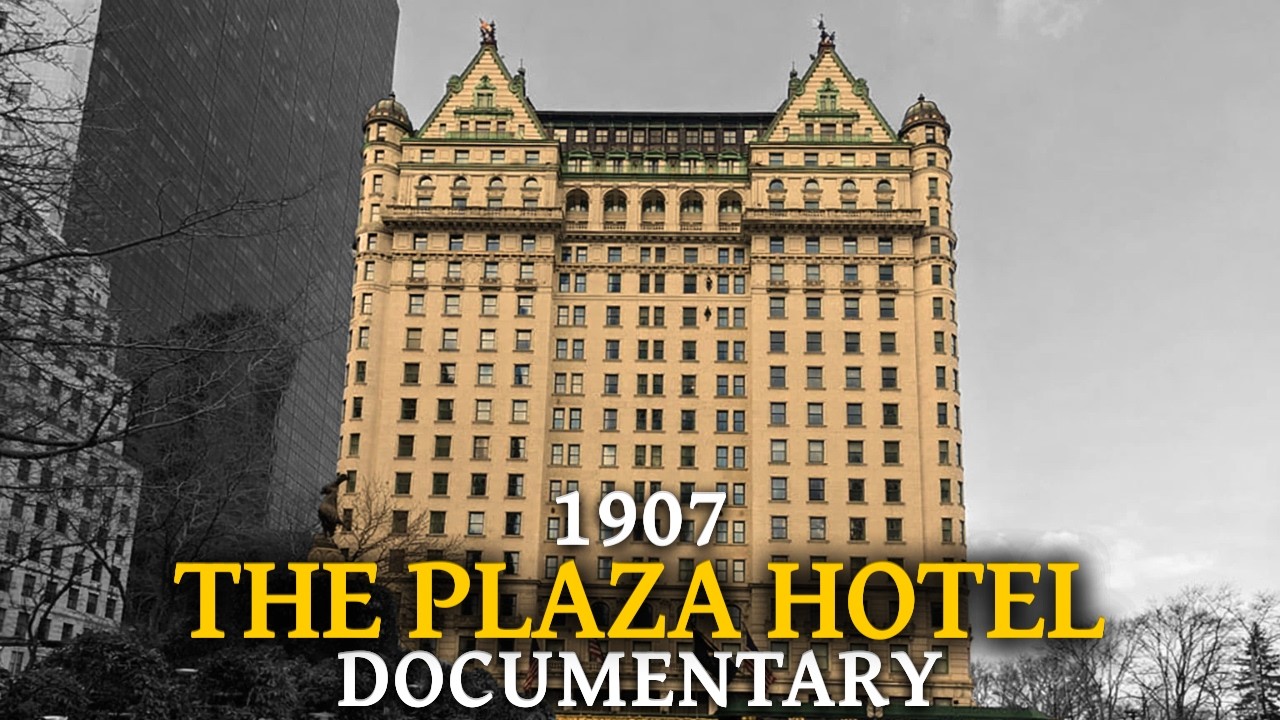
They hired Henry Janeway Hardenbergh, an architect who had already designed the legendary Waldorf Astoria. His design for the Plaza was audacious: an eighteen-story French Renaissance chateau rising from the corner of Fifth Avenue and Central Park South like a dream carved in limestone and white brick, complete with mansard roofs, dormer windows, and turrets that seemed to pierce the clouds. It would cost twelve and a half million dollars, an almost unimaginable sum. The George Fuller Company was contracted to build it, and Harry Black watched over every detail.
But even before the first guest arrived, violence had stained the site. Butler’s death was hushed up, swept under the rising walls. Twenty-seven months later, on October 1, 1907, the Plaza Hotel opened its doors to a crowd of astonished guests. Among the first to sign the pristine guest ledger was Alfred Gwynne Vanderbilt, one of the richest men in America, unaware that in just eight years he would meet his own tragic end aboard the Lusitania.
The opening was attended by the cream of American society, including Diamond Jim Brady, the actress Lillian Russell, producers David Belasco and Oscar Hammerstein, and even Mark Twain, his white suit a beacon among the evening gowns and tuxedos. But behind the champagne and laughter, a shadow was forming. The Panic of 1907 had just begun to grip the nation’s economy. Banks were failing, fortunes evaporating.
The Plaza, born in a moment of supreme confidence, would have to prove itself in the teeth of a financial storm. To walk through the Plaza in those early years was to enter another world. The lobby stretched before visitors like a cathedral of commerce, marble floors gleaming beneath crystal chandeliers. The Palm Court, at the hotel’s heart, became the gathering place for society’s elite, with ladies in silk gowns taking afternoon tea while violinists played softly.
The hotel contained eight hundred rooms, each furnished with a level of luxury New York had never seen. But for Harry Black, the Plaza was never enough. Even as guests filled the rooms and critics praised his achievement, he was already planning his next conquest, the Savoy-Plaza across the street. His ambition was a hunger that could never be satisfied.
As the 1920s roared into history, the Plaza found an unlikely savior in the quiet apartments of wealthy widows. After the stock market crash of 1929 sent America spiraling into the Great Depression, many hotels struggled to survive. But the Plaza had something others lacked: permanent residents. Wealthy women who had lost their husbands but not their fortunes had made the hotel their home, living in grand suites attended by servants.
They paid their bills reliably, month after month, keeping the lights on when tourists stopped coming. These women, whose names have largely been forgotten, became the financial lifeline that kept the Plaza from bankruptcy. But if the Depression tested the Plaza’s survival, it also claimed its most important victim. Harry Black had always lived on the edge.
When Prohibition arrived in 1920, he simply ignored it, caught bootlegging in 1921 when agents raided his private Pullman train car and discovered eight thousand dollars’ worth of illegal liquor. At trial, the jury thoroughly inspected the evidence, sampling the illegal goods with considerable enthusiasm, and returned a verdict of not guilty. But the stock market crash of 1929 proved an enemy that even Black could not charm or bribe his way past. His fortune, built on borrowed money and leveraged investments, began to crumble.
On October 18, 1930, Black walked into his suite on the eighteenth floor of the Plaza and attempted to drown himself in the bathtub. Staff found him and revived him. Months later, at his Long Island summer home, he completed what he had started in that bathtub, shooting himself in the head. He was sixty-six years old.
At the time of his death, his estate was valued at six million dollars, a pittance for a man who had once controlled hundreds of millions. The Plaza passed to new hands, its original visionary destroyed by the very dream he had created. For the next several decades, the Plaza changed hands like a prized jewel. In 1943, Conrad Hilton purchased it for seven million four hundred thousand dollars, seeing opportunity where others saw only risk.
Under his ownership, the hotel survived the war years and emerged into the prosperity of the 1950s. Frank Lloyd Wright moved into suites 223 through 225, living there for six years. In 1955, a writer named Kay Thompson, who had been performing in the hotel’s Persian Room, created a character that would become inseparable from the Plaza’s identity: Eloise, a precocious six-year-old girl who lived in the hotel with her nanny, her dog Weenie, and her turtle Skipperdee. The Eloise books sold millions of copies and cemented the Plaza’s place in American popular culture forever.
The 1960s transformed the Plaza into a stage for some of the most memorable moments in American cultural history. On February 7, 1964, four young men from Liverpool stepped out of a limousine and walked through the Plaza’s doors mobbed by screaming fans. The Beatles had arrived in America for the first time, and they had chosen the Plaza as their home during that historic week. Two years later, in November 1966, Truman Capote threw his legendary black and white ball in the grand ballroom.
Five hundred forty guests, including Frank Sinatra, Mia Farrow, Candice Bergen, and Norman Mailer, arrived in black and white formal wear, their faces hidden behind elaborate masks. Photographs from that evening became iconic images of an era that believed in glamour and excess. But dark clouds were gathering. In the spring of 1988, Donald Trump purchased the Plaza from Westin Hotels for four hundred seven and a half million dollars, the highest price ever paid for a single hotel property in American history.
He took out a full-page advertisement in the New York Times with a headline that read simply, “Why I bought the Plaza. ” In the ad, he compared the hotel to the Mona Lisa. “I haven’t purchased a building,” he declared. “I have purchased a masterpiece.
For the first time in my life, I have knowingly made a deal that was not economic. ” He installed his wife, Ivana, as the hotel’s president. But trouble was already brewing. In the winter of 1989, during a family skiing vacation in Aspen, Ivana encountered a young actress named Marla Maples.
By February 1990, the affair was public knowledge, and the Trump marriage was over. The divorce proceedings became a spectacle that dominated New York media for months, with Ivana locked out of her presidential office while lawyers argued over the terms of separation. The scandal coincided with something far more serious. Trump’s entire financial empire, built on borrowed money and leveraged debt, was beginning to collapse.
He had purchased the Plaza at the peak of the 1980s real estate boom, borrowing heavily to finance the deal. By 1990, the real estate market had turned cold. Behind the scenes, Trump was engaged in increasingly desperate negotiations with his bankers. Citibank and a consortium of other lenders held notes totaling more than five hundred fifty million dollars on the Plaza alone.
On November 2, 1992, Trump filed for Chapter 11 bankruptcy protection for the Plaza Hotel, the first bankruptcy in the hotel’s eighty-five-year history. The filing ran nearly fifteen hundred pages. The Plaza’s assets were listed at three hundred seventy-five million dollars; its liabilities ran to nearly four hundred eighty million. Trump had managed to lose more than one hundred million dollars on what he had called a masterpiece.
He agreed to hand over forty-nine percent of the Plaza to Citibank and the other creditors in exchange for easier payment terms. He would remain chairman in name, but the real power now belonged to the banks. In December of 1993, Trump married Marla Maples in the grand ballroom of the very hotel he had just bankrupted. Two months earlier, Marla had given birth to their daughter Tiffany.
Despite its financial troubles, the Plaza remained a magnet for the famous. In December 1991, the hotel served as a filming location for Home Alone 2, with a cameo appearance by Trump himself. When Michael Douglas married Catherine Zeta-Jones in 2000, they chose the Plaza’s grand ballroom. But behind the flashbulbs, the Plaza was passing through a series of owners.
After Trump lost control, a partnership between Singapore’s City Developments Limited and Saudi Prince Alwaleed bin Talal took over. In 2004, Elad Properties, controlled by Israeli billionaire Yitzhak Tshuva, purchased the Plaza with plans for a four hundred fifty million dollar renovation. The renovation was controversial from the start. About half of the rooms were converted into luxury condominiums, some selling for tens of millions of dollars.
The Plaza was no longer purely a hotel; it had become a hybrid, part hospitality venue, part residential address for the ultra-wealthy. In 2012, Sahara India Pariwar, one of the largest conglomerates in India, purchased the Plaza for five hundred seventy million dollars. At the helm stood Subrata Roy, a man who had risen from nothing to become one of the most powerful businessmen in Asia. Born in 1948 in the small town of Araria in Bihar, Roy had founded the Sahara Group in 1978 with just two thousand rupees, roughly twenty-four dollars.
He offered financial services to India’s vast population of poor and working-class citizens, people who had no access to traditional banks. Millions of Indians, many of them illiterate villagers, trusted Roy with their small savings. By the 2000s, the Sahara Group claimed to employ over 1. 2 million people.
Roy owned television channels, newspapers, a Formula 1 racing team, and luxury hotels around the world. But the foundation of his fortune was already crumbling. In 2010, India’s Securities and Exchange Board began investigating two of his companies. What they found was staggering: Sahara had raised approximately twenty-four thousand crore rupees, nearly four billion dollars, from over thirty million investors through bonds that regulators deemed illegal.
When investigators demanded proof of these investors’ identities, Sahara sent 127 trucks containing over thirty thousand cartons of paperwork. Many of the names and addresses turned out to be fictitious. The Supreme Court of India ordered Roy to refund the money, but the billions had already been spent, much of it on trophy properties like the Plaza Hotel. In February 2014, the Supreme Court issued a non-bailable warrant for his arrest.
On February 28, he surrendered to police in Lucknow and was taken to Tihar Jail, the largest prison complex in South Asia. What happened next was almost unprecedented in the history of luxury hospitality. Roy, accused of defrauding thirty million people, continued to run the Plaza Hotel from his prison cell seven thousand miles away in Delhi. The Supreme Court, recognizing that Roy needed to sell assets to pay back investors, granted him extraordinary privileges, allowing him to use an air-conditioned conference room inside the prison equipped with phones, internet access, and three secretaries.
For months, potential buyers came and went. Deals were announced and then collapsed. Roy spent over two years in Tihar Jail before being released on parole in 2016. In 2018, the chaos finally resolved when Katara Hospitality, a company owned by the Qatar Investment Authority, acquired full ownership of the Plaza for approximately six hundred million dollars.
Subrata Roy remained entangled in legal battles in India, his reputation destroyed, his fortune gone. In November 2023, at the age of seventy-five, he died of cardiac arrest following a prolonged illness. Standing back and looking at the Plaza Hotel’s history, a disturbing pattern emerges. The building has consumed nearly everyone who has tried to possess it.
Harry Black, who built the hotel, died by his own hand. Donald Trump, who called it his Mona Lisa, became the first owner in its history to bankrupt it. Subrata Roy purchased the Plaza at the height of his power and lost everything shortly after. Even the smaller players seemed touched by misfortune.
Alfred Gwynne Vanderbilt, the hotel’s first registered guest, drowned on the Lusitania just eight years after signing that pristine guestbook. Perhaps the Plaza simply attracts a certain type of person, those whose ambition outstrips their wisdom, whose hunger for status blinds them to the dangers of overreach. Or perhaps Michael Butler’s ghost still walks those halls, his blood forever woven into the foundation, his murder unavenged. Today, the Plaza Hotel still stands at the corner of Fifth Avenue and Central Park South, just as it has for over a century.
The white brick facade still gleams in the afternoon sun. The doormen still greet arrivals with practiced courtesy. The Palm Court still serves afternoon tea. Tourists still pose for photographs in front of the grand entrance.
The hotel is not cursed. It is simply eternal in a way that its owners are not. It was built to outlast the men who created it, and it has. It will outlast the current owners, and the next ones, and the ones after that.
A hundred years from now, when the names Trump and Roy and Black have faded from memory, the Plaza will still stand, welcoming new guests into its marble embrace. It cannot be owned, not truly. It can only be borrowed for a time, maintained for a season, before passing to the next ambitious soul who believes they can tame it.






