Look at the wedding photograph from 1947. Westminster Abbey, two thousand guests. And on the groom’s side of the church, almost no one. The story people tell is that his parents hated him.
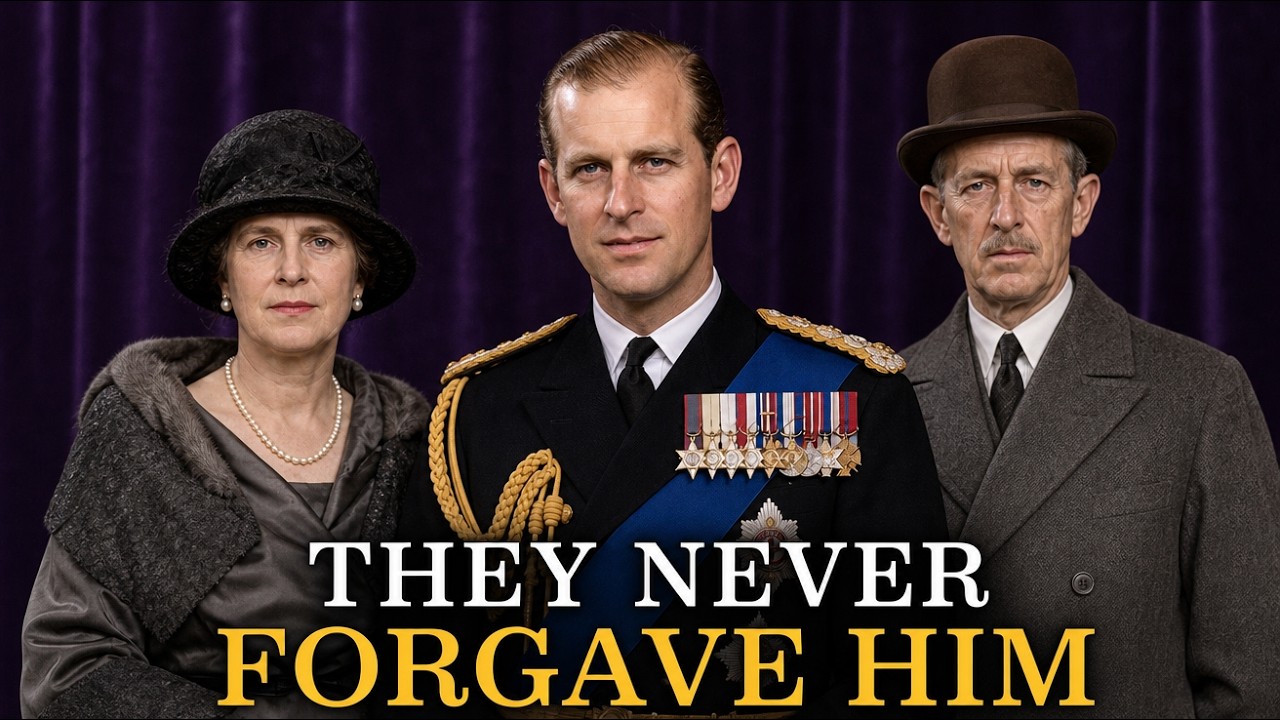
They did not. His mother came dressed in the grey habit of a nursing order, having taken apart her last tiara so the diamonds could become his fiancée’s engagement ring. His father had been dead for three years. Philip inherited a signet ring, a shaving brush, and a suit that fitted him without alteration.
Seventeen years before that wedding, men had come to the house and taken his mother away. A relative signed the papers. Decades later, Philip decided who would be allowed to read them. The story does not begin with cruelty.
It begins with a warship. In December 1922, HMS Calypso carried a family away from Corfu because the alternative was a firing squad. Six leading Greek figures had already been executed in Athens that November, in the aftermath of the catastrophe in Asia Minor. Prince Andrew of Greece and Denmark, the fourth son of a murdered king, had been arrested, tried before a revolutionary tribunal, and stripped of his rank.
British diplomatic pressure, applied personally by his cousin King George V, turned a likely death sentence into exile instead. So the family boarded the ship, and the eighteen-month-old child was put to sleep in a fruit box because no one had thought to bring a cradle for a baby leaving a country he would never live in again. That is the fact worth holding onto. Philip’s first documented experience of his parents was them getting him out.
It makes what happened over the next eight years harder to explain, and much harder to forgive. His mother had been born inside Windsor Castle in February 1885, in the Tapestry Room, with Queen Victoria in the building. Princess Alice of Battenberg was Victoria’s great-great-granddaughter, and she was born completely deaf, though no one discovered it immediately. Her mother, Princess Victoria of Hesse, refused to let that define her.
Alice learned to read lips, then learned to read lips in more than one language. English and German first, Greek and French later. She learned them as an adult, reading them from the mouths of people who had no idea how much effort sat in front of them. Think about what that does to a person’s habits.
Alice spent her life watching faces for information. She also wrote constantly—letters, notes, diaries about her own life, page after page, decade after decade. That habit will matter enormously at the end of this story, so hold onto it. Her family had already learned what a name could cost.
Her father, Prince Louis of Battenberg, had risen to become First Sea Lord of the Royal Navy, but he was forced to resign in October 1914 because his name sounded German at a time when Britain was at war with Germany. He stepped down. The family anglicised its name to Mountbatten. Alice watched her father’s career end over something he had no control over.
Her son would later be asked to change his name too, and he would not like it either. She was not a woman for ornament. During the Balkan Wars of 1912 and 1913, she worked in Greek military hospitals, not in the ceremonial way royal women usually appear in photographs. She helped in operating rooms.
She handled wounds. She organised supplies. Contemporary accounts, including her mother’s correspondence, describe her working in conditions most of her relatives would not have entered. King George V awarded her the Royal Red Cross in 1913.
Her husband, by every surviving account, was charming. Prince Andrew wore a monocle, spoke fluent English, told good stories, and was genuinely liked. He was also a professional soldier in a country that changed governments the way other countries changed ministers. Between 1910 and 1924, Greece saw coups, a national schism, a royal exile, a restoration, a war, and a collapse.
Andrew’s career was never his own. He was dismissed, reinstated, dismissed again, and finally recalled in 1921 when the monarchy needed royalist officers at the front. His father, King George I, had been shot dead in a street in Thessaloniki in 1913 by a man the authorities described as mad. So Andrew already knew that being royal in Greece was not a safe job.
He went anyway. They met in London in 1902, during the coronation celebrations of Edward VII. By every indication, they genuinely wanted each other. Alice was seventeen.
Andrew was twenty. The families agreed so quickly and so warmly that the marriage looks from a distance like the easiest dynastic arrangement. Hessian and Battenberg blood joined to the Greek throne under the approving eye of the House of Windsor. Three ceremonies in Darmstadt in October 1903.
A civil ceremony, a Lutheran ceremony, and a Greek Orthodox one, because the bride’s faith and the groom’s church could not be combined in a single room. Among the guests were the Tsar of Russia and his wife. Nearly every ruling house in Europe sent someone. This was the wedding Europe recorded.
Photographs, honours, military uniform. A young couple in love, five children. Margarita in 1905, Theodora in 1906, Cecilie in 1911, Sophie in 1914, and finally, after a gap of seven years, a son. Philip arrived on 10 June 1921 at Mon Repos on Corfu, on the dining room table.
By family accounts, his birth was a passing triumph. The Greek royal family had produced a boy. Andrew left for the front within weeks. Here the marriage that Europe recorded and the marriage the two of them actually lived begin to separate.
In August 1921, at the Sakarya River, Andrew led the Second Army Corps in an attack that failed. He received an order to advance in a direction he considered suicidal and objected in writing. When the entire Asia Minor campaign collapsed a year later, the new revolutionary government needed a scapegoat, and Andrew’s refusal became the indictment. He was accused of disobedience in the face of the enemy.
It never went to trial. Nine years later, he published a book about it. “Towards Disaster: The Greek Army in Asia Minor in 1921,” one of the strangest documents in this family’s history, because Alice translated it herself into English. Her husband’s defence of himself, in her own handwriting, in her own time.
She was still trying to hold the family together then. The book is a man arguing with a court that had already convicted him. It also reads now as a man explaining why nothing that happened to him was his fault. That posture becomes a pattern.
Exile did the rest. The family reached Paris with no homeland, no income, no possessions, and no legal status. Andrew was a prince of a monarchy that had just abolished itself, holding a passport situation so vague that his son would still be technically stateless twenty-five years later, at the moment he proposed to the future Queen of England. They lived at Saint-Cloud in a lodge on the grounds of a house belonging to Andrew’s brother George—more precisely, to George’s wife.
Princess Marie Bonaparte was Bonaparte by name and Blanc by money. Her grandfather had built the Monte Carlo casino. By the 1920s she was also a significant figure in psychoanalysis, patient and then colleague of Sigmund Freud, and she paid for much of this family’s survival. Keep that detail.
The woman whose generosity housed them was personally connected to Freud. In 1930, that connection would produce a medical recommendation about Alice that is genuinely hard to read. For now, understand the arrangement in plain domestic terms, because that is where the damage lies. Andrew and Alice had four daughters, a young son, and no income.
The house was not theirs. The furniture was not theirs. Alice’s mother sent money. The Milford Haven relatives in England sent money.
Alice opened a small shop in Paris selling Greek handicrafts under the name “Hellas” to raise funds for refugees. An operating-room nurse turned charity seller, working while her husband did not. Andrew’s response to poverty was to leave the room. Not violently, not dramatically.
He simply spent less and less time in it. He went south. He played cards in Monte Carlo with money that was not his. He was, by everyone’s testimony, wonderful company at the table.
Alice’s response was to turn inward. Between 1928 and 1930, she converted to Greek Orthodoxy, then deepened into mysticism, healing, and visions, convinced she had been chosen for something. Her family’s letters moved from concern to panic within months. By 1930, this couple had four teenage daughters, a nine-year-old son in boarding school paid for by someone else, no money, no homeland, a wife describing conversations with God, and a husband on the Riviera.
They never divorced. That is the thing people get wrong. There was no decree, no scandal, no settlement, no legal separation. On paper they remained Prince and Princess Andrew of Greece for another fourteen years, writing to each other, occasionally appearing at family weddings as though they were perfectly married.
What actually happened in 1930 was quieter and much worse. Alice was removed from the house. Her son was told she was ill, and then told nothing at all. Within thirteen months, her four daughters were married off to German princes and gone.
Andrew closed the Saint-Cloud house, sold its contents, and left for the coast. The boy was nine years old. No one sat down and decided to abandon him. That is what makes it colder than hatred.
Every adult in that family made an individual, defensible choice. Treatment. Marriage. Economy.
Distance. The sum of those choices was a child with no home address. He would spend the next decade moving between his mother’s relatives, spending birthdays in other people’s houses, opening letters from a father he saw perhaps once a year. And in May 1930, before all of that, someone had to sign the papers authorising Alice’s forcible removal.
It was not a doctor. It was the family. It was Alice’s own mother, Princess Victoria of Hesse, who had spent two years watching her daughter’s letters change. The religious conversion she could accept.
The visions were harder. By early 1930, Alice was telling relatives she had healing powers, that she was in direct communication with Christ, and, in a detail preserved in family correspondence, that she was married to him. She had also begun, according to the records Hugo Vickers worked from in his 2000 biography, laying her hands on people to heal them. Her mother arranged an examination in Berlin with Dr Ernst Simmel at the Tegel sanatorium, then sought a second opinion, and then made a plan.
On 2 May 1930, at Saint-Cloud, men came to the house to take Alice away. Her daughters were sent out of the house that day so they would not be present. She was sedated with morphine and carried off. She did not consent.
She was not told where she was going. She was forty-five years old, and only eight years earlier she had been a decorated war nurse and the wife of a serving general. Andrew was not at home. Several accounts suggest he was away.
In any case, he was not the one who handled it. The signature belonged to her family, and the arrangements were made through the house of her brother-in-law, the Saint-Cloud house paid for by Marie Bonaparte, the psychoanalyst. Alice was taken to Bellevue, a private clinic in Kreuzlingen, Switzerland, run by Dr Ludwig Binswanger, one of the most respected psychiatrists in Europe. The diagnosis recorded in her file was paranoid schizophrenia.
Binswanger consulted Freud. The treatment Freud recommended, preserved in the clinic documents and relayed by Vickers, was X-ray exposure of the ovaries, based on the theory that accelerating menopause would eliminate what he described as excessive libido. They did it to her. It is easy to turn psychiatry in 1930 into a horror story and stop there.
Binswanger was not a charlatan. Alice’s family were not sadists. Something was genuinely wrong. By the standards of the time, she received expensive, sophisticated, well-intentioned treatment from the best people available.
But the sequence remains the sequence. A deaf woman who had spent her entire life reading other people’s faces to survive was sedated, removed, confined against her will, and sterilised with X-rays for what was in essence a religious obsession. She tried to leave. She wrote letters demanding release.
She wrote to her children. Some correspondence was withheld from her. Two attempts to leave the clinic grounds failed. Once, according to the clinic record, she reached the railway station.
No one told Philip any of this. He was nine years old at Cheam School in Surrey, where his mother’s brother George, the second Marquess of Milford Haven, known in the family as Georgie, was paying the fees. What the boy was told was that his mother was ill. What he experienced was that she ceased to exist.
Then the house was emptied. Between December 1930 and August 1931, Philip’s four sisters married German princes. Sophie went first, at sixteen, marrying Prince Christoph of Hesse. Cecilie married George Donatus of Hesse in February.
Margarita married Gottfried of Hohenlohe-Langenburg in April. Theodora married Berthold, Margrave of Baden, in August. Nine months, four weddings, four departures. You can read that two ways, and both are probably true.
They were young women with no homeland, no dowry, no mother in the house, and no financial future. Marriage was the only exit available. Practically speaking, it was a liquidation of assets. The house was closed because there was no longer any reason to keep it open.
Andrew sold what was in the Saint-Cloud lodge, gave up the lease, and went to the south of France. He did not take his son with him. That period, 1930 to 1931, produced everything the public later read as paternal coldness. Within roughly twelve months, a nine-year-old boy lost his mother to a closed asylum, his four sisters to Germany, his home to the inventory of the bailiffs, and his father to the Riviera.
Not through hatred. He lost his family through a set of decisions, each of which seemed reasonable in itself. His education continued because his English relatives kept paying. In 1933, he was sent to Schule Schloss Salem in Germany, which had the convenient feature of being owned by his brother-in-law Berthold.
That convenient feature evaporated almost immediately. The school’s founder, Kurt Hahn, was Jewish, had been arrested by the Nazis, and was released only after British intervention. Hahn left for Scotland. Philip followed in 1934 to a new school at Gordonstoun in Moray, the furthest point from continental Europe reachable without a boat.
Look at the practical reality of his adolescence. He had no permanent address. He spent school holidays at Linden Manor with the Milford Havens, or at Kensington Palace with his grandmother, or in Germany with whichever sister had space. He later told the writer Basil Booth in an authorised account that he simply coped with it, that the family had fallen apart and that is what one does.
He said something colder to Gyles Brandreth much later, that he did not think anyone considered he had a father. Both are late memories offered by a man who spent seventy years refusing to discuss the subject, and they should be treated for what they are: formulas he devised for dealing with the question. But the second one is factually wrong in an interesting way, and Philip knew it was wrong, because the letters still exist. Andrew wrote to him.
Not consistently, not helpfully, but he wrote affectionate letters addressing him as “dear little Philip,” asking about school and sending news. He sent a birthday telegram. He attended family weddings. In every documented interaction he was warm toward his son.
He just did not want to live with him. The real explanation for Andrew’s disappearance is not indifference. It is money, and shame about money. By the mid-1930s, Andrew was living in Monte Carlo, essentially aboard the yacht Davida, owned by Countess Andrée de La Bigne.
She was a French actress, the granddaughter of a famous courtesan from the Second Empire era, and by every reliable account the woman with whom Andrew spent the last decade of his life. He never divorced Alice. There was no scandal, no confrontation, no public break, because in that world these arrangements were understood and not discussed. What Andrée provided was not just company but a standard of living.
Andrew had no income at all. He had a title, a family name, good English, and excellent stories. In Monte Carlo, those were tradeable assets. A man who could not bear to be seen poor by his children could, with the right hostess, afford to be charming before strangers.
That is the version the evidence supports. Not a father who hated his son, but a father who could not stand his son looking at him. Meanwhile, Alice had done something that at first looks harder to defend. She was released from Kreuzlingen in 1932.
She spent time at a clinic in Merano, then almost vanished between 1932 and 1937 in central Europe. No fixed residence, moving between cheap rooms, cutting off contact with her children almost entirely. Five years. A boy from eleven to sixteen, and his mother sent him nothing.
Biographers have been careful about this, and they should be. She was recovering from a breakdown and from a course of treatment considered assault today. She was ashamed. She had been declared insane, and she had daughters with new husbands and new positions who needed protecting.
There is also the real possibility that she was told, or believed, that staying away was best for them. But the silence happened, and Philip lived inside it. What broke it was a plane crash. On 16 November 1937, a Sabena aircraft carrying Cecilie, her husband George Donatus, their two small children, and George’s mother came down in fog near Ostend.
They were on their way to London for a family wedding. Everyone on board was killed. Cecilie was eight months pregnant. The wreckage indicated she had given birth to her baby during the descent.
Her infant daughter, Johanna, who had stayed behind in Germany, survived but died of meningitis two years later. Philip was sixteen. He was pulled out of Gordonstoun and put on a train to Darmstadt. There is a photograph of that funeral procession, one of the most used images in this entire story.
A boy in a dark coat walking behind the coffins, surrounded by adult men, many of them wearing Nazi uniform. Christoph von Hesse, his brother-in-law, was a member of the SS. Gottfried was in the Wehrmacht. The German state sent official representation.
That photograph has been used for eighty years as evidence of Philip’s political sympathies. It is worth saying plainly: what the photograph actually shows is a teenager attending his sister’s funeral in the only place the funeral could be held. Something else happened in Darmstadt. Alice came.
Andrew came. For a few days in November 1937, the entire scattered family stood in the same city, and the mother who had not written to her son in five years stood beside him. And it worked. That is the strange part.
Alice’s letters to Philip resumed from that moment and never stopped again. Grief did what nothing else had managed. It brought her back into contact with her own son. Then, five months later, the man who had been effectively raising him died.
Georgie Milford Haven, the uncle who paid the fees, whose house was the closest thing Philip had to a home, died of bone cancer in April 1938, aged forty-five. Philip was sixteen. The gap was filled within weeks by Georgie’s younger brother, who had ambitions of a kind Georgie never possessed. Louis Mountbatten did not simply take over responsibility for his nephew.
He took over a project. Uncle Dickie was thirty-seven, a serving naval officer, and the most dynastically ambitious man in twentieth-century Britain. He had spent his life resenting what had been done to his father in 1914. He had a fixed idea about how to correct it: put a Mountbatten back at the centre of the British monarchy.
He had a nephew with no money, no homeland, no resident parents, good looks, and the blood of half the royal houses of Europe. In July 1939, the King and Queen visited the Royal Naval College at Dartmouth with their two daughters. There was a naval college. The princesses were kept away from the cadets, and a young officer was assigned to entertain them.
Mountbatten, then serving as the King’s escort, was on that trip. He recorded in his diary that Philip was asked to look after Lilibet and Margaret. Elizabeth was thirteen. Philip was eighteen.
He showed off by jumping over the tennis nets. She watched him through a telescope from the royal yacht as he left. Popular accounts treat that evening as the start of a love story, and perhaps it was. Elizabeth’s attachment appears to have been real, immediate, and permanent, striking given how few other things she chose in her life.
Her governess Marion Crawford wrote about it later, though Crawford wrote for money and what she wrote should be treated with caution. What is beyond dispute is that Mountbatten worked on this for eight years. He managed the correspondence. He arranged the holidays.
He pushed for British citizenship. He pressured King George VI, who was not enthusiastic and stalled repeatedly. He handled the surname question, which was necessary because Philip did not legally have one. When the family lawyers looked into it, the name they chose was Mountbatten.
See what Mountbatten was actually doing. His nephew’s parents were unavailable. So he stepped in and became the family. It happened that the family’s interests were also his own.
It was generous. It was also self-interested. Both are true. And Philip, who was not stupid, understood both.
While that was being arranged in England, his mother went back to Greece. Alice returned to Athens in 1938 and stayed through the Italian invasion, the German occupation, the famine of 1941 and 1942, and the civil violence that followed liberation. Her sons-in-law were fighting for Germany. Her son was in the Royal Navy fighting against it.
Her nephew, Prince Christoph’s brother, was in the German army. There was no side of that war that was not inside her own family. She lived in a small flat in Athens, worked with the Red Cross, ran soup kitchens, organised orphanages, and travelled to Sweden through neutral channels to bring back medical supplies. Her deafness turned out to be an operational advantage.
German officers spoke freely in front of a woman they assumed could not understand them. In autumn 1943, when the occupation authorities began deporting the Jews of Athens, she hid the Cohen family in her home. Haimaki Cohen was a Greek parliamentarian who had once sheltered Alice’s late father-in-law, King George I, during a storm. His widow Rachel and two of their children came to Alice’s flat and lived there in hidden rooms until liberation.
The Gestapo interrogated Alice at least once. According to the family’s later testimony, she pretended to be deaf and gave nothing useful, so they left. Her son knew none of this at the time. Contact with occupied Greece was practically impossible.
Philip was on active service at Cape Matapan, Sicily, and Tokyo Bay, and managed to get a message to her once through a courier when a Royal Navy ship reached Athens after the withdrawal. That is the woman the 1930 clinic file described as delusional. Worth pausing on, because the record contains both things and neither cancels the other. His father, meanwhile, spent the war stuck in Vichy France, cut off from Greece, from England, from his wife, from all his children.
Andrew and Alice had not seen each other since 1939. He died on 3 December 1944 of heart failure in a room at the Hôtel Métropole in Monte Carlo. He was sixty-two. Andrée de La Bigne was there.
No family member was present. Philip was serving in the Pacific. He could not attend a funeral, and there was no funeral for him to attend. Andrew was buried in the Russian Orthodox church in Nice and was not brought home to the royal cemetery at Tatoi until 1946.
What his son inherited was a trunk of clothes, a shaving brush, an ivory-handled razor set, and a signet ring bearing the family crest. Philip put the ring on and wore it for the rest of his life—seventy-seven years. Every photograph of him from 1947 to 2021 contains that ring if you know to look at his left hand. He also, according to accounts from the period, had his father’s naval officer’s suit altered, requiring only minor adjustments.
Back to the Abbey now. The engagement was announced on 10 July 1947, and the ring had already been made. Philip went to his mother, who had nothing left but the jewellery she had refused to sell during the famine, and Alice dismantled a tiara. The jeweller was Philip Antrobus of Bond Street.
Philip himself took part in the design. A three-carat round diamond, surrounded by ten smaller stones, set in platinum from the tiara itself. Later, when some diamonds remained, he had a bracelet made too. The most valuable thing his family owned was broken apart to buy an engagement ring for the future Queen of England, and the man who paid for it with his mother’s last possessions was a stateless naval lieutenant earning seven pounds a week.
On 20 November 1947, he walked into Westminster Abbey. This is the photograph. His mother was there, in the grey habit of the nursing order she planned to found, seated among the royal family. She was the only member of his family born into it who was present.
His three living sisters were not invited. Margarita, Theodora, and Sophie were all married to Germans. Two of those Germans had served the Reich, and Britain was two years past the war. The decision was political, and it was made on his behalf.
He did not object publicly. He never complained about it publicly at all, which is itself a statement from a man who had by then acquired a great deal of practice at not complaining. So the empty side of the church was not an expression of indifference. It was an accounting.
A father dead in a hotel. A sister dead in a plane. A mother who had entered an asylum and come out of it, now in a nun’s habit. Three sisters excluded on the Foreign Office’s understanding of public mood.
The public saw in that photograph a lucky foreigner marrying above himself. In fact, it was documentation of what remained. What Alice did next tells you she was not broken in 1930, only paused. In 1949, she founded the Christian Sisterhood of Martha and Mary, a nursing order on the island of Tinos, and spent years trying to build it with little success and entirely on her own initiative.
She wore the habit for the rest of her life. She smoked constantly, played canasta, and by the accounts of everyone who met her in old age was extremely cheerful and entirely unemotional. The Colonels’ coup in Greece ended the project in 1967, when she was eighty-two and in poor health. She was brought to Buckingham Palace and lived there until her death on 5 December 1969.
She left almost no possessions. She had given almost everything away. Her will was said to contain a line that she had nothing left, having disposed of everything. But she had documented her entire life.
Notes, letters, an unfinished account of her personal history, the correspondence she had kept from the 1920s onward, and the surviving records of what was done to her at Kreuzlingen. She had also written up the Cohen family story in the 1940s, for the record. Her son inherited those papers. Here the man everyone called cold becomes the most interesting figure in his family’s history.
Philip could have buried all of it. Royal families routinely destroy things. Letters have been burned to protect matters far less significant than a schizophrenia diagnosis, or forced sterilisation, or a father living on his mistress’s yacht. He did the opposite.
In the 1990s, he granted Hugo Vickers access to his mother’s papers for a full biography. The crucial part was allowing the Bellevue clinic file to be disclosed. That is why we know about the morphine, the removal, Freud’s recommendation, the failed escape at the station—not because a journalist dug it out, but because her son approved its release. She had a request about her burial, and it was an uncomfortable one.
She wanted to be buried in the Church of Saint Mary Magdalene at Gethsemane on the Mount of Olives, near her aunt Elizabeth, who had been murdered by the Bolsheviks and canonised. Her remains were moved there in 1988. In 1993, Yad Vashem recognised her as Righteous Among the Nations for saving the Cohen family. Philip went to Jerusalem in October 1994 to accept the award and visit the grave.
He said at the ceremony that he believed she had never thought her action was anything special, that she was a woman of deep religious faith and considered her act a natural human response. He waited until he was seventy-three to speak about her in public. Then he did it at a Holocaust memorial, formally, about a woman whose relatives had once obtained a certificate of insanity for her. So look at the wedding photograph again.
The empty side of that church has been used for seventy-five years to explain the character of Prince Philip: the outsider, the social climber, the man with no family, the boy nobody wanted. The story that photograph actually tells is that everyone who could have stood there was dead, or excluded by the British government, or wearing a nun’s habit in the third row because she had sold the last thing she owned to put a ring on the bride’s finger. They did not hate him. His family fell apart in public over eight years, and its wreckage scattered around a nine-year-old boy who was never told why.
He grew up to be the only archive the family produced that survived. And when he finally stood before the choice between the beautiful version and the documented one, he handed over the clinic file. He received his mother’s medal, wearing his father’s suit.






