The rattle of a Swan Vesta box, the scrape, the little hiss and flare that lit the gas ring, the coal fire, the last cigarette of the night—for generations of Britons, this sound was as ordinary as breathing. At its height, the empire behind that flame produced 45 billion matches a year. The Garston works on the Mersey employed close to 900 Liverpudlians, most of them women. It survived the phossy jaw scandal and the matchgirls’ strike.
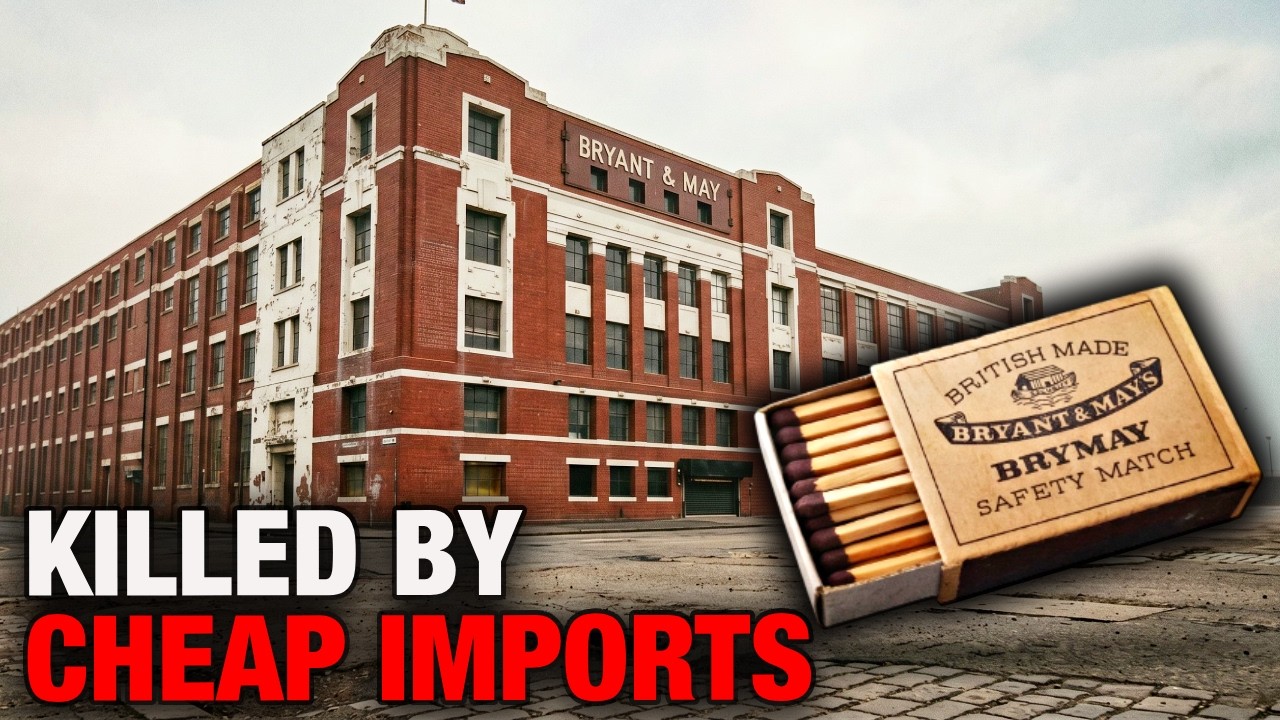
It survived the abolition of white phosphorus. It survived the Blitz, when the bombers came for the docks and production moved inland. It survived two world wars and a century of mergers. Then, after more than 130 years of making, the machines stopped, and Britain never made another match.
The story began not on the Mersey, but in Victorian London, with two Quaker merchants who did not much want to make matches at all. In 1843, William Bryant and Francis May went into partnership over tea and general provisions near London Bridge. Neither man wished to touch the match trade, and the reason was religious. The matches of the day were tipped with white phosphorus, which rotted the jawbones of the workers who dipped them.
As Quakers, Bryant and May had a conscience about the things they sold. What they would touch was something new from Sweden. In the early 1850s, brothers Carl and Johan Lundström had begun making a safer match, one that only struck against a specially prepared surface, keeping the deadly phosphorus off the match head and onto the box. Bryant and May started importing them.
The British public took to the safety match quickly, and within a couple of years the partners were shifting eight million boxes annually—close to half of everything the Lundströms could produce. In 1855, Bryant and May bought the British patent rights to the safety match outright. In 1861, they became manufacturers, opening the Fairfield Works at Bow in East London. By 1876, the Bow Works employed around 5,000 people.
By the mid-1880s, the firm was turning out something like 300 million matches a day. In 1888, the human cost of that empire arrived. The workforce at Bow was overwhelmingly female—around 1,400 women and girls, some of them very young, working up to 14 hours a day for wages under five shillings a week—and the firm fined them for talking, for dropping matches, for going to the toilet without permission. Overhead, the phosphorus did its slow work.
In June of that year, the campaigning journalist Annie Besant published an article in her paper The Link. She called it “White Slavery in London” and named the firm. When one worker was dismissed, the whole place walked out. The matchgirls organized and they won.
The fines were abolished, and the Union of Women Matchmakers was formed—the largest union of women and girls in the country. Among the strike committee was a young woman named Sarah Chapman, whose great-great-granddaughter would one day unveil a plaque on the very ground where the factory stood. The company weathered the scandal, but the next threat came from America and nearly finished them. The Diamond Match Company had a machine that could turn out 600,000 matches an hour, and it built a plant to run it just north of Liverpool at Litherland.
Bryant and May faced being simply outproduced. In the early years of the new century, they handed Diamond a controlling stake in exchange for Diamond’s British assets and machines. Among those assets was a brand of wax match that had started life in 1883 as Swan. In 1906, under Bryant and May, it was christened Swan Vesta, the smoker’s match.
In 1913, the company bought a family firm that had created a match with a label showing a great sailing warship and a name of its age: England’s Glory. The heart of the story, though, moved north. On Speke Road in Garston, a dock suburb in the south of Liverpool, a firm called Maguire, Patterson and Palmer had built a matchworks in 1887. Between roughly 1919 and 1921, they raised one of the most advanced industrial buildings in the country, designed by the architects behind the Ritz Hotel with a structural engineer named Sven Bylander.
It was among the very first structures in Britain to use reinforced concrete flat-slab construction, creating vast, open, light-flooded floors. A modernist landmark hiding in plain sight behind rows of red concrete roses, carved at the head of every column so that each pillar resembled a struck match standing upright against the Mersey sky. Bryant and May took over the English interests of Maguire, Patterson and Palmer in the early 1920s, and Garston became theirs. At its mid-century height, the factory employed close to 900 people.
The company laid on a canteen, medical rooms, a doctor and a chiropodist. There were recreation rooms, a bowling green, a tennis court, gardens. The logs came off the ships and were stripped of their bark. Machines chopped them into splints, soaked them to stop them smoldering, waxed them, carried them to the dipping machines, then dried them, filled the boxes, and printed the labels—the swan, the sailing ship—out to the sidings and away on the railway.
The whole place smelled of cut wood, hot wax, and the faint bite of sulfur, a smell the women carried home in their hair and clothes. In 1941, the Litherland plant was hit by German bombers, and production was consolidated here. From that point on, this was the group’s Merseyside stronghold. By the 1930s, the empire was at its summit.
In 1934, the British Match Corporation produced 45 billion matches in a single year. As late as 1971, Bryant and May still controlled something like 55 percent of the entire British match market. Britain still ran on fire. You lit by hand.
Almost every home in the land had a box of Swan Vestas rattling in a drawer. And at the very moment Garston stood at its peak, the instruments of its undoing were already in the room. The gas cooker was learning to light itself. Electric ignition was creeping in.
And in 1973, a French company put a small plastic butane lighter on every shop counter in Britain. The disposable lighter was cheap, reliable, bought for pennies and thrown away. Within a few years, disposable lighters held around two-thirds of their market. At the same time, the nation was putting the cigarettes down.
In the 1970s, half of British men smoked; by the 2020s, it was around one in ten. The open coal fire, that great daily consumer of matches, was pushed aside by central heating and clean air laws. The treasury removed the excise duty on disposable lighters, making them cheaper still. One by one, the small rituals that required a struck match were engineered out of ordinary life.
Bryant and May had already done the arithmetic. The great matchmaker went into the lighter business in 1981. A firm that starts selling the thing killing its own product is a firm that has understood the future completely. The decisions that killed Garston were rational.
In 1973, the British Match Corporation diversified, bought Wilkinson Sword, the razor firm, and renamed itself Wilkinson Match. Overnight, matchmaking became merely one division inside a broader consumer goods business—a legacy product. The Bow Works had already closed in 1971, taking 250 jobs. Gloucester, the home of England’s Glory, followed in 1975.
In 1978, Wilkinson Match caught the eye of Allegheny International, a conglomerate out of Pittsburgh. By 1980, the Americans had taken full control. To a steel and consumer goods giant, the match factory was an asset to be made more efficient. So it was made more efficient—machine by machine, year by year.
The Glasgow plant closed in 1981, and Garston was steadily automated until, by 1986, the last match factory in Britain was down to around 317 people, still turning out 35 billion matches a year. In 1987, Allegheny International went bankrupt. Wilkinson Match was sold, and the buyer was Swedish Match. The Swedish company whose founders’ safety match had started the entire British business back in the 1850s now owned the whole of it once more.
In 1994, Swedish Match, by then folded inside the Volvo Group, decided to close Garston and move all remaining British match production to Tidaholm in Sweden. Demand had collapsed. It was cheaper to make Britain’s matches in one consolidated European plant. On the 19th of January 1994, Eddie Loyden, Labour member of Parliament for Liverpool Garston, a former merchant navy seaman and dock worker, tabled a motion in the House of Commons, early day motion 384, expressing regret at the proposal to close the last matchmaking factory in the United Kingdom, deploring the government’s inactivity, and condemning its failure to retain jobs on Merseyside.
Sixty members of Parliament put their names to it, among them Jeremy Corbyn, Dennis Skinner, and Ken Livingstone. It did nothing. The government declined to intervene. Market forces, it was called.
Production at Garston ceased in December 1994. The exact day is oddly difficult to pin down. The final redundancies numbered fewer than 100—some sources say 94, some say 96. Fewer than 100 workers, most of them women, walked out through that 35-bay frontage for the last time into a Merseyside winter.
Bryant and May Limited was renamed Swedish Match Limited. In Tidaholm in Sweden, the machines that would now make Britain’s matches ran on, shipping the boxes back across the North Sea. One hundred and thirty-three years after the first match was struck at Bow, and 73 years after the great works had risen on Speke Road, Britain stopped making matches. It has not made one since.
For a while the building simply stood empty, derelict. Then, in 1998, the works was given Grade II listed status. Between the late 1990s and the mid-2000s, the developer Urban Splash turned it into an award-winning office estate. They called it the Matchworks, threading new mezzanine floors through the original concrete columns, and adding a glazed pavilion named, with a smile, the Matchbox.
The building lives; only its purpose was lost. The old Fairfield Works at Bow became a gated development of luxury flats. Britain makes no matches, but Swan Vestas endures. The box barely altered, the swan still swimming across the front of it, made now in Sweden from Swedish wood.
England’s Glory still sails on its label. And the match itself outlived its own necessity in one last way—as memory, as image. A box of Swan Vestas was found among the effects of George Mallory high on Everest in 1924. A half-burned Vesta is the clue that cracks a Sherlock Holmes case.
That small sound—the hiss, the flare, the drift of smoke—was the sound of 130 years of Liverpool labor, of Quaker fortunes and matchgirl courage, of a modernist masterpiece hiding all its life behind rows of concrete roses on a road down by the docks. It was made here once, all of it, and then the country simply stopped needing to strike a match. And so, one quiet December, in a building too fine to fall, the last flame in the Empire of Fire went out.






