On a warm Saturday afternoon in July 1975, two teenage girls climbed into a white pickup truck in Pensacola, Florida, and were never seen alive again. They left behind a half-empty bag of sunflower seeds, a pair of yellow roller skates, and a town that spent five decades searching for answers the authorities decided it didn’t deserve. Patrice Morris was fifteen. She lived with her mother, Linda Faye, and her younger brother in a yellow brick house on Terragon Street, just two buildings from the Catholic school she had attended since third grade.
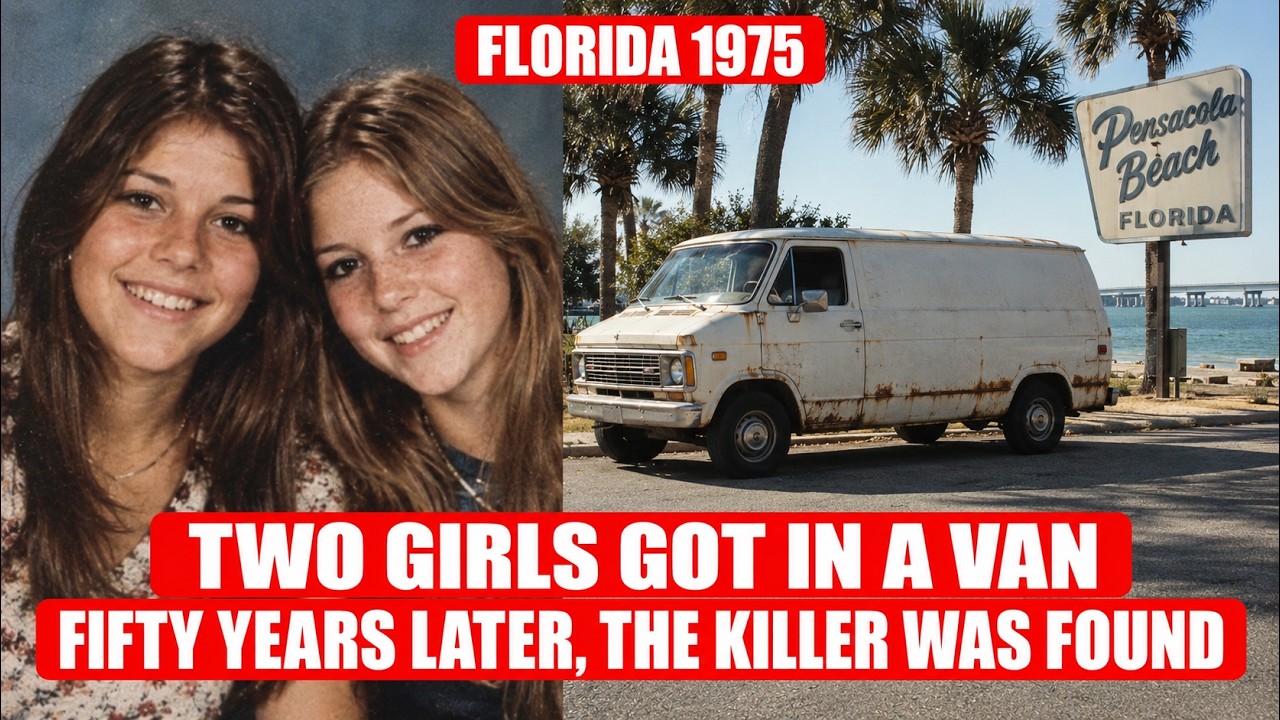
She had inherited her mother’s dark hair and her late father’s habit of collecting things: bottle caps, matchbooks, tickets from local fairs. She kept them in a shoebox under her bed. She was due to start tenth grade in September and had already told her closest friend she wanted to become a nurse, the kind who worked in emergency rooms, because she didn’t want quiet shifts where nothing happened. Cheryl Rene Duhon was fourteen, Patrice’s closest friend in the way only summer friendships between teenage girls can be.
She lived three streets away with her grandmother and two younger cousins. She was quieter than Patrice, slower to laugh, but when she did, you could hear her across the yard. That summer she was learning to play guitar. Her grandmother had found one at a church sale, a worn acoustic with a cracked tuning peg, and Cheryl carried it around the house all June, playing notes until the neighbors on the left stopped complaining and the neighbors on the right started leaving their windows open.
That Saturday, July 12, 1975, began like any other day. Patrice had been at Cheryl’s since noon. They walked to the corner store around two, bought sunflower seeds and a bottle of Coke, and were back in front of Cheryl’s grandmother’s house by quarter past two. A retired Navy man across the street, Herbert Crane, was trimming his hedge when he saw them laughing at something and tossing seeds at each other.
He waved. Patrice waved back. The truck was white, with a strip of rust along the bottom of the passenger door. Crane thought nothing of it at the time.
Trucks were everywhere in 1975. But he would remember it later, for the rest of his life. He saw the driver lean over and say something through the open window. He saw the girls look at each other.
He saw them laugh again, and he assumed the driver must have said something funny. Then he returned to his hedge. When he looked up a few minutes later, the girls were gone. That was the last time anyone who wished them no harm ever saw Patrice Morris and Cheryl Duhon.
By seven that evening, Linda Faye Morris was calling Cheryl’s grandmother. By eight, both women were calling everyone they could think of. By nine, they had driven to the park, the 7-Eleven, and the skating rink on Garden Street. By ten, Linda Faye was at the Escambia County Sheriff’s Office, where a deputy handed her a form to fill out.
He told her the girls were teenagers. He told her teenagers run away all the time. Linda Faye told him her daughter had not run away. The deputy asked her to come back if she hadn’t heard anything within 48 hours.
The official investigation would soon take shape as a pattern of institutional failure at nearly every level. A report was filed. Two officers conducted what the case file later described as a neighborhood canvass: six houses, none of them Herbert Crane’s, none of them on the side of the street where the truck had stopped. The file noted that no witnesses had reported seeing anything unusual.
Herbert Crane was not interviewed until eleven days after the girls vanished. The deputy assigned to the case, Sergeant Dale Hopper, had four other open cases on his desk that week. He was careful by most accounts, neither malicious nor neglectful, but overburdened in an understaffed department dealing with a summer crime surge. His initial report, filed three days after the disappearance, cited a lack of physical evidence, the absence of any known conflict at home, and the fact that both girls had expressed interest, according to a school friend, in one day moving to Miami.
The case was classified as suspected voluntary runaway. Linda Faye Morris spent the next three years trying to change that classification. She wrote letters to the county sheriff, the state attorney’s office, and the Florida Department of Law Enforcement. She traveled to Tallahassee twice with a folder of photographs and a two-page summary of everything she knew about the truck, the driver, and the afternoon of July 12.
She was received politely. She was told the case was under review. She was told there was no new information. She was never told that Herbert Crane had seen a white truck with a rust strip parked in front of that house and that no one had followed up on it.
Cheryl’s grandmother, Adele DuPont, did what the Morris family couldn’t always afford. In 1977, she hired a private investigator, a former Escambia County deputy named Tom Broder, who spent six weeks on the case before his money ran out. He discovered two things the official investigation hadn’t. The first was Herbert Crane.
The second was a woman living two miles away on Michigan Avenue who told him that in the summer of 1975, a man she knew only as Ray drove a white truck with a rust line and gave rides to pedestrians along Cervantes Street. She had seen it herself more than once. She thought about reporting it at the time. She said she never did.
Broder brought both pieces of information to Sergeant Hopper’s office in the fall of 1977. Hopper logged them in the file. The case remained classified as voluntary runaway. By 1980, five years had passed, and the Terragon Street neighborhood began to change.
The yellow brick house where Linda Faye lived was sold to a young couple from Tennessee. The corner store where the girls bought sunflower seeds closed and reopened as a tax preparation office. Herbert Crane moved to a care facility in 1983, carrying the memory of that white truck like a stone in his shoe. Cheryl’s guitar remained in her grandmother’s living room, on a stand in the corner, the broken tuning peg still unrepaired, as if waiting for Cheryl to come back and finish learning to play it.
In 1989, a new Escambia County investigator named Marcus Webb was assigned to review a set of old unsolved cases as part of a statewide cold case audit. He pulled the file on a Wednesday afternoon and read it in full within an hour. What troubled him wasn’t just the classification, though that troubled him too. It was the specific gap.
No trace of the truck. No follow-up on Broder’s witness on Michigan Avenue. No record of Herbert Crane being interviewed in any official capacity. Just two girls and a form saying they had run away.
Webb spent three evenings of his own time trying to find the Michigan Avenue woman. She had moved twice since 1977. He finally located her, still living in Escambia County, and she confirmed everything she had told Broder. She still remembered the man she called Ray.
She remembered he had worked at a boat repair shop near Bayou Texar at some point. She couldn’t remember more than that. Webb filed a supplementary report recommending the case be reclassified. He was told the case was too old, the evidence too thin, and the department too busy to redirect resources toward a thirty-year-old runaway case.
He kept a copy of the file in his garage, in a box next to a missing shrimper case from 1981 he also couldn’t let go. Webb retired from the sheriff’s office in 2003. He took the boxes with him. By then, the case had been cold for twenty-seven years.
That fall, Webb sat down at a desk in the Pensacola Public Library and began working through the genealogy databases that had started appearing online in the late 1990s. He wasn’t looking for a DNA match yet. The crime scene evidence had sat in a county evidence locker for decades, and the technology to match it wasn’t yet available to a retired investigator in northwest Florida. He was looking for a man named Ray who had worked at a boat shop near Bayou Texar around 1975.
He found eight men named Raymond licensed as marine repair technicians in Escambia County between 1970 and 1980. He spent six months narrowing the list to three. One had died in 1991. The second had moved to Alabama and, according to public records, was imprisoned for assault in 1984.
The third was still living in Pensacola: Raymond Dale Sutter, 68 years old, with a driver’s license, a modest home off Highway 9 Mile, and no criminal record Webb could find. Then, in November 2019, forty-four years after Patrice Morris and Cheryl Duhon disappeared, the Florida Department of Law Enforcement announced a partnership with a private forensic genealogy lab. The program was designed specifically for unsolved cases with biological evidence that traditional DNA testing had failed to resolve. Webb saw the announcement in a local news brief.
He called the FDLE field office in Pensacola the next morning. The biological material had been collected in 1975 from the site where the girls’ remains were found in 1976, in a wooded area of Santa Rosa County about seventeen miles from Pensacola. The original forensic work had identified the remains but, with the technology of the time, had found no lead to a suspect. The samples sat in envelopes bearing the case number in a storage facility that had been moved twice since 1975.
They were still there. The laboratory extracted a usable male DNA profile from a sample recovered from the crime scene. They uploaded it to GEDmatch, a public genealogy database where people share their DNA for family history research. The process works by identifying distant relatives of an unknown person, third or fourth cousins, people who share a common ancestor, and then tracing those family trees down to a single individual.
On a Tuesday evening in March 2021, Marcus Webb sat at his kitchen table when the phone rang. The caller was Special Agent Diane Robles, the investigator who had taken over the case. She had only three words to say: they had a name. Raymond Dale Sutter had lived in Pensacola for 68 years.
He had worked at Bayou Marine Repair on East Lloyd Street from 1972 until 1981. He had owned a white 1971 Dodge truck, registered in Escambia County from 1974 until 1977, when he sold it to a man in Brewton, Alabama. He had married twice, divorced twice, and had three adult sons who described him to investigators as a quiet, withdrawn man. He had a workshop in his garage where he built ship models.
He had no criminal record. He coached a Little League team for two seasons in the late 1970s. He attended St. Michael’s Catholic Church.
He had a neighbor who described him as the type to shovel your driveway after a storm without being asked, and leave before you could thank him. He was the man driving the white truck. The DNA from the Santa Rosa County crime scene matched Sutter with a statistical certainty of 1 in 72 billion. There was no ambiguity.
The genetic confirmation was absolute, obtained through a court-ordered buccal swab when Sutter’s son unknowingly submitted to a DNA test during a routine medical examination. Robles and three sheriff’s deputies arrived at Sutter’s home on Highway 9 Mile on the morning of April 8, 2021. Sutter opened the door in a flannel shirt. He looked at Robles.
He looked at the deputies behind her. According to the arrest report, he said: I was expecting someone to come. He said nothing else. He was 74 years old.
He had lived 46 years inside the life he had built on top of the bodies of two teenage girls. Sutter was charged with two counts of first-degree murder. He entered a plea of no contest in October 2022 and was sentenced to two consecutive life terms. He will die in prison.
He will never be eligible for parole. Linda Faye Morris lived to see the arrest. She was 81 years old, and she learned of it over the phone from a victims’ advocate at the Escambia County Sheriff’s Office who called at seven in the morning on April 8, 2021. She listened to the entire call without saying a word.
When the advocate asked if she was still on the line, she said: I’ve waited 46 years to hear someone say that. She took a minute to absorb it. She died fourteen months later. Her family said she was at peace.
Adele DuPont had died in 2009, before the genetic work began, before Raymond Sutter’s name appeared in any database. She never knew. But in her living room, in the house she left to Cheryl’s cousin, the guitar was still there. The cracked tuning peg was still unrepaired, still in the same corner.
It is still there to this day. The case changed several things in Florida. The FDLE forensic genealogy program, initially funded on a trial basis, became permanent in 2023 with a dedicated budget to process cold case evidence. The program has since resolved three other cases in northwest Florida alone.
Herbert Crane, who died in 1997, never saw his testimony about the white truck put to use. But his words were in Tom Broder’s notes. And Tom Broder’s notes were in Marcus Webb’s box. And Marcus Webb’s box stayed around long enough to matter.
What took 50 years to solve had not been unsolvable from the start. The witness had been there. The truck had been real. The name could have been found if anyone had looked.
What the Morris and DuPont families lost, beyond what can never be replaced, was fifty years of an answer that was always there. Raymond Dale Sutter will spend the rest of his life in prison. Patrice Morris never became a nurse. Cheryl Duhon never finished learning the guitar.
The verdict is real. The accountability is incomplete. That gap between justice served and justice complete is where most of these cases live.






