The agreement came apart in a single gesture. On April 11th, 1873, under a flag of truce, the Modoc leader Kintpuash spoke three words to the American commissioners gathered on the lava field: “Ot-we-kau-tux. ” Let us do it. He drew a pistol and shot General Edward Canby in the face.
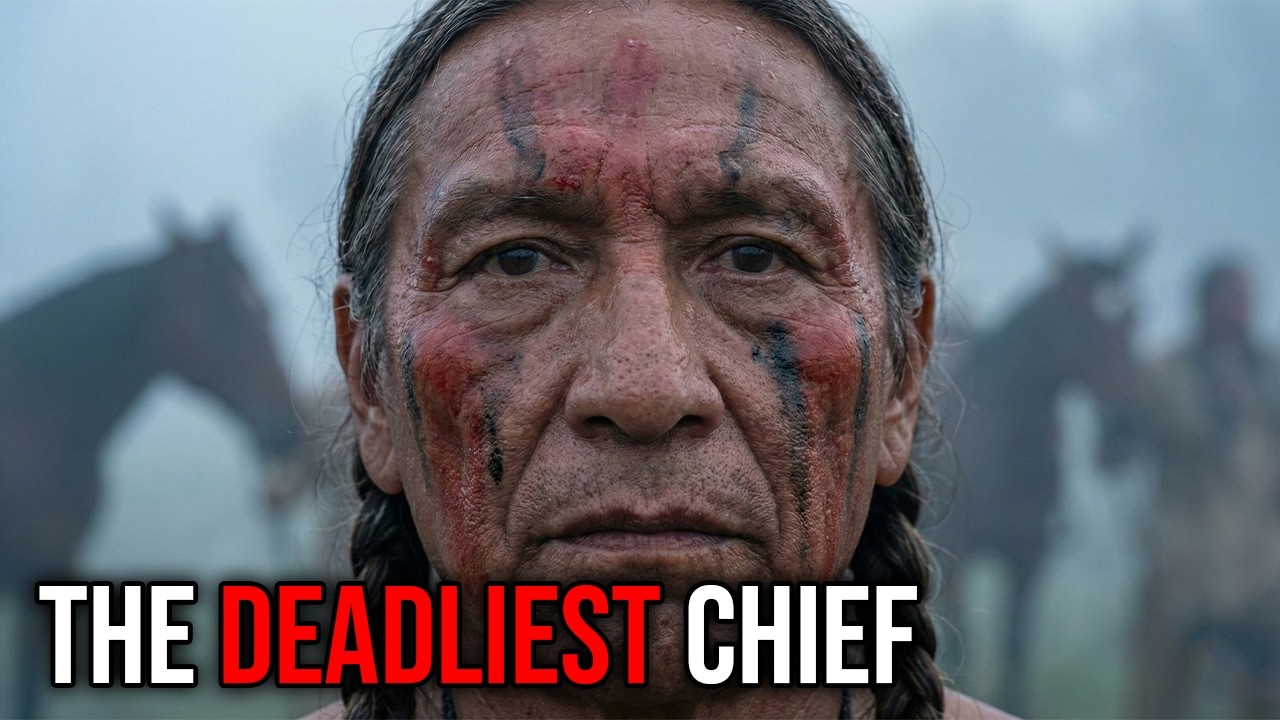
The bullet killed him instantly, and with it, any possibility of a negotiated peace. Canby remains the only United States general killed during the Indian Wars. The man who fired that shot had spent months trying to avoid it. Kintpuash, known to the settlers as Captain Jack, had not been born a warlord.
He had not wanted war at all. But by the spring of 1873 he had been maneuvered into a corner where peace meant shame and war meant destruction, and he had chosen the destruction. To understand how he got there, it helps to remember that the most dangerous figures in Native American history were not always the obvious ones. The textbooks give us Sitting Bull, Crazy Horse, Geronimo.
But the archives also record men like Iron Jacket, a Comanche war chief of the Quahadi band who rode into battle in the Texas borderlands wearing sixteenth-century Spanish chain mail, scavenged from a conquistador expedition that had passed through the region centuries earlier. For years the smoothbore muskets of settlers and soldiers could not penetrate that ancient steel. He would ride straight into the gunfire and the bullets would deflect off him. His enemies came to believe he could blow the lead away with his breath.
It was a perfect loop of fear and confidence, until technology caught up with tradition. In 1858 Iron Jacket rode out to challenge the Texas Rangers as he always had, but the Rangers and their Tonkawa scouts carried new heavy-caliber buffalo guns. A single shot from a large-bore rifle shattered the mail and the myth at the same moment. Others relied not on metal but on the spiritual.
In the Apache Wars there was Lozen, sister of the great chief Victorio and his right hand in battle. Victorio said she was strong as a man, braver than most, and cunning in strategy. Her people believed she could sense the enemy: she would stand with her arms outstretched, chanting to the creator, and her palms would turn until she felt the direction of the threat. In 1880 she protected a mother and a newborn baby for days in hostile territory, armed with only a knife and a rifle, and finally ambushed a soldier to steal his horse and bring the family to safety.
But the conflict that military historians often call the Vietnam of the West belongs to Kintpuash and the Modoc. And to a place: the lava beds of northern California. Kintpuash was a pragmatist. He adopted western dress, often wearing military-style coats with brass buttons, which is how he earned his English nickname.
He did not want to destroy the white man. He wanted to live in his home territory, the Lost River and Tule Lake basin. The trouble began when the government forced the Modoc onto a reservation shared with their traditional enemies, the Klamath. The Modoc were harassed and hungry and treated poorly.
Kintpuash famously declared: “I am not a dog. I am a man. I shall not live here. ”
The government refused to grant the Modoc their own small reservation on the Lost River.
It would have cost the Treasury about twenty thousand dollars. Instead, Washington chose to spend over four hundred thousand dollars on a war to crush them. They miscalculated badly, not only who they were fighting, but where. When the war broke out in 1872, Kintpuash led his people into the lava beds.
The terrain is a geological nightmare for an attacking army: ancient lava flows that cooled and buckled into a natural fortress of trenches, caves, and razor-sharp rock formations called shastel and domes. A fortress made of magma. Inside it, a warrior could move from the center of the stronghold to the perimeter without ever being seen. The first major test came on January 17th, 1873.
Lieutenant Colonel Frank Wheaton marched on the stronghold with roughly four hundred troops, backed by mountain howitzers. Inside the rocks, Kintpuash had only fifty-three warriors. The odds were nearly eight to one. As the soldiers advanced, a thick fog rolled in and blanketed the lava fields.
The Modoc spiritual leader, Curly-Headed Doctor, claimed he had raised the fog to blind the invaders. He had also strung a red tule cord around the perimeter, prophesying that no soldier who crossed it would live. Whether it was the fog, the red rope, or the terrain, the result was a disaster for the army. The soldiers stumbled blindly over the jagged rocks, met by devastatingly accurate sniper fire from enemies they could not see.
The army suffered thirty-seven casualties, including twelve dead. The Modoc lost not a single man. The army retreated in disgrace, having never even seen a Modoc warrior during the entire battle. Part of the Modoc dominance was hardware, a detail often overlooked.
The US troops carried the Springfield Model 1873 trapdoor rifle, a single-shot weapon with a slow rate of fire, prone to jamming when the copper casings swelled in a hot breech. In the middle of a firefight, a soldier with a jammed rifle was holding a club. The Modoc had scavenged and traded for better arms. Archaeological evidence confirms they were armed with Spencer and Henry repeating rifles, lever-action guns that could fire seven to sixteen rounds without reloading.
In the close-quarters, pop-up fighting of the lava trenches, that volume of fire was overwhelming. A single Modoc warrior could suppress an entire squad. It was a classic case of a bureaucratic decision—sticking with single-shot rifles to save ammunition—costing American lives. But even after the victory, Kintpuash felt the pressure of time.
He knew they could not hold out forever. He wanted to negotiate a peace that would allow his people to survive. He faced enemies on both sides. Outside, the army wanted revenge.
Inside, a radical faction was led by a warrior named Hooker Jim, the man who had escalated the conflict by murdering settlers, creating a blood debt that made surrender impossible. Hooker Jim held Kintpuash hostage to his own violence. A peace commission was formed, led by Canby. But inside the stronghold, Hooker Jim and the radicals taunted Kintpuash, called him a coward for wanting to talk peace, and threw a woman’s shawl over him at a council meeting.
Shamed and cornered, Kintpuash agreed to a plot he knew would seal their doom. The trap was sprung at the parley. The assassination of Canby erased any hope of mercy. The army responded in full.
General Jefferson C. Davis arrived, a man with no interest in peace talks. He changed the tactics. Instead of charging the stronghold, the army brought in Coehorn mortars, which could lob explosives high into the air to drop vertically into the trenches, negating the cover of the lava rocks.
Then they found the Modoc’s weakness: water. The stronghold bordered Tule Lake, and the Modoc had kept secret routes to resupply at night. The army cut them off. Deprived of water and pounded by mortar fire, the Modoc were forced to flee the fortress that had protected them for months.
The group splintered, and the end came through betrayal. Hooker Jim, the man who had started the killings, the man who had shamed Kintpuash into assassinating the general, surrendered. In exchange for amnesty, he agreed to hunt down his own chief. He and his band became known as the Modoc Blood Hounds, tracking Kintpuash through the wilderness.
The man who forced the war was the one who sold out the leader who tried to prevent it. On June 1st, 1873, with the soldiers finally surrounding him, Kintpuash was captured, exhausted and starving. His simple, devastating words were: “Jack’s legs give out. ”
Kintpuash and three of his subchiefs were tried by a military commission.
They were denied legal counsel. In his defense, Kintpuash argued that he had fought under the laws of war, just as the soldiers did. He pointed out the government’s hypocrisy, referencing the Ben Wright massacre of 1852, where his father had been killed during a peace feast that turned into a trap. He asked the court: “If the government refuses to protect my people, who shall I look to for protection?
”
His plea fell on deaf ears. On October 3rd, 1873, Kintpuash was hanged along with Schonchin John, Black Jim, and Boston Charlie. In a final indignity, their heads were severed and sent to Washington, DC for scientific study. The remaining 153 Modoc people were exiled to Indian Territory in Oklahoma, thousands of miles from the lava beds they had fought so hard to keep.
The Modoc War was not a victory in the traditional sense. It is a tragedy. But inside that tragedy there is a testament to human will. For months, a handful of families held off the might of an industrial power, using every advantage they had: the volcanic rock, superior rifles, and the fog itself.
Kintpuash remains a complex figure, a man who sought peace but excelled at war, a leader undone not by the enemy in front of him but by the division behind him.