On May 27th, 1949, a swimming pool on the French Riviera was scented with 450 liters of cologne, and two flower letters floated on its surface. An A for the groom, and an M for Margarita. Three hundred reporters had come to photograph the wedding of the year, and the fairy tale they captured carried a price the newsreels never showed. Within four years, her side of the family and the prince’s would be bargaining over the child she carried that day, with an offer reported at one million dollars if she would let the girl be raised a Muslim.
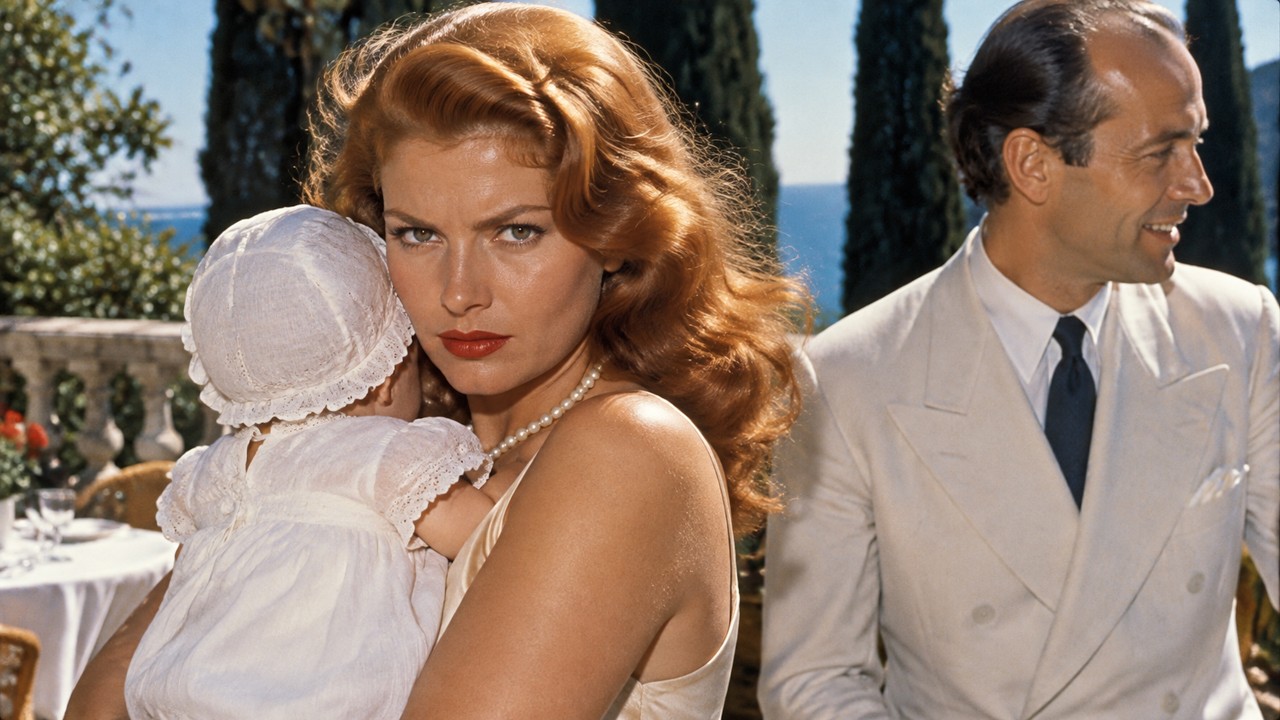
Rita Hayworth said no. Long before anyone called her a goddess, Margarita Cansino was a girl dancing in Tijuana nightclubs, her hair dyed black for the act. She was born in New York on October 17th, 1918, the eldest of three children. Her father, Eduardo Cansino, was a Spanish dancer from Castilleja de la Cuesta, a village near Seville, and his own father had been a renowned dancer before him.
Her mother, Volga Hayworth, had performed with the Ziegfeld Company and hoped her daughter would act. Eduardo wanted a dancer. Margarita later remembered how the dancing began: she did not have the courage to tell her father no, so she began taking the lessons. At eight, she appeared in a Warner Brothers short called La Fiesta.
The next year, the family moved to Hollywood. By 1931, her father had built a new act around her, the Dancing Cansinos, a father and his young daughter on the same bill. California law barred minors from working in nightclubs, so they worked across the border in Tijuana, and her hair was dyed black to make her look more Latin. What happened on those tours stayed hidden for most of her life.
Years later, she told Orson Welles that her father had sexually abused her while they traveled as the Dancing Cansinos. The account comes down through her biographer, Barbara Leaming, who wrote that her mother may have been the only other person who knew. Another writer recorded a line Hayworth reportedly used for the way she escaped it in her own head: “I hear the music. I’m on a horse.
” The girl the audiences watched was smiling. The girl inside the act had nowhere to go. Fox signed her in 1934 as Rita Cansino and let her go when the six-month contract ran out. Columbia Pictures then signed her to a seven-year contract, and the studio’s chief, Harry Cohn, set about deciding what she was for.
He thought she looked too Mediterranean. He thought Cansino sounded too Spanish. So the name went first: she became Rita Hayworth, taking her mother’s maiden name to her father’s dismay. The black hair went next, dyed a ginger red.
Then, with Cohn’s encouragement and her husband’s, she went through electrolysis to raise her hairline, so that the forehead of a Spanish dancer became the forehead of an American star. That husband was Edward Judson, an older oilman turned promoter whom she had married in 1936 or 1937, the records differ. He managed her rise and he managed her money. When she filed for divorce in February 1942, citing cruelty, she put it plainly: “Judson had helped me with my career, and he had helped himself to my money.
” She alleged that he forced her to sign over property and that he threatened her. One later profile goes further, reporting that Judson once threatened to throw lye in her face. The same profile, which names no documents, says Cohn had her dressing room bugged, fined her, and made her punch a time clock. Judson was not the first man to decide what Margarita Cansino’s talent was for, and he would not be the last.
The image they built was a sensation. In August 1941, Life magazine ran a photograph by Bob Landry of Rita Hayworth in a negligée with a black lace bodice. For two years, it would be the most requested pinup of the war. In 1946 came Gilda, and the one-gloved striptease, “Put the Blame on Mame,” that made her the great femme fatale of the screen.
That same year, at Bikini Atoll in the Pacific, the United States tested an atomic bomb carrying her photograph and the name Gilda. It was the fourth atomic bomb ever exploded. She was deeply offended. Welles, her husband by then, remembered that she almost went insane with anger.
Welles himself saw the joke differently; he said he wanted their daughter to be able to say that grandmother’s picture was on the last atom bomb ever to explode. She complained about the character, too, and the wording has come down in more than one form. One version runs: “Every man I knew went to bed with Gilda and woke up with me. ”
The numbers of the Columbia years tell you who held the keys.
In 1943, when she refused a part, Cohn suspended her for nine weeks without a cent of pay. By 1947, she was valuable enough to win a contract worth $250,000 plus 50 percent of the profits of her films, paid through her own company. She named it the Beckworth Corporation after her daughter Rebecca, born to Welles on December 17th, 1944. Two years as the war’s most wanted photograph, nine weeks of punishment, a quarter of a million dollars and half the profits; that was the price of the goddess, and the woman underneath still answered to the studio’s calendar.
In 1947, Life put her on the cover, and its writer, Winthrop Sargeant, called her the Love Goddess. The marriage to Welles was already over. She said he didn’t want the responsibility and that he never should have married in the first place. Their divorce was granted that November.
She was twenty-nine, the Love Goddess of the magazines, with a daughter not yet three and a studio contract that told her where to be every morning. By then she had been owned in one way or another since she was a child. Her father had owned the act. Judson had owned the money.
Cohn owned the name, the hair, and the hairline. Of Cohn, in 1968, she needed only four words: “He was a monster. ” So when a prince appeared, the question was never whether Rita Hayworth wanted glamour. She had more glamour than anyone alive.
The question was whether anyone would ever let her own her life. Elsa Maxwell, who made a living out of introductions, would later take the credit for this one. In the summer of 1948, Maxwell was a society hostess, and the meeting she claimed was the kind she lived for. One account says Prince Aly Khan had first seen Rita Hayworth at a charity ball in Paris and asked to meet her, and that Maxwell brought them together at a dinner party in Cannes.
Another record says simply that they met at a nightclub. Either way, by the end of that summer, Columbia’s biggest star and a prince were being chased by photographers together. He was not a storybook prince to look at. One writer describes him as five-foot-six, thin on top, with a ready voice and an immaculate English accent, and adds that men were baffled and women beguiled.
Aly Khan was born in Turin in June 1911, the son of Aga Khan III, the hereditary imam of the Nizari Ismaili Muslims, and of an Italian dancer named Cleope Teresa Magliano. He was raised by tutors in India and France and trained in law in England. He rode his own racehorses. In the war, he had joined the French Foreign Legion’s cavalry, then the Royal Wiltshire Yeomanry, and he had landed in southern France with the American Seventh Army as a liaison officer.
France gave him the Croix de Guerre. The Americans gave him the Bronze Star. In 1948, he bought a villa called the Château de l’Horizon on the shore of the Gulf Juan, built in 1932 for the actress Maxine Elliott. His reputation traveled ahead of him.
He admitted in one profile to being involved with several women, and his own father reportedly said that Aly would do better if he chose his women as carefully as his horses. He was also married. His wife was Joan Yarde-Buller, who had been married to a Guinness when Aly met her; he had been named in her divorce. By one telling, he had introduced himself to her, a married woman, with the words, “Darling, will you marry me?
” They wed in Paris in 1936. She converted to Islam, taking the name Taj ud-Dawlah, and gave him two sons, Karim and Amyn. Rita Hayworth was separated from Orson Welles, but she was not yet free of him either. Two married people were about to be chased across two continents.
Photographers followed them to Spain, to Mexico, to Cuba. She moved into his château in the south of France, then went back to America to work, and he followed her to Los Angeles and rented a house in Brentwood. When Columbia offered her a leading role, she turned it down, and the studio suspended her. A suspension in those years was more than a scolding: it stopped the star’s pay, and the time she spent suspended was added to the end of her contract.
Every month she refused to work was a month the studio would own later. Then she accepted his invitation to leave her film career altogether. Reporters followed them as they boarded the liner Britannic for Britain. The reaction came from every direction at once.
The British press attacked them. The hierarchy of the Roman Catholic Church, her own church, condemned the affair at a time when the church condemned marriage outside it after a divorce. She was breaking the rules of her studio and the rules of her faith in the same season. Even Aly’s father disapproved.
The French papers followed her too. On August 1st, France Dimanche ran a headline in which Orson Welles promised, “I shall never remarry Rita Hayworth. ” Modern Screen introduced Aly Khan to its readers as a character in the pageant of Rita’s holiday, and reported that the French coverage was sensational and that the story had created such an uproar that echoes were heard in New York. The Hollywood Reporter reduced the whole career to a pun in a headline: “From Cohn to Cannes to Khan to Canned.
”
The system that ruled Aly’s life was older and stricter than any studio. His father was the spiritual head of millions of followers, and the imam’s family was expected to behave like one. Aga Khan III had become imam in 1885 at the age of seven, the forty-eighth in his line. He had presided over the assembly of the League of Nations in 1937.
He owned five winners of the Derby, won sixteen British Classic races, and was champion owner on the British flat thirteen times. He had married four times, and Aly’s mother, the Italian dancer, had died in 1926 when Aly was fifteen. This was a man who had led a faith for more than sixty years. According to one account of what followed, the Aga Khan met his son in Gstaad in Switzerland and gave him a choice: he could end the affair, or he could marry the actress.
When Rita traveled to Cannes to meet the old man, the same account says, he liked her. The engagement was announced. What followed was a race through the courts of two countries. Her divorce from Welles became final on December 1st, 1948.
Aly’s was harder. On February 19th, 1949, he appeared before a French court for the routine attempt at reconciliation. It failed. His divorce decree came through on April 7th, more than a month earlier than expected.
That decree carried a detail worth remembering: Aly Khan received uncontested custody of his two sons. In this family, the children stayed with the family. By then, there was another reason to hurry. In March 1949, Rita Hayworth learned that she was pregnant.
So the picture the world saw that spring was a romance at its peak: the Love Goddess who had given up her studio for a prince. The picture the record shows is a woman under suspension, with no contract she was honoring, carrying a child and about to marry into a dynasty whose rules about children she had not yet had to test. She had walked out on Harry Cohn. She was walking into the house of a man whose father commanded the loyalty of a faith.
Within weeks, three hundred reporters would be waiting for the wedding. Aly Khan asked the mayor of Vallauris to keep the reporters out, and at first the mayor agreed. Vallauris was a town near Cannes. The mayor, Paul Derigon, granted the prince’s request at first.
Then, at the last moment, the journalists were let into the back of the room. It was May 27th, 1949, and the wedding of the year was going to be watched, whether the groom liked it or not. The building that housed the town hall carries a marble plaque recording the day. Twelve years later, Pablo Picasso would marry Jacqueline Roque in the same building, but the plaque commemorates the prince and the film star.
The couple arrived in a white convertible Cadillac through a cheering crowd. About three hundred reporters had come from around the world, and the newsreel notes record that the mayor welcomed the groom. The British Movietone cameras filmed the Aga Khan and his wife, the Begum, arriving at the town hall and the crowds pressing inside and out. The Begum was the old man’s fourth wife, Om Habibeh, born Yvonne Labrousse, whom he had married in Geneva in 1944.
She had been his wife for five years, and she already knew what the bride was about to learn: in this family, the title came with a role. One history of royal women would later call Rita the first American actress to marry royalty. Movietone’s commentator found the line every newsreel wanted: “The oldest Hollywood fairy story comes true. ”
It was a civil ceremony, the legal marriage.
Rita Hayworth was a Roman Catholic and did not convert to Islam. The Vatican remained critical of her for marrying outside the church. The next day, a Muslim ceremony followed which, by one account, appeased the Aga Khan and his son’s religious followers. The bride was, by one careful account, two months pregnant.
From the town hall, the party drove down to the sea to the Château de l’Horizon at Juan-les-Pins, which had been dressed for the day as a Hollywood villa. It stood on the shore of the bay, designed by the American architect Barry Dierks for the actress Maxine Elliott, and it had been Aly’s for barely a year. Guests moved between the buffets and the swimming pool. Floating on that pool were the two letters, an A for the groom and an M for Margarita, crowns of white flowers drifting side by side on water scented with cologne.
The studio had turned Margarita Cansino into Rita Hayworth. Here, on her wedding day, a prince’s household floated the initial of her real name on his pool. The scale of the day was meant to be seen. Thirty thousand roses decorated the villa.
Four hundred fifty liters of eau de cologne were poured into the pool. Eight chefs prepared the buffets, and five trucks delivered champagne, caviar, and lobster. In the account later given by the biographer Anne Edwards, about a hundred guards and a boat patrol were hired to keep the press at a distance. The guests drank more than six hundred bottles of champagne and worked their way through about fifty pounds of caviar.
Eve Montand sang. The town’s tourist office still describes the day as worthy of a super-production, the most glamorous event of the year, and for once the publicity and the record agree. Two stories about that afternoon come to us secondhand, and both should be held loosely. One guest reportedly described followers of the Aga Khan kneeling to kiss the bride’s foot, and the old man himself is said to have told her, “Too much caviar, Rita.
” Whether the line was a joke or a warning, it was the kind of thing a dynasty says to a new member about the house rules. She had paid for the day in a currency the guests could not see. Two years earlier, she had won a contract worth $250,000 and half the profits of her films. She had walked out on it, and Columbia had answered with a suspension.
The prince’s champagne was flowing, and her own pay had stopped. The newsreel cameras caught the rest, and the cameraman’s own shot list survives: a general view of Cannes; close shots of the bride and groom and of the Begum; crowds inside the town hall and outside it; the departure by car; the couple looking through photographs at the château; and the Aga Khan, the Begum, the bride and groom seated together around a table. The crowd believed it was watching a fairy tale. A girl who had danced in Tijuana nightclubs was marrying the son of a religious leader to millions.
A woman whose own church condemned the match was being welcomed by another faith’s leader with thirty thousand roses. It looked like an ending. It was a contract, because a dynastic marriage is a contract whether anyone signs it or not. The prince’s world had rules about religion, about travel, about duty to the followers, and about children.
His first wife had converted. His first wife’s sons had stayed with him. Rita Hayworth had not converted, and she was carrying his child. For now, none of it showed.
The bride smiling for three hundred reporters was carrying a child whose religion would become the price of everything that followed. Princess Yasmin was born in a Lausanne clinic on December 28th, 1949, weighing five pounds two ounces. The clinic was the Clinique de Montchoisi in Switzerland, and the date itself is a small example of how this story was recorded: most accounts give the twenty-eighth, while one record of her father’s life gives the twenty-sixth. She was a princess from the moment she was born, the granddaughter of the imam, and her mother was now a princess too.
That same year, Rita’s filly Double Rose finished second in the Prix de l’Arc de Triomphe. It was the life Aly Khan lived: racecourses, villas, the Riviera. But the title came with work, and the work was not the kind Rita Hayworth knew. Aly’s father led the Nizari Ismailis, a community the British Movietone newsreel of the wedding put at about twelve million followers, with settlements as far away as East Africa.
The imam’s eldest son had duties to them, and one account says his father required the couple to make the tour, with his wife expected to be seen beside him. In 1950, France made Aly an officer of the Legion of Honor. In December 1950, the couple set off on what was billed as a second honeymoon. Rita’s representative, Jackson Leighter, came along with his wife, Lola, and he filmed the journey.
Years later it would be released as a documentary called Champagne Safari, and through its footage and narration, the trip can still be followed almost stop by stop. They went to Pompeii and to Athens, where they walked the Parthenon. They went to Egypt, to the tombs in the Valley of the Kings, and sailed on the Nile. Then they flew south into Kenya, to Aly’s house in Nairobi, where musicians and dancers performed what the film calls a long hymn of praise to the prince and princess.
In Mombasa, they visited schools the Aga Khan had founded and watched a Wakamba dance. Elsewhere, the camera caught a Buganda ghost dance. They flew by private plane to Ismaili communities across the region, to Tanganyika, to Zanzibar, and on to Madagascar as guests of the French government. At one girls’ school graduation, the film records, Rita gave her speech in Swahili.
It is one of the quietest details in the whole story: a woman whose looks and name had been chosen for her by a studio spoke to schoolgirls in Swahili because that was what a princess in this family did. A friend of the prince once said that in Karachi, in Ismaili dress, Aly looked like a Pakistani; in Paris he looked French; in Rome, Italian. He belonged everywhere, and his wife was expected to follow. Leighter’s narration explained the man beside her to American audiences in a single line: Aly, it said, was the forty-ninth generation in direct line from Muhammad and worshipped almost as a god.
The numbers of that journey show how far from Hollywood she had gone: a community of about twelve million, more than three months on the road for the Leighters, flights by private plane from one community to the next, speeches, dances, receptions, a graduation speech in Swahili. She had left the studio calendar for another one, and this one had no suspensions, because a princess could not be suspended. The tour had a cost the film does not show. One later account says that Rita, who had given up her career for the marriage, found the duties of the tour difficult; the man holding the camera was her own representative.
The honeymoon was being recorded by someone with an eye on an audience, and in time it would become a product with a price of its own. The prince lived at a pace few could match: he reportedly went to bed at three in the morning and rose two hours later. He was a hunter too, and by one magazine’s count, his trophies ran to three lions, seven tigers, and some twenty leopards. The marriage did not survive the trip.
Aly had a reputation as a womanizer, and by one account it traveled with him to Africa too. One later summary of the marriage says he had affairs during these journeys. An unnamed source quoted by Vanity Fair put it more bluntly: “The trouble with Aly is that he is grossly oversexed. ” The same source reportedly added that he must have three or four of them at a time.
Orson Welles, who knew both of them, called the prince a nice man, a charmer, and also the most promiscuous man in Europe. Rita’s own verdict, as one profile of the prince records it, was gentler and more devastating: “Aly is very nice, but he doesn’t really understand family life. ”
The film shows where it ended. Near the close of the trip, there was a safari camp on a hunting reserve in Masai country.
Aly arrived there alone. Rita, the narration explains, had concluded that the marriage was not working. The prince went out after a buffalo and lost it to a lioness. The Leighters went home to America, and on the way they met Rita again in Alexandria.
So the record leaves us with two images of the same winter. In one, a princess in East Africa reads a speech in Swahili to a row of girls at their graduation. In the other, her husband walks into a camp in the bush without her, because she has already decided. She came back from Africa having made up her mind, and the man she was about to leave was the eldest son of a religious leader whose family kept its children.
In 1951, Aly Khan was seen dancing with Joan Fontaine in the same nightclub where he had first met his wife. It was the kind of picture that ends a marriage in public. Rita Hayworth threatened divorce, and she meant it. On April 28th, 1951, her attorney announced that she was seeking a divorce.
Within two weeks she was on the road in Nevada. A press photograph taken on May 10th shows her at a luncheon stop in Winnemucca, Nevada. The caption, kept today in the special collections of the University of Nevada, Reno, describes her as informally clad in blue jeans. She was on a long drive to Lake Tahoe, where she had rented a house and where her two daughters, Yasmin and Rebecca, were waiting.
The same caption chose its words carefully: it said she was seeking a legal separation from Prince Aly Khan. Twelve days after her attorney had spoken of divorce, the papers were still printing the softer word. There was a reason she went to Nevada. Nevada’s law required only six weeks of residency before a spouse could file.
Until 1931, it had been six months. That year, in the depths of the Depression, the legislature cut it to six weeks to bring money into the state, in the same session that legalized wide-open gambling. In the 1930s alone, more than thirty thousand divorces were granted at the Washoe County Courthouse in Reno. Divorce ranches outside town offered privacy and pampering to the people waiting out their weeks.
The law still demanded a legally recognized ground, a fault, before a divorce could be granted. One account places the house she rented at Glenbrook. The girl who had once been carried across the border to Tijuana because of California’s laws was crossing another border now, for the same reason: a different state’s law would give her what she needed. The six weeks passed.
On September 2nd, 1951, she filed for divorce in Reno. The complaint used the standard formula of the Nevada courts. She had married before three hundred reporters; she was ending it with a phrase from a lawyer’s form. It cited “extreme cruelty, entirely mental in nature.
” The prince did not answer the summons within the thirty days allowed. Under the rules, she could have finalized the divorce once the residency was complete. She did not. For about eighteen months, the case simply waited.
The reasons, as one detailed account gives them, were three. There was talk for a time of reconciliation. There was the Aga Khan’s health, because the old man had suffered a heart attack and she did not want to wound him. And there was the child.
During the proceedings there were death threats, and Rita Hayworth feared for Yasmin’s safety. One later retelling, which names no source, describes how close that fear came to the house at Lake Tahoe. A district attorney named Jack Streeter, the story goes, overheard two men bragging about what the little princess was worth and about a plan to approach by boat, snatch her, and escape across the lake. He is said to have arrived with seven guards.
No attack came. Whether the men were serious or only talking, the account cannot say, and no arrest is recorded. But from then on, by that telling, the mother and both girls lived inside a ring of bodyguards. Money was a quieter pressure.
Welles had been ordered to pay fifty dollars a week toward Rebecca. Years later, Hayworth would sue him for $22,450 in support that had never arrived. The men in her life had a habit of leaving the bills with her. Meanwhile, the old machine was still running.
In 1951, Columbia alleged that it had $800,000 invested in properties for her. A British article that year called for a boycott of her pictures. The audience that had cheered the wedding was being invited to punish the bride. The numbers of that year were all about waiting and owing: six weeks to earn the right to file; thirty days for the prince to answer, which passed in silence; eighteen months of a case left open; $800,000 that the studio said it had invested in her.
Every figure was a clock or a debt, and she was on the wrong side of all of them. Picture the house on the lake that summer: two little girls, Rebecca, aged six, the daughter of Orson Welles, and Yasmin, not yet two, the daughter of a prince. A mother who had been the most valuable star at Columbia and was now suspended from it. A husband an ocean away.
And beyond the trees, the threats against her child. What had been a romance was now a legal question, and the legal question had moved past the marriage. The marriage was over the day she filed. What remained was the girl.
In Aly Khan’s world, Yasmin was not only a daughter; she was the granddaughter of the imam. She belonged, in the eyes of that family, to a faith and to a community of millions. And her mother intended to raise her as an American in her own church, a continent away from all of it. Once the papers were filed in Reno, the question was no longer how the marriage ended.
It was who would keep the child. The prince wanted his daughter raised a Muslim, and the mother wanted her raised a Christian. There was no middle of the road. Money and property could be settled by lawyers; that was the ordinary business of Reno.
But Yasmin was the granddaughter of the imam of the Nizari Ismailis. To her father’s family, that made her more than a child of a broken marriage; it made her a member of a faith and of a line. Rita Hayworth was a Roman Catholic. She had not converted when she married.
Now she meant to raise her daughter in America as a Christian, far from the château and the followers and the duties she had watched on the safari. There was a hard irony in it. Her own church had condemned her for marrying outside it; the Vatican had remained critical of the wedding at Vallauris. Yet when the marriage failed, the faith she chose to fight for was that same faith, the one that had disapproved of her.
Whatever the church thought of Rita Hayworth, she wanted her daughter inside it. So the prince made an offer. The figure reported is one million dollars. The conditions are recorded in two slightly different versions.
In one, Yasmin would be raised a Muslim from the age of seven, and her mother would bring her to Europe two or three times a year to see her father. In the other, the visits were to last two or three months of every year. Either way, the money and the religion were tied together in the same sentence. There is one more detail in the record that sits strangely beside that offer.
Seven was the age at which her daughter’s grandfather had himself become imam in 1885. No source connects the two, and it may be nothing more than coincidence, but it was the age the offer named. Set the offer beside her life: a woman whose income had been stopped by her studio, who had walked away from her contract, who was paying for two children in a rented house on a lake, was being offered a sum that could have changed all of their lives. The price was her daughter’s faith.
She refused. Her answer has been preserved word for word: “Nothing will make me give up Yasmin’s chance to live here in America among our precious freedoms and habits. ”
There is a line in the record from a few years earlier that now came due. When Aly Khan’s first marriage ended in a French court in April 1949, he received uncontested custody of his sons Karim and Amyn.
His first wife had converted to Islam, and her boys stayed in their father’s world. The elder, Karim, born in Geneva in December 1936, was the boy his grandfather would one day choose as the next imam. This family had settled the question of children once before, in the father’s favor. Rita Hayworth meant to keep this child with her.
Her first divorce from a famous man had been simpler. When she and Orson Welles parted, she received custody of Rebecca, and Welles was ordered to pay child support. A director’s daughter was a private matter. A prince’s daughter, in the eyes of his family, belonged in part to a faith and to millions of followers who looked to her grandfather as their imam.
That was the weight resting on a girl of two and three. What the prince himself felt is harder to know. The record of the custody fight preserves his position and almost none of his words. By one later account, he asked for Yasmin to live with him in Europe, and he gave as his reason the threats being made against her life.
That account is secondhand and should be taken as his side’s argument reported. Hayworth refused that too. Both sides, by these accounts, spoke of the child’s safety. They could not agree on where she would be safe.
The numbers of that fight were measured in years and visits rather than dollars alone: one million dollars offered once; a religious upbringing to begin at the age of seven; two or three journeys to Europe every year, or two or three months, depending on which record you trust; seven guards at a lakeside house, if the later story is right. And at the center of it all, a child who was three years old when the court finally ruled. That ruling came in January 1953 in Reno. The divorce was granted on the ground the papers had named: extreme mental cruelty.
And one detail from the courtroom that day is preserved in the record of Yasmin’s own life. Three-year-old Yasmin played around the courtroom during the hearing, and at one point she climbed onto the judge’s lap. The girl at the center of a fight between two continents and two faiths did not know there was a fight. She was a toddler in a courtroom, and the judge’s lap was the most interesting place in the room.
The accounts differ about how cleanly it ended. Most give January 1953 as the date the divorce was granted. One detailed account says that the final agreement on visitation and money was signed later, on November 20th, after the two sides had worked out terms, and that Rita received custody of Yasmin at that point. However the papers were dated, the result was the same: the mother kept the child, and the father had the right to see her.
By one later account, the struggle over Yasmin went on in one form or another for the rest of Aly Khan’s life. And the threats did not stop with the decree. The fight was never only about one marriage. It was about whose world a little girl belonged to.
According to a later retelling, which cites no documents, a letter dated August 24th, 1953, warned that Yasmin would be killed unless she was returned to her father. A second letter, by the same account, threatened to beat her mother so badly that her film career would be over. A third arrived, the story goes, days before Rita Hayworth’s next wedding in September of that year; it is quoted in that telling as reading, “Yasmin will die unless her father is permitted to raise her as a Muslim. ” The letters were postmarked in New York, the account says, and the police and J.
Edgar Hoover’s office watched for more. No ransom was ever paid. No arrest is recorded. Then, by that account, the letters stopped.
Nothing in the record ties those letters to Aly Khan or to anyone in his family, and nothing here should be read that way. Whoever wrote them, they show how a private custody question had become public property. By now, Rita Hayworth had walked away three times. She had walked out on Harry Cohn’s studio.
She had walked out of a prince’s marriage. And she had refused one million dollars and the expectations of a dynasty for the right to raise her own daughter as she chose. Each choice was hers. Each one had a cost that someone else set.
The bill for the last choice was about to arrive. She had kept her daughter. Now she had to pay for her. Columbia’s advertisements announced the return of Rita Hayworth after four years away.
The studio’s accountants had their own view of the return. The picture was Affair in Trinidad, released in 1952. One film history describes her as nearly broke when she came back, after her marriage to a profligate playboy, with two children to support. That judgment is the historian’s, and it fits everything else in the record.
She was back at the studio she had walked out on, under the man she would later call a monster, because she needed the work. Harry Cohn’s view was simple: under her contract, he said, he had to use her or lose her. Columbia paid her $3,500 a week, and its New York financial office resented paying that much for nothing while the studio still had no script for her. When she threatened to walk out again over the missing script, Cohn fell back on what one history calls his old strong-arm tactics.
She could work, or she could be suspended again. So Columbia built a film to look like Gilda. Affair in Trinidad was modeled on it, and it paired her with Glenn Ford for the fourth time. The production was marked by delays and chaos.
The producer, Bert Granet, left the project. The director, Vincent Sherman, said Cohn had hired him before the full story even existed. There were delays upon delays. The budget ballooned, the reviews were tepid, and the fans turned out anyway, to see the princess who had come home.
The money of that comeback is the clearest picture of the bargain she was now inside: $3,500 a week, paid by a studio that grumbled about it; a budget that swelled to $1,200,000; seven million dollars in domestic receipts alone flowing back to Columbia. The woman who had refused a million dollars for her daughter’s faith was earning a weekly wage for a studio that took the profits of the image she had made. She made Salome next, released in 1953, and then Miss Sadie Thompson. The films kept her name in front of the public.
They did not give her back control of her life. Cohn, in 1957, told Time magazine that she had to get married and had to get out of the business. “She might be worth $10 million today easily,” he said, and he summed her up in one word: unpredictable. In his telling, the problem with Rita Hayworth was that she had a life outside his studio.
Then, on September 24th, 1953, at the Sands Hotel in Las Vegas, she married the singer Dick Haymes. It is hard to imagine a man who could have brought more trouble into a house that already had enough. Haymes was born in Buenos Aires in 1918 and was not an American citizen. During the war, he had claimed his status as an Argentine to stay out of military service, and the columnists Louella Parsons and Hedda Hopper had questioned his patriotism.
In the end, the draft board classified him unfit for hypertension, confirmed during a short stay in a hospital on Ellis Island. In 1953, he visited Rita Hayworth in Hawaii, then an American territory. When he came back to the mainland that August, he was arrested for deportation under the McCarran-Walter Act, for having refused to serve. He would fight the case for two years and win it in 1955, on the argument that Hawaii was part of the United States, so he had never left.
Haymes had just come out of a marriage to Nora Eddington, a former wife of Errol Flynn. He was deep in debt. He had been married before, twice by one count and three times by another, and he faced suits over child support. The Internal Revenue Service attached his salary of $5,000 a week to collect a bill of $100,000.
Rita Hayworth paid most of his debts. One later profile adds that Haymes demanded Columbia cast him in her pictures and that she was unemployed for four years, a claim that profile makes without documents. Set the two facts side by side: a woman turns down a million dollars rather than give up her daughter’s upbringing, and within months she is paying a new husband’s tax bill out of a studio wage. Even the second honeymoon with the prince had become a product.
Jackson Leighter, the representative who had filmed the safari, had turned the footage into a documentary called Champagne Safari. In May 1954, his companies sued her own company, the Beckworth Corporation, along with Columbia and Harry Cohn, for four million dollars. They claimed that Cohn had interfered with the film’s release. Cohn’s position was that Columbia held exclusive rights to Rita Hayworth’s appearances on screen as its contract artist.
The film ran sixty minutes, shot in color, with Leighter’s own commentary, and its copyright had been registered on the last day of 1953. The suit was settled out of court the next month. The terms were kept private, except for one: Columbia and Beckworth agreed not to interfere with the film’s distribution. Her failing marriage to a prince in East Africa was now something to be sold in theaters.
The custody settlement brought its own obligations, and they collided with the studio. Columbia, by her account, had promised that production on a biblical picture called Joseph and His Brethren would begin by March 8th, 1954. She said she was obliged by visitation rights to take Yasmin to Europe by the end of June to see her father. When the start date passed, she treated it as a breach and went to law to end the contract, while still claiming a salary of $150,000.
Her lawyer was Samuel Zagon. Columbia answered that the suit had no legal or moral basis or justification and called it a flagrant disregard of her contractual obligations. The outcome was never made public. She went back to Columbia for two more pictures, Fire Down Below and Pal Joey, and then she and the studio parted.
So the fight she had won in Reno now had to be kept month by month, with plane tickets and calendars, against a studio that measured her time in weeks of salary. The decree had given her the child. It had also given her a schedule that belonged to someone else. We watched all of this and we liked what we saw.
We bought tickets to Affair in Trinidad because she had come home. We read about the wedding at the Sands. We did not ask who was paying the tax bill or where the children were while the photographers were busy. By the spring of 1954, the woman who had refused a dynasty was paying a husband’s debts, fighting her studio over a visitation date, and being sued over the film of her own honeymoon.
And that spring, while she traveled, her daughters stayed behind in a house in White Plains. In April 1954, neighbors in White Plains, New York, began to complain about two little girls who were said to be playing in the trash outside a babysitter’s house. The girls were Rebecca Wells, nine years old, and Yasmin, the princess, who was four. One of the neighbors’ complaints was that the older girl was not attending school.
The Society for the Prevention of Cruelty to Children stepped in. In New York, that society had a long history. It had been founded in 1874 after the case of a little girl named Mary Ellen Wilson, and it is described as the first child protection agency in the world. Its business was children whom the adults around them had failed.
Where their mother was depends on who is telling it. One account of Rebecca’s life says Rita Hayworth had left the girls with the babysitter while she traveled to Florida with Dick Haymes. Another account says the couple were in a Manhattan hotel. Either way, the princess whose upbringing had been worth a million dollars to her father was said to be living in a run-down house in a New York suburb, in the care of a woman whose name the record does not keep.
The case went before a judge. A history of the scandal press of that era puts it bluntly: Rita Hayworth faced a New York judge over charges of criminally neglecting her two daughters, who were said to be living in squalor at a babysitter’s rundown home. A later profile goes further, reporting that the children were placed under the protective custody of the children’s court, that neglect charges were considered, and that both fathers, Aly Khan and Orson Welles, moved to seek custody. Those last details come from that one account and should be held as reported only.
What the record does not tell us is how the case ended. None of the sources that describe the hearing record its outcome. What they do record is the sequel, because the sequel was printed for over a million readers. That autumn, in September 1954, the magazine Confidential revived the story.
Confidential was a scandal magazine founded by a New York publisher named Robert Harrison. Its first issue, dated December 1952, sold 250,000 copies. By August 1953, after a story about Marilyn Monroe and Joe DiMaggio, it was selling 800,000. It used informants, hotel employees among them, and hired detective agencies.
By the time it reached Rita Hayworth’s daughters, its circulation was over one million copies, and within a year, by another count, it would claim five million. Its reporter had found the house by posing as someone interested in buying the property, and he had taken photographs. The magazine ran pictures of the two girls in what it called a poverty-stricken environment, and beside them it ran photographs of Rita Hayworth and Dick Haymes dining at a fashionable restaurant. It was the oldest trick of the image business turned against her: two photographs side by side, each true in its own frame, arranged to tell a story.
A history of the magazine says the couple were deeply embarrassed. The same magazine called Haymes “Mr. Evil” for the way he was alleged to treat her. The allegations that surfaced later were ugly: that he had repeatedly struck her head against a wall at a time when he was drinking heavily.
His own biographer, Ruth Prigozy, later disputed those allegations, and they should be held as allegations. For Confidential, business was good. One history of the magazine says its fortunes were to get even better before things got a lot worse. In 1957, its people were tried in Los Angeles for conspiracy to commit criminal libel, and stars such as Maureen O’Hara and Dorothy Dandridge came to testify.
The trial ended in a mistrial that October, and the next year the rights to the magazine were sold for $25,000. The numbers of that season are few, and every one of them is a person: two girls, nine years old and four; two fathers, one a prince and one a director, both reported to be seeking custody; more than a million copies of a magazine. And at the center, a mother who had refused one million dollars to keep one of those girls, now accused of failing to keep both of them. There is no honest way to tell this part of the story that makes her blameless.
By the most detailed account, she did leave her daughters with a babysitter while she traveled. By the complaint, the house was a poor place for two little girls, and a child of nine was missing school. But the judging came from familiar places. The same magazines that had sold the wedding at Vallauris now sold the squalor at White Plains.
The same public that had cheered the princess bought the photographs of her daughters. Nobody photographed the studio contract, the visitation calendar, or the husband’s tax bill. We were the readers. We bought the fairy tale in 1949, and we bought the scandal in 1954.
It was the same appetite both times. We wanted the goddess, and then we wanted to see her fall, and we never once asked who was looking after the children while we looked at the pictures. The money ran out that same year. In 1954, she dissolved the Beckworth Corporation, the company named for Rebecca, to pay her debts.
The marriage to Haymes lasted barely longer. Years later, he would say it himself: “By the early sixties, I was a desperate alcoholic. ” By then he had declared bankruptcy with $500,000 in debts. The woman who had paid his tax bill was long gone.
In 1955, at the Coconut Grove, he struck her in public. She left him and never returned. Orson Welles, who had watched her from closer than almost anyone, later gave his own judgment of those years to her biographer Barbara Leaming: “After that, Rita was on a downward path, a steep, steep toboggan slide. ”
Rebecca, the older girl in the Confidential photographs, grew up to give her own account of that childhood.
She was dry about the reason for it: it wasn’t because mother was filming in so many places, it was because she was married so often. Her school years were spent in boarding schools and summer camps in France, Switzerland, and California. By one account, at nineteen, she walked out of a Christmas gathering in Madrid, upset by her mother’s drinking. She declined to be interviewed for Barbara Leaming’s biography of her mother.
She did not see her mother at all between 1976 and 1983. Rebecca died at home in Tacoma, Washington on October 17th, 2004. It was her mother’s birthday. The younger girl in those photographs was the princess the custody fight had been about.
Nobody in 1954 could have guessed it, but she would one day be the only person left who could answer for her mother. On May 12th, 1960, Aly Khan’s car collided with another at Suresnes outside Paris, and he died at the Foch Hospital at the age of forty-eight. He had lost the thing his life had been built around three years earlier. When his father, the Aga Khan, died on July 11th, 1957 at Versoix near Geneva, the old man’s will passed over his eldest son and named Aly’s own son, Karim, then a student at Harvard, as the forty-ninth imam.
The will gave its reasons: the world had changed, it said, including the advances of atomic science, and a younger man brought up in the new age would bring a fresh outlook to the office. The age of the atom bomb, the age that had put a film star’s name on a weapon, had now been named as the reason the prince would never lead his faith. Aly made another life. In 1958, Pakistan appointed him its permanent representative to the United Nations, and that September he was elected a vice president of the General Assembly.
Henry Cabot Lodge would remember him as a most generous and considerate man. He served Pakistan with distinction. He was engaged again to the model Bettina, and she was expecting a child. She was in the car with him at Suresnes.
She survived the crash, but she lost the baby. He was buried first at the Château de l’Horizon, the villa of the wedding reception. In 1972, his remains were moved and re-interred in Salamiyah in Syria. Yasmin was ten when her father died.
Her own memory of him, in her own words, is warm. She spent her summers with him in the south of France, she has said, and her parents’ divorce left no bad feelings. She has said simply, “I had a wonderful childhood. ” Of her mother, she has said, “She was just a wonderful mother and so loving, so caring.
” She went to school in Massachusetts and in Geneva, graduated from Bennington College in 1973, and was drawn to opera singing. Rita Hayworth kept working: Pal Joey in 1957, Separate Tables in 1958. That February, she married the producer James Hill, and the marriage was another cruelty. Charlton Heston later described Hill heaping obscene abuse on her at a dinner in Spain, and she filed for divorce in September 1961, citing mental cruelty, close to the words she had used against a prince.
She made They Came to Cordura and Circus World, which brought a Golden Globe nomination, and the money trap. But something was going wrong, and for years almost no one named it. In 1971, she tried the stage, and the attempt ended because she could not remember her lines. In her last pictures, Road to Salina and The Wrath of God, she could not remember her lines, and her scenes had to be filmed one line at a time.
In 1976, she was removed from a TWA flight at Heathrow, and the press reported her drunk, agitated, and confused. Her friends and colleagues saw the memory problems and the mood changes and blamed the drinking. Yasmin had noticed something earlier, in their telephone calls as far back as the 1960s. “I just noticed that in some phone calls, she was slightly off and repetitive.
I became very concerned,” she said, “but I really had no control or idea what to do. ” Her mother’s doctors did not talk to her. Later, she would explain why no one understood: “It was the 1970s. No one really talked about or knew what Alzheimer’s was.
”
The diagnosis came in 1980 or 1981; the records differ. It was Alzheimer’s disease. In July 1981, a judge of the Los Angeles Superior Court ruled that Rita Hayworth could no longer care for herself and placed her in the care of her daughter. Yasmin moved her to an apartment at the San Remo in Manhattan and arranged nursing around the clock.
The years after that are told in Yasmin’s own words. “She would look at me and say, ‘Who are you? ’ That was heartbreaking. I had to regulate her medication as she became more aggressive.
My motherly instincts just took over. ” And then the line that holds the whole story: “She’s still beautiful, but it’s a shell. ”
The numbers of those last years are the measure of what the daughter built from the loss: sixty-eight years of a life; a court order in July 1981; testimony before Congress in 1983, where Yasmin described her mother’s state of utter helplessness; a gala in her mother’s name, first held in the middle of the 1980s, that had raised more than seventy-two million dollars for Alzheimer’s charities by 2017, and with the events that grew from it, more than eighty-five million. A historian, Barron Lerner, would call Rita Hayworth the first public face of Alzheimer’s.
The work had begun almost by accident. After Yasmin spoke about her mother in a television interview with Barbara Walters, a man named Jerome Stone contacted her. He was a caregiver himself; by one account, the founding president’s wife, Evelyn, had been diagnosed in 1970. Stone had started a small group for families living with the disease.
That group became the Alzheimer’s Association. Stone asked Yasmin to join its board and to help launch an event in New York. It became the Rita Hayworth Gala, first held in 1984. In October 2022, France made Yasmin a member of the Legion of Honor for the work.
“Denial is a world problem,” she has said, “one that prevents people from talking about the disease. ”
At one point a priest was called to give Rita the last rites, and she lived for two more years. She slipped into a semi-coma in February 1987 and died at home in Manhattan on May 14th, aged sixty-eight. In 1985, Orson Welles had called her one of the dearest and sweetest women that ever lived.
The funeral was held on May 18th at the Church of the Good Shepherd in Beverly Hills, and she was buried at Holy Cross Cemetery in Culver City. President Reagan’s statement was brief: “In her later years, Rita became known for her struggle with Alzheimer’s disease. ”
We were there for all of it. We saw the pinup and the wedding and the photographs from White Plains.
We saw the actress who could not remember her lines, and we called it drink. And the woman we had watched for forty years did not disappear quietly. She became the face that taught us the name of a disease. The château on the Gulf Juan passed in 1979 to the future King Fahd of Saudi Arabia, and one biographer, Mary S.
Lovell, wrote that it was expanded and altered almost beyond recognition. The flower letters, the A and the M for Margarita, lasted an afternoon. The letters that lasted were the ones her daughter chose for the stone in Culver City: “To yesterday’s companionship and tomorrow’s reunion. ” On a May afternoon in 1949, three hundred reporters watched a film star marry a prince beside a pool of scented water, and not one of them could see the child she was carrying: the girl a dynasty would bargain for and a magazine would photograph in squalor.
That child grew up and kept her mother’s name alive long after her mother had stopped knowing who she was. Of everyone who claimed a share of Rita Hayworth, only her daughter came back for her.






