Manuel Ruiz heard the rock crack and stepped back. The slab came down where he had been standing, a piece of the roof the size of a door, and when the dust settled, something was still up there. He was a timberman, three hundred feet inside the Longfellow mine above the copper camp of Clifton, Arizona Territory, wedging a post under the roof of a new stope. He took the thing in the stone for old pipe at first, left by some other crew, but no one had ever worked this ground before today.
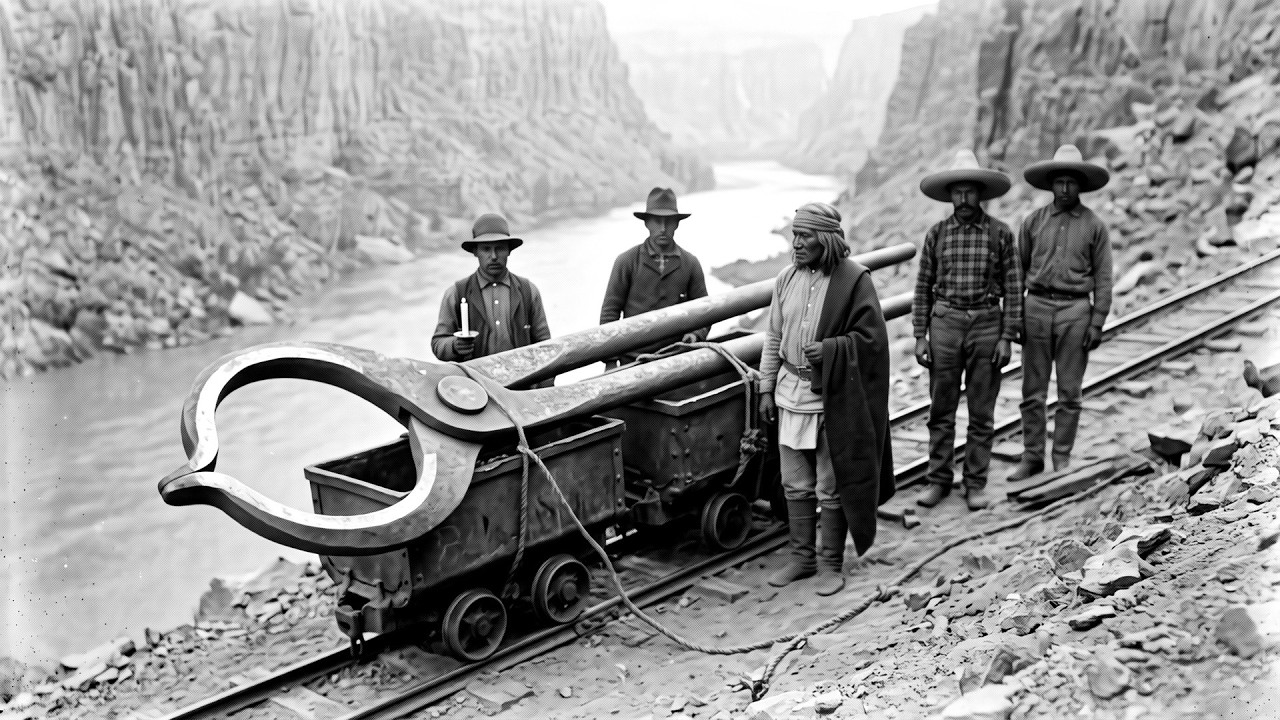
It was metal, dark and smooth, curving out of the rock about as wide as his hand. A second curve bent toward it until the two ends almost touched, four inches apart. When Ruiz lifted his candle, he saw them close around a round hollow as wide as a barrel, shining inside as if it had been glazed in a kiln. Behind them sat a rivet as big as a man’s head, and two bars running back into the hill.
It was a pair of tongs, the kind every blacksmith in the camp used for hot iron, only twenty feet long. When Ruiz closed his hand around one of the handles, his fingers went halfway around. The company blacksmith measured them and wrote every number in his daybook. The owner of the mine called them old furnace tongs and had them carried down the hill.
That might have been the end of it. But a year later, forty miles away near Fort Thomas, an old Apache man who had never set foot in a mine described those tongs to an army officer named John Burke—the jaws, the hollow they held—and told him what no one in Clifton knew: where they had been set down, which way they faced, and who left them there. To understand why those tongs should not have been there, the hill above Clifton has to be understood first. A man going to work in the Longfellow climbed a steep path in the dark and walked into a tunnel cut straight into the ridge.
The air inside smelled of wet stone and candle smoke. Hard walls of a gray rock the miners called porphyry ran through the hill, and between them lay soft broken ore that crumbled under a pick. Where the ore was rich, the men cut it out in wide rooms called stopes, and the timbermen set posts to hold the roof. A timberman listened to the roof all day.
Below the ridge, where Chase Creek meets the San Francisco River, sat the camp of Clifton, less than ten years old. In 1872, a party from Silver City had staked the first claims here, and the brothers Henry and Charles Lesinsky soon bought the best of them. The nearest railroad was seven hundred miles away. What brought men this far was copper.
By 1879, the Longfellow was sending out forty tons of ore a day, a fifth of it copper. The Lesinskys hired Mexican furnace men to smelt it and built a railroad twenty inches wide to bring it down the canyon. In 1878, they had a jail blasted out of the cliff above the river. Both would come back into this record.
The first record is not a rumor. It is a daybook, the account book of the company’s blacksmith, where every job was written down with its price: a shoe for a mule, a new edge on a drill. On the fourteenth of March, 1881, he was called up the hill. Among the mule shoes and drill edges, the daybook holds three entries that are not work at all.
The first is about the surface. Every smith leaves his hammer on what he makes in small flat marks he can read like handwriting. He went over those tongs inch by inch with his candle. He found no hammer mark anywhere—not on the handles, not on the jaws, not on the rivet.
Beside the entry, he wrote two words: “Not forged. ”
The second entry is stranger, and it is about the rivet. A rivet is a pin pushed through two pieces of iron and hammered flat on both ends. This one had no ends.
The pin and the handles were one piece of metal, with no seam and no join. And yet, when twelve men leaned on the handles, the jaws moved. He put his ear to the rivet while they pushed and heard nothing—no grinding, no scrape of metal on metal. He wrote it down as plainly as he could: “Turns, never put together.
”
The third entry is the shortest. It is about the round hollow the jaws had held. Its walls were glazed and glassy like the inside of a furnace after a long run. He had seen that shine before on the adobe walls of the first furnaces in Clifton, where the heat had melted them.
Beside it, one word: “fired. ”
The man who wrote those lines had spent his life at a forge, and he did not believe in anything he could not hit with a hammer. His name was Conrad Bauer. He was forty-six, born in Hesse, in Germany, and he had made the iron for the Lesinskys’ furnaces since 1874.
This is the stope as he described it. It was a room cut in rich ore, forty feet long and twelve feet high, still half full of broken rock, with the fallen slab lying across the floor. The tongs lay flat in the roof, the jaws showing at the open end of the stope, the handles running back into solid ground. Before anything was moved, the mine foreman laid his compass along the handles, and Bauer wrote the bearing at the bottom of the page: south 38 degrees west.
He drew a line under it, but he did not write why. The second record is not something anyone wrote. It is the tongs themselves, cut out of the hill over eleven days and measured on the twelfth. For once, the company did not mind the delay—the tongs lay in the richest ore in the Longfellow, and every ton broken away around them went down to the furnaces.
Bauer would not let the miners use powder anywhere near the jaws. They worked with picks and short bars. On the twenty-fifth of March, the last of the ore came away, and for the first time anyone could see the whole of it. Two straight handles, fifteen feet long, each as thick as a man’s calf.
A round rivet as big as a man’s head. Two short heavy jaws, bent like half moons, closing into a ring thirty-one inches across—wide enough to go around a man’s waist. Twenty feet from end to end, shaped exactly like the tongs every smith in Clifton used to lift hot iron, only more than three times as long as the men standing around them. But tongs are made to grip something.
Bauer measured the gap between the tips of the jaws: four inches. Then he turned to the hollow the jaws had held, still open in the rock where the tongs had come away. It was round, thirty-one inches across, and its walls were glazed like fired pottery, so smooth that his candle flame showed in them. Whatever the tongs had been holding was gone, and it had left the shape of itself behind.
Something had been in that grip. They lowered the tongs down the Longfellow incline lashed across two ore cars, eight hundred feet down the side of the ridge, and brought them along the bottom of Chase Creek on the little twenty-inch railroad to the smelter yard at Clifton, where Bauer kept his forge. On the scale that weighed the copper bars, they came to 3,200 pounds, about what iron of that size should weigh. Henry Lesinsky, who owned the Longfellow, looked at them for a long time.
He decided that they were furnace tongs from some old Mexican working, buried when it caved in. He had them laid on timbers in the yard beside the forge, where everyone could see them. This account may be correct—men were digging copper in this part of the Southwest long before Clifton had a name—but it does not explain how a pair of tongs came to lie inside three hundred feet of unbroken rock, why their joint turns though it was never put together, or what they had held that was hot enough to turn stone to glass. The third record was not written in Clifton.
It was written the next autumn, forty miles to the west, at the foot of a mountain, by an army officer. Clifton stood at the edge of Apache country, where the lands of the Chiricahua met the lands of the Western Apache. The copper here had first been noticed by men riding after Apaches, and for years the raids kept the camp small. To the west lay the San Carlos Reservation, set aside by President Grant in December of 1872.
On the night of the eighteenth of April, 1882, several hundred Chiricahua under Loco left San Carlos. On Eagle Creek, just west of the mines, ten men, women, and children were killed. In September of 1882, General George Crook came back to Arizona to take command, and with him came his aide, John Bourke. Bourke was a soldier, but also a careful recorder of what the Apache would tell him.
That autumn he spent weeks at San Carlos, asking them about their lives. In October, he was near Fort Thomas, an army post on the Gila River, below the long dark ridge of the Graham Mountains, whose highest peak rises more than ten thousand feet. An old man came to Bourke’s tent there. He had been born long before any miner came into these hills.
He had heard that the miners at Clifton had found something, but he had never been inside a mine. Through the interpreter, he asked to tell the officer what it was. He said there were tongs in the hill above the river, longer than three men lying down. He said no one had hammered them—they had been made whole, the joint and the arms together.
He said that what they held had been hotter than any fire people make, and that where they held it, the rock had become ice that does not melt. He said they had not fallen; they had been set down, and they were still holding. Bourke asked which way they faced. The old man did not point.
He said, “They face Dzil and Ch’aa Sian, Big Seated Mountain, the mountain that stood over the fort. ”
Then Bourke asked who had left them. The old man said they had been left by the ones who worked fire inside the mountains before the people were there. When Bourke asked who those were, he said nothing more.
This knowledge belonged to the Apache. It was not something to be given to an outsider. Bourke kept a diary for most of his life. This page is not in it.
He wrote it on a separate sheet, and a week later, he rode east to Clifton. These two records were never meant to be read together. One was written by a German blacksmith who trusted nothing he could not hit with a hammer; the other by an army officer, from the words of a man who had never seen the hill. Yet they ended up in the same book, because Bourke carried his page to the forge.
He came into the smelter yard in the last days of October 1882. Bauer opened the daybook; Bourke laid his page beside it, and they read them side by side. Bauer had written that there was no hammer mark anywhere: not forged. The old man said no one had hammered them.
Bauer had written that the rivet turned but was never put together. The old man said they had been made whole, the joint and the arms together. Bauer had written that the hollow was glazed, and beside it, fired. The old man said the rock had become ice that does not melt.
And the last: the foreman’s compass had read south 38 degrees west. The old man said they face Big Seated Mountain. In 1881, a compass at Clifton pointed almost thirteen degrees east of true north. Correct the foreman’s bearing for that, and the tongs point fifty degrees west of south.
Draw that line on a map from the Longfellow, and it crosses forty miles of desert, river, and valley and arrives at the summit of Mount Graham—Dzil and Ch’aa Sian. The jaws pointed at the mountain. Before he left, Bourke did one more thing, and Bauer wrote it down. He stepped over one jaw into the ring where the tongs lay on their timbers, and the ring closed around his waist with room to spare.
He stood there a long time. Then he handed his page to Bauer and said it did not belong in an army book. Bauer pinned it into the daybook beside the bearing. None of this says what the tongs were.
It says only that two men who never met, forty miles apart, described the same tool and turned it toward the same mountain. The last record is not a book. It is a river, and it runs for twenty-five years. In 1882, the Lesinskys sold the Longfellow and their smelter, and within months the mines belonged to the Arizona Copper Company, owned by investors in Edinburgh, Scotland.
Beside the date of the sale in his daybook is a short line: “The tongs counted with everything else. One pair of tongs, use unknown. ”
The tongs stayed where they were, on their timbers in the yard by the river. Then came the water.
The San Francisco River had flooded Clifton before, in 1880 and in 1885, but the flood of 1891 was different. According to a government report, it covered the town from mountain to mountain. Buildings were washed away. The railroad track was moved and the rails twisted.
When the water went down, the timbers in the smelter yard were gone, and so were the tongs. Bauer searched the river for them through the rest of that year. His last entry about them is from the spring of 1892, and it is four words long: “gone with the river. ”
Fifteen years passed.
On the fourth of December, 1906, a tailings dam up Chase Creek broke, and a wall of water and mud came down the canyon into the town. At least eighteen people died. In the weeks after, crews clearing the wreckage dug into the riverbank below the mouth of Chase Creek, and under six feet of gravel, they struck metal. It was the tongs.
The company sent an engineer, a Scotsman named Duncan Reed, and he measured them where they lay: twenty feet. The rivet, the jaws, and the handles, all as Bauer had written them. Then he measured the gap between the tips of the jaws: one inch. In 1881, Bauer had written four.
Reed had never seen Bauer’s daybook, and he wrote his number without comment. Nothing was caught between the jaws. They had closed on nothing. Reed noted one more thing.
The inner faces of the jaws, buried in wet gravel for fifteen years, were still bright. The company had no use for twenty feet of iron. The bank was being rebuilt against the next flood, and the tongs were left where they lay, under the new fill. Bauer had died by then, but his daughter heard what the crews had found.
She copied Reed’s numbers onto the last page of her father’s daybook, below his own. There is a reading of this case in which everything resolves into comfortable categories. In that version, the tongs are old work. Copper was mined in the Southwest long before Clifton, and at Santa Rita, seventy miles to the east, Spanish and Mexican miners were sending it south by mule train in the early 1800s.
Giant furnace tongs that had been cast instead of forged would carry no hammer marks at all. Their joint could have rusted solid under a mineral crust until no seam showed. The hollow need not be strange either, because oxidized copper ore is full of natural cavities, and some are lined with crusts that shine like glaze. The Longfellow ore lay in a broken funnel-shaped mass, and parts of the hill later settled as the old workings caved.
A forgotten working could have been buried the same way. A river that can twist railroad rails can bend iron, and two men measuring twenty-five years apart may not have measured at the same points. And the old man may simply have heard that the tongs were the talk of Clifton for a year—freight and scouts carried news along every road, and an officer who asks questions can be told what he hopes to hear. Skeptics reasonably point out every one of these things, and every one of them is fair.
Nor did anyone hide anything. Bauer wrote down what he saw, and Lesinsky put the tongs in an open yard where anyone could look at them. The records were not suppressed, simply not followed up. The company changed hands, the river took the yard, and the papers went wherever the papers of a sold company go.
But that version has to explain each record by itself. It cannot explain them together. Tongs with no hammer mark inside three hundred feet of rock. A joint that turns but was never put together.
A hollow turned to glass. A gap that closed from four inches to one. And an old man near Fort Thomas who had never been inside the hill, naming the mountain the jaws pointed to. That is not a weakness in the evidence.
It is the evidence. So what is in those hills now? The Longfellow is gone. In 1937, the company began stripping the ground for an open pit at Morenci, and over the next fifty years the pit swallowed the old town of Morenci, the camp of Metcalf, and the ridge where Manuel Ruiz once set his post.
Clifton is still there where Chase Creek meets the river, and nearly four thousand people live there today. The jail the Lesinskys blasted into the cliff in 1878 still stands. It was closed after the flood of 1906. Beside it stands a small locomotive called the Copperhead, one of the little engines of the twenty-inch railroad that once carried the tongs down the canyon.
The river still floods. In October of 1983, it rose higher than ever before and took the house on Chase Creek where Bauer’s daybook was last seen. Forty miles to the southwest, Big Seated Mountain still stands over the valley. For the San Carlos Apache, it is still Dzil and Ch’aa Sian.
And for decades, they have defended it against the telescopes built on its summit. John Bourke died in 1896. The last line in the daybook puts the tongs under the riverbank below Chase Creek in December of 1906. If they are still there, they lie under a century of gravel and fill, a short walk from the jail.
The mines are real. The copper, the little railroad, the floods, and the jail in the cliff are real. The breakout of 1882, Crook’s return, and Bourke’s autumn among the Apache are real. The unanswered questions begin only after that point.
In 1881, three hundred feet inside the Longfellow, Manuel Ruiz set a post under a roof that was already coming down. When the dust settled, something was still up there. His hand reached only halfway around it, and the numbers in the daybook say the tongs were not finished holding on. A joint that was never put together.
A hollow turned to glass. Jaws that kept closing while no one was watching. Four inches in 1881. One inch in 1906.
No one has measured it since.






