In 1606, a Polish noblewoman became the tsarina of Russia by marrying a man who claimed to have reclaimed a stolen throne. Just nine days later, her husband was butchered by an angry mob. She refused to surrender her crown. Instead, she stunned the empire by publicly declaring that a second, completely different impostor was her surviving husband.
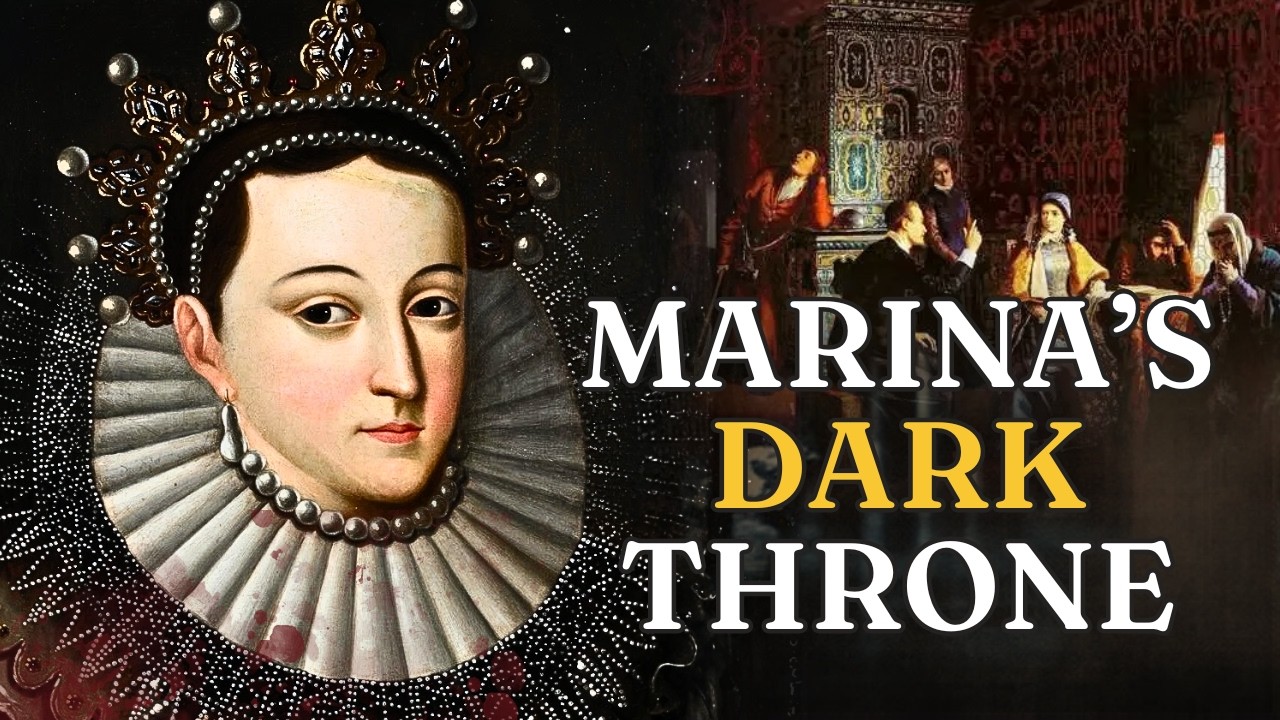
Her relentless pursuit of power plunged a fragile nation into civil war and ultimately led her three-year-old son to the gallows. History would later brand her a witch. But the true horror of Marina Mniszech, the false tsarina of Russia, was rooted entirely in her cold refusal to abandon a fabricated dynasty. Marina Mniszech was born in the late 1580s into a world where a noble daughter was the supreme political currency.
Her father, Jerzy Mniszech, was the voivode of Sandomierz, a man of significant titles who moved through the highest circles of the Polish aristocracy. The Commonwealth, however, was a uniquely brutal political arena. Unlike the absolutist rule of neighboring Muscovy, Poland was a noble republic. The king was elected, and the great magnates—the ultra-wealthy elite—wielded enormous power, maintaining their own armies and vast estates.
In this hyper-competitive environment, stagnation was synonymous with death. A family either expanded its influence through aggressive alliances or was devoured by its rivals. Jerzy Mniszech was a man consumed by ambition, but he was also drowning in mounting debts. He needed a lifeline, a gamble that would elevate his house above the petty squabbles of the Polish parliament.
Marina was raised under this desperate ambition. The psychological conditioning of a noblewoman in that era was brutally efficient. From childhood, she learned that her body, her future, and her obedience belonged to her family’s record. She received a strict Catholic education, learning to read, to carry herself with absolute dignity, and to understand the intricate protocols of court.
But this education was not for her personal enlightenment; it was to increase her market value. The suffering of this existence was not sharp but chronic—the slow, stifled realization that she was an asset to be spent when the exchange rate was at its peak. She was not allowed the luxury of personal desire. Her mind was honed only to be a more effective tool of her father’s will.
While Marina was being forged into a political instrument, an unprecedented storm was gathering across the eastern border in Russia. The Rurik dynasty, which had ruled the Russian lands for centuries, was rotting from within. In 1591, Tsarevich Dmitry, the youngest son of Ivan the Terrible, died in the town of Uglich at the age of eight. The official report claimed the boy suffered an epileptic seizure while playing with a knife, accidentally cutting his own throat.
But the people knew the nature of their government. They believed the boy had been assassinated on the orders of Boris Godunov, the powerful regent who coveted the throne for himself. When the last son of Ivan the Terrible died in 1598, Godunov took the crown, but his rule was built on the suspicion of child murder. The deeply religious and superstitious Russian people viewed his reign as cursed, and the land itself seemed to agree.
Between 1601 and 1603, Russia suffered a catastrophic famine. Crops failed entirely. People ate grass and tree bark, and eventually, the flesh of the dead. Society disintegrated.
Hundreds of thousands perished. In a system based on the absolute divine right of the tsar, a starving people do not blame the weather. They blame the ruler for lacking divine favor. This systemic collapse of the Russian state created a vacuum.
Desperate people do not look for logical solutions; they look for miracles. They needed a savior untainted by the hands of the current regime. This desperation was the fertile soil in which the greatest lie of the seventeenth century would grow. Around 1603, a man appeared in the Polish-Lithuanian Commonwealth claiming the impossible.
He declared he was Tsarevich Dmitry, asserting he had not died in Uglich, that someone else had been killed in his place, and that he had been living in hiding for over a decade. Most modern historians identify this man as Grigory Otrepyev, a runaway Russian monk. But his true identity was irrelevant to the mechanics of power. What mattered was that he possessed intimate knowledge of the Russian court, bore a physical resemblance to the royal family, and offered the Polish nobles what they had long desired: an agent through whom they could control Russia.
When this man met Jerzy Mniszech, the machinery of the system began to turn. Jerzy did not subject the man to a rigorous investigation of the truth. In the high-stakes game of aristocratic power, truth was entirely subjective. Truth was whatever could be enforced by a standing army.
Jerzy saw an opportunity to become the father-in-law of a Russian tsar, a means to erase his debts and acquire unimaginable wealth. The deal was struck in the shadows of ambition. Jerzy would provide military and financial support for this Dmitry to march on Moscow and reclaim his throne. In return, Dmitry promised Jerzy a million zloty, the Russian cities of Smolensk and Severya, and the establishment of Catholicism in Russia.
But the cornerstone of this entire geopolitical contract was Marina. She was presented to the pretender as his bride. The weight of this moment was immense. Marina was a highly educated, intelligent young woman who very likely recognized the absurdity of this man’s story.
She knew he was a vagrant, a renegade running an audacious con. But the systemic reality of her life dictated that her personal beliefs were irrelevant. If her father ordered it, she would marry a ghost. Yet Marina was not merely a passive victim.
The shock of being commodified often breeds a profound and terrifying realism. If she was to be sold, she would ensure the price was the highest conceivable. She demanded a written contract from Dmitry. She secured promises of vast personal estates, diamonds, and an absolute guarantee that if the campaign failed, she would retain her wealth and status.
She was stepping toward the abyss, but she was negotiating the terms of her own fall. In November 1605, a proxy wedding was held in Krakow. King Sigismund III of Poland attended, lending implicit state endorsement to the union. The false Dmitry was not even present; he was already in Russia leading an army of mercenaries toward Moscow, capitalizing on the sudden and highly suspicious death of Boris Godunov.
Marina stood at the altar and bound her life, her soul, and her future to a man she barely knew, a man whose very name was a fabrication. She was stripped of her national identity, her familial security, and her connection to reality. She had become officially the tsarina of a foreign country, married to a ghost. As winter approached in 1605, Marina prepared to leave her homeland.
She assembled a massive retinue of ladies-in-waiting, Polish knights, and Catholic priests. She packed trunks of velvet, pearls, and silver. It was a procession designed to project absolute, unshakeable power. But beneath the velvet and jewels, it was a march toward death.
She was heading toward a shocked and starving country that hated her religion, despised her nationality, and saw her husband as an enemy of Christ. She was riding her carriage into the eye of the storm. When Marina Mniszech’s carriage crossed the frozen border into Russian territory, she passed an invisible point of no return. The Commonwealth faded behind her.
The safety of the known world was gone. Ahead lay the vast, snow-covered expanses of Muscovy, a land defined by brutal autocratic violence and religious fervor. She was entering a society where human life was astonishingly cheap and political failure was always punished by death. Marina was no longer merely the daughter of Jerzy Mniszech.
She was an invading force, a living geopolitical weapon deployed by the Polish nobility to break the Russian state. The system that created her, however, had made a fatal miscalculation. It assumed that a fabricated truth could be maintained by arrogance alone, that the starving masses of Russia would simply bow to a foreign queen. As the towers of Moscow appeared on the horizon, the false Dmitry’s great lie was about to collide with the terrifying reality of Russian fury.
The deal was complete. The nightmare was about to begin. Marina’s arrival in Moscow in the spring of 1606 was not a royal homecoming; it was an occupation wrapped in velvet. As her massive carriage, drawn by twelve white horses, passed through the gates of the Russian capital, the air thrummed with the clanging of hundreds of Orthodox bells.
But for the people of Moscow, the ringing sounded like a warning. Marina was accompanied by a private army of two thousand Polish and Lithuanian nobles, mercenaries, and Catholic priests. They marched through the muddy, unpaved streets of the wooden city with the swagger of conquerors, looking upon the Russian commoners with open contempt. The Muscovites returned the gaze with silent, smoldering hatred.
The collision of these two worlds was immediate and violent in its psychological impact. Marina was raised in the Polish-Lithuanian Commonwealth, a society that valued Renaissance culture, political debate, and Western European aesthetics. Moscow, in contrast, was a fortress of extreme isolationism. The Russian state maintained its absolute control over its people through strict adherence to Orthodox doctrine and a systematic suspicion of anything foreign.
The tsar was not merely a king; he was God’s representative on earth. Amidst this closed, deeply traumatized system entered a Polish Catholic woman who refused to change her religion. This refusal was a catastrophic political error, but it was mandated by the terms of her father’s great bargain. Jerzy Mniszech and his Polish backers needed Marina to remain Catholic, to be a wedge that would eventually open Russia to the Vatican.
The false Dmitry, desperate to please his foreign financiers and secure his fragile grip on the throne, allowed it. He permitted Marina to keep her Catholic confessors and ignored the Russian patriarch’s demands that she be rebaptized into the Orthodox faith. The Russian boyars, the old powerful noble families who truly controlled the levers of state, watched this heresy with cold calculation. Men like Vasily Shuisky cared nothing for theological implications.
All that mattered was power. They had allowed the false Dmitry to take the throne because they needed him to eliminate the Godunov dynasty. Dmitry was a crude instrument used to clear the path. But the instrument was now acting with independence, alienating the Russian guards, spending treasury funds on Polish mercenaries, and, most dangerously, elevating a foreign woman to an unprecedented position of power.
On May 8, 1606, Marina Mniszech was crowned Tsarina of All Russia in the Assumption Cathedral. It was a historical anomaly. No foreign-born woman had ever been crowned in her own right before her husband. The ceremony was designed to cement her authority, but it only crystallized Russian discontent.
During the sacred rites, Marina refused to take the Orthodox sacrament. She sat on a diamond-encrusted throne, wearing a crown that seemed heavy with borrowed authority. As she looked at the faces of the Russian nobles, she was unaware that nearly every man in the room was already calculating the logistics of her assassination. The cultural clash accelerated rapidly in the days following the coronation.
Royal banquets became the stage for a culture war. Marina and her Polish entourage introduced Western music, foreign dances, and consumed meats that Orthodox believers considered ritually unclean. Most controversially, Marina ate her meals using a two-pronged fork. To the seventeenth-century Russian mind, the fork was not a dining tool; it was a demonic trident, physical proof that the tsarina was an agent of the devil bringing Western corruption to poison Russia’s pure soul.
Meanwhile, the Polish mercenaries treated Moscow as an occupied city. They drank heavily, looted markets, assaulted Russian women, and barged into Orthodox churches wearing their hats, mocking the priests. The false Dmitry did nothing to stop them. He was paralyzed by his own self-deception, knowing he was a fraud and that the Polish swords were the only thing keeping him on the throne.
Marina, intelligent enough to sense the hostility, was utterly isolated. She did not speak the language, did not understand the deadly, complex politics of the boyars, and was entirely dependent on a husband she did not love and a father busy extracting gold from the Russian treasury. She was the most powerful woman in the country, yet she had no control over her own survival. She was simply an asset placed in a war zone.
Vasily Shuisky decided it was time to liquidate that asset. The conspiracy was executed with terrifying efficiency. Shuisky and his allies did not need to hire assassins; they only needed to unleash the fury of the mob. In the early hours of May 17, 1606, just nine days after Marina’s coronation, Moscow’s great bells began to ring violently.
It was the signal for the uprising. The boyars spread a rumor through the city that Polish soldiers were trying to assassinate the tsar. The starving, traumatized Muscovites, pushed to the edge by years of famine and foreign humiliation, exploded into the streets. A mob of tens of thousands, armed with axes, spears, and pitchforks, rushed toward the houses where the Polish nobles were sleeping.
The slaughter was indiscriminate and merciless. Men, women, and children of the Polish retinue were dragged into the streets and cut to pieces. Blood ran in the muddy gutters. While the city burned, a special force of boyars and rebel guards breached the Kremlin.
They bypassed the outer defenses and stormed the royal apartments. The false Dmitry woke to the sound of his executioners breaking down his door. The man who had convinced a nation he was the son of Ivan the Terrible panicked like a common thief. He abandoned his wife, slipped through a window, and fell fifteen feet into the courtyard below.
He landed badly, breaking his leg. The Streltsy, the Russian musketeers, found him. For a brief moment, they hesitated, unsure if they were looking at their sovereign or an impostor. But the boyars arrived and demanded his death.
The pretender was shot at close range, his body stabbed with swords and spears. The illusion was over. His corpse was tied to a horse, dragged through the dirt to Red Square, and thrown onto a table. A carnival mask was placed on his face, and a flute was shoved into his dead mouth.
For three days, the people of Moscow desecrated the body of the man they had worshipped only a week earlier. Inside the palace, Marina’s reality was collapsing in real-time. As the mob stormed her chambers, the true horror of her commodification materialized. The political contract her father had signed provided no physical shield against an attacker’s axe.
The Tsarina of Russia was reduced to a terrified animal. In a desperate attempt to survive, she threw herself on the floor and crawled under the wide, heavy skirts of her chief lady-in-waiting. The rioters ransacked her room, smashed her furniture, looted her jewels, and killed several of her servants. They thrust their swords into wardrobes and under beds, searching for the foreign witch.
For hours, Marina lay pressed against the cold floorboards, listening to the screams of her dying retinue and the footsteps of the men hunting her. The mob failed to find her. Eventually, the boyars restored order in the Kremlin. Marina was found trembling, stripped of her dignity and her wealth.
She was not killed. Vasily Shuisky intervened, stepping over the corpses of her guards. Shuisky was a political predator who understood the mechanics of influence. If he killed Marina, King Sigismund of Poland would have a legitimate pretext for a full-scale invasion of Russia.
If he kept her alive, she was a hostage. Marina and her father Jerzy were arrested. The crown was torn from her head just nine days after it had been placed there. She was dragged out of the Kremlin, the same fortress she had entered in triumph, and transported under heavy guard to the city of Yaroslavl.
For two years, she remained in a fortified house, completely cut off from the outside world. Her father, the architect of her tragedy, was imprisoned beside her, a daily reminder of the ambition that had destroyed them both. During those two years, the Russian state continued to disintegrate under the newly crowned Tsar Vasily Shuisky. He was hated by everyone, a usurper who had killed another usurper.
Famine persisted. Peasant revolts flared across the countryside. And in the dark, miserable corners of the empire, a terrifying rumor began to spread: the disfigured corpse in Red Square was not Dmitry. The true tsar had escaped the boyars’ trap and was in hiding again.
Inside her prison, Marina Mniszech knew with absolute certainty that her husband was dead. But in the summer of 1608, as diplomatic negotiations between Poland and Russia finally secured her release, a strange new opportunity loomed on the road to the border. Marina was granted her freedom on the strict condition that she sign a document formally renouncing her title as tsarina. She signed it.
She was broken, destitute, and ready to fade into the obscurity of a Polish convent. But as her armed escort moved west toward the Commonwealth, they were intercepted by a huge, unruly army of Cossacks and mercenaries. Their leader was a man who looked nothing like the dead tsar. He was coarse, uneducated, and vulgar.
Yet this man stood before the Polish guards and declared he was Tsar Dmitry, claiming he had survived the massacre in Moscow. The trap was set again, but this time Marina would not be a passive commodity. The shock of the Kremlin had burned away the obedient daughter. If she returned to Poland, she would be a disgraced widow, a failed investment.
But if she recognized this coarse stranger, she would immediately regain the title of tsarina. The psychological transformation required to make this decision was staggering. Marina had to kill her own perception of reality. She had to look at a stranger and agree to call him her husband, knowing that doing so meant invoking another war, another massacre, and possibly another mob.
But the lure of the crown and the desperate need for revenge against her humiliation overrode her survival instinct. The Polish daughter died. The Russian witch was about to be born. With cold, calculated precision, Marina Mniszech stepped forward and threw herself into the arms of the man history would call the Thief of Tushino.
She wept. She kissed him. She declared to the watching army that God had answered her prayers and saved her husband from the jaws of death. In that single theatrical embrace, Marina crossed a moral event horizon.
She was no longer a victim of her father’s schemes; she had become an active, willing engineer of national deception. By recognizing this impostor, she gave him undeniable proof of his legitimacy, for who could argue with a wife who recognizes her own husband? In return, this impostor gave Marina an army, a court, and the title of tsarina. It was a symbiotic relationship built entirely on mutual blackmail.
The rebel army did not march directly on Moscow. Instead, they established a massive fortified camp at the village of Tushino, just a few miles from the capital’s walls. Tushino soon became a sprawling, chaotic shadow capital, a squalid den of mercenaries, Cossacks, runaway serfs, and opportunists. But it was also a functioning government.
For nearly two years, Russia was violently split into two parallel realities. Tsar Vasily Shuisky ruled from the Kremlin, besieged and starving. The False Dmitry II and Marina ruled from Tushino, surrounded by military force but utterly lacking moral authority. A widespread phenomenon known as the Tushino flights emerged.
Boyars would swear loyalty to Tsar Shuisky in Moscow, collect enormous salaries, then sneak out of the city under cover of darkness to ride to Tushino. There, they would kneel before the false Dmitry II, claim they had seen the error of their ways, and collect a second enormous salary. Some boyars travelled back and forth between the two capitals multiple times, extracting titles, lands, and gold from both sides. In this environment of systematic betrayal, Marina simply adapted.
She played the game better than the men who designed it. In Tushino, she held her own court, received foreign diplomats, led her own retinue, and issued decrees. She was the anchor of the Tushino project, the living embodiment of the illusion that they were fighting a just war to restore the true tsar, rather than running a massive armed extortion racket. But an empire built on a lie requires constant momentum to survive.
As the siege of Moscow dragged on, the momentum in Tushino began to fade. Polish mercenaries went unpaid. The Russian countryside had been completely looted. Then a geopolitical earthquake shattered the fragile reality of the rebel camp.
King Sigismund III of Poland, watching the complete collapse of the Russian state, decided he no longer needed to work through proxies. He abandoned the pretense of supporting Dmitry and launched a direct, official invasion of Russia, laying siege to the strategic city of Smolensk. Sigismund sent orders to all Polish mercenaries in Tushino to abandon the impostor and march to Smolensk to join the official royal army. The Tushino alliance disintegrated instantly.
Polish commanders packed their tents. Russian boyars fled the camp. The False Dmitry II, terrified of being stripped of his foreign power, abandoned his army, his shadow capital, and Marina. Disguised as a peasant, he fled in a cart loaded with timber to the city of Kaluga.
Marina woke to find her husband gone and her court collapsing. Polish generals offered her an escort back to Poland, telling her the game was over. She refused to leave. She wrote a furious, scathing letter to the Polish king, refusing to renounce her claim.
She declared she had been crowned by God’s will in the Assumption Cathedral and would not return to her homeland as a begging pauper. She was Tsarina of Russia and would defend her crown. She donned men’s clothing, mounted a horse, and with a small guard of loyal Cossacks, rode out of the collapsing Tushino camp into the harsh Russian winter. She travelled hundreds of miles through hostile, frozen territory, pursued by Shuisky’s patrols and mercenary bands, until she finally reached Kaluga.
There she found the False Dmitry II hiding behind the city walls, trying to rebuild a force from the remnants of his shattered alliance. When she entered the gates, she restored the legitimacy he had lost when he fled in terror. She was no longer just the impostor’s wife; she had become his backbone. In Kaluga, their situation was grim.
Surrounded by enemies on all sides, the official Polish army invaded from the west, and the Swedish army intervened from the north. The boyars in Moscow finally deposed Tsar Vasily Shuisky and opened negotiations to hand the Russian throne to the Polish prince Wladyslaw. As the noose tightened, paranoia in Kaluga reached its peak. The False Dmitry II became erratic and violent, executing his own supporters on suspicion of treason.
On December 11, 1610, the lies finally caught up with the Thief of Tushino. He rode out of the city gates on a hunting trip with a small escort. Among his retinue was a baptized Tatar prince named Pyotr Yusupov, nursing a simmering grudge after Dmitry had recently executed one of Yusupov’s close relatives on baseless treason charges. In the snow-covered fields, far from the protection of the city walls, Yusupov approached the impostor, drew his pistol, and shot the False Dmitry II at point-blank range.
As the man fell from his horse into the snow, Yusupov and his men drew their sabers and cut off his head. They left the headless corpse bleeding into the frozen mud and rode off toward the steppe. For the second time in four years, Marina Mniszech stood over the slaughtered remains of a man she had called her husband. But the psychological landscape of this second widowhood was entirely different.
When the first Dmitry was killed in the Kremlin, Marina was a terrified girl hiding under skirts, waiting to be killed. When the second Dmitry was killed in Kaluga, Marina did not hide. She did not panic. She could not afford the luxury of panic.
Because as the blood of the Thief of Tushino froze on the stones, Marina Mniszech was carrying a secret that would change the course of the entire Russian civil war. She was in the late stages of pregnancy. In the immediate aftermath of the assassination, Marina realized that the pregnant widow of a murdered rebel leader is usually the first to be eliminated by volatile factions. But she also understood the deadly calculations of royal dynasties.
If she was carrying a son, she no longer needed a fake husband. She would possess something infinitely more powerful: a living geopolitical weapon. The son could be presented to the desperate, superstitious masses not as a fraud, but as a true, innocent grandson of Ivan the Terrible. The death of the False Dmitry II was not the end of Marina’s campaign.
It was its evolution. She was no longer fighting to place a man on the throne. She was fighting to secure a ruling dynasty that she alone would control. In January 1611, just weeks after her second husband’s headless corpse had been dragged through the city gates, Marina gave birth to a son.
She named him Ivan. It was a deliberate, calculated choice. By naming him Ivan Dmitrievich, she publicly tied the child to the legacy of his supposed grandfather, Ivan the Terrible. The infant was not just a child; he was a living manifesto, the physical embodiment of the lie she had embraced on the dusty road outside Yaroslavl.
If the Thief of Tushino was the real Dmitry, then this child was the sole legitimate heir to the Rurik dynasty. With the birth of her son, Marina ceased to be a tool for other men’s ambitions. She became the sole guardian of a ruling dynasty. The fight was no longer about placing a husband on the throne so she could wear the crown.
It was a primal, relentless crusade to secure absolute power for her own bloodline. She was a mother defending her cub in a forest of predators, ready to burn the entire country down to keep him alive. The Russian political elite immediately recognized the existential threat this infant posed. The boyars in Moscow launched an instant propaganda war to delegitimize the child.
They refused to call him Ivan or recognize his royal title. Instead, they branded the boy with an insulting epithet translated roughly as “the little thief” or “son of the thief. ” This was not mere name-calling; it was a necessary legal maneuver. In an autocratic system, if a child is recognized as a tsar, he commands absolute obedience from the army and the peasantry.
By branding him a bastard born of a criminal, the elite gave themselves the legal and moral justification to eventually hunt him down. To protect her son and assert his claim to the throne, Marina needed an army. The Polish mercenaries had largely abandoned her to join their king’s official invasion. The Russian nobles were busy negotiating with foreign princes to take the throne.
The only remaining force in Russia that thrived on chaos and despised the Moscow elite was the Cossacks. This is where Ivan Zarutsky enters the story. Zarutsky was an ataman, the supreme commander of the Don Cossacks. A man who had carved his way from obscurity through sheer physical courage and a talent for intense, calculated violence, he had served the first False Dmitry and the second.
Now, looking at the torn landscape of the Russian civil war, he saw an opportunity to elevate himself from warlord to regent of a sovereign empire. The alliance between Marina Mniszech and Ivan Zarutsky was a masterpiece of brutal pragmatism. Marina possessed ideological legitimacy and the tsar’s son. Zarutsky possessed military force, commanding tens of thousands of battle-hardened Cossack cavalry.
She needed his swords to protect her child from assassination. He needed her child to justify his seizure of the Russian state. If they shared a bed, it was to cement a political pact, a fusion of physical force with symbolism. Together, they formed a new, deadly faction.
Zarutsky swore absolute loyalty to the infant Ivan as the legitimate tsar of Russia, and in return, Marina elevated Zarutsky to the position of supreme military commander and de facto ruler of their shadow government. By 1611, the Russian state resembled a rotting corpse being picked apart by vultures. The official Polish army had captured Smolensk and occupied the Kremlin in Moscow. The Swedish army was carving out territory in the north.
As a response to this catastrophic national humiliation, a resistance movement known as the First National Militia began to form in the Russian provinces. It was a chaotic coalition of disgruntled nobles, provincial militias, and Cossacks unified by a single desire: to expel the foreign occupiers from Moscow. Zarutsky and Marina marched their Cossack army to join this siege of Moscow. But their presence was like a poison.
Provincial nobles wanted to liberate Russia to restore order and elect a new tsar, while Zarutsky and Marina wanted to liberate Russia to place the infant Ivan on the throne. The militia was paralyzed by this internal contradiction. Tensions exploded into violence in the summer of 1611. The leader of the noble faction, Prokopy Lyapunov, tried to rein in the chaos of Zarutsky’s Cossacks.
In response, Zarutsky engineered a mutiny, luring Lyapunov into the Cossack camp where he was hacked to pieces. The assassination gave Zarutsky complete control of the siege, but it was a catastrophic strategic error for Marina’s cause. The killing horrified the Russian nobles and provincial militias. They abandoned the siege in droves, refusing to fight under a murderous Cossack and a foreign queen claiming an illegitimate child was their tsar.
The First National Militia collapsed. Marina and Zarutsky were left camped outside Moscow’s walls, staring at the Polish garrison inside the Kremlin, completely isolated. The deadlock broke in 1612 with the rise of the Second National Militia, led by the butcher Kuzma Minin and the veteran military commander Prince Dmitry Pozharsky. This new force was funded by ordinary Russian merchants and citizens who realized the elite would never save the country and that the Cossacks were no less dangerous than the foreign invaders.
This new militia was disciplined, well-financed, and highly motivated, with a unified, clear mandate: expel the Poles from the Kremlin, crush the Cossack warlords, and convene a national assembly to elect a legitimate Russian tsar. As the massive, organized forces of Minin and Pozharsky approached Moscow in the summer of 1612, Zarutsky realized his position was untenable. The new militia viewed him not as an ally but as a traitor and bandit. He ordered a retreat.
For Marina, this was a devastating psychological blow. The retreat meant abandoning physical proximity to the throne. She placed her child in a wagon surrounded by armed Cossack guards and fled southeast toward the city of Ryazan. The departure of Marina and Zarutsky cleared the stage.
In November 1612, the Second National Militia successfully starved out the Polish garrison in the Kremlin. The foreign occupiers surrendered, and Moscow finally returned to Russian control. The liberation of the capital triggered the most important political event of the seventeenth century: the convening of the Zemsky Sobor, the Assembly of the Land. In early 1613, delegates from every corner of the Russian Empire, representing the clergy, nobility, merchants, and commoners, gathered in war-torn Moscow.
Their task was monumental: to elect a new tsar and establish a ruling dynasty capable of unifying a country utterly devastated by fifteen years of civil war, famine, and foreign invasion. The name of Ivan Dmitrievich, “the little thief,” was raised by some Cossack delegates still loyal to Zarutsky. The assembly’s response was swift and decisive. They declared that the Russian throne would never be given to a foreign prince, and in explicit language, they decreed that Marina and her son were forbidden from ruling under any circumstances.
This decree was a death sentence for Marina’s child. The delegates eventually reached a consensus on a candidate who offended no one, precisely because he had never done anything. They elected Mikhail Romanov, a sixteen-year-old boy living in a monastery with his mother. Mikhail had two vital qualifications.
First, he was the grandson of the brother of Anastasia Romanova, the beloved first wife of Ivan the Terrible, giving him a faint but undeniable link to the old Rurik dynasty. Second, and far more importantly, he was young, inexperienced, and backed by a powerful family. The boyars thought they were electing a puppet they could easily control. But any new dynasty, no matter how weak its frontman, operates by the cruel logic of absolutism.
To achieve legitimacy, the Romanov system had to prove its monopoly on force, to demonstrate its ability to enforce the laws of the realm and eliminate all rival claimants to the throne. News of Romanov’s election reached Marina and Zarutsky in the provinces. It was the final, indisputable signal that their political project had failed. They were no longer a competing government in exile; they were hunted fugitives.
Every town they entered looked at them with suspicion. Local governors, eager to prove their loyalty to the new tsar, closed their gates to Zarutsky’s forces. The Cossack army, once tens of thousands strong, bled manpower. Men deserted in the dead of night.
Marina, Zarutsky, and the remaining hardcore loyalists were pushed toward the remote edges of the empire. They fled across the great Volga River, traversing harsh, unforgiving terrain. Marina’s daily reality was one of constant movement, paranoia, and physical exhaustion. She was a mother trying to keep her small child alive in military camps, sleeping in fortified, tense wagons, constantly looking over her shoulder for the dust of Romanov’s cavalry.
The shock of this unending retreat stripped away the last remnants of her aristocratic identity. The velvet dresses were long gone, replaced by heavy furs and riding leathers. She was living on the edge of the world, driven by a blind, fanatical refusal to accept defeat. In the summer of 1613, the desperate fugitives reached Astrakhan, a vast fortress city at the mouth of the Volga River where it empties into the Caspian Sea.
Astrakhan was the frontier of the Russian Empire, a melting pot of Cossacks, Tatar traders, and Persian merchants, far from the direct reach of Moscow’s power. Zarutsky stormed the city, deposed the local governor, and established a brutal military dictatorship. He declared Astrakhan an independent kingdom, ruled in the name of the little tsar Ivan. For a brief, delusional moment, Marina had a royal court again.
They controlled the lucrative Caspian trade routes and attempted to open diplomatic negotiations with the Shah of Persia, begging for military intervention against the Romanovs. But Zarutsky’s rule in Astrakhan was characterized by extreme paranoia and violence. He executed anyone suspected of Romanov sympathies. He alienated the local population and terrorized the merchants.
He was a warlord running out of time, and he knew it. Marina sat in the Astrakhan fortress watching her three-year-old son play. The boy knew nothing of Poland, the Kremlin, or the complex lies that had led to his existence. He knew only the rough faces of Cossack guards and the endless lapping waters of the Volga.
Marina had dragged him to the edge of the earth to keep him safe, to keep his claim to the throne alive. But even at the edge of the earth, it was impossible to escape the tsar’s grasp. The Romanov government in Moscow was systematically organizing a massive punitive expedition. They were sending their most capable military commanders down the Volga.
The directive from Tsar Mikhail was clear: there would be no negotiations, no treaties, no exile. This false bloodline had to be cut out at the root. The net was being cast, and it was closing fast. As the winter of 1613 faded and the spring of 1614 arrived, the psychological atmosphere inside the fortress became suffocating.
Marina Mniszech, the Polish noblewoman once crowned in the Assumption Cathedral, was now a besieged pirate queen at the end of the world. She had weaponized her personal trauma to survive the deaths of two husbands and the collapse of three armies. She had transformed herself into a creature living for political survival, abandoning her nationality, her religion, and her morality to protect the child she believed was born for absolute power. As the dust clouds of the vanguard of the Romanov army appeared on the northern horizon, Marina looked at the Cossack guards standing on the ramparts.
She understood the brutal arithmetic of loyalty. When men face certain death, the price of betrayal drops dramatically. The men who had sworn to protect her son were already calculating what the new tsar would pay for his head. The long, horrifying flight was over.
There was nowhere left to run. In late May 1614, the Cossacks who served as their final bodyguard made the ultimate pragmatic calculation. They bound Zarutsky, seized Marina and the child, and handed them over in chains to the Romanov forces. The deal was done.
Marina’s network had completely evaporated. She no longer had a father to negotiate her diplomatic release, a husband to rally a rebel army, or mercenaries to buy with promises of future gold. She was at the mercy of a government that viewed her very existence as a biological threat. The prisoners were transported to Moscow under heavy guard.
The journey retraced the geography of Marina’s ambition, crossing the lands she had once claimed to rule. When she reached the capital, she did not enter as tsarina; she entered as the most important trophy of the new Romanov dynasty. The state wasted no time dismantling the rebellion’s leadership. Zarutsky, the fierce Cossack who had tried to play kingmaker, was condemned to death.
His execution was deliberately brutal: he was impaled alive in the center of Moscow. It was not a quick or merciful death but a slow, agonizing display of state power. The Romanovs were sending a clear, physical message to any remaining Cossack factions on the periphery: the era of warlords negotiating with the throne was over. Autocracy had returned, and its monopoly on violence was absolute.
But Zarutsky was merely a rebel general. The real threat to the Romanov dynasty was biological. The authorities turned their attention to Ivan Dmitrievich. The boy was three years old.
He had committed no treason, led no armies, and understood nothing of the geopolitical nightmare that had shaped his birth. To keep the child alive was strategically impossible for the newly crowned Tsar Mikhail Romanov. The child had been publicly declared the grandson of Ivan the Terrible. As long as he breathed, he was a walking banner for rebellion.
Disgruntled nobles, unpaid mercenaries, or future throne-seekers could kidnap the child and use his lineage to legitimize a new civil war. In dynastic politics, royal children are not viewed as innocents; they are viewed as vessels of legitimacy, or conversely, as living geopolitical weapons. The Romanov dynasty could not build an empire that would last three hundred years on a foundation of mercy. It required a foundation of absolute resolve.
In the freezing winter air of Moscow, the three-year-old boy was taken to the Serpukhov Gate. He was stripped of his heavy coat. The executioner placed the noose around the child’s neck. Historical accounts record that the boy was crying and calling for his father.
Because he was so small, his body weight was insufficient to break his neck when he was dropped. He strangled slowly, dying frozen and suffocated in the shadows of the Kremlin walls. This horrific act was the true conclusion of the Time of Troubles. The hanging of a small child was the price the Russian elite willingly paid to purchase stability.
The false bloodline was physically severed, ensuring the ghost of Tsar Dmitry could never again be used to tear the country apart. With her husband executed and her son hanged, the Romanov state had completely neutralized Marina Mniszech. Yet they did not execute her publicly. The diplomatic complications surrounding her death were sensitive.
She was, after all, still a high-ranking noblewoman of the Polish-Lithuanian Commonwealth. A public execution could provoke unwanted hostility from King Sigismund III. Moreover, executing Marina would grant her a final platform, a kind of martyrdom the state preferred to avoid. Instead, she was quietly transported to the city of Kolomna and imprisoned in the brick fortress overlooking the Moscow River.
She was placed in a tall, circular structure that became known as Marina’s Tower. The shock of this final imprisonment defies description. Marina was completely isolated. She had staked her entire life on the power of the crown and lost everything.
She had witnessed the complete annihilation of her family, her allies, and her child. In Kolomna, stripped of all will and agency, there was nothing left but the suffocating silence of a stone room. Marina died shortly after her imprisonment, probably in late 1614 or early 1615. The exact cause of her death remains a state secret.
The official Romanov records vaguely state she died of illness or succumbed to grief. Other historical whispers suggest more active state intervention, that she was quietly strangled, poisoned, or drowned in her cell to eliminate the last loose thread. The truth of her biological death was lost to history. The Romanov state simply erased her physical existence from the face of the earth.
But the state could not simply erase the memory of a woman who had ruled the capital twice, commanded armies, and fundamentally humiliated the entire Russian political establishment. The boyars had knelt before her. The Orthodox Church had been forced to tolerate her existence. Her husbands had ruled the people of Moscow.
The Romanov dynasty had to explain how the Russian Empire had allowed itself to be subjugated by a twenty-year-old Polish girl and a succession of vagrants. It was politically impossible to admit the truth that the Russian elite had been opportunistic, greedy, and treasonous, willingly selling their country for Polish gold. The new dynasty needed a scapegoat. They needed a narrative that absolved the Russian people of their complicity.
And so, the Romanov propaganda machine birthed “Marinka the witch. ” In the decades following her death, Marina Mniszech was systematically transformed in Russian folklore and official history. She ceased to be a brilliant, ambitious politician. She was reimagined as a demonic entity, an agent of the devil sent to destroy the Orthodox faith.
Chronicles portrayed her as an insatiable sorceress who used black magic to blind the Russian boyars and bewitch the minds of the people. The use of the “witch” label was an effective tool of political technology. By portraying Marina as a supernatural threat, the state achieved two vital goals. First, it externalized the blame for the Time of Troubles.
The civil war was no longer a failure of Russian leadership; it was the result of a foreign Catholic curse. Second, it essentially stripped Marina of her political intelligence. A woman who negotiated treaties, led Cossacks, and built a shadow government was a terrifying example of female agency. But a witch is merely a monster.
By reducing her to a caricature of evil, the patriarchal autocracy nullified her intelligence and ambition. The legends grew wilder over time. The most enduring myth from Kolomna claims that Marina did not die in her cell. The story insists that on the night her jailers came to execute her, she conjured dark Catholic magic, transformed into a magpie, and flew out through the narrow opening of her prison window, escaping into the frozen night sky.
It is a striking poetic image, but ultimately it represents the final insult of the victors. The bird myth suggests a cowardly escape, a supernatural trick to avoid the consequences of her actions. It obscures the cold, brutal reality that Marina Mniszech died a broken prisoner at the hands of a system infinitely more ruthless than she ever was. Looking across the centuries at Marina Mniszech’s life, the witch myth must be dismantled to understand the truth of the woman.
Was she a tragic victim or a ruthless villain? The truth is she was absolutely a product of her environment. She arrived in Russia as a political commodity, a teenager traded by her father for promises of land and power. She was thrust into a completely alien, xenophobic society and bound to a man whose very existence was a lie.
When that lie collapsed in the massacre of May 1606, she could have retreated. She could have accepted her status as a victim. But Marina chose to become an active player in the most dangerous game on earth. She recognized the second False Dmitry not out of delusion but out of sharp, terrifying pragmatism.
She understood that in the power vacuum of the Time of Troubles, legitimacy was not a matter of divine right but of theatrical conviction backed by military force. She allied with warlords, rode with mercenaries, and used her son as a weapon, all in a desperate pursuit of a crown she believed she deserved. Her fatal sin was not choosing the wrong men. Her fatal sin was believing that a title, a piece of paper, and an aristocratic pedigree could substitute for the consent of a nation.
The woman who tried to conquer Russia with a lie found herself buried beneath an empire that decided to turn her into a fairy tale, ensuring that the true, terrifying depth of her ambition was lost to the winds of history.
