On the twelfth of January 1976, a document was filed with the principal probate registry in London. It stated, in the flat language such papers always use, what a woman named Agatha Mary Clarissa Mallowan owned on the day she died: £16,683. That was the whole estate. Everything held in her own name at the end, cleared of debt, set down in a single line of type.
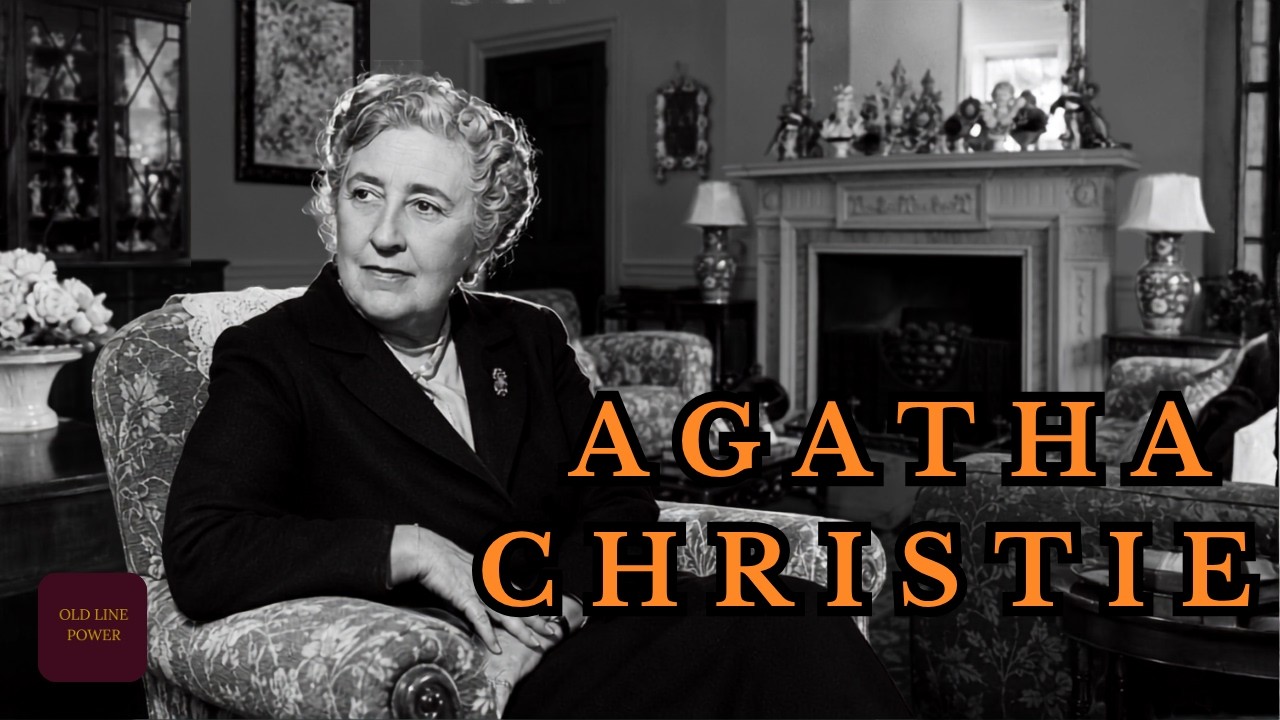
She had died that morning at a house called Winterbrook, on the edge of a village in Oxfordshire. She was 85. The Guinness record keepers list her as the bestselling writer of fiction in history, a position she had held by any reasonable measure for decades before anyone thought to formalize it: 66 detective novels, the story collections, the plays, the radio work, an estimated 300 million books sold while she was still alive to count them, in more than a hundred languages. In the week she died, a play she had written was in its 24th year at St.
Martin’s Theatre in London. It had opened in 1952 and has not closed since. Time magazine, running the figures that January, put her total earnings across half a century of work at somewhere near $20 million. She left £16,000.
Only two things written in English have ever outsold Agatha Christie. One is the Bible. The other is Shakespeare. She got there selling paperbacks about murder to ordinary people from the 1920s to the 1970s without once pretending to be anything grander than a working writer.
Most people who make money on that scale spend their last decade closing their hands around it. She spent hers opening them, on a schedule, in favor of people she had chosen. That is the mystery worth solving, and unlike the famous one, it can actually be solved. She earned an enormous amount of money.
Then she spent 40 years quietly getting rid of it, not losing it—something a great deal more deliberate than that. —
In 1869, a merchant in New York named Nathaniel Frary Miller died, leaving instructions that would shape the next hundred years of a family he would never meet. Miller had come up the hard way, starting as a junior clerk in a milling firm and working his way up to partner. The fortune came from dry goods, made at the moment when American commerce was learning how large it could become.
From the middle of the 1850s he crossed to England regularly because the firm had a branch in Manchester. On one of those crossings he met and married an English woman named Margaret West and settled in Cheshire. When he died, he had one child from an earlier marriage, a son called Frederick, and he left him almost everything—not as cash, but as a series of trusts, layered and interlocking, the kind of structure a nineteenth-century lawyer built when he wanted an inheritance to outlive the man who wrote it. The effect was simple.
Frederick Alvah Miller would never need to earn a living. He did not attempt to. On his daughter’s birth certificate, in the space for occupation, he wrote the word “gentleman. ” In New York he belonged to the Union Club; in London, to Boodles; in the seaside town of Torquay, where he eventually settled, he was vice president of the cricket club and a fixture at the yacht club.
He married Clara Boehmer, Margaret West’s niece, who had been fostered by the Millers as a child. Margaret’s husband had left Clara £2,000, and in 1881 that money bought the lease on a villa above Torquay called Ashfield. In 1890, the last of the three Miller children was born inside it. Here is the part that never appears in the profiles.
The trusts were being handled in New York, three thousand miles from the man they were meant to support, and they were not being handled well. Mismanagement, financial crisis, and what one account calls plain chicanery worked through the structure over two decades. Frederick had no profession to fall back on, because the whole architecture of his life had assumed he would never need one. He seems to have known.
His last years were marked by ill health and anxiety about money, and in November 1901 he died of pneumonia and chronic kidney disease. His youngest daughter was 11 years old. She said afterward that her childhood ended that month. Everything about the household changed at once.
Madge, the eldest, married the following year and moved to Cheshire. Monty was abroad with a British regiment. The two remaining Millers—mother and youngest daughter—were left with a large house they could no longer comfortably afford. It was often cheaper to let Ashfield out and live abroad, and so they did.
There was no season in London for the youngest daughter, because a London season cost more than the family had. She was taken to Cairo instead, where the dances were just as good and the hotels cheaper. Her education was assembled from whatever was affordable: some singing, some piano, a few undemanding lessons at fourteen, a series of finishing schools in France. What she learned properly, she learned in that house, from a mother who was managing a decline.
The girl would end her life with a fortune arranged across a private company, a set of deeds, and a bank vault. As a child, she had watched exactly what happens to a family when the money sits somewhere else, when the paperwork belongs to somebody you have never met. She never wrote a novel about it. She spent 75 years making sure it did not happen again.
—
Two and a half guineas a week. That was the rent on the first home Agatha Christie ever shared with her husband. For the money you got two rooms in a subdivided house in St. John’s Wood.
She remembered the beds as being full of hard iron lumps. She was 28; Archie was 29. They had been married for almost four years and had never lived together. They met at a dance at Ugbrooke in Devon in October 1912, married on Christmas Eve 1914 while he was home on leave, and then the war took him back to France.
She stayed at Torquay and worked 3,400 hours in the Red Cross hospital at the town hall—unpaid at first, as a nursing volunteer, then, after qualifying as an apothecary’s assistant, for £16 a year as a dispenser. £16. Keep that number next to the $20 million, because the distance between them is the whole story. When Archie came home to a desk job at the Air Ministry, they finally moved in together.
She discovered she had married a man on a low salary in a city where she knew almost nobody. She enrolled in a bookkeeping course to fill the days. She learned to make rations stretch. She was, in her own account, lonely.
Her first novel had been written and rejected by everyone she sent it to. Rosalind was born at Ashfield in August 1919. Two weeks later her mother was back in London looking at flats, because the new arrangement needed room for a nanny and a maid. The London rental market after the war was brutal.
She took a furnished place in Addison Mansions and hated the furniture. She lined up a flat in Battersea Park, which fell through when the owner’s own move collapsed. Cornered, she and Archie agreed to buy a house in South Kensington they could not afford, purely to stop the search. Then she saw an advertisement for an unfurnished flat in the building across the road from where she already lived.
She ran to it—not walked, ran—and secured it before anyone else could. She then got out of the Kensington purchase owing nothing but the agent’s fee, because there were other buyers waiting, and she kept the Battersea flat, sublet it at a profit, and used that profit to pay the rent on the flat she actually wanted. She was 29 years old and had earned £25 from her first published book. She had just run a property chain from both ends and come out ahead.
She described the maneuver afterward as “a moment of financial genius” on her part, and for once she was not being modest for effect. The shy amateur who fell into money by accident never existed. The money from the writing, when it started arriving, did not stay long. In 1922 her brother came home.
Monty had gone out to East Africa and taken a wound to the arm that turned septic. He came home in a condition his family found difficult to describe and impossible to manage. He lived at Ashfield for a while, grew bored, and took to firing a revolver out of the bedroom window at people going down the drive. After he shot at one of his mother’s friends, the family accepted this could not continue.
Agatha and Max—no, Agatha and her mother—bought him a bungalow on Dartmoor for £800 and found him a housekeeper who could keep him under control. Agatha’s verdict on the expense was that £800 had been cheap at the price. Her earliest real money as a writer went straight out the door and into a stone cottage on a moor, to house a brother who could not house himself. —
In 1925, the Christies bought a house near the railway station at Sunningdale in Berkshire.
They bought it for a reason that ought to have given somebody pause: it was going cheap because the previous owner’s marriage had broken down, and locally the place had a reputation for being unlucky. It was also, on any honest reading of their finances, above what they could afford, so they took a mortgage and moved in anyway. Archie wanted to be near a good golf course and within commuting distance of his job in the city. Agatha wanted a garden and had wanted one for years.
Then Archie suggested calling the house Styles, after the mansion in his wife’s first published novel. She agreed. This decision still strikes me as the strangest thing either of them did. Anyone who has read the book knows what happens to the mistress of Styles.
For about 18 months it looked like it was working. The Murder of Roger Ackroyd came out in 1926 and made her properly famous for the first time. Her sixth book had turned her from a working writer into a name, and the money finally started to look like a career rather than a series of lucky payments. In April, her mother died.
Clara had been the one constant across the whole of her life, through the collapse of the American trusts, through the war, through the years at Ashfield when there was no one else in the house. Agatha went down to clear out Ashfield alone, room by room, a lifetime of it, in a house she had been born in and could not bring herself to sell. Archie was abroad. He did not come.
By the summer she had lost weight, could not concentrate, and at one point could not remember her own name when she went to sign a check. In August, the newspapers reported that Mrs. Christie had gone to a village near Biarritz to recover from a breakdown brought on by overwork. Overwork was the word the family gave the press.
That same month, Archie asked her for a divorce. He had fallen in love with a woman named Nancy Neele, a friend of Major Belcher, the man they had gone around the world with four years earlier. Then came December. On the 3rd, a Friday, Archie announced he was spending the weekend with friends and that she was not coming.
They argued. He left the house and drove to Godalming, to the party where Nancy Neele would be. At about a quarter to ten that evening, his wife went upstairs, kissed her sleeping seven-year-old daughter, came back down, and drove away in a Morris Cowley. At 11:00 the next morning, the superintendent of the Guildford division was told about a car.
It had been found abandoned at a place called Newlands Corner, halfway down a grassy slope well off the main road, its hood buried in bushes as though it had gotten away from the driver. The headlights were still burning. Inside was a fur coat, a dressing case with a woman’s things in it, and a driving license, expired, in the name of Mrs. Agatha Christie of Sunningdale.
Below the slope was a chalk quarry. The mortgage on Styles still had years left to run. —
There is a line in the hotel register of the Swan Hydropathic in Harrogate that has been argued over for a hundred years. The guest wrote that she was Mrs.
Neele, from Cape Town, South Africa. The first name is where it gets interesting. A notice placed in the Times reads “Teresa”; the register signature reads more naturally as “Tessa,” and newspapers reported she used “Teresa” elsewhere during those days, including when she joined the local library. Neele was the surname of the woman her husband intended to marry.
She wrote it in her own handwriting, without disguising it. While she was signing that book, the county of Surrey was being taken apart. The deputy chief constable, a man named Kenward, put about three dozen regular officers into the search, drawn deliberately from quiet districts where they would not be missed. With them went special constables and a large number of civilian volunteers.
Two organized sweeps of the downs went out, one across the first weekend and one on the 9th of December. The home secretary applied pressure. A newspaper offered £100. The Silent Pool, a beauty spot near where the car was found, was searched because the police were considering the possibility that she had gone into the water.
Then the story left the ground entirely. The press reported 15,000 volunteers, aircraft overhead, divers, police forces from multiple counties. Dorothy L. Sayers, a fellow crime novelist, came and walked the site.
Arthur Conan Doyle, who took spiritualism seriously, obtained one of the missing woman’s gloves and handed it to a medium. It reached the front page of the New York Times. Here is what Kenward wrote to the Home Office two months later. The aircraft had nothing to do with the police.
The Metropolitan force was never called in. Officers were not drawn from other counties. The number of police involved had been, in his word, “exaggerated. ” A good deal of what appeared in the papers, he wrote, was without foundation.
The largest manhunt in British history was substantially an invention of the newspapers covering it. And the woman they were looking for was in Yorkshire, having a perfectly pleasant time. On the 4th of December, the day after she disappeared, she had tea in London and went into Harrods to look at the Christmas display. Then a train from King’s Cross, a taxi to the Swan Hydropathic, and a room she could easily afford.
She did not hide. She dined in the dining room every evening. She took the spa treatments and played billiards with the other guests. She danced the Charleston with a man who remembered it decades later.
She sat in the public rooms reading newspapers that carried photographs of her own face. And when the other guests discussed the disappearance of Mrs. Christie, she joined in. One of them recalled her observing that Mrs.
Christie seemed to be a very hard person to find. On the 11th she placed the notice in the Times, asking relatives of Teresa Neele to get in touch. It was the hotel staff who worked it out. A maid recognized the face in the papers.
From there it reached a banjo player in the hotel band, a man named Bob Tappin, who went to the police and claimed the newspaper’s £100. Archie arrived on the 14th with police officers and identified his wife. Two doctors examined her and recorded a genuine and unquestionable loss of memory. She never explained it—not to the press, not in her autobiography 50 years later, where the entire episode is simply absent.
Whatever the true account is, she took it with her. But she signed that register in the other woman’s name, and she signed it in her own hand. —
The bill came to £25. That is what the search of the Surrey Downs actually cost, according to the man who ran it: mostly the hire of vehicles and refreshments for the special constables, who were unpaid volunteers.
About a dozen of the regular officers had come in on their weekly rest day of their own accord, for nothing. The police approached Colonel Christie and asked whether he would contribute. He declined. It was, in his view, entirely a police matter.
£25 was not a sum that would have troubled him. His wife had been missing for 11 days, and half of England had gone out into the cold to look for her. When the invoice arrived, he took the position that it was somebody else’s problem. The public had already turned by then.
While she was missing, she was a victim. Within days of being found, she was a fraud. The newspapers that had run the story for a fortnight now needed a second act, and they settled on two theories: either the whole thing had been staged to sell books, or she had tried to arrange matters so that her husband would be suspected of killing her. There were letters to editors complaining about wasted public money.
She was taken to Abney Hall in Cheshire, her sister’s house, and kept behind locked gates with the telephone disconnected and callers turned away. She rented a flat on Kensington High Street so she had somewhere to stay while she saw a psychiatrist on Harley Street. In January she sailed for the Canary Islands with her daughter and her secretary and stayed three months. She wrote a book there.
She said afterward that she took no pleasure in writing it, and that she wrote it because she now had to. That is the change, and it happened in that room in Las Palmas rather than in the hotel in Harrogate. Before 1926 she was a woman who wrote books. After it, she was a woman whose income depended on writing books permanently, with no husband’s salary underneath her and a daughter to raise.
The divorce came through in April 1928 and was made absolute in October. Archie married Nancy Neele the following week. She kept custody of Rosalind. She also kept the name Christie, and she was clear about why: the name was on six books.
It was by that point an asset, and she was not going to hand it back along with everything else. And she stopped taking communion. She had been a quiet, regular churchgoer her whole life and kept her mother’s devotional book beside her bed until she died. But the church of her generation did not admit divorced people to the sacrament, and so she did not present herself for it again.
Of everything the 11 days cost her, that is the one she felt longest, because it was the one she could not renegotiate. The rest she could. Over the next 30 years she would renegotiate almost everything else in her life, item by item, until there was very little left in her name at all. —
Colonel Archibald Christie died on the 20th of December 1962 at Godalming in Surrey.
He was 73. The obituaries were short, and most of them mentioned his first wife in the second sentence. He is the only person in this story who could have explained 1926 and never did. Almost every account treats him as scenery.
He was born in Peshawar in 1889, the son of a barrister in the Indian civil service. He came to flying early, when flying was still close to lunacy. He was seconded to the Royal Flying Corps in 1913 and went to France in the first month of the war, flying aircraft made of wood and canvas while the pilots carried revolvers. He came out of it a colonel with a Distinguished Service Order and an appointment as Companion of the Order of St Michael and St George.
By any measure of that generation, he had a good war. Then he had to find something to do with the rest of his life. He left the air force and went into the City on a small salary. A great many decorated officers were doing the same thing that year and finding it a poor substitute.
He took up golf seriously. He moved his family out to the commuter belt to be near a course, and his wife’s income overtook his. Between 1920 and 1926 his wife went from an unpublished writer to a national name. He spent those same years as a middling employee of a city firm.
He met Nancy Neele through Major Belcher. He asked for the divorce in August 1926, four months after his mother-in-law died. While his wife was visibly unwell, he went to a house party that December rather than stay home. He gave the press a statement about his wife’s nervous condition.
He refused the £25. Then he married Nancy in October 1928, one week after the decree was made absolute, and he disappeared from public life almost completely. That second marriage lasted 30 years. By all available accounts it was a settled, ordinary, contented life.
Nancy died in 1958; he outlived her by four years. In all that time, he never spoke publicly about the 11 days—not when the newspapers came back to the story, which they did every few years; not when his first wife became the bestselling novelist in the world; not when journalists appeared at Godalming, which they did. He and Agatha appear to have had no contact after the divorce beyond what their daughter made necessary. There is one detail worth keeping.
When Agatha Christie died in 1976, it emerged that she had kept her first wedding ring. Fifty years, two houses in Devon, a second marriage she described as happy—and she still had the ring from the man who is buried in Surrey with somebody else. He is the reason for the most famous 11 days in publishing history, and he never gave a single interview about them. —
In 1928, with the divorce settled, Agatha Christie bought a mews house at 22 Cresswell Place in London.
It was not a house yet. The ground floor was still stables; access to the living quarters was by a ladder she described as rickety. She bought it anyway, then rebuilt it, adding rooms, reconfiguring the whole interior, and installing a green bathroom painted with dolphins. It was the first property she had ever owned entirely by herself.
Her biographer, Janet Morgan, made an observation that is exactly right: she bought and furnished houses when she was happy. The buying was not a symptom of the money. It was a symptom of recovery. Then in 1929 she did something that changed the rest of her life, and it was not a dramatic gesture.
It was a favor. An archaeologist named Leonard Woolley was excavating at Ur in southern Iraq, one of the great digs of the century. His wife Katherine was a keen reader of detective fiction. When the Woolleys were in London, Agatha lent them Cresswell Place to stay in.
They repaid it with an invitation: come out next season and see the work. She went in February 1930. Leonard Woolley was busy running an excavation, so he handed the job of showing the famous guest around to his young assistant, a 26-year-old named Max Mallowan. What happened next reads like something she would have rejected as too convenient for a plot.
Mallowan took her and a small group on an excursion to see the nearby site at Nippur. On the way they stopped at a lake and swam in their underclothes. Then the vehicle broke down. They were stranded in the desert and eventually spent a night in adjoining cells at a police post, the only accommodation available.
By the end of that trip, he had decided. He proposed at Ashfield later that year. She was 39 and he was 26, and the 13-year gap in the wrong direction bothered her considerably more than it bothered him. She said no at first.
It was Rosalind, ten years old, who talked her mother into it. They married in Edinburgh on the 11th of September 1930, six months after they met, deliberately small: her daughter, her secretary, the secretary’s sister, and her dog. The marriage lasted 46 years, until her death. What it gave her, beyond the obvious, was a second working life.
From then on she spent three or four months of every year on excavation sites in Iraq and Syria. She photographed finds, catalogued, reassembled broken pottery—which she was good at and enjoyed—and cleaned excavated ivories using her own face cream. She also paid for a great deal of it. The expeditions ran partly on her royalties.
Cresswell Place stayed in her possession until the day she died. Of all the property she bought, sold, transferred, and gave away over the next four decades, that little converted stable was the one she never let go of. —
By the middle of the 1930s, Agatha Christie owned eight houses at the same time. She had a name for the period; she called it her “plutocratic period,” which tells you she found the whole thing slightly funny.
The buying started with a house in Campden Street in Kensington, chosen because it was convenient for her husband’s walk to the British Museum. Then in 1933 she bought 58 Sheffield Terrace, remodeled it, and renamed it Green Lodge. That house mattered. The flats and mews cottages she had lived in since her marriage had all been small.
Sheffield Terrace had the high ceilings and large rooms she had grown up with and lost. For the first time since Ashfield, she was living at the scale of her childhood, and she had paid for it herself. She gave herself a work room there: a Steinway grand piano, a large firm table, a hard upright chair for the typewriter, and a sofa for the gaps in between. In 1934 came Winterbrook House at Wallingford, a Queen Anne place with a garden running down to the Thames.
Max knocked two rooms together to make a library facing the water. They added a squash court, which she barely used for squash. The rest were investments, properties in Mayfair and St James’s bought and let to tenants. She was funding all of it from the same source, and the source was America.
The top rate of British income tax at the time was 90%; foreign income was treated differently, and her serializations in American magazines were substantial. The property portfolio of an English novelist was being paid for by readers in Ohio. Then in 1938 she made the trade this chapter is named for. She sold Ashfield, the house she had been born in, where she had grown up, where her father had died and her mother after him, where she had given birth to her daughter.
She had held on to it through the lean years, when letting it go would have been the sensible thing. She let it go in 1938, once she no longer needed the money. The reasons she gave were practical and largely true: Torquay had grown up around the house, the fields the road once ran out into were housing now, the place had started to feel like an imitation of itself. Max, who had no attachment to it whatsoever, told her to be practical.
And she wanted something else—a place called Greenway, set in woods that ran down to the water on the Devon side of the Dart. Selling Ashfield was how she paid for it. She got fewer than two years of it. In 1940, the Admiralty requisitioned the house for the war.
There is a coda, and it comes 25 years later. In the 1960s, Ashfield was demolished to clear the site for new housing. Somebody told her. By then she was in her 70s, with more money than she could spend, and the account of it says she wept helplessly.
She had sold it herself. Nobody took it from her. She had made a decision in 1938 that she was still paying for in 1965. That is the only transaction in this entire story that she got wrong.
—
In 1940, an officer of the Admiralty served notice that Greenway House was being taken over for the duration of the war. That was one house gone. In October of the same year, a bomb came down on Sheffield Terrace, hitting the basement and the front steps and destabilizing the whole structure. The Steinway was pulled out of the wreckage and stored elsewhere, and she said afterward that it never sounded the same again.
That was two. Winterbrook was let to tenants, and so was Cresswell Place. The insurance on the Campden Street house had become prohibitive. Agatha Christie entered the Second World War as the owner of a substantial property portfolio and could not live in any of it.
Her furniture went into the squash court at Wallingford. She rented a furnished flat in a block in Hampstead: the Isokon Building on Lawn Road, a piece of hard modernist architecture with a restaurant downstairs and staff who handled the laundry. She had spent her life buying Victorian and Georgian houses. She moved into a concrete box and found, to her own surprise, that she liked it.
There was a cherry tree outside the window. She also went back to work in a dispensary, taking shifts at University College Hospital, updating knowledge she had first acquired in a hospital pharmacy in Torquay in 1917. The chief pharmacist there, a man named Harold Davis, gave her the idea that eventually became one of her strangest novels. And the intelligence services opened a file on her.
In 1941 she published a thriller featuring an unpleasant character called Major Bletchley. Bletchley Park was the most secret installation in Britain, and the security service wanted to know how a novelist had come by the name. The answer was that she had been stuck at the railway station there on a slow journey from Oxford and had named a character after it out of irritation. She told a friend at the codebreaking center exactly that, and the matter was dropped.
But the important thing she did in those years was not published at the time. She wrote two novels and put them away. One was the final case of Hercule Poirot. The other was the final case of Miss Marple.
She wrote them while the bombs were falling, sealed them, and placed them in a bank vault. Then she signed the copyright of one over to her daughter and the copyright of the other over to her husband. Not the royalties—the copyright itself, transferred by deed of gift while she was alive. She was explicit about what they were for.
There was every reason in 1941 to think she might not survive the war. If she did not, each of the two people who depended on her would own outright a new Agatha Christie novel that nobody knew existed, an asset that would appreciate every year it stayed in the vault. They sat in that vault for more than 30 years. She could not simply leave them money, because money was taxable and uncertain and might not survive her.
So she manufactured two assets out of nothing but her own work, in the middle of an air raid, and put them in somebody else’s name before the ink was dry. Everything she did over the following 25 years is a version of that afternoon. —
A boy turned nine in 1952, and his grandmother gave him a play. Matthew Prichard has said since that he does not remember any presentation and that nobody at the time understood what the present was.
It was a stage thriller his grandmother had adapted from a short radio piece. It opened at the Ambassadors Theatre in London that November. She expected it to run about eight months. She had signed the royalties over to him before it opened a single night.
By the time she died, that play had taken close to $3 million. It is still running. It is the longest-running production in the history of the theater, and it has belonged to her grandson since the year of the coronation. It is hard to think of a more valuable present ever given to a child.
That was the first move. There were three more, and together they took 16 years. To understand why, you have to look at what the British tax system was doing to her. The top rate on income was 90%.
Her American earnings had complicated her position rather than simplified it, and the arrangements that had funded the plutocratic period no longer worked the same way. She wrote that the changes made it pointless to produce more than one book a year, because the additional royalties would mostly go to the state. So she slowed down, and she described her own position sourly as being a “wage slave. ” She was the bestselling novelist alive, and she had concluded she was working for somebody else.
That is the most revealing thing she ever said about money, and almost nobody quotes it. In 1955 she incorporated a private company. Agatha Christie Limited was registered in June of that year, and into it went the copyrights. From that point, the books were no longer her personal property in the ordinary sense.
They were assets of a company, and she was a shareholder in it. In 1959, or thereabouts, she transferred Greenway to her daughter: 278 acres of Devon, the house she had sold her childhood home to buy, signed over 17 years before her death. And in 1968, at 78 years old, she sold a controlling stake in Agatha Christie Limited to a food and sugar conglomerate called Booker—51% at first, rising to 64% by the time the dust settled. She kept 36%, and the family kept the right to appoint half the board and to veto what was done with the work.
Read those four transactions in order, and something becomes visible. She was not selling out. She was not being advised into it by somebody with an interest of their own. She was systematically removing her fortune from her own name and placing it, piece by piece, inside structures that would survive her, in the hands of people she had chosen.
Her father had inherited a fortune held in trusts he did not control, administered three thousand miles away by men he never met. It came apart while he watched. His daughter had spent 67 years watching what that does to a family. She was not going to leave anything to chance, or to lawyers, or to the revenue, or to whatever might happen once she was no longer in the room.
She left it early, and she left it deliberately, and she left almost nothing behind her to argue over. —
In 2009, a professor of English at the University of Toronto ran a piece of software across a set of Agatha Christie novels and counted the words. What Ian Lancashire and his colleague Graeme Hirst found was a decline. Across her career, the richness of her vocabulary fell by about a fifth.
In one late novel written when she was 81, the drop measured 31% against a book she had produced 18 years earlier. Repeated phrases increased. Vague, indefinite words increased. The pattern they identified is not the pattern of ordinary aging.
The book showing the sharpest change is called Elephants Can Remember. Its central character is an aging woman novelist struggling to retrieve things she used to be able to recall. The researchers were careful not to claim certainty about what was happening to her, and neither should anyone else. But she chose that title, and she wrote that character, and the two facts sit next to each other.
She finished her last novel in 1973. In 1974 she had a heart attack and a bad fall, and after that she could not write. So her daughter opened the vault. The final Poirot novel, written in an air raid more than 30 years before and sitting in a bank ever since, was published in 1975.
It was a considerable event. On the 6th of August that year, the New York Times ran an obituary for Hercule Poirot on its front page. It remains the only time a newspaper of record has done that for a person who never existed. She was still alive to see it.
She had six months left. She died at Winterbrook on the 12th of January 1976, of natural causes, at 85. They buried her in the churchyard at Cholsey, in a plot she and Max had chosen together ten years earlier. About 20 reporters came, some from as far as South America.
There were 30 wreaths, including one from the cast of the play she had given away. Max Mallowan remarried the following year, to an archaeologist who had worked with him for decades. He died in 1978 and was buried beside his first wife. And then the estate was settled: £16,683 against earnings estimated at $20 million across more than half a century.
There was nothing to fight over because there was nothing left to fight over. It had all gone out in advance—to a nine-year-old boy in 1952, to a company in 1955, to her daughter in 1959, to a conglomerate in 1968 on terms her family still holds. The money did not disappear. It was moved on a timetable she set herself, decades before anybody needed it to be.
Her father had let other people hold his fortune and had watched it evaporate. His daughter held her own right to the end and then handed it over on the days she had chosen. That is the whole answer. It took her 50 years, and it is written across four documents and one birthday.
One more thing. In 1977, the year after she died, a nurse in a London hospital was reading one of her novels on a night shift. There was a child on the ward, 19 months old, whose illness nobody had been able to identify. The nurse recognized something from the book, said so to the consultant the next morning, and was right.
The child was treated and recovered. She had been dead for a year, and the work was still going. That was always the point of it, not the money.
The money was only ever the thing she built to keep the work safe.






